From one photography collector to another: a venue for thoughtful discussion of vintage and contemporary photography via reviews of recent museum exhibitions, gallery shows, photography auctions, photo books, art fairs and other items of interest to photography collectors large and small.
Friday, April 5, 2013
Every Booth at the 2013 AIPAD Photography Show, Part 2 of 6
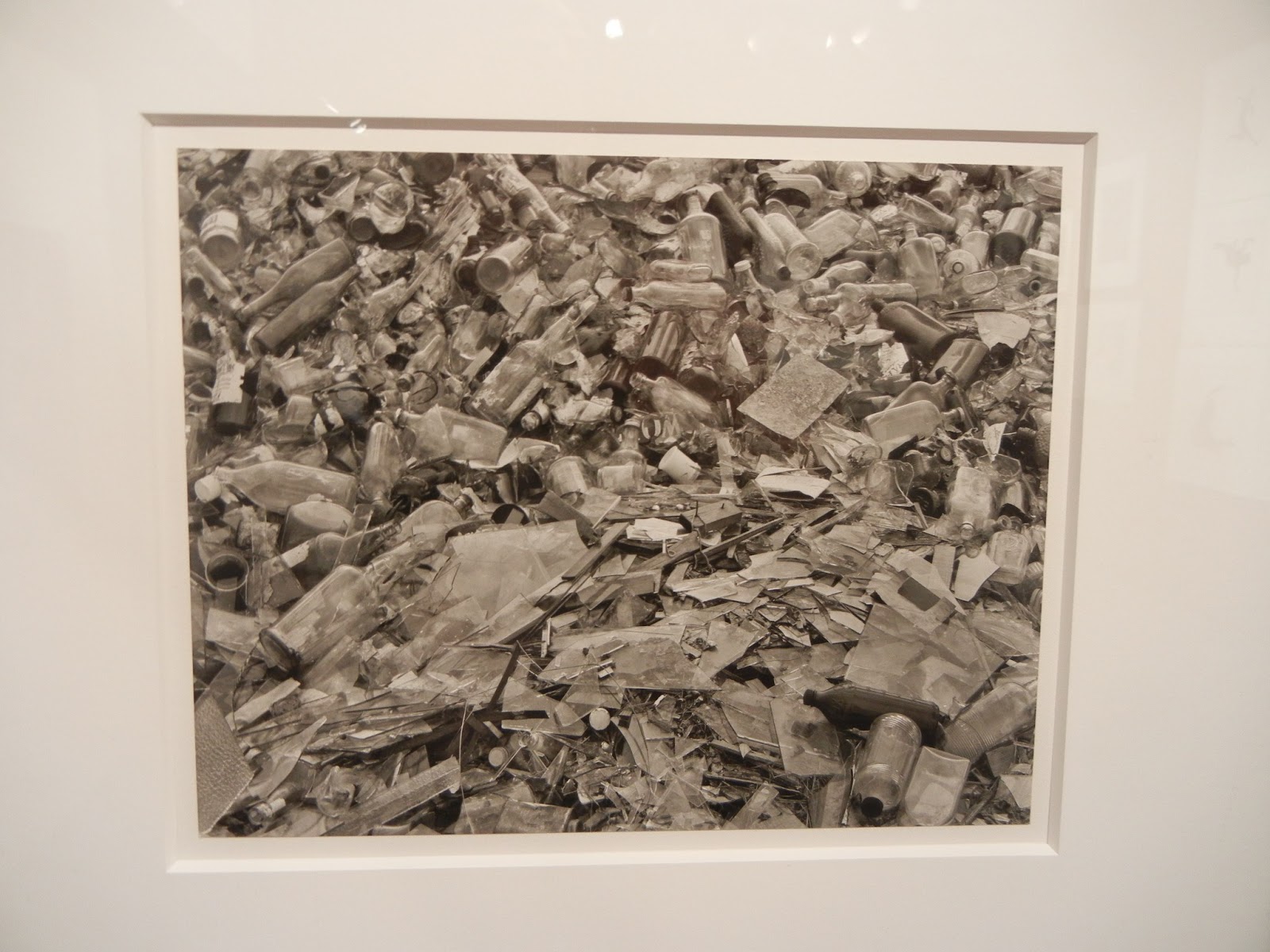
Etherton Gallery (here): Frederick Sommer, $35000. It's a glass pile, but it's also an exercise in texture, all-over abstraction, flattened space, and generally blowing your mind.
Galeria Vasari (here): Anatole Saderman, $10000. I've only ever seen a few of these Saderman florals, so it was great to see an entire wall of them in one place.
Yancey Richardson Gallery (here): Alex Prager, $6000. Don't miss the falling body in the bottom of the frame.
Joseph Bellows Gallery (here): John Schott, $8000. One of the lesser known New Topographics photographers, Schott deserves a closer look. I like the collapsed layers of space in this image, as well as the up and down movement of the hose.
Jackson Fine Art (here): Jody Fausett, $5500. The surreal, saturated color matching of cats and sofa upholstery.
Galerie Johannes Faber (here): Bernd and Hilla Becher, $9600. We've all seen countless Becher winding towers, but I haven't seen many vintage prints in intimate sizes like this one. It couldn't have been larger than 10x8, but it was still powerful.
Monroe Gallery of Photography (here): Nina Berman, $5500. It's a fracking picture first and foremost, but the soft enveloping glow from the gas flare is what makes it durably memorable.
M+B (here): Jessica Eaton, $5000. If I was an abstract photography collector, I'd be all over Jessica Eaton's work. Every time I see something new from her, it's fresh, exciting, and increasingly complex.
Yossi Milo Gallery (here): Alison Rossiter, $6500 each. I know, I know, I highlighted a similar bunch of works by Rossiter in my Armory review. But they're just so smart that I can't help myself. They're small and hardedged from afar, curled and handmade up close.
Paul Cava Fine Art Photographs (here): Emmet Gowin, $7500. I don't remember ever seeing this double exposure Gowin before, mixing vegetal forms and a nude of Edith.
Winter Works on Paper (here): Charles Jones, $8500. Jones' sublime fruits and vegetables should be in every chef's kitchen. Their lush tonalities remind us of how a still life can be magical.
M97 Gallery Shanghai (here): Jiang Zhi, $4500. We're flower collectors, so we like to think we've seen it all when it comes to floral photography. And yet, here's something new - flowers on fire. This small flaming orchid print came from a portfolio; the price above represents what a larger stand alone print would cost.
PDNB Gallery (here): William Eggleston, $40000. Great sunlight, great color. Enough said.
Charles Schwartz Ltd. (here): Samuel Gottscho, $8000. A tactile print of dark, smoky, Modernist docks.
Continue to Part 3 here.
Tuesday, October 2, 2012
Bernd and Hilla Becher @Sonnabend
The works on view come from three different subject matter series, with a mix of traditional typologies (one image per location) and other works which combine multiple perspectives of a single structure or site. For each series, the number of typologies, their makeup (number of prints), and the overall dimensions are provided below:
Industrial Facades:
6 nine image typologies, each sized 56x68
Coal Bunkers:
1 two image typology, sized 37x22
2 four image typologies, each sized 38x46 (or reverse)
3 six image typologies, each sized 37x55
2 eight image typologies, each sized 38x76
2 nine image typologies,each sized 68x55
Stone Works:
1 two image typology, sized 22x41
5 three image typologies, each sized 22x64 or 38x42
5 four image typologies, each sized 38x46 (or reverse)
1 fifteen image typology, sized 68x94
The large typologies of industrial facades in the entry gallery will feel the most familiar to Becher-philes. They use boxy factories and warehouses to highlight stepped roof lines in brick, curved barrel roofs, arched windows, rectangular boxes with repeating window patterns, peaked roofs with vertical striping, and buildings decorated with external pipes running horizontally. The theme and variation style of the typology structure focuses crisp attention on these overlooked details.
So for those of you who may think you have already seen everything the Bechers had to offer, this show brings together both lesser known subject matter and an unexpected conceptual twist on their signature typology. As always, the work is exquisitely crafted and meticulously considered; what I appreciated here was the sense of smart freshness that seemed to reanimate their much celebrated and highly influential photographic approach.
2 image typologies: $26000
3 image typologies: $39000
4 image typologies: $52000
6 image typologies: $78000
8 image typologies: $104000
9 image typologies: $117000
15 image typologies: $195000
The Bechers' work is now consistently available at auction, in every season and every geography. Prices for single images have ranged from roughly $3000 to $35000 in recent years; typologies have ranged between roughly $25000 to $180000 during that same time.
- Museum Collections: MoMA (here), Tate (here), Met (here), Getty (here), Guggenheim (here), Walker (here)
Thursday, June 23, 2011
Auction Results: Photographie, May 26, 2011 @Villa Grisebach
The summary statistics are below (all results include the buyer’s premium):
Total Lots: 190
Pre Sale Low Total Estimate: 492200€
Pre Sale High Total Estimate: 673500€
Total Lots Sold: 151
Total Lots Bought In: 39
Buy In %: 20.53%
Total Sale Proceeds: 643489€
Here is the breakdown (using the Low, Mid, and High definitions from the preview post, here):
Low Total Lots: 176
Low Sold: 139
Low Bought In: 37
Buy In %: 21.02%
Total Low Estimate: 442500€
Total Low Sold: 379969€
Mid Total Lots: 14
Mid Sold: 12
Mid Bought In: 2
Buy In %: 14.29%
Total Mid Estimate: 231000€
Total Mid Sold: 263520€
High Total Lots: 0
High Sold: NA
High Bought In: NA
Buy In %: NA
Total High Estimate: 0€
Total High Sold: NA
The top lot by High estimate was lot 1409, Oskar Schlemmer/Kurt Bryner, Zwei Alben mit Photographien der familie Schlemmer und Freunden, 1937-1940, at 25000-30000€; it sold for 29280€. The top outcome of the sale was lot 1434, Bernd and Hilla Becher, Forderturme, Schuylkill County, PA, USA, 9-teilige Photoarbeit, 1974-1978, at 70760€ (image at right, top, via Villa Grisebach)
95.36% of the lots that sold had proceeds in or above the estimate. There were a total of 12 surprises in this sale (defined as having proceeds of at least double the high estimate):
Lot 1310, Ilse Bing, Self Portrait, 1931/1996, at 7320€
Lot 1316, Bill Brandt, Nude, Baie des Anges, France, 1958/Later, at 3416€
Lot 1325, Robert Doisneau, Le manege de Monsieur Barre, Place de la Mairie, Paris, 1925/Later, 10370€
Lot 1428, Paul Wolff, Ohne Titel (Frankfurt am Main: Hute im Waldstadion), 1929 at 3172€
Lot 1429, Paul Wolff, Ohne Titel (Start zum Segelfliegen), 1933-1945, at 3660€
Lot 1430, Paul Wolff, Ohne Titel (Frankfurt am Main, Blick auf den Burgersteig von oben), 1933-1945, at 3904€ (image at right, bottom, via Villa Grisebach)
Lot 1432, Yva, Vornehmer hut aus blauer Seide mit doppelter, weisser Krempe und schwal aus gleichem Material. Modell: Gurau-Friedrich, 1932, at 3172€
Lot 1433, Yva, Den Schuh schmuckt die schnalle, den Fuss der...Strumpf, 1934-1938, at 3294€
Lot 1434, Bernd and Hilla Becher, Forderturme, Schuylkill County, PA, USA, 9-teilige Photoarbeit, 1974-1978, at 70760€ (image at right, top, via Villa Grisebach)
Lot 1462, Ken Probst, Tattooed Twins, San Diego, 1989/2001, at 4880€
Lot 1468, Thomas Ruff, Interieur 1D (Tegernsee) aus der Serie "Interieurs", 1982, at 3050€ (image at right, middle, via Villa Grisebach)
Lot 1476, Michael Schmidt, o.T., 1998, at 1708€
Complete lot by lot results can be found here.
Villa Grisebach Auktionen
Fasanenstraße 25
D-10719 Berlin
Monday, May 9, 2011
Baltz, Becher, Ruscha @Richardson
Comments/Context: As quite a few gallery owners I know will attest, I have been struggling of late with what I call "the tyranny of the new". This is a disease which afflicts many; its symptoms include the constant search for the new high, at the expense of recognizing the true value of the quality work that has come before but now seems like old hat because we have become used to its pleasures. Since I see a lot of both new and old work, I find that I must try not to compare apples to oranges, and instead force myself to see each show on its own merits, without this filter of the freshness of the new. It's quite a bit harder and more nuanced than you may realize.
This fine show is a perfect example to demonstrate this phenomenon. Here we have a group show of three recognized masters of 1960s/1970s conceptual photography, collecting together icons of important (and valuable) work from that time: Becher water tower typologies, Baltz New Industrial Parks, and Ruscha gasoline stations and parking lots. Taken at the level of pure facts, what could be better than this? If you've never seen this work, and you've recently arrived from another planet, this show should and will blow your mind. At the time of their making, these were astonishingly innovative works, and they continue to be strongly resonant and influential many decades later.
But since I have been infected with the tyranny of the new, I am embarrassed to admit that I had a "yeah, yeah, yeah, and so what" kind of reaction to this show. I shudder to say such a thing in public, but it's true. I don't think this grouping of greats adds much to what we already know about this time period or offers any new ideas, relationships, or interpretations of the art on view. It just hangs these spectacular images on the wall. Shouldn't we all just bow and genuflect? This is not to say that I didn't thoroughly enjoy this show, I did; I just didn't get that infusion of new that I have come to crave, and so I was left a little (yikes) unsatisfied.
Such a conclusion is deeply troubling to me. How could such a show of brilliance fail to jump start my brain? Have I become so jaded that I can't really "see" these treasures anymore? Clearly, I need to recapture some of that wonder I had when I saw my first Becher typology and I stood transfixed for what seemed like an eternity, or those hours I spent slowly paging through Baltz' NIP, page by page, savoring the tiny subtleties of each and every image. Those joys are still there, right on the wall, for all to see; I just need an inoculation that will empty my brain of this agonizingly manic "what's new" impulse and return me to a more balanced and less time-relative examination of the truly extraordinary in the world of photography.
Collector's POV: The prints in this show are priced as follows. The Baltz images were marked NFS (not for sale), although some may have been available individually if one was to inquire further. The Becher typologies were priced at $120000 (water towers) and $140000 (winding towers) respectively. The Ruscha portfolio (gasoline stations) was $175000, and the individual parking lot images were either $8800 or NFS. The work of all of these artists can regularly be found in the secondary markets as well. Individual Baltz images have recently traded hands from $6000 to $26000, while Ruscha's prints have ranged between $5000 and $19000. And Becher typologies (from diptychs to larger groups) have sold at auction between roughly $25000 and $175000 in recent years.
While I have a nearly infinite supply of appreciation for Becher typologies, I suppose I was most excited by seeing such a broad selection of Baltz vintage images from NIP, which tend not to be seen together quite as often. It would be shockingly easy to choose one for our own collection.
Rating: ** (two stars) VERY GOOD (rating system described here)
Transit Hub:
- Review: TimeOut New York (here)
Through May 27th
.
Yancey Richardson Gallery
535 West 22nd Street
New York, NY 10011
Tuesday, December 14, 2010
Auction Results: Photography, with Contemporary Art, December 2 and 4, 2010 @Lempertz
Three lots of winding towers from Bernd and Hilla Becher provided nearly half of the Total Sale Proceeds for photography at the recent sales at Kunsthaus Lempertz in Cologne (one photography auction and one contemporary art auction that included photographs). In an otherwise routine set of sales, these and other smaller surprises helped bring the results in over the Total High Estimate. (Lempertz does not provide an estimate range in most cases, just a single estimate number, so this figure is used as the High estimate in our calculations)..
Here is the breakdown (using the Low, Mid, and High definitions from the preview post, here):
80.47% of the lots that sold had proceeds in or above the estimate. There were a total of 20 surprises across the two sales (defined as having proceeds of at least double the high estimate):Friday, November 12, 2010
Bernd and Hilla Becher, Water Towers @Sonnabend
JTF (just the facts): A total of 26 single image black and white photographs and 6 black and white typologies, individually framed in white and matted, and hung in the entry gallery and two of the rooms in the rear. All of the single image works are gelatin silver prints in editions of 5, made between 1978 and 1995 in New York city (while no dimensions were given, I believe these works are roughly 24x20). There are five 9-image typologies and one 15-image typology, again consisting of gelatin silver prints, made between 1972 and 2009 (the individual prints in these works appear to be roughly 20x16); the combinations in the typologies are never repeated, so they are all unique works. (Installation shots at right.)Comments/Context: Grids of water towers by the Bechers have become so common that it's pretty hard to visit a major contemporary art museum and not bump into one. With such universal acclaim and ubiquitous display, it seems altogether possible that these works would somehow become overexposed, losing their visual power due to sheer repetition. And yet, their cool conceptualism and crisp execution keep them startlingly fresh; they never fail to stand out in a crowd.
My first reaction when I heard about this show was: what more can Sonnabend have to say about the revolutionary Becher water towers? Haven't they been completely covered already? And one of the back rooms of the show does provide a sampler of familiar typologies, the kind of work we have come to know and love: groups of bulb towers, concrete cylinders, towers with geometric bases or ones that open upward like funnels, some striped with vertical lines, all arrayed in rigid grids to highlight their architectural variations.But what is both surprising and exciting are the other images that make up most of the show: iconic New York rooftop water tanks. I had never seen these pictures before; it's like the Bechers have made a conceptual valentine to the city. In each image, a single cone-topped wood barrel tank sits centered on some kind of iron mounting or platform. The cylindrical banded barrels are generally the same, except for the finials on the top that distinguish the two main manufacturers. But the Bechers theme and variation style finds hundreds of small details worth noting: tubes that run down the sides or from the bottom, arched ladders, brick backgrounds, sculptural frameworks of girders that hold the tanks in the air, patterns and geometries in the angles of bases. In nearly every picture, the dark black form of the tank looms against the white sky of the city, often with a contextual frame of surrounding buildings.
For the Bechers, these tanks are likely just another piece of vernacular industrial architecture to be codified and preserved, another form to be documented and explored. But I think local New Yorkers will find much more to connect with in these pictures. They combine both the exacting standards of the Bechers artistic vision with a tiny twinge of nostalgia for something authentic and original to this city, overlooked subject matter that is deep in the fabric of this particular, crazy place.
Collector's POV: The works in this show are priced as follows. The single image water towers from New York are $25000 each. The 9-image typologies are $117000 and the 15-image typology is $195000. The Bechers' work is consistently available at auction, with prices for single images ranging from $3000 to $34000 in recent years; typologies (including diptychs of two images as well as much larger groups) have ranged between $23000 to $176000. We continue to covet images by the Bechers for the city/industrial genre of our collection; what we'd really like to find is one of the smaller, earlier diptychs (with one large image on one side and a grid of nine smaller images as one on the other), but both locating such a piece and then having it be the right price (for us) have so far been elusive. But we keep looking.- Museum Collections: Met (here), Getty (here), Guggenheim (here), Walker (here)
- Feature: Tate (here)
- Interview: Art in Amercia, 2002 (here)
.
Thursday, June 10, 2010
Auction Results: Photography, with the Vogel Collection and Contemporary Art, May 31, June 1, and June 2, 2010 @Lempertz
The results from the various sales at Kunsthaus Lempertz in Cologne (one photography, one single owner collection, and one contemporary art including photographs) would have been entirely uneventful had it not been for the photographic works in the Vogel Collection sale (most importantly those by the Bechers, Sigmar Polke, and Richard Hamilton), whose proceeds carried the overall outcome up much higher. While the overall buy-in rate across all of the sales reached almost 50%, the Total Sale Proceeds covered the Total High Estimate by a meaningful margin (Lempertz does not provide an estimate range in most cases, just a single estimate number, so this figure is used as the High estimate in our calculations).The summary statistics are below (all results include the buyer’s premium):
Total Lots: 264
Pre Sale High Total Estimate: 883700€
Total Lots Sold: 136
Total Lots Bought In: 128
Buy In %: 48.48%
Total Sale Proceeds: 1077900€
Here is the breakdown (using the Low, Mid, and High definitions from the preview post, here):
Low Total Lots: 233
Low Sold: 112
Low Bought In: 121
Buy In %: 51.93%
Total Low Estimate: 398200€
Total Low Sold: 322860€
Mid Total Lots: 30
Mid Sold: 24
Mid Bought In: 6
Buy In %: 20.00%
Total Mid Estimate: 425500€
Total Mid Sold: 755040€
High Total Lots: 1
High Sold: 0
High Bought In: 1
Buy In %: 100.00%
Total High Estimate: 60000€
Total High Sold: 0€
The top lot by High estimate was lot 951, Andy Warhol, Untitled (The Dirty Half Dozen), 1969, at 50000-60000€; it did not sell. The top outcome was lot 1131, Sigmar Polke, Ohne Titel (Aus Der Serie: Meissenkanne), 1968, at 91200€.
92.42% of the lots that sold had proceeds in or above the estimate. There were a total of 24 surprises across the three sales (defined as having proceeds of at least double the high estimate):Lot 2, D.F. Metcalfe, Ohne Title (Südpazifik), c1870, at 1440€
Lot 25, Heinrich Kühn, Lotte Kühn, 1906, at 15000€
Lot 27, Heinrich Kühn, Hans im Gras, 1906, at 8400€
Lot 38, Albert Renger-Patzsch, Buchenwald im November, 1954, at 5040€
Lot 75, Man Ray, Les Larmes, 1933/1990, at 7080€
Lot 76, Man Ray, Die Marchesa Casati, 1935, at 21000€
Lot 120, Lotte Laska, Köln Hauptbahnhof, 1960, at 1200€
Lot 168, Julius Shulman, House Edgar Kaufman, Colorado Desert, Palm Springs, CA, 1964, at 2640€
Lot 173, Thomas Lüttge, Gropiusbau, Berlin, 1984, at 1080€
Lot 180, Jan Saudek, History of Drinking in Czechoslovakia, 1990, at 2400€
Lot 186, Miroslav Tichy, Ohne Titel, 1950-1980, at 5760€
Lot 195, Hiroshi Sugimoto, Pacific Ocean, Iwate (#302, Aus: Time Exposed), 1986, at 900€
Lot 1010, Bernd & Hilla Becher, Zeche Bonifacius, Essen, 1981-1982, at 81600€
Lot 1011, Bernd & Hilla Becher, Siege La Houve No. 1, Creutzwald, Lorraine, 1967-1974, at 57600€ (image at right, via Lempertz)
Lot 1012, Bernd & Hilla Becher, Siege Cheratte, Puits No.3 , Liege, 1967-1971, at 48000€
Lot 1013, Bernd & Hilla Becher, Grube Camphausen-Franziiska, Fischbach, Saarland, 1968-1979, at 45600€
Lot 1014, Bernd & Hilla Becher, Zeche Germania, Dortmund, 1971-1978, at 52800€
Lot 1131, Sigmar Polke, Ohne Titel (Aus Der Serie: Meissenkanne), 1968, at 91200€
Lot 1139, Sigmar Polke, Ohne Titel, n.d., at 28800€
Lot 1140, Sigmar Polke, Ohne Titel (Aus Der Serie: Paris), 1971, at 37200€
Lot 1183, Richard Hamilton, Bathers (B), 1969, at 6600€
Lot 1184, Richard Hamilton, Bathers (B), 1969, at 7200€
Lot 1185, Richard Hamilton, Bathers (B), 1969, at 14400€ (image at right, top, via Lempertz)
Thursday, May 27, 2010
Auctions: Photography, with the Vogel Collection and Contemporary Art, May 31, June 1, and June 2, 2010 @Lempertz
Kunsthaus Lempertz has a group of sales coming up in Cologne next week, a various owner Photography sale, a single collector sale that includes photography, and a Contemporary Art sale that includes photography. Lempertz does the smart thing of pulling all the photo lots into one printed catalog, so collectors don't have to dig through all the various catalogs to find the photo lots of interest (they are separate online however). Overall, there are a total of 264 photo lots on offer across the three sales, with a Total High Estimate of 883700€.If you ever said to yourself that you wanted a Sigmar Polke photograph for your collection, now would be a good time to acquire one: there are 16 Polkes in the Vogel sale, the most I have ever seen at auction at one time (Lot 1140, Sigmar Polke, Untitled (from the series: Paris), 1971, at 12000-15000€, image at right, via Lempertz.) There are also a number of excellent Becher winding towers (all groups of 4 images) available (Lot 1010 Zeche Bonifacius, Essen, 1981-1982, at 15000€, image at right, bottom, via Lempertz.)
Here's the breakdown:
Total Low Lots (high estimate up to and including 7500€): 233
Total Low Estimate (sum of high estimates of Low lots): 398200€
Total Mid Lots (high estimate between 7500€ and 35000€): 30
Total Mid Estimate: 425500€
Total High Lots (high estimate above 35000€): 1
Total High Estimate: 60000€
The top lot by High estimate is lot 951, Andy Warhol, Untitled (The Dirty Half Dozen), 1969, at 50000-60000€.
Here's the list of photographers who are represented by three or more lots in the three sales (with the number of lots in parentheses):Sigmar Polke (16)
Bernd & Hilla Becher (8)
Heinrich Kühn (7)
Albert Renger-Patzsch (7)
August Sander (6)
Nobuyoshi Araki (5)
Candida Höfer (5)
Peter Keetman (5)
Richard Hamilton (4)
Clemens Kalischer (4)
Alfred Stieglitz (4)
Hiroshi Sugimoto (4)
Henri Cartier-Bresson (3)
Robert Doisneau (3)
T. Lux Feininger (3)
Edmund Kesting (3)
August Kreyenkamp (3)
Hedda Hammer Morrison (3)
Man Ray (3)
Leni Riefenstahl (3)
Jeanloup Sieff (3)
Miroslav Tichy (3)
Umbo (3)
The complete lot by lot online catalogs can be found here (Photography), here (Vogel Collection) and here (Contemporary Art).
Photography
May 31st
The Vogel Collection
June 1st
Contemporary Art
June 2nd
Kunsthaus Lempertz
Neumarkt 3
D-50667 Köln
Wednesday, February 3, 2010
Book: The Düsseldorf School of Photography, Stefan Gronert (ed.)
JTF (just the facts): Published in 2010 by Aperture (here). 320 pages, with 162 color and black and white images by 11 different photographers. Includes a foreword by Lothar Schirmer, an essay by Stefan Gronert, and summary biographies, exhibition lists and bibliographies for each of the artists. The German version of the book is being published by Schirmer/Mosel (here). (Cover shot at right, via Amazon.)The photographers included/discussed are:
Bernd & Hilla Becher
Laurenz Berges
Elger Esser
Andreas Gursky
Candida Höfer
Axel Hütte
Simone Nieweg
Thomas Ruff
Jörg Sasse
Thomas Struth
Petra Wunderlich
Comments/Context: The Düsseldorf school of photography is probably the largest topic in contemporary photography that has yet to receive the kind of in-depth scholarly treatment we would expect for such an important and influential artistic movement. While I'm sure there have been quite a few masters and Ph.D. theses that have been written about the Bechers and their students, until the publication of this book, there have been effectively no survey style volumes brought to market with the broader public in mind. Given the many monographs and exhibition catalogues that have been written about these photographers individually, the gathering of a representative sample of the various artists' work is the lesser of the challenges here; the real test falls to the essay and how coherently and insightfully it ties together what heretofore have been generally separate but parallel narratives. We have all been searching for someone to help connect the dots and fill in the gaps; I'm happy to report that this book is certainly a good start.
One important semantic definition is required before we get to the analysis: what is it we mean by the term the "school"? In general, I think there are two possible answers as applied to artistic movements: the narrow - the education derived from a specific set of teachings/learnings (i.e. the how/what of the curriculum at the Düsseldorf Kunstakademie or the Yale School of Art and how it was absorbed by specific students), and the broad - the larger geographic and temporal phenomenon (i.e. Düsseldorf or Helsinki as the umbrella term for a common style of working).
This volume (and its keystone essay) has chosen to focus on the Düsseldorf school in the broad sense, looking for the larger commonalities seen in its most successful and best known adherents. It lays at the feet of the Bechers the "emancipation of photography": the critical artistic mindset that photography was fully equal to painting, the results of which are embodied in the downstream success of the students who wholeheartedly embraced this unorthodox-at-the-time concept. It also implies an amorphous teaching by osmosis approach, where the Bechers were effectively leading by example: off doing their own highly stringent and objective documentary work, using the series and typology as modes for working and comparison, all underneath a rigid conceptual framework, with the students watching and absorbing some or all of what they saw as they saw fit. The narrative is thus one of commonality rather than causation: the students all started from a generally similar location; as they grew and matured as artists and selectively incorporated the Bechers' teachings over time, they went off in different but often parallel directions.
While there are some anecdotal comparisons and back and forth between the artists, in general, the book follows each photographer down his or her own particular evolutionary path, often starting prior to their involvement with the Bechers, and running to the present, now decades after the teacher/student relationship has ended. Each photographer gets a short biographical analysis, often through the lens of the Düsseldorf similarities. We see some exploring the limits of conceptual ideas (Ruff, Hütte, Esser, Struth, Sasse), while others have consistently worked in subject matter based series (Höfer, Wunderlich, Nieweg, Struth); over time, many have experimented with the use of large formats and prints (Höfer, Hütte, Nieweg, Struth, Berges, Ruff, Esser, Gursky). The challenge here is that most of these artists have worked through a handful of different projects over their careers to date, moving back and forth between working styles and approaches - the Düsseldorf narrative is therefore circular and cyclical rather than strictly linear, the Bechers' influence waxing and waning as the artists continually evolve and reinvent themselves.
As such, the story of the Düsseldorf school is not nearly as neat and tidy as one might expect from the rigid Germans; the Bechers put down some foundation concepts, but their students have long since moved beyond those initial ideas. Perhaps it is the mark of great teachers that they imparted their wisdom and experience about successful methods for discovering one's artistic voice through photography, without imposing their own specific vision too strongly.
While this book provides the satisfying summary and overview I have outlined, I found myself still wishing for more specifics; perhaps the next scholarly book on the Düsseldorf school needs to limit its scope to the period when the photographers were actually studying with the Bechers, and needs to cover in more detail how the curriculum was embodied in the early pictures. I'd also like to see more work from a broader range of the students (not just the "winners") to see how the teachings got applied in different ways. Similarly, I think some commentary from the artists themselves on what they took away from the Becher experience would be enlightening. Clearly, all of these photographers have long since moved beyond their early education, but I for one would be interested to hear what if anything they still find of value.
Overall, this book fills a gaping hole in the history of photography. It provides a well-selected sampler of the work of the best known members of the Düsseldorf school and offers a readable explanation of how it all fits together. While I have an insatiable appetite for more on this group of photographers, this volume certainly delivers a solid and thoughtful introduction to one of the most important movements in contemporary photography.
Collector’s POV: In many ways, there isn't much "new" information to be found in this book on the best known photographers in the group. It was therefore the sections on Petra Wunderlich, Simone Nieweg, Jörg Sasse, and Laurenz Berges that were the eye openers for me, in terms of exposing me more fully to some of the other students who are a little further out of spotlight. I also think the essay was helpful in clarifying my rudimentary understanding of the evolution of both Axel Hütte and Elger Esser, neither of which I have felt particularly comfortable with in the past.
Transit Hub:
- Review: Conscientious (here)
Friday, May 1, 2009
Auction: Photographs, May 19, 2009 @Sotheby's London
Sotheby's upcoming London sale is an unusual mix of material, with a heavier dose than normal of 19th century imagery and a few somewhat random portfolios and multi-image lots. To our eye, there is a marked absence of real stand out works here, although there is a solid smaller vintage Cartier-Bresson (lot 75) included. The sale has a total of 154 lots on offer, with a total high estimate of £1349000. (For some reason, there is no image of the catalog cover on the website at the moment, so this picture of the catalog on my desk will have to do, at right.)Here's the breakdown:
Total Low Lots (high estimate below £5000): 58
Total Low Estimate (sum of high estimates of Low lots): £264000
Total Mid Lots (high estimate between £5000 and £25000): 91
Total Mid Estimate: £845000
Total High Lots (high estimate above £25000): 5
Total High Estimate: £240000
By far the most exciting lot for our collection in this sale is the set of 13 maquettes of typologies by Bernd and Hilla Becher, from the 1970s (lot 136 at right). Given both the limitations of our walls and our wallet, it seems unlikely that we would ever own a full size Becher typology, even though it would fit perfectly into our collection. One of these small maquettes would be an excellent substitute, but these too have risen in price in past years, and this large group is estimated at £50000-70000. I very much wish they were being sold individually so we could pick off a single sheet.
One other random note. The recent news about more layoffs at Sotheby's perhaps made me a bit more attuned to the first few pages of the catalog, where I noticed that London Department Head Francis Hodgson is curiously absent: no picture, no listing of his name, no inclusion of him as part of the larger photography department. Since this information is spread across a couple of pages, it would be quite a coincidence to have made the same mistake everywhere. I went back and looked at the November London catalog and he is listed in all of these places. I hope this is just a production error and not a subtle sign of a shrinking department.
The complete lot by lot catalog can be found here.Photographs
May 19th
Sotheby's
34-35 New Bond Street
London W1A 2AA
Wednesday, April 22, 2009
Book: Andreas Gursky, Werke Works 80-08
JTF (just the facts): Published in 2008 by Kunstmuseen Krefeld, Moderna Museet Stockholm, Vancouver Art Gallery, and Hatje Cantz. 272 pages, with 155 color images. Includes an essay by Martin Hentschel. (Cover image at right.)Comments/Context: We already own two Gursky monographs: one from the 1998 Kunsthalle Dusseldorf show and another from the 2001 MoMA show. So why do we need another, you might ask? The reason is that this smaller volume is trying to do something different. Instead of being a large format, coffee table sized book with big, beautiful pictures, this monograph is the size of a hardback novel, and the pictures are printed much smaller; what's interesting is that there are many more of them, nearly twice as many as in either of the other books. While this isn't a catalog raissoné, and many of the thumbnail images fail to evoke the grandeur of their mural sized cousins, the deeper dive into Gursky's archives helps to tell a much fuller and more varied story about his evolution as an artist.
For quite a while now I have been wondering about the early work of the Becher students and how it shows the influence of their teaching style. An oversimplified definition of the Becher formula is as follows: 1.) choose a large subject, with lots of different potential examples, 2.) choose a consistent approach to picture making, 3.) take lots of pictures in this manner, and 4.) display some of them together (the "typology") to get at the underlying essence of the subject. How Gursky internalized this teaching (and how he eventually evolved it into his own personal vision) is clearly shown in this book. His first subjects were interiors of restaurants, and he soon moved on to desk attendants (pairs). If you've never seen these images, they have all the Becher hallmarks: cool detached, frontal viewpoint, uniform and meticulous view camera picture making. It's in Gursky's next series, the Sunday Walkers, where the rigidity of the formula starts to break down; the pictures are more fluid, still using a common theme, but allowing for more flexibility of vision.
In the next few years, Gursky started to make his first bird's eye view images, with tiny ant-like people dwarfed by the immense scale of their surroundings, the images still rigorous in their style, but now much less cookie cutter. By the time you get to the early 1990s, the Gursky that took the art world by storm is now in top form: extra large sized prints of far flung locales, where hotels, office buildings, industrial warehouses, raves and stock exchanges become metaphors for the spectacle of our anonymous contemporary lifestyle, minimalism and conceptualism merging (with the help of some digital manipulation) into something altogether new.
The reason I like this book is that many more patterns emerge when you see a larger sample of Gursky's images. Since most of his recent works are printed mural sized and have become so expensive, one hardly gets a chance to see more than one or two at any one time these days; it's hard to plot much of a line with only a couple of points. If you're interested in the broader trajectory of Gursky's career and want to place the themes and approaches he has come back to again and again in a larger context, this is a good book for your library. The exhibition should also be well worth a visit.
Collector's POV: Andreas Gursky is represented by Matthew Marks Gallery in New York (here). Gursky's large prints tend to be made in editions of 4, 5, or 6, and are routinely sold above $100000, ranging all the way up into the low millions of dollars. Smaller prints are often made in editions of 12, 25, 30 or even 60, which generally drives the prices down to a zone between $5000 and $50000.
Transit Hub:
- The complete list of Gursky's contemporaries while studying with the Bechers: Candida Höfer, Axel Hütte, Tata Ronkholz, Thomas Ruff, Thomas Struth, and Petra Wunderlich
- 2001 MoMA exhibition (here)
- Jerry Saltz: It's Boring at the Top, New York magazine, 2007 (here)
- Video of Gursky exhibit at Kunstmuseum Basel (here)
- 2008 Matthew Marks show (DLK COLLECTION review here)
- Upcoming 2009 Vancouver Art Gallery exhibit, in conjunction with this book (here)