Tuesday, May 18, 2010

Auction: Photobooks, May 21, 2010 @Christie's South Kensington

We're now quite a few years into the establishment of the secondary market for photobooks, with Swann and Christie's having emerged as the dominant players and Bloomsbury beginning to ramp up efforts as well. As the market becomes more liquid, the "usual suspects" are starting to be become more standardized, with iconic and well known titles (often well correlated with the Parr/Badger anthologies) showing up in every sale. This sale has its fair share of these books, as well as a strong group of photobooks from Central Europe, carved off in their own special section. Overall, there are a total of 136 lots on offer, with a Total High Estimate of £347400. (Catalog cover at right, via Christie's.)

Given the pricing realities of collectible photobooks, I've modified the scale used for photographs and brought the various thresholds down a bit to better reflect the spirit of the labels Low, Mid, and High. I'll apply this scale to photobook sales on a going forward basis (adjusted for different currencies). As such, here's the revised statistical breakdown:

Total Low Lots (high estimate up to and including £800): 38
Total Low Estimate (sum of high estimates of Low lots): £26000

Total Mid Lots (high estimate between £800 and £5000): 88
Total Mid Estimate: £202400

Total High Lots (high estimate above £5000): 10
Total High Estimate: £119000

The top lot by High estimate is lot 265 (the cover lot), Emmet Gowin, Concerning America and Alfred Stieglitz, and Myself, 1965, at £18000-25000.

This is a diverse photobook sale, with most of the photographers/book makers represented by a single lot. Only a handful are represented by three or more lots in the sale (with the number of lots in parentheses):

Nobuyoshi Araki (4)
Josef Sudek (4)
Shomei Tomatsu (4)
Karl Blossfeldt (3)
Yasuhiro Ishimoto (3)

The complete lot by lot catalog can be found here. The eCatalogue is located here.

Photobooks
May 21st

Christie's
85 Old Brompton Road
London SW7 3LD

Auction: Photographs, May 20, 2010 @Bonhams London

Following up on its New York Photographs sale earlier in the week, Bonhams has scheduled a twin Photographs auction in London for this coming Thursday. This sale has primarily lower end and lesser known material, with a healthy mix of British photographers. Overall, there are a total of 137 lots on offer, with a Total High Estimate of £490400. (Catalog cover at right, via Bonhams.)

Here's the statistical breakdown:

Total Low Lots (high estimate up to and including £5000): 109
Total Low Estimate (sum of high estimates of Low lots): £219400

Total Mid Lots (high estimate between £5000 and £25000): 27
Total Mid Estimate: £236000

Total High Lots (high estimate above £25000): 1
Total High Estimate: £35000

The top lot by High estimate is lot 125, Thomas Ruff, Porträt (V. Liebermann), 1998, at £25000-35000. (Image at right, via Bonhams.)

Here is the list of the photographers who are represented by three or more lots in the sale (with the number of lots in parentheses):

Horst P. Horst (9)
Thurston Hopkins (6)
Nobuyoshi Araki (5)
Ken Griffiths (5)
O. Winston Link (5)
Wolfgang Suschitzky (5)
Brassaï (4)
Norman Parkinson (4)
Grace Robertson (4)
Sebastião Salgado (4)
Jock Sturges (4)
André Villers (4)
Andy Warhol (4)
David Bailey (3)
Lillian Bassman (3)
Terence Donovan (3)
Mario Giacomelli (3)

The complete lot by lot catalog can be found here.
May 20th

Bonhams
101 New Bond Street
London W1S 1SR

Auction: Photographs, May 20, 2010 @Phillips London

The upcoming Photographs sale at Phillips later this week continues the unbroken string of "in the middle" sales for this London spring season. While this auction has a few more contemporary works than the others, there just aren't enough jaw-dropping stand out images on offer at any of the sales to really draw significant attention. Overall, there are a total of 127 lots available here, with a Total High Estimate of £1166500. (Catalog cover at right, via Phillips.)

Here's the statistical breakdown:

Total Low Lots (high estimate up to and including £5000): 57
Total Low Estimate (sum of high estimates of Low lots): £173500

Total Mid Lots (high estimate between £5000 and £25000): 61
Total Mid Estimate: £628000

Total High Lots (high estimate above £25000): 9
Total High Estimate: £365000

The top lot by High estimate is lot 54, Robert Mapplethorpe, X, Y, Z Portfolios, 1977/1978, at £60000-80000.

Here is the list of the photographers who are represented by three or more lots in the sale (with the number of lots in parentheses):
.
Peter Beard (4)
Nobuyoshi Araki (3)
Lillian Bassman (3)
Bryn Campbell (3)
Horst P. Horst (3)
Robert Mapplethorpe (3)
Irving Penn (3)
Sebastiao Salgado (3)
.
While there weren't too many great fits for our own collection, the wit in the Graham Smith image above certainly made me smile. (Graham Smith, Who She Wanted and What She Got, South Bank, Middlesbrough, 1982/2008, at £1800-2200; image at right, via Phillips.)

The complete lot by lot catalog can be found here.

Photographs
May 20th

Howick Place
London SW1P 1BB

Monday, May 17, 2010

Auctions: The Photographs Sale, May 19, 2010 @Bloomsbury London, Rome and New York

Rather than spread out its Photographs sales for London, Rome and New York across multiple months, Bloomsbury has taken the unusual step of scheduling all three back to back on one day (leveraging Internet bidding) and placing all the lots in one handy catalog. There are certainly some economies of scale with this approach and likely some cross pollination of geographies that wouldn't normally have happened.

In general, all three sales are filled with lower end material; there are no High lots in any of the sessions. Each sale has its own primary currency, which makes aggregating the financial data a bit trickier. In the London sale, there are a total of 120 lots on offer, with a Total High Estimate of £252100. In the Rome sale, there are a total of 178 lots on offer, with a Total High Estimate of 282050€. And in the New York sale, there are a total of 126 lots on offer, with a Total High Estimate of $490700. I've outlined the statistical details for each session separately below. (Catalog cover at right, via Bloomsbury.)

London: Session I

Total Low Lots (high estimate up to and including £5000): 113
Total Low Estimate (sum of high estimates of Low lots): £190100

Total Mid Lots (high estimate between £5000 and £25000): 7
Total Mid Estimate: £62000

Total High Lots (high estimate above £25000): 0
Total High Estimate: NA

The top lot by High estimate in this session is lot 27, Eugenio Courret, Vistas Monumentos Y Tipos De Lima, 1870, at £10000-15000.

Here is the list of the photographers who are represented by three or more lots in this portion of the sale (with the number of lots in parentheses):

Willy Ronis (7)
Constantin Brancusi (4)
Harry Benson (3)
Bill Brandt (3)
Brassai (3)
Elliot Erwitt (3)
Jacques-Henri Lartigue (3)
Leni Riefenstahl (3)
Orthon Von Ostheim (3)

Rome: Session II

Total Low Lots (high estimate up to and including 7500€): 175
Total Low Estimate (sum of high estimates of Low lots): 243050€

Total Mid Lots (high estimate between 7500€ and 35000€): 3
Total Mid Estimate: 39000€

Total High Lots (high estimate above 35000€): 0
Total High Estimate: NA

The top lot by High estimate in this session is effectively tied between lot 227 (the cover lot), Robert Mapplethorpe, Patti Smith, N.Y.C., 1976, at 10000-15000€, and lot 280, Elio Luxardo, Pietro Donzelli, Federico Vender and others, Con una piccola Rondine, 1951, at 12000-15000€.

Here is the list of the photographers who are represented by three or more lots in this portion of the sale (with the number of lots in parentheses):

Edouard Boubat (5)
Willy Ronis (5)
Thomas Hopker (4)
Andre Kertesz (4)
Vincenzo Castella (3)
Denise Colomb (3)
Robert Doisneau (3)
Mario Giacomelli (3)
Luigi Ghirri (3)
Mimmo Jodice (3)
Federico Patellani (3)
Domenico Riccardo Peretti Griva (3)
Fulvio Roiter (3)

While not one of the top lots, lot 211, Gabriele Basilico, Rotterdam, 1986, at 2800-3200€, is one of our favorite images by Basilico. (image at right, via Bloomsbury)

New York: Session III

This session includes both photographs and photobooks.

Total Low Lots (high estimate up to and including $10000): 123
Total Low Estimate (sum of high estimates of Low lots): $438700

Total Mid Lots (high estimate between $10000 and $50000): 3
Total Mid Estimate: $52000

Total High Lots (high estimate above $50000): 0
Total High Estimate: NA

The top photography lot by High estimate in this session is tied between lot 417, Imogen Cunningham, Nude, 1932/1960 and lot 426, Marilyn Minter, Mardi Gras, 2007, both at $15000-20000.

The following is the list of photographers represented by three or more lots in this portion of the sale (with the number of lots in parentheses):

George Barris (3)
Elliot Erwitt (3)
Andre Kertesz (3)
William Klein (3)
Daido Moriyama (3)
Weegee (3)

Complete lot by lot catalogs are available for London (here), Rome (here), and New York (here).

Photographs
May 19th

Bloomsbury Auctions

24 Maddox Street
Mayfair
London W1S 1PP

Palazzo Colonna
via della Pilotta 19
00187, Roma

6 West 48th Street
New York, NY 10036

Auction Results: Contemporary Art, Parts I and II, and the Halsey Minor Collection, May 13 and 14, 2010 @Phillips

The photographs in the various Contemporary Art auctions at Phillips last week delivered more mixed results than those in the preceding sales at Christie's and Sotheby's. While the Total Sale Proceeds did cover the low estimate, the buy-in rate was over 35%. Dennis Hopper's works performed well beyond expectations, perhaps signalling a run-up ahead of his MOCA show this summer.

The summary statistics are below (all results include the buyer’s premium):

Total Lots: 93
Pre Sale Low Total Estimate: $2232000
Pre Sale High Total Estimate: $3157000
Total Lots Sold: 58
Total Lots Bought In: 35
Buy In %: 37.63%
Total Sale Proceeds: $2413563

Here is the breakdown (using the Low, Mid, and High definitions from the preview post, here):

Low Total Lots: 34
Low Sold: 24
Low Bought In: 10
Buy In %: 29.41%
Total Low Estimate: $225000
Total Low Sold: $240375

Mid Total Lots: 45
Mid Sold: 26
Mid Bought In: 19
Buy In %: 42.22%
Total Mid Estimate: $1302000
Total Mid Sold: $596788

High Total Lots: 14
High Sold: 8
High Bought In: 6
Buy In %: 42.86%
Total High Estimate: $1900000
Total High Sold: $1576400

The top photography lot by High estimate was lot 13, John Baldessari, Two Cars, One Red, in Different Environments, 1990, at $300000-400000; it sold for $338500. The top outcome of the sale was lot 134, John Baldessari, Lion Jet Truck, 1988, at $554500. (Image at right, top, via Phillips.)

81.03% of the lots that sold had proceeds in or above the estimate range. There were a total of 6 surprises in this sale (defined as having proceeds of at least double the high estimate):

Lot 225, Dennis Hopper, Ed Ruscha, 1964, at $23750
Lot 229, Dennis Hopper, Andy Warhol and Members of the Factory, 1964, at $26250
Lot 230, Dennis Hopper, Dennis Hopper, 1962, at $31250
Lot 231, Dennis Hopper, John Wayne and Dean Martin, 1962, at $27500
Lot 279, Richard Prince, Untitled (Cowboy), 1992, at $96100
Lot 564, Catherine Opie, Untitled #13 (Wall Street), 2001, at $16250 (image at right, via Phillips)

Complete lot by lot results can be found here (Minor), here (Part I) and here (Part II).

Phillips De Pury & Company
450 West 15th Street
New York, NY 10011

Auction: Photographs, May 21, 2010 @Christie's South Kensington

The upcoming Christie's Photographs sale takes place at the South Kensington office in London later this week, and this particular location (in contrast to the King Street space) is often a signal of lower end material. 44 of the lots in this sale come from the collection of picture editor Norman Hall, and there are quite a few Brandt nudes mixed in across the action. Overall, there are a total of 111 lots on offer, with a Total High Estimate of £797500. (Catalog cover at right, via Christie's.)

Here's the statistical breakdown:

Total Low Lots (high estimate up to and including £5000): 67
Total Low Estimate (sum of high estimates of Low lots): £173500

Total Mid Lots (high estimate between £5000 and £25000): 37
Total Mid Estimate: £404000

Total High Lots (high estimate above £25000): 7
Total High Estimate: £220000

The top lot by High estimate is lot 47, Gustave Le Gray, View across the Nile, 1867, at £30000-40000. (Image at right, via Christie's.)

Here is the list of the photographers who are represented by three or more lots in the sale (with the number of lots in parentheses):
.
Henri Cartier-Bresson (9)
Helmut Newton (8)
Bill Brandt (7)
Irving Penn (7)
Mario Giacomelli (5)
Robert Mapplethorpe (5)
Brett Weston (5)
Cecil Beaton (3)
Robert Doisneau (3)
.
The complete lot by lot catalog can be found here. The eCatalogue is located here.

May 21st

85 Old Brompton Road
London SW7 3LD

Friday, May 14, 2010

Auction: Photographs, May 20, 2010 @Sotheby's London

After a series of disappointing Photographs sales in the London office in previous seasons, Sotheby's took a breather last fall and focused its attentions on Paris. This spring, Sotheby's is back with a Photographs offering in London, filled with both usual suspects (Penn, Mapplethorpe, etc.) and lesser known works. 30 of the lots come from a single French collection and a large group of vintage prints from the estate of the German photographer Heinz Hajek-Halke have been included. As an aside, I think the Mapplethorpe photogravures on offer have surprisingly high estimates. In any case, there are a total of 125 lots on offer, with a Total High Estimate of £1557000. (Catalog cover at right, via Sotheby's.)

Here's the statistical breakdown:

Total Low Lots (high estimate up to and including £5000): 6
Total Low Estimate (sum of high estimates of Low lots): £24000

Total Mid Lots (high estimate between £5000 and £25000): 110
Total Mid Estimate: £1138000

Total High Lots (high estimate above £25000): 9
Total High Estimate: £395000

The top lot by High estimate is lot 76, Irving Penn, Two Liqueurs, New York, 1951/1960, at £60000-80000.

Here is a list of the photographers who are represented by three or more lots in the sale (with the number of lots in parentheses):

Heinz Hajek-Halke (13)
Robert Mapplethorpe (7)
Irving Penn (7)
Nobuyoshi Araki (5)
Horst P. Horst (5)
Helmut Newton (5)
Henri Cartier-Bresson (4)
Robert Doisneau (4)
Lee Friedlander (4)
Hiroshi Sugimoto (4)
William Eggleston (3)
Alexander Rodchenko (3)
Anton Stankowski (3)
Andy Warhol (3)

The complete lot by lot catalog can be found here.

Photographs
May 20th

Sotheby's
34-35 New Bond Street
London W1A 2AA

Auction Results: Contemporary Art, May 12 and 13, 2010 @Sotheby's

The results for the photography buried in Sotheby's various Contemporary Art sales earlier this week, coupled with those at Christie's in the days before, are making me think that the confident art market swagger is on its way to a full recovery. Sotheby's total photo proceeds topped their high estimate with room to spare, with a buy-in rate hovering around 10% and more than 50% of the lots that sold selling above their range. Virtually all the high end lots found buyers. On a going forward basis, I think we can expect this positive, optimistic momentum to swell the Fall consignments.

The summary statistics are below (all results include the buyer’s premium):

Total Lots: 52
Pre Sale Low Total Estimate: $2894000
Pre Sale High Total Estimate: $4099000
Total Lots Sold: 46
Total Lots Bought In: 6
Buy In %: 11.54%
Total Sale Proceeds: $4255750

Here is the breakdown (using the Low, Mid, and High definitions from the preview post, here):

Low Total Lots: 1
Low Sold: 1
Low Bought In: 0
Buy In %: 00.00%
Total Low Estimate: $10000
Total Low Sold: $8125

Mid Total Lots: 30
Mid Sold: 25
Mid Bought In: 5
Buy In %: 16.67%
Total Mid Estimate: $849000
Total Mid Sold: $896125

High Total Lots: 21
High Sold: 20
High Bought In: 1
Buy In %: 4.76%
Total High Estimate: $3240000
Total High Sold: $3351500

The top photography lot by High estimate was lot 49, Andreas Gursky, Rimini, 2003, at $500000-700000; it was also the top outcome of the sales at $722500.
.
97.83% of the lots that sold had proceeds in or above the estimate range. There were a total of 4 surprises in this sale (defined as having proceeds of at least double the high estimate):
.
Lot 327, Matthew Day Jackson, Bucket, 2007, at $34375
Lot 425, Candida Höfer, Musee Du Louvre, Paris XV, 2005, at $104500 (image at right, top, via Sotheby's)
Lot 431, James Casebere, Spiral Staircase, 2002-2003, at $50000 (image at right, via Sotheby's)
Lot 432, Hiroshi Sugimoto, Satellite City Towers, 2002, at $28125
.
Complete lot by lot results can be found here (Evening) and here (Day).

1334 York Avenue
New York, NY 10021

Auction Results: Post-War and Contemporary Art, Including Works from the Collection of Michael Crichton, May 11 and 12, 2010 @Christie's

When both of the million dollar photo lots pass, but somehow the total sale proceeds for photography can still fall within the estimate range, I think it says something about how broad based the demand in the market has become. This is exactly what occurred at Christie's earlier this week - both the Wall and the Prince bought in, but the rest of the sale picked up the slack, with an overall buy-in rate of less than 10%. The evening portion of the Crichton Collection sale was white glove, with the Gursky (at right) and another Prince (below) both selling above their estimates.

The summary statistics are below (all results include the buyer’s premium):

Total Lots: 44
Pre Sale Low Total Estimate: $4521000
Pre Sale High Total Estimate: $6684000
Total Lots Sold: 40
Total Lots Bought In: 4
Buy In %: 9.09%
Total Sale Proceeds: $5514600

Here is the breakdown (using the Low, Mid, and High definitions from the preview post, here):

Low Total Lots: 1
Low Sold: 1
Low Bought In: 0
Buy In %: 00.00%
Total Low Estimate: $3000
Total Low Sold: $2750

Mid Total Lots: 22
Mid Sold: 20
Mid Bought In: 2
Buy In %: 9.09%
Total Mid Estimate: $621000
Total Mid Sold: $873350

High Total Lots: 21
High Sold: 19
High Bought In: 2
Buy In %: 9.52%
Total High Estimate: $6060000
Total High Sold: $4638500

The two top photography lots by High estimate were lot 69, Richard Prince, Untitled (Cowboy), 1999, and lot 73, Jeff Wall, Adrian Walker, artist, drawing from a specimen in the Dept. of Anatomy at the University of British Columbia, Vancouver, 1992, both at $800000-1200000; neither of these lots sold. The top outcome of the series of sales was lot 8, Andreas Gursky, Chicago Board of Trade, 1997, at $902500. (Image at right, top, via Christie's.)

95.00% of the lots that sold had proceeds in or above the estimate range. There were a total of 6 surprises in this sale (defined as having proceeds of at least double the high estimate):
.
Lot 26, Richard Prince, Untitled (Cowboy), 2003, at $602500 (image at right, via Christie's)
Lot 145, Charles Ray, Untitled, 1973, at $158500
Lot 147, Tom Friedman, Untitled, 1996, at $27500
Lot 487, Cindy Sherman, Untitled #102, at $146500
Lot 493, Mike Kelley, Nostalgic Description of the Innocence of Childhood, 1990, at $62500
Lot 494, Mike Kelley, Manipulating Mass-Produced Idealized Objects, 1990, at $86500
Lot 560, Vik Muniz, The Reader after Fragonard from Pictures of Chocolate, 2002, at $84100

Complete lot by lot results can be found here (Crichton), here (Evening), here (Morning) and here (Afternoon).

Christie's
20 Rockefeller Plaza
New York, NY 10020

Thursday, May 13, 2010

Mohamed Bourouissa, Périphéries @Milo

JTF (just the facts): A total of 9 large scale color works, framed in white with no mat, and hung in the single room gallery space. The digital c-prints were made between 2005 and 2008 and vary in size between 35x47, 42x63, and 53x64; all of the prints come in editions of 10. (Installation shots at right.)

Comments/Context: I first came across the work of the French photographer Mohamed Bourouissa at the Younger Than Jesus show at the New Museum last year (here). This exhibit contains the same body of work that was in that show (Périphéries), only in a much larger sample of images from the series.
.
Bourouissa's pictures are staged scenes of young people on the streets and in the suburban neighborhoods of Paris (banlieues). They take on plenty of complex issues: the mixing of cultures and races, the disparity of economic opportunity, the changing dynamics of French society, and the disaffection of youth. Nearly every vignette takes place at a moment of friction, that point where strong emotions and tense violence simmer beneath the surface ready to explode; many capture a stand-off between proud individuals, defending their turf.
.
Stylistically, even though the works are meticulously staged, the overall effect is more like a fleeting documentary snapshot, thick with gritty realism, taken just at the moment before the action gets heavy. As such, some of the images recall the poised paintings of the 19th century, where the story has been frozen at the height of emotion. Bourouissa's La République, from 2006, is just such a picture - a youth on a roof top holding a French flag over a night time mob of people; it's a dead ringer for Delacroix's Liberty Leading the People, from 1830 (here).
.
At a high level, Bourouissa is another example of a contemporary photographer who is using a more painterly approach and mind set in his photographic image making. He is starting with memory, reducing it down to its most important elements and gestures, and then composing the stylized scene for the camera, to give it an added layer of "truth". While not every scene in this show grabbed me by the throat, a few did, leaving me wondering what this young photographer will show us next.
.
Collector's POV: The prints in this show range in price from $4500 to $12000, with lots of intermediate prices along the way; it seems each piece has been priced individually. Since this is Bourouissa's first solo show in the US, it is not surprising that his work has not yet entered the secondary markets; gallery retail is therefore the only real option for those collectors that want to follow up.
.
Rating: * (one star) GOOD (rating system described here)

Transit Hub:
  • Features: Helsingin Sanomat, 2009 (here), Metro, 2008 (here), Portfolio, 2007 (here)
Through June 12th

525 West 25th Street
New York, NY 10001

Wednesday, May 12, 2010

A Contemporary Photography Investment Vehicle

While we often talk about art as an asset class (in the financial sense), the fact remains that given the uniqueness of the objects being traded and their general illiquidity, it's nearly impossible to find ways to bet on the "market" without going "long" (via a buy and hold strategy) on certain artists or specific works. There really are no synthetic financial instruments that can be used to mimic the behavior of the art markets, no ways to "short" certain artists, or to buy insurance against volatility in art prices. After recently reading Michael Lewis' The Big Short and diving into the weeds of credit default swaps and collateralized debt obligations as applied to the subprime mortgage market, my head has been swimming with unrealistic ideas for finding a way to create a financial instrument that could encompass the world of contemporary photography.

So here's a thought experiment. Suppose you are a financial investor looking to get exposure to contemporary photography as a niche asset class. You are not interested in visiting gallery shows, looking at pictures, talking to gallery owners, or "buying what you love". You instead want to objectively place a financial bet on the prospects of contemporary photography, as it seems like a "hot" market that might outperform other asset classes, if you only knew how to access it.

Let's say that you heard about this site and decided that you would use the data provided here to generate "trade" ideas. If you went back through the 170+ reviews we did in 2009 and strip out all the museum shows (not for sale) and the exhibits of vintage work (not new/contemporary), you'd be left with a rated list (one to three stars) of the world of New York contemporary photography for the year (potentially a biased snapshot, but hopefully grounded in some reality, and far better than any you could generate on your own). If you then selected the top ten (or so) shows and purchased one print from each show, you might have a decent proxy (or "market basket") for the best of what was available in 2009. Sure, there are differences in quality between the works in any one show, but let's gloss over those for a moment and assume that a solid, representative work can be chosen from what was on view. And sure, we can have real arguments about whether the show ratings are accurate, but since you have no effective way to second guess the ratings (and no real interest in doing so), you are really just executing on what you have been given.

Taking this as a structural model, you then extrapolate this to a ten year fund vehicle (similar to a venture capital fund), five years of buying/investing in the work, and five years of "harvesting" (waiting to liquidate the images, via selling privately or in the auction market). Thus, in its minimum incarnation, the ultimate fund has approximately 50 diverse works from as many as 50 artists from a 5 year period. You then build a ladder of funds for each 5 year period of art.

If you followed the above instructions, here's what the 2009 DLK COLLECTION market basket for contemporary photography would have looked like (in alphabetical order):

1 Roger Ballen, 20x20, from Boarding House (Gagsoian)
1 Edward Burtynsky, 40x50, from Oil (Hasted Hunt Kraeutler)
1 Doug DuBois, 20x24, from All the Days & Nights (Higher)
1 Lee Friedlander, 16x20, from Still Life (Janet Borden)
1 Beate Gütschow, 36x31, from series of constructed cities (Sonnabend)
1 Sally Mann, 15x14, from Proud Flesh (Gagosian)
1 Walter Niedermayr, 50x100, from series of mountains/ski resorts (Robert Miller)
1 Nicholas Nixon, 11x14, from Old Home, New Pictures (Pace/MacGill)
1 Alec Soth, 32x40, from The Last Days of W. (Gagosian)
1 Kehinde Wiley, 24x20, from Black Light (Deitch)

This basket, as a whole, would have cost almost exactly $100000 last year. It covers both black and white and color, straight and manipulated, large scale and smaller sizes. If investors in this fund wanted to invest more than $100000 each year, simply multiply the investment out, buying say 5 prints from each show instead of 1 ($500000 a year invested in 50 pictures rather that $100000 in 10). This would avoid the temptation to dilute the pool by adding images from further down the list of shows. Year to year, there would of course be variation in the cost of the basket based on the arrival rate of great work, but I'm guessing it would likely even out over time.

The returns of the fund would follow a similar path as the "j-curve" of venture capital. Immediately after purchasing the works, their actual market value would fall, as a retail premium is paid before any lasting value is created. (The value of the works could in theory be "marked to market" by using comparative auction results.) The value of the images would likely slowly build over time, with some "winners" growing faster than others, driving the ultimate return on the whole pool of images. Was 2009 a "good vintage" for contemporary photography or not? It's too early to tell.

To me, all of this seems utterly plausible, in a ruthlessly financial sense.

From other vantage points, I think this whole concept raises a few tangentially interesting ideas, even for those who are not particularly financially minded.
  • Suppose you are a wealthy person who has hired a "photography consultant" to assist you in choosing what to buy for your collection. You are paying this person a fee for their services. If you were interested in building a contemporary collection, how were his/her recommendations different than what I've proposed? Did you buy the prints on the list above? And if not, why not, and what did you buy instead, and why?
  • Suppose you are on a museum acquisitions committee for photography, and you have a decent sized budget to spend on recent contemporary work. How did what you actually bought in 2009 match with the list above? Did you actually talk through all of these and actively dismiss them?
In both cases, I'd be tempted to slap this list down and force some real discussion about why you made the buying choices you did. Not because your aim is to maximize your financial return on contemporary photography (it almost certainly isn't in these two cases), or because our ratings are somehow all-knowing, but because the exercise of talking through the choices and trade-offs would be worthwhile. And of course, if you change your mind, it is altogether possible to still "buy into" this 2009 "trade", although prices may have already started to rise, diluting your eventual returns.

For you money managers out there, I'd be interested to hear how you might improve on this fanciful idea or if someone else is already doing it. By the way, I also think there is the potential for an "event-driven" investment vehicle for photography as well, driven by upcoming retrospectives, artist deaths, and other major market movers; but we'll save that for another day.

Tuesday, May 11, 2010

Auction: Photographic Literature & Important Photographs, May 20, 2010, @Swann

Like Swann's sale last December, this auction is a combination of two effectively separate sales: one for photographic books and one for photographs. Across the two sales, there are 454 lots on offer, with a total High estimate of $1956100. Since the two genres are so different, I've separated the analysis of the sales into two parts below. (Catalog cover at right, via Swann.)

Photographic Literature

Here's the statistical breakdown:

Total Low Lots (high estimate up to and including $10000): 186
Total Low Estimate (sum of high estimates of Low lots): $286150

Total Mid Lots (high estimate between $10000 and $50000): 9
Total Mid Estimate: $152000

Total High Lots (high estimate above $50000): 0
Total High Estimate: NA

The top lot by High estimate in the book section is lot 22, Doris Ullman, Roll, Jordan, Roll, 1933, at $25000-35000.

Below is the list of photographers represented by at least 3 lots in the book portion of the sale (with the number of lots in parentheses):
.
Ed Ruscha (9)
Shomei Tomatsu (6)
Robert Frank (5)
Henri Cartier-Bresson (4)
Lee Friedlander (4)
Richard Avedon (3)
Bernd & Hilla Becher (3)
Manuel Alvarez Bravo (3)
Walker Evans (3)
Robert Heinecken (3)
The Journal of Contemporary Photography (3)
William Klein (3)
Josef Sudek (3)
.
Our favorites among the books were:
.
Lot 112, Lee Friedlander, Flowers and Trees, 1981
Lot 117, Gordon Matta-Clark, Walls Paper, 1973
Lot 142, Ed Ruscha, Thirtyfour Parking Lots in Los Angeles, 1967
Lot 165, Thomas Struth, Unconscious Places, 1987
Lot 181, Martin Parr, Flowers, 2000
.
Important Photographs

Here's the statistical breakdown:

Total Low Lots (high estimate up to and including $10000): 236
Total Low Estimate (sum of high estimates of Low lots): $1122950

Total Mid Lots (high estimate between $10000 and $50000): 23
Total Mid Estimate: $395000

Total High Lots (high estimate above $50000): 0
Total High Estimate: NA

The top lot by High estimate in the photographs section is lot 279, Edward Weston, Nude (Charis), 1935, at $35000-45000.

Below is the list of photographers represented by at least 4 lots in the photographs portion of the sale (with the number of lots in parentheses):
.
Edward Weston (12)
Berenice Abbott (10)
Lewis Hine (10)
Andre Kertesz (7)
Edward Curtis (6)
William Henry Jackson (5)
O. Winston Link (5)
Wilhelm Von Gloeden (5)
Brett Weston (5)
Minor White (5)
Ansel Adams (4)
Ruth Bernhard (4)
Alexey Brodovitch (4)
Harry Callahan (4)
Aaron Siskind (4)
Alfred Stieglitz (4)
George Tice (4)

Our favorites among the photographs were:

Lot 279, Edward Weston, Nude (Charis), 1935
Lot 336, Weegee, Untitled (Empire State Building distortion), 1950s

The complete lot by lot catalog (for both parts of the sale) can be found here. The 3D version is located here.

May 20th

104 East 25th Street
New York, NY 10010

Ion Zupcu: Painted Cubes @Clamp Art

JTF (just the facts): A total of 17 black and white works, framed in white with no mat, and hung against grey walls in the single room gallery space. All of the prints are gelatin silver prints, made in 2009 or 2010. Each image comes in one of two sizes: 15x15, in editions of 15, and 30x30, in editions of 5. There are 4 large prints and 13 small prints in the show. (Installation shots at right.)
.
Comments/Context: Romanian photographer Ion Zupcu's new images are a theme and variation exercise in photographing painted cubes, extending and expanding the stripped down aesthetic vocabulary of Minimalism by employing techniques specific to photography. While Albers, Judd, LeWitt, and many others went down this road long ago, Zupcu has augmented his contemporary toolkit with multiple exposures, blurs, and gelatin silver tonality/luminescence, all in an effort to find new vantage points on pared down forms and essential geometries.

Starting with the single square face of a cube and working up to more three dimensional views of multiple sides, Zupcu experiments with photographic tonality and contrast, testing the subtle gradations between white on white, black on white, and white on black. Further complexities of pattern and repetition come from arrays and grids of these same cubes, with multiple photographic exposures creating more complicated intersections and overlays. Scale and depth become hard to measure, with ghostly blurs and painterly textures softening the edges.
.
While these works are rooted in the simplicity and purity of modular form, they seem to lack the strong conceptual foundation that lay underneath the original Minimalist approach; these geometric images aren't blunt and brainy or particularly challenging and perception-altering. As such, this show represents a kinder, more inviting strain of retro-Minimalism, warmed up with a dash of quiet elegance and meditative finesse.

Collector's POV: The works in this show are priced as follows: the 15x15 prints are $1200 each and the 30x30 prints are $3000 each. Zupcu's photographs have not yet entered the secondary markets, so gallery retail is likely the only option for interested collectors at this point. Zupcu is also represented by the Halsted Gallery in Michigan (here).

Rating: * (one star) GOOD (rating system described here)

Transit Hub:
Ion Zupcu: Painted Cubes
Through May 28th

Clamp Art
521-531 West 25th Street
New York, NY 10001

Monday, May 10, 2010

Auction: Photographs, May 18, 2010 @Bonhams

Bonhams' various owner Photographs sale next week begins the string of auctions that bridge from the end of the New York season to the beginning of the season in Europe (London, Paris, Germany and elsewhere). Overall, there are 132 photographs on offer, with a total High estimate of $1039550. (Catalog cover at right, via Bonhams.)

Here's the statistical breakdown:
.
Total Low Lots (high estimate up to and including $10000): 112
Total Low Estimate (sum of high estimates of Low lots): $545550

Total Mid Lots (high estimate between $10000 and $50000): 19
Total Mid Estimate: $439000

Total High Lots (high estimate above $50000): 1
Total High Estimate: $55000
.
The top lot by High estimate is lot 100, Richard Avedon, Nastassja Kinski and the Serpent, 1981, at $35000-55000.
.
Below is the list of photographers represented by at least 3 lots in the sale (with the number of lots in parentheses):

Ansel Adams (8)
Andre Kertesz (8)
Joel-Peter Witkin (7)
Edward Curtis (6)
Jim Dow (5)
Herb Ritts (5)
Edward Weston (5)
Berenice Abbott (4)
Johan Hagemeyer (4)
O. Winston Link (4)
Ruth Bernhard (3)
Robert Mapplethorpe (3)
Sebastiao Salgado (3)

For our particular collection, the platinum Laura Gilpin, Narcissus, 1928, would be the best fit. (Image at right, via Bonhams.)

The complete lot by lot catalog can be found here.

Photographs
May 18th
.
580 Madison Avenue
New York, NY 10022

Thomas Struth @Marian Goodman

JTF (just the facts): A total of 16 large scale color works, framed in white with no mat, and hung against white walls in divided spaces in the north and south galleries. All of the images are c-prints, in editions of 10, made between 2007 and 2010. Sizes vary from 45x35 to 113x140. An exhibition catalogue is available from the gallery for $40. (Unfortunately, no photography was allowed in the galleries; as a result, there are no installation shots for this exhibit. The images at right were taken from the gallery website. Tokamak Asdex Upgrade Periphery, Max Planck IPP, Garching, 2009, at right.)

Comments/Context: Thomas Struth's new images of cutting edge science and technology facilities examine the often messy reality of 21st century experimentation and innovation. In the past several years, he has visited nuclear reactors, pharmaceutical clean rooms, shipbuilding docks, the Kennedy Space Center at Cape Canaveral, and the Max Planck Institute for Plasma Physics, gaining access to the areas behind closed doors where the real work is going on. His photographs tell a complex story, of ambitions and aspirations to understand and change the world, and of incomprehensible contraptions and unlikely structures built to enable our visions.

Most of the photographs in this show are both formal in execution and dense with information. Many focus on up-close jumbles of wires, tubing, pipes, insulation, and gauges, swirled and clustered into spaghetti, or rigidly ordered and overlapped to maximize the use of available space. Copper flashing, steel bolts, plastic tape, rubber sheathing, metal scaffolding, electronics and bubble wrap are alternately added to the ungainly mix to achieve a wide variety of technical results. Often taken from above, the deadpan compositions are flattened out into abstract collections of line and color. To the untrained eye, science looks an awful lot like trial and error tinkering, barely ordered chaos or maybe just a pile of junk; Struth's images expose a layer of subtle awe-inspiring, ridiculousness (how could that possibly work?) lying hidden underneath our futuristic potential.

In the case of a shipyard, a reactor, or the Space Shuttle, the complexity gets increased exponentially by the massive scale of the endeavor. (Reactor Pressure Vessel Phase Out, AKW Würgassen, Beverungen, 2009, at right.) In all three cases, extra parts lie scattered everywhere, and layers of additional structure are required just to maintain what already exists. The criss-crossing wires that anchor the shipyard to the mainland are all perfectly logical, but also seemingly crazy when seen shooting out in all directions. Similarly, while the heat-resistant tiles on the underside of the Space Shuttle look surprisingly like perfectly patterned armadillo skin, it is the disarray of tripods, ladders, and testing equipment gathered below that really makes you wonder about how the work actually gets done.

Having lived a life of technology, I am familiar with the workings of clean rooms, testing facilities, and factory floors, and so these pictures didn't necessarily show me anything I haven't seen before in countless other places. But instead of seeing these venues with my usual combination of impressed wonder and future-oriented confidence, I was forced by Struth's images to admit to seeing the absurdity of it all, to acknowledge the imperfections and stop gaps being regularly employed to keep it all running. It's a Wizard of Oz moment - the curtain has been pulled back, revealing that our precise, systematic genius might also, from time to time, manifest itself as something altogether less glamorous - fragile, cobbled together, and on the verge of potential breakdown.

Collector's POV: The prints in this show range in price from 45000€ to 275000€ roughly based on physical size, with most of the works priced at 90000€. Struth's photographs are consistently available in the secondary markets, with prices starting as low as $5000 and rising all the way past $1000000, with large, well known pieces routinely fetching six figures.

Rating: ** (two stars) VERY GOOD (rating system described here)

Transit Hub:
  • Upcoming retrospective @Kunsthaus Zurich, 2010 (here)
  • Interview with Gil Blank, 2007 (here)
  • Reviews: NY Times, 2007, (here), artcritical.com, 2005 (here)
  • Retrospective @Met, 2003 (here)
Thomas Struth
Through June 19th

Marian Goodman Gallery
24 West 57th Street
New York, NY 10019

Friday, May 7, 2010

Richard Renaldi: Touching Strangers @Hermès

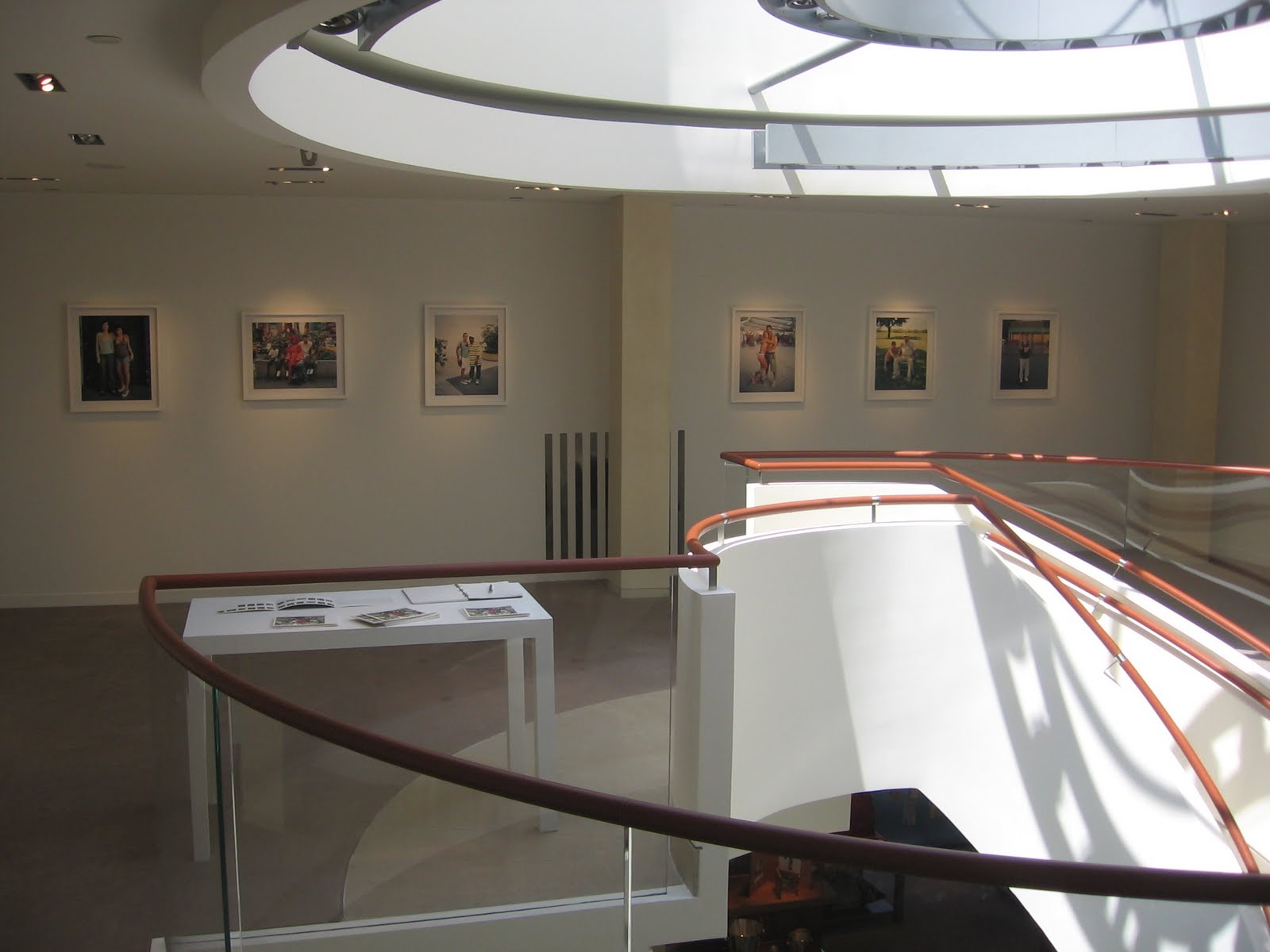
JTF (just the facts): A total of 22 color photographs, framed in white with no mat, and hung in the atrium gallery space at the top of the store. All of the works are chromogenic prints made between 2007 and 2010. The prints on display are each 24x20 or reverse, made in editions of 12+2. A larger size is also available, 40x33 or reverse, in editions of 3+2. (Installation shots at right.)

Comments/Context: Richard Renaldi's recent portraits are built on a deceptively simple construct that turns out to be much deeper and more complex than you might initially expect. The idea is straightforward: bring two generally unlikely people (or groups of people) together and ask them to pose for a portrait. The wrinkle here is that Renaldi has required the sitters to touch each other: to embrace, hold hands, intertwine their arms, or otherwise get much closer than two strangers normally would.
.
While at first glance, some of these images have the look of large format family snapshots, the overall effect is often a wonderfully strange and awkward moment, where cultures clash, invisible boundaries are reluctantly crossed, and stereotypes are broken down. A closer look reveals unexpected connections between these people, where ethnicities, ages, genders, and personality types seem to melt away, and honest and authentic emotions seem to come through. The gestures run the gamut from stiff and wooden to tender and moving, exposing an entire spectrum of subtle social interaction.
.
I found myself drawn to those portraits that not only brought stark opposites together, but also maximized the available color and texture in the environment. Reginald and Nicole pose on a vibrant yellow concrete sculpture, Carlos and Alex stand in front of a lime green wall, and Lindsay and Mark square off in front of a pattern of cinder blocks. The image of Julie and Xavier was the most memorable picture for me; she in her wedding dress holding a champagne bottle, he in his yellow bandanna and oversized baseball shirt, oddly dissimilar, yet able for just a moment to come together and share their common humanity.
.
Collector's POV: While this isn't a selling show, prints from this series are available directly from the artist (linked below). The 24x20 prints start at $2500 and escalate to $5000 based on the place in the edition. The 40x33 prints start at $4500 and escalate to $6000. Renaldi's work has not yet surfaced in the secondary markets, so interested collectors will need to follow up at gallery retail or directly with the artist.
.
Rating: * (one star) GOOD (rating system described here)

Transit Hub:
  • Artist site (here)
  • Interview on Conscientious (here)
  • Review: Wallpaper (here)
  • Foundation d'enterprise Hermès (here)
Through May 28th

The Gallery at Hermès
691 Madison Avenue
New York, NY 10065

Thursday, May 6, 2010

Henri Cartier-Bresson: The Modern Century @MoMA

JTF (just the facts): A total of 306 black and white photographs, alternately framed in white and black and matted, and hung in a series of 8 rooms on the sixth floor of the museum. The works span the period between 1929 and 1989. The entry to the exhibit contains a collection of large scale color maps that chart the photographer's worldwide travels in meticulous detail. There are 5 glass vitrines scattered throughout the exhibit (each running the length of an entire wall) containing magazine spreads. Two large seating areas (tables/chairs) stand at the center of the exhibit, with exhibition catalogues available for further review.

After 4 images in the entry hall and 6 images used to show differences in printing techniques, the exhibit is divided into 13 discrete sections, which wind around in a rough figure eight pattern across the various rooms, using different colors of grey paint to set off different areas. The titles of these sections (which are slightly different than those in the exhibition catalog in some cases) are listed below, with the number of images on view in each in parentheses:
  • Early Years (34)
  • After the War, End of an Era (21, with 1 case)
  • Old Worlds: East (13)
  • Old Worlds: West (22)
  • Old Worlds: France (17)
  • New Worlds: USA (22, with 1 case)
  • New Worlds: USSR (17, with 1 case)
  • Photo Essay: The Great Leap Forward, China, 1958 (37, with 1 case)
  • Photo Essay: Bankers Trust Company, New York, 1960 (15)
  • Portraits (34)
  • Beauty (10)
  • Encounters and Gatherings (26)
  • Modern Times (28, with 1 case)
The show was organized and curated by Peter Galassi, Chief Curator of Photography at MoMA. After its run in New York, the exhibit will travel to the Art Institute of Chicago, SFMOMA, and the High Museum in Atlanta. A detailed exhibition catalog, with a thoughtful and well-researched scholarly essay by Galassi and detailed background information (including the maps), is available from the museum for $50 or $75, depending on the binding (here). (Unfortunately, no photography was allowed in the exhibit, so there are no installation shots for this show.)

Comments/Context: As you make your way to the top of the escalator on the sixth floor of the MoMA, if you can block out the chaos of the gift shop, the audioguide station, and the thronging crowds for a moment, the staggering floor to ceiling maps of Henri Cartier-Bresson's worldwide travels as a photojournalist will come into view. While you might be tempted to rush into the galleries to see the photography, I'd suggest taking a moment to let these hopelessly detailed maps wash over you a bit, to take in the multi-colored squiggling lines that criss-cross the continents decade after decade, and to consider the many challenges Cartier-Bresson faced in both getting from one far flung exotic or politically charged locale to the next, and in making his pictures when he got there.

Like many collectors I expect, I have become almost overexposed to the artist's best known images. But the real life context of the maps reminded me of how much more to the story there really was beyond the early greatest hits, and just how hard it was going to be from a curatorial standpoint to both capture all that he did in his long career and somehow organize it into an easily communicated shorthand. Curator Peter Galassi has done his best to weave various threads together, alternating between chronological, geographic, structural, and thematic approaches in presenting the works, creating a interlocking brocade of ideas. But in the end, Cartier-Bresson remains more elusive than you might expect; the "decisive moment" tells part of the story, but certainly not all of it, and even the best organizational intentions left me with a sense of wondering how it all should fit together.

The exhibition begins chronologically with Cartier-Bresson's early 1930s work, and these pictures strongly stand out in terms of their Modernist, avant-garde and Surrealist influences. The first room contains many of the photographer's best known and most innovative vintage images, and together, they feel like a fresh, self-contained body of work, rooted more in compositional experimentation, literature, and left-wing politics than in what we now call photojournalism. As I moved into subsequent rooms, I was struck by how Cartier-Bresson seemed to leave this aesthetic behind, or perhaps to refine it for more everyday use, moving more toward neutral observation and away from conscious aesthetic exploration.

After a room of images from the post-WWII period, Cartier-Bresson's output is roughly grouped by geography, selecting single images from different decades and assignments, loosely sorted into a "before and after" of old and new worlds. Images of Asia, Europe, and France in particular chronicle pre-industrial cultures, while shots of the US and USSR document economic expansion and growth. Galassi then does a deep dive into two photo essays (one of the Great Leap Forward in China and one of financial workers at Bankers Trust), trying to show the more detailed process and context in Cartier-Bresson's single subject projects - long captions add an unexpected level of reporting background, while multiple images help to tell a narrative with more vantage points. The final sections of the show are then grouped thematically by subject matter, starting with a large collection of portraits, and ending with images of crowds and modern society.

In virtually all of the work after the second World War, all the way through into the 1970s, Cartier-Bresson was remarkably consistent in his crafting of photojournalistic vignettes. Most pictures are a self-contained story, often capturing subtle social cues, glances, and gestures that have coalesced into a composition that captures the juxtaposition of different people. Whether in India or France, China or the US, he was able to reduce the chaos around him into clear relief, highlighting the figures and their cultural interrelationships. Expressions, facial emotions, fleeting encounters, and unexpected action form the basis of virtually all of his best images.

On one hand, seeing hundreds of these images can make them seem a bit formulaic, but in the context of those maps at the beginning, I saw his repeated search for certain themes and ways to construct a picture as mechanisms for simplifying the unusual situations and tough challenges he continually encountered all over the globe. It seems he had already discovered how to be successful in telling the kinds of stories he wanted to tell, and he refined his eye and approach to fit his needs over the long decades of his career. It was all a matter of moving and waiting until the moment was right; it sounds so effortless, but a massive show likes this is proof that it took an enormous amount of dedication to his craft.

Overall, this retrospective does a fine job of providing a larger framework for considering Cartier-Bresson. It successfully forced me to get beyond his iconic early work, to appreciate a broader sample of his images from various decades, and to see patterns and evolutions in his style. That said, I can't help wondering if many more targeted exhibitions will now be necessary to really unravel the complexities of his work between 1945 and 1975; the narrative still seems messy and unfinished. But perhaps this is the mark of a thought-provoking exhibition: it provides some of the answers, but leaves many more open-ended clues and puzzles for future study.

Collector's POV: Cartier-Bresson's prints are ubiquitous at auction, with dozens of prints available each and every season. Prices have ranged from $1000 to $200000 in recent years; obscure images and later prints are generally at the bottom end of that range, with vintage prints of the iconic images at the top. That said, even later prints of his most famous works are now regularly pricing above $10000, so prices continue to inch upward. Active collectors of Cartier-Bresson's work shouldn't miss the small selection of prints at the beginning of the show that highlights the differences in prints made by the photographer and various labs over the years. I was interested to learn that early prints made by the photographer himself were very muted in tone, and that later prints have black borders and are signed on the front, a handy heuristic for auction previews and the like.

Rating: *** (three stars) EXCELLENT (rating system described here)

Transit Hub:
  • Exhibition site (here)
  • Reviews: NY Times (here), New Yorker (here), Daily Beast (here), Wall Street Journal (here)
  • Charlie Rose interview with Galassi, Frank and Sire (here)
  • Fondation Henri Cartier-Bresson (here)
  • Magnum Photos page (here)
Henri Cartier-Bresson: The Modern Century
Through May 22nd

The Museum of Modern Art
11 West 53rd Street
New York, NY 10019