Thursday, July 8, 2010

Rineke Dijkstra @Marian Goodman

JTF (just the facts): A total of 3 videos and 4 large scale color portraits, displayed in separate darkened video rooms and hung in the north and south galleries. All of the photographs are larger than life size archival inkjet prints, each 48x40, in editions of 10, made in 2008 or 2009. The videos are:
  • 3-channel HD, 12 minutes, in an edition of 6, from 2009
  • 1-channel HD, 6 minutes, 36 seconds, in an edition of 6, from 2009
  • 4-channel HD, 25 minutes, in an edition of 6, from 2009
Unfortunately, no photography was allowed in the galleries; as a result, there are no installation shots for this exhibit. The images at right were taken from the gallery website. (Still from The Krazy House, Liverpool, UK, 2008- 2009, at right.)

Comments/Context: If you actually take the time to watch all five segments of Rineke Dijkstra's The Krazy House, to patiently stand there in the dark for the entire 25 minutes and drink it all in, I think it would be nearly impossible to leave the gallery without a broad smile on your face. Without a doubt, it is the warmest, most compelling and uplifting time I have had in an art gallery all year.
.
The artistic conceit at work here is relatively straightforward. Dijkstra constructed an all-white room in a Liverpool dance club, and she invited club goers to come and dance to their favorite tracks when the club was closed. At first glance, you might think that this concept has echoes of the simple, unadulterated joy of dancing found in the early Apple iPod ads or those from the Gap featuring swing dancers from a few years back, and on the surface, there are some parallels in terms of look and feel. But what is altogether more surprising is that Dijkstra's video is actually about a process, like the fantastic transformation of a caterpillar into a butterfly. In each segment, the young person starts out timid, self-conscious, painfully aware of the ridiculousness of dancing alone in front of white wall for a camera. They are all shy and tentative, unsure of themselves, only trying out the simplest of their moves. But in each case, as they get more comfortable and feel empowered by the music, something spectacular happens: they blossom into amazingly beautiful individuals, giddy with freedom and lost in themselves.
.
What is fascinating is how each person responds to the music, making movements that match their range of emotions. A young girl with lilting blond braids pulled back from her face slowly swings her hips, her bare arms waving over her head in a mellow trance. A young guy in jeans and a t-shirt rips his moves with choreographed precision, aggressively jerking his body up and down, exploding with energetic hand positions. Another young girl mouths the words, acts out the lyrics, and makes a heart with her fingers, as her bright laughter and huge contagious smile fill the room. And a young guy with long greasy black hair slashes his head back and forth with rhythmic, twisting drama, adding in ecstatic snippets of earnest air guitar for flair. The classic motif of the whole piece is at the end of his session, when the music stops and he closes himself back up: he lets slip a sly goofy grin, acknowledging his stolen moment of letting it all hang out. (Still from The Krazy House, Liverpool, UK, 2008-2009, at right.)
.
There are plenty of meaty ideas and questions buried in these dances, from how we attract others using constructed behaviors to how young people search for outlets for expressing themselves, and from how we assert our own personalities to how we protect ourselves from our own doubts and insecurities. In each case, the music takes over and the subject eventually lets his or her guard down to reveal something special and otherwise hidden. Dijkstra has also made still portraits of many of the women club goers, arrayed in their cheap finery and posed against uniform grey backgrounds in classic grace. These reveal much less than the videos, but raise many of the same subtle questions about the process of creating our identities.
.
The other two videos in the show capture an array of children responding to art at the Tate Liverpool: in one, the kids verbally respond to Picasso's Weeping Woman, and in the other, a single girl sits on the floor and makes a drawing in response to the painting. The first is particularly engrossing, as the children try to explain what they see. Like the dancers, in the beginning, the children are shy and uncomfortable, chewing on their fingernails, looking around, yawning, and fidgeting. Soon, they being to reluctantly talk about the colors they have picked out, and all at once, they seem to explode into a flood of increasingly fanciful ideas that build upon each other (the sliced three-screen display makes this interchange all the more swirling and chaotic). Like a wild jazz improvisation, the kids throw their ideas back and forth, connecting and embellishing them into imagined stories and creative vignettes, their individual personalities coming out from behind their common grey sweaters, white shirts, and red ties. In the abstract, Dijkstra seems to have captured the very essence of brainstorming, the uncontrolled conversational exchange where multiple perspectives interact and converge. In the second video, this coalescing occurs more subtly, as the single school girl sits quietly on the floor, looking back and forth between the picture and her pencil drawing, intermittently distracted by students nearby, until she finally becomes completely engrossed in her drawing and hardly notices the action around her. (Still from I See a Woman Crying (Weeping Woman), Tate Liverpool, 2009, at right.)
.
In all of these works, Dijkstra creates an inversion for the viewer, where the obvious subject turns out not to be the subject at all. These works are not about dancers or school kids exactly, but about the more complex idea of how we create and explore who we are, how we get immersed in something that lets us be free, if only for a moment. While some readers here might quibble that these artworks are mostly video not photography, I would respond that these videos are entirely photographic in their approach. The difference comes in that Dijkstra has tried to capture an invisible process not a subject, something that is fleeting and amorphous not stable, and a still frame just doesn't provide the richness needed to describe the changing and morphing she is trying to document.
.
Overall, I found this to be a tremendously impressive and entirely thought-provoking show, full of original conceptual ideas, expressed with maturity and executed with confidence. Simply put, to my eyes, this is the most exciting and memorable body of new contemporary work I have seen this year.
.
Collector's POV: The four photographs in this show are priced at 22000€ each. The three videos are respectively 65000€ (I See a Woman Crying), 50000€ (Ruth Drawing Picasso), and 85000€ (The Krazy House). Dijkstra's photographic work has become generally available at auction in the past few years, with prices ranging widely, from roughly $4000 to $180000, with a sweet spot between $10000 and $50000. She is also represented by Galerie Max Hetzler in Berlin (here) and Galerie Jan Mot in Brussels (here).
.
Rating: *** (three stars) EXCELLENT (rating system described here)
.
Transit Hub:

  • Exhibit: Tate Liverpool, 2010 (here)
  • Review: Frieze, 2010 (here)
  • Features: Almerisa @MoMA (here), Guardian, 2010 (here)
Through August 21st

24 West 57th Street
New York, NY 10019

Auction Results: Jeanloup Sieff Photographies, Collection Gert Elfering, June 30, 2010 @Christie's Paris

The results from the Jeanloup Sieff sale at Christie's in Paris last week were generally right in line with expectations. The overall Buy-In rate was near 25% and the Total Sale Proceeds fell near the top end of the estimate range.

The summary statistics are below (all results include the buyer’s premium):

Total Lots: 67
Pre Sale Low Total Estimate: 304000€
Pre Sale High Total Estimate: 461000€
Total Lots Sold: 49
Total Lots Bought In: 18
Buy In %: 26.87%
Total Sale Proceeds: 416300€

Here is the breakdown (using the Low, Mid, and High definitions from the preview post, here):

Low Total Lots: 54
Low Sold: 40
Low Bought In: 14
Buy In %: 25.93%
Total Low Estimate: 293000€
Total Low Sold: 249500€

Mid Total Lots: 13
Mid Sold: 9
Mid Bought In: 4
Buy In %: 30.77%
Total Mid Estimate: 168000€
Total Mid Sold: 166800€

High Total Lots: 0
High Sold: NA
High Bought In: NA
Buy In %: NA
Total High Estimate: 0€
Total High Sold: NA

The top lot by High estimate was tied between four lots, all estimated at 10000-15000€:

  • Lot 9, Jeanloup Sieff, Hommage à Seurat (variant), New York, 1965, sold for 16250€
  • Lot 12, Jeanloup Sieff, Yves Saint Laurent, Paris, 1974, sold for 39400€ and was the top outcome of the sale (image at right, top, via Christie's)
  • Lot 16, Jeanloup Sieff, Grès #160, Harper's Bazaar, 1964, did not sell
  • Lot 67, Jeanloup Sieff, Corset, New York, 1962, sold for 18750€
87.76% of the lots that sold had proceeds in or above the estimate. There were a total of 8 surprises in the sale (defined as having proceeds of at least double the high estimate):

Lot 8, Jeanloup Sieff, Femme nue gravissant une dune, 1970, at 10625€
Lot 12, Jeanloup Sieff, Yves Saint Laurent, Paris, 1971, at 39400€
Lot 14, Jeanloup Sieff, Derriere Anglais, Paris, 1969/Later, at 27400€
Lot 22, Jeanloup Sieff, Par un jour pluvieux, Paris, 1975, at 22500€
Lot 33, Jeanloup Sieff, Ina, Angleterre, Queen, 1965/Later, at 6000€
Lot 41, Jeanloup Sieff, Jane Birkin, Paris, 1968/Later, at 10000€
Lot 47, Jeanloup Sieff, Le tapis volant, Normandie, 1988, at 22500€
Lot 57, Jeanloup Sieff, Alfred Hitchcock et Ina sur le plateau de 'Psycho', Harper's Bazaar, 1962, at 8125€

Complete lot by lot results can be found here.

Christie's
9 Avenue Matignon
75008 Paris

Wednesday, July 7, 2010

Will Steacy, Down These Mean Streets @Mazzeo

JTF (just the facts): A total of 22 color images, framed in black with no mat, and hung against grey walls in the entry and main gallery spaces. The pigmented ink prints come in two sizes (or reverse): 16x20 (in editions of 5+2AP) and 24x30 (in editions of 3+2AP). While no dates were given on the gallery checklist, I think we can safely assume that all of these images were made in the past few years. A 16-page tabloid newspaper in both color and black and white is available from the gallery for $5. (Installation shots at right.)

Comments/Context: The plight of our inner cities isn’t exactly a new topic in the world of contemporary photography. Many photographers have pointed their cameras at our abandoned houses, empty streets, and broken neighborhoods, most with an air of clinical detachment or meticulous anthropological documentation, searching for abstract photographic beauty or subtle irony hidden amid the grit. Will Steacy’s photographs, taken at night while wandering in the transitional zones between airports and urban areas in some of America’s best known cities, have no such comfortable, eyes-averted distance. They are right up in your face, with a level of aggressive confrontation that is unavoidable. This is an artist with a chip on his shoulder, willing to take some risks to jolt us out of our stupor, combining the eye of an investigative reporter with the angry heart of a dramatic story teller.

One wall in the reception area of the gallery is blanketed in a dense, highly personal installation of 3x4 photographs, maps, airline stubs, lottery tickets, news articles, terrorist mug shots, pulp novel covers, flattened beer cans, book pages, plastic booze flasks, matchbooks, taxicab licenses, and other miscellaneous artifacts and ephemera collected along the way during this project, all covered and annotated with scrawled handwriting. It’s the kind of manic, obsessive, intelligent, rage-filled wall that you normally find in the basement lair of a serial killer in the movies. It weaves failings in banking, joblessness, wars, terrorism, foreclosures, broken education, and unaffordable health care together with fear, neglect, and devastation, all wrapped up with an unforgiving rawness that is entirely mesmerizing and real. The wrench Steacy used for protection during his night time shoots is collaged next to his old labor union card; a broken newspaper box lies in front, with strewn trash on the floor nearby. It is a harrowing, multi-dimensional portrait of an artist thoroughly annoyed by the destruction of the American Dream and exasperated at our complicit avoidance of seeing what is happening or doing anything about it.

Nearly all of the larger photographs in the main gallery are awash in the malignant glare of acidic streetlights. They depict bullet holes, cigarette butts, boarded up housing projects, homeless people, gutter trash, and vacant lots, but they do so without voyeuristic sentimentality or cheap sensationalism. Even though Steacy is an outsider to these particular communities, his viewpoint comes from within, more in a social documentary style steeped in everyday realism. He has chosen emblematic scenes that have a formal clarity, with an added edge of anxiety and danger. A coffee cup lies inside a broken newspaper vending machine, a bus bench is reduced to two sawed off stubs, a purse lies abandoned on the sidewalk, and a fence encircles a dark brick housing facility, a barrier for both those wanting to get in and those wanting to get out. The sense of being out-in-the-open and alone is palpable.

In some ways, this isn’t the easiest work to like. It holds up a mirror to a world we have created for ourselves that isn’t particularly pretty. What I find most memorable is that there is a sense of fighting spirit in these pictures; the artist has dug deeply and worked hard to tell these sometimes bleak and unforgiving stories. As result, they have power and intensity that is absent in other similar drive-by projects of ruined cities. Steacy has immersed himself in this neglected and forgotten part of our world, made it his own, and is clearly taking it personally.

Collector's POV: The works in this show are priced in rising editions. The 16x20 works begin at $1200 and rise to $2200; the 24x30 works begin at $2000 and rise to $3500. Steacy's work is not yet available in the secondary markets, so gallery retail is likely the only option for interested collectors at this point.
.
As an aside, I think these images will make a terrific book, especially if the photographer adds in some of the back stories and ideas found in the chaotic installation.

Rating: ** (two stars) VERY GOOD (rating system described here)

Transit Hub:
  • Artist site (here) and blog (here)
  • Review: New Yorker (here)
  • Interviews: Conscientious (here), BOMBlog (here)
  • Feature: Conscientious (here)
Will Steacy, Down These Mean Streets
Through July 30th

Michael Mazzeo Gallery
526 West 26th Street
New York, NY 10001

Auction Results: Post-War and Contemporary Art Evening and Day Sales, June 30 and July 1, 2010 @Christie's King Street

While the big Gursky didn't sell, Christie's was still able to tally the largest photography proceeds in the Contemporary Art sales in London last week. While the overall Buy-In rate was similar to that of Phillips the day before (just over 31%), the top end lots were pretty soft in these two sales. With the absence of the income from the Gursky, the Total Sale Proceeds for photography missed the estimate range by a wide margin; if the Gursky had sold for its low estimate, the results would have fallen just below the range.

The summary statistics are below (all results include the buyer’s premium):

Total Lots: 45
Pre Sale Low Total Estimate: £2156000
Pre Sale High Total Estimate: £2986000
Total Lots Sold: 31
Total Lots Bought In: 14
Buy In %: 31.11%
Total Sale Proceeds: £1229225

Here is the breakdown (using the Low, Mid, and High definitions from the preview post, here):

Low Total Lots: 0
Low Sold: NA
Low Bought In: NA
Buy In %: NA
Total Low Estimate: £0
Total Low Sold: NA

Mid Total Lots: 21
Mid Sold: 14
Mid Bought In: 7
Buy In %: 33.33%
Total Mid Estimate: £286000
Total Mid Sold: £218875

High Total Lots: 24
High Sold: 17
High Bought In: 7
Buy In %: 29.17%
Total High Estimate: £2700000
Total High Sold: £1010350

The top lot by High estimate was lot 47, Andreas Gursky, Pyongyang II, 2007, at £900000-1200000; it did not sell. The top outcome of the sale was lot 177, Hiroshi Sugimoto, Kattegat, Kullaberg, 1996, at £205250.

A perfect 100.00% of the lots that sold had proceeds in or above their estimate. There were a total of three surprises in these sales (defined as having proceeds of at least double the high estimate):

Lot 317, Mike Kelley, Nostalgic Depiction of the Innocence of Childhood, 1990, at £37250
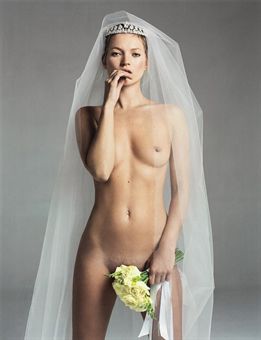
Lot 384, Inez Van Lamsweerde, Kate Moss, Bride, 2003, at £21250 (image at right, top, via Christie's)
Lot 387, Andres Serrano, Black Jesus, 1990, at £73250

Complete lot by lot results can be found here (Evening) and here (Day).

Christie's
8 King Street, St. James's
London SW1Y 6QT

Tuesday, July 6, 2010

Auction Results: Contemporary Art Evening and Day Sales, June 29 and 30, 2010 @Phillips London

The media narrative around the results of Phillips' Contemporary Art sales in London last week has centered on weakness in the market (via Art Market Monitor here and here), but the photography buried in the pair of sales performed, for the most part, in line with expectations. Most of the top photo lots found buyers in their estimate ranges. The overall Buy-In rate was somewhat soft (at just over 32%) and the Total Sale Proceeds fell just below the bottom of the estimate range, but in general, it wasn't too far from "normal", given a mixed bag of material, a lack of superior/standout lots, and a summertime sale date.

The summary statistics are below (all results include the buyer’s premium):

Total Lots: 46
Pre Sale Low Total Estimate: £853000
Pre Sale High Total Estimate: £1208000
Total Lots Sold: 31
Total Lots Bought In: 15
Buy In %: 32.61%
Total Sale Proceeds: £836125

Here is the breakdown (using the Low, Mid, and High definitions from the preview post, here):

Low Total Lots: 4
Low Sold: 2
Low Bought In: 2
Buy In %: 50.00%
Total Low Estimate: £17000
Total Low Sold: £5500

Mid Total Lots: 25
Mid Sold: 16
Mid Bought In: 9
Buy In %: 36.00%
Total Mid Estimate: £356000
Total Mid Sold: £205875

High Total Lots: 17
High Sold: 13
High Bought In: 4
Buy In %: 23.53%
Total High Estimate: £835000
Total High Sold: £624750

The top lot by High estimate was lot 21, Gilbert & George, Damned Buddleia, 1980, at £150000-200000; it was also the top outcome of the sale at £169250.

90.32% of the lots that sold had proceeds in or above their estimate. There was only one surprise in these sales (defined as having proceeds of at least double the high estimate):

Lot 181, Dash Snow, Untitled, 2007, at £63650 (image at right, top, via Phillips)

Complete lot by lot results can be found here (Evening) and here (Day).

Phillips De Pury & Company
Howick Place
London SW1P 1BB

Jesse Burke: Intertidal @ClampArt

JTF (just the facts): A total of 32 color images, framed in white with no mat, hung edge to edge in an undulating up and down pattern across the walls of the single room gallery space. The digital c-prints range in size between 11x14 and 38x30, with a variety of intermediate sizes. The works were made between 2004 and 2010, and have been printed in two sizes each, in editions of 8. A monograph of this body of work, published by Decode Books (here), is available from the gallery for $35.(Installation shots at right.)
.
Comments/Context: Jesse Burke's subtle photographs of stereotypical male activities are consistently filled with contradictions. They tackle the underlying rift between society's surface assumptions about masculinity and the more complicated reality of how men really behave, exposing tensions and vulnerabilities that fall beyond a simplistic view of male toughness. These are introspective pictures, taken with tenderness and understanding, a more nuanced and less polarized portrait of the "Fight Club" search for male meaning in the modern world.
.
The show covers a broad range of conventional masculine subjects, with an eye for detail: a pyramid of beer cans, push-ups, deer hunting, dogs, eye black, camouflage gear, basketball hoops at night, and mud. My favorite pictures chronicle the quintessential male ritual of shotgunning a beer. Burke photographs his subjects at the moment just after they have finished the race or the chest-thumping spectacle, when the beer runs down the front of their shirts and they stand wide-eyed and jolted by the rush of alcohol. The moment is filled with an unvarnished swirl of emotions: exhilaration, ridiculousness, testing, physical pain, and forced but somehow real camaraderie. These images are juxtaposed with a variety of gentler landscapes and more intimate shirtless portraits, posed against floral backgrounds. A self-portrait of the photographer holding his fragile baby in front of a stack of rough sawed logs poignantly captures the irony and conflict of his own male role.

It would be easy for a project like this to veer off into worn-out and obvious beer ad mockery, but Burke does an excellent job of keeping the feelings and symbols simple and authentic, opening up the stresses and paradoxes underneath the typical male stereotype without going overboard. As a result, the installation has the feel of a quiet discussion, where the men let their guard down for a just moment and expose their unprotected, imperfect selves.
.
Collector's POV: The works in this show are priced between $700 and $2200, based on size, with many different intermediate prices. Since this is Burke's first solo show in New York, it is not at all surprising that his work has not yet made it to the secondary markets. Gallery retail is thus the only option for interested collectors at this point.
.
Rating: * (one star) GOOD (rating system described here)

Transit Hub:
Through July 9th
521-531 West 25th Street
New York, NY 10001

Friday, July 2, 2010

Auction Results: Contemporary Art Evening and Day Auctions, June 28 and 29, 2010 @Sotheby's London

The photography lots in the pair of Contemporary Art sales at Sotheby's in London earlier this week performed right in line with expectations. The overall Buy-In rate was solidly in the mid twenties (24%) and the Total Sale Proceeds fell in the middle of the estimate range.

The summary statistics are below (all results include the buyer’s premium):

Total Lots: 25
Pre Sale Low Total Estimate: £1014000
Pre Sale High Total Estimate: £1407000
Total Lots Sold: 19
Total Lots Bought In: 6
Buy In %: 24.00%
Total Sale Proceeds: £1191975

Here is the breakdown (using the Low, Mid, and High definitions from the preview post, here):

Low Total Lots: 0
Low Sold: NA
Low Bought In: NA
Buy In %: NA
Total Low Estimate: £0
Total Low Sold: NA

Mid Total Lots: 16
Mid Sold: 12
Mid Bought In: 4
Buy In %: 25.00%
Total Mid Estimate: £222000
Total Mid Sold: £222575

High Total Lots: 9
High Sold: 7
High Bought In: 2
Buy In %: 22.22%
Total High Estimate: £1185000
Total High Sold: £969400

The top lot by High estimate was lot 14, Andreas Gursky, Stateville, Illinois, 2002, at £500000-700000; it was also the top outcome of the two sales at £577250.

94.74% of the lots that sold had proceeds in or above their estimate. There was only one surprise in these sales (defined as having proceeds of at least double the high estimate):

Lot 298, Hiroshi Sugimoto, Baltic Sea, Rugen, 1996, at £36050 (image at right, top, via Sotheby's)

Complete lot by lot results can be found here (Evening) and here (Day).

Sotheby's
34-35 New Bond Street
London W1A 2AA

Thursday, July 1, 2010

Book: Frank Gohlke, Thoughts on Landscape

JTF (just the facts): Published in 2009 by Hol Art Books (here). Subtitled Collected Writings and Interviews. 300 pages. Contains essays, book introductions, interviews, artist statements, lectures, and other writings from 1976-2007. (Cover shot at right, via Amazon.)

Comments/Context: Frank Gohlke's writings are quiet and clear, the record of a photographic life lived with a sense of measured humility and thoughtful attentiveness. The fact that Gohlke has a written voice of genuine eloquence has perhaps gone unnoticed by many during his long career, as his careful words have been intermittently scattered between descriptions and interrogations of his own work and acute observations of the work of friends, students and colleagues. This volume gathers together the photographer's varied writings over a period of three decades, and provides a chronological history of the progression and evolution of his artistic thinking.

What I found most interesting in these consistently articulate writings was the underlying and ongoing process of Gohlke searching for meaning in the intersection of humanity and nature. While Gohlke was included in the now famous New Topographics exhibit, his personal explorations of the meaning of the land around him across his career go far beyond the implications of the "man-altered landscape". As these writings reveal, every one of his projects comes back to the same central subject: the patient and affectionate study of the roots of the landscape, trying to understand its subtleties and nuances with intelligence and gratitude.

In each successive essay, Gohlke's world view can be seen changing, becoming synthesized and transformed by intersections and refinements of ideas. His famous grain elevators start out as studies of structure and surface, but soon become investigations of function, space and the relationships between society and the land. Images of the aftereffects of a tornado in his North Texas hometown document patterns of erasure and rebuilding. His pictures of the land surrounding the Mount St. Helens volcano investigate the power of nature and the scale of destruction with the sympathetic eyes of a combination artist/scientist. And his intimate study of the less than glamorous Sudbury River asks hard questions about our actual understanding of the land around us and its history. In every case, we see Gohlke approaching his subject with intellectual rigor. What is really going on in this particular landscape? What do its surface clues tell us about its underlying structure? What are the relationships between the people and the geography and how can they be manifested in an image? He treats the land with respect and dignity, and asks his questions with both conviction and optimism. Each project represents a set of decisions, a sense of going deeper into a meaningful conversation with the world around him.

I also found Gohlke's reflections on his life as an artist to be personal and insightful. He expresses genuine excitement in his discovery of photography and his subsequent freedom from a life of academia. His story moves through several different cities and towns, as well as a parallel journey of figuring out how to be an artist and which creative paths to follow. All along the way, he proves to be a person who is thinking deeply and maturely about his craft, its connections to his own individual history, and its place in the larger society of humanity.

After reading these essays, I only wish Gohlke had written more, especially about other artists. His introductions, prefaces, and reviews of the work various other photographers are incisive and graceful, getting underneath superficial surface observations into more thoughtful and nuanced readings of intention and execution; he paid attention and drew insightful and original conclusions.

As a collector, this terrific book is a good reminder that there are no short-cuts to understanding the motives for photography. One must look, and look again, and then actively think, and think again, before we can even hope to understand. Frank Gohlke has made a career out of this kind of steady, persistent looking, and his work and writings teach us to calm down, engage our brains, and see what the landscape around us really has to say.

Collector’s POV: Frank Gohlke is represented by Howard Greenberg Gallery in New York (here). Prices for his works (both vintage and more recent) have ranged between $4000-7500 at retail and between $3000-6000 at auction, although very few of his best works have come up for sale in the secondary markets in past few years. We have two images from Gohlke's 1970's grain elevator series in our collection (here).

Transit Hub:
  • Artist site (here)
  • Reviews: Design Observer (here), The Online Photographer (here), Englewood Review of Books (here)

Auction Results: Film, June 24, 2010 @Phillips

The results for the photographs in the FILM themed sale at Phillips last week were generally dismal, with a buy-in rate over 60% and Total Sale Proceeds that fell well below half of the Total Low Estimate. The material just wasn't strong or unusual enough to attract an active group of buyers.

The summary statistics are below (all results include the buyer’s premium):

Total Lots: 128
Pre Sale Low Total Estimate: $387700
Pre Sale High Total Estimate: $564400
Total Lots Sold: 49
Total Lots Bought In: 79
Buy In %: 61.72%
Total Sale Proceeds: $155814

Here is the breakdown (using the Low, Mid, and High definitions from the preview post, here):

Low Total Lots: 123
Low Sold: 48
Low Bought In: 75
Buy In %: 60.98%
Total Low Estimate: $485400
Total Low Sold: $145814

Mid Total Lots: 5
Mid Sold: 1
Mid Bought In: 4
Buy In %: 80.00%
Total Mid Estimate: $79000
Total Mid Sold: $10000

High Total Lots: 0
High Sold: NA
High Bought In: NA
Buy In %: NA
Total High Estimate: $0
Total High Sold: NA
.
The top lot by High estimate was lot 108, Youssef Nabil, Rossy De Palma, Madrid, 20o2, at $18000-22000; it did not sell. The top outcome of the sale was lot 84, Lawrence Schiller, Marilyn Monroe (Color 3, Frame 18), 1962/Later, at $11875. (Image at right, bottom, via Phillips.)

77.55% of the lots that sold had proceeds in or above the estimate range. There was only one surprise in this sale (defined as having proceeds of at least double the high estimate):

Lot 10, Joe Shere, Jayne Mansfield and Sophia Loren at Romanoff's, Beverly Hills, 1958/1978, at $6000 (Image at right, top, via Phillips.)

Complete lot by lot results can be found here.

Phillips De Pury & Company
450 West 15th Street
New York, NY 10011

Wednesday, June 30, 2010

Cartier-Bresson Attendance at MoMA

According to an article by Erica Orden in yesterday's Wall Street Journal (here), it's been a great year for attendance at the MoMA. Buried in the chart at right (via the WSJ website), you'll see that the Henri Cartier-Bresson retrospective brought in a total of 412379 visitors. It was the only show of photography to make the short list.

Over four hundred thousand people got me thinking. It was certainly crowded when I visited the show, but what do those big numbers really mean (and how are they really counted)? So I made a few quick calculations.

The exhibit was open from April 11th through June 28th. Given that the museum is closed on Tuesdays, that makes for a total of 68 visitor days. So roughly 6064 people visited the HCB show every day it was open. Given the museum is open on average 7 hours a day (10:30AM to 5:30PM, we'll gloss over the later hours on Fridays), this means there were roughly 866 visitors to the show every hour. This translates to approximately 14.4 visitors entering every minute, or about one new HCB visitor every 4.2 seconds, all day, every day. Pretty mind boggling stuff. I would have never guessed that there was so much demand to see Cartier-Bresson. Even with many people seeing the show more than once, this is a huge number of people (both locals and tourists I realize) interested in vintage photography.

For pure curiosity, I'd be interested to compare these statistics with those from the recent Frank show at the Met, which was also overrun with visitors. (I can't think of any other blockbuster photo-only shows in NY in the last year that would have attracted a comparable number.) If anyone knows the total attendance figures for that show, please let me know and we can do an interesting side by side comparison.

Photography Collectors in the 2010 ARTnews 200

Every year, ARTnews publishes its list of the largest, most active art collectors in the world (here, magazine cover at right, via ARTnews), complete with their geographic location(s), how they came into their money, and the general categories of their often varied collections. Given our photography focus, we're always interested to see which photography collectors are on the annual list.

Compared to the 2009 list, not much has changed. Eight of the 2010 collectors who have the word "photography" in their bio were on the list last year:

Cristina and Thomas W. Bechtler-Lanfranconi
Joop van Caldenborgh
Danielle and David Ganek
Ydessa Hendeles
Martin Z. Margulies
Lisa S. and John A. Pritzker
Aby J. Rosen
Chara Schreyer
.
Of the other 2009 listed "photography" collectors, Sheikh Saud bin Mohammad bin Ali al-Thani is still very much on the active list, but photography is no longer part of his diverse bio. Leonora and Jimmy Belilty are not included at all in 2010.
.
Two new "photography" names have been included in 2010:
.
Ella Fontanals Cisneros
Thomas H. Lee and Ann Tenenbaum
.
This short photo-focused list is a little deceiving, in that more than 85% of the names on the complete list of 200 collectors have "modern" or "contemporary" art in their bios, so many of them could (and likely do) collect some photography as a subset of their larger efforts, likely at the top end of the contemporary market that crosses over from traditional vintage photography.
.
Overall, my takeaway from this year's list is that the world of focused photography collecting remains relatively small, and that the largest, most powerful collectors remain fairly constant/consistent from year to year; most people don't change their collecting passions overnight, especially coming out of an economic downturn. This kind of list is however a strong reminder that the major challenge for the community as a whole is how to entice more and more significant contemporary collectors to pay more attention to photography; this is the "low hanging fruit" in terms of potential growth.
.
By the way, if your name is on the list above and we don't already know that you are visiting this site from time to time, please do drop us a line to say hello.

Tuesday, June 29, 2010

Auction: Italia, June 30, 2010 @Phillips London

Another installment in Phillips' themed sale series takes place in London later this week with an auction entitled Italia. It's generally a mixed bag of Italian artists, with an additional group of other artists using Italy or Italians as subject matter. Out of a total of 235 lots available in all mediums, 73 are photographs, with a Total High Estimate for photography of £631100. (Catalog cover at right, via Phillips.)

Here's the breakdown:

Total Low Lots (high estimate up to and including £5000): 32
Total Low Estimate (sum of high estimates of Low lots): £110600

Total Mid Lots (high estimate between £5000 and £25000): 37
Total Mid Estimate: £355500

Total High Lots (high estimate above £25000): 4
Total High Estimate: £165000

The top lot by High estimate is lot 120, David LaChapelle, Statue, Los Angeles, 2007, at £50000-70000. (Image at right, via Phillips.)

Here is the list of photographers who are represented by three or more lots in the sale (with the number of lots in parentheses):

Piergiorgio Branzi (5)
Mario Giacomelli (4)
William Klein (3)
Enzo Sellerio (3)

The complete lot by lot catalog can be found here.

Italia
June 30th

Phillips De Pury & Company
Howick Place
London SW1P 1BB

Auctions: Post-War and Contemporary Art Evening and Day Sales, June 30 and July 1, 2010 @Christie's King Street

Christie's is up third in the early summer London season, with its Post-War and Contemporary Art Evening and Day sales at King Street later this week. The top lots include Gursky (with yet another chance to top the $1 million dollar mark), Sugimoto, Gilbert & George, and Eliasson. Overall, there are 45 photography lots on offer across the two sales, with a Total High Estimate of £2986000.

Here's the breakdown:

Total Low Lots (high estimate up to and including £5000): 0
Total Low Estimate (sum of high estimates of Low lots): NA

Total Mid Lots (high estimate between £5000 and £25000): 21
Total Mid Estimate: £286000

Total High Lots (high estimate above £25000): 24
Total High Estimate: £2700000

The top lot by High estimate is lot 47, Andreas Gursky, Pyongyang II, 2007, at £900000-1200000. (Image at right, top, via Christie's.)

Here is the list of photographers who are represented by three or more lots in the two sales (with the number of lots in parentheses):

Hiroshi Sugimoto (5)
Gregory Crewdson (3)
Douglas Gordon (3)
Vik Muniz (3)
Shirin Neshat (3)
Thomas Ruff (3)

The complete lot by lot catalogs can be found here (Evening) and here (Day).

Post-War and Contemporary Art Evening Auction
June 30th

Post-War and Contemporary Art Day Auction
July 1st

Christie's
8 King Street, St. James's
London SW1Y 6QT

Valérie Belin, Recent Works @Sikkema Jenkins

JTF (just the facts): A total of 7 large scale black and white and color works, generally framed in black with no mat, and hung in the back two galleries. The images on view are a mix of pigment and c-prints, ranging in size from 49x39 to 71x71. All of the works were made between 2006 and 2008. (Installation shots at right.)
.
Comments/Context: The work of French photographer Valérie Belin seems to be popping up all over the place recently. A group of her color model portraits was included in Dress Codes at the ICP last year, and one of her black and white mannequin heads is now on display in the Pictures by Women show at MoMA. This small exhibit provides a sampler of her most recent work, covering four different projects, all from the past few years.
.
If there is a common theme to Belin's photography, it appears to be the exploration of the edge between the artificial and the real. In the past, she has made images of body builders and ballroom dancers, shop mannequins and Michael Jackson impersonators, all touching on the human impulse to manufacture identity. This concept is explored further in this show via three recent black and white images of Lido dancers, each wearing an outlandish and ornate costume (complete with leather, fur, or sequins), and punctuated by an identical plastic smile. These women look like stylized characters from a science fiction novel, simultaneously beautiful and altogether weird and unsettling in their perfection.

Belin has also considered the idea of artificiality in the context of the traditional still life. Two massive color images of fruit baskets dominate the first room of the show. These over-saturated pictures were paired with still lifes by Manet in a recent exhibition at the Musée d'Orsay (linked below). In Belin's compositions, the explosion of fruit has become so controlled that it has been transformed into luscious, comical kitsch; real fruits look like decorative imitations, displayed for maximum visual effect. While there are echoes of Baroque still life allegories of prosperity and abundance in these works (there is also a direct link to Roger Fenton's dense, exotic piles of fruit), her images are wonderfully over-the-top, bold and vibrant exaggerations of the importance of surface beauty. A black and white floral still life hangs on the back side of one wall, a dark and shadowy foil to the colorful chaos of the fruit baskets. The artful bouquet hovers in the air disembodied from any context, reminiscent of the delicate 19th century still lifes of Adolphe Braun, but somehow more puzzling and aggressive.

While I might have preferred to dig into any one of these projects more deeply by seeing a wider selection of images from the same series, this one-of-each style exhibit did successfully highlight a variety of her recent ideas. Having not seen a collection of her work in person before, I came away impressed by both the deceptive depth of her thinking and the quality of her execution. There is evidence of an original artistic voice coming into maturity here, building momentum with each successive project.
.
Collector's POV: The works in this exhibit range in price from $20000 to $34000. Belin's work does not have a deep history at auction; only a few of her works have come into the mainstream secondary markets in the past few years. Prices for these works have fallen between $5000 and $9000, but since the sample size is so small, they may not be entirely representative of the actual market reality. I do think that one of Belin's fruit baskets would hold an entire wall with startling ease.
.
Rating: * (one star) GOOD (rating system described here)
.
Transit Hub:
  • Artist site (here)
  • Exhibits: Musée d'Orsay, 2008 (here), Peabody Essex, 2009 (here)
  • Review: Time Out (here)
  • Feature: Guardian (here)
Through July 2nd

53o West 22nd Street
New York, NY 10011

Monday, June 28, 2010

Auction: Jeanloup Sieff Photographies, Collection Gert Elfering, June 30, 2010 @Christie's Paris

Before the summer season fully kicks in, Christie's has one last single owner/single photographer sale scheduled for later this week in Paris. The sale contains a selection of works by the French photographer Jeanloup Sieff, taken from the broad collection of Gert Elfering. The auction mixes nudes, fashion photography, portraits, and other subjects. While most of the works were made in the 1960s, the sale spans much of Sieff's long career. Overall, there are a total of 67 lots on offer, with a Total High Estimate of 461000€. (Catalog cover at right, via Christie's.)

Here's the statistical breakdown:

Total Low Lots (high estimate up to and including 7500€): 54
Total Low Estimate (sum of high estimates of Low lots): 293000€

Total Mid Lots (high estimate between 7500€ and 35000€): 13
Total Mid Estimate: 168000€

Total High Lots (high estimate above 35000€): 0
Total High Estimate: NA
.
The top lot by High estimate is tied between four lots, all estimated at 10000-15000€:
  • Lot 9, Jeanloup Sieff, Hommage à Seurat (variant), New York, 1965
  • Lot 12, Jeanloup Sieff, Yves Saint Laurent, Paris, 1974
  • Lot 16, Jeanloup Sieff, Grès #160, Harper's Bazaar, 1964 (image at right, via Christie's)
  • Lot 67, Jeanloup Sieff, Corset, New York, 1962
The complete lot by lot catalog can be found here. The eCatalogue is located here.

Jeanloup Sieff Photographies, Collection Gert Elfering
June 30th

9 Avenue Matignon
75008 Paris

Vera Lutter, Venice I @Richardson

JTF (just the facts): A total of 6 black and white images, framed in white with no mat, and hung in the small Project Gallery at the back. All of the prints are selenium toned gelatin silver prints, each 25x21, from 2007. The works have been grouped together as a portfolio, entitled Venice I, with a case and a poem by Rainer Maria Rilke. (Installation shots at right.)

Comments/Context: Vera Lutter has consistently produced images of different sizes in working with her now familiar and easily recognizable camera obscura process. Most of her images are extremely large scale (often diptychs or triptychs, almost mural sized), made in shipping containers or large rooms, capturing wide vistas of layered cities and dense industrial zones. A handful of her other works are more intimate, capturing details and more closely cropped views of these same places. This show is made up of a portfolio of these smaller pictures from her recent visits to Venice, where Lutter's conceptual aesthetic has taken the warm romance of famous city and turned it into a ghostly parade of Italian architecture.

While there are a number of towers, colonnades and ornate domes on display here, reversed out with bright white doors and windows and an inky black sky, I found the ethereal images of canal boats, gondolas, and dock areas to be the most striking. Wooden posts stick up out of the water like matchsticks, and the boats float in an indistinct haze on the tactile surface of the slowly moving water. The gondolas are so blurred they are like an airy memory, delicate and wispy, just an inexact hint of their real selves.

What I like best about Lutter's approach here is her ability to make us see her subjects with new eyes. Indeed, what could be more overworked and cliche than the canals and towers of Venice. And yet, in her images, Venice is an otherworldly place, drained of its wondrous life, vacant of its bustling throngs, threatening to dissolve into nothingness or transform itself into something far darker. This town overrun by tourists suddenly has a witchy spirit, something a bit mysterious and chilling.

Collector's POV: The six images of Venice in this show are being sold together as a single portfolio for $35000. Lutter is represented in New York by Gagosian Gallery (here). Her work has become generally available in the secondary markets in recent years, ranging in price between $7000 and $85000, mostly dependent on size. We own one of her smaller images of the Pepsi-Cola sign (here).

Rating: * (one star) GOOD (rating system described here)

Transit Hub:
  • Exhibit: Gagosian Beverly Hills, 2009 (here)
  • Review: LA Times Culture Monster (here)
Vera Lutter, Venice I
Through July 9th

Yancey Richardson Gallery
535 West 22nd Street
New York, NY 10011

Thursday, June 24, 2010

Auctions: Contemporary Art Evening and Day Sales, June 29 and 30, 2010 @Phillips London

Phillips is up second next week with its pair of Contemporary Art Evening and Day Sales in London. Gilbert & George, Thomas Ruff and Olafur Eliasson provide the top five lots. Overall, there are a total of 46 lots of photography available across the two sales, with a Total High Estimate of £1208000.

Here's the statistical breakdown:

Total Low Lots (high estimate up to and including £5000): 4
Total Low Estimate (sum of high estimates of Low lots): £17000

Total Mid Lots (high estimate between £5000 and £25000): 25
Total Mid Estimate: £356000

Total High Lots (high estimate above £25000): 17
Total High Estimate: £835000

The top lot by High estimate is lot 21, Gilbert & George, Damned Buddleia, 1980, at £150000-200000. (Image at right, top, via Phillips.)

Here is the list of the photographers who are represented by more than one lot in the two sales (with the number of lots in parentheses):

Thomas Ruff (4)
Elger Esser (2)
Gilbert & George (2)
Candida Höfer (2)
Roni Horn (2)
Hélio Oiticica (2)
Hiroshi Sugimoto (2)

The complete lot by lot catalogs can be found here (Evening) and here (Day).

Contemporary Art Evening Sale
June 29th

Contemporary Art Day Sale
June 30th

Phillips De Pury & Company
Howick Place
London SW1P 1BB

Auctions: Contemporary Art Evening and Day Auctions, June 28 and 29, 2010 @Sotheby's London

As we head into the hot summer season here in the Northeast, there are a handful of last minute contemporary art and photography sales to tempt collectors before they tune out until September. Sotheby's has a pair of Contemporary Art Evening and Day sales early next week in London, with a small selection of photography on offer. There are a total of 25 lots available across the two sales, with a Total High Estimate of £1407000. (Catalog covers at right, via Sotheby's.)

Here's the statistical breakdown:

Total Low Lots (high estimate up to and including £5000): 0
Total Low Estimate (sum of high estimates of Low lots): £0

Total Mid Lots (high estimate between £5000 and £25000): 16
Total Mid Estimate: £222000

Total High Lots (high estimate above £25000): 9
Total High Estimate: £1185000

The top lot by High estimate is lot 14, Andreas Gursky, Stateville, Illinois, 2002, at £500000-700000.

Here is a list of the photographers who are represented by more than one lot in the two sales (with the number of lots in parentheses):

Roni Horn (3)
Hiroshi Sugimoto (3)
David LaChapelle (2)
Sam Taylor-Wood (2)

The complete lot by lot catalogs can be found here (Evening) and here (Day).

June 28th
.
June 29th

34-35 New Bond Street
London W1A 2AA