Wednesday, January 12, 2011

Nathan Harger @Hasted Kraeutler

JTF (just the facts): A total of 16 individual photographs and 2 grids (25 and 20 prints each), framed in white with no mats, and hung in the entry and the first two rooms of the gallery space. All of the works are digital c-prints mounted to Plexiglas, made between 2008 and 2010; most are printed in high contrast black and white. Dimensions range from 25x26 to 34x53, with many at 42x28 or reverse; all are available in editions of 7. The two grids are sized 65x43 and 70x62 respectively. (Installation shots at right.)

Comments/Context: Nathan Harger's photographs of city and industrial architecture take the idea of a monochrome silhouette to its logical extreme. Most of his images strip out the intermediate gray scale tones, leaving behind a flattened exercise in black and white, almost like an intricate ink or charcoal drawing. Cranes and power lines, silos and billboards become bold abstract outlines.
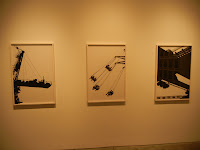
While this type of subject matter has already been thoroughly covered by many of the masters of photography (particularly the ID photographers from 1950s Chicago), Harger's images have a striking sense of the polarized maximum, where skies are pure blinding white, and process tanks and subway overpasses are richly black, almost tactile and velvety. He has bumped up against the point where photography intersects with graphic design, as his blocked out forms and delicate traceries lose their sense of photographic detail and are transformed into stylized representations.

For me, the works have surprising parallels in look and feel to James Welling's formal abstractions made from strips of simple black paper. Or maybe Harger is somewhere in between, almost like a Neo-Precisionist (channeling and reinterpreting Sheeler, Demuth, Crawford and others), exploring the linearity of recognizable imagery, albeit with the tools of pared down monochrome photography.
.
Collector's POV: The images in this show are generally priced based on size. The smallest individual prints are $2500, the medium 42x28 prints are $4500 and the largest prints are $5000. The two grids are $9000 and $7500. Harger's work is not consistently available in the secondary markets, so gallery retail is likely the only option for interested collectors at this point.

My favorite image in the show was Untitled (Crane 2), New York, NY, 2008; it's the picture on the right in the installation shot below. I like the geometric patterns of the vertical lines and angled cross beams, and the unbalanced composition set off by the bold black dot.

Rating: * (one star) GOOD (rating system described here)

Transit Hub:
Through January 29th

537 West 24th Street
New York, NY 10011

Tuesday, January 11, 2011

Wijnanda Deroo: Inside New York Eateries @Mann

JTF (just the facts): A total of 23 color photographs, framed in white and hung throughout the main gallery space. The chromogenic dye coupler prints come in three sizes: 16x29, 36x43, and 48x57, each in editions of 10. There are 16 in the small size (matted) and 7 in the medium size (unmatted) on display. All of the images were taken in 2009. (Installation shots at right.)

Comments/Context: Wijnanda Deroo's images of New York restaurants are a short-hand catalog of the diversity of this great city: its traditions and routines, its ethnicities and neighborhoods, its celebrations and memories. Her quiet, unpeopled interiors capture the essence of the dining experience at each individual place, from table settings and surrounding decorations, to exuberant colors or muted light, running the gamut from down-and-dirty to over-the-top extravagant.

Deroo's pictures document these rooms on a human scale, at eye level, often looking straight at a geometrically balanced group of tables, or down a long bar or counter. Many seem to have been taken in the purity of the morning, when the light is bright and the tables are neatly set. Her photographs are like formal portraits of these spaces, rich in color and texture, some "personalities" crisp and starched, others worn and smooth. The Russian Tea Room and 21 Club are darkly opulent, while Milon and Papaya Dog have ebullient effervescence to spare.

When taken as a series, the works provide a historical (sometimes almost nostalgic) snapshot of the nature of dining in New York; as restaurants age and mature, or come and go, they reflect the aspirations, moods, and tastes of those they serve. Deroo's formal compositions etch these quintessential places in memory, removing the cacophony of the babbling customers, leaving behind silent, studied environments and surfaces, each patiently waiting for its next jolt of life.

Collector's POV: The works in this show are priced as follows. The small 16x20 prints are $3500 each; the medium 36x43 prints are $5000 each; and the large 48x57 prints are $8500 each. Very little of Deroo's work has appeared in the secondary markets, so gallery retail is likely the only option for interested collectors at this point.

My favorite image in this exhibit was Jerry's, 90 Chambers Street, 2009; it's the coffee shop image on the left in the group of three at right. I like the breaking up of the picture plane and the way the light falls on the red leather of the booth.

Rating: * (one star) GOOD (rating system described here)

Transit Hub:
  • Artist site (here)
  • Review: Wall Street Journal (here)

Through January 29th

210 Eleventh Avenue
New York, NY 10001

Monday, January 10, 2011

Antonio Caballero, Las Rutas de la Pasión, Mexico 1960's -1970's @Sikkema Jenkins

JTF (just the facts): A total of 19 individual black and white images and 1 group of 28 black and white images as a single work, hung in the entry, the main gallery space and two side rooms. All of the prints are modern gelatin silver prints (made between 2005 and 2010) made from negatives taken between 1960 and 1980. There are 7 smaller 24x20 prints on view in the entry, framed in white and matted, in editions of 6. There are also 12 larger prints on view in the other rooms, each 40x40, framed in white and not matted, in editions of 6. An intact portion of a fotonovela is displayed as 28 images hung edge to edge, pinned directly to the wall in a long line, each print 7x7 unframed, the entire set in an edition of 3. (Installation shots at right.).

Comments/Context: During the 1960s and 1970s, Antonio Caballero was a prolific maker of Mexican fotonovelas, a kind of photography-based graphic novel form, filled with soap opera-style narratives of love and betrayal. By taking them out of their original sequenced context and blowing them up to large scale, this show takes these dated pop culture images and recharacterizes them, highlighting their entertaining retro-melodrama.
.
The images on view are full of big sculpted hair, exaggerated expressions, and staged moments of intrigue: a man cradles a slumped woman in the street, a young woman looks on in horror as she discovers a stolen kiss, a dead woman lies face down on the stairs as another woman looks on with barely concealed glee, two stylish women exchange secrets on a train platform. The scenes are theatrical and exaggerated, with plenty of opportunities for good looking people to pose with fashionable glamour.
.
While these confections are simple and diverting, I don't think they deliver much more than a dose of outlandish fun with a sliver of muted irony. They are the kind of stills that Cindy Sherman re-enacted and dissected by adding an underlayer of conceptual rigor. As such, they are the original article: their artificiality pleasingly amusing, but ultimately empty of deeper ideas.
.
Collector's POV: The smaller 24x20 works are priced at $4500 each, while the larger 40x40 prints are $8500 each. Caballero's work has little or no secondary market history, so gallery retail is likely the only option for interested collectors at this point.
.
Rating: * (one star) GOOD (rating system described here)

Transit Hub:
  • Review: New Yorker (here)
Through January 22nd
.
Sikkema Jenkins & Co.
530 West 22nd Street
New York, NY 10011

Thursday, January 6, 2011

Top 10 Photobooks of 2010

Back in November, Photo-Eye graciously asked me to participate in their annual roundup of Top 10 lists of photobooks. These diverse lists have been published today and can be found here.

My first reaction to the Photo-Eye invitation was that it was a kind of challenge; to be included with such an esteemed group of photobook experts and working photographers was both flattering and somewhat problematic. Regular readers here will know that while I review photobooks quite regularly, I don't limit myself in any way by a book's publication date; I am equally happy to review books from this year or a decade ago, based on any number of quirky collector-driven reasons. I don’t really think about photobooks in "vintages", nor have I ever done a “best of” gathering for photobooks. To submit a list I could stand behind, I would have to think hard about what had really risen to the top in the past year, something it had heretofore never once occurred to me to do.

As I have said elsewhere before (here), as a photography collector (which is something entirely different than being a photobook collector by the way), I primarily measure photobooks by their use as reference and by their ability to provide meaningful and lasting ideas and education. In my view, the best books of the year are those that will get used, that will be pulled down from the shelves over and over again, for repeated reviewing and rereading. As such, most of my choices for 2010 are meaty monographs, retrospectives, or exhibition catalogues, with insightful essays and detailed background material. They are anchor books for any photography library, and I expect to wear them thin in the coming years.

I've listed below the details of each of these books (in alphabetical order by photographer or show title), with links to their publishers. For a short and snappy rationale for why I included each book, please visit (and patronize) Photo-Eye (here). I've also included links to my previous more in-depth reviews of these books or the related exhibits, as appropriate.

Uta Barth, The Long Now, Gregory R. Miller & Co.
.
Henri Cartier-Bresson, The Modern Century, Peter Galassi, Museum of Modern Art
(exhibit review here)

Lee Friedlander, America By Car, Fraenkel Gallery/DAP
(exhibit review here)

Moholy-Nagy, The Photograms, Catalogue Raisonne, Renate Heyne, Hatje Cantz

Zwelethu Mthethwa, Aperture
(book review here)

Helios: Eadweard Muybridge in a Time of Change, Philip Brookman, Steidl/Corcoran Gallery of Art

Framing the West: The Survey Photographs of Timothy O’Sullivan, Toby Jurovics, Library of Congress and Smithsonian American Art Museum

From Here to There: Alec Soth’s America, Siri Engberg, Walker Art Center
(book review here)

Starburst: Color Photography in America 1970-1980, Kevin Moore, Hatje Cantz
(exhibit review here)

Paul Strand in Mexico, James Krippner, Aperture
(exhibit review here)

Since I provided this list long before the overall results were gathered and posted, I haven't had the chance to see whether my choices as a collector have any correlation to those of the other experts polled; my guess is that my list won't overlap much with those of the rest of the judges. What I can say with conviction is that each and every one of these books took me deeper into a thoughtful exploration of the work at hand, inspired and instigated new seeing and thinking, and richly rewarded the investment of my time.

Wednesday, January 5, 2011

Book: Patti Smith, Just Kids

JTF (just the facts): Published in 2010 by HarperCollins/Ecco (here). 308 pages, with 37 black and white photographs, 4 reproductions of drawings, and 2 reproductions of poems. (Cover shot at right, via Amazon.)
.
Comments/Context: Patti Smith's much acclaimed memoir came wrapped in tissue paper on Christmas morning, and I finished it several days before we rang in the New Year - I just couldn't put it down. While it's easy to pile on the praise after a book has been so universally celebrated, this story is really something special, much more than just the shared tale of two famous artists.

Patti Smith's story of her life with Robert Mapplethorpe is perhaps the best description of the elusive process of creating a life in art that I have ever encountered. It is told with a quiet, matter-of-fact romanticism, her words restrained and tender, tinged with innocence and a surprising lack of bravado. It is a narrative full of difficult times, unglamorous poverty, and optimistic serendipity, their lives rooted in an understated and serious mutual commitment to relentlessly trying, to figuring it out along the way and to never giving up.

Given Mapplethorpe's later career in photography, it is fascinating to see him struggling with beads and jewelry, making altarpieces out of found objects and collaged images from skin magazines, and generally looking for his artistic voice while hustling to make ends meet. Smith similarly wanders from drawing to poetry, working at bookstores to pay the bills, finally finding rock music as her outlet. They build a solid support structure out of their evolving personal relationship, and find a sense of community in the eccentric bohemian tenants of the Chelsea Hotel. Their dedication to each other and to their art is honest and unwavering.

While there are plenty of quirky anecdotes and star sightings to spice up the 1970s New York story line, I think it is Smith's pared down, purity of prose that makes this book so memorable. It dives into truth and genuine emotion with youthful sensitivity, finding goodness and selflessness in a gawky, gritty world. Her view of Mapplethorpe is affectionate and devoted, even when the situation gets complicated. In the end, they both find their own successful paths forward, but the artistic road to getting there is anything but direct or easy for either of them.

My favorite part of the book is Smith's memory of Mapplethorpe singling out a specific image and saying "That's the one with the magic." It's a tiny moment, but for me, it gets to the essence of what art is all about: the search for a view of the world where the mundane is transformed into the magnetic, where an unknown original voice shows us something we haven't seen anywhere before. So whatever you do, don't miss the chance to live vicariously through these two as they struggle to find themselves; it's a subtly spellbinding story of making a life in art.

Transit Hub:

  • 2010 National Book Award Winner, Nonfiction (here)
  • Reviews: NY Times (here), Washington Post (here), Village Voice (here), Guardian (here)

Tuesday, January 4, 2011

A Grab Bag of Holiday Photobooks

Over the holidays, I was lucky enough to receive a handful of photobooks, both old and new, as gifts. Rather than embark on full reviews for them all, I've added a few thoughts and reactions to each below:


Thomas Ruff, Surfaces, Depths, Kunstahalle Wien, 2009.
.
I first saw this book on a display shelf at David Zwirner, during Ruff's show there last spring (review here). What is striking about this book is that although it is bound like a regular retrospective catalogue, inside it is printed on newsprint, giving the pages a more fragile feel. This presentation totally recontextualizes many of his older projects, especially those that appropriate black and white imagery. The book is the first place I have found that publishes his new Cassini and Zycles works, and it also includes stereo photographs, interiors, newspaper images, and "portraits" of Herzog & De Meuron buildings that I had never seen before. All in, an unexpectedly terrific addition to the discussion of Ruff's work.
.
Barbara Crane: Chicago Loop, LaSalle Bank, N.A., 2001. (here)
.
Kim Bourus of Higher Pictures (which represents Crane) showed me this book a year or so ago, and I have been wanting a copy for our library ever since. It gathers together a group of black and white images that Crane made of the Chicago Loop between 1976 and 1978, and the works could hardly be a better fit for our particular collecting affinities. Each is a textural mix of geometric layers, where grids of windows and edges of skyscrapers are deftly juxtaposed and flattened into intricate patterns and abstractions. It's a spectacular exercise in compositional control.
.
Irving Penn, Still Life, Bullfinch Press, 2001.
.
I'm not exactly sure why we've never acquired a copy of this Penn standard, but I was nevertheless glad to see it emerge from under the tree on Christmas morning. I was most excited to see some of the less familiar images that are mixed in among the greatest hits, and for the first time, I started to understand Penn's still life work within a stronger sense of chronology, starting in the late 1940s and moving back and forth between commercial and more personal work through the decades.
.
William Abranowicz, Hellas, Hudson Hills Press, 2010.
.
Abranowicz' new images of modern Greece are filled with warmth and affection. Elderly men and women tend goats and sheep or idle in the streets and cafes, while still lifes of fish and tomatoes pop with mouth-watering exuberance. The enveloping blue of the Mediterranean is rarely far from view, and cloudless skies range from washed out pastel to almost purple. What keeps these pictures from becoming a travel brochure is their subtle mixing of the modern and ancient: religious icons, church spires and island landscapes are juxtaposed with kisses on the beach in Mykonos, tourist postcards, and active nightlife. The story keeps shifting, with moments of subtle realism poking through the veil of obvious expectations.

Monday, January 3, 2011

2010 Photography Auction Summary

2010 was a year of rebounding in the auction markets for photography, with most of the major statistical indicators trending upward, some significantly.

As regular readers know, we write preview and results posts for most of the major photography auctions around the world, including both stand alone photography auctions, and contemporary art and other auctions that contain a meaningful amount of photography. Additionally, we report on photobook auctions, and sales that offer both photographs and photobooks. Last year, we covered 71 individual auctions, from 13 different auction houses.

The auctions we have covered have taken place in Dollars, Euros and Pounds; for the purposes of these calculations, we have converted everything into Dollars (where 1 Euro = 1.33 Dollars and 1 Pound = 1.55 Dollars; statistical purists might argue for specific exchange rates at the time of each sale, but I don't think using a single summary rate moves the numbers meaningfully). Also, it is clear that photographs and photobooks were offered for sale in many more auctions than we have covered here, perhaps in smaller houses (particularly in Europe), in secondary and tertiary markets, or in antiques and collectibles sales. As such, I think this data likely captures 80-85% or more of the actual public transactions, but certainly not everything.

Across the photography auction market for the entire year, the total sale proceeds taken together were $136,948,680, up by more than 83% from last year's total of $74,612,997. These numbers were driven by both higher average selling prices and better sell through.

Here's how the sale proceeds for photography (including premium) were divided up by auction house in the past year:
.
Christie's: $49,550,246 (up from $21,231,561 in 2009)
Sotheby's: $47,476,113 (up from $25,428,318 in 2009)
Phillips De Pury: $27,589,516 (up from $15,957,910 in 2009)
Swann: $3,977,848 (down from $4,061,690 in 2009)
Lempertz: $2,233,602 (up from $989,540 in 2009)
Bonhams: $1,610,648
Villa Grisebach: $1,300,100
Van Ham: $1,176,106
Heritage: $901,518
Bloomsbury: $737,897
Yann Le Mouel: $395,090

The top three houses all increased their gross sales by meaningful amounts, with Christie's more than doubling its total from the previous year. For those of you who like to do quick math, take roughly 20% or 25% of the numbers above, and you'll get the approximate amount of total premium that the houses earned as fees on these sales.

These dollar figures can then be turned into dollar-based market share numbers, tabulating the percentage of the photography proceeds in the market which fell to each house. I have added the actual number of individual sales that took place in parentheses as background.

Christie's (19): 36.18%
Sotheby's (12): 34.67%
Phillips De Pury (18): 20.15%
Swann (5): 2.90%
Lempertz (2): 1.63%
Bonhams (4): 1.18%
Villa Grisebach (2): 0.95%
Van Ham (2): 0.86%
Heritage (2): 0.66%
Bloomsbury (4): 0.54%
Yann Le Mouel (1): 0.29%

Christie's increased its dollar share of the photography market by more than 7.7%, while its main rivals stayed relatively flat. 90.99% of the photography market in 2010 was held by the top three houses (Sotheby's, Christie's, and Phillips De Pury), with Swann the only other house to capture more than 2.00% of the market.

There were a total of 10,296 photography lots on offer this year across the market, roughly flat with last year's total of 10,530. (The Top 10 photography lots of the year can be found here.) 6,622 of these sold, while 3,677 failed to sell, making the industry-wide buy-in rate 35.71%, up from 41.28% in 2009. The data below shows the house by house overall buy-in rate, compiled from all the sales at that house. I have added the total number of lots on offer for each house in parentheses as background.

Christie's (1807): 23.02% (1495 lots and 28.29% in 2009)
Sotheby's (1509): 23.06% (1100 lots and 38.00% in 2009)
Villa Grisebach (378): 30.42%
Heritage (398): 32.41%
Swann (1420): 38.31%
Phillips De Pury (2162): 39.37% (1619 lots and 36.75% in 2009)
Yann Le Mouel (250): 42.40%
Bonhams (529): 44.42%
Lempertz (481): 45.11%
Van Ham (702): 49.72%
Bloomsbury (660): 55.91%

Another intriguing statistic is the $ per lot sold. One might call this an average selling price, for those lots that actually sold. Across the market, the average selling price for a photograph at auction in 2010 was $20,681.

Sotheby's: $40,892 (up from $37,285 in 2009)
Christie's: $35,596 (up from $19,806 in 2009)
Phillips De Pury: $21,013 (up from $15,584 in 2009)
Lempertz: $8,397 (up from $3,974 in 2009)
Bonhams: $5,478
Villa Grisebach: $4,943
Swann: $4,541
Heritage: $3,351
Van Ham: $3,332
Yann Le Mouel: $2,744
Bloomsbury: $2,536

While most of the major auctions houses provide both a low and high estimate for each lot, not every house does this, so it is impossible to tabulate industry-wide data for estimates. For those houses that do provide both a low and a high estimate for every lot, only Christie's was able to bring in total proceeds (across all sales) higher than the total of the high estimates. Sotheby's, Phillips de Pury and Villa Grisebach were each able to cover the total of the low estimates on an aggregate basis. Statistics for the big three are below:
.
Christie's:
Total Low Estimate: $33,892,395
Total High Estimate: $49,376,225
Total Proceeds: $49,550,246

Sotheby's:
Total Low Estimate: $33,609,844
Total High Estimate: $49,135,639
Total Proceeds: $47,476113

Phillips de Pury:
Total Low Estimate: $25,746,758
Total High Estimate: $36,853,838
Total Proceeds: $27,589,516

Overall, in a year of stabilization and renewed growth, Christie's seems to have taken it to its competitors a bit. The house doubled its total sale proceeds for photography from the previous year, dramatically increased its average selling price per lot (even when diluted by a sale of lower priced photobooks), and took share from the market.

Looking forward, if the economic environment continues to slowly but steadily improve, I think we can expect that 2011 will be another solid year at auction. Big numbers are driven by the quality of material that is consigned and the overall confidence in the marketplace; 2010 had the landmark Penn, Avedon, and Polaroid sales (among others) and the beginnings of forward looking optimism. For 2011 to top 2010, we'll need to see more superlative material come out into the markets, particularly in the realm of photography that is classified as contemporary art, and we'll have to see a continued positive outlook from collectors.

Thursday, December 23, 2010

A Sincere Plug for our 2010 Sponsors

I'd like to end this year with a sincere plug for the 2010 sponsors of DLK COLLECTION. Given that the vast majority of our readers subscribe to the feed (rather than arriving directly to the site), many of you may not even realize that we have sponsors. In fact we do, and their banners fly proudly along the sidebar.

As a friendly reminder, although we don't have non-profit status, being a photography critic/blogger is undeniably a money losing proposition. It's also a massive time sink, and if it wasn't such an amazingly gratifying and challenging labor of love, a rational person would give it up right away.

Our sponsors provide something extremely valuable that our mostly silent readers, followers, and intermittent anonymous visitors don't: they provide a public vote of confidence for what we are doing. With their dollars and their brands, they support the grand idea of a multitude of hopefully intelligent voices engaging in thoughtful discussion about photography of all kinds.

But let's not be confused however. While counting the number of click throughs or page views of a banner is mildly entertaining, the point of sponsoring this site is to get bodies in the door, to add subscribers (for the magazines), and to generate tangible sales. If we can reliably connect the dots between reading reviews on this site and buying photographs in the real world, then we're doing much more than just shouting into the void.

While each and every one of our 2010 sponsors is deserving of my heartfelt thanks and your disposable income, I would particularly like to highlight the support of Janet Borden Inc. (here). Janet's gallery has been an anchor sponsor of this site for the entire year, taking the top banner slot month after month. She has been tirelessly enthusiastic about the evolution of this blog, and has been quick to point out my delusions and misguided opinions with her biting wit. Her persistent encouragement, even when her show of the moment didn't get 3 STARS, has been invaluable. If you find enjoyment in what we are doing here, I urge you to reward Janet for giving her support when it wasn't even remotely obvious. Get down to Soho and buy that Lee Friedlander, Tina Barney, Martin Parr (or whoever) that you have been coveting, and tell Janet that one of the reasons you are there with your dollars out is that you read DLK COLLECTION. You can thank me by thanking her.

Our other monthly sponsors also deserve your attention and your patronage. They have chosen to stand and be counted as well, so open your wallets folks and show them you value their commitment to independent photography writing:

Amador Gallery (here)
ClampArt (here)
Robert Koch Gallery (here)
Lee Gallery (here)
Photograph magazine (here)
Von Lintel Gallery (here)

Finally, I'd like to send out an authentic thank you to the many sponsors (past, present and future) of other photography blogs. This is a vibrant and collegial community and the dollars that are spent in support of Joerg Colberg or AD Coleman, Marc Feustel or Andy Adams, or countless other important voices are critical to keeping them on the air. I know from experience: don't underestimate what a small amount of support will do for the confidence of a writer wondering if they can feed the beast with something intelligent for yet another day. And by the way, their daily traffic of targeted, photography-loving visitors is likely larger than the entire client database of most galleries.

This is the last post of 2010. We'll be back in January, starting with the posts that didn't get done this week: the 2010 Auction Summary, the Top 10 Photobooks of 2010, and hopefully some reviews of books that came out from under the tree. Happy Holidays!

Top Photography Venues in New York in 2010

In the past year, I have reviewed photography shows at a total of 77 different venues in New York and the surrounding area. After sifting through the best shows of the year in yesterday's post (here), I wondered about whether there might be some intriguing patterns if I looked more closely at the venues that were organizing those shows.
.
I've divided the venues into four groups: Specialist Photography Galleries, Contemporary Art Galleries (who show photography from time to time), Specialist Photography Museums and more general Art Museums (who also show photography from time to time). Of course we can quibble about which group a particular gallery belongs in, but I've done my best to locate them where I think they actually belong. I've then made two simple sets of calculations: a raw tally of the total number of shows I reviewed at each venue, and subsequently, the average rating I gave those specific shows.
.
In reviewing these statistics, keep in mind a couple of things: 1.) many of these places have multiple gallery spaces, and often run two or more exhibits simultaneously that I might review as separate and distinct shows, so while a normal gallery calendar might have 6-8 shows in a year, some of these locations have twice that many shows on view across the same period of time, and 2.) our rating scale has a high of 3 STARS and a low of 1 STAR, with shows below that receiving no review/rating; therefore the highest possible average is 3.00, and the lowest is 1.00 - although this low number is misleading, as one could imagine tallying all the shows I didn't review and giving them zeros and then adding them into that average, which would bring the numbers down substantially for many venues. Rather than descend into that kind of negativism ("all the photography shows at Gallery X or Museum Y were crap!"), I suggest we focus on the positive and just take the statistics with a grain of salt.
.
So let's start with the total number of reviews per venue:

Specialist Photography Galleries

Yancey Richardson Gallery: 7
Amador Gallery: 5
Janet Borden Inc.: 5
Howard Greenberg Gallery: 5
Edwynn Houk Gallery: 4
Yossi Milo Gallery: 4
Bruce Silverstein Gallery: 4
Danziger Projects: 3
Hasted Hunt Kraeutler/Hasted Kraeutler Gallery: 3
Pace/MacGill Gallery: 3
Throckmorton Fine Art: 3
Aperture Gallery : 2
Bonni Benrubi Gallery: 2
Robert Mann Gallery: 2
Laurence Miller Gallery: 2
Sputnik Gallery: 2
Commerce Graphics: 1
Daniel Cooney Fine Art: 1
Keith DeLellis Gallery: 1
Foley Gallery: 1
Gitterman Gallery: 1
Gallery at Hermes: 1
Higher Pictures: 1
Michael Mazzeo Gallery: 1
Julie Saul Gallery: 1
L. Parker Stevenson: 1
Sasha Wolf Gallery: 1

Contemporary Art Galleries

Cheim & Read: 3
Gladstone Gallery: 3
Pace and PaceWildenstein: 3
Von Lintel Gallery: 3
303 Gallery: 2
ClampArt: 2
Paula Cooper Gallery: 2
Gagosian Gallery: 2
Marian Goodman Gallery: 2
Sean Kelly Gallery: 2
Matthew Marks Gallery: 2
Marvelli Gallery: 2
Robert Miller Gallery: 2
Sonnabend Gallery: 2
Winkleman Gallery: 2
Bryce Wolkowitz Gallery: 2
David Zwirner: 2
Tanya Bonakdar Gallery: 1
Mary Boone Gallery: 1
Bortolami Gallery: 1
Kathleen Cullen Gallery: 1
Gana Fine Art: 1
Murray Guy: 1
Stellan Holm Gallery: 1
Hous Projects: 1
Paul Kasmin Gallery: 1
Koenig Projekte: 1
Galerie Lelong: 1
Luhring Augustine: 1
Postmasters: 1
Andrea Rosen Gallery : 1
Sikkema Jenkins & Co: 1
Stux Gallery: 1
Sundaram Tagore Gallery: 1
Team Gallery: 1
Leslie Tonkonow Artworks + Projects: 1
UBU Gallery: 1
Zabriskie Gallery: 1
.
Specialist Photography Museums

International Center of Photography: 6

Art Museums

Metropolitan Museum of Art: 5
Museum of Modern Art: 5
Whitney Museum of American Art: 3
FLAG Art Foundation: 1
Guggenheim Museum: 1
Jewish Museum: 1
Lever House Collection: 1
MoMA PS1: 1
NYPL of the Performing Arts: 1
Princeton University Art Museum: 1
Studio Museum in Harlem: 1

I think these numbers are mostly indicative of depth, both in the sophistication of their exhibition programs and the breadth of their stables or curatorial interests. They tally consistent commitment and performance in the staging of solid photography shows, and over time, create a sense of brand, in terms of places that visitors can expect to see quality photography over and over again. I think a score of 4 or higher here is something to be proud of. Congratulations to Yancey Richardson Gallery for putting up the biggest numbers.
.
Now let's turn to the average ratings for shows put on at these venues. I have separated out those venues with only one review, as their "average" score is not as meaningful:

Specialist Photography Galleries
.
2 or more shows (average)

Pace/MacGill Gallery: 1.67
Aperture Gallery : 1.50
Robert Mann Gallery: 1.50
Bruce Silverstein Gallery: 1.50
Amador Gallery: 1.40
Throckmorton Fine Art: 1.33
Edwynn Houk Gallery: 1.25
Janet Borden Inc.: 1.20
Howard Greenberg Gallery: 1.20
Bonni Benrubi Gallery: 1.00
Danziger Projects: 1.00
Hasted Hunt Kraeutler/Hasted Kraeutler Gallery: 1.00
Laurence Miller Gallery: 1.00
Yossi Milo Gallery: 1.00
Yancey Richardson Gallery: 1.00
Sputnik Gallery: 1.00
.
1 show (no average)
.
Michael Mazzeo Gallery: 2.00
Commerce Graphics: 1.00
Daniel Cooney Fine Art: 1.00
Keith DeLellis Gallery: 1.00
Foley Gallery: 1.00
Gitterman Gallery: 1.00
Gallery at Hermes: 1.00
Higher Pictures: 1.00
Julie Saul Gallery: 1.00
L. Parker Stevenson: 1.00
Sasha Wolf Gallery: 1.00

Contemporary Art Galleries
.
2 or more shows (average)

Marian Goodman Gallery: 2.50
Pace and PaceWildenstein: 2.33
Matthew Marks Gallery: 2.00
Cheim & Read: 1.67
Sonnabend Gallery: 1.50
David Zwirner: 1.50
Von Lintel Gallery: 1.33
303 Gallery: 1.00
ClampArt: 1.00
Paula Cooper Gallery: 1.00
Gagosian Gallery: 1.00
Gladstone Gallery: 1.00
Sean Kelly Gallery: 1.00
Marvelli Gallery: 1.00
Robert Miller Gallery: 1.00
Winkleman Gallery: 1.00
Bryce Wolkowitz Gallery: 1.00
.
1 show (no average)
.
Tanya Bonakdar Gallery: 2.00
Mary Boone Gallery: 2.00
Andrea Rosen Gallery : 2.00
Bortolami Gallery: 1.00
Kathleen Cullen Gallery: 1.00
Gana Fine Art: 1.00
Murray Guy: 1.00
Stellan Holm Gallery: 1.00
Hous Projects: 1.00
Paul Kasmin Gallery: 1.00
Koenig Projekte: 1.00
Galerie Lelong: 1.00
Luhring Augustine: 1.00
Postmasters: 1.00
Sikkema Jenkins & Co: 1.00
Stux Gallery: 1.00
Sundaram Tagore Gallery: 1.00
Team Gallery: 1.00
Leslie Tonkonow Artworks + Projects: 1.00
UBU Gallery: 1.00
Zabriskie Gallery: 1.00
.
Specialist Photography Museums

2 or more shows (average)

International Center of Photography: 1.67

Art Museums
.
2 or more shows (average)

Museum of Modern Art: 2.00
Metropolitan Museum of Art: 1.80
Whitney Museum of American Art: 1.67
.
1 show (no average)
.
NYPL of the Performing Arts: 3.00
Princeton University Art Museum: 3.00
Jewish Museum: 2.00
Studio Museum in Harlem: 2.00
FLAG Art Foundation: 1.00
Guggenheim Museum: 1.00
Lever House Collection: 1.00
MoMA PS1: 1.00

In my view, an average of over 1.00 for the Photography Specialist galleries is an achievement worth noting (they're putting on photography shows every month remember), and for all other venues, an average of over 1.50 signals something special. It is no surprise to me that the MoMA and Met have such solid ratings numbers, nor that Marian Goodman, Pace, and Matthew Marks came out so high this year. Congratulations to Marian Goodman Gallery for having the highest ratings for photography of any local venue this year.
.
I think these numbers expose an obvious reality in the gallery world: in many cases, top photographers "graduate" from a Photography Specialist gallery to a Contemporary Art gallery when they achieve a certain level of stature. This isn't always true, but the fact that many of the Contemporary Art galleries have such impressive ratings numbers is indicative of cherry picking of the "best" photographers and showing their work from time to time - their overall photography programs are not as consistent, but when they do show photography, the quality tends to be high.
.
A final consideration for these lists is who's conspicuously missing. I went back to my list from 2009 and discovered a large number of well known venues (38) who either failed to attract my attention enough for a review of anything on view this year or were somehow absent from the photography scene entirely. Without naming names or casting aspersions, I very much hope to see a return of superlative photography to these locations in 2011.

Wednesday, December 22, 2010

Top Photography Shows of 2010

As 2010 draws to a close, the time has come to single out those gallery and museum shows of photography that were the best of the year. In many ways, such a choosing and list making has a delicate element of photographic re-evaluation - what looked good then is perhaps less amazing now and vice versa. With the benefit of 20/20 hindsight, we can now see the past year's photography shows not as discrete individual units rated on their own merits in a certain place and time, but as passing moments placed on a larger scale of relative worth, part of the entire continuum of art history. Which of these shows (or artists) will matter in ten or fifty years, and which others will have faded into obscurity before we ring in the New Year? After a total of 153 in-depth photography reviews this year (and countless others visited and tactfully omitted), I certainly have some opinions on these questions.

While I had plenty of moments of awe and enchantment this year, I have to admit that as the months clicked by, I more often struggled not with too much joy, but with the concept of grade inflation: not wanting to give an endless stream of 1 STAR ratings (which some of you have complained about), and yet, not really finding enough shows that met my internal idea of something astonishing. Where were all the mind-blowing shows I was searching for?

At year's end, a total of 10 shows (a paltry 6.54% of all shows reviewed) had received our highest 3 STARS rating, given to the single best photography show on view in any given month in our restricted time-based rating scheme. Logically, this kind of system should have produced twelve 3 STARS shows (1 for each of the 12 months), but this year, somehow it didn't. Similarly, a total of 31 shows got a 2 STARS rating (20.26% of all shows reviewed). And again, the system should have produced 36 of this 2 STARS rating type (given to the next three best shows in any given month, times 12 months), but it didn't. Was I just annoyingly stingy and overly critical, or was there really a slight decline of quality and originality?
.
So in the spirit of sparking some discourse and thinking, I have asked myself whether any of the 2 STARS shows deserve a retroactive promotion. So I'll start by providing you will all the raw data, so you can draw your own conclusions. Below you'll find the list of the 10 shows that received 3 STARS in 2010 (in alphabetical order by artist or show title), and further down, the 31 shows that received 2 STARS, with links to the original reviews in parentheses for the "why" of each choice:

3 STARS

Robert Adams, Summer Nights, Walking @Matthew Marks Gallery (here)
John Baldessari, Pure Beauty @Metropolitan Museum of Art (here)
Henri Cartier-Bresson: The Modern Century @MoMA (here)
Rineke Dijkstra @Marian Goodman (here)
Lee Friedlander: America By Car @Whitney Museum of American Art (here)
The Original Copy: Photography of Sculpture, 1839 to Today @MoMA (here)
W. Eugene Smith, The Jazz Loft Project @NYPL for the Performing Arts (here)
Frederick Sommer, Circumnavigation @Bruce Silverstein Gallery (here)
Starburst: Color Photography in America 1970-1980 @Princeton University Art Museum (here)
Hiroshi Sugimoto: The Day After @Pace Gallery (here)

2 STARS

Uta Barth: ... to walk without destination and to see only to see. @Tanya Bonakdar Gallery (here)
Bernd and Hilla Becher, Water Towers @Sonnabend Gallery (here)
Cuba in Revolution @ICP (here)
Joe Deal, West and West @Robert Mann Gallery (here)
William Eggleston, 21st Century @Cheim & Read (here)
Lee Friedlander, Recent Western Landscape @Mary Boone Gallery (here)
Adam Fuss, Home and the World @Cheim & Read (here)
David Goldblatt, Particulars @Howard Greenberg Gallery (here)
South African Photographs: David Goldblatt @Jewish Museum (here)
Chris Killip, 4+20 Photographs @Amador Gallery (here)
Hipsters, Hustlers, and Handball Players: Leon Levinstein's New York Photographs, 1950–1980 @Metropolitan Museum of Art (here)
Looking Forward Looking Back @Pace/MacGill Gallery (here)
David Maisel, Library of Dust @Von Lintel Gallery (here)
The Mexican Suitcase @ICP (here)
Richard Misrach @PaceWildenstein Gallery (here)
Ryuji Miyamoto, Kobe @Amador Gallery (here)
Tina Modotti: Under the Mexican Sky @Throckmorton Fine Art (here)
Zwelethu Mthethwa, Inner Views @Studio Museum in Harlem (here)
Martin Parr, Luxury @Janet Borden Inc. (here)
Irving Penn, Archaeology @Pace/MacGill Gallery (here)
Pictures by Women: A History of Photography @MoMA (here)
Man Ray, Paris @Edwynn Houk Gallery (here)
Thomas Ruff @David Zwirner (here)
Lucas Samaras, Poses/Born Actors @Pace Gallery (here)
Will Steacy, Down These Mean Streets @Michael Mazzeo Gallery (here)
Stieglitz, Steichen, Strand @Metropolitan Museum of Art (here)
Paul Strand in Mexico @Aperture Gallery(here)
Thomas Struth @Marian Goodman (here)
Miroslav Tichy @ICP (here)
Wolfgang Tillmans @Andrea Rosen Gallery (here)
Twilight Visions: Surrealism, Photography and Paris @ICP (here)

As I review these two lists, now with the advantage of passing time and the resonance of memory, I am generally happy to defend how these ratings ended up; I feel like this Top 40 (41 actually) was largely the best of what was on view in New York this year - if you only saw the 3 STARS shows and nothing else, and even though these shows had their own flaws, on the whole, you would have had a pretty solid year of photography viewing. If pressed to do some fudging along the edges with the long arm of history watching, I think Joe Deal (@Robert Mann), David Goldblatt (@Jewish Museum), or Leon Levinstein (@Met) may end up being more important than I originally gave them credit for. But on the whole, I stand behind the ratings and the logic/rationale the supports each of them.

The harder question to answer is whether my conclusion that 2010 was a less than stellar year for photography was actually a commonly held perception among gallery patrons, museum goers or collectors. Perhaps this community of readers saw the world differently, and the breath taking high points you experienced were more consistent than mine. I think great shows take us outside ourselves, providing excitement and inspiration, challenging our accepted ways of thinking, and hopefully educating us in broad and unexpected ways. I think many of us that haunt galleries and museums are relentless seekers, looking for those stimulating ideas that jolt us into new and unexpected mindsets. But unfortunately, regardless of whether the work was vintage or contemporary, black and white or color, I just don't think that there was enough of the ground-breaking, durably original, idea-rich, radical boldness on view in 2010 that would normally keep my mind buzzing for days.

This apparent minimum of greatness does not however dampen my overflowing enthusiasm for photography in all its myriad and ever-changing forms. Perhaps we are in a short-term, temporary lull, waiting for the gathering of now-unformed ideas into authentically new visual vocabularies. Hopefully 2011 will bring all those mythical shows to New York that I have been impatiently waiting for, the work having been caught in the backwaters of scheduling and slot filling. Against the backdrop of nearly two centuries of photographic history, I'm sorry to report that 2010 didn't show us as much as I had hoped for, but my standards and aspirations for the medium are perhaps unrealistically high. But with the New Year comes a clean blank slate, and the opportunity to be surprised and amazed all over again.

Tuesday, December 21, 2010

Stieglitz, Steichen, Strand @Met

JTF (just the facts): A total of 115 photographs, all drawn from the permanent collection, variously framed and matted, and hung in a series of three connected rooms on the second floor of the museum. A handful of images are exhibited on the exterior walls, showing work from each photographer plus additional detail on several photographic processes. In the main exhibit area, each photographer is given his own room. In the Stieglitz room on the left, there are a total of 42 individual photographs by Stieglitz (either framed or in cases), plus two cases of Camera Work and other books/plates and 4 portraits of Stieglitz - 1 by Steichen and 3 by Strand. The Steichen room in the center contains 36 photographs by Steichen, either framed and hung on the grey walls or laid out on tables. The Strand room on the right contains 24 works by Strand, with 1 portrait of Strand by Stieglitz and a case containing 3 Camera Work gravures. Overall, the works in the exhibit span the period from the early 1890s to the mid 1930s, and cover a wide range of processes, including gelatin silver, platinum, platinum-palladium, palladium, direct carbon, gum bichromate and autochrome. A catalog of the exhibition has been published by Yale (here) and is available for $35. A supporting group exhibit of 1910s photography entitled Our Future is in the Air continues in adjacent rooms. (Blurry, crowded installation shots of the main show at right.)

Comments/Context: The Stieglitz, Steichen, Strand show at the Met is exactly what its title suggests: three silos of star-power vintage work by contemporaneous master photographers, the connecting backstory provided by snippets of explanatory wall text. Given the Met's truly world class holdings in the work of these three influential artists, the show is a budget-friendly way for the museum to bring some of its treasures out of storage.
.
The Stieglitz room is basically a mini-retrospective, with representative images from most of his major themes and subjects: late 1800s Pictorialist New York, Modernist nudes of Georgia O'Keeffe, cloud study Equivalents, views near Lake George, and later 1930s New York cityscapes. It's a solid, greatest hits summary of Stieglitz' career, with everything from Spring Showers and The Steerage to Spiritual America. While this room is densely packed with famous imagery, Stieglitz' nudes of O'Keeffe never fail to outshine everything else for me. There is a full wall of elegant fragmented body parts on display, pared down and thrillingly alive; few have done it better in the century since.

The Steichen room focuses on his turn of the century Pictorialist work, leaving out virtually all of his later career. Clustered at one end of the room are some of the gems of this era: moonlit landscapes, ethereal nudes, and haunting images of Rodin's Balzac. But shockingly, even these masterpieces fade into the background when hung near the set of three large exhibition prints of the Flatiron Building. Seen alternately in soft green, rich blue, and dark brown, the building's personality changes, looming out of the twilight. Together, they are a staggering example of tour-de-force printing.
.
The Strand room centers on the first two decades of the photographer's career, and it is Strand's images from before 1920 that are the most relevant to the discussion of the interactions with Stieglitz and Steichen. His sparse, geometric abstractions from 1915-1917 really broke with the past and ushered in Modernism. The black rectangles of Wall Street, the arcs of bowls, the patterned shadows on a table, even laundry strung across city backyards are all transformed into pure lines and shapes, breaking with the fussiness of Pictorialism and leading the move to straight photography.
.
With such an embarrassment of riches on display, it seems downright ridiculous to find fault with this show, and yet, I think it suffers from trying to do too many things, and ultimately fails to tell us anything particularly new about these three photographers. If the goal was to parse the intricate connections between these three (both artistically and as people), then a chronological ordering and timeline would have been much more effective in teasing out the influences; the current structure creates three distinct buckets, and the connections and overlaps between them aren't made particularly clear (the supporting exhibit of 1910s photography doesn't add much to the narrative either). And while the Stieglitz room has a retrospective feel, the other two are edited in ways that add more random and tangential elements into the conversation (Steichen's autochromes, Strand's Mexican portfolio). There is also an overlay of process instruction, begun on an exterior wall, but left unfinished and uncorrelated in the three gallery spaces.

In the end though, these quibbles are drowned out by the power of some of the iconic prints on view. While the scholarship ball may not have been moved forward much with this show, what I'll remember about this exhibit five or ten years from now is getting the rare opportunity to stand up close to those three Steichen Flatirons, and to see for myself just how spectacular they truly are.
.
Collector's POV: I'm going to forgo the usual discussion of prices for this show, not only because this is a museum exhibition, but because trying to accurately pin down prices for the rarities on display here is simply a fool's exercise. While the work of all three photographers is generally available in the secondary markets, if we focus on the "best of the best" prints (especially the large exhibition prints), there are few if any market equivalents. Undeniably, if some of these masterworks were to inexplicably come into the market now, they would easily fetch well into the millions. This isn't true for everything on display, but this exhibit has a stronger concentration of exceptionally valuable/expensive vintage photography than any other show in New York this year.
.
Rating: ** (two stars) VERY GOOD (rating system described here)
.
Transit Hub:
  • Reviews: NY Times (here), New Yorker (here), Financial Times (here), Haber Arts (here)
Through April 10th

1000 Fifth Avenue
New York, NY 10028

Monday, December 20, 2010

Top 10 Photography Lots at Auction in 2010

According to our statistics on 71 different auctions around the world in 2010 (covering both focused Photography sales and the photography buried in Contemporary Art and other compilation sales), these were the top 10 photography lots in terms of overall selling price this year. Unlike last year, when no works crossed the $1 million dollar mark in public secondary market transactions, 8 out of the top 10 lots this year broke that threshold (3 actually crossed $2 million dollars). Our top lot last year (Gilbert & George, The Moon, 1978), would have been good for a tie for 10th place this year (last year's list can be found here).

While some might persuasively argue that certain artists do not fall under the label of "photography", all of the works that have been included in this list are made up of photographic prints. Prices all include the buyer's premium and have been converted to dollars/rounded to the nearest dollar where appropriate (1 Euro = 1.31 Dollars; 1 Pound = 1.55 Dollars, both exchange rates slightly lower than last year; varying quality reproductions via the respective houses).
.
1.) $2770500: Lot 14, Cindy Sherman, Untitled #153, 1985, at Phillips de Pury & Company, Carte Blanche, November 8th


2.) $2098500: Lot 8, Andreas Gursky, Frankfurt, 2007, at Sotheby's, Contemporary Art, November 9th


3.) $2060338: Lot 6, Andreas Gursky, Pyongyang IV, 2007, at Sotheby's, Contemporary Art, October 15th


4.) $1669738: Lot 72, Andreas Gursky, Madonna I, 2001, at Sotheby's, Contemporary Art, February 10th

5.) $1426500: Lot 19, Cindy Sherman, Untitled #420, 2004, at Phillips de Pury & Company, Carte Blanche, November 8th


5.) $1426500: Lot 58, Cindy Sherman, Untitled (#88), 1981, at Christie's, Post-War and Contemporary Art, November 10th


7.) $1101710: Lot 16, Richard Avedon, Dovima with elephants, Evening dress by Dior, Cirque D'Hiver, Paris, August 1955, 1955/1978, at Christie's, Photographies provenant de la Fondation Richard Avedon, November 20th


8.) $1082500: Lot 122, Edward Weston, Nautilus, 1927, at Sotheby's, Photographs, April 13th


9.) $962500: Lot 17, Thomas Schütte, Old Friends, 1993, at Phillips de Pury & Company, Carte Blanche, November 8th


10.) $902500: Lot 113, Richard Prince, Untitled (Cowboy), 1998-1999, at Phillips de Pury & Company, Contemporary Art, November 8th


10.) $902500: Lot 8, Andreas Gursky, Chicago Board of Trade, 1997, at Christie's, Collection of Michael Crichton, May 11th
.
While we cover most of the major auctions, it is entirely possible (though not hugely likely) that a photograph could have sold outside our coverage area, in a smaller house or in a secondary market location (especially in the 19th century realm), but could still have reached the top 10 in terms of overall price. So please, if we've missed something somewhere, by all means, add it in the comments.