Wednesday, February 8, 2012

Motoyuki Daifu, Lovesody @Lombard-Freid

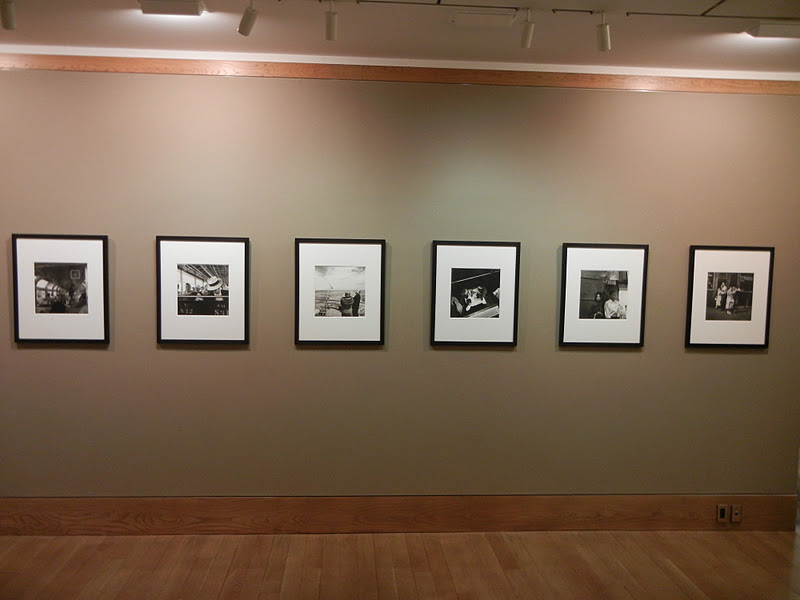
JTF (just the facts): A total of 25 color works (22 single images and 3 diptychs), framed in white and unmatted, and hung in the main gallery space. All of the works are c-prints taken in 2011. The prints come in three sizes: 14x17, 20x24, and 30x40 (or reverse), all in editions of 10. The diptychs are made up of 11x14 or 20x24 photographs. There are 7 small images, 11 medium sized images, and 4 large images in the show, plus the 3 diptychs. A monograph of this body of work was published in 2011 by Little Big Man (here) and is available from the gallery for $75. (Installation shots at right.)

Comments/Context: The history of photography is filled with photographers and their muses: Stieglitz, Strand, Callahan, Gowin, the list goes on and on. Motoyuki Daifu follows in these weighty footsteps, making affectionate pictures of a young single mother during her pregnancy and the subsequent birth of her second child. He is undeniably smitten with his subject, and his playful images feel like snapshots from an intimate family album. While the infatuation only lasted six months, the warm energy of his crush lives on in the pictures.

These are casual images, unconstrained by typical Japanese formality and societal control. The young mother shows off her pregnant belly flanked by a pile of garbage bags, hangs up laundry and Hello Kitty baby blankets in the cramped bedroom, cooks a meal wearing only a towel (exposing her bare bottom), and takes a bath with her son in the tub. Half eaten toast, cigarette ashes in a plastic Winnie the Pooh bowl, leftover breakfast dishes, and a tornado of discarded toys decorate her small chaotic apartment. His images of her wander between the trials of motherhood (breastfeeding, exhaustion, crying children) and the reality of her attractiveness (clutching a microphone on the floor of a karaoke room or splayed suggestively on a mattress). Whatever she does, he finds it cute and endearing.

Even though many of these photographs seem quick and ephemeral, quite a few capture a surprising depth of emotion. He is enamored, charmed, and thoroughly fascinated by this woman, and his fondness has the ring of authenticity. We're voyeurs taking in the action second hand, but Daifu's charged atmosphere is a vivid reminder of the spellbound state of young love.
.
Collector's POV: The photographs in this show are priced as follows. The unframed single images are priced based on size: the 14x17 prints are $1000, the 20x24 prints are $1600, and the 30x40 prints are $3000. The unframed prices of the diptychs are also based on component size: the works made up of 11x14 prints are $1800 and those made up of 20x24 prints are $3200. Daifu's photographs have not yet entered the secondary markets, so gallery retail is likely the only option for interested collectors at this point.

Rating: * (one star) GOOD (rating system described here)
.
Transit Hub:
Motoyuki Daifu, Lovesody
Through March 3rd

Lombard-Freid Projects
518 West 19th Street
New York, NY 10001

Tuesday, February 7, 2012

High Line Billboard: Anne Collier


JTF (just the facts): A single billboard, 25x75 feet, displayed at the corner of 18th Street and 10th Avenue in Chelsea. The work is entitled Developing Tray #2 and is print on vinyl, from 2009.
.
Comments/Context: The High Line Billboard series is turning out to be much more intriguing than I might have thought at the outset. The parameters of the billboard make for unexpected experimentation with monumental scale, and its location allows for contextual relationships that are wholly different from a gallery setting.

In this second iteration of the series, one of Anne Collier's recent developing tray images is blown up and left drifting in an expanse of wide, thick blackness. On the white walls of a gallery and at normal scale, this image (it's the artist's eye) would be much more intimate and personal, and the whole process centric theme of the emerging image floating in the tray would be more at the forefront of engaging with the work. But on this massive scale, and in the context of the bustling city around it, the work is transformed into a penetrating, disconcerting, Orwellian gaze. It's as though she's peering through the knothole of the tray out into our diorama world.
.
Collector's POV: This commissioned work was not overtly for sale, nor are there many comparables in terms of scale in recent auction history. Collier is represented in New York by Anton Kern Gallery (here).
.
Rating: * (one star) GOOD (rating system described here)
.
Transit Hub:
  • Review: Societe Perrier (here)
Anne Collier
Through February 29th

High Line
Billboard at 18th Street and 10th Avenue

Monday, February 6, 2012

Gregory Halpern, A @Clamp Art

JTF (just the facts): A total of 24 color photographs, framed in white and unmatted, and hung in single room gallery space. The chromogenic prints come in two sizes: 10x8 (editions of 7) and 18x14 (editions of 5), with a few images also available in a 40x30 size (editions of 3). There are 8 images in the small size, 14 in the medium size, and 2 in the large size on display in the exhibit. The works were made between 2005 and 2011. A monograph of this body of work was published in 2011 by J&L Books (here). (Installation shots at right.).
.
Comments/Context: In Gregory Halpern's photographic portrait of Rust Belt America, a sparkling piece of jewelry offered by a black gloved hand seems like an impossible treasure, a talisman of uncanny brilliance somehow blindingly inappropriate or just completely out of context in this dingy, downtrodden world. It refers to a better time, a time of luxury and wealth and optimism, but in these pictures, that time is long gone.
.
What Halpern has documented in these cities (Baltimore, Cincinnati, Omaha, and Detroit) is the beginning of the end, where wildness is creeping back into the realms of civilization. Faces are quietly defiant or meekly averted, wearing a mix of haggard, bloodied, and exhausted glances. Houses smoulder with lingering fire, or crumble from decay and rot regardless of makeshift supports. Trees take on an almost sinister quality, triumphing over human pruning to win in the end. And feral cats and aggressive raccoons prowl the streets with an unabashed lack of fear; a peacock runs loose and blackbirds smother a tree in the eerie twilight. In these pictures, Halpern takes the broad economic challenges of these regions and turns them into smaller life and death struggles, a resilient battle between relentlessly persevering and giving in to the invading desolation. The inhabitants are reduced to scavengers, scratching out an existence against the raw tide of ruin.
.
Halpern's photographs have a harsh lyricism that may make them hard for some collectors to warm up to. But they are soberly successful (especially in book form) in capturing the sense of helpless, slowly encroaching chaos that has overtaken some of our once great cities. In these worlds, when seen from the perspective of a lowly mouse, even a hissing kitty can seem ferociously predatory.
Collector's POV: The works in this show are priced as follows: the 10x8 prints are $1200, the 18x14 prints are $2000, and the 40x30 prints are $3500. Halpern's work has little or no secondary market history, so gallery retail is likely the only option for interested collectors at this point.
.
Rating: * (one star) GOOD (rating system described here)
.
Transit Hub:
  • Artist site (here)
  • Review: New Yorker (here)
  • Book Reviews: Photo-Eye (here), LPV (here)
Gregory Halpern, A
Through February 11th
.
521-531 West 25th Street
Ground Floor
New York, NY 10001

Friday, February 3, 2012

The Loving Story, Photographs by Grey Villet @ICP

JTF (just the facts): A total of 20 black and white photographs, framed in black and matted, and hung against light blue walls in a single room gallery space on the lower level of the museum. All of the works are vintage gelatin silver prints from 1965. No dimension or edition information was provided for any of the works on view. A glass case in the center of the room contains a copy of the LIFE magazine article The Crime of Being Married, which includes several of the photographs and ran in 1966. A single video screen runs a small tape loop giving news background on the story. The curator of this exhibit was Erin Barnett. Since photography is unfortunately not allowed in the ICP galleries, the images for this show come via the ICP website. (Photographs by Grey Villet, top to bottom, at right.)

Comments/Context: Grey Villet's photographs of Richard and Mildred Loving are a sensitive and surprisingly powerful example of the classic photo essay. Using a handful of interconnected photographs to tell the human back story of their unassuming but controversial interracial marriage, Villet documents the quietly personal aspects of the miscegenation laws of 1960s Virginia and of the Loving's history making Supreme Court battle. This isn't a story about shouting and marching, but about unlikely heroes going about their lives, defying the authorities and the prevailing attitudes of the day in the name of love and family.

Villet's photographs center on the intimacy and tenderness expressed between the couple, and while we have seen these kinds of softly romantic images before, these pictures have an undercurrent of intensity; the Loving's role in the civil rights struggle makes their ordinariness seem extraordinary. Hands touch, arms drape casually over shoulders, Richard lies in Mildred's lap on the couch, and knowing looks and kisses are exchanged. Their lives seem utterly normal and natural: Mildred wears curlers, sweeps the living room, and bandages a child's arm, the kids play with dandelions and joyfully climb trees in the backyard, the couple socializes with friends at the local diner or the drag racing track. The only clues to their larger struggle are their often tired faces (brave and dedicated in a supremely understated way), the disapproving glances of Richard's mother, and the smug portrait of the judge in his library.

This is a small exhibit, but I think it provides clear proof of the lasting value of the photo essay as a journalistic form. Photographs are used to illustrate a story ripped from the headlines, and in doing so, give it a much richer and more nuanced reading than could ever have been accomplished with text alone. No amount of saying so can replace the sight of this couple acting like all couples do. Given the context of the times, their behavior was inconceivable to many, and yet, when really observed, it was seen to be genuinely loving. It's a story that needed to be told with photographs, and Villet did an admirable job of avoiding a harsher and more obvious political angle and instead let the everyday actions of the people speak for themselves.
.
Collector's POV: Since this is a museum show, there are, of course, no posted prices. Villet's photographs have little or no consistent secondary market history, so gallery retail is likely the only option for interested collectors at this point. Many of Villet's prints are available from the Monroe Gallery in Santa Fe (here).
.
Rating: * (one star) GOOD (rating system described here)

Transit Hub:
  • Estate site (here)
  • The Loving Story film site (here)
  • Features/Reviews: NY Times (here), Lens (here), La Lettre de la Photographie (here)
The Loving Story, Photographs by Grey Villet
Through May 6th

1133 Avenue of the Americas
New York, NY 10036

Thursday, February 2, 2012

The Checklist: 2/2/12

Checklist 2/2/12
Current New York Photography Shows

New reviews added this week in red.
(Rating: Artist/Title: Venue: Closing Date: link to review)

Uptown

ONE STAR: Cecil Beaton: Museum of the City of New York: February 20: review
ONE STAR: Photographic Treasures from the Collection of Alfred Stieglitz: Met: February 26: review
THREE STARS: The Radical Camera: New York's Photo League: Jewish Museum: March 25: review

Midtown

ONE STAR: Massimo Vitali: Bonni Benrubi: February 4: review
ONE STAR: Robert Bourdeau: Edwynn Houk: February 18: review
TWO STARS: Reinstalled Permanent Collection: MoMA: March 28: review
TWO STARS: Magnum Contact Sheets: ICP: May 6: review
ONE STAR: Perspectives 2012: ICP: May 6: review
THREE STARS: Weegee: ICP: September 2: review

Chelsea

ONE STAR: Pierre Gonnord: Hasted Kraeutler: February 4: review
TWO STARS: Joel Sternfeld: Luhring Augustine: Februay 4: review
ONE STAR: The Wedding: Andrea Rosen: February 4: review
ONE STAR: Jitka Hanzlová: Yancey Richardson: February 11: review
TWO STARS: Shirin Neshat: Gladstone: February 11: review
ONE STAR: Bertien van Manen: Yancey Richardson: February 11: review
TWO STARS: August Sander/Seydou Keita: Walther Collection: March 10: review

SoHo/Lower East Side/Downtown

No reviews at this time.

Elsewhere Nearby

ONE STAR: Patti Smith: Wadsworth Atheneum: February 19: review
ONE STAR: Claire Beckett: Wadsworth Atheneum: March 4: review

Wednesday, February 1, 2012

Weegee: Murder Is My Business @ICP

JTF (just the facts): A total of 116 photographs by Weegee (along with 6 additional photographs by other photographers and a handful of wall sized enlargements), framed in black and matted, and hung against light brown walls in a series of 4 connecting rooms on the lower level of the museum. All of the Weegee works on view are gelatin silver prints, taken between 1935-1946. No dimension or edition information was provided for any of the prints. The exhibit was curated by Brian Wallis. Since photography is unfortunately not allowed in the ICP galleries, the images for this show come via the ICP website. (Photographs by Weegee, top to bottom at right.)
.
The exhibit is divided into four sections. The details of each section are as follows:

Photo Detective: Weegee and the Art of Self Invention
15 photographs
1 glass case (camera/bulbs, press card, hat, 2 magazine spreads)
Bedroom recreation
1 interactive screen

Read All About It! Weegee and the Tabloid Press
43 photographs
1 glass case (5 images in newspapers, 3 in magazine spreads)
1 case (crime scene log book)
1 interactive screen

Documentary Truth: Weegee and the Photo League
21 photographs
6 photographs by other photographers (1936-1948, Aaron Siskind, Vivian Cherry, Sandra Weiner, Helen Levitt, Lee Sievan, Arnold Eagle)
1 glass case (exhibition comment book)
Photo League exhibit recreation
1 interactive screen

Naked City: Weegee and Urban Disorder
37 photographs
1 video (Weegee's New York: New York Fantasy, 1948)
1 glass case (13 spreads from PM, 1940-1944)
1 glass case (6 copies of Naked City open to spreads matching prints above)
1 video (Coney Island, 1948)
1 interactive screen

Comments/Context: As you come down the stairs toward the first gallery of the new Weegee show at the ICP, you are greeted by a massive papier-mache revolver (recreating one his famous self portraits looming down over a gun shop) and foot high letters shouting the show's lurid title Murder Is My Business. These details announce that this exhibit is going to be full of high drama production values mixed with a film noir sense of hard-boiled roughness, and it certainly does deliver on that score. But as I circled the rooms of this excellent exhibit, I started to read the title with a slightly different cadence and emphasis. Say those same words in a deadpan monotone, as a statement of fact (like I Am An Accountant), with a sense that Weegee took his subject matter (murder) seriously and practiced his craft with relentlessness and care, and suddenly some of the over-the-top huckster bravado falls away, leaving behind a photographer who was undeniably very, very good at his chosen vocation.

While the meticulous recreation of Weegee's bedroom (police scanner on the bedside table etc.) and his exhibits at the Photo League (complete with red nail polish applied to the photographs to enhance their bloodiness) are visually exciting and break up the normal monotony of a normal photography exhibit, the real core of this exhibit comes in the second room, where Weegee's early flash-lit images for the tabloid press are shown with scholarly clarity. Instead of a parade of individual greatest hits, a smaller number of rightly famous images are selected and then surrounded by Weegee's other photographs of that same scene, often creating a cluster of 3 or 4 pictures of the same accident or perp walk. These groups prove that Weegee wasn't a fly-by paparazzi, snapping haphazardly. While any particular incident might be anchored by a bloody corpse or sheet covered body, Weegee took the time to orient his compositions looking for contextual stories. His pictures are never just the gangster or the criminal; they are always broader, rounder compositions including bystanders, gawkers, police officers, anguished relatives, other photographers, and other random passersby and local architecture, sometimes in multiple overlapping layers of foreground and background. He had an eye for witty irony, and black humor, and gritty, unexpected truth, and his pictures are almost always the story of a reaction, a gesture, a juxtaposition, or a movement that accompanies the central action. A movie marquee, an overturned white hat, a thick rooftop edge, onlookers craning out of upstairs windows, the bold sign for a bar and grill, they all provide context for the dingy repeated drama of death and disfigurement. It is clear from this series of pictures that Weegee understood that it wasn't enough to simply document the facts, but that every picture needed a visual hook to get run, and his approach to any given event was to search for that hook.

The other rooms in the exhibit surround this central "murder" core, providing evidence of Weegee's tireless self-promotion and of his work to expand his photographic subject matter to include many more facets of New York life. The first room is all self-portraits (with a bomb, with a pile of loot, out of a paddy wagon) and we get a refrain of self-portraits later in the exhibit (with his typewriter in the back of a car), as if we hadn't had enough of Weegee's fascination with his own persona. After the seemingly endless parade of corpses (and there is a particularly good one of a sheet covered body still holding a shorn off steering wheel), we see Weegee turn his camera to ice covered firemen, a trampling incident, tenement living, top hats covering faces, cars submerged in the river, Bowery entertainers, and even Santa being inflated for the Macy's parade and the endless crowds of the Coney Island beaches in summertime. In just a few short years, he went from the murder beat to covering the entire city, and his back to back shows at the Photo League were further proof that he was beginning to be recognized by his peers in the fine art world as something much more than a cigar chomping, nocturnal parasite.

My walk-away conclusion from this show is that Weegee really does get better and better the more you look at his work. This show brims with electric violence and nervous anxiety, and does an exemplary job of making a museum show interactive and fun, but what really got my attention (and what will stay with me long into the future) was the consistent cleverness of Weegee's compositional vision.

Collector's POV: This is a museum show, so of course, there are no posted prices. Since Weegee was so prolific, dozens of his photographs are routinely available at auction in any given year. Recent secondary market prices have ranged between roughly $1000 and $48000, with the vast majority available for under $5000.
.
Rating: *** (three stars) EXCELLENT (rating system described here)

Transit Hub:
  • Features/Reviews: NY Times (here), Lens (here), Hyperallergic (here), ARTINFO (here), Artdaily (here), Photo Booth (here), Capital New York (here), NPR Picture Show (here)
Weegee: Murder Is My Business
Through September 2nd

1133 Avenue of the Americas
New York, NY 10036

Tuesday, January 31, 2012

Perspectives 2012 @ICP

JTF (just the facts): A group show consisting of the work of 3 photographers, variously framed and matted, and hung against white walls in a series of three connected rooms on the entire upper level of the museum. Starting at the entry to the exhibit, there are a total of 13 photographs by Chien-Chi Chang from his series China Town. 6 are gelatin silver prints and the other 7 are chromogenic prints. They are all framed in silver with no mat and hung edge to edge as diptychs and triptychs based on the relationships of the families depicted. The works were taken between 1998 and 2008. In the side room, there are a total of 11 photographs by Greg Girard from his series Half the Surface of the World. All of the prints are chromogenic prints, framed in silver with no mat. The works were taken between 2008 and 2009. And in the main space, there are a total of 12 images by Anna Shteynshleyger from her series City of Destiny. All of the prints are archival inkjet prints, framed in brown wood with no mat. The works were taken between 2002 and 2011. No dimension or edition information was provided for any of the works on view. Since photography is unfortunately not allowed in the ICP galleries, the images for this show come via the ICP website. (Photographs by Chien-Chi Chang, Greg Girard, and Anna Shteynshleyger, top to bottom, respectively.)

Comments/Context: This year's version of the ICP's annual Perspectives show gathers together three bodies of recent work that revolve around the idea of transplanted communities and the process of creating a feeling of home in a new environment. It's a loose theme that allows for divergent photographic approaches and cultural contexts.

Chien-Chi Chang's contrasting images of fathers working in New York and families back in China are the most successful. The men are photographed in black and white, sitting in cramped dormitories after a day of hard work, drinking beer, eating noodles, and calling home. The women and children are photographed in color, wives caring for babies, girls watching TV and lounging around. The contrast of these two worlds documents the dislocations that are occurring, where distance impedes communication and sacrifices are being made on both sides in the hopes of something better for the family. I liked the down time simplicity of these pictures, where the quiet loneliness of the subjects comes through.

Greg Girard's photographs follow in a long line of military base photography, but center not so much on the juxtaposition of opposing cultures but on the attempt to create a slice of the United States in far away lands. At bases in Kora and Japan, he finds big box stores, sculpted suburbs with manicured lawns, regulation US Postal Service mail boxes, ATMs and Pepsi trucks. Kids play on residential sidewalks, and American style news comes from military TV anchors and the Stars and Stripes newspaper. His images have the atmosphere of a surreal stage set, where small details of the underlying local world poke through at odd moments.

Anna Shteynshleyger's images of her life in an Orthodox Jewish community in Des Plaines, Illinois, are the most understated and subtle, to the point of being less durably memorable. The photographs are opaque and closed, the meanings less identifiable: a bare lightbulb in a room, carnations on a windowsill, a bird's nest on the hood of a car, an uncle standing in the greenery, a still life of backyard leftovers and pink Crocs. From these images, I was less able to connect with the narrative being told, or to resonate with the particular nuances of this cultural world and its challenges. I needed a few more clues to understand why these moments mattered.

All three of these projects likely function best in book form, where an aggregation of images can tell a broader and more robust story. That said, Chang's photographs will resonate most with me going forward, as I think he was most able to document the complexities of the underlying emotional state of an uprooted, transplanted life.

Collector's POV: This is a museum show, so of course, there are no posted prices. In general, these three photographers have little or no consistent secondary market history; as such, gallery retail is likely the only option for interested collectors at this point. Chien-Chi Chang is part of Magnum; his vintage and modern prints are available directly from the Magnum Print Room (here) or via the Chi-Wen Gallery in Taipei (here). Greg Girard is represented by Monte Clark Gallery in Vancouver and Toronto (here). Anna Shteynshleyger is represented by Dvir Gallery in Tel Aviv (here).
.
Rating: * (one star) GOOD (rating system described here)
.
Transit Hub:
  • Chien-Chi Chang Magnum Photos page (here)
  • Greg Girard artist site (here)
  • Anna Shteynshleyger artist site (here)
Perspectives 2012
Through May 6th

1133 Avenue of the Americas
New York, NY 10036

Monday, January 30, 2012

Magnum Contact Sheets @ICP

JTF (just the facts): A group show consisting of the work of 22 photographers, framed in black or enlarged and pinned directly to the wall, and hung against dark grey walls in a single room on the lower level of the museum. Many of the vintage contact sheets are shown in a large glass case in the center of the room, and copies of the recent book are arrayed on a bench along one wall. The show was curated by Kristen Lubben. A monograph of the larger collection was published in 2011 by Thames & Hudson (here); a special version with a limited edition print is also available (here). Since photography is unfortunately not allowed in the ICP galleries, the images for this show come via the ICP website. (Contact sheets from Rene Burri, Jonas Bendicksen and Philippe Halsman, top to bottom, respectively.)

The following photographers are included in the show, with the date of images in the contact sheet(s) in parentheses. Each photographer is represented by one sheet (some vintage, some modern) unless otherwise noted:

Eve Arnold (1959)
Jonas Bendicksen (2000)
Rene Burri (1963, plus 2 smaller contact sheets)
Cornell Capa (1961)
Robert Capa (1944, plus 1 individual print)
Chien-Chi Chang (2008)
Elliott Erwitt (1953)
Martine Franck (1976)
Leonard Freed (1978)
Bruce Gilden (1984)
Burt Glinn (1957)
Jim Goldberg (1989)
Philippe Halsman (1948)
Thomas Hoepker (1966)
Josef Koudelka (1968)
Susan Meiselas (1975, plus 1 smaller contact sheet)
Inge Morath (1957)
Trent Parke (2000)
Martin Parr (1985)
Marc Riboud (1953)
George Rodger (1940)
Alex Webb (1978)

Comments/Context: Right up front, I should confess that I am a lover of contact sheets. Seeing an entire roll of film displayed frame by frame is for me the ultimate expression of the photographic process, and I never seem to tire of poring over misfires and accidents on the way to the triumphant finish. The unaltered contact sheet represents (in a convenient short hand) the way the photographer's brain works, how he or she solves visual problems, and how chance and experimentation play a part in the picture making.
.
At a detailed level, this show offers the ability to trail along behind the creation of some of photography's most iconic images: Robert Capa comes ashore at Normandy, Marc Riboud watches a painter high atop the Eiffel Tower, Rene Burri circles seemingly unnoticed around Che Guevara, and Josef Koudelka stands in the streets of revolutionary Prague. I was fascinated by the handful of images Martin Parr made of his famous New Brighton sunbather under the crusty treads of an excavator. He discovered the scene, moved around cautiously looking for the right compositional angle, and then was rewarded with the arrival of a small girl and the exact timing of a passerby in the background. It all happens in a handful of pictures, but it's a tight example of the calculating, iterative, construction of a terrific photograph.

For working photographers, this show should be on the required syllabus, since it proves that there is no one right way to work; below the specifics of the well-known images, the exhibit works on a more abstract level, exploring the nature of seeing, in-camera editing,and the passing of time. Some masters shoot only a frame or two when presented with a visual idea, and then move on rather quickly. Others snap frame after frame of variants on the same image, fine tuning angles and relationships until the magic happens. Still others set up a picture's underlying architecture and then wait for something unexpected to happen. I was just as interested in how these individual photographers worked, as in the eventual alchemy that produced a particular winner. I thoroughly enjoyed watching Susan Meiselas playing with adjacent/secondary cropped nude bodies in the contact sheet from her Carnival Strippers project, working to get just the right balance in the overall frame.

The accompanying catalogue is a wrist-breaking doorstop, but seems to offer hours of tracking and vicarious stalking of your most admired photographers. In our futuristic digital age, these contact sheets are now relics from a bygone era, but they still provide both an unmatched record of pathways of the artist's mind and a valuable teaching tool. In the end, it's just as interesting to see the ones that didn't work, on the way to finding the one that eventually did.
.
Collector's POV: Contact sheets like these are rarely if ever found in the secondary markets, since they tend to be archived with the artist's negatives and papers rather than released as finished works. As such, there is no straightforward way to determine a current market value for these kinds of prints, either vintage or modern. Perhaps the safest answer here is "priceless"?

Rating: ** (two stars) VERY GOOD (rating system described here)
.
Transit Hub:
  • Magnum Photos page (here)
  • Book Reviews: NY Times (here), Guardian (here)
Magnum Contact Sheets
Through May 6th

International Center of Photography
1133 Avenue of the Americas
New York, NY 10036

Friday, January 27, 2012

Claire Beckett, Simulating Iraq @Wadsworth Atheneum

JTF (just the facts): A total of 18 large scale color photographs, framed in white and unmatted, and hung in a single room gallery space on the first floor of the museum. All of the prints are archival inkjet prints, sized 40x30 or reverse. The images were taken in 2008 and 2009. (Installation shots at right.)

Comments/Context: Claire Beckett's recent photographs turn on the idea of upending our expectations. Taken at specialized military training sites around the US, her smart, sometimes dissonant images document artificial, stage set versions of Iraq and Afghanistan, staffed with "soldiers" and "civilians" and used for simulations and training exercises. Nearly every picture is an inversion or a breakdown of reality as we know it, each one undermining our ability to impose our now ingrained stereotypes.

Her images of these fabricated towns look plausibly real from far away, but up close, the makeshift mosques are made of rough plywood and the warrens of interlocking alleys and buildings are cinderblocks painted the color of sand. Simplistic forms and fake brickwork provide an illusory backdrop for small narratives and role playing exercises played out by the soldiers: Al-Qaeda terrorist cells making IEDs, Taliban fighters hoarding machine guns, nurses and injured marines, and unsuspecting locals and civilians drinking tea in the village square. Beckett's portraits of these "actors" have an even more surreal quality. Marines and locals from nearby American towns dress up in tunics, robes and headscarves and are given Iraqi or Afghani names and elaborate backstories, but their blue eyes, fair skin, and work boots provide incongruous cultural mixtures and contrasts. Fresh makeup and perfect nails adorn a young "Iraqi nurse" and fake carcasses hang from a "butcher shop". Everything is a visual approximation, a window-dressed stand-in for the real.
.
I like the fact that these pictures are free from a specific point of view; they aren't slanted or pushing a particular agenda. Their matter-of-fact conceptual oddity is part of what makes them so successful - they are open for any number of complex interpretations or conclusions. Beckett's photographs capture a different side of these conflicts than we have seen previously, broadening the ultimate story of our approach to these long running wars.

Collector's POV: Since this is a museum exhibition, there are, of course, no posted prices. Beckett's photography has no secondary market history, so gallery retail is likely the only viable option for interested collectors at this point. She is represented in Boston by Carroll and Sons (here).

Rating: * (one star) GOOD (rating system described here)

Transit Hub:
  • Artist site (here)
  • Interview: Big, Red & Shiny (here)
Claire Beckett, Simulating Iraq
Matrix 163
Through March 4th
.
Wadsworth Atheneum Museum of Art
600 Main Street
Hartford, CT 06103

Thursday, January 26, 2012

The Checklist: 01/26/12

Checklist 1/26/12

New reviews added this week in red.

Uptown

ONE STAR: Cecil Beaton: Museum of the City of New York: February 20: review
ONE STAR: Photographic Treasures from the Collection of Alfred Stieglitz: Met: February 26: review
THREE STARS: The Radical Camera: New York's Photo League: Jewish Museum: March 25: review

Midtown

TWO STARS: Vivian Maier: Howard Greenberg: January 28: review
ONE STAR: Massimo Vitali: Bonni Benrubi: February 4: review
ONE STAR: Robert Bourdeau: Edwynn Houk: February 18: review
TWO STARS: Reinstalled Permanent Collection: MoMA: March 28: review

Chelsea

ONE STAR: Pierre Gonnord: Hasted Kraeutler: February 4: review
TWO STARS: Joel Sternfeld: Luhring Augustine: Februay 4: review
ONE STAR: The Wedding: Andrea Rosen: February 4: review
ONE STAR: Jitka Hanzlová: Yancey Richardson: February 11: review
TWO STARS: Shirin Neshat: Gladstone: February 11: review
ONE STAR: Bertien van Manen: Yancey Richardson: February 11: review
TWO STARS: August Sander/Seydou Keita: Walther Collection: March 10: review

SoHo/Lower East Side/Downtown

ONE STAR: Mel Bochner: Peter Freeman: January 28: review

Elsewhere Nearby

TWO STARS: Walker Evans: Florence Griswold Museum: January 29: review
ONE STAR: Patti Smith: Wadsworth Atheneum: February 19: review

Wednesday, January 25, 2012

Robert Bourdeau @Houk

JTF (just the facts): A total of 24 black and white photographs, framed in black and matted, and hung in the main gallery space. All of the works are vintage (or printed with a year or two) gelatin silver prints, many toned with gold, alternately available in editions of 15 or 30. Physical dimensions range between 8x12 and 11x14 (or reverse). The images were originally taken between 1981 and 2005. (Installation shots at right.)

Comments/Context: Robert Bourdeau's recent photographs of decaying industrial architecture are in many ways a throwback to a time when superlative black and white craftsmanship was regarded as the pinnacle of photographic achievement. His images celebrate the tactile quality of surface texture with an almost fetish-like reverence, making stained steel and flaking concrete glow with burnished gold-toned glory.

Bourdeau's compositions crop out the sky, centering down on fragments of piping and industrial cement, where boilers, engines, furnaces, ladders, and railings criss-cross in layered abstract geometries. Residues drip down the sides of steel tubs, walls erode and crumble, swirls and imperfections decorating every inch of disused, dusty equipment. These are formal pictures, where shapes, angles and patterns have been arranged with care, their subtle tonalities enhanced by exacting printing. They have the echo of Bourdeau's friend and teacher, Minor White, the rotting hulks infused with an almost spiritual grace.

While we have all certainly seen these kinds of industrial subjects over and over again across the history of the medium, that doesn't take away from the fact that these are undeniably well made photographs. They're almost like old cabaret songs or jazz standards being sung once again; they're entirely familiar but still noteworthy when executed with such obvious technical expertise.

Collector's POV: The prints in this show are priced at $8500 each.
Bourdeau's work has not yet reached the secondary markets with any regularity, so gallery retail is likely the only option for interested collectors at this point.
.
Rating: * (one star) GOOD (rating system described here)
.
Transit Hub:
Robert Bourdeau
Through February 18th

Edwynn Houk Gallery
745 Fifth Avenue
New York, NY 10151

Tuesday, January 24, 2012

Shirin Neshat, The Book of Kings @Gladstone

JTF (just the facts): A total of 56 black and white photographs, framed in black and unmatted, and hung in the main gallery space, the reception hallway, and a smaller side room. The show also includes a new three-channel video installation entitled OverRuled, on view in a separate darkened room. 45 of the photographs come from the series Masses and are ink on LE gelatin silver prints, each sized 40x30, in editions of 5+2AP. 6 of the photographs come from the series Patriots and are also ink on LE gelatin silver prints, each sized, 60x45, also in editions of 5+2AP. And 3 of the photographs come from the series Villains and are also ink on LE gelatin silver prints, each sized 99x50, also in editions of 5+2AP. The other two works in the reception hallway are 47x60 and 62x49, with similar details in terms of process and edition size. All of the works were made in 2012. (Installation shots at right.)

Comments/Context: Shirin Neshat's newest photographs are a direct response to recent political events in the Middle East, encompassing both the Green Movement in Iran in 2009 and the broader protests and revolutions of the Arab Spring. Her images take her back to her mid 1990s aesthetic style (spare black and white portraits with faces covered in painstakingly detailed calligraphy) and apply this haunting look to contrasting groups of participants (Masses, Patriots and Villains) in the struggle for power and freedom.

The Masses portraits are hung in a overpowering 3x15 grid that covers an entire wall with serious, staring head shots. Her subjects run the gamut from the older generation to younger people, and each everyday face provides tiny nuances of group emotion: anxiety, uncertainty, resignation, hope, aspiration. The Patriots images step back to show torso level portraits, with the universally young subjects placing their right hands over their hearts. These activist faces have even more intense expressions: defiance, fervor, pride, devotion, even potentially hatred(the image of Nida is particularly striking, second from the right, at right). The calligraphic text written on their skin is larger and bolder than on the people from Masses, as if shouting rather than whispering, even though the poses are equally sober and quiet. The Villains are full length portraits of older men, where the calligraphic text has been replaced with elaborate illustrations across their bare chests like tattoos. These drawings of ancient war (complete with spurting decapitations in blood red) reinforce the feeling of implicit violence (religious or political) that hangs in the air. Taken together, these three sets of participants are made into metaphors, or symbols of simplified emotions.

I have to admit that I think it is hard to completely understand these works given my inability to read the text superimposed on the bodies and faces. For Western audiences, the calligraphy is transformed from a storytelling layer into a purely decorative motif, and I'm guessing that I'm missing quite a bit of the desired effect. Imagine trying to understand Barbara Kruger's work if you couldn't read the text; sure, there is a graphic quality we as viewers can all connect to, but the irony and juxtaposition of the images and text would be completely lost. I have the same sense of being in the dark with these images. What is being said by the text blaring from the foreheads of the Patriots? And how might it change my experience of their ultra serious faces?

With this caveat of likely misunderstanding, I do think that many of these portraits are quite beautiful, even if they are sometimes harsh and heavy handed. The whole body of work is a personal reminder of the powerful emotions that surround the abstraction of political revolution, where individuals (not types) take part in the action on the front lines.

Collector's POV: The prints in this show are priced as follows. The works from Masses are $35000 each, Patriots are $65000 each, and Villains are $85000 each. The other two photographs are $65000 and $75000 respectively. Neshat's images are regularly available in the secondary markets, particularly I Am Its Secret, which was printed in an edition of 250. Recent prices at auction have ranged from roughly $3000 to $70000.

Rating: ** (two stars) VERY GOOD (rating system described here)

Transit Hub:
  • Interview: Modern Art Notes podcast (here)
  • Review: Huffington Post (here)
Shirin Neshat, The Book of Kings
Through February 11th

Gladstone Gallery
515 West 24th Street
New York, NY 10011

Monday, January 23, 2012

Vivian Maier: Photographs from the Maloof Collection @Greenberg

JTF (just the facts): A total of 56 black and white photographs, framed in black and matted, and hung in the main gallery space and the book alcove. 31 of the prints (shown in the main space) are posthumous/modern gelatin silver prints, each sized 12x12, in editions of 15. The other 25 prints (shown in the book alcove) are lifetime gelatin silver prints, ranging in size from 4x3 to 11x14. All of the images were taken in the 1950s and 1960s. A monograph of this body of work was published by powerHouse Books in 2011 (here). (Installation shots at right.)
.
Comments/Context: Whatever we might think about the rediscovery of the 1950s street photographs of Vivian Maier, it's impossible to conclude that the press coverage has been anything but breathless and ubiquitous; if you have even the slightest interest in photography, you can't have missed this story in the past year or two. Since every feature article follows the same exact path (the nanny, the storage locker, the 100,000 negatives, the auction, etc.), I'm going to assume this thin background is by now pretty well common knowledge.
 
Photography is likely the only mainstream artistic medium where we continue to unearth potentially major talents who have been heretofore completely overlooked or lost, so Maier's emergence is by no means an isolated case. In recent years, similar stories have played out with the work of Charles Jones and Mike Disfarmer to name just two of many. I think the hard thing about such rediscoveries is that it is very difficult to place these photographers back into their original historical context, since no one of that era saw the work or was influenced by it, nor do we have any concrete information about what shows the artist saw, what people he/she met or admired, or what books were on his/her shelves; the whole artistic narrative is disconnected. Until this data is uncovered by diligent scholarship and historical study (if ever), all we can really do is look at the pictures and try to draw our own narrowly drawn hypothetical conclusions about what might have been.
 
The other challenge with such a project, especially when the work is found as an undifferentiated whole, is that we really have no sense of Maier as an editor of her own art. We don't know which pictures she thought were her best, which ones she thought were failures, and which ones she thought were interesting but not necessarily representative of what she was trying to accomplish. In this small show, there are photographs reminiscent of Friedlander, Frank, Model, Callahan, Winogrand, Levinstein, Weegee, and even Arbus. Seeing such a gathering, one might plausibly conclude that she was a photographer still searching for her own style, perhaps trying on other ways of working in the process of looking for her own, borrwing here and there and incorporating pieces she found useful. Absent verifiable connections or a complete chronology, it's impossible to say which came first, or which echo was purposeful, random, or otherwise uniquely original.
 
So it is fair to say that I came to this show with a fair amount of inherent skepticism, especially given the hype. What is evident however is that Vivian Maier was undeniably talented. Her street photographs have a sense of formal control that is too consistent to be a coincidence; there is very little motion or chance in these pictures. She had an eye for small urban gestures: the turn of head on the street, the resting of a sleeping head on the bus, the clasp of hands across a lunch table, or the matching hats and newspapers on the train. She also had a fondness for the eccentric details in people: a crop of bushy white hair under a hat, the scowling veiled faces of society women in furs, the elastic bands exploding out of a conductor's back pockets, the watch chain of a suited man sleeping in a car, or the blurry glamour of a puffy white dress in the night. There is a strong undercurrent of crisp storytelling here, even with her self-portraits, which capture her modest figure with deadpan rigor, often reflected in shop windows or store mirrors.
.
This show felt to me like a broad introductory edit, a little of everything, and I look forward to tighter slices of her work as the overall view of her photography becomes clearer. It's too early to say definitively where Maier fits or to understand how reinserting her into the march of 1950s photography might alter the agreed-upon progression, but it's safe to declare that her photographs are truly exciting and well-crafted. Much more work is clearly needed to process her voluminous output and synthesize it down into those images that represent a unique, innovative contribution to the history of the medium. That work is ongoing, so I expect this will be just the first of many Vivian Maier shows to come, bit by bit (re)defining her legacy.
.
Collector's POV: The prints in this show are priced as follows. The posthumous prints start at $1800 and rise up through $2600 and $3500 to $5000. The lifetime prints range from $4750 to $8250, with a few NFS or already sold. Maier's work has not yet reached the secondary markets, so gallery retail is likely the only option for interested collectors at this point.
 
Rating: ** (two stars) VERY GOOD (rating system described here)
.
Transit Hub:
  • Artist site/Maloof (here)
  • Artist site/Goldstein (here)
  • Reviews/Features: NY Times (here), Lens (here), New Yorker (here)
Through January 28th

Howard Greenberg Gallery
41 East 57th Street
New York, NY 10022

Friday, January 20, 2012

Jitka Hanzlová, HERE @Richardson

JTF (just the facts): A total of 10 color photographs, framed in blonde wood and matted, and hung in the back project space. All of the prints are chromogenic prints, each sized 12x8, in editions of 8. The images were taken between 1998 and 2010. (Installation shots at right.)

Comments/Context: This small show of the work of Czech photographer Jitka Hanzlová is a sampler from a decade long project to document her transplanted existence in the Ruhr region of Germany. Her vertical fragments of landscapes and three quarter environmental portraits are infused with the acute curiosity and questioning eyes of an outsider. What locals would walk by without another glance, Hanzlová investigates with crisp, almost antiseptic, precision.

Most of the images on view mix industrial infrastructure with the rural countryside: a cow meandering under an imposing concrete overpass, a man-made hillside reflected in a yellow reservoir, towering electric stanchions above a grassy soccer field, and a snow covered coal mining depression that looks like a miniature striated amphitheater. These landscapes are formal and quiet, sparse but rigid in their own way. I most enjoyed the two portraits in the show, which have a timeless quality to them. The young women pose in front of monochrome walls and yellow leaves with a kind of fresh grace and alert simplicity that is found in paintings from another age.

The whole installation left me with a lingering sense of unease. Hanzlová's photographs have a real feeling of puzzled foreignness, of noticing the subtleties of the everyday with a heightened awareness for difference.
.
Collector's POV: The prints in this show are priced at 4300€ each. Hanzlová's work has become somewhat more available in the secondary markets in recent years, particularly in the European auctions; prices have generally ranged between $1000 and $3000.
.
Rating: * (one star) GOOD (rating system described here)
.
Transit Hub:
  • BMW Paris Photo Prize, 2007 (here)
  • Feature: Frieze, 2003 (here)
Jitka Hanzlová, HERE
Through February 11th

535 West 22nd Street
New York, NY 10011

Thursday, January 19, 2012

The Checklist: 01/19/12

Checklist 1/19/12

New reviews added this week in red.

Uptown

ONE STAR: Cecil Beaton: Museum of the City of New York: February 20: review
ONE STAR: Photographic Treasures from the Collection of Alfred Stieglitz: Met: February 26: review
THREE STARS: The Radical Camera: New York's Photo League: Jewish Museum: March 25: review

Midtown

ONE STAR: Jeff Wall: Marian Goodman: January 21: review
ONE STAR: Massimo Vitali: Bonni Benrubi: February 4: review
TWO STARS: Reinstalled Permanent Collection: MoMA: March 28: review

Chelsea

ONE STAR: Alex Webb: Aperture: January 19: review
ONE STAR: Pierre Gonnord: Hasted Kraeutler: February 4: review
TWO STARS: Joel Sternfeld: Luhring Augustine: Februay 4: review
ONE STAR: The Wedding: Andrea Rosen: February 4: review
ONE STAR: Bertien van Manen: Yancey Richardson: February 11: review
TWO STARS: August Sander/Seydou Keita: Walther Collection: March 10: review
.
SoHo/Lower East Side/Downtown

ONE STAR: Mel Bochner: Peter Freeman: January 28: review

Elsewhere Nearby

TWO STARS: Walker Evans: Florence Griswold Museum: January 29: review
ONE STAR: Patti Smith: Wadsworth Atheneum: February 19: review

Patti Smith: Camera Solo @Wadsworth Atheneum

JTF (just the facts): A total of 70 black and white photographs, generally framed in black and matted, and hung in a series of four connected gallery spaces. All of the prints are gelatin silver prints taken with a Land 250 Polaroid camera, available in editions of 10; dimensions were not available. The images were taken between 1995 and 2011. The exhibit also includes 1 sculpture, 1 video (in a separate darkened room), and 4 glass cases containing poems, drawings, books, letters, Robert Mapplethorpe's slippers and marble cross, a prayer cloth, a stone, contact sheets, a camera, a portrait of Baudelaire, Pope Benedict's slippers, and her father's china teacup. A monograph of this body of work was published by Yale University Press in 2011 (here). (Installation shots at right.)

Comments/Context: Patti Smith's photography is full of ghosts. Not the scary spectral beings or spooky monsters of a horror movie, but the gentle, ephemeral imprints of lives now gone that have remained deeply resonant for her in one way or another. Her pictures are brimming with objects infused with personal significance, together a kind of artistic diary or the map of a life long journey, where ideas and influences pile up like loose memories and everyday objects become a source of spiritual inspiration.

The vast majority of the photographs on display are deceptively simple, sometimes dull, black and white still lifes or interior scenes, often taken in the available light and left grainy and shadowy, full of subtle beauty and immediacy. The show reads like a parade of heroes or a puzzle of aesthetic (I hesitate to use the word "poetic") connections: Rimbaud's fork and spoon, Keats' bed, Woolf's cane, Nureyev's slippers, Tolstoy's stuffed bear, Hesse's typewriter, Bolaño's chair. As if communing with the dead, she earnestly searches out countless graves and tombstones: Sontag, Whitman, Blake, Baudelaire, Shelley, Modigliani, Brancusi. Other pictures document her children, her guitars and workspace, religious icons and cherubs, landmarks from Paris and Vienna, with treasured items from her life with Robert Mapplethorpe never far from view. Every item is symbolic, every seemingly insignificant thing a talisman or relic.

In the hands of one less talented, these same pictures might have been cloying, pretentious and suffocatingly arty; instead, Smith's images are modest, sincere, and surprisingly lyrical. She seems altogether unaware of the danger of cliche, walking right up to the line and somehow coming away with pictures that are altogether genuine. There is a sense of deep respect and honor in these photographs, of mundane personal effects made special, and of an intense, meaningful pilgrimage made to linger in their presence and to be moved by their strength.

This is one of the more inward looking shows I have seen in quite a long time, and there were moments where I felt a little claustrophobic being allowed in so close. Together, these images are the visual journal of a solitary artistic life, each item a tiny fragment of her searching persona. I can almost image the collectors of this work placing the same kind of obsessive energy into these prints, capturing a piece of the essence of Patti Smith in the pictures, to be placed on a shelf like a beloved shrine.

Collector's POV: Since this is a museum exhibition, there are, of course, no posted prices. Smith's photography has virtually no secondary market history, so gallery retail is likely the only viable option for interested collectors at this point. She is represented in New York by Robert Miller Gallery (here).

Rating: * (one star) GOOD (rating system described here)

Transit Hub:
  • Reviews/Features: Guardian (here), BOMBLOG (here), Neon Tommy (here), Style.com (here), Hartford Courant (here)
  • Interviews: Vogue (here), ARTINFO (here)
  • DLK COLLECTION review of Just Kids (here)
Patti Smith: Camera Solo
Through February 19th

Wadsworth Atheneum Museum of Art
600 Main Street
Hartford, CT 06103