In the annual battle for venue dominance in the New York photography world, there were two clear winners: the International Center of Photography and eclectic, evolving diversity. While the ICP re-cemented its position of strength with a consistently engaging year of photography programming, perhaps the more exciting development of 2012 was the emergence of the Lower East Side as viable, energetic cluster for photography viewing.
As a reminder, these statistics are built using simple arithmetic, adding up the total number of rating stars I awarded to shows at a particular venue throughout the course of the year. This approach rewards both quality (in the form of 3 STAR shows) and consistent quantity (a solid program of 1 STAR shows month after month) in relatively equal measure. The one kink in the hose comes from venues (both galleries and museums) that support multiple viewing spaces that are filled simultaneously; this scale gives these "bigger" venues an advantage in terms of having more opportunities to show us something brilliant. Caveats aside, I do think the numbers provide a pretty accurate reflection of the past year's best places to enjoy superlative photography.
I reviewed a total of 159 photography shows at 93 different venues in and and around New York in 2012, awarding a total of 204 stars to these exhibits large and small. The International Center of Photography took home 12 stars, besting its rivals by a meaningful margin. It was the only place in the city to deliver two 3 STAR shows (Weegee and Apartheid) and 7 different exhibits at the museum received at least a 1 STAR rating. As a benchmark for the ICP's overall quality this year, last year's winner, Pace/MacGill Gallery, won with a tally of 8 stars. And the ICP's well earned triumph comes against much stiffer competition this year - MoMA, Howard Greenberg Gallery, Yancey Richardson Gallery, and Janet Borden all posted a total of 8 stars or more.
While the data compiled below doesn't include any Lower East Side galleries (none brought in at least 2 stars in aggregate), the emergence of the neighborhood as a location worth visiting for photography was undeniable. Two or three years ago, I reluctantly trekked down to the LES once or twice a year and often came away underwhelmed; at this point, the LES is fixed into my itinerary every two weeks or so. I reviewed worthwhile 1 STAR photography shows at no less than 12 different LES venues in the past year and my crazy tracking spreadsheet has 60+ LES venues that I'm watching for signs of intermittent photographic life. With the recent moves of Sasha Wolf Gallery and Foley Gallery to the neighborhood and the continued conversion of storefronts into risk-taking young galleries, I expect things will continue to heat up. As Chelsea becomes more brittle and corporate, the LES is picking up the mantle as the place for the fresh and unexpected. Virtually all the new (or new to me) spaces I visited for the first time in 2012 were located in and around the LES.
The complete 2012 venue data set is below, with gallery name, followed by total number of review stars earned over the course of the year (including only those 40 venues with a sum total of 2 stars or more):
Specialist Photography Galleries
Howard Greenberg Gallery (here): 9
Yancey Richardson Gallery (here): 9
Janet Borden (here): 8
Yossi Milo Gallery (here): 7
Aperture Gallery (here): 5
Higher Pictures (here): 4
Edwynn Houk Gallery (here): 4
Pace/MacGill Gallery (here): 4
Bonni Benrubi Gallery (here): 3
Steven Kasher Gallery (here): 3
Bruce Silverstein Gallery (here): 3
Danziger Gallery (here): 2
Robert Mann Gallery (here): 2
Walther Collection (here): 2
Contemporary Art Galleries
Pace Gallery (here): 6
Gagosian Gallery (here): 4
Marian Goodman Gallery (here): 4
Sonnabend Gallery (here): 4
Lehmann Maupin (here): 3
Team Gallery (here): 3
Flowers Gallery (here): 2
Gladstone Gallery (here): 2
Sean Kelly Gallery (here): 2
Luhring Augustine (here): 2
Matthew Marks Gallery (here): 2
Metro Pictures (here): 2
Mitchell-Innes & Nash (here): 2
Von Lintel Gallery (here): 2
Winkleman Gallery (here): 2
David Zwirner (here): 2
Museums
International Center of Photography (here): 12
Museum of Modern Art (here): 9
Solomon R. Guggenheim Museum (here): 5
Metropolitan Museum of Art (here): 5
Yale University Art Gallery (here): 3
Aldrich Contemporary Art Museum (here): 2
High Line (here): 2
Katonah Museum of Art (here): 2
Neue Galerie (here): 2
Wadsworth Athaneum (here): 2
Tuesday, January 8, 2013

Monday, January 7, 2013
Top Photography Shows of 2012
Art criticism comes in many forms and guises: academic, obtuse, snarky, long winded, analytical, fawning, nitpicky, snappy, even soaring once in a while. But regardless of its style and trappings, at its root, art criticism is pure unadulterated reaction, a conscious process of looking, seeing, thinking and finally ordering and recording. It is a public dialogue between artist and viewer, a matching of influence and response, an attempt to connect and communicate.
I've often thought about what my personal criteria for a great photography show might be, and whether there is some kind of framework or system that can be created to handle the nearly infinite diversity of artistic expression found in the medium. Over the years, I've come to see that such questions are exercises in structured self delusion; as much as I might like to classify and organize, there isn't any right answer to be found. Quality is ultimately in the eye of the beholder, and while training and experience certainly form a foundation for making informed judgments, in the end, a review is a reasoned opinion, nothing more, nothing less.
One thing I can testify to is that great photography shows have an undeniable feeling of transcendence. At least for me, I never wonder about whether a show should be rated 2 STARS or 3 STARS. It's never close, up for discussion or subject to persuasion or analysis; it's always patently obvious. Every time a show merits 3 STARS, I stand in the middle of the exhibit and I gaze in circles, warmed by the physical flush of endorphins running through my bloodstream - it's absolutely a feeling rather than any scholarly cerebral thought. And like a junkie chasing a high, I wander the galleries and museums of our city month after month looking for my next fix. In 2012, I visited 300+ photography shows (between 4 and 12 most weeks on average) and I found this tingling feeling a sum total of 8 times. A quick calculation tells us that my hit rate was less than 3%, so I might have done better looking for needles in haystacks.
The shows and exhibits below run the gamut from vintage to contemporary, from gallery to museum, from black and white to color, from analog to digital, and from single body of work to career retrospective. In short, there is no pattern. If you follow the links to the original reviews, you will be able to trace my original train thought in each case (the "why" of each rating), tracking my questions and conclusions and parsing my reactions and logic. But even many months later, the elemental 3 STAR glow of these particular shows is wholly undiminished in my brain; that physical rush clearly carves a deep rut in my memory. So while the countless others I saw last year have already begun to slowly wash away into the fog and I eagerly look ahead to what might be discovered in 2013, these 8 remain fresh, alive and durably astonishing.
Top Photography Shows of 2012 (all 3 STARS, alphabetically by last name/exhibit title)
Robert Adams, The Place We Live @Yale University Art Gallery (original review here)
Richard Avedon, Murals & Portraits @Gagosian Gallery (original review here)
Rineke Dijkstra: A Retrospective @Solomon R. Guggenheim Museum (original review here)
Lee Friedlander: Nudes @Pace Gallery (original review here)
Gerhard Richter, Painting 2012 @Marian Goodman Gallery (original review here)
Rise and Fall of Apartheid: Photography and the Bureaucracy of Everyday Life @International Center of Photography (original review here)
Cindy Sherman @Museum of Modern Art (original review here)
Weegee: Murder Is My Business @International Center of Photography (original review here)
I've often thought about what my personal criteria for a great photography show might be, and whether there is some kind of framework or system that can be created to handle the nearly infinite diversity of artistic expression found in the medium. Over the years, I've come to see that such questions are exercises in structured self delusion; as much as I might like to classify and organize, there isn't any right answer to be found. Quality is ultimately in the eye of the beholder, and while training and experience certainly form a foundation for making informed judgments, in the end, a review is a reasoned opinion, nothing more, nothing less.
One thing I can testify to is that great photography shows have an undeniable feeling of transcendence. At least for me, I never wonder about whether a show should be rated 2 STARS or 3 STARS. It's never close, up for discussion or subject to persuasion or analysis; it's always patently obvious. Every time a show merits 3 STARS, I stand in the middle of the exhibit and I gaze in circles, warmed by the physical flush of endorphins running through my bloodstream - it's absolutely a feeling rather than any scholarly cerebral thought. And like a junkie chasing a high, I wander the galleries and museums of our city month after month looking for my next fix. In 2012, I visited 300+ photography shows (between 4 and 12 most weeks on average) and I found this tingling feeling a sum total of 8 times. A quick calculation tells us that my hit rate was less than 3%, so I might have done better looking for needles in haystacks.
The shows and exhibits below run the gamut from vintage to contemporary, from gallery to museum, from black and white to color, from analog to digital, and from single body of work to career retrospective. In short, there is no pattern. If you follow the links to the original reviews, you will be able to trace my original train thought in each case (the "why" of each rating), tracking my questions and conclusions and parsing my reactions and logic. But even many months later, the elemental 3 STAR glow of these particular shows is wholly undiminished in my brain; that physical rush clearly carves a deep rut in my memory. So while the countless others I saw last year have already begun to slowly wash away into the fog and I eagerly look ahead to what might be discovered in 2013, these 8 remain fresh, alive and durably astonishing.
Top Photography Shows of 2012 (all 3 STARS, alphabetically by last name/exhibit title)
Robert Adams, The Place We Live @Yale University Art Gallery (original review here)
Richard Avedon, Murals & Portraits @Gagosian Gallery (original review here)
Rineke Dijkstra: A Retrospective @Solomon R. Guggenheim Museum (original review here)
Lee Friedlander: Nudes @Pace Gallery (original review here)
Gerhard Richter, Painting 2012 @Marian Goodman Gallery (original review here)
Rise and Fall of Apartheid: Photography and the Bureaucracy of Everyday Life @International Center of Photography (original review here)
Cindy Sherman @Museum of Modern Art (original review here)
Weegee: Murder Is My Business @International Center of Photography (original review here)
Friday, January 4, 2013
A Tuning of the Formula for 2013
The windswept beach, the cresting waves, the melting warmth of the sun, they’re all a fleeting vacation memory at this point. Frigid temperatures, driveway ice, and rock hard snow have welcomed me back to a new year of writing about photography, and a bracing, fresh-eyed, skepticism has got me wondering about the nature of this never-ending dance with our favorite medium. With the benefit of some suntan lotion covered reflection, I’ve got some changes cooked up for this blog. Nothing major exactly, but a tweak to the formula to liven things up. Otherwise, we’ll all end up glassy-eyed and bored, frantically looking for something else.
Over the past few years, the terrain of this site has slowly but undeniably narrowed to a heavy dose of structured reviews of gallery and museum shows of photography in and around New York. This specialization has made managing the blog very straightforward, as it’s allowed me to stay laser focused on one kind of thinking/writing and to refine that approach without being otherwise distracted. At this point, I see shows and crank out reviews with a scary kind of military precision. (If you’ve ever seen my eye straining 400 line spreadsheet of current shows in the city, you’ll know that I’m not exaggerating too much with that analogy.) But this blindered method has crowded out lots of other potentially worthwhile photo-related ideas, mostly due to the constraints of the fixed amount of time that I can reasonably devote to this volunteer endeavor. It’s a zero sum game of available hours, and by forcing myself to write only reviews, I have effectively limited the size of my play space.
But ruthlessly churning out reviews, however well-crafted and thoughtful, leaves too much other intriguing stuff unconsidered. So I’ve decided that the best way to keep the reviews from getting stale and rote is to do less of them, thereby freeing up some mindspace and hours for thinking about other aspects of the world of photography. And so with a sweep of my keyboard, I’m preemptively eliminating roughly 25% of the reviews I plan to do this coming year. For context, I did 159 individual reviews in 2012, so we’re talking about 40 plus reviews not happening in 2013. If we make the assumption that I’ll still see and review all of the 3 and 2 STAR shows I would have written about normally, we’re talking about killing off a meaty cohort of 1 STAR shows. My hope is that this winnowing process will keep me on my toes and force me to really think hard about which shows truly merit a review, and perhaps make the 1 STAR rating something gallery owners and photographers hate just a little less (since it will be all that more scarce). And if the spirit moves me and a show really earns it with its astonishing flameout, I may yet unsheathe the mythical 0 STAR rating.
With roughly one day free each week (one of the reviews I would have written having now been eliminated), I plan to do two things. First, I plan to get back to reviewing photobooks again. Honestly, I’ve missed it, as there are plenty of books worth taking about that aren’t directly associated with a concurrent New York show, from museum catalogs from far off exhibits to independently published small runs. One new twist though is that I will only review books that I purchase with my own money. When I did photobook reviews before, I felt like I became trapped by the siren song of free books. I came to see that it was one thing to review a valuable book you had been given for free and quite another to plunk down $75 bucks for that same thick tome. So this time, I’m going purist - no review copies or freebies; if I review a book, you will all know that I actually consciously shelled out the cash to add it to our library. I think this better supports the publishers and authors/artists, and more accurately reflects the hard choices we photobook enthusiasts with limited budgets are forced to make.
Second, I’m going to start writing a column of sorts, longer essays that roughly run the length of a New York Times Op-Ed piece (plus or minus 800 words). These pieces will not dive into the specifics of a particular show, but will tackle many of the issues (large and small) that surround photography, from collecting and the art market, to the impact of changing technology and the coalescing of trends. Ironic types might say I am going meta. I used to think that someone out here on the interweb would eventually ask the questions I wanted to hear discussed or at least mentioned, but sadly, at least so far, I was wrong; perhaps this is a function of being an entrepreneur, investor and collector rather than a working photographer, gallery owner, or museum curator – my mind seems to be wired differently. In any event, using this longer form approach (and working on my craft as a writer in the process), I’m going to dig in and see what I can swirl up. I’m either going to be the guy who has timidly raised his hand and finally asked the question you always wanted to ask, or the jackass in the back row who has burdened the entire class with his annoying, tangential ramblings. Either way, I plan to have some fun and hopefully spark some broader and more analytical photographic debates.
So next week, I’ll begin with the various summaries of 2012 and then move on to the new crop of shows, with a sprinkling of books, essays, and my usual one-off diversions into relevant art fairs, auctions, and other marginalia added in for good measure. My goal is to have the new mix be more uneven and eclectic, with less room for boring, too nice reviews of expected, forgettable shows, and more space for ideas worth wrapping your head around.
Over the past few years, the terrain of this site has slowly but undeniably narrowed to a heavy dose of structured reviews of gallery and museum shows of photography in and around New York. This specialization has made managing the blog very straightforward, as it’s allowed me to stay laser focused on one kind of thinking/writing and to refine that approach without being otherwise distracted. At this point, I see shows and crank out reviews with a scary kind of military precision. (If you’ve ever seen my eye straining 400 line spreadsheet of current shows in the city, you’ll know that I’m not exaggerating too much with that analogy.) But this blindered method has crowded out lots of other potentially worthwhile photo-related ideas, mostly due to the constraints of the fixed amount of time that I can reasonably devote to this volunteer endeavor. It’s a zero sum game of available hours, and by forcing myself to write only reviews, I have effectively limited the size of my play space.
But ruthlessly churning out reviews, however well-crafted and thoughtful, leaves too much other intriguing stuff unconsidered. So I’ve decided that the best way to keep the reviews from getting stale and rote is to do less of them, thereby freeing up some mindspace and hours for thinking about other aspects of the world of photography. And so with a sweep of my keyboard, I’m preemptively eliminating roughly 25% of the reviews I plan to do this coming year. For context, I did 159 individual reviews in 2012, so we’re talking about 40 plus reviews not happening in 2013. If we make the assumption that I’ll still see and review all of the 3 and 2 STAR shows I would have written about normally, we’re talking about killing off a meaty cohort of 1 STAR shows. My hope is that this winnowing process will keep me on my toes and force me to really think hard about which shows truly merit a review, and perhaps make the 1 STAR rating something gallery owners and photographers hate just a little less (since it will be all that more scarce). And if the spirit moves me and a show really earns it with its astonishing flameout, I may yet unsheathe the mythical 0 STAR rating.
With roughly one day free each week (one of the reviews I would have written having now been eliminated), I plan to do two things. First, I plan to get back to reviewing photobooks again. Honestly, I’ve missed it, as there are plenty of books worth taking about that aren’t directly associated with a concurrent New York show, from museum catalogs from far off exhibits to independently published small runs. One new twist though is that I will only review books that I purchase with my own money. When I did photobook reviews before, I felt like I became trapped by the siren song of free books. I came to see that it was one thing to review a valuable book you had been given for free and quite another to plunk down $75 bucks for that same thick tome. So this time, I’m going purist - no review copies or freebies; if I review a book, you will all know that I actually consciously shelled out the cash to add it to our library. I think this better supports the publishers and authors/artists, and more accurately reflects the hard choices we photobook enthusiasts with limited budgets are forced to make.
Second, I’m going to start writing a column of sorts, longer essays that roughly run the length of a New York Times Op-Ed piece (plus or minus 800 words). These pieces will not dive into the specifics of a particular show, but will tackle many of the issues (large and small) that surround photography, from collecting and the art market, to the impact of changing technology and the coalescing of trends. Ironic types might say I am going meta. I used to think that someone out here on the interweb would eventually ask the questions I wanted to hear discussed or at least mentioned, but sadly, at least so far, I was wrong; perhaps this is a function of being an entrepreneur, investor and collector rather than a working photographer, gallery owner, or museum curator – my mind seems to be wired differently. In any event, using this longer form approach (and working on my craft as a writer in the process), I’m going to dig in and see what I can swirl up. I’m either going to be the guy who has timidly raised his hand and finally asked the question you always wanted to ask, or the jackass in the back row who has burdened the entire class with his annoying, tangential ramblings. Either way, I plan to have some fun and hopefully spark some broader and more analytical photographic debates.
So next week, I’ll begin with the various summaries of 2012 and then move on to the new crop of shows, with a sprinkling of books, essays, and my usual one-off diversions into relevant art fairs, auctions, and other marginalia added in for good measure. My goal is to have the new mix be more uneven and eclectic, with less room for boring, too nice reviews of expected, forgettable shows, and more space for ideas worth wrapping your head around.
Thursday, December 20, 2012
The Checklist: 12/20/12
Current New York Photography Shows
New reviews added this week in red.
(Rating: Artist/Title: Venue: Closing Date: link to review)
Uptown
ONE STAR: Cy Twombly: Gagosian: December 22: review
TWO STARS: Faking It: Met: January 27: review
ONE STAR: After Photoshop: Met: May 27: review
Midtown
THREE STARS: Lee Friedlander: Pace: December 22: review
TWO STARS: Lee Friedlander: Pace/MacGill: December 22: review
ONE STAR: Gail Albert Halaban: Edwynn Houk: December 22: review
ONE STAR: Abelardo Morell: Bonni Benrubi: December 22: review
ONE STAR: Joel Meyerowitz: Howard Greenberg: January 5: review
THREE STARS: Rise and Fall of Apartheid: ICP: January 6: review
ONE STAR: New Photography 2012: MoMA: February 4: review
ONE STAR: Philip Trager: NY Public Library: February 17: review
TWO STARS: The Shaping of New Visions: MoMA: April 29: review
Chelsea
ONE STAR: Marc Asnin: Steven Kasher: December 22: review
ONE STAR: Olafur Eliasson: Tanya Bonakdar: December 22: review
ONE STAR: Jitka Hanzlová: Yancey Richardson: December 22: review
ONE STAR: Leon Levinstein: Steven Kasher: December 22: review
ONE STAR: Julie Blackmon: Robert Mann: January 12: review
SoHo/Lower East Side/Downtown
TWO STARS: Mary Ellen Mark: Janet Borden: January 26: review
Elsewhere Nearby
No reviews at this time.
Forward Auction Calendar
New auctions added this week in red.
(Sale Date: Sale Title: Auction House: link to catalog)
No sales at this time.
ADMINISTRATIVE NOTE: This is the final post before the holidays. We'll be back again in January with the 2012 summary posts, rounding up our picks for the top shows, venues, and newcomers of the past year.
New reviews added this week in red.
(Rating: Artist/Title: Venue: Closing Date: link to review)
Uptown
ONE STAR: Cy Twombly: Gagosian: December 22: review
TWO STARS: Faking It: Met: January 27: review
ONE STAR: After Photoshop: Met: May 27: review
Midtown
THREE STARS: Lee Friedlander: Pace: December 22: review
TWO STARS: Lee Friedlander: Pace/MacGill: December 22: review
ONE STAR: Gail Albert Halaban: Edwynn Houk: December 22: review
ONE STAR: Abelardo Morell: Bonni Benrubi: December 22: review
ONE STAR: Joel Meyerowitz: Howard Greenberg: January 5: review
THREE STARS: Rise and Fall of Apartheid: ICP: January 6: review
ONE STAR: New Photography 2012: MoMA: February 4: review
ONE STAR: Philip Trager: NY Public Library: February 17: review
TWO STARS: The Shaping of New Visions: MoMA: April 29: review
Chelsea
ONE STAR: Marc Asnin: Steven Kasher: December 22: review
ONE STAR: Olafur Eliasson: Tanya Bonakdar: December 22: review
ONE STAR: Jitka Hanzlová: Yancey Richardson: December 22: review
ONE STAR: Leon Levinstein: Steven Kasher: December 22: review
ONE STAR: Julie Blackmon: Robert Mann: January 12: review
SoHo/Lower East Side/Downtown
TWO STARS: Mary Ellen Mark: Janet Borden: January 26: review
Elsewhere Nearby
No reviews at this time.
Forward Auction Calendar
New auctions added this week in red.
(Sale Date: Sale Title: Auction House: link to catalog)
No sales at this time.
ADMINISTRATIVE NOTE: This is the final post before the holidays. We'll be back again in January with the 2012 summary posts, rounding up our picks for the top shows, venues, and newcomers of the past year.
Wednesday, December 19, 2012
Echoes of Silence: Philip Trager, Early Photographs, 1967-83 @NYPL
 JTF (just the facts): A total of 84 black and white photographs, framed in black and matted, and hung against grey walls in two separate hallway galleries on the third floor of the library. All of the works are gelatin silver prints, made between 1967 and 1983. No physical dimensions or edition information was available on the wall labels. The exhibit also includes a wooden case containing four of Trager's photobooks. (Installation shots at right.)
Comments/Context: Philip Trager's early photographs are remarkably straightforward and unpretentious. Executed with a pared down, unassuming formalism and combined with a touch of New England reserve, the images draw from Walker Evans' lyric documentary style and extend it in quiet, more personal directions. The pictures remind us of the value of consistent craftsmanship and win us over with their modest precision.
 The photographs in this show span a wide range of subject matter, from Connecticut towns and New York city landmarks, to cactus abstractions, intimate nudes, and architectural details from Paris, Barcelona, and San Francisco. Mansions in Norwalk, row houses in New Haven, and downtown buildings in Hartford are all seen with a familiar frontal Modernism, tracking repeated geometries, flanking trees, and salt box simplicity. Trager's New York pictures capture icons like the Guggenheim, the Flatiron building, and the Cathedral of St. John the Divine with measured grace, and close in on overlooked city details, like a swirl of stone steps, a series of vaulted arches, and a group of zig zag of fire escapes under a Chock Full o' Nuts sign. His fascination with the nuances of architecture extends into the 1980s, where he tackled the stately campus of Wesleyan University and the linear strata of Frank Lloyd Wright's houses.
Seeing these pictures was a reminder for me that we have largely moved beyond this kind of old school rigor these days. The crispness of vision here is tempered by attentive gentleness, not overly exaggerated by conceptual frameworks or self-referential styling. Looking back, it's as if the sound has been deliberately turned down, so we are forced to look more closely.
 Collector's POV: Since this is effectively a museum show, there are no posted prices for the works on display. Trager's work has very little secondary market history, so gallery retail likely remains the best option for those collectors interested in following up. The artist is represented by Fahey-Klein in Los Angeles (here) and prints are also available directly from Trager at the website below.
Rating: * (one star) GOOD (rating system described here)
Transit Hub:
Through February 17th
New York Public Library
Fifth Avenue at 42nd Street
New York, NY 10018
Tuesday, December 18, 2012
After Photoshop: Manipulated Photography in the Digital Age @Met
 JTF (just the facts): A group show consisting of 85 photographic/video works made by 20 different photographers/artists, variously framed and matted, and hung against white walls in a single room divided space on the museum's second floor. The works span the period from 1982 to 2010. Physical dimensions and edition information were not provided on the wall labels. (Installation shots at right.)
The following photographers/artists have been included in the exhibit, with the number of images on view and details in parentheses:
Jonathan Anderson and Edwin Low (1 inkjet print, 2009)
Nancy Burson (1 gelatin silver print, 1982)
Kelli Connell (2 chromogenic prints, 2006)
Nancy Davenport (2 chromogenic prints, 2001)
Kota Ezawa (1 chromogenic transparency, 2004)
Filip Dujardin (1 inkjet print, 2009)
Joan Fontcuberta (1 chromogenic print, 2005 )
Tom Friedman (1 chromogenic print, 1998)
Debbie Grossman (16 inkjet prints, 2010)
 Beate Gutschow (1 chromogenic print, 2000)
Matthew Jensen (1 set of 49 chromogenic prints, 2008-2009)
Craig Kalpakjian (1 silver dye bleach print, 1999)
Maria Marshall (1 video, 1998)
Osamu James Nakagawa (2 inkjet prints, 2008)
Robert Pollidori (1 chromogenic print, 2007)
Matthew Porter (1 inkjet print, 2010)
Bradley Rubenstein (1 inkjet print, 1986)
Thomas Ruff (1 chromogenic print, 2000)
Jason Salavon (1 chromogenic print, 2009)
Comments/Context: As a bookend to the much larger Faking It: Manipulated Photography Before Photoshop show across the hall (review linked below), the Met's photography curators have drawn together a sampler of contemporary work from the permanent collection that brings the manipulation story into the present, highlighting how the introduction of more powerful software tools has impacted the medium. There is no particular stated thesis or analytical narrative to this show; it's a fence-sitter, offering both evolution and revolution without taking sides or picking winners. But the "one of each" example approach does have its own implied conclusion: that these new tools have opened up lots of new artistic freedoms and that profound (and continuing) change is going on in many simultaneous directions.
 In many ways, the modern answer to the question of why manipulate is breathtakingly simple: "why not, when we can do so so easily?" This starts with works as seeminngly straightforward as Robert Pollidori's image of Varanasi, where stitched together digital negatives allow the artist to pack more information into a single, still plausibly truthful frame, and ends with countless imagination stretching digital fictions, like Filip Dujardin's impossible architecture and Beate Gutschow's fabricated landscapes. Digital composites are a recurring theme here, running the gamut from Nancy Burson's facial composite of 1980s era world leaders based on their nation's percentage of warheads to Jason Salavon's visual average of every portrait by Frans Hals. The Internet-based appropriation trend is represented by a pixelated nude by Thomas Ruff and a series of flared suns drawn from Google Street View by Matthew Jensen. And others are using the new tools to upend our expectations in more subtle and unexpected ways, like Kelli Connell's doppelganger double portraits and Debbie Grossman's all female remixing of Russell Lee.
As one might expect, this show leans toward the more conservative edge of the digital realm, leaving out the wilder, more exotic and more experimental edges of contemporary photographic manipulation, especially as it bumps into the fuzzy edge of what we might call digital art. But as a coda to the larger historical show next door, it certainly fulfills its purpose of providing a contemporary reference point, allowing curious viewers to trace the threads from the past all the way into the swirling digital chaos of the present.
 Collector's POV: Since this is a museum show, there are obviously no posted prices for the works on display. As such, I will dispense with the usual discussion of prices, secondary market history, and gallery representation for this review.
Rating: * (one star) GOOD (rating system described here)
Transit Hub:
- DLK COLLECTION review of companion exhibit Faking It: Manipulated Photography Before Photoshop (here)
After Photoshop: Manipulated Photography in the Digital Age
Through May 27th
Metropolitan Museum of Art
1000 Fifth Avenue
New York, NY 10028
Monday, December 17, 2012
Faking It: Manipulated Photography Before Photoshop @Met
 JTF (just the facts): A group show consisting of roughly 212 photographic works made by 126 different photographers, variously framed and matted, and hung (or displayed in cases) in a series of five connecting rooms on the museum's second floor. The works span the period from 1846 to 1993. The exhibit was curated by Mia Fineman, and a catalog of the exhibit has been published by the museum (here). Unfortunately, no photography was allowed inside the exhibit and the Met press office was unable to provide any installation shots, so there are no installation images for this show.
The exhibit is divided into sections with the following titles:
Picture Perfect
Artifice In the Name of Art
Politics and Persuasion
Novelties and Amusements
Pictures in Print
Mind's Eye
Protoshop
The following photographers/artists have been included in the exhibit, with the number of images on view and details in parentheses:
Exterior Walls
William Henry Jackson (1 gelatin silver print with applied media, 1913)
John Paul Pennebaker (1 gelatin silver print, 1933)
Grete Stern (1 gelatin silver print, 1949)
Carleton Watkins (2 albumen prints, 1867)
Unidentified (1 salter paper print, 1865)
Unidentified (1 gelatin silver print with applied color, 1915)
Unidentified (1 gelatin silver print, 1920)
Unidentified (1 gelatin silver print, 1930)
Unidentified (2 gelatin silver prints, 1956-1957)
Room 1
Owen Angel (1 album in case, 2 albumen prints displayed, 1880)
James William Bailey (9 albumen prints, 1880s)
Edouard Baldus (2 salted paper prints, 1851, 1855, 1 waxed paper negative, 1851)
Matthew Brady/George Barnard (1 albumen print, 1865)
Andre Adolphe Eugene Disderi (1 albumen print, 1866)
Levin Corbin Handy (1 gelatin silver print, 1902)
William Henry Jackson (3 albumen prints, 1881, 1906)
Robert Johnson (in case, 2 books, 1913, 1930)
Calvert Richard Jones (1 paper negative and 1 salted paper print, 1846)
Gustave Le Gray (3 albumen prints, 1856-1857)
John Murray (1 waxed paper negative with applied media and 1 albumen print, 1862-1864)
Charles Negre (1 salted paper print, 1850s)
William Notman (4 albumen prints, 1877, 1880, 1881, 1888)
Paolo Salviati (1 albumen print with applied color, 1880s)
Albert Sands Southworth (1 daguerreotype with applied color, 1850)
Albert Sands Southworth/Josiah Johnson Hawes (1 daguerreotype, 1850s)
Raimund von Stillfried/Kusakabe Kimbei (1 albumen print with applied color, 1870s)
Unidentified (in case, 1 ambrotype with applied color, 1860)
Unidentified (2 albumen prints, 1861-1865)
Unidentified (1 albumen print with applied color, 1870)
Robert H. Vance (in case, 1 ambrotype with applied color, 1855)
J.I. Williamson (1 salted paper print with applied color, 1882)
George Washington Wilson (1 albumen print, 1857)
Room 2
Ernest Eugene Appert (4 albumen prints, 1871)
Dimitry Baltermans (1 gelatin silver print, 1942)
Arthur Batut (5 albumen prints, 1885-1887)
Anne W. Brigman (1 gelatin silver print, 1912)
F. Holland Day (1 platinum print, 1907)
Louis Ducod du Hauron (2 albumen prints, 1888-1889)
Francis Galton (2 albumen prints, 1877, 1883)
John Heartfield (1 gelatin silver print collage, 1935, 1 photogravure, 1935)
Lewis Hine (1 gelatin silver print, 1913)
Heinrich Hoffman (2 gelatin silver prints, 1937)
John L. Lovell (2 albumen prints, 1887)
Barbara Morgan (1 gelatin silver print, 1937)
Francis James Mortimer (1 carbon print, 1917)
Herbert George Ponting (4 gelatin silver prints, 1927)
Mikhail Razulevich (1 gelatin silver print, 1933)
Oscar Gustave Rejlander (1 carbon print, 1851, 1 albumen print, 1860)
Henry Peach Robinson (3 albumen prints, 1857, 1858, 1860)
Camille Silvy (2 albumen prints, 1858, 1858-1980)
Edward Steichen (1 gum bichromate print, 1902, 1 platinum print with applied color, 1904)
Unidentified (1 gelatin silver print, 1914)
Unidentified (1 gelatin silver print, 1916)
Unidentified (1 gelatin silver print, 1949)
Unidentified (1 gelatin silver print, 1964)
Weegee (1 gelatin silver print, 1968)
Alexsandr Zhitomirsky (1 gelatin silver pribnt, 1941)
Room 3
Richard Avedon (1 gelatin silver print collage, 1967)
Ralph Bartholomew Jr. (1 carbro print, 1957)
Barthelemy (1 albumen print, 1870)
Erwin Blumenfeld (1 gelatin silver print with applied color, 1949, 1 magazine lithograph, 1950)
William Robert Bowles (1 gelatin silver print, 1900)
Claude A. Bromley (1 book, 1941)
Frank Roy Fraprie/Walter E. Woodbury (1 book, 1931)
Maurice Guibert (1 gelatin silver print, 1900)
J. Halstead (1 albumen print, 1865-1877)
Edwin T. Hamilton/Ralph Sommer (1 book, 1938)
J.C. Higgins & Son (1 albumen print, 1870)
K. Himmelreich (1 gelatin silver print, 1910s)
Albert A. Hopkins (1 book, 1897)
Amos Mallen (1 gelatin silver print, 1865-1870)
William H. Martin/George B. Cornish (9 gelatin silver prints/chromolithographs, 1910s)
Richard C. Miller (1 carbro print, 1941, 1 magazine lithograph, 1941)
William H. Mumler (6 albumen prints, 1862-1875)
Horace W. Nicholls (3 gelatin silver prints, 1906)
Howard S. Redell (1 gelatin silver print, 1930)
Oscar Gustave Rejlander (1 albumen print, 1871)
Unidentified (1 daguerreotype, 1855)
Unidentified (in case, 1 stereoscopic albumen print, 1856)
Unidentified (1 tintype with applied color, 1865)
Unidentified (1 albumen print collage, 1870)
Unidentified (1 albumen print with applied color, 1875)
Unidentified (1 albumen print, 1880)
Unidentified (1 albumen print, 1880s)
Unidentified (1 cyanotype, 1890)
Unidentified (1 gelatin silver print, 1899)
Unidentified (1 gelatin silver print, 1903)
Unidentified (2 gelatin silver prints, 1905)
Unidentified (in case, 1 gelatin silver print, 1907)
Unidentified (1 gelatin silver print, 1910s)
Unidentified (1 gelatin silver print, 1910s)
Unidentified (8 gelatin silver print postcards, 1910s)
Unidentified (1 gelatin silver print, 1920)
Unidentified (1 gelatin silver print, 1930)
Unidentified (1 gelatin silver print, 1949)
Unidentified (1 gelatin silver print, 1950)
Unidentified (1 gelatin silver print, 1953)
Unidentified (1 gelatin silver print, 1954)
Unidentified (1 gelatin silver print, 1960)
Weegee (2 gelatin silver prints, 1952-1959, 1959)
Weegee/Gerry Speck (1 book, 1964)
John Wolters (1 gelatin silver print, 1936)
Room 4
John Baldessari (1 set of 4 gelatin silver prints, 1976)
Herbert Bayer (1 gelatin silver print, 1932)
Bill Brandt (1 gelatin silver print, 1956)
Claude Cahun (1 gelatin silver print, 1929)
Will Connell (1 gelatin silver print, 1937)
Yves Klein/Harry Shrunk/Janos Kender (1 gelatin silver print, 1960, 1 newspaper, 1960)
Clarence John Laughlin (1 gelatin silver print, 1947)
George Platt Lynes (1 gelatin silver print, 1935)
Frank Majore (1 inkjet print, 1987)
Angus McBean (1 gelatin silver print, 1949)
Duane Michals (1 set of 7 gelatin silver prints, 1968)
William Mortensen (2 gelatin silver prints, 1930, 1932)
Dora Maar (2 gelatin silver prints, 1936, 1940)
Ann Rhoney (1 gelatin silver print with applied color, 1982)
Martha Rosler (1 chromogenic print, 1967-1972)
Jim Shaw (4 gelatin silver prints, 1978)
Frederick Sommer (1 gelatin silver print, 1946)
Grete Stern (1 gelatin silver print, 1948)
Maurice Tabard (1 gelatin silver print, 1930)
Jerry Uelsmann (2 gelatin silver prints, 1969, 1976)
Oliver Wasow (1 dye transfer print, 1987)
Wanda Wulz (1 gelatin silver print, 1932)
Room 5
Kathy Grove (3 gelatin silver prints, 1989-1990, 1990-1992, 1993)
Boris Mikhailov (1 gelatin silver print with applied color, 1975)
William Wegman (1 set of 6 gelatin silver prints, 1972)
Comments/Context: In the past twenty years, and with the continuing ascendance of digital technologies, we have come to reluctantly accept the notion that photographs of all kinds are routinely manipulated. This slow change in cultural mindset has been an extremely rough road, and even today, we are still fooled (and therefore outraged) by our trust in the truth of the photographic image. We have grudgingly learned to know better, and many of us have become savvier consumers of media, but that doesn't mean we are entirely happy about the rules of the new world we live in.
Part of the sense of violation that manipulated photographs seem to embody comes from the fact that they are contrary to everything we have been taught that is right and good about photography; they're cheating somehow, and we're not so secretly angry that folks aren't coloring inside the lines. This is why Mia Fineman's thoughtful show is so important - it's a kind of watershed moment of revisionist history. Looking back from our knowing perch of manipulation run amok, she has picked out the overgrown trail of fakery and fabrication that reaches all the way back to the origins of the medium. It's been there all along, of course, but it just didn't fit the rigidly orthodox view of straight photography as the be all and end all, and was therefore marginalized and largely forgotten. In a certain way, this show is the anti-Beaumont Newhall, a history of photography where manipulation is just as valid and creative as straight photography, and extra crisp "truth" is just one of many styles that a camera-toting artist might decide to employ.
While this exhibit is roughly chronological in flow, it's structure is mostly driven by a succession of answers to the question of why photographers were modifying their pictures; it's a rational analysis, not out to score points, but designed to provide a logical, step-by-step progression of justification and proof. The first answer to why is largely a technical one - photographers resorted to manipulation when the existing tools failed them in one way or another. Overexposed skies were a common problem: Carleton Watkins and Gustave Le Gray both combined negatives to get the right clouds above the right land/sea scapes, while John Murray simply blacked the sky out with India ink and Edouard Baldus painted the clouds in or jigsawed negatives together. Group portraits also posed difficulties - multiple negatives allowed missing participants to be added in later or separate details to be combined; in one portrait, Ulysses Grant, a horse, and a background battle scene are combined into a single heroic image. Given a lack of color, many photographers also resorted to hand coloring or painted extras to give their images a more realistic or pleasing look.
The next answer to why seems to have been a more purely artistic one. Oscar Rejlander and Henry Peach Robinson created wholly staged/combined tableaux, following their own interests in allegorical scenes and controlled emotional settings. Simple retouching and painting in soon gave way to full blown Pictorialism and its emphasis on hand crafted modifications; two examples from Edward Steichen show the pinnacle of this kind of hand applied finishing. In the same room, a third manipulation answer is proposed: political propaganda and falsification. This collection of images includes anti-Fascism collages, Lenin and Stalin retouched, Chairman Mao smoothed to perfection, and composite views looking for the "essence" of criminal faces, diseased bodies and French regional groups.
The next room contains perhaps the simplest and most obvious answer to why photographers altered their images: to entertain. There are several copies of the same man in a single image, lots of severed heads, a woman riding a moth, plenty of ghosts and spirits, and various fantasies, from oversized produce to Times Square under water to the stork bringing a baby and the Mona Lisa frowning. These outright fabrications then give way to more journalistic/advertising examples, executed in halftone printing: derby crowds in the rain collaged together, a dirigible parked at the tip of the Empire State building, mushroom clouds, a woman in a champagne glass, and doctored Saturday Evening Post covers of Thanksgiving dinner. Richard Avedon even gets in on the action, with a fashion shot of Audrey Hepburn with five heads. Crossing into the next gallery, Surrealism comes to the forefront, with Dora Maar's curved floor, Wanda Wulz' cat face, and William Mortensen's fingers driven into eye sockets. In these images, nothing is as expected, from a two headed Claude Cahun to a multi-armed Brandt nude.
Inexplicably, the rigor and logic that held the preceding thematic sections together so tightly falls apart at the end of this show. In the final rooms, manipulated photographs from roughly 1950 to 1990 are left to roam freely, without so much as a whisper of a connecting framework. Yves Klein jumping into the void is mixed with Jim Shaw's before and after aliens, while Martha Rosler's soldiers in the kitchen compete with Jerry Uelsmann's mysterious levitating trees. Boris Mikhailov's garish May Day Parade sits across from Kathy Grove's erased Satiric Dancer, their relationship completely unfathomable. I sorely missed some kind of clear parsing and unpacking of this later period; it felt like a monumental missed opportunity to chart a path through more recent (and arguably more complex and conceptual) manipulation strategies.
If this show had ended with Surrealism, I would have almost certainly given it my highest rating, as it takes some risks and teaches us something new. As hung, however, I am forced to take it down one notch. Fineman does an admirable job of reconsidering photographic history and explaining the whys of early photographic manipulation, but the last gallery or two left me wanting something more in terms of a continuing analytical thread. I hate to say it, but once again, a comprehensive, thoughtful, well researched Met photography show has lost its way after 1950. I'm not sure if this is a function of the balance of permanent collection or the mindset of the curators, but it's happened too many times not to be some kind of pattern.
But I quibble. Overall, congratulations are in very much in order for bucking the established orthodoxy and offering a credible alternate history of the medium. Photographic manipulation clearly has a long and storied history, and Fineman has deftly provided us with a plausible framework for connecting the ever more complicated fabrications of the present with the long arm of the past. More work is needed to clarify recent developments, but I'm certain this will end up being a first choice reference baseline for future investigations.
Collector's POV: Since this is a museum show, there are obviously no posted prices for the works on display. As such, I will dispense with the usual discussion of prices and secondary market history for this review.
Rating: ** (two stars) VERY GOOD (rating system described here)
Transit Hub:
- Features/Reviews: NY Times (here), Wall Street Journal (here), New York Review of Books (here), Time LightBox (here)
Faking It: Manipulated Photography Before Photoshop
Through January 27th
Metropolitan Museum of Art
1000 Fifth Avenue
New York, NY 10028
Friday, December 14, 2012
Auction Results: A Show of Hands: Photographs from the Collection of Henry Buhl, December 12 and 13, 2012 @Sotheby's
 The results of the Buhl collection sale at Sotheby's earlier this week were marked by a mix of highs and lows. On the high side, the Total Sale Proceeds covered the Total High Estimate, and new auction records were set for Herbert Bayer, El Lissitzky, Lee Miller, Peter Hujar, and Helen Levitt, with additional records for photographs by Man Ray and Gabriel Orozco. There were lots of positive surprises, and more than 38% of the lots sold for above the estimate range. On the low side, the Buy-In Rate of nearly 35% was quite high, meaning that many of the more esoteric and unknown hand pictures failed to find buyers. All in, probably about what we might have expected for such a broad collection.
The summary statistics are below (all results include the buyer’s premium):
Total Lots: 432
Pre Sale Low Total Estimate: $8119600
Pre Sale High Total Estimate: $12157500
Total Lots Sold: 281
Total Lots Bought In: 151
Buy In %: 34.95%
Total Sale Proceeds: $12318704
Here is the breakdown (using the Low, Mid, and High definitions from the preview post, here):
Low Total Lots: 270
Low Sold: 166
Low Bought In: 104
Buy In %: 38.52%
Total Low Estimate: $1560500
Total Low Sold: $973329
 Mid Total Lots: 116
Mid Sold: 78
Mid Bought In: 38
Buy In %: 32.76%
Total Mid Estimate: $2387000
Total Mid Sold: $2046500
High Total Lots: 46
High Sold: 37
High Bought In: 9
Buy In %: 19.57%
Total High Estimate: $8210000
Total High Sold: $9298875
The top lot by High estimate was lot 33, Alfred Stieglitz, Georgia O'Keeffe - Hands and Thimble, 1919, at $800000-1200000; it sold for $770500. The top outcome of the sale was tied between lot 12, Herbert Bayer, Lonely Metropolitan, 1932, at $300000-500000 and lot 20, Laszlo Moholy-Nagy, Fotogramm, 1925, at $300000-500000; both sold for $1482500. (All three images are displayed in the preview post, linked above.)
 82.21% of the lots that sold had proceeds in or above the estimate range. There were a total of 37 surprises in the sale (defined as having proceeds of at least double the high estimate). Normally, these would be enough to hold our attention, but within this group, there were a total of 8 extreme surprises (defined as having proceeds of at least triple the high estimate); these are listed below:
Lot 9, Man Ray, Mannequin Fatigué, 1926, at $314500 (image at right, middle, via Sotheby's)
Lot 47, Edward Weston, Charis at Lake Ediza, 1937, at $62500
Lot 82, Gabriel Orozco, Mis Manos Son Mi Corazon, 1991, at $278500 (image at right, top, via Sotheby's)
Lot 178, Georges Hugnet, Arms and Canal, 1936, at $28125 (image at right, bottom, via Sotheby's)
Lot 180, Man Ray, Meret Oppenheim at the Printing Wheel, 1933, at $98500
Lot 344, Kenneth Josephson, New York State, 1970, at $11250
Lot 424, Robert Mapplethorpe, Nude Self-Portrait, 1973, at $43750
Lot 427, Larry Gianettino, Blood Finger (AKA Self-Portrait in Blood), 2000, at $8750
Complete lot by lot results can be found here.
Sotheby's
1334 York Avenue
New York, NY 10021
Joel Meyerowitz, 50 Years of Photographs, Part II: 1976-2012 @Greenberg
 JTF (just the facts): A total of 43 color photographs, framed in white and variously matted/unmatted, and hung against light brown walls in the main gallery space, the book alcove, the back transition gallery, and the smaller side viewing room. All of the works are either chromogenic or archival pigment prints made between 1976 and 2011 (most are from the 70s and 1980s); the show includes a mix of vintage and modern prints. Physical sizes range from 8x10 to 51x40 (or reverse). No edition information was available for the vintage prints; edition sizes for the modern prints are variously 5, 10, 15, or 20. (Installation shots at right.)
Comments/Context: This second part of the Joel Meyerowitz gallery retrospective begins with the late 1970s period when color itself became the primary subject of the artist's work. Looking back, we now think of this time as the innovative heyday of American color photography, and this selection of images makes a compelling case that Meyerowitz was right in the thick of things. As he slowly traded the streets of New York for the beach communities of Truro and Provincetown out on Cape Cod, his pictures settle down a bit, no longer chasing the chaos of a cinematic city scene; they move more deliberately, waiting for the right light conditions that would produce the color effects he was now interested in.
 The last few New York images on display here all primarily play with color as a compositional tool. A glowing red neon sign is balanced by the green tinge of a New Jersey neighborhood street light. The sliver of the Empire State Building is offset by the rich afternoon light on an orange storefront, punctuated by a dancer in a bright green dress. A spinning lobby Christmas tree is transformed into a conical electric rainbow. And the soft pink of a bathtub becomes a study in color gradations and shadows.
Meyerowitz' photographs from the Cape seem even slower, where the buzz of yellow neon reflects across a wood sided station wagon and car doors are aimlessly left open revealing saturated red warmth against the dark purple twilight. Dusk seems to have been his most productive time of day, when the changing tones of cotton candy pink, burnt orange, and periwinkle blue could be captured through the railing of a porch, over a swimming pool, near the light of a telephone booth, or simply at the beach looking out to sea. His daytime pictures of cottages are more formal, using the scallop of a roofline to decorate the disorienting view to the ocean through a rectangular hallway or interleaving the lattice pattern of a rose trellis with its own shadows in the punishing midday sun. A side room of beachgoers stand at attention near the water, prefiguring Rineke Dijkstra's famous images but with a more casual, easygoing, summertime mood.
 Aside from the shattered blue of an extra large Hockney-esque swimming pool pattern, most of Meyerowitz' recent works are executed in a more subtle and subdued palette. The skulls and tin cups of Cezanne's studio in Aix-en-Provence sink into tactile grey, a warehouse butchery in Tuscany wallows in muted reds and browns, and the twinkling light streaming through early morning cypresses washes everything to silhouetted black and white. The color is now soft, worn, and understated.
In general, as with the first part of the survey, I think this second part has been well chosen, mixing instantly recognizable photographs with lesser known rarities. While there are gaps in the story and the recent work is less memorable, the selections from the 1970s and 1980s certainly show Meyerowitz' artistic progression and clarify his evolving approach to the medium. Across these two exhibits, we've been given a smart and thorough retrospective of Meyerowitz' long career, with plenty of highlights to burnish his reputation.
 Collector's POV: The works in the show are priced between $10000 and $26000. Meyerowitz' work is routinely available in the secondary markets, particularly prints of his 1970s images made in large editions (75 or even 100). Prices have typically ranged from $1000 to $14000, mostly on the lower end of that range.
Rating: * (one star) GOOD (rating system described here)
Transit Hub:
- Artist site (here)
- DLK COLLECTION review of Part I of the exhibit (here)
- Joel Meyerowitz: Taking My Time, published by Phaidon (here)
Through January 5th
Howard Greenberg Gallery
41 East 57th Street
New York, NY 10022
Thursday, December 13, 2012
The Checklist: 12/13/12
Current New York Photography Shows
New reviews added this week in red.
(Rating: Artist/Title: Venue: Closing Date: link to review)
Uptown
ONE STAR: Cy Twombly: Gagosian: December 22: review
Midtown
THREE STARS: Lee Friedlander: Pace: December 22: review
TWO STARS: Lee Friedlander: Pace/MacGill: December 22: review
ONE STAR: Gail Albert Halaban: Edwynn Houk: December 22: review
ONE STAR: Abelardo Morell: Bonni Benrubi: December 22: review
THREE STARS: Rise and Fall of Apartheid: ICP: January 6: review
ONE STAR: New Photography 2012: MoMA: February 4: review
TWO STARS: The Shaping of New Visions: MoMA: April 29: review
Chelsea
ONE STAR: Danny Lyon: Churner and Churner: December 15: review
ONE STAR: Marc Asnin: Steven Kasher: December 22: review
ONE STAR: Olafur Eliasson: Tanya Bonakdar: December 22: review
ONE STAR: Jitka Hanzlová: Yancey Richardson: December 22: review
ONE STAR: Leon Levinstein: Steven Kasher: December 22: review
ONE STAR: Julie Blackmon: Robert Mann: January 12: review
SoHo/Lower East Side/Downtown
TWO STARS: Mary Ellen Mark: Janet Borden: January 26: review
Elsewhere Nearby
No reviews at this time.
Forward Auction Calendar
New auctions added this week in red.
(Sale Date: Sale Title: Auction House: link to catalog)
December 12/13: Photographs from the Collection of Henry Buhl (New York): Sotheby's: catalog
New reviews added this week in red.
(Rating: Artist/Title: Venue: Closing Date: link to review)
Uptown
ONE STAR: Cy Twombly: Gagosian: December 22: review
Midtown
THREE STARS: Lee Friedlander: Pace: December 22: review
TWO STARS: Lee Friedlander: Pace/MacGill: December 22: review
ONE STAR: Gail Albert Halaban: Edwynn Houk: December 22: review
ONE STAR: Abelardo Morell: Bonni Benrubi: December 22: review
THREE STARS: Rise and Fall of Apartheid: ICP: January 6: review
ONE STAR: New Photography 2012: MoMA: February 4: review
TWO STARS: The Shaping of New Visions: MoMA: April 29: review
Chelsea
ONE STAR: Danny Lyon: Churner and Churner: December 15: review
ONE STAR: Marc Asnin: Steven Kasher: December 22: review
ONE STAR: Olafur Eliasson: Tanya Bonakdar: December 22: review
ONE STAR: Jitka Hanzlová: Yancey Richardson: December 22: review
ONE STAR: Leon Levinstein: Steven Kasher: December 22: review
ONE STAR: Julie Blackmon: Robert Mann: January 12: review
SoHo/Lower East Side/Downtown
TWO STARS: Mary Ellen Mark: Janet Borden: January 26: review
Elsewhere Nearby
No reviews at this time.
Forward Auction Calendar
New auctions added this week in red.
(Sale Date: Sale Title: Auction House: link to catalog)
December 12/13: Photographs from the Collection of Henry Buhl (New York): Sotheby's: catalog
Wednesday, December 12, 2012
Mary Ellen Mark, Prom @Borden
 JTF (just the facts): A total of 30 black and white photographs, framed in white and mounted but unmatted, and hung against white walls in the divided gallery space. All of the works are unique 24x20 Polaroid prints made between 2006 and 2009. A 33 minute film made by Martin Bell runs on a video monitor in the back viewing room. A monograph of this body of work was recently published by the J. Paul Getty Museum (here). (Installation shots at right.)
Comments/Context: The formal prom night portrait is a classic of American photographic cliche. Nearly every basement in the nation has a dusty box somewhere with a handful of snapshots of high school seniors in fancy clothes, standing in the front hall or lit up in the makeshift studio in the ballroom lobby, posing awkwardly with their dates. In a certain sense, the prom didn't really happen unless these kinds of pictures were dutifully taken, as they were (and still are) documentary evidence of the passing of an important coming of age milestone.
Before seeing this show, I was skeptical that Mary Ellen Mark could find a new way into this tired subject. And in many ways, she hasn't changed the formula for the standard portrait all that much, except to pare it down to its essentials: two (or sometimes three) teenagers stand against a uniform grey background (differentiated only by the patterns of the ballroom carpets underfoot) and are photographed in black and white in either full length or three quarter poses. The smart thing about this minimalist approach is that it pulls away all the other potential visual distractions, forcing the viewer to really look closely at the couple.
 Before I even get to the people, their clothes, their hairstyles and their poses, I think the exquisite quality of the prints here is worth mentioning. These images were taken with a 20x24 Polaroid Land Camera (one of five in existence) and the prints have a depth of detail that is nothing short of astonishing, especially in the mid range tones. The glimmer of a dress, the worn shine of a rented tuxedo, the soft skin tone of an exposed arm, the sparkle of a handbag, they are all captured with an authentic richness that makes the subjects jump off the wall with vitality. Every single image deserves to be examined up close to revel in this meticulous precision.
Mark has chosen her subjects from thirteen different proms across the country, from California to New York and everywhere in between, providing a diverse cross section of regional styles, fashions, and cultural phenomena. She clearly has an eye for mismatched pairs and outliers: the very pregnant girl, the dark eyed Emo guy, the same sex couple, the huge football player with his tiny girlfriend, the tall short combo, the nerds, the baby dolls. Closer inspection brings out more fabulous details: the nail polish, the Death belt buckle, the matching animal prints, the hooded cloak, the striped jacket and fedora, the mohawk, the tiara, the New England lace. It's an engrossing mix of the personal and the aspirational.
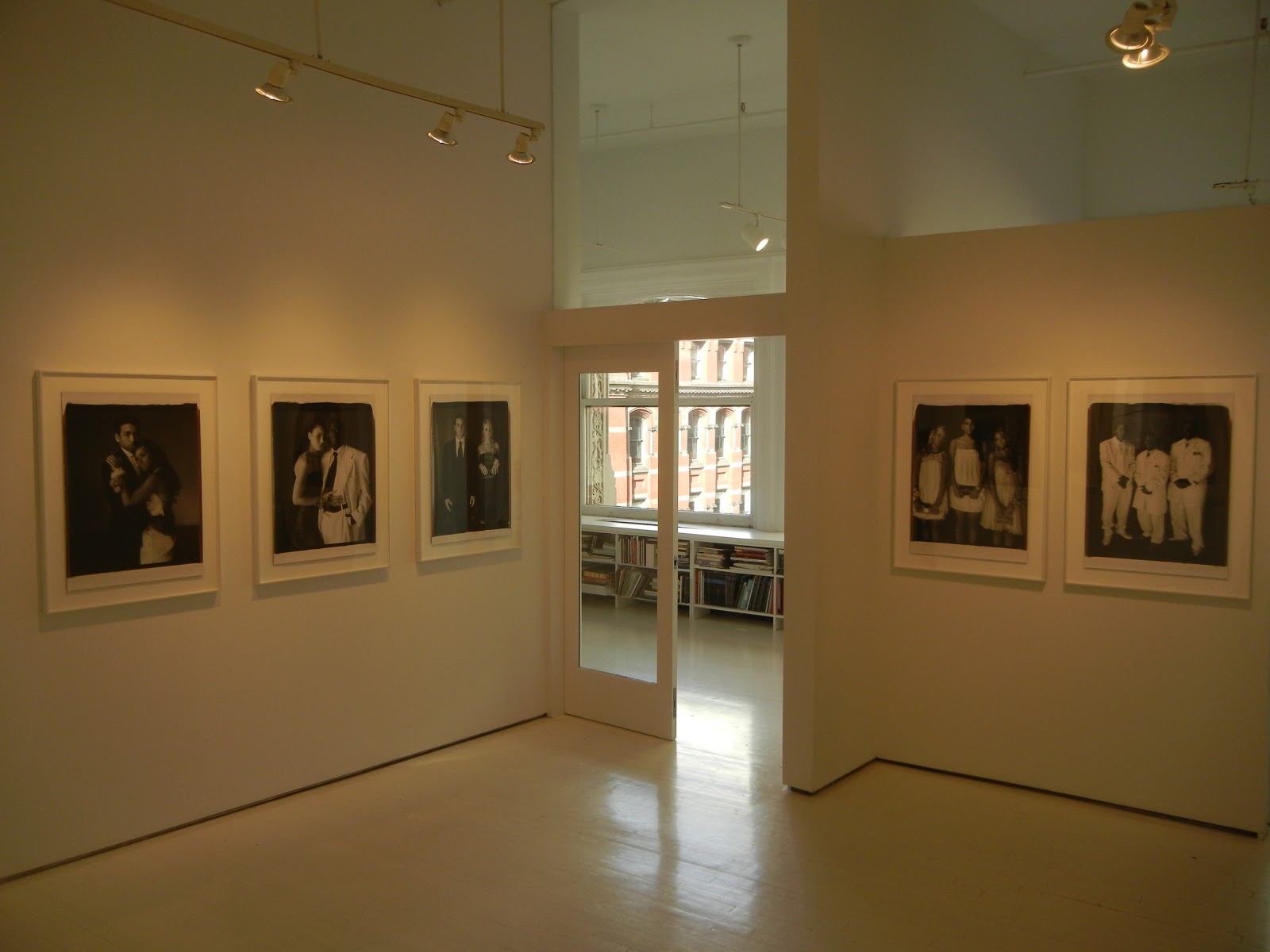 But I think in the end, it's the faces that make these pictures memorable. They bring together all the emotions that are part of the jump to adulthood: hope and trepidation, confidence and fear, swagger and uncertainty, unbridled joy and put on maturity. The photographs are unwaveringly honest and consistently optimistic; even the girl from the cancer ward, whose hair has fallen out, looks out with heartbreaking elegance and grace. Whether bursting with self-assurance or seemingly resigned to their fates, for one night, they get to show off their best and be who they had always wanted to be. Mark has deftly captured this elusive essence of prom, the bridge crossing significance that explains the long lasting durability of the ritual. The event mixes celebration of the past and the promise of the future, and Mark's photographs document that swirl of emotions with surprising openness.
Collector's POV: The prints in this show are priced at $15000 each. Mark's work has come up at auction consistently over the past decade, albeit in relatively small numbers (perhaps a handful of lots in any given year). Secondary market prices have generally ranged between $1000 and $9000.
Rating: ** (two stars) VERY GOOD (rating system described here)
Transit Hub:
- Artist site (here)
- Exhibit: Philadelphia Museum of Art, 2012 (here)
- Features/Reviews: NY Times Lens (here), NPR Picture Show (here)
Mary Ellen Mark, Prom
Through January 26th
560 Broadway
New York, NY 10012
Tuesday, December 11, 2012
Julie Blackmon: Day Tripping @Mann
 JTF (just the facts): A total of 11 large scale color photographs, framed in white with no mats, and hung in the two room gallery space. All of the works are archival pigment prints made between 2010 and 2012. The images on view come in three sizes, with corresponding edition sizes. The smallest size ranges from 24x24 to 25x34 (or reverse) and is available in editions of 25. The medium size ranges 36x36 to 36x50 (or reverse) and is available in editions of 10. And the largest size ranges from 44x44 to 44x59 (or reverse) and is available in editions of 5; one image (Olive & Market Street) is also available in an extra large size of 60x80, also in an edition of 5. (Installation shots at right.)
Comments/Context: Julie Blackmon's newest photographs continue her exploration of the intersection of 21st century domestic life and the painterly nuances of the staged tableaux format. Mixing brightened, colorful, digitally-crisp hyper-reality and carefully choreographed scenes featuring families and children, her images have evolved an instantly recognizable signature look, placing the viewer in a stylized world that feels both obviously constructed and plausibly familiar. It's as if the action has been frozen for just a split second, offering us a heightened sense of all the competing activity that is swirling around.
 A handful of earlier photographs by Blackmon played with references to the chaotic interiors of the Dutch Renaissance painter Jan Steen, but aside from a sharpie incident on the living room couch and a mother's book club (reading Fifty Shades of Grey), this group has generally moved outdoors. Most of the vignettes have multiple points of tension and compositions that draw the viewer's eye around to interrelated details. A pack of boys in a grassy meadow shoots a shotgun at overhead birds while babies howl in the abandoned stroller and a picnic is left unattended. Mom lounges on the patio reading a magazine and eating from a giant bag of potato chips, while the baby wanders around and the barbecue fire flares up, rubber balls strewn all over, including on the roof. Prim girls in dresses tend babies near a nighttime fire, while rampaging young boys turn a hot dog on a stick into a flaming torch. And The Sound of Music playing on a makeshift backyard screen is the setting for various groups of popcorn eating kids and distracted babies on rumpled blankets.
  Two of the newest images on display pay homage to the busy street scenes of Balthus, with multiple characters moving independently of each other. In Homegrown Food, a girl plays tennis against the wall with a red ball, a man smokes, and another carries a wooden plank, both the girl and the plank man echoes of figures in Balthus' La Rue. In Olive & Market Street, a woman with a bag, a man walking away, a dog in the middle of the street, and even the closed in architecture of the surrounding buildings are all dead ringers for the setting in Balthus' Le Passage du Commerce Saint-Andre. In both images, a composed painterly scene is transformed by Blackmon's stylized photographic detail, melding manipulated "fact" and outright fiction with a nod to art history.
I think the best of Blackmon's work combines this multiple points of entry, all-over composition style with an underlayer of wry wit and knowing parental humor. When you're nodding your head in silent recognition at some exaggerated moment or arcane visual reference in her jarringly unreal world, you know she's got you.
 Collector's POV: The works in the show are priced by size and place in the edition. The smallest works are priced at $3100 or $3500, the medium sized works are either $4500 or $5000, and the large works are either $7500 or $7900. The single extra large print is $12000, as are two medium sized AP prints from already sold out editions. Blackmon's work has recently begun to enter the secondary markets, but not enough lots have sold to chart much of a pricing pattern. As such, gallery retail is still likely the best option for those collectors interested in following up.
Rating: * (one star) GOOD (rating system described here)
Transit Hub:
Julie Blackmon: Day Tripping
Through January 12th
Robert Mann Gallery
525 West 26th Street
New York, NY 10001
Monday, December 10, 2012
Leon Levinstein @Kasher
 JTF (just the facts): A total of 49 black and white photographs, framed in black and unmatted, and hung against white walls in the North and South gallery spaces. All of the works are vintage gelatin silver prints, made between 1950 and 1975. The prints are sized between 11x11 and 13x17, with most roughly 11x14 or reverse. No edition information was provided on the checklist. (Installation shots at right.)
Comments/Context: Following on the heels of 2010 exhibits at the Met and Howard Greenberg (reviews of both linked below), this show continues the methodical reemergence and reconsideration of the work of Leon Levinstein. At this point, Levinstein's talent for capturing the funky diversity of 1960s and 1970s New York street life is decently well known, so what we have here is more of a deepening of this now familiar story, via another selection of energetic sidewalk pictures.
 Levinstein is perhaps best known for his undeniably keen eye for the quirks of personal fashion, and this show has plenty of gems from this genre, covering the spectrum from a sleek white blazer to dirty work coveralls. Women in patterned dresses strut down the street like it was a catwalk, and men unabashedly turn to check out the action. Skew camera angles freeze effusive hand gestures mid motion, whether from suit wearing businessmen or a screaming woman in front of a pizza joint. A trio of pictures focus on the angles of men's feet: perched on a fire hydrant, pulled up on a lamp post, or crossed leaning against a railing. And a group of stately women's faces recall Lisette Modell, with fur coats, dark hats, and veils (and even one chihuahua), framing stoic upper class wrinkles.
This particular edit also brings in a broader sample of local neighborhoods, getting beyond the swagger and grit of Times Square: couples lounging on the beach at Coney Island, serious nuns from the Lower East Side, grim faced workers from Harlem, and wide eyed street boys from Brooklyn. It also discovers plenty of unlikely city moments: a man with a pack of stray cats, a girl in a tutu following a nun, two older ladies talking though a window with Jesus underneath, a smiling family posing in front of a wall of psychedelic op art posters, and men slumbering in the shade under a scrawl of Fuck the Pigs.
 All in, this is a solid sampler of Levinstein's street photography; not perhaps his most notable or recognizable images, but a worthwhile extension and addition to the larger ongoing education process surrounding his rightful place in photographic history.
Collector's POV: The prints in the show range in price from $6000 to $11000. In recent years, Levinstein's work
has only been sporadically available in the secondary markets, with prices
ranging
between roughly $1000 and $9000.
Rating: * (one star) GOOD (rating system described here)
Transit Hub:
- Features/Reviews: NY Times Lens (here), Wall Street Journal (here), New Yorker (here), Elle (here)
- DLK COLLECTION reviews of 2010 exhibits: Met (here), Howard Greenberg (here)
Through December 22nd
Steven Kasher Gallery
521 West 23rd Street
New York, NY 10011
Friday, December 7, 2012
Gail Albert Halaban: Hopper Redux @Houk
 JTF (just the facts): A total of 11 color photographs, generally framed in white and unmatted, and hung against light peach colored walls in the main gallery space and the smaller side room. 9 of the works are archival pigment prints mounted to plexi, made between 2010 and 2012. Physical dimensions range from roughly 33x42 to 34x45 and the prints are available in editions of 5. The other two works on display archival pigment prints on film, fitted into custom LED lightboxes, made in 2011 and 2012. Physical dimensions of these works are roughly 25x31 and the works come in editions of 10. (Installation shots at right.)
Comments/Context: In Gail Albert Halaban's previous series, Out My Window, her photographs of buildings in New York drew an implicit parallel with Edward Hopper's urban street scene paintings, sharing a sense of dark moodiness and making common use of isolated figures looking out windows. In her newest body of work, Halaban has made this artistic connection to Hopper more explicit, tracking down the houses in Gloucester, Massachusetts, that were the subjects of his early watercolors, and making recreations in her own style from the exact same vantage points.
 Hopper's watercolor portraits of seaside houses, with their Victorian details, mansard roofs, and New England unpretentiousness, shimmer in bright sunlight, giving them an unexpected energy and vitality. The world has of course changed in the roughly ninety intervening years between these two projects, and the front yard trees are now larger, the telephone wires and satellite dishes are more intrusive, and the details of the houses (awnings, paint color, other architectural decorations) are more reflective of modern tastes. While Halaban has taken great pains to echo Hopper's compositions, she has entirely reconsidered the light, often capturing the houses at twilight, when the streetlights have just begun to come on, the sky is a soft purple, and the windows glow from the inside. Nearly every picture includes a person posed in a window, both visible from the street and obliquely looking outward, seen and seeing at the same time. These Hitchkockian characters add the potential for mysterious lonely narratives to the now vaguely spooky houses. Even a house draped in friendly icicle lights has a faintly sinister cast.
In updating these architectural portraits, Halaban has transformed their overall temperament. Their spirit is now more separate and guarded; the light in the windows isn't entirely welcoming and beds of flowers and overturned bikes can look a little imposing. The images have been infused with both crisp photographic detail and a modern sense of isolation, at once concealed and visible, reclusive and longing for connection.
 Collector's POV: The prints in this show are priced as follows. The large prints are $12000 each and the smaller lightboxes are $8500. Halaban's photographs have very little secondary market history, so gallery retail remains the best option for those collectors interested in following up.
Rating: * (one star) GOOD (rating system described here)
Transit Hub:
Edwynn Houk Gallery
745 Fifth Avenue
New York, NY 10151
Thursday, December 6, 2012
The Checklist: 12/6/12
Current New York Photography Shows
New reviews added this week in red.
(Rating: Artist/Title: Venue: Closing Date: link to review)
Uptown
ONE STAR: Lynne Cohen: Higher Pictures: December 8: review
ONE STAR: Cy Twombly: Gagosian: December 22: review
Midtown
THREE STARS: Lee Friedlander: Pace: December 22: review
TWO STARS: Lee Friedlander: Pace/MacGill: December 22: review
ONE STAR: Abelardo Morell: Bonni Benrubi: December 22: review
THREE STARS: Rise and Fall of Apartheid: ICP: January 6: review
ONE STAR: New Photography 2012: MoMA: February 4: review
TWO STARS: The Shaping of New Visions: MoMA: April 29: review
Chelsea
ONE STAR: Danny Lyon: Churner and Churner: December 15: review
ONE STAR: Marc Asnin: Steven Kasher: December 22: review
ONE STAR: Olafur Eliasson: Tanya Bonakdar: December 22: review
ONE STAR: Jitka Hanzlová: Yancey Richardson: December 22: review
SoHo/Lower East Side/Downtown
No reviews at this time.
Elsewhere Nearby
No reviews at this time.
Forward Auction Calendar
New auctions added this week in red.
(Sale Date: Sale Title: Auction House: link to catalog)
December 7: Photographs (Cologne): Van Ham: catalog
December 11: Fine Photographs & Photobooks (New York): Swann: catalog
December 12/13: Photographs from the Collection of Henry Buhl (New York): Sotheby's: catalog
New reviews added this week in red.
(Rating: Artist/Title: Venue: Closing Date: link to review)
Uptown
ONE STAR: Lynne Cohen: Higher Pictures: December 8: review
ONE STAR: Cy Twombly: Gagosian: December 22: review
Midtown
THREE STARS: Lee Friedlander: Pace: December 22: review
TWO STARS: Lee Friedlander: Pace/MacGill: December 22: review
ONE STAR: Abelardo Morell: Bonni Benrubi: December 22: review
THREE STARS: Rise and Fall of Apartheid: ICP: January 6: review
ONE STAR: New Photography 2012: MoMA: February 4: review
TWO STARS: The Shaping of New Visions: MoMA: April 29: review
Chelsea
ONE STAR: Danny Lyon: Churner and Churner: December 15: review
ONE STAR: Marc Asnin: Steven Kasher: December 22: review
ONE STAR: Olafur Eliasson: Tanya Bonakdar: December 22: review
ONE STAR: Jitka Hanzlová: Yancey Richardson: December 22: review
SoHo/Lower East Side/Downtown
No reviews at this time.
Elsewhere Nearby
No reviews at this time.
Forward Auction Calendar
New auctions added this week in red.
(Sale Date: Sale Title: Auction House: link to catalog)
December 7: Photographs (Cologne): Van Ham: catalog
December 11: Fine Photographs & Photobooks (New York): Swann: catalog
December 12/13: Photographs from the Collection of Henry Buhl (New York): Sotheby's: catalog
Wednesday, December 5, 2012
Marc Asnin: Uncle Charlie @Kasher
 JTF (just the facts): A total of 23 black and white photographs, framed in black and unmatted, and hung against white walls in the side alcove and the back viewing room. All of the works are modern gelatin silver prints, made between 1981 and 2010. The prints are sized either 16x20 or 20x24 and are available in editions of 9. A monograph of this body of work was recently published by Contrasto (here). (Installation shots at right.)
Comments/Context: Rarely has a long term family portrait been as brutally conflicted as Marc Asnin's unflinching documentation of the life of his Uncle Charlie. In shadowy black and white photographs spanning more than thirty years, Asnin cuts to the raw bone of Charlie's existence, exposing a dark, downward spiral of poverty, violence, depression, loss, and isolation. But even as the crushing weight of bad choices, delusions, and madness piles up, Asnin's tenderness and affection for Charlie never falters. As sideline viewers, we continue to somehow root for Charlie's success, even when it is altogether clear that the deluge of personal tragedies is going to win.
 With the benefit of the context of the entire project, Asnin's early pictures from the 1980s feel pregnant with clues to the impending disasters to come. Charlie humps his wife in the kitchen with a crazed look in his eye, and lies like a corpse in his convertible bed in the living room. Images of his five young children hint at disquiet and unrest: a lonely look through a scratched glass door, a triangle of boys with resigned stares, and a daughter flash lit and haunted. The penetrating photograph of Charlie sitting naked in the dark, holding a gun and smoking a cigarette, looking out the bright window is surely evidence that his struggles were already starting to overwhelm him.
By the 1990s, the cycle of destruction engulfing Charlie had clearly intensified. His kids begin to rebel with more harshness and venom; Brian gives his dad the finger while Jamie talks trash on the front stoop. Family celebrations like birthdays and baptisms are hollowed out pantomimes, and his new young girlfriend openly smokes crack in the living room. Charlie is now mostly seen resting, lost in a decline of frail depression. The death of his son to AIDS in 1996 seems to have been the last straw; his face hardens into a deranged mask, and he sits curled up in a chair, the picture of utter despondency.
The most recent images in the series plumb the depths of sadness and despair in ever more punishing ways. Charlie scrawls sorrowful messages in chalk on his walls, trudges by his son's grave site in the snow, and sits alone in his empty apartment on moving day. A close up picture of his now older and weathered face is heartbreaking, a diary of best intentions, broken dreams, and dreary outcomes.
 Even as his life crashes down around him, Charlie remains surprisingly sympathetic as a subject. While many of his injuries may have been self inflicted and the larger cycle of life had him trapped, we're still left hoping for an unlikely, snatched from the jaws of defeat happy ending which doesn't of course come. All in, Asnin's family portrait is undeniably woeful and distressing, but it's cracklingly and memorably alive with the genuine emotions of his one of a kind uncle.
Collector's POV: The prints in the show are priced based on size; the 16x20 prints are $1800 and the 20x24 prints are $2500. Asnin's work has very little secondary market history, so gallery retail is likely the best option for those collectors interested in following up.
Rating: * (one star) GOOD (rating system described here)
Transit Hub:
Through December 22nd
521 West 23rd Street
New York, NY 10011
Subscribe to:
Posts (Atom)