Showing posts with label Gagosian Gallery. Show all posts

Tuesday, June 4, 2013

Dennis Hopper: The Lost Album @Gagosian

JTF (just the facts): A total of 445 black and white photographs, generally mounted and unframed, and hung against white walls in a large divided gallery and the adjacent entry area on the 5th floor. Aside from the 12 unique gelatin silver prints on view near the reception desk (each framed in blond wood and matted and sized 3.5x5 or reverse), the show is comprised of clusters of vintage photographs hung together in groups, mostly in mixed subject matter sets of 25, with one single subject matter set of 8 from Mexico. No detailed information on these prints was provided on the checklist, although the individual prints look to be sized roughly 5x8 (or reverse); there is some repetition of images from cluster to cluster, so the prints are likely not unique. The images were taken between 1961 and 1967. A monograph of this body of work was recently published by Prestel (here). (Installation shots at right courtesy Gagosian Gallery. Photography by Robert McKeever. Artworks © Dennis Hopper, courtesy of The Dennis Hopper Art Trust.)

Comments/Context: Back in the days before the instantly disposable digital print, people seemed to have a hard time throwing photographs away. Rather than heedlessly pitching them in the bin, we tended to squirrel them away in boxes, pushed to the backs of closets and the recesses of attics, waiting for some later generation to unearth them once again. There was something mildly heretical about trashing history, and so for the most part we didn't; it was easier to let them gather dust than make the active decision to get rid of them. As a result, the recent history of photography is full of fantastic and improbable rediscovery stories: Vivian Maier, Mike Disfarmer, Charles Jones, Robert Capa's mexican suitcase, the list goes on and on. The story of this exhibit follows this same pattern: boxes of prints tucked away after Dennis Hopper's 1970 exhibit at the Fort Worth Art Center Museum, generally thought to be forever lost, but miraculously found once again.

If we play a word association game with the name "Dennis Hopper", most of us will blurt out actor, director, or maybe Hollywood cool guy, but few of us will start with photographer or artist. But as this time capsule of photographs clearly shows, Hopper was busy shooting pictures long before his prime years as an actor. Looking at the literally hundreds of images in this show, it's easy to see Hopper at the center of a starburst diagram, with dozens of connections splashing outward to all kinds of cultural communities. He took portraits of actors, rock stars, artists, gallery owners, politicians, Hell's Angels, and hippies. He hung out at rallies and riots, went to bullfights in Mexico, and documented the civil rights marches in Selma. He watched TV, noticed commercial signage, and thought about abstraction. In short, he had amazing access to the cultural melting pot of the 1960s and he took advantage of that position to make a wide range of pictures that reflect the conflicted spirit of that time.

The way these photographs are installed discourages focusing in on single images; your eye darts from picture to picture in these clusters, flitting from one to another like a hummingbird looking for nectar. Jane Fonda's wedding, the Kennedy funeral on pixelated TV, Martin Luther King Jr. giving a speech, a matador flashing his cape, an abstraction of torn posters, a hippie chick, a Rauchenberg and Cunningham performance, the groups return again and again to common visual themes, like refrains and choruses of a song. By the time you reach the fifth or sixth grouping, the patterns have settled into recognizable rhythms, a little of this, a little of that, all wrapped up in one long stream of consciousness memory.

Photographically, Hopper was a bit of shape shifter, moving from documentary seriousness to Siskind-like Abstract Expressionist studies in found line and form. His celebrity portraits are his best works, if only for their careful looseness; Hopper had an eye for in situ composition, but didn't seem to let his photography break the sense of easy casualness that pervades these pictures. He was an insider, and his subjects are comfortable and open in ways others couldn't possibly replicate. Regardless of whether it was Claes Oldenburg or Ed Kienholz, Paul Newman or Timothy Leary, Hopper caught his friends unguarded, generally opting for playful rather than posed.

By the early 1970s, Hopper had left photography behind for other pursuits, and while he did return to making pictures at various times later in his career, none of those images really match the verve and immediacy of these 1960s works. Looking back at them as an interwoven group, they have an undeniable right place right time vitality, even if Hopper's photographic voice hadn't entirely emerged. Seen together, they are a transporting, swaggering frieze of curious, idealistic, cultural signifiers.

Collector's POV: The photographs in this show are priced as follows. The clusters of 25 prints are priced at $250000 each (prints not sold individually) and the smaller single prints near the reception desk are $15000 each. Hopper's photographs have been intermittently available in the secondary markets in recent years, with prices ranging between roughly $5000 and $48000.

Rating: * (one star) GOOD (rating system described here)

Transit Hub:
  • Artist site (here)
  • Features/Reviews: New York Times (here), Daily Beast (here)
  • Exhibit: MOCA retrospective, 2010 (here)

Dennis Hopper: The Lost Album
Through June 22nd

Gagosian Gallery
980 Madison Avenue
New York, NY 10075

Tuesday, December 4, 2012

Cy Twombly: A Survey of Photographs 1954-2011 @Gagosian

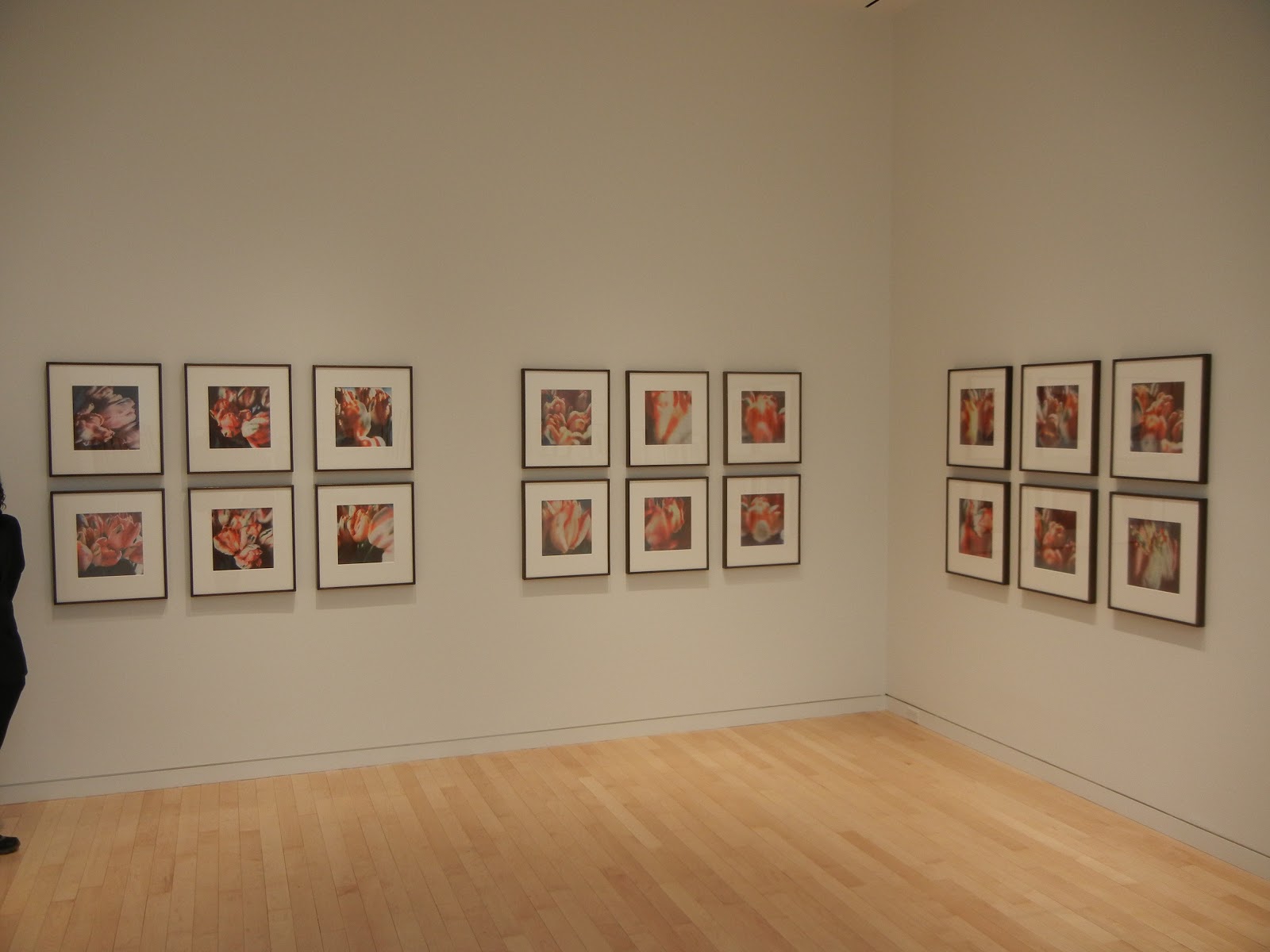
JTF (just the facts): A total of 102 color photographs, framed in brown and matted, and hung against white walls in a single room on the 5th floor of the gallery. Additionally, 2 portfolios (several images on view for each) are displayed in wood/glass cases in the center of the space. All of the works are color dry-ink prints (some mounted on cardboard), made between 1951 and 2011. Physical dimensions of the prints range from roughly 8x17 to 28x25 and editions range in size from 3+2AP to 10+2AP. A catalog of the exhibit is available from the gallery for $80 (here). (Installation shots at right.)

Comments/Context: Gathered together in conjunction with an exhibit of Cy Twombly's exuberantly gestural last paintings, this show provides a retrospective look at the artist's lesser known efforts with a camera. Starting with a few Morandi-like glass bottle still lifes from his time at Black Mountain College in the early 1950s and continuing all the way through recent floral images from a cemetery in St. Barths in 2011, the survey offers an inside look at Twombly's approach to photographic problem solving and aesthetic experimentation. It's a mixed bag full of thoughtful trial and error, and a surprisingly intimate and personal sampler of visual tests and memories.

Perhaps the most striking thing about Twombly's photographs is their unexpected texture. Taken as Polaroids and then printed using the relatively arcane color dry print (AKA Fresson) process, the prints have a luscious tactile quality, almost like washed out watercolors. Regardless of subject matter, the inks float over the paper, the colors becoming ephemerally soft and blurred. The effect is a mix of Pictorialism in color and outright romance.

Compositionally, Twombly seemed to be drawn again and again to changes in scale to create abstraction. Whether looking a vase of tulips, an ancient sculpture in shadows, or up at the silhouette of trees in the sky, he produced sets of images that move in and out, allowing blurring, distortion, and edge cropping to happen naturally. His three portfolios of striped pink tulips are the strongest and most original works in the show. Twombly gets right up close, turning clusters of petals into blasts of fiery yellow, creamy pink, and rich red. Graininess turns into subtle Pointilism, and flowers break down into component parts of curving fuzzy color. The permutations are seemingly endless, especially as the shapes become more indistinct and illegible. Separate groups of white peonies and yellow tulips get the same treatment, although to slightly less boldly abstract ends.

Twombly tries his fragmented vision on serious bits of ancient stone sculpture as well, but these images seem much fussier, like he was trying to hard too be artistic. Aside from a wonderfully blended swirl of paint brushes in a can, his studio interiors and outdoor landscapes are generally forgettable, and Twombly's seascapes are equally boring, except for a dark whorled sunset bleeding orange, ochre, and yellow. Other later images of lemons, glossy green leaves, and other table top remains are more successful, bathing in a warm golden glow and exploring more complex spatial relationships. His last images start with white crosses and tombstones and periscope into overexposed piles of lush lilies, daisies, and roses, becoming more and more expressive with each dissolving step forward.

Seen as an entire career-length body of work, Twombly's photographs are decidedly uneven. But at their best, his images are effusively inventive, hypnotizing in their diffusing abstraction, and warmly nostalgic in their sumptuous, lavish, painterly color.

Collector's POV: The individual prints and portfolios in this show are priced between $30000 and $80000 each. Twombly's photographs are not readily available in the secondary markets, so gallery retail is likely the only option for those collectors interested in following up.

Rating: * (one star) GOOD (rating system described here)

Transit Hub:
  • Feature/Review: NY Times (here)

Cy Twombly: A Survey of Photographs 1954-2011
Through December 22nd

Gagosian Gallery
980 Madison Avenue
New York, NY 10075
Monday, September 24, 2012

Sally Mann: Upon Reflection @Houk

 
JTF (just the facts): A total of 23 black and white photographic works, unframed and hung against light peach colored walls in the main gallery space and the smaller side room. All of the works are ambrotypes (unique collodion wet-plate positives on black glass), made between 2006 and 2012. Each unit print is sized roughly 15x14. The individual works are arranged into groups and grids of 1, 3, 6, 9, and 20 prints, and are divided by subject matter into two projects: Self-Portraits and Omphalos. There are 17 works from Self-Portraits and 6 works from Omphalos on view. (Installation shots at right.)

Comments/Context: In the future, when some museum does a full and comprehensive retrospective of Sally Mann's work, I think it will be fascinating to consider how her embrace of the wet-plate collodion process has changed the trajectory of her artistic life. In my view, there is a very distinct break right in the middle of her prolific career, a before wet-plate and after wet-plate bright line where her work took an entirely new direction. Some will argue that the progression is smoother than I am making out, that she has always thoughtfully focused her camera on her family and the land around her, but to my eye, while the subjects haven't evolved dramatically, the mood is meaningfully different, perhaps a byproduct of the ghostly look and feel of the wet-plate prints, or perhaps a turn inward toward a more complex and personal psychological landscape.

What is new here is that after a riding accident laid her up with serious injuries in 2006, she boldly turned the camera on herself, making countless head shot portraits and nude torsos. There are no smiling, happy faces in this parade, however; her expressions cover the territory from deadpan to grave, with a few stops for steely, weary, wise, zombie-eyed, and almost meditatively ecstatic in between. The tonalities shift from washed out grey to brown to bronze to shadowy black, and the chance movements of the chemicals create unexpected spectral drips, swirls, and highlights that often obscure the image. Some of the works have also been scratched and abraded, with the emulsion flaking and chipping off, exposing areas of crackly black glass. Seen together as grids and typologies, the faces become a taxonomy of subtle emotional states; a wisp of hair or the details of wrinkles make some of the pictures humanly specific, while others drift into silhouette or death mask, the personal features erased and blurred. Mann's torso images are generally more abstract, reducing her body to a sculptural mass of white with a shadowy hint of a belly button or a dark triangle. The classical forms seem smooth and weathered, like fertility symbols from antiquity, at once haunting and timeless. The variation in these images is more subtle, elemental curves repeated with minute changes in brightness and contrast.

While Mann's images her nude husband were tender in their unflinching truth, these images of her own face and body seem tougher to me, even in their most elegant state. When she does engage the camera, her gaze is strict and penetrating, and I felt a sense of quiet defiance, a letting down of her guard but with a knowing resignation to and acceptance of what she was letting in. Taken together, the works are a rich, multi-dimensional portrait, full of dark, complex emotions and ephemeral moods, riding on an undercurrent of inner strength.

Collector's POV: The prints in this show are priced based on the number of prints included in the work/grid. The single print works are $20000, the 3 print works are $36000, the 6 print works are $60000, the 9 print works are $84000, and the 20 unit work is $172000. Mann's photographs are widely available in the secondary markets. Auction prices for Mann's prints have generally ranged between $3000 and $70000 in recent years, with most still under $20000. Her earlier works were printed in editions of 10 and 25, so these new unique works will clearly have a different scarcity value. Mann is also represented in New York by Gagosian Gallery (here).

Rating: * (one star) GOOD (rating system described here)

Transit Hub:
  • Artist site (here)
  • Exhibit: Virginia Museum of Art, 2010 (here)
Through November 3rd
 
745 Fifth Avenue
New York, NY 10151

Friday, June 8, 2012

Richard Avedon, Murals & Portraits @Gagosian

JTF (just the facts): A total of 4 monumental photographic murals, 46 individually framed works and miscellaneous additional ephemera, hung in the large gallery space interrupted by four V shaped interior walls. The murals hang unframed behind protective barriers at the ends of each axis, while the prints are framed in silver and matted, and displayed against black walls inside each of the Vs. The smallest items and other ephemera are shown under glass in the small triangular area at the point of each V. A catalog of the show has been published by Gagosian/Abrams (here) and is available from the gallery for $100. (Installation shots at right.)

The exhibit is effectively divided into four sections, each led by one of the murals. Each section is outlined starting with the mural itself, followed by the details of the photographs and archival material on view in the adjacent/supporting V:

Andy Warhol and members of The Factory

Mural: gelatin silver prints, three panels mounted on linen, 1969/1975, 123x375, edition of 2+2AP
Prototype mural: gelatin silver prints,  three panels mounted on masonite, 1969, 30x115, unique
7 gelatin silver prints, 59x48, 38x51, 34x42, 24x20, 20x16, 1969-1971 (some printed 1975, 1993, 1997)
1 c-print, 20x16, 1969
Vitrine: 6 gelatin silver contact prints, 8x10 or reverse, 1969, 2 sheets of loosely mounted contact prints, 1968, 1 Candy Darling model release

The Chicago Seven

Mural, gelatin silver prints, three panels mounted on linen, 1969/1969, 122x243, edition of 2+1AP
12 gelatin silver prints, 67x61, 37x29, 36x28, 24x20, 20x16, 14x14, 10x8, 1963-1975 (some printed 1975, 1998)
Vitrine: 1 comic book, 1975, 1 book cover, 1968, 3 gelatin silver contact prints, 1969, 1 contact sheet, 1969, 1 newspaper article and opening photograph from the Minneapolis Institute of Arts, 1970

The Mission Council

Mural: gelatin silver prints, five panels mounted on linen, 1971/1975, 120x390, edition of 2+1AP
14 gelatin silver prints, 41x33, 40x32, 20x16, 10x8, 1971, 1975, 1976 (some printed 1993, 1998, 1990-1999)
Vitrine: 2 gelatin silver contact prints, 1971, 3 gelatin silver prints of Avedon at work by Denis Cameron, 1 Vietnam sittings book belonging to Avedon, 1 edited model release, 1 Department of Defense ID card, 1 NY Times article, 1971, 1 metal engraver's block

Allen Ginsberg's family

Mural: gelatin silver prints, two panels mounted on linen, 1970/1993, 96x240, edition of 3
6 gelatin silver prints, 40x30, 24x20, 20x20, 20x16, 11x14, 1960, 1963, 1970 (some printed 1970, 1980)
6 gelatin silver contact sheets, 20x16, 1963
Vitrine: 3 gelatin silver contact prints, 8x10, 1963, 1970, 1 poetry magazine, 1971, 2 photographs of Ginsberg by Elsa Dorfman, 1977, 1978, 2 books, 1980, 2001, 1 postcard, 2 magazines, 1970, 1973

Comments/Context: When the announcement came earlier this spring that Gagosian had taken over the representation of the estate of Richard Avedon, it stood to reason that an exhibit would follow soon afterward that would both make a splash and create some separation from the shows of Avedon's fashion images and celebrity portraits that had been seen in New York at other venues in the past few years. It comes as no surprise therefore that the gallery has flexed its muscles in this inaugural Avedon exhibit, pulling out nearly all the stops, from a custom-built architectural space and a thick supporting monograph to a massive advertising billboard near the High Line. It would of course be natural to be intensely skeptical of such comprehensive and lush marketing, but the fact is, this is a truly spectacular show, one of the best of the year in my view.

Before I get to the photography itself, the modifications to the normal gallery experience made by the special architectural elements here deserve some discussion. As a reminder, the Gagosian space in Chelsea is truly cavernous, with extremely high ceilings and the possibility for broad open areas. But instead of the usual room to room linear progression common to most large shows, this space is built on a central axis, like an X of hallways through the larger overall rectangle. As you enter the gallery, all that you can see is a fairly narrow, all-white pathway to the center, where a snippet of one of the large murals is partially visible in the background. So you walk through this thin empty area and then emerge into the expansive middle space, with long views down the four cardinal points to the murals on the outside walls (see the guards in the installation shots above for a sense of the scale). It's a dazzling, smile-inducing piece of theater, and allows you to see the monumental images from a decent distance.

The way the walls are aligned, once you pick your first mural to explore, there is no choice but to walk straight toward it until you are up close, the white walls on the sides funneling you down to the artwork. This forces a gradual change of scale, as the larger than life people now tower above your head, their immensity and crisp detail more pronounced from a few feet away. Now, out of the corner of your eye, you'll see another single print, hanging near the corner of the gallery space, somehow related to the mural you've just examined. As you follow the invisible breadcrumbs to see this photograph, you pass the end of the white wall, and behind it is revealed the interior of a V shaped area, painted all black, and covered in smaller images that support the larger story of the mural. It's another well-orchestrated surprise. And as you dig deeper into this material, you are led into the very apex of V, where smaller bits of ephemera are found under glass. The space is so well designed that this all feels effortless, the transitions in scale managed carefully to support a layered reading of all the work. You then head back to the center of the gallery and repeat the process for the other three murals. Designed by David Adjaye of Adjaye Associates, it's one of the smartest, most well-considered gallery installations I can remember encountering; not cheap, I'm sure, but undeniably extremely effective in showcasing the photographs.

Now all of this showmanship wouldn't matter one iota if the work itself couldn't match the innovations in the architecture. Lucky, the brilliance of these Avedons from the 1960s and 1970s hasn't dimmed at all in the intervening decades; they remain as fresh and original as when they were made. The murals combine Avedon's now signature featureless white background with an expansion of scale that was truly unprecedented at the time; their imposing physicality makes them seem like contemporary versions of ancient marble friezes or triumphant monuments. I was most struck by Avedon's careful control over his compositions in these works, from the individual posing and preening of Warhol's entourage (with Warhol himself almost an afterthought) and the rigid vertical linearity and repetition of the Vietnam-era military and government officials in their dark suits, to the bushy bearded, casual confidence of the Chicago Seven and the overcrowded, multi-generational massing of Allen Ginsberg's family. Each mural creates a complex internal conversation from edge to edge, the subtle relationships between the subjects coming through in the tiniest of gestures.

The portraits and materials in each supporting area broaden the story of each mural. In some cases, this means a deeper exploration of Avedon's methodical journalistic rigor, where incisive portraits were made of all the stakeholders surrounding an issue, taking into account competing viewpoints or downstream effects. So for the Chicago Seven, not only are there fabulous portraits of Abbie Hoffman (including one of him holding a gun with a charismatic cackling laugh, giving the finger to the camera), but there are images of lawyers and writers associated with the case, as well as other radicals and organizers of differing views. For the Mission Council, there are portraits of soldiers and napalm victims, social workers, hookers, and krishnas, flanked by Nixon's secretary in her pearls. This selection of works proves that Avedon sought multi-layered context, not just the single powerful image we might be familiar with.

Other portions of the archival material give insights into Avedon's process. There are work prints (with grease pencil selections and instructions) and contact sheets, as well as plenty of alternates and variant images, like the members of the Factory putting their clothes back on after the mural shoot. This is particularly true in the section devoted to Ginsberg, where there are 6 engrossing contact sheets of Ginsberg and Peter Orlovsky trying out countless nude poses. The collected ephemera takes us even deeper, into model releases, images of Avedon working, his DoD ID card, and even his notebooks. I found this getting down into the weeds of Avedon's photographic life fascinating, especially in the context of the gargantuan murals nearby.

While I'm not sure that this exhibit represents a wholesale reappraisal of Avedon's work or a repositioning of his place in the canon, the show has clearly been designed with a sense of seriousness that stands in contrast to more easily consumable gatherings of his fashion shots and celebrity portraits. Here we are shown Avedon in the middle of the momentous events of the day (war, politics, sexuality, counterculture), crafting his own unique visual record of this critical period in our collective history. The nearly perfect production values of this show enable a richer and more complete presentation of this particular body of work, but in the end, the exhibit successfully reinforces Avedeon's versatility and originality, and provides further proof of his importance in the larger sweep of photographic history.
.
Collector's POV: While I never saw a detailed item by item price list for this show, the folks from the gallery let me know that the murals were priced at $2000000 "and up" and the individual prints were $30000 "and up". Avedon's work is routinely available in the secondary markets, as many of his most famous images were made in editions and portfolios of 50, 75, 100, and even 200 prints. The artitst's fashion images and portraits are relatively equal in price at this point, with the iconic images generally finding buyers in six figures, and most other images priced in five figures. The recent white glove Avedon sale at Christie's Paris in 2010 (detailed results here) is probably the best proxy for the current market. In that auction, a print of Dovima with elephants, Evening dress by Dior, Cirque D'Hiver, Paris, August 1955, 1955/1978, set a new auction record for Avedon at 841000€ (just over $1100000).

Rating: *** (three stars) EXCELLENT (rating system described here)

Transit Hub:
  • Avedon Foundation site (here)
  • Reviews/Features: Wall Street Journal (here), New Yorker (here), Daily Beast (here)
Richard Avedon, Murals & Portraits
Through July 27th

522 West 21st Street
New York, NY 10011

Wednesday, May 23, 2012

Taryn Simon: A Living Man Declared Dead and Other Chapters I-XVIII @MoMA

JTF (just the facts): A total of 9 multi-panel mixed-media works, framed in brown wood with cream colored mounts, and hung in a divided two room gallery space on the 3rd floor of the museum. Each work is made up of three sections: an ordered group of pigmented inkjet prints displayed in 1-4 panels, a single narrow panel of explanatory text and image details, and a third panel containing other related photographs and ephemera. All of the works are dated 2011. A think monograph of this entire body of work was published in 2011 by MACK books (here) and is on display in a glass case. A newspaper style catalog is available for free in a rack outside the exhibit. As an aside, most of the works on view came from the collection of Michael and Jane Wilson. (Installation shots at right.)

Comments/Context: Taryn Simon's newest photographic project dives deeper into the nature and definition of history than any of her previous work. It explores how photographs, text, and other documents can be used to piece together a story, providing clues and context while still leaving many questions unanswered. Her works are like exploded files from an archive, presented with an eye for order and classification, teasing out buried multi-generational narratives of struggle, violence, and survival.

From afar, Simon's panels are totally indecipherable. Row upon row of deadpan faces (and in one case, rabbits in vitrines), strictly laid out in a genealogical tree from eldest to youngest, stare out at the viewer, devoid of recognizable context. Only after the textual background on the middle panel is read can the stories start to unfold. The people are surviors (or remains) of the Srebrenica massacre, or Ukranian orphans, or Jewish settlers, or the countless offspring of a Kenyan polygamist healer. Tied up in each of these narratives is the study of inherited consequences, of descendants being trapped by the decisions (or fate) their ancestors. An Indian man was mistakenly declared dead by the local land office, thereby throwing the ownership of the land into confusion for his entire family. A legal adviser to Hitler and a PFLP airplane hijacker permanently alter their family histories. And hundreds of Australian rabbits die testing poisonous strains of viruses used to control the exploding population, descendants from an original group of 24 introduced over 150 years earlier. It seems there is no escape from the effects of choices made long ago.

The third panel of each work is a kind of grab bag of evidence; photographs, documents, and other ephemera are offered as related facts or footnotes to the larger stories. These items and artifacts further probe the idea of how historians edit and connect, and how seemingly random pieces of information are tied together to tell a broader, more comprehensive story. In one work, Simon documents a family chosen to represent China by the State Council Information Office. Alongside these photographs and the accompanying background text, Simon has included a gift bag provided by the SCIO. It is a surprisingly resonant data point (almost ominously comic) used to reinforce just how controlled her interaction with this agency was, deftly undermining the veracity of the family story she is supposedly telling.
.
In these works, the documentary photographs are just one element that supports the creation of an entire narrative. And while all of the stories (constructed from both text and visuals) are presented with a kind of cohesive, scientific rigor, the structured, conceptual analysis isn't conclusive; the patterns are there to be observed, but the process of creating the history itself is also on view. In the end, these works are an examination of the components of history, and how they are fit together to uncover and discern meaning.
.
Collector's POV: Given this is a museum show, there are of course no posted prices. Taryn Simon is represented by Gagosian Gallery in New York (here) and Almine Rech Gallery in Paris and Brussels (here). Simon's work has only recently begun to enter the secondary markets, so no definitive pricing history has yet emerged. As such, gallery retail is likely the only real option for interested collectors at this point.

Rating: * (one star) GOOD (rating system described here)

Transit Hub:
  • Artist site (here)
  • Features/Reviews: Aesthetica (here), Artnet (here), Cool Hunting (here), Photograph (here),  Independent (here)
Taryn Simon: A Living Man Declared Dead and Other Chapters I-XVIII
Through September 2nd

Museum of Modern Art
11 West 53rd Street
New York, NY 10019

Friday, December 2, 2011

Andreas Gursky @Gagosian

JTF (just the facts): A total of 13 large scale color works, framed in brown wood and unmatted, and hung in a pair of divided gallery spaces. There are 6 works from the Bangkok series in the left hand gallery. These are inkjet prints, each sized 121x89 or 121x93, printed in editions of 6, and made in 2011. There are 7 works from the Oceans series in the right hand gallery. These are c-prints, sized 134x98, 137x98, or 96x179 (or reverse), also printed in editions of 6, and made in 2010. A catalog is available from the Gagosian shop for $120 (here). No photography is allowed in the galleries, so the installation shots at right come from the Gagosian website.
.
Comments/Context: Since I have a significant amount of respect for the outstanding and innovative work of the German photographer Andreas Gursky, the easiest thing to do in this review would be to fall in line with the rest of the sycophantic, fawning critics and tell you that these new works are equally as astonishing and groundbreaking as many of his true and undeniable masterpieces. But the fact is, they are not. There, I've said it: the emperor (and he is undeniably the emperor of contemporary photography) has no clothes, at least at the moment.

Of the two new bodies of work on view in this show, the Oceans series has more to recommend it. Using satellite imagery, Gursky has stitched together omniscient view, weather-less composite images of the world's oceans, large expanses of blue with fragments of more recognizable continents and land masses intruding on the edges. These works are printed at such a gargantuan scale that they envelop the viewer, drawing us into the depths of the wide seas. I like the conceptual inversion going on here, where Gursky is capturing the negative space of the globe, upending our education about what the continents are supposed to look like. If someone asked me "what is the shape of South America?", I could immediately bring a decently accurate image to my mind's eye; ask me "what is the shape of the Pacific Ocean?", and I'd be a bit stumped. Gurksy's photographs flatten out the roundness of the globe, tweaking the distortions for broadening effect; the oceans are huge, engulfing, and somehow new. That said, the major innovation here is the monumental scale; if these pictures were 20x24, we'd all say ho hum and think they were intriguing if forgettable scientific shots from National Geographic. And so while this explosion of size does change our perception of the content, the whole group comes off a bit flat for me (no pun intended), especially when seen as a series; perhaps staged as a single image dwarfing a low ceilinged room of other art, one of these Oceans might be a bit more powerful.

Gursky's newest series of Bangkok water abstractions is, I'm very sorry to report, simply dreadful; the folks at Gagosian must have cringed when they saw that this was the work that would inaugurate their new representation relationship. The works are dark bodies of reflected water, where the refractions shatter into abstract fragments of light. More than a few have heavy-handed gestural references to the AbEx masters (Newman and Still are seen repeatedly), with zips and flames dancing through the blackness. These oil slick reflections are interrupted by small pieces of digital debris: clumps of greenery, plastic shampoo bottles, and other snippets of trash and pollution that float into the painterly abstractions, mixing a kind of real world truth into the swaths of energetic pigment. While I intellectually understand the conceptual dichotomy Gursky is going for (beauty and ugliness intertwined), the fact is that photographic reflections on water have been done endlessly; recently by artists like Jessica Backhaus (Venice canals), but also by every amateur photographer in the world (including myself). Once again, excessive scale is the only thing that changes the game here; not only are these pictures visually lifeless, they don't tell us anything new. I expect much more from Gursky, and to say I was underwhelmed by these images is a significant understatement; mostly I was just bored.

On its visual merits alone, this show could have conceivably earned my first zero star review in the history of this site, which pains me severely given my love for Gursky's previous work. That said, after much reflection, I think it jumps just barely to the one star category, mostly because I would recommend seeing this work to consider for yourself how one of our most shining stars could swing and miss so egregiously.

Collector's POV: The prints from the Bangkok series are priced at 400000 Euros each, while the prints from the Oceans series are generally 450000 Euros, with the exception of the largest panoramic work which is 500000 Euros. Gursky's works are routinely among the most expensive photographs available in the secondary markets, consistently fetching upwards of $1 million dollars at auction. His Rhein II recently broke the record for the most expensive photograph ever sold at auction, topping $4.3 million.

Rating: * (one star) GOOD (rating system described here)
.
Transit Hub:
  • Reviews: Artforum (here), New Yorker (here), New York (here)
Andreas Gursky
Through December 17th

Gagosian Gallery
522 West 21st Street
New York, NY 10011

Friday, November 5, 2010

Taryn Simon: Contraband @Lever House

JTF (just the facts): A total of 1075 color photographs, mounted on archival paper, and hung in Plexiglas frames on three, two-sided walls in the single room lobby space. Each of the individual images is sized roughly 6x6. They are then grouped by subject matter onto 16 panels, each 95x71. All of the works were taken in 2009 and printed in 2010. A complete monograph of this project was recently published by Steidl (here). (Installation shots at right.)

Comments/Context: Taryn Simon's approach to photography mixes a deadpan documentary style with an undercurrent of cerebral, conceptual ideas that tests the limits of what a photograph can see and communicate. In previous projects, she has photographed people wrongly convicted of crimes at the scenes of their undoing, and made images of objects that have a hidden or indecipherable purpose. In her newest work, she spent five days in the bowels of JFK airport, taking pictures of all the items that were confiscated from passengers and express mail packages. The result is a taxonomy of contraband, a snapshot catalogue of all of the things that fall outside the approved and acceptable.

In this series, Simon's images are basically commercial still lifes: frontal shots of various objects set against neutral white backgrounds. This aesthetic approach depersonalizes the items, making them cold, pared down, documentary facts. Photographically, the images themselves aren't particularly interesting.

But taken together, seen as an extremely long and eclectic list of things that are prohibited, illegal, counterfeit, unlicensed, or undeclared, the objects start to take on a different resonance. They start to create a picture of the edges of our culture, telling stories of the forbidden and illicit, of people who pursue activities that fall outside the norms. They paint a picture of a melting pot of puzzling cultural influences and traditions. They tell us about the global commerce that flows in and out of America like a flood each and every day, meeting our demands, fueled by our desires. They highlight what we find threatening or scary. In short, they provide a surprisingly direct social commentary on what we have decided we are not (and yet we still are).
.
So what's on this exhaustive list? Deer blood, Cuban cigars, pirated DVDs, counterfeit Beanie Babies, peyote, moon cakes, pharmaceuticals of various kinds, leaves from endangered species, nesting dolls, bongs, skeletons, berries, chicken feet, sugar cane, unidentified meats, fake watches, seeds, eggshells, pirated handbags, bags of fat, and cigarettes, among many, many others. It's a parade of oddities and curiosities, a set of both the bizarre and the mundane.

This is a show where the backstory is everything, where the context provides the spark of ideas. It's a thoughtful conceptual exercise, bounded by a particular slice of time, and it successfully focuses the viewer on a striking inversion. It forces us to look closely at how we have defined our world by seeing what falls outside its boundaries.

Collector's POV: Taryn Simon is represented by Gagosian Gallery in New York (here) and Almine Rech Gallery in Paris and Brussels (here). Simon's work has only just begun to enter the secondary markets in the last year or so, and no definitive price pattern has yet emerged. As such, gallery retail is likely the only real option for interested collectors at this point.

Rating: * (one star) GOOD (rating system described here)

Transit Hub:

  • Artist site (here)
  • Feature: NY Times Lens (here)
  • Current exhibitions: Gagosian Beverly Hills (here) and Almine Rech Brussels (here)
Taryn Simon: Contraband
Through December 31st
.
390 Park Avenue
New York, NY 10022

Wednesday, October 20, 2010

Book: From Here to There: Alec Soth's America

JTF (just the facts): Published in 2010 by Walker Art Center (here), in conjunction with an exhibition of the same name, on view now. 224 pages, with 237 color and black and white images. Includes essays by Siri Engberg, Geoff Dyer, Britt Salvesen, and Barry Schwabsky, a poem by August Kleinzahler, an interview with the artist conducted by Bartholomew Ryan, and a foreword by Olga Viso. Posts from the artist's blog are also interspersed throughout the plates. The catalog includes a bibliography, exhibition history, and exhibition checklist. In the back, a 48-page artist's book entitled The Loneliest Man in Missouri is held in a small pocket. (Cover shot at right, via Walker Art Center.)

Comments/Context: Alec Soth's first major museum retrospective is now on display at the Walker Art Center in Minneapolis, and for those of us who won't likely get to see the show in person, this excellent catalog provides an unusually comprehensive view of his career to date. An artist's first museum survey is usually an occasion for a carefully selected sampler of work from different projects, tied together with a handful of somber, scholarly essays, published in grand style to befit the seriousness of the moment. What I like best about Soth's catalog is it's overt subversiveness; while it of course contains plenty of images from the past 15 years and a handful of texts, it's overall feel is unlike any other exhibition catalog I have ever encountered. The cover is both unpretentious and quirky. The essays wander all over the place, following exploratory tangents. Choice blog posts are interleaved, like little vignettes or thought bubbles. The obligatory artist interview is actually insightful and revealing. In short, the book is personal, real, and intelligently authentic, rather than packaged up in the normal trappings of haughty art world cool; it is joyfully nerdy and unabashedly eccentric.

The catalog covers the entire arc of his career to date, starting with his early black and white images from the 1990s, through Sleeping by the Mississippi, Niagara and The Last Days of W., to newer projects like Single Goth Seeks Same, Broken Manual, and The Loneliest Man in Missouri. Seeing all the work brought together and sequenced in rough chronological order, my biggest take away is that the pictures are a thorough and penetrating reflection of Soth's day-to-day life as an artist. The cacophony of ideas that swirls around and between the photographs repeatedly comes back to Soth's process: his wanderings, his road trips, his searching for lists of random things, his patience, his vulnerabilities, his discoveries, his chance encounters. He is the main character in this transparent novelistic story; the startling pictures are the inextricable end product of his purposeful excursions out into the world around him.

I think Soth's success as an artist stems directly from his ability to cautiously open himself up to the frailties and anxieties of others, and to see in them some of the same seeking that lies within his own personality. Even in his earliest pictures, he catches the subtle awkwardness of strangers at a bar, a man and his poodle, a personal ad printed on a billboard in front of a snow covered yard - people looking for ways to connect, to share their passions, to be loved. Fast forward a decade, and he is still searching, seeing goth girls not as weirdos on the margin, but simply as people expressing their individuality and looking for like-minded souls who will treat them with respect and dignity.

Another way to get at this idea is to say that Soth's pictures are always documenting emotions (even when they are obviously still lifes, landscapes, or architectural images). He has rejected all of the prevailing memes of recent contemporary photography: the cool conceptualism of the typology, the anything is art aesthetic, and the self-reflective art about art. He has instead turned inward, become introspective, and perhaps inadvertently tapped into the mood of current-day America. The more he does this, the better (and more nuanced) his pictures seem to get. The images from Broken Manual chronicle the lives of people trying to escape society, to live off the grid, in buses, caves and underbrush, with unruly beards and hand made tools, a hauntingly appropriate metaphor for those struggling with today's economic hardships and feeling like they have nowhere to turn except to run away. Each one is just a piece of a very personal narrative, suggesting a more intricate story than meets the eye. Each also depicts a hidden landscape of emotional terrain, of reasons and rationales, of individualism, defensiveness, loneliness, fear, anger, and exhaustion. The little artist's book tucked in the back of the catalog (The Loneliest Man in Missouri) is equally poignant: snapshots of men alone in cars, solitary men trudging through parking lots and along sidewalks, splashing lake fountains, and finally Ed getting a birthday song in his living room from Blaze (a stripper from Miss Kitty's). The mini-theme unfolds with restraint, meandering here and there, and eventually punches you right in the gut. In both projects, Soth the artist and Soth the person are inextricably intertwined; he is both the narrator who is driving the plot forward and the one making the compositionally-spare photographs.

In the end, if you buy this book for your library, don't just give it an idle flip of the plates and put it on the shelf for reference (although it will perform quite nicely in this mode as well). It merits a deep and thoughtful reading (yes, reading), and if you invest the time in this multi-layered, overlapped, not-yet-finished story, you'll emerge with a surprisingly rich and personal view of one of contemporary photography's most influential new leaders.

Collector’s POV: Alec Soth is represented by Gagosian Gallery in New York (here) and Weinstein Gallery in Minneapolis (here). Soth's work has begun to appear in the secondary markets more consistently in recent years (a handful of lots each year), with prices ranging from roughly $4000 to $22000.

Transit Hub:

  • Artist site (here)
  • Little Brown Mushroom Books (here)
  • Walker Art Center exhibition, 2010 (here, scroll down for dozens of links)
  • Features: Star Tribune (here), Minnesota Public Radio (here)
  • Review: Conscientious (here)

Tuesday, October 19, 2010

Gregory Crewdson: Sanctuary @Gagosian

JTF (just the facts): A total of 22 black and white works, framed in silver and matted, and hung in a pair of rooms on the 6th floor of the gallery. All of the works are pigment inkjet prints, each sized 29x35, printed in editions of 6+2AP, and made in 2009. 20 of the images are hung in the main room, with an additional 2 images on display in a smaller side room. The works in the show have been drawn from a series of 41 photographs. (Installation shots at right.)

Comments/Context: Elaborate, cinematic staging has been the hallmark of Gregory Crewdson's photography for more than a decade. In recent years, his sets have become increasingly extravagant, with massive crews of professionals on hand to create his dramatic (and often surreal) film-still scenes of suburban life. I have often wondered where the logical limit to these overblown constructions would lie - what is your next step when your last image took an army of people weeks to put together?
.
Crewdson's newest work seems to begin again from the rubble of his previous ideas, as if his entire artistic enterprise finally collapsed under its own ponderous weight and Crewdson was left looking for a new path forward. It has all the trappings of a mid-life crisis, including big frame-breaking changes: he's gone back to black and white, traveled to Europe, embraced digital, slimmed down his retinue, and returned to a closer connection with photographic truth. The result is a set of quiet, elegant images that are rooted in the traditions of the medium, but continue to explore some of the artist's interests in the nature of visual fiction.
.
All of the pictures in this show were taken in the abandoned back lots of the famous Cinecittà studios in Rome, where streets filled with old stage sets rot and fade into obscurity. Stylistically, apart from a little bit of dramatic mist and some soft lighting (dawn and dusk), the images seem almost classically documentary. The architecture of the dilapidated stage sets is rendered in a array of crisp, controlled greys, empty and understated rather than operatic. His subjects are the layers of film-making fakery, gone to seed: scaffolding holding up paper thin facades, weeds pushing through molded cobblestones, muddy puddles dotting behind-the-scenes dirt paths, faux colonnades falling down. Stairs lead to nowhere, a broken boat lies in the middle of an intersection, sky pokes through splintered walls and a shattered plaster urn lies in pieces on the ground. In nearly every image, Crewdson captures the contrast of the frontal stage and the background machinations, both sides now coming apart, the illusion uncovered. Several pictures add an additional element of formal compositional framing, using an arch, alleyway, or door as a portal through which to view the truth of the deserted ruins.
.
What I found most striking about these pictures was their overwhelming sense of silence. There are no actors, artfully posed in some enigmatic narrative; the stage sets themselves are the actors, and the movie was finished a very long time ago. At first glance, the images can seem a bit underwhelming (especially from afar given their middle tonality), but after further looking, they slowly reveal a more complex mixing of the ideas of reality and artifice. For me, this new work seems most like a bridge for Crewdson: leaving behind most of what came before and taking along a thin thread of connection to explore further going forward.
.
Collector's POV: The works in this show are priced at $30000 each. Crewdson's prints are regularly available in the secondary markets (both in the photography and contemporary art auctions), with prices ranging from roughly $4000 to nearly $100000.

Rating: * (one star) GOOD (rating system described here)

Transit Hub:

  • Yale faculty page (here)
  • Reviews: Daylight (here), Vanity Fair (here), NY Times, 2005 (here)
  • Feature: Artinfo (here)
Through October 30th

98o Madison Avenue
New York, NY 10075

Monday, June 28, 2010

Vera Lutter, Venice I @Richardson

JTF (just the facts): A total of 6 black and white images, framed in white with no mat, and hung in the small Project Gallery at the back. All of the prints are selenium toned gelatin silver prints, each 25x21, from 2007. The works have been grouped together as a portfolio, entitled Venice I, with a case and a poem by Rainer Maria Rilke. (Installation shots at right.)

Comments/Context: Vera Lutter has consistently produced images of different sizes in working with her now familiar and easily recognizable camera obscura process. Most of her images are extremely large scale (often diptychs or triptychs, almost mural sized), made in shipping containers or large rooms, capturing wide vistas of layered cities and dense industrial zones. A handful of her other works are more intimate, capturing details and more closely cropped views of these same places. This show is made up of a portfolio of these smaller pictures from her recent visits to Venice, where Lutter's conceptual aesthetic has taken the warm romance of famous city and turned it into a ghostly parade of Italian architecture.

While there are a number of towers, colonnades and ornate domes on display here, reversed out with bright white doors and windows and an inky black sky, I found the ethereal images of canal boats, gondolas, and dock areas to be the most striking. Wooden posts stick up out of the water like matchsticks, and the boats float in an indistinct haze on the tactile surface of the slowly moving water. The gondolas are so blurred they are like an airy memory, delicate and wispy, just an inexact hint of their real selves.

What I like best about Lutter's approach here is her ability to make us see her subjects with new eyes. Indeed, what could be more overworked and cliche than the canals and towers of Venice. And yet, in her images, Venice is an otherworldly place, drained of its wondrous life, vacant of its bustling throngs, threatening to dissolve into nothingness or transform itself into something far darker. This town overrun by tourists suddenly has a witchy spirit, something a bit mysterious and chilling.

Collector's POV: The six images of Venice in this show are being sold together as a single portfolio for $35000. Lutter is represented in New York by Gagosian Gallery (here). Her work has become generally available in the secondary markets in recent years, ranging in price between $7000 and $85000, mostly dependent on size. We own one of her smaller images of the Pepsi-Cola sign (here).

Rating: * (one star) GOOD (rating system described here)

Transit Hub:
  • Exhibit: Gagosian Beverly Hills, 2009 (here)
  • Review: LA Times Culture Monster (here)
Vera Lutter, Venice I
Through July 9th

Yancey Richardson Gallery
535 West 22nd Street
New York, NY 10011

Friday, May 21, 2010

Claude Monet: Late Work @Gagosian

I know, I know.

You come here for photography and this show has absolutely nothing to with photography. But having seen this incredible exhibit, I just couldn't resist the temptation to pass along a few thoughts. Since this is entirely outside the norm for this site (this is the very first deviation from photography-related topics in nearly two years of writing), I'm going to forgo the usual review structure/detail and just lay out some free form observations and conclusions.

Regular readers know that we reserve our highest "three star" rating for the best photography shows of the year, those shows that not only include superior pictures but add a layer of scholarship that forces the viewer to reconsider their understanding of an artist and his/her entire career. While I won't pretend to be an expert on Monet, I can say with authority that this group of late works entirely destroyed my original conception of the artist. The use of color and gesture is radical, explosive, and exuberant, and the connection to Abstract Expressionism, which would come decades later, seems downright unmistakable.

The first room of this show is the straight man, the "before" that we all recognize immediately: water lilies on the surface of the pond at Giverny, refined, soft, and delicate. The following three rooms bring together the "after", works from 1914-1924, and these are the ones that will blow your mind. The brush strokes get long, large, and swirling, with expressive, rhythmic gestures built in layers. The group of paintings in the third gallery use a palette rooted in deep purples and sublime blues. They're still water lilies, but they have become altogether more abstract, free and lively, the mesmerizing color pulsating from the canvas. In one image, perhaps my favorite in the show, the reflections of willow trees are transformed into thick vertical squiggles that shimmer down the surface.

The last gallery confines its palette to earth tones and fall colors: rust, yellow, orange, brown, with remnants of green thrown in for good measure. These paintings move even closer to complete abstraction; they are nearly unidentifiable as the subjects they supposedly depict. In the three versions of the path under the rose arches (hung together for maximum effect), the layered piling up of colors varies just slightly, with minute shadings of light and dark creating three distinct impressions, each bold and earthy. And in one version of the Japanese bridge, the brush strokes become so wild and unruly that the subject ceases to matter, and the composition is transformed into an all-over blast of chaos and energy.

Sometimes it's easy to get trapped in the world of photography and lose sight of the bigger picture of the art world. So break out of the photography ghetto and go see this show. Go for the use of color, the masterful blending and mixing of tones, some of which will leave you hypnotized. Go also for the connections to the future, the hints of Abstract Expressionism in the flowing, eruptive gestures. But mostly go because it will make you break the foundation conclusions about Monet stuck in your memory from Art History 101 - I guarantee you'll leave this show with an entirely new perspective on one of the greats in the history of art. It's not photography folks, but it's certainly, undeniably, three stars.

Reviews: NY Times (here), New York (here), WSJ (here), Artnet (here), ArtObserved (here)

Claude Monet: Late Work
Through June 26th

Gagosian Gallery
522 West 21st Street
New York, NY 10011

Monday, February 8, 2010

Elisa Sighicelli: The Party Is Over @Gagosian

JTF (just the facts): A total of 11 color works, unframed, and sparsely hung in a series of six gallery spaces and a hallway on the fifth floor. There are 9 photographic works and two video installations. All of the photographs are partially backlit c-prints on lightboxes. Most of the images are made up of a single 48x48 panel (plugged in to an electrical outlet); two additional works are 5 panels and 2 panels respectively; a third is a smaller 23x23 single panel. All of the photographs are in editions of 3, from 2009. The two color videos are also in editions of 3, from 2006 and 2009. A catalog of the exhibition is available from the gallery for $30. (Installation shots at right, via Gagosian.)

Comments/Context: Elisa Sighicelli's straightforward nocturnal compositions glow unlike any night scenes you've seen before. The effect comes from a clever adaptation of Jeff Wall's signature lightboxes: mask out large portions of the print from the back, allowing only certain areas to show through, enhancing the contrast. The result is that the dark black areas are extremely opaque, while the brightly lit zones pulsate with vivid luminosity.

Most of the images depict massive, spotlit billboards, anonymous and often seen from behind, the glare of the illumination radiating out into the darkness. Others capture the gold glitter of a brilliant chandelier, the otherworldly glow of a planetarium, or the diffused radiance of a tangle of bamboo scaffolding that covers a building. While the compositions are unassuming, the character and quality of the light is different in each work, shading from smoky warmth to blinding pure white, alternately human and inhuman depending on the circumstances.

I particularly enjoyed one of the videos (The Party Is Over), which depicts a fireworks display running in reverse. The shards and blooms of light retreat upward, imploding, as if they were falling into a black hole. The squelching of the light happens in a regular rhythm, over and over again, twinkles and sparks disappearing into the night; the effect is successfully meditative.
.
The medium of photography is filled with exercises and experiments with light. These pictures are something tangentially different; they seem to be "about" light, how it conveys information, mood, and emotion, rather than a demonstration of how it is to be controlled for maximum pictorial effect. This is what is memorable here: it's not the infrastructure of the back of a billboard that matters, but the idea of its light as a beacon of truth, or an ominous consumerist nightmare, or simply an empty but beautiful abstraction, hovering in the darkness.

Collector's POV: The photographic works in the show are priced as follows. The 48x48 single panel images are $15000. The 5 panel group is $55000, while the 2 panel pair is $25000. The smaller 23x23 single panel is $10000. I didn't ask the prices for the videos. Sighicelli's work has started to appear at auction intermittently in the past few years; prices have generally ranged between $9000 and $17000, although the data set is pretty small.

Rating: * (one star) GOOD (rating system described here)

Transit Hub:
  • Artist site (here)
  • Interview: Brooklyn Rail (here)
Through February 27th

Gagosian Gallery
98o Madison Avenue
New York, NY 10075