Showing posts with label Photo Books. Show all posts

Tuesday, August 6, 2013

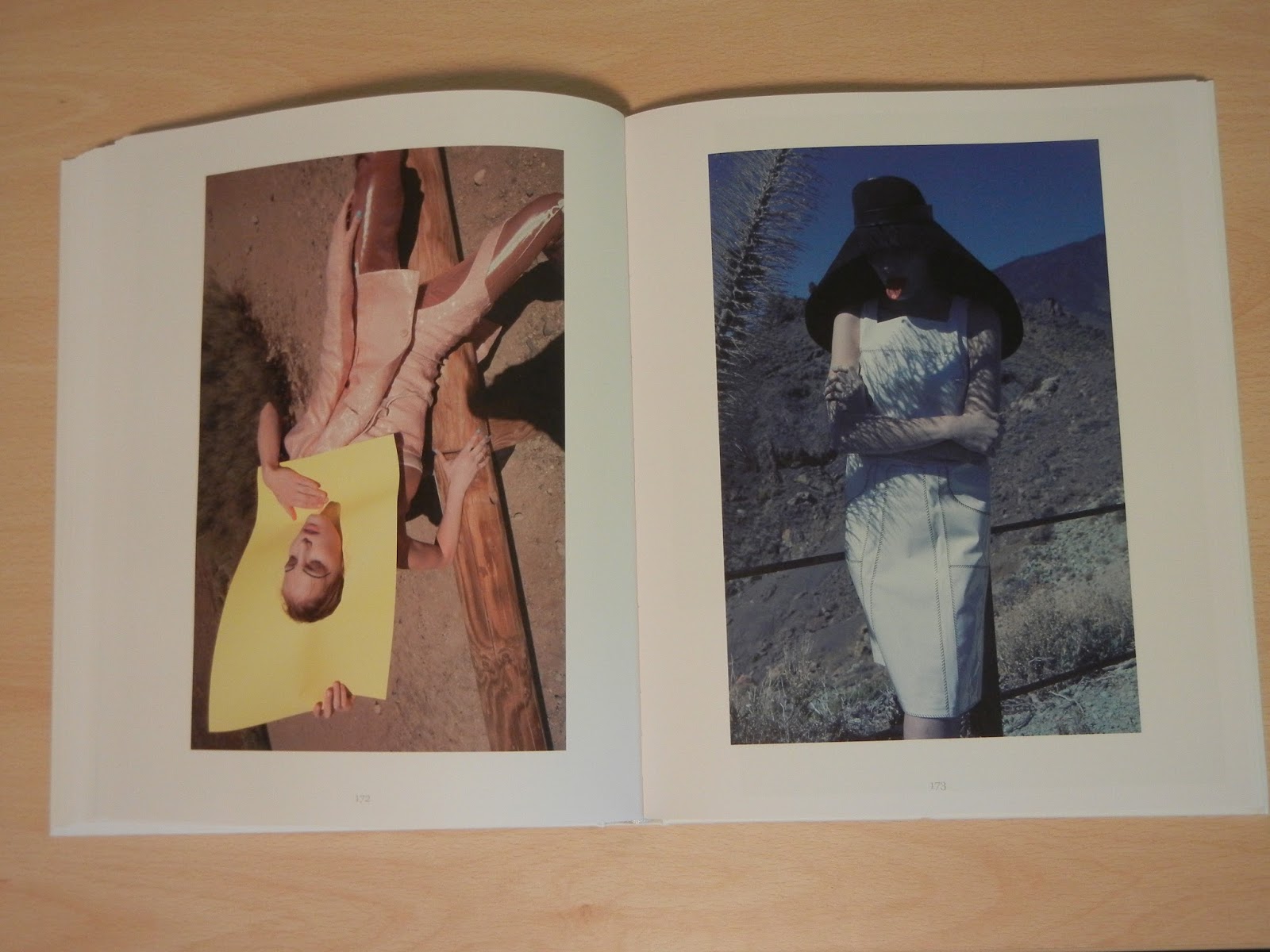
Book: Viviane Sassen, In and Out of Fashion

JTF (just the facts): Published in 2013 by Prestel (here). Hardcover, 296 pages, with 250 color images. The volume includes essays by Nanda van den Berg and Charlotte Cotton, and a spread by spread bibliography of Sassen's fashion work from 1998 to 2012. (Spread shots below.)

Comments/Context: For all its attempts to catch our eye with outlandish styling and elaborate set-ups, much of contemporary fashion photography still follows the simple underlying formula of the model and dress (or other accessories) given front and center attention. As a result, no matter how fresh, original, or shocking the surrounding trappings might be, the central compositions have a familiar, generic uniformity to them; there are only so many ways to pose a model while still explicitly featuring the fashions. A casual flip through any thick fashion monthly will quickly clarify the conventional boundaries most fashion photographers are working within.
 
These genre-defining methods are what make Viviane Sassen's fashion photographs seem so unexpected. In comparison to the standard fare, her work brashly defies the normal routines, breaking quietly accepted visual rules left and right. This hefty volume is a retrospective look at Sassen's fashion photography from 1998 to 2012 and offers a seemingly never ending stream of strange surprises. Her pictures are the opposite of obvious or straightforward, forcing the viewer to do a double take just to puzzle out what is going on; she plays on our ingrained expectations, and takes every opportunity to upend those short hand assumptions.
 
Sassen's compositions are built with a knowing eye for how the camera sees. Her models become sculptural human forms, where clothing is almost incidental to the posing of the limbs and torso. Bodies are bent, arched, and contorted in unusual ways, often further fragmented by the reflections of a mirror or made surreal by the intertwining of multiple models into one unlikely mass of arms and legs. Odd camera angles and vantage points (upside down, twisted, off kilter) add another layer of disorientation, making the flattening out of the visual field and the interplay of space even more mysterious. In nearly every shoot, she has rejected any kind of thematic narrative or clichéd setting (a day at the beach, a glamorous nightclub, a city woman on the street etc.) and instead opted for something much more inconclusive, abstract and conceptual.
 
Sassen takes this innovation further by disregarding another foundation rule of fashion photography - the idea that we need to see the model's face. In image after image, she obscures faces, covering them with dark shadows, hair, or simply the rotation of the body getting in our way. At first, this lack of looking eye to eye is meaningfully disconcerting; there is none of the usual back and forth connection we have come to expect. But this visual device forces the viewer to return to the sculptural realm, where beauty is seen in the shapes and forms on view. Sassen can then additional layers of extremity by punctuating a composition with intense light or bold color. Body paint, color filters, flares of color, neon light streaks, or simply the unexpected introduction of a brightly colored prop (a green garden hose, red shoes, an orange scarf, a yellow piece of construction paper) help to unbalance things. By the time all these ideas are crammed into one frame or shoot, Sassen's brand of surreal glamour has become ravishingly unconventional.
 
Seen across more than a decade of work, the originality in Sassen's eye is proven to be remarkably varied and consistent; time and again, she has done something startling, kicking us out of our visual ruts. Hers is the kind of work that always keeps us guessing, making us active and engaged participants in her images, rather than glassy eyed zombies mindlessly searching for the next fashions to consume.
 
Collector’s POV: Viviane Sassen is represented by Stevenson Gallery in Cape Town (here); she does not appear to have consistent representation in New York. More broadly, her work has not yet reached the secondary markets with any regularity, so gallery retail remains the best option for those collectors interested in following up.
 
Transit Hub:
  • Artist site (here)
  • Exhibit: Huis Marseille Museum, 2013 (here)
  • Features/Reviews: Time LightBox (here), photo-eye (here),  Feature Shoot (here)


Friday, July 26, 2013

Book: Alec Soth and Brad Zellar, LBM Dispatch #5: Colorado

JTF (just the facts): Published in 2013 by Little Brown Mushroom (here). Newsprint, 48 pages, with 42 black and white images taken by Alec Soth. Most of the photographs are accompanied by texts by Brad Zellar, and/or by quotes from James Galvin, EE Cummings, Willa Cather, and others. (Spread shots below.)
 
Comments/Context: While photocopied and small run artists' zines have long been part of an amorphous underground publishing community, there is no doubt that the explosion of economically viable self publishing options that have emerged in the past few years has dramatically reshaped the photo book industry. While major titles with superlative printing and design may still follow more traditional production paths and release schedules, the do-it-yourself disruption has led to a flourishing of book making creativity and innovation, and a fast moving landslide of publications that don't look and feel like we expect them to. The five crammed shelves of revolutionary photobooks included in this year's ICP Triennial are a testament to just how important this phenomenon has become to the way we are experiencing contemporary photography.
 
The LBM Dispatch series from Alec Soth and Brad Zellar is a fantastic example of how newfound publishing freedoms have allowed artists to follow their own interests more precisely. Their "books" are nearly the opposite of what we've been taught to appreciate: they're big (tabloid sized), they're printed on cheap disposable paper (newsprint), they're relatively inexpensive, and they reject the normal "parade of solitary imagery" approach by liberally mixing photographs and text. But by breaking all the rules, what Soth and Zellar have really done is simply matched form to function, molding the in-your-hands physical display to fit the kind of serial storytelling they want to do, which by the way, is a kind of storytelling that they've had to reinvent because it's been overlooked for so long.
 
At the simplest level, the LBM Dispatch project falls into the long American tradition of expedition and road trip photography. Walking in the footsteps of everyone from Timothy O'Sullivan to Robert Frank, Soth and Zellar have headed out on rambling open ended trips and documented what they've found. But unlike their predecessors, Soth and Zellar have brought prose much more fully into the artistic end product; the texts here are not addendums or afterthoughts, but integrated parts of the collaborative storytelling experience. While the James Agee/Walker Evans team is certainly once precedent, I think there is stronger kinship here with the work of Wright Morris, where text and pictures were used with nearly equal brilliance to capture the nuances of specific American places and times.
 
In this particular issue, Soth and Zellar have driven the roads of Colorado, taking in healthy gulps of mountain vistas and frontier spirit. While their trips clearly have a dose of serendipity, these are not really random moments; they've done their homework, read their history, and are looking for certain kinds of encounters that will touch on larger themes. This method of building up a narrative is well suited to Soth's approach to photography; he has never been one to be pigeon holed into just portraits, landscapes, still lifes, or any other type or subject matter, so this kind of vignette-driven storytelling fits well with his natural working style. While rugged snowy mountains and huge storm clouds are an inescapable part of any portrait of Colorado, Soth and Zellar have dug deeper than the stunning landscape, probing the edges of local communities, common folklore, and the undercurrent of violence seemingly inherent to life in this wide open country.
 
Many of Soth's photographs in this book are portraits of people and objects, seen with an open, unassuming honesty that allows a sliver of the surreal to slip in nearly undetected: a bearded man stands in front of an enormous pile of antlers, while another sports a plastic mask of Doc Holliday, and a woman in formal riding gear waits for her horse perched on a set of stairs, while another beams in her colonial frontier dress amid a row of parked cars. Often, the still life objects and places are secondary evidence, physical remains with some additional resonance: a tombstone of a famous cannibal, the path leading to the Columbine High School memorial, a bullet hole in the wall at Focus on the Family, a rusted out, pock-marked car in the dust near the home of the Dragon Man, a plastic bear torso at a local archery club. Each image tells its own self contained mini-story, and contributes to the weaving of a larger non-linear tapestry of collective impressions.
 
Zellar's words are equally important to the overall rhythm of this collaboration. Some of his contributions are casual, quirky interviews with the portrait sitters, often laced with nuggets of personal history or pithy wisdom. Others are background explanations, reflections, or poetry selections, incomplete hints of something more, but just enough to give us some context or a narrative handhold to grasp. The cadence of his voice is quiet and conversational, generally pared back to essentials and lacking in showy verbal flourishes, with a soft, poetic irony that is at once true to the facts and open to interpretation. His texts are easy going and approachable, authentically curious in their search for meaning, but appropriately ambiguous and open ended. Perhaps most amazingly, Zellar and Soth have got the artistic balance just right, where the mood of the photographs and the content and style of the prose never compete or trample on one another.
 
What I like best about this collaboration is that it has produced a truly personal riff on visual storytelling. They have blatantly disregarded the notion that words and photographs have no business mixing together, and instead have embraced the combination of forms as a more flexible method of communicating their own kind of mysterious narrative. They have resolutely camped out in no man's land, bring prose that is more than a caption but less than an essay into direct conversation with individual images, allowing each photograph to open up further. And they have rejected the notion that such a product need thump down on your coffee table, and have instead offered us a physical form that can be enjoyed with unassuming pleasure. All in, Soth and Zellar have taken a bunch of obvious risks and delivered something of unpretentious grace and genius, a product that elegantly fits both who they are and the way they see the world.
 
Collector’s POV: Alec Soth is represented by Sean Kelly Gallery in New York (here). Soth's photographs have begun to appear in the secondary markets more regularity in recent years, with prices ranging from roughly $4000 to $22000.
 
Transit Hub:
  • Alec Soth artist site (here)
  • Alec Soth - Magnum Photos page (here)
  • LBM Dispatch tumblr (here)
  • Feature: Vice (here)


Friday, July 19, 2013

Book: Daido Moriyama: Sunflower

JTF (just the facts): Published in 2011 by Match and Company (here). Hardcover, 88 pages, with 64 black and white images. The photographs included were taken between 1965 and 2009. There are no essays or texts. (Spread shots below.)

Comments/Context: Daido Moriyama's photographs of flowers aren't like most floral pictures. They aren't intricate botanical specimens, up-close geometries, or bright blossoms captured at the peak of their freshness and beauty. Moriyama's flowers are much darker and edgier, turning floral innocence into something alternately sultry, menacing, decaying or decidedly urban. This book brings together a broad sample of Moriyama's flowers, taken over four prolific decades, offering a subject matter-based view into his singular aesthetic.

This edit applies perhaps the loosest possible definition of "floral" to the photographs that have been included here. While there are a handful of single images of sunflowers, roses, hydrangeas, tulips, and the like, as well as some wider shots of fields and cherry trees, for the most part, Moriyama has avoided straight-on floral portraits. Instead, his flowers are found in the flow of daily life, in bursting bouquets wrapped in plastic and tin foil, reflected in shop windows, and discarded in dingy gutters and alleys. They are often seen in flash lit glare, looming out of the surrounding darkness with out of place, tactile seductiveness.

Moriyama's restless eye for the contrast between flowers and their surroundings extends in all directions, from printed floral clothing and tawdry motel furnishings to funeral wreaths and elaborate tattoos. Patterned blouses and skirts, swimsuits and shoulder bags all add a pop of flower power to an otherwise shadowy world, while bedspreads, curtains, and worn carpet with floral prints add a touch of faded energy to empty rooms. Hints of floral motifs show up in even more subtle and unexpected places in Moriyama's world, in lace lingerie and underwear and on ironwork benches and shop awnings. Even fireworks, dancefloor confetti, and nighttime snowflakes become vaguely floral when seen from the right angle.

The best of Moriyama's flowers have a lush eroticism that feeds on his dark palette; whether literal or figurative, they have a lurking sense of knowing danger or spent beauty. Even the cheapest and ugliest of his flowers have some seedy come hither attraction, trading pure elegance for something a little grittier.

Collector’s POV: Daido Moriyama has been a prolific book maker, and the specialized secondary markets and photobook auctions are routinely stocked with vintage rarities for deep pocketed collectors. Morimaya's photographs have also become more widely available at auction in recent years, with print prices generally ranging from $2000 and $40000.

Transit Hub:
  • Artist site (here)
  • Features/Reviews: Japan Exposures (here)


Tuesday, July 16, 2013

Book: Ron Jude, Other Nature

JTF (just the facts): Published in 2008 by The Ice Plant (here). Hardcover, 80 pages, with 39 color images. Aside from a short Kafka quote, there are no essays or texts. (Spread shots below.)

Comments/Context: There is something truly wondrous about picking up an unknown photobook and having it grab you. Unlike gallery and museum shows which relentlessly come and go with the changing seasons, a photobook is permanent, an artifact to be unearthed at any time in the future and enjoyed by its future discoverer. Some of you (especially the photobook crazed among you) will wonder why I would review Ron Jude's Other Nature some five years after its publication, but the truth of the matter is that I just found it. While I had tangentially heard about Jude's work, I hadn't ever seen any of his prints in person, nor had I taken the time to track down one of his books. So for me, seeing this book was entirely fresh and new, an introduction to a photographer I had meant to investigate.

A first flip through the pages comes off a bit dull and boring: medium range scraggly landscapes interspersed with nondescript hotel room details, all offered in deadpan color clarity. But with longer looking, both sets of pictures start to reveal themselves as quite a bit more thoughtful. Jude's landscapes have compositional echoes of early 1980s Lewis Baltz (San Quentin Point) and Robert Adams (Los Angeles basin), but without the same suburbanization/ecological point of view. In fact, they have no point of view at all; there is no obvious sense of location, no potential narrative, nothing but an interrupted, blocked view of the land, often decorated with the lazy detritus of human involvement. Overgrown greenery, thick evergreen hedges, dry scrubland decorated with rusty oil drums, sandy desolation with the twist of a garden hose, every image is a reductive smack in the face, the opposite of what we think a landscape should be.

Jude's interior still lifes are equally familiar yet unknowable. Doors and windows are closed, and artificial surfaces and textures stand in for reality. Fake wood paneling, vegetal vine patterns in drab carpeting, the synthetic stickiness of an extra blanket in the closet, the shiny plastic of an empty pastry rack, they all try to give us a clue to a larger story, but ultimately fail. When interleaved with the outdoor landscapes, a rhythm is created, moving back and forth between outside and inside with a frustration that borders on subtle tweaking comedy. There is no way into this body of work, and that, in a certain way, is the insightful point.

So what Jude has done is actually made a book of landscapes that aren't landscapes, in the sense that they don't function in the way that normal landscapes do. His project is more of a conceptual deconstruction of the genre, breaking each image down until it stands right on the knife edge of narrative plausibility, teasing us with our preconceptions but ultimately running off laughing. The hotel interiors provide the palate cleanser between courses of thwarted intention, where clean geometries balance the unruly wildness of the natural world. Seen together and in careful sequence, the images upend our sense of how a photograph is supposed to operate. That deliberate removal of narrative is a powerful concept, one that left me impressed with just how smart this book is.

Collector’s POV: Ron Jude is represented by Gallery Luisotti in Santa Monica, CA (here). Jude's work has little or no secondary market history, so gallery retail is likely the best/only option for those collectors interested in following up.

Transit Hub:
  • Artist site (here)
  • Features/Reviews: Fraction (here), 5B4 (here), The Photobook (here)
  • Interviews: Ahorn (here)


Tuesday, July 9, 2013

Book: Asger Carlsen, Hester

JTF (just the facts): Published in 2012 by Mörel Books (here). Hardcover, 48 pages, with 21 black and white images. There are no essays or texts. (Spread shots below.)

Comments/Context: When describing classic nudes from photographic history, we often refer to the bodies as being "sculptural", where the curve of a hip or the bend of an arm is somehow abstracted beyond its fleshy existence into an elemental realm of line and form. Asger Carlsen's new book Hester takes the concept of the sculptural female nude to its ultimate limit, where constructed "bodies" are assembled mad scientist-style into impossible Frankenstein combinations of merged musculature and borrowed limbs. His results are at once reverential to the aesthetic traditions of the genre and deeply unsettling.

Posed against the white walls and bare wood floors of a studio, Carlen's nudes seem at first glance to take their cues from any number of pared down photographic studies of the human form - unadorned flesh reduced to its simplest essence. But Carlsen's digital concoctions quickly disrupt this conclusion, sending us down the rabbit hole of mind bending distortions, scary deformities, and stomach turning mutations. Arms become legs, spines are twisted back to front, and bulging limbs explode from unnatural locations. Many of the headless bodies are reduced to smooth skinned torsos and blocky masses of flesh, with folds of skin borrowed from one location and grafted somewhere else.

While Carlsen's previous body of work had an element of dark humor, these photographs never take on a jokey feeling, even when one of his nudes has three ass cheeks. Several of Carlsen's forms seem reminiscent of Hans Bellmer's surreal poupee, especially when legs extend in opposite directions. Others seem to borrow from Francis Bacon's melted faces and distended bodies, but without the raw psychological emotion; Carlsen's mute bodies writhe and bend in equally disturbing ways, but they are generally free of buried anguish. Carlsen's innovation is that he has truly broken the nude down into component parts, turning each piece of skin and bone into a malleable puzzle piece, to be mixed and matched in seemingly endless deadpan combinations. Compared to normal human bodies, his constructions are in some sense altogether horrifying, like some questionable medical experiment gone tragically wrong. But their apparent realism (especially in the way light glances off skin) keeps the viewer off guard, forcing us to constantly match his fabrications with our own knowledge of how bodies actually fit together.

For all their creepy oddness, I think these works are a terrific example of digital manipulation used smartly. By staying within the boundaries of certain visual conventions, his constructed figures start off with an assumption of plausibility, which enhances their power when the inversion finally comes. Carlsen's nudes would make a great ending to a traditional historical survey of the genre, effectively yanking the rug out from under the previously contented visitors.

Collector’s POV: Asger Carlsen doesn't appear to have US gallery representation, but V1 Gallery in Copenhagen (here) has prints available. Carlsen's work has little or no secondary market history, so gallery retail is likely the best/only option for those collectors interested in following up.

Transit Hub:
  • Artist site (here)
  • Features/Reviews: A Photo Editor (here), American Suburb X (here)
  • Interviews: VICE (here), Lay Flat (here)


Wednesday, July 3, 2013

Book: Craig Fineman, Pools

JTF (just the facts): Published in 2012 by Stussy/Dashwood Books (here and here). Hardback, 68 pages, with 66 black and white images. The book also includes short essays/remembrances by Duncan & Malcolm Campbell, Michael Gutierrez, Jim Goodrich, Pat Ngoho, Audrey Rader, Lorin Flemig, and Mike Funk. (Spread shots below.)

Comments/Context: Craig Fineman's black and white images of late 1970s dry pool skateboarding aren't like most skateboard photography. They aren't about attitude, or swagger, or roughness, or trick making one-upsmanship. Instead, they turn the gravity defying moves of these athletes into a kind of stop motion ballet, following the flowing momentum of arms and legs across curved expanses of smooth concrete and then freezing the action at moments of grace and power. They capture skateboarding with a sense of pared down purity that seems almost elemental.

The images in this thin volume were all taken at one midday session, where the bright sun beats down and casts shadows across the lip of the empty kidney shaped pool. In many cases, Fineman positioned himself at the bottom of the pool, looking up at his subjects as they moved up and down the side walls. The result is a set of images that are often underneath the action, where the apex of the turn is the most precarious and the subject is about to drop. Riders balance with outstretched arms and flexed knees, turning with precision or grinding the edge, with long sun bleached hair thrown into motion.

The architecture of the set up and Fineman's sense for composition lead to images with unexpected vitality. Bodies surf the concrete like waves, cresting with stored potential energy. The shadows cast on the bottom of the pool are like echoes of the primary action, the silhouettes distorted into another plane of movement. And when the upward angle is just right, the extended fingers of the riders seem to pluck the electric wires overhead like guitar strings. 

The fluidity and suppleness in these images transcends the normal boundaries of sports photography, taking the pictures toward the elegance of dance. Fineman's photographs combine wheels up muscularity with sculptural refinement, turning the gestures of the riders into natural forms.

Collector’s POV: It is not at all clear where vintage prints from this book might be found, as Fineman doesn't appear to have either obvious gallery representation or any secondary market history. Add the information to the comments area if you know the details.

Transit Hub:
  • Features/Reviews: American Photo (here), Trendland (here), Slate Behold (here)


Monday, February 11, 2013

Book: Sam Falls, Problems with Decomposition

JTF (just the facts): Published in 2012 by Mörel Books (here). Paperback, 60 pages, with 31 color images. There are no essays or texts. (Spread shots below.)

Comments/Context: Sam Falls is one of a new crop of contemporary artists who has his roots in the soil of photography but is otherwise seemingly unconstrained by the traditional boundaries of medium or genre. The works in this thin volume traverse the borderlands between photography and painting, creating multi-layered hybrid images that investigate the less-than-obvious essence of still life objects and probe the conceptual connection between a photographic image of something and its physical imprint. He is clearly experimenting with the definitions of representation, pushing us to consider what information each artistic method is best at conveying.

The underlying premise of this series of works is elegantly simple and concise. Falls starts with studio set-ups of piles of tires and groups of fruits and vegetables, set against a rainbow of bright colored backgrounds. Photographs of these still lifes are then used as the foundation for painted overlayers, which are made block print style by covering the objects in question (or sliced halves of those items) with colored paint and laying down impressions right on top. Tires become interlocked circles like Olympic rings, blueberries become small dots, halved peppers become lumpy heart-shaped outlines, and bunches of bananas become radial arrays of stubby fingers, all executed in color-coordinated harmony. Together, the works show us both a crisp two dimensional image and a messy, tactile manifestation of the subject, mixed and interleaved in one combined portrait. The effect is playful and exuberant, while still retaining a brainy edge, and the smart wordplay between "composition" and "decomposition", between indestructible rubber and quickly rotting fruit, adds another flash of subtle cleverness. Overpainting photographs could easily come off as crafty or contrived, but Falls' works avoid this preciousness, adding a layer of relevant gestural movement to the static documentation provided by the underlying photograph.

This small book is neatly self-contained, offering a single body of work in enough depth to see the variations and permutations taken to their logical limits and sequenced with care to accent the natural rhythms of the changing subject matter and color palette. It's meaningful proof that a photobook need not be a door stop, and that an intimate, unadorned paperback presentation can be just the right formula for works that already have plenty of visual pop.

Collector’s POV: Sam Falls is represented by American Contemporary in New York (here) and by M+B Gallery in Los Angeles (here). He also had a solo show in New York at Higher Pictures in 2011 (here).

Transit Hub:
  • Features/Reviews: NY Times T magazine (here), Art in America (here), Les Rencontres d'Arles (here)


Friday, January 18, 2013

Book: Elad Lassry, On Onions

JTF (just the facts): Published in 2012 by Primary Information (here) and distributed by DAP (here). Paperback, 240 pages, with 112 color images. Arranged by Stuart Bailey and includes an essay by Angie Keefer. (Spread shots below.)

Comments/Context: Elad Lassry's On Onions is the kind of clever photobook that I wish the artist had made earlier in his career, as it would have helped me to find a more obvious entry point into his work. In the past few years, Lassry has become something of a rising star, with the requisite museum group shows, gallery solos, curator favor, and buzz in the press. His color saturated commercial-style still lifes with their matching frames have become an instantly recognizable signature look. And yet, at least for me, Lassry's photographs have heretofore been a bit of a head scratching mystery - original to be sure, but their seductiveness more often outweighed in my mind by lack of context and a mystifying randomness. I had a hard time trying to decipher their obtuse puzzle, or perhaps there was no puzzle at all and the images were purposefully campy and vapid.

What I like very much about this well designed book is that there is an underlying conceptual framework that holds these particular photographs together. The book balances two sets of imagery (onions and eyes), moving back and forth between the two groups in mixed bunches. Lassry's deadpan still life onions cover the entire taxonomy of types and colors (white, yellow, brown, red, green, pearl, and sweet) as well as depciting a selection of presentation and knife skills (chopped, sliced, sectioned, halved, peeled, grouped, and bunched). These forms are matched with variations on objectified eyes - contact lenses, arrays of colored lenses, sections of an eye, prosthetic eyes, and multiple black background retina scans that look alarmingly like veined onions or moons.

The parade of right-hand side images is tied together by a wandering meditative essay on tears that is interleaved among the pictures. It's an eclectic, brainy study, from a story about dysfunctional tear ducts and lacrimal glands to an examination of the different chemical properties of emotional and reflex tears. Along the way, we follow the path of the magical tear that changes a stuffed animal into a real rabbit in The Velveteen Rabbit and track the career of Hollywood director Douglas Sirk and his melodramas of hopeless situations and happy endings. The result is a smart sense of rhythm and wry purpose that was completely absent from my previous encounters with Lassry's work. It's not exactly an underlying narrative, but it's certainly a defining structure that provides logic and meaning to the sequence of pictures. In the end, it's still a quirky, open-ended project, but for the first time, there is a trail of bread crumbs to follow.

Collector’s POV: Elad Lassry is represented by David Kordansky Gallery in Los Angeles (here). He was included in MoMA's New Photography exhibit in 2010 (review here), had a show at Luhring Augustine in New York later that year, and recently had one of his images displayed on the High Line billboard.
 
Transit Hub:
  • Various reviews: NY Times, 2012 (here), LA Times, 2012 (here), Art in America, 2011 (here)


Monday, May 16, 2011

Auction: Important Photobooks & Photographs, May 19, 2011 @Swann

Swann has its Spring combo sale of photobooks and photographs in New York later this week, mixed right in the middle of the London season for maximum confusion. The photobooks section is littered with signed first editions and other rarities, highlighted by a massive single lot collection of monographs, portfolios, bound prints, loose photographs, and other volumes from 21ST Editions. The photographs section sticks more closely to the lower end/later print material Swann is best known for. Across the two sales, there are 391 lots on offer, with a total High estimate of $1704150. Since the two genres are so different, I've separated the analysis of the sale into two parts below.

Important Photobooks
.
Here's the statistical breakdown:

Total Low Lots (high estimate up to and including $10000): 122
Total Low Estimate (sum of high estimates of Low lots): $208050
.
Total Mid Lots (high estimate between $10000 and $50000): 5
Total Mid Estimate: $104000

Total High Lots (high estimate above $50000): 1
Total High Estimate: "Refer to Department"
.
The top lot by High estimate in the book section is lot 99, 21ST Editions, Collection, 1998-2010, at "Refer to Department".

Below is the list of photographers represented by 3 or more lots in the book portion of the sale (with the number of lots in parentheses):

Ed Ruscha (9)
Richard Avedon (5)
Walker Evans 5
Robert Frank (5)
Lee Friedlander (4)
Camera Work (3)
Henri Cartier-Bresson (3)
Eikoh Hosoe (3)
.
(Lot 45, Ed Ruscha, Twentysix Gasoline Stations, 1963, at $8000-12000, image at right, top, via Swann.)

Photographs

Here's the statistical breakdown:

Total Low Lots (high estimate up to and including $10000): 242
Total Low Estimate (sum of high estimates of Low lots): $1003100
.
Total Mid Lots (high estimate between $10000 and $50000): 21
Total Mid Estimate: $389000

Total High Lots (high estimate above $50000): 0
Total High Estimate: NA

The top lot by High estimate in the photographs section is tied between two lots: lot 161, Ansel Adams, Clearing Storm, Mount Williamson, From Manzanar, Sierra Nevada, California, 1944/1970s, and lot 212, Walker Evans, 5 photographs from the portfolio Walker Evans, 1935-36/1971, both at $20000-30000.

Below is the list of photographers represented by 4 or more lots in the photographs portion of the sale (with the number of lots in parentheses):

Andre Kertesz (9)
Edward Curtis (7)
Berenice Abbott (6)
Ansel Adams (6)
Edward Weston (5)
Ilse Bing (4)
Walker Evans (4)
Milton Greene (4)
Lewis Hine (4)
Horst P. Horst (4)
Alfred Cheney Johnston (4)
Minor White (4)

(Lot 268, Margaret Bourke-White, Hi-Level Bridge, 1928, at $3000-4500, image at right, middle, and lot 293, Toshio Shibata, Yugawara Town, Kanagawa Prefecture, 1993, at $2000-3000, image at right, bottom, both via Swann.)
.
The complete lot by lot catalog (for both parts of the sale) can be found here. The 3D version is located here.

Important Photobooks & Photographs
May 19th

Swann Galleries
104 East 25th Street
New York, NY 10010

Thursday, January 6, 2011

Top 10 Photobooks of 2010

Back in November, Photo-Eye graciously asked me to participate in their annual roundup of Top 10 lists of photobooks. These diverse lists have been published today and can be found here.

My first reaction to the Photo-Eye invitation was that it was a kind of challenge; to be included with such an esteemed group of photobook experts and working photographers was both flattering and somewhat problematic. Regular readers here will know that while I review photobooks quite regularly, I don't limit myself in any way by a book's publication date; I am equally happy to review books from this year or a decade ago, based on any number of quirky collector-driven reasons. I don’t really think about photobooks in "vintages", nor have I ever done a “best of” gathering for photobooks. To submit a list I could stand behind, I would have to think hard about what had really risen to the top in the past year, something it had heretofore never once occurred to me to do.

As I have said elsewhere before (here), as a photography collector (which is something entirely different than being a photobook collector by the way), I primarily measure photobooks by their use as reference and by their ability to provide meaningful and lasting ideas and education. In my view, the best books of the year are those that will get used, that will be pulled down from the shelves over and over again, for repeated reviewing and rereading. As such, most of my choices for 2010 are meaty monographs, retrospectives, or exhibition catalogues, with insightful essays and detailed background material. They are anchor books for any photography library, and I expect to wear them thin in the coming years.

I've listed below the details of each of these books (in alphabetical order by photographer or show title), with links to their publishers. For a short and snappy rationale for why I included each book, please visit (and patronize) Photo-Eye (here). I've also included links to my previous more in-depth reviews of these books or the related exhibits, as appropriate.

Uta Barth, The Long Now, Gregory R. Miller & Co.
.
Henri Cartier-Bresson, The Modern Century, Peter Galassi, Museum of Modern Art
(exhibit review here)

Lee Friedlander, America By Car, Fraenkel Gallery/DAP
(exhibit review here)

Moholy-Nagy, The Photograms, Catalogue Raisonne, Renate Heyne, Hatje Cantz

Zwelethu Mthethwa, Aperture
(book review here)

Helios: Eadweard Muybridge in a Time of Change, Philip Brookman, Steidl/Corcoran Gallery of Art

Framing the West: The Survey Photographs of Timothy O’Sullivan, Toby Jurovics, Library of Congress and Smithsonian American Art Museum

From Here to There: Alec Soth’s America, Siri Engberg, Walker Art Center
(book review here)

Starburst: Color Photography in America 1970-1980, Kevin Moore, Hatje Cantz
(exhibit review here)

Paul Strand in Mexico, James Krippner, Aperture
(exhibit review here)

Since I provided this list long before the overall results were gathered and posted, I haven't had the chance to see whether my choices as a collector have any correlation to those of the other experts polled; my guess is that my list won't overlap much with those of the rest of the judges. What I can say with conviction is that each and every one of these books took me deeper into a thoughtful exploration of the work at hand, inspired and instigated new seeing and thinking, and richly rewarded the investment of my time.

Tuesday, January 4, 2011

A Grab Bag of Holiday Photobooks

Over the holidays, I was lucky enough to receive a handful of photobooks, both old and new, as gifts. Rather than embark on full reviews for them all, I've added a few thoughts and reactions to each below:


Thomas Ruff, Surfaces, Depths, Kunstahalle Wien, 2009.
.
I first saw this book on a display shelf at David Zwirner, during Ruff's show there last spring (review here). What is striking about this book is that although it is bound like a regular retrospective catalogue, inside it is printed on newsprint, giving the pages a more fragile feel. This presentation totally recontextualizes many of his older projects, especially those that appropriate black and white imagery. The book is the first place I have found that publishes his new Cassini and Zycles works, and it also includes stereo photographs, interiors, newspaper images, and "portraits" of Herzog & De Meuron buildings that I had never seen before. All in, an unexpectedly terrific addition to the discussion of Ruff's work.
.
Barbara Crane: Chicago Loop, LaSalle Bank, N.A., 2001. (here)
.
Kim Bourus of Higher Pictures (which represents Crane) showed me this book a year or so ago, and I have been wanting a copy for our library ever since. It gathers together a group of black and white images that Crane made of the Chicago Loop between 1976 and 1978, and the works could hardly be a better fit for our particular collecting affinities. Each is a textural mix of geometric layers, where grids of windows and edges of skyscrapers are deftly juxtaposed and flattened into intricate patterns and abstractions. It's a spectacular exercise in compositional control.
.
Irving Penn, Still Life, Bullfinch Press, 2001.
.
I'm not exactly sure why we've never acquired a copy of this Penn standard, but I was nevertheless glad to see it emerge from under the tree on Christmas morning. I was most excited to see some of the less familiar images that are mixed in among the greatest hits, and for the first time, I started to understand Penn's still life work within a stronger sense of chronology, starting in the late 1940s and moving back and forth between commercial and more personal work through the decades.
.
William Abranowicz, Hellas, Hudson Hills Press, 2010.
.
Abranowicz' new images of modern Greece are filled with warmth and affection. Elderly men and women tend goats and sheep or idle in the streets and cafes, while still lifes of fish and tomatoes pop with mouth-watering exuberance. The enveloping blue of the Mediterranean is rarely far from view, and cloudless skies range from washed out pastel to almost purple. What keeps these pictures from becoming a travel brochure is their subtle mixing of the modern and ancient: religious icons, church spires and island landscapes are juxtaposed with kisses on the beach in Mykonos, tourist postcards, and active nightlife. The story keeps shifting, with moments of subtle realism poking through the veil of obvious expectations.