Showing posts with label Lehmann Maupin. Show all posts

Monday, February 4, 2013

Robin Rhode: Take Your Mind Off the Street and Paries Pictus @Lehmann Maupin

JTF (just the facts): A total of 9 multi-panel works and 1 single image photograph, framed in white and unmatted, and hung against white walls in the two separate gallery venues. Each of the multi-panel works is made up of a series of 16x24 c-prints, gathered into sets of 8, 9, 12, 15, or 16 prints. All of the works were made in 2012-2013 and are available in editions of 5+2AP. The round single image photograph is sized 73x73. The show also includes 2 metal sculptures suspended from the ceiling in the 26th Street location and a series of crayon-colored wall decals in the Chrystie Street location. All of the photographs are on view at the 26th Street location, except for 1 set of 8 prints (switchblade) shown on the second floor balcony at Chrystie Street. (Installation shots at right.)

Comments/Context: Robin Rhode's photographic works distill an unlikely mash-up of artistic styles and genres into cleverly simple visual vignettes. Mixing equal parts hip-hop street art and active performance with a photographic approach that reaches back to Marey and Muybridge, his mini-stories play out with flip book style lightness and ease. Told against the backdrop of anonymous walls and using himself as a kind of subtly comic straight man, his works play with camera-viewed flatness and perspective, using iterative stop motion steps to create a linear progression of time and narrative.

Most of Rhode's series are step-by-step charcoal drawings (black on white or white on black) that find the artist interacting with the evolving hand-drawn scene behind him. Huge feathers fan out in an arc, a car spanner spirals overhead, and a massive comb makes crossed striations on the wall. Unexpected scale and optical trickery often play a part: an oversized afro pick pumps up a tangled ball into a big circle, birds fly over a barbed wire fence, and ships multiply across a wavy sea tracked by sight lines drawn straight from Rhode's eyes. Motion is indicated by cartoon swooshes, giving the bounce of a basketball, the curved climb of a bicycle, and the speed of a car the appearance of movement. Rhode's works give the one-liner of street art more degrees of freedom, allowing basic visuals to morph and change.

These recent works feel slightly less subversive and reactionary than previous works I have seen by Rhode; they have less political edge and more carefree wit. I think this softens their impact, tipping the balance away from social critique and toward nimble ingenuity. This doesn't diminish their imagination or originality, but it reduces their perceived weight. These works ask less of us, and as a result, feel more like exercises in whimsy.

Collector's POV: The photographic works in these shows range in price from 50000€ to 75000€ based on size/number of panels. Rhode's work has not been consistently available in worldwide photography auctions; when it has shown up, it has generally been placed in the Contemporary Art sales. Recent prices have ranged between $30000 and $35000, but these numbers should be taken with a degree of caution as my data from these sales is less comprehensive.

Rating: * (one star) GOOD (rating system described here)

Transit Hub:
  • Features/Reviews: TimeOut New York (here), ArtFCity (here), ArtINFO (here), GalleristNY (here)

Robin Rhode: Take Your Mind Off the Street and Paries Pictus
Through February 23rd and March 16th

Lehmann Maupin
540 West 26th Street
New York, NY 10001

Lehmann Maupin
201 Chrystie Street
New York, NY 10002

Wednesday, May 16, 2012

Gilbert & George, London Pictures @Lehmann Maupin and Sonnabend

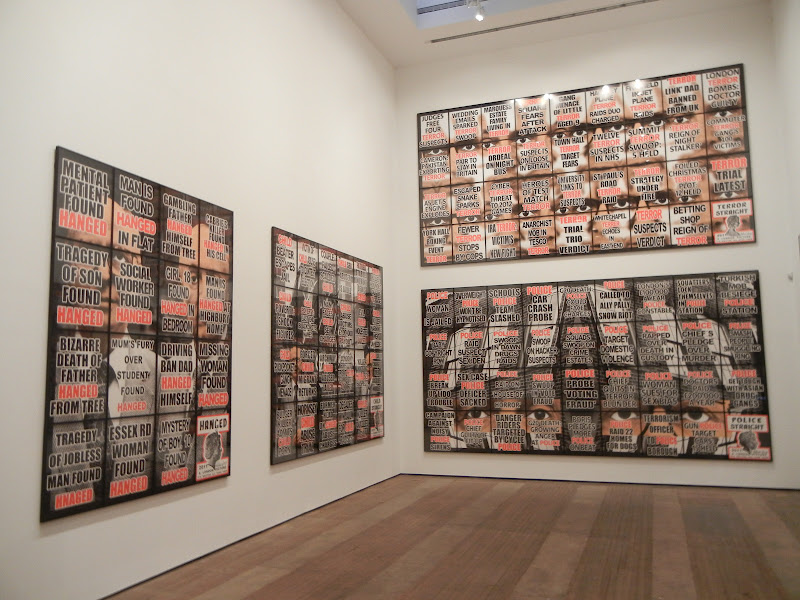
JTF (just the facts): A total of 66 multi-image works spread across 3 gallery venues. Each mixed-media work is made up a grid of individual images hung edge to edge, each framed in black and unmatted. The works range in size from 4 panels (2x2, sized 60x50 in total) to 36 panels (4x9, sized 119x225 in total). All of the works are unique and were made in 2011. A catalog of of all 292 of the works in this London Pictures series was recently published by Hurtwood Press (here) and is available from the galleries for $30. (Installation shots at right, from all three galleries.)
 
For each of the venues below, I have used the panel configuration as the method for tallying the number of works on view (in parentheses):
 
Lehmann Maupin Chrystie Street (18)
 
Front Room
2x2 (1)
4x4 (1)
5x4 (1)
 
Main Space
4x4 (3)
4x6 (4)
4x9 (2)
 
Upstairs Room
2x2 (6)
 
Lehmann Maupin West 26th Street (23)
 
Main Space
3x3 (2)
3x4 (5)
3x6 (2)
4x6 (4)
 
Back Room
2x2 (6)
2x3 (4)
 
Sonnabend (25)
 
Side Front Room 1
2x2 (2)
2x3 (1)
3x5 (1)
3x6 (1)
 
Side Front Room 2
2x2 (1)
3x4 (2)
3x6 (1)
 
Entry Room
2x2 (1)
 
Back Center Room
2x2 (2)
2x4 (1)
3x4 (1)
 
Back Left Room
2x3 (3)
3x3 (2)
 
Back Right Room
2x2 (2)
2x4 (1)
3x3 (2)
3x5 (1)
.
Comments/Context: Gilbert and George's sprawling new series London Pictures is really the final outcome of a rigorously academic linguistics study, delivered in the form of contemporary art. It is a meticulous and exhaustive examination of words and their charged relationships in our attention starved modern culture, thrown back at us in carefully ordered groups of shouting, hysterical headlines from the tabloid press. Spread across three galleries here in New York (and countless others across the globe from London to Hong Kong), the works are a taxonomy of urban horrors, collated and ordered into surprisingly universal patterns.
 
The back story to these pictures starts with the tearsheets found displayed outside newsstands across London. Gilbert and George managed to discretely steal a total of 3712 of these disposable posters over the period of several years, providing them with the raw material for their further sorting and classification of subjects and key phrases. The resulting clusters of common topics tell the story of 21st century urban life, with an eye for the shock factor that catches eyes and sells papers. Citizens are STABBED, HANGED, KNIFED, and MURDERED, while a parade of troublemakers and undesirables run rampant: ADDICT, MUGGER, PLAYBOY, BANKER, BURGLAR, RAPIST, GUNMAN, HOOKER, KILLER, DRUNK. TERROR, SEX and DEATH are never far behind (see the entire list in the installation shot from Sonnabend above). Displayed in large block letters and highlighted in vibrant red, these repetitive words and phrases dominate the artworks, the rest of the text (in black) fading into the background. The effect is both initially startling and ultimately dulling, as the weight of the text piles up.
 
The black and white photographic images that lie behind the graphic design elements are often patterned or kaleidoscopic, but in a supremely unassuming manner. Tree limbs and brick paving provide angled patterns, while rows of faceless windows, sidewalks, and car reflections are distorted by fish eye lenses. Gilbert and George appear as peach-faced, dapper-suited characters, like grim pedestrians on the street. And the profile of the queen (taken from various coins) makes an appearance in the corner of each work, hovering over the messiness of life with stiff upper lip formality. But all of this imagery is secondary to the bold overlaid text, which relentlessly pounds the viewer into submission.
 
I visited all three NY venues for this mega-show, and there is certainly a sense that once you have seen a few of these works, you've seen them all. This is entirely a function of visual overstimulation; seen as stand alone works, these will all pop off the wall, but when seen together over and over again, they quickly lose their punch - the shocking is no longer so urgent once you've seen it a dozen times, which is perhaps an apt reflection of our media saturated lives. In any case, if you're only going to visit one of the three spaces, I'd suggest going to Lehmann Maupin's Chrystie Street venue, as it has both the largest grids its towering main gallery, as well as a selection of the small grids upstairs, so you can see the whole breadth of the project in one place.
 
In the end, I like the mix of appalling truth and the can't-make-this-stuff-up wackiness that is found in these grids of words. Gilbert and George have reminded us how the odious and the offensive have become everyday entertainment, and how commonplace and universal these tawdry tales really are. They have mapped the sensational, dumbed-down vocabulary of big city living, exposing the lurid extremes that we now take for granted.
 
Collector's POV: The works in these shows range in price from £50000 for the smallest 2x2 grids to £160000 for the largest 4x9 grids. Using an average selling price of £75000, the 292 works in the full series represent roughly £21900000 of primary market value; collectors should get used to seeing these works, as they are likely to become a fixture in the secondary markets for years to come. In general, works by Gilbert & George can be found at auction with regularity at this point, mostly in Contemporary Art sales as opposed to Photographs sales. Prices for their multi-panel works have ranged between roughly $50000 and $900000 in the past decade, with a few single image or editioned works at lower prices.
.
Rating: ** (two stars) VERY GOOD (rating system described here)
.
Transit Hub:
  • Features/Interviews: Art in America (here), Wall Street Journal (here), Telegraph (here), Daily Beast (here), Economist (here), Huffington Post (here)
Gilbert & George, London Pictures (here, here, and here)
Through June 23rd

Lehmann Maupin
540 West 26th Street
New York, NY 10001

Lehmann Maupin
201 Chrystie Street
New York, NY 10002
Sonnabend Gallery
536 West 22nd Street
New York, NY 10011

Wednesday, February 22, 2012

Juergen Teller @Lehmann Maupin

JTF (just the facts): A total of 21 color works (19 single images, 1 triptych, and 1 four panel work), framed in white with no mat, and hung in the entry room, the main gallery space, and a small room on the second floor. All of the works are c-prints, in editions of 5, ranging in size from 10x8 (or reverse) to 24x20 (reverse), with intermediate sizes of 14x11, 16x12, and 20x16 (or reverse). The images were taken in 2010 and 2011. (Installation shots at right.)

Comments/Context: Seeing the recent work of well-known fashion photographer Juergen Teller has got me mulling over what it means to be a contrarian in the context of contemporary photography. I think a pretty compelling case can be made that Teller's aesthetic style contradicts almost everything we associate with fashion/glamour/celebrity photography, which is why it stands out so joltingly in the countless pages of ads in a fashion monthly. His work is raw, rough, and consciously imperfect, blindlingly flash-lit and captured with a compositional style and snapshot look that is often exaggerated to its logical extreme. His images can be shocking and provocative, so much so that they border on being dismissed as off-hand stunts. And yet his best images are the ones that use this unconventional, sometimes harsh, approach to get at a fresh underlying layer of reality and truth, one that would have normally stayed hidden in the controlled perfection of twenty-first century glamour.

If, however, we take Teller out of his fashion sand box and ask his photographs to stand in comparison with the larger context of contemporary photography/art, which is already full of hell raisers and rule breakers by the way, I wonder about whether at least some of his pictures start to lose their juxtapositional punch. This show includes a number of  forgettable dirt road landscapes and quiet views of pastoral scenes. These images have no verve, no edge, no rebellion, and the mix of beauty and ugliness in the landscape has been done better by many others before; taken off the walls of this show, even a photography expert would have little chance of identifying them as made by Teller.

But what does work here are those pictures and portraits that startle and puzzle: a soaking wet dog flanked by a riot of pink roses, the delicate neck of Roni Horn's stuffed swan seen from behind, a creepy nude of Kristen McMenamy wearing black eye makeup and a pointy shark jawbone. The star of this show is the triptych of Vivienne Westwood tucked away in the upstairs gallery (it's in the middle of the bottom installation shot): it's striking, unsettling, and surprisingly beautiful all at once. The nude Westwood is draped across an ornate chaise decorated with bright orange pillows, her fiery orange hair and her milky white skin competing for attention. She's like a contemporary (and clearly older) version of Manet's Olympia (an allusion I don't throw around lightly): frank, seductive, unnervingly explicit, and thoroughly unexpected. In these images, Teller's brash approach has clearly unlocked something both controversial and enduring.

I suppose my conclusion is that if an artist is going to take the path of the contrarian, then his/her job is to consistently push us out of our comfort zone and challenge us to broaden our ability to see. We may not ultimately like this much, but I think we can respect it. To my eye, this show mixes too much conventional material in with the subtle and not-so-subtle shockers, and so the overall confrontational power of the show is somewhat diluted. That said, when Teller does open the throttle, the handful of strong images here testify to his ability to create elegant comparative dissonance.

Collector's POV: The single images in the show are priced between £3800 and £6000, based on size (all prices quoted in £). The triptych is £35000 and the 4 panel work is £16000. While Teller's name recognition is high, his work still has very little secondary market history, so gallery retail is likely the only viable option for collectors at this point.

Rating: * (one star) GOOD (rating system described here)

Transit Hub:
  • Features/Reviews: Vogue (here), Flavorwire (here), Huffington Post (here)
Juergen Teller
Through March 17th

Lehmann Maupin
201 Chrystie Street
New York, NY 10002

Friday, September 18, 2009

Juergen Teller, Paradis @Lehmann Maupin

JTF (just the facts): A total of 9 color images, framed in white with no mat, hung in the main gallery space. All of the images are c-prints, in editions of 5, ranging in size from 50x30 to 70x50. The works were originally commissioned by the French magazine Paradis and were shot in 2009; a limited edition book of the work is forthcoming. (Installation shots at right.)

Comments/Context: Fashion photographer Juergen Teller clearly has his pick of choice assignments: who else gets access to shoot in the Musee du Louvre when it's empty in the evening? And who else can deliver Raquel Zimmermann (model) and Charlotte Rampling (actress) to participate in the project? And nude no less?

There is remarkable sense of audaciousness and rule breaking in these pictures: nudes lounging on the couches in the galleries, standing stock still like mannequins amidst classical sculpture, and casually posing with the Mona Lisa; the jarring juxtapositions clearly have tremendous shock value, and will therefore appeal to a certain group of contemporary/fashion collectors who thrive on controversy and recklessness.

As photographs, however, the images are pretty underwhelming. Over bright flash, dead pan looks, and offhand compositions detract from what could have been a spectacularly memorable set-up. (Or perhaps that is the point?) The images of art works themselves on their own are the weakest; these kinds of mischievous shots don't tell us much that is new. Overall, I had a profound sense of a missed opportunity as I walked through the gallery; all the pieces were in place for something unexpected and brilliant; how these pictures ended up being less than exciting is a mystery. So go to this show primarily for the hype, and ruminate on what might have been.

Collector's POV: The images in the show are priced between $10000 and $17000, based on size. Teller's work has very little auction history, so gallery retail is likely the only viable option for collectors at this point.

Rating: * (one star) GOOD (rating system described here)

Transit Hub:
  • Reviews: ArtObserved (here), WSJ Speakeasy (here), The L Magazine (here)
  • New York magazine article 2008 (here)
Through October 17th

540 West 26th Street
New York, NY 10001