Showing posts with label Viviane Sassen. Show all posts

Tuesday, August 6, 2013

Book: Viviane Sassen, In and Out of Fashion

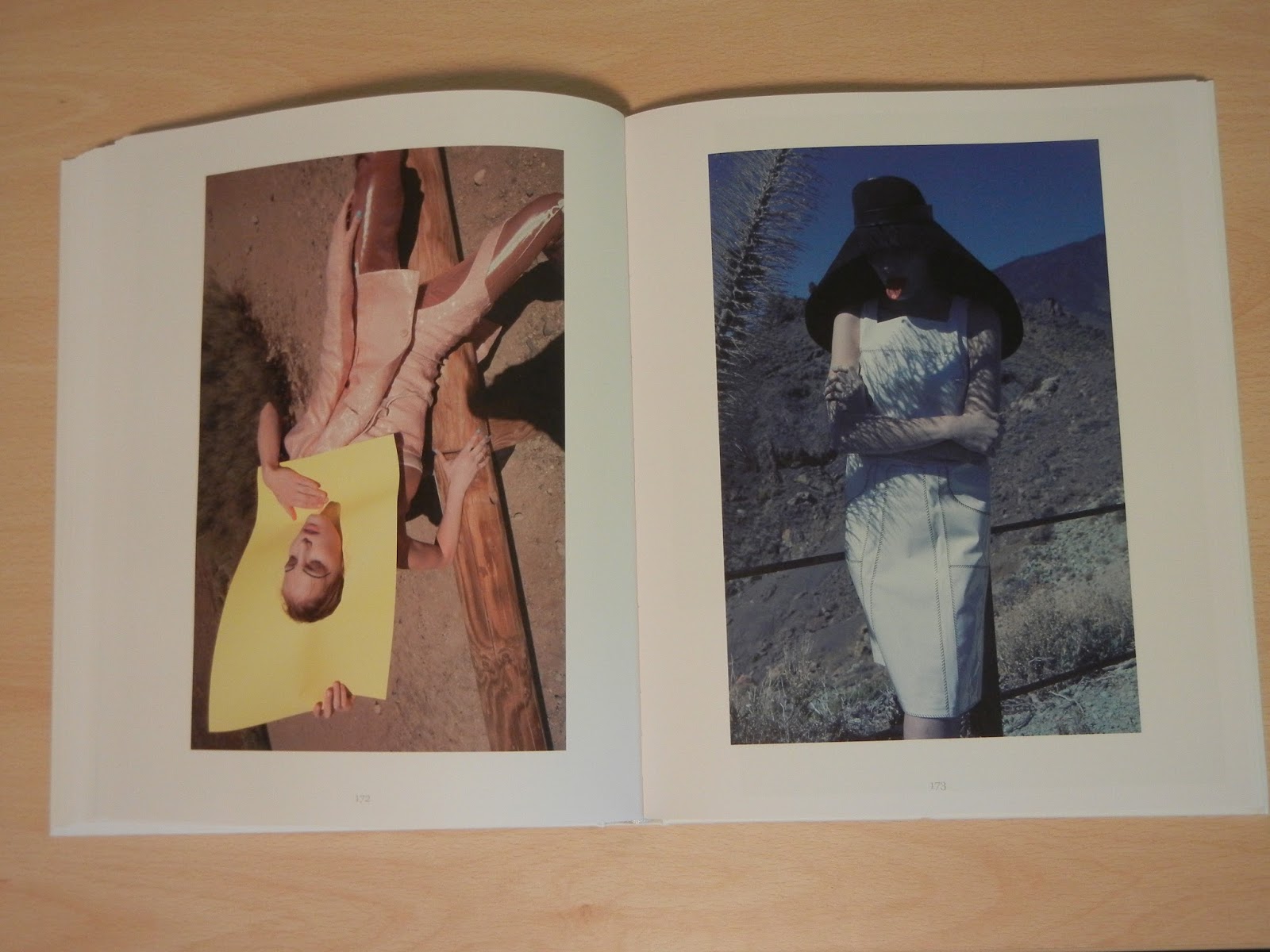
JTF (just the facts): Published in 2013 by Prestel (here). Hardcover, 296 pages, with 250 color images. The volume includes essays by Nanda van den Berg and Charlotte Cotton, and a spread by spread bibliography of Sassen's fashion work from 1998 to 2012. (Spread shots below.)

Comments/Context: For all its attempts to catch our eye with outlandish styling and elaborate set-ups, much of contemporary fashion photography still follows the simple underlying formula of the model and dress (or other accessories) given front and center attention. As a result, no matter how fresh, original, or shocking the surrounding trappings might be, the central compositions have a familiar, generic uniformity to them; there are only so many ways to pose a model while still explicitly featuring the fashions. A casual flip through any thick fashion monthly will quickly clarify the conventional boundaries most fashion photographers are working within.
 
These genre-defining methods are what make Viviane Sassen's fashion photographs seem so unexpected. In comparison to the standard fare, her work brashly defies the normal routines, breaking quietly accepted visual rules left and right. This hefty volume is a retrospective look at Sassen's fashion photography from 1998 to 2012 and offers a seemingly never ending stream of strange surprises. Her pictures are the opposite of obvious or straightforward, forcing the viewer to do a double take just to puzzle out what is going on; she plays on our ingrained expectations, and takes every opportunity to upend those short hand assumptions.
 
Sassen's compositions are built with a knowing eye for how the camera sees. Her models become sculptural human forms, where clothing is almost incidental to the posing of the limbs and torso. Bodies are bent, arched, and contorted in unusual ways, often further fragmented by the reflections of a mirror or made surreal by the intertwining of multiple models into one unlikely mass of arms and legs. Odd camera angles and vantage points (upside down, twisted, off kilter) add another layer of disorientation, making the flattening out of the visual field and the interplay of space even more mysterious. In nearly every shoot, she has rejected any kind of thematic narrative or clichéd setting (a day at the beach, a glamorous nightclub, a city woman on the street etc.) and instead opted for something much more inconclusive, abstract and conceptual.
 
Sassen takes this innovation further by disregarding another foundation rule of fashion photography - the idea that we need to see the model's face. In image after image, she obscures faces, covering them with dark shadows, hair, or simply the rotation of the body getting in our way. At first, this lack of looking eye to eye is meaningfully disconcerting; there is none of the usual back and forth connection we have come to expect. But this visual device forces the viewer to return to the sculptural realm, where beauty is seen in the shapes and forms on view. Sassen can then additional layers of extremity by punctuating a composition with intense light or bold color. Body paint, color filters, flares of color, neon light streaks, or simply the unexpected introduction of a brightly colored prop (a green garden hose, red shoes, an orange scarf, a yellow piece of construction paper) help to unbalance things. By the time all these ideas are crammed into one frame or shoot, Sassen's brand of surreal glamour has become ravishingly unconventional.
 
Seen across more than a decade of work, the originality in Sassen's eye is proven to be remarkably varied and consistent; time and again, she has done something startling, kicking us out of our visual ruts. Hers is the kind of work that always keeps us guessing, making us active and engaged participants in her images, rather than glassy eyed zombies mindlessly searching for the next fashions to consume.
 
Collector’s POV: Viviane Sassen is represented by Stevenson Gallery in Cape Town (here); she does not appear to have consistent representation in New York. More broadly, her work has not yet reached the secondary markets with any regularity, so gallery retail remains the best option for those collectors interested in following up.
 
Transit Hub:
  • Artist site (here)
  • Exhibit: Huis Marseille Museum, 2013 (here)
  • Features/Reviews: Time LightBox (here), photo-eye (here),  Feature Shoot (here)


Friday, November 16, 2012

Aperture Remix @Aperture

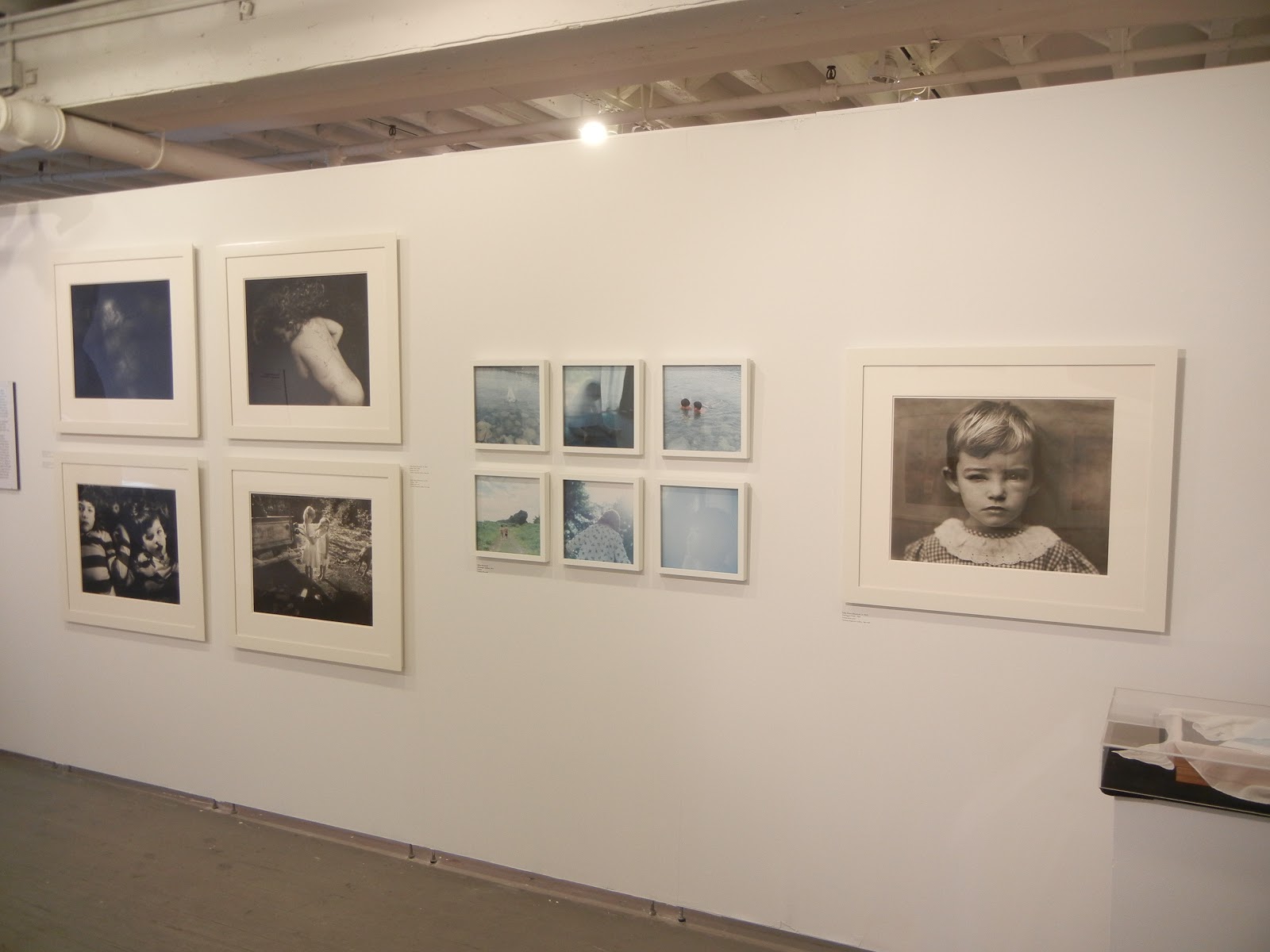
JTF (just the facts): A group show consisting of 8 individual photographers and 1 artistic pair who were asked to make new work inspired by an Aperture publication. The exhibit is divided into 9 sections, with each section containing the new works, a sample of the works which made up the original book/magazine, and a limited edition book combining the old and new. The exhibit was curated by Lesley Martin. (Installation shots at right.)
 
The following photographers have been included in the show, with their chosen influential publication as reference. The details on the works on view made by both the commissioned artists and the subjects are underneath.
 
Rinko Kawauchi: Sally Mann, Immediate Family, 1992
  • Mann: 5 gelatin silver prints, 1984-1989
  • Kawauchi: 6 c prints, 2012
  • Case with Kawauchi's limited edition book
Vik Muniz: Edward Weston, Daybooks, Volume 1, Mexico, 1973
  • Weston: 3 gelatin silver prints, 1921-1924
  • Muniz: 1 digital gelatin silver print, 2012, 1 copy of Daybooks cut up
Taiyo Onorato and Nico Krebs, Aperture essay books, 1976-2011
  • Onorato/Krebs: 1 camera made from a dozen cut through books, 1 archival pigment print
Martin Parr: Aperture issue 103, 1986
  • Nan Goldin: 2 cibachrome prints, 1977-1980
  • Chris Killip: 2 gelatin silver prints, 1983-1984
  • Larry Sultan: 2 digital c prints, 1984
  • Parr: 3 digital c prints, 1990-2001
  • Case with Parr's limited edition book
Doug Rickard: Stephen Shore, Uncommon Places, 1982
  • Shore: 1 set of postcards, 1971-2000, 5 chromogenic prints, 1973-1975
  • Rickard: 8 archival pigment pigment prints, 1971-1978/2012
  • Case with Rickard's limited edition book
Viviane Sassen: Edward Weston, Nudes, 1977
  • Weston: 3 gelatin silver prints, 1 palladium print, 1927-1936
  • Sassen: 5 archival pigment prints, 2003
  • Case with Sassen's limited edition book
Alec Soth: Robert Adams, Summer Nights, 1985
  • Adams: 4 gelatin silver prints, 1975-1980
  • Soth: 1 video
  • Case with letters and Soth's limited edition book
Penelope Umbrico: Masters of Photography series, 1977-1999
  • Group of source images: 2 Henri Cartier-Bresson gelatin silver prints, 1948 and 1964, 1 Wynn Bullock gelatin silver print, 1958, 2 Manuel Alvarez Bravo gelatin silver prints, 1966 and 1967, 1 Edward Weston gelatin silver print, 1935, 1 Alfred Stieglitz gelatin silver print, Eikoh Hosoe gelatin silver print, 1996, 1 Paul Strand gelatin silver print, plus other reproductions
  • Umbrico: 87 iPhone images, manipulated by apps, hung as a single cluster
  • Case with Umbrico's limited edition book and stack of original Masters of Photography series books
James Welling: Paul Strand, Time in New England, 1980
  • Strand: 6 gelatin silver prints, 1928-1946
  • Welling: 22 archival pigment prints, 1 diptych, and 3 texts, 2012
  • Case with Welling's limited edition book
Comments/Context: In honor of its 60th anniversary this year, Aperture might have easily trotted out a luscious parade of past masters and iconic photobooks, in a deservedly congratulatory and self-referential manner given the publisher's important position in the history of the medium. But the overly obvious greatest hits show has been smartly avoided and instead recast by asking ten contemporary photographers to make fresh works (and books) in reference/homage to any one of Aperture's many publications. The idea of exploring how a contemporary artist borrows and incorporates ideas from other artists is not a new one, of course, but in our age of image explosion and remixed culture, one that seems ever more relevant. Where is the line between responding and appropriating, riffing and reworking, entirely reformulating and just being derivative? The works in this show examine this process, opening a dialogue between past and present, asking and answering thorny questions about the nature of influence and interpretation across the photographic generations.
 
Edward Weston provides the starting point for two of the photographers included. Viviane Sassen has made deceptive pink toned nudes in reference to Weston's iconic almost abstract creations, starting with a similar interest in the lines of the human form, but extending it in her own way into multi-body nudes that have a mysterious selection of extra limbs. Her images are both seductive and sculptural like Weston, but startlingly disconcerting and unexpected. Vik Muniz has also channeled Weston, immersing himself in the Daybooks and building one of his signature constructions out of text fragments from the book and other Weston imagery. His rework of Weston's elegant portrait of Tina Modotti holding a white iris is both reverential and also uniquely Muniz.
 
Alec Soth's homage to Robert Adams' Summer Nights is fascinating near failure. After backtracking from night photography to experimenting with his new camera's video function, Soth opted for still video clips of trees and their shadows, strip malls at twilight, and houses with lights in the windows; my first reaction was that it was all a little too literal for me, and not quite enough of Soth's own vision coming through. But then I stopped looking and started listening more actively: the rustling of the trees, the background noise of a town, the settling down for the night, all captured (perhaps inadvertently) by the video. It's an amazingly perfect soundtrack of summer nights, achingly evocative of Adams' own photographs.
 
Other pairings are equally clever  and thoughtful. Rinko Kawauchi reconsiders Sally Mann's images of her children, with her own ephemeral, atmospheric shots of kids: boys swimming, a splash of water, a baby behind a curtain, the soft sunlight streaming down behind a young girl. Penelope Umbrico dives into images of mountains made masters of the medium, and then reworks them using her iPhone, creating a candy colored array of the very same mountains, somehow made less imposing by tints, tiling, and reorientations. And Doug Rickard parrots Stephen Shore's own postcard idea back at him, discovering his own 1970s era postcards of motels, cars, and restaurants, and then further tuning them to accent the saturated yellow palette of the times; they're a smart homage, using Rickard's own affinity for found imagery.
 
What I like best about this show is its sense of honoring without fawning, of acknowledging influence while still staying true to original thinking. If all of our remixed, reshuffled, chopped, and appropriated digital art of the future is as shrewd as most of what is on view here, we need not ever fear that photography is somehow over.
 
Collector's POV: One of the consistently puzzling things about this venue is that it is always a challenge to figure out what is actually for sale. For the most part, this is a non-selling environment more like a museum, so there is hardly ever an easily accessible checklist with ready price information and image details. What is perplexing about this approach is that often at least some of the works are really for sale or there are additional prints available in the print room, so it usually takes some initiative to get the answers. In the case of this particular show, it is not at all clear whether any of the photographs are available for purchase. My assumption is that at a minimum the limited edition collaborative books are for sale, but I didn't surface any prices, so interested collectors will need to follow up directly with Aperture or potentially with the various galleries that represent the artists.
 
Rating: * (one star) GOOD (rating system described here)
 
Transit Hub: 
  • Features/Reviews: CNN (here), Capital NewYork (here), New Yorker PhotoBooth (here), Time LightBox (here)
Through November 17th
 
547 West 27th Street
New York, NY 10001

Wednesday, November 2, 2011

New Photography 2011 @MoMA

JTF (just the facts): A group show of the work of six contemporary photographers, variously framed and matted, and hung in a two room divided gallery on the 3rd floor. The exhibit was curated by Dan Leers. (Installation shots at right.)

The following photographers have been included in the show, with the number of works on view and image details in parentheses:
  • Moyra Davey (2 works, consisting of grids of 25 and 16 c-prints respectively, unframed and pinned directly to the wall, from 2010-2011)
  • George Georgiou (8 pigmented inkjet prints, framed in white and unmatted, from 2006-2007)
  • Deana Lawson (7 pigmented inkjet prints, framed in white and unmatted, from 2007-2010)
  • Doug Rickard (8 pigmented inkjet prints, framed in white and unmatted, from 2009-2011)
  • Viviane Sassen (8 pigmented inkjet prints, variously framed and unmatted, various sizes, from 2006-2010)
  • Zhang Dali (20 gelatin silver prints, with photomechanical reproductions and type written text, framed in white and matted, from 2003-2011)
Comments/Context: There's a little bit of everything in this year's New Photography exhibit at the MoMA, making it much broader and more inclusive than other recent incarnations of this annual survey. Rather than highlighting a particular theme or grouping similar/contrasting approaches, this show runs the gamut from documentary to digital appropriation, with relatively equal measures of conceptual and straight photography, offering us diversity and divergence as opposed to a particular institutional point of view. The implication is that the medium is expanding and extending in so many directions that it's impossible to use any one narrow definition anymore, and there's quality and innovation to be found in a plethora of styles and working methods.

In terms of sheer visual elegance, Viviane Sassen's photographs are far and away the most successful. Her pictures have a perplexing, mesmerizing magic, where simple forms and odd compositional angles create an atmosphere of the unexpected. Orange soda is poured into a hole in the sidewalk, a boy lies tipped over in a blue plastic chair, a paper bursts into flames in front of a subject's face, and a woman's body lies draped in a light blue sheet. Seemingly normal subjects take on an air of confusing mystery, and decoding some kind of plausible narrative becomes tricky, pushing the viewer back into an exploration of the lines, color, and space of the formal elements of the pictures. The enigmatic, unknowable secrets of the images give them a power that goes far beyond their straightforward appearance.

I think the opposite wall pairing of Doug Rickard and Zhang Dali was an inspired connection of related ideas, where elusive photographic truth and power-driven propaganda mix with surveillance, privacy, and the omniscience of the digital Internet. Rickard's photographs are full of thorny conceptual questions, from how they were made (appropriated from Google Street View and then selected/cropped/reframed) to what they might represent (the digital embodiment of "everything", the intrusion on the edges of personal freedoms, and the details of suburban decline which they so clearly document). All of the works look downward from the all-seeing robot cameras, finding a depressing array of rusting cars, muddy lots, wayward youths, and poverty stricken streets, unvarnished and exposed to the eyes of the Internet. Zhang's pictures are proof positive of deliberate photographic censorship and alteration in a more political sense, where history and collective memory get changed by airbrushing out undesirables. Photo ops of Chairman Mao are retouched and enhanced, simplifying the visual story, collaging together separate parts, or cropping out distractions to get to a new kind of truth. Both sets of work consider the nature of documentatio, manipulation and archival memory, and standing between them, the resonance of interchangeable ideas is very strong.
.
The remaining works by Moyra Davey, Deana Lawson, and George Georgiou are all accomplished in their own ways (although slightly less exciting to my eye/brain), ranging from voyeuristic portraiture to documentary photography capturing the dichotomies of old/new, returning all the way back to a pleasingly retro, analog dip into the tangible. Davey's intellectual taxonomies of bare bulb light fixtures and book bindings/empty coffee cups are much better in grid form than in the long around-the-room hang of her last gallery show; the visual echoes and repeated patterns of tape are much more apparent.

All in, this show has a something-for-everyone safety that makes it approachable, while still educating viewers about the complex heterogeneity of the contemporary photographic world. In the future, I think this incarnation of the New Photography series will be remembered as a coming out party for Viviane Sassen, and as a further validation of the artistic white space created by Internet driven digital imagery, as embodied by the work of Doug Rickard.

Collector's POV: Given this is a museum show, there are of course no prices. The photographers in the show are represented by the following galleries:
  • Moyra Davey: Murray Guy (here)
  • George Georgiou: unknown
  • Deana Lawson: unknown
  • Doug Rickard: Yossi Milo (here)
  • Viviane Sassen: Motive (here), Stevenson (here)
  • Zhang Dali: Eli Klein (here)
None of these artists has any significant secondary market track record, so gallery retail will likely be the only option for acquiring their work in the short term.

Rating: * (one star) GOOD (rating system described here)

Transit Hub:
  • Exhibition site (here)
  • Reviews: NY Times (here), New Yorker (here), Time LightBox (here), PhotoBooth (here)
  • George Georgiou artist site (here)
  • Deana Lawson artist site (here)
  • Doug Rickard artist site (here)
  • Viviane Sassen artist site (here) 
New Photography 2011
Through January 16th

Museum of Modern Art
11 West 53rd Street
New York, NY 10019

Monday, March 7, 2011

Photography at the 2011 Armory, Part 2 of 4

Part 2 of our 2011 Armory summary covers the remainder of the main Pier 94, straight ahead from the entrance. Part 1 of the review (which includes an explanation of the format) can be found here.

Catherine Edelman Gallery (here): Julie Blackmon (2), Robert and Shana ParkeHarrison (3), Gregory Scott (3), Nan Goldin (2), Myra Green (group of 23). Green's works depict the close-up features of the artist's face (ears, nose, mouth, lips), in an exploration of black stereotypes. I liked the messiness of the ambrotype process, which adds a blunt roughness to the simple forms. To get a sense of scale for the image below, each work is just a few inches by a few inches, each easily held in one hand. The whole set was available for $44000.


Galeria Oliva Arauna (here): Zwelethu Mthethwa (1), Per Barclay (1), Jorge Molder (3), Juan Carlos Robles (2), Gabriele Basilico (24), Alfredo Jaar (1), Miguel Rio Branco (1)

Galleri Bo Bjerggaard (here): Per Bak Jensen (1)

Jiri Svetska Gallery (here): Miroslav Tichy (3), Petra Feriancova (5), Petra Mala Miller (2), Katarina Poliacikova (1)

Galerie Eigen+Art (here): Rémy Markowitsch (8). A water damaged auction catalogue forms the basis of Markowitsch's images. The reproductions are torn and eroded, allowing multiple layers to show through, creating interlocking patterns and textures in black and white. They were priced at $22000 each.


Galerie Guy Bartschi (here): Marina Abramovic (1), Nan Goldin (2)

Rena Bransten Gallery (here): Vik Muniz (2), Candida Hofer (2)

Bryce Wolkowitz Galley (here): Ola Kolehmainen (2)

Yossi Milo Gallery (here): Yukio Onodera (11), Simen Johan (2), Alison Rossiter (2 diptychs), Sze Tsung Leong (2), Loretta Lux (2), Pieter Hugo (2). Hugo's imposing portrait is from a sprawling computer recycling facility in Ghana, where spare parts and metals are salvaged. It was priced at $23000.


Cardi Black Box (here): Shirana Shahbazi (1)

Voges Gallery (here): Martin Liebscher (1)

Greenberg Van Doren Gallery (here): Tim Davis (6)

Michael Stevenson (here): Viviane Sassen (6). Sassen's work has a quiet dance-like elegance; I particularly liked the one of the far left below, where the anonymous body lounges amid the drapery. These were priced between $2000 and $7500.


Luciana Brito Galeria (here): Caio Reisewitz (1), Allan McCollum (1), Geraldo de Barros (8), Rochelle Costi (5)

Goodman Gallery (here): Adam Broomberg and Oliver Chanarin (1), Mikhael Subotzky (3), Jodi Bieber (1), David Goldblatt (1). Goldblatt's elevated image of an endless shanty town resolves itself into intricate texture and dense pattern. I remember asking the price, but I somehow didn't write it down.


Galerie Laurent Godin (here): Gonzalo Lebrija (3)

Carolina Nitsch (here): EV Day (6), Alyson Shotz (6), Vera Lutter (3). Shadowy new photogravures by Lutter, this time of pyramids. They were $6000 each or $15000 for the set (pre-publication).


Timothy Taylor Gallery (here): Susan Hiller (11)

Produzentengalerie Hamburg (here): Wael Shawky (2)

Galerie Sfeir-Semler (here): Akram Zaatari (3), Yto Barrada (2)

Kukje Gallery (here): Candida Hofer (1)

Galerie Krinzinger (here): Frank Thiel (1), Kader Attia (1), Paul McCarthy (2), Oleg Kulik (2), Rudolf Schwartzkogler (2), Gunter Brus (1), Otto Muehl (10), Valie Export (1), Marina Abramovic (8), Angelika Krinzinger (4 triptychs). Krinzinger's images depict fragmented bodies supported by plastic braces with velcro strips; the effect is sculptural and abstract. The triptychs were priced at $2500 each.


Galerie Thaddeus Ropac (here): Sturtevant (11)

Sies + Höke (here): Etienne Chambaud (2), Joao Maria Gusmao and Perdo Paiva (4)

Part 3 can be found here.