Monday, May 16, 2011

Japan Today @Amador

JTF (just the facts): A group show consisting of a total of 33 black and white and color photographs from 3 photographers. The front gallery space contains the work of Taiji Matsue and Mikiko Hara. Hara's works are square format type c prints from the series Hysteric Thirteen, each 14x14 and framed in white with white mats, printed in editions of 10. The 8 images on view were made between 1996 and 2005. Matsue's works are type c prints, 20x24 and framed in white with white mats, printed in editions of 5. The 8 images on view from the JP-22 series were all made in 2005; a single image from the Cell series is also on display; it is an 18x18 digital type c print, available in an edition of 15. The back gallery contains 16 images by Osamu Kanemura. All of these works are gelatin silver prints, each 20x24 and framed in black with no mat, printed in editions of 5. 7 of the works come from the 1995 series Today's Japan; the other 9 works come from the 2007 series My Name is Shockhammer. (Installation shots at right.)

Comments/Context: In the wake of the recent earthquake and tsunami in Japan, there have been countless efforts to provide support, assistance and awareness to the people suffering through the devastation. In reaction to the events on the ground, this show gathers together the work of three contemporary Japanese photographers from the gallery's stable and provides a pre-disaster view of Japan in the last decade.

The exhibit begins with the pared down aerial photographs of Taiji Matsue. Taken from a helicopter, these images document a single Japanese province, capturing details from urban and factory zones, wide expanses of agriculture, and deep blue areas of water. At these heights, pure abstraction reigns, with grids of city streets and rectangular buildings boiled down to rigid geometries. Rice paddies are cut into angular forms, often covered in tiny stripes of green. And the immensity of the sea is dotted with minuscule kayaks and strips of fishing traps, or decorated by lines of cut logs gathered in perfect alignment like matchsticks. There is a strong sense of order and organization in these pictures, of a people efficiently managing the land. The best are those that take some time to decipher; when the subjects become too obvious (like the golf course), the images lose a bit of their power to startle.

Osamu Kanemura's black and white images get down into the crowded infrastructure of Tokyo city streets, where tangles of overhead wires clash with architectural geometries and neon signage. His photographs have a dark compactness, a sense of overlapping, constricting tightness, where the shadowy layers of the city pile one upon another, creating narrow alleyways and overwhelming mazes. There is something wonderful about Kanemura's messiness, where visual ideas intrude on each other like an unruly brawl.

Mikiko Hara's color photographs go yet another level deeper, finding women in moments of uncertainty in the subways and on the streets. Isolated women stand in long lines, buy tickets, wait for trains, and linger on sidewalks, their everyday narratives open ended and ambiguous. Gazes are averted, gestures are muted, and the scenes are unknowable. What seem at first glance like simple snapshots are found to have a deeper sense of mystery, a nagging undercurrent of tension lurking just beneath the surface. The more I looked at these images, the more they seemed to have to offer, if only in my imagination.

Overall, this show provides three markedly different perspectives on contemporary Japan: the cleaned-up, orderly perfection from the air, the tumultuous ferment of the city, and the weary uncertainty of the inhabitants. It's a diverse and thoughtful combination, creating a multi-faceted portrait of the time before the storm.

Collector's POV: The prints in this show are priced as follows. The Kanemura images are either $2500 or $3000, based on the series the image is from. The Hara images are either $2500 or $3000. The Matsue images are either $4000 or $5000, and the single image from the Cell series is $2500. The work of these three photographers has not been widely available in the secondary markets, so gallery retail is likely the only option for interested collectors at this point.
.
I have long thought that a dense, chaotic Kanemura would make a good addition to our city/industrial genre, and this show was a good reminder of how just many of his images would fit neatly into our collection. With so many solid choices, we'll need to invest some time in looking through all the images from the various series to select one with the right balance of complex skewed angles.
.
Rating: * (one star) GOOD (rating system described here)
.
Transit Hub:
  • Reviews: New Yorker (here), DART (here), Woman Around Town (here)
Through June 30th
.
Amador Gallery
41 East 57th Street
New York, NY 10022

Friday, May 13, 2011

Auction: Photographs, May 19, 2011 @Phillips London

The London season continues next week at Phillips, with a various owner Photographs sale on Thursday. This is a diverse sale, with a wide range of vintage and contemporary work, especially at the middle price points. A special selection of Subjective Photography rounds out the auction. Overall, there are a total of 188 lots of photography on offer, with a Total High Estimate of £1627600.

Here's the statistical breakdown:

Total Low Lots (high estimate up to and including £5000): 82
Total Low Estimate (sum of high estimates of Low lots): £279100

Total Mid Lots (high estimate between £5000 and £25000): 97
Total Mid Estimate: £980500

Total High Lots (high estimate above £25000): 9
Total High Estimate: £368000

The top lot by High estimate is lot 94, Leni Riefenstahl, Nuba Portfolio, 2002, at £60000-80000.

Here is the list of the photographers who are represented by three or more lots in the sale (with the number of lots in parentheses):

Christer Strömholm (7)
Robert Mapplethorpe (6)
Roger Ballen (4)
Henri Cartier-Bresson (4)
Yto Barrada (3)
Heinz Hajek-Halke (3)
David LaChapelle (3)
Loretta Lux (3)
Vik Muniz (3)
Kiyohsi Niiyama (3)
Irving Penn (3)
Robert Polidori (3)
Herb Ritts (3)
Stephen Shore (3)
Malick Sidibe (3)
Hiroshi Sugimoto (3)

(Lot 65, Robert Frank, New York City, 1947/Later, at £6000-8000, image at right, top, lot 134, Frank Thiel, Stadt 2/63/B (Berlin), 2002/2005, at £7000-9000, image at right, middle, and lot 177, Christer Strömholm, Tangier, c1951/1970s, at £1500-2500, image at right, bottom, all via Phillips.)

The complete lot by lot catalog can be found here.

Photographs
May 19th

Phillips De Pury & Company
Howick Place
London SW1P 1BB

Auction: Photographs, May 18, 2011 @Bloomsbury London

Bloomsbury's upcoming Photographs sale in London next week continues the house's pattern of gathering a broad variety of lower end and lesser known vintage material, much of it European. Most of the lots have a high estimate of £2000 or lower, so bargain hunting will be the norm. Overall, there are a total of 225 lots on offer, with a Total High Estimate of £405750.

Here's the breakdown:

Total Low Lots (high estimate up to and including £5000): 207
Total Low Estimate (sum of high estimates of Low lots): £254750

Total Mid Lots (high estimate between £5000 and £25000): 18
Total Mid Estimate: £151000

Total High Lots (high estimate above £25000): 0
Total High Estimate: NA

The top lot by High estimate is lot 125, Irving Penn, Five Dahomey Girls, One Standing, 1967/1974, at £10000-15000.

Here is a short list of the photographers who are represented by four or more lots in the sale (with the number of lots in parentheses):

Eugene Atget (5)
Walker Evans (5)
George Rodger (5)
Cecil Beaton (4)
Edouard Boubat (4)
Bob Carlos Clarke (4)
Frank Horvat (4)
Yoshiyuki Iwase (4)

The complete lot by lot catalog can be found here.

(Lot 67, Albert Renger-Patzsch, Petals of the Echinopsishybride, 1928, at £1000-1500, at right, middle, lot 79, Bill Brandt, East Sussex Coast, 1957/1960, at £3000-4000, at right, top, and lot 112, Berenice Abbott, Canyon: Broadway and Exchange Place, 1936, at £9000-12000, at right, bottom, all via Bloomsbury.)

Photographs
May 18th

Bloomsbury Auctions
24 Maddox Street
Mayfair
London WS1 1PP

Thursday, May 12, 2011

The Checklist: 05/12/11

DLK COLLECTION

Checklist 05/12/11

New reviews added this week in red.

Uptown

ONE STAR: Night Vision: Met: September 18: review
ONE STAR: After the Gold Rush: Met: January 2: review

Midtown

ONE STAR: Georges Dambier: Bonni Benrubi: May 27: review
ONE STAR: Herb Ritts: Edwynn Houk: June 25: review
TWO STARS: Henry Wessel: Pace/MacGill: July 8: review

Chelsea

ONE STAR: Ruud van Empel: Stefan Stux: May 14: review
ONE STAR: Andreas Gefeller: Hasted Kraeutler: May 14: review
TWO STARS: Baltz, Becher, Ruscha: Yancey Richardson: May 27: review
ONE STAR: Jeff Brouws: Yancey Richardson: May 27: review
ONE STAR: Yuki Onodera: Yossi Milo: May 28: review
ONE STAR: Chris Marker: Peter Blum: June 4: review
ONE STAR: Shen Wei: Daniel Cooney: June 4: review
ONE STAR: Jo Ratcliffe: Walther Collection: July 15: review

SoHo/Lower East Side/Downtown

TWO STARS: Ray Mortenson: Janet Borden: May 27: review
ONE STAR: Alvin Baltrop: Third Streaming: May 28: review

Elsewhere Nearby

ONE STAR: Sam Taylor-Wood: Brooklyn Museum: August 14: review
TWO STARS: Lorna Simpson: Brooklyn Museum: August 21: review

Auction: Photographs, May 19, 2011 @Bonhams London

Following up on its New York Photographs sale earlier this week, Bonhams has another Photographs auction scheduled for London next week. The sale includes mostly lower end material, with few standouts that really caught my eye. Overall, there are a total of 102 lots on offer, with a Total High Estimate of £340900.

Here's the statistical breakdown:

Total Low Lots (high estimate up to and including £5000): 81
Total Low Estimate (sum of high estimates of Low lots): £155900

Total Mid Lots (high estimate between £5000 and £25000): 21
Total Mid Estimate: £185000

Total High Lots (high estimate above £25000): 0
Total High Estimate: NA

The top lot by High estimate is lot 56, Irving Penn, Five Dahomey Girls, Two Standing, 1967/1985, at £15000-20000. (Image at right, bottom, via Bonhams.)

Here is the list of the photographers who are represented by three or more lots in the sale (with the number of lots in parentheses):

Willy Ronis (12)
Horst P. Horst (5)
Edouard Boubat (4)
Mario Giacomelli (4)
Jürgen Schadeberg (4)
Jock Sturges (4)
Brassaï (3)
Robert Doisneau (3)
Erna Lendvai-Dircksen (3)
André Villers (3)

(Lot 77, Mario Testino, Kate Moss in Blue Cafe, 2005, at £1500-2000, image at right, middle, and lot 88, Luigi Ghirri, Mirrors, 1977, at £1000-1500, image at right, top, both via Bonhams.)

The complete lot by lot catalog can be found here.

Photographs
May 19th

Bonhams
101 New Bond Street
London W1S 1SR

Wednesday, May 11, 2011

Herb Ritts @Houk

JTF (just the facts): A total of 28 black and white photographs, framed in black and matted, and hung in the main gallery and entry spaces. 24 of the prints are gelatin silver prints, some of which are toned; the other 4 prints are platinum. The images on view were taken between 1979 and 2000, with most made in the 1980s and 1990s. Physical dimensions range from 11x14 to 26x22, and editions range from editions of 1 to editions of 12. (Installation shots at right.)

Comments/Context: Imagine I was to draw a Venn diagram with three intersecting circles, and then label those circles: Celebrity, Fashion, and Nude. If we were then to brainstorm photographers who would best fit in the intersection of those three areas, I'm guessing that Herb Ritts would be either the first or at least one of the first names we might come up with. Ritts made a highly successful career out of mixing these three genres, developing a visual style that has been remarkably durable and popular, walking the knife edge of "classic" and "glamour" with surprising deftness.
.
Edwynn Houk has recently taken on the representation of the estate of Herb Ritts, and this solid first show smartly avoids a greatest hits parade, and instead dives a little deeper into his back catalog, digging up variants, alternates, and lesser knowns and juxtaposing them with a few crowd pleasers. While Madonna, Richard Gere, and Michael Jackson all take star turns, most of the images are nudes or fashion images, or some combination of the two.

If I am to be honest, I must admit that I am not a massive fan of the "glamour nude" as practiced (and perfected) by Ritts and others. Even though we are collectors of photographic nudes, and while I can certainly appreciate the quality of the prints and the beauty of the bodies, the sleek stylized perfection of these works crosses some invisible line for me, away from elegance and purity of form and toward something more glossy and artificial. For this reason, I think I was most drawn to some of the more anonymous nudes that have been unearthed in this show, where Ritts may have been exploring the contrast of dark and light or the interaction of line and form, but without having amped it up to that level of fabulousness that is his signature.

With this caveat, I came away from this show very much impressed with the consistency of Ritts' craft from image to image across the decades, as well as with a renewed interest in his compositional skill. If you step back into the middle of the gallery and look beyond the specific people and the embellished details of the stately polished bodies, many of his images resolve themselves into bold, simplified graphics, bringing back the formal refinement and proportion that I think underlies all great nudes. All in, I think this show forced me to look beyond the flashiness of Ritts that I have heretofore found a bit rich for my tastes, and to see more of the underlying talent that was being masked for me by the celebrity glamour.
.
Collector's POV: The works in the show range in price from $5000 to $150000, with many intermediate prices, most under $35000. Ritts' work is routinely available in the secondary markets, with dozens of images for sale in any given year, especially those images printed in editions of 25. Recent prices have ranged between $1000 and $110000, with most under $20000.

My favorite image in the show was Christy Turlington, Versace 6, El Mirage, 1990; it's second from the right in the bottom installation shot. I liked the furry feathered texture of the dress, and the dark arch of her back.
.
Rating: * (one star) GOOD (rating system described here)

Transit Hub:
  • Foundation site (here)
  • Book: Herb Ritts: The Golden Hour (here)
Herb Ritts
Through June 25th

Edwynn Houk Gallery
745 Fifth Avenue
New York, NY 10151

Tuesday, May 10, 2011

Auction: Photographs, May 17, 2011 @Christie's King Street

The Spring photographs season in London swings into gear next week, beginning with a various owner auction at the Christie's King Street location on the 17th. The sale is dominated by number of generally lower end Helmut Newton prints. Overall, there are 102 photography lots on offer, with a Total High Estimate of £1013000.

Here's the breakdown:

Total Low Lots (high estimate up to and including £5000): 39
Total Low Estimate (sum of high estimates of Low lots): £136000

Total Mid Lots (high estimate between £5000 and £25000): 55
Total Mid Estimate: £562000

Total High Lots (high estimate above £25000): 8
Total High Estimate: £315000

The top lot by High estimate is lot 61, Peter Beard, Hunting Cheetah on the Tarn Desert, 1960/Later, at £50000-70000.
.
Here is the list of photographers who are represented by three or more lots in the sale (with the number of lots in parentheses):

Helmut Newton (18)
Don McCullin (13)
Irving Penn (6)
Lewis Carroll (4)
Peter Beard (3)
Julia Margaret Cameron (3)
Jacques-Henri Lartigue (3)
Peter Lindbergh (3)
.
(Lot 8, Julia Margaret Cameron, Cassiopeia, June 1866, at £20000-30000, image at right, middle, lot 31, Don McCullin, Shell-shocked Marine, Vietnam, Hue, 1968, at £12000-18000, image at right, top, and lot 52, Irving Penn, Theatre Accident, 1947/1984, at £25000-35000, image at right, bottom, all via Christie's.)

The complete lot by lot catalog can be found here. The eCatalogue is located here.
.
Photographs
May 17th

Christie's
8 King Street, St. James's
London SW1Y 6QT

Jeff Brouws, Typologies @Richardson

JTF (just the facts): A total of 63 color photographs arranged into three typologies/grids, each image individually framed in white and matted, the sets hung in the small single room Project Gallery in the back. All of the prints are archival pigment prints. The 15 images of storage units were made between 2001 and 2010 and are roughly 9x11 each; the typology is available in an edition of 11. The 24 images of signs were made between 2003 and 2007 and are 7x7 each; the typology is available in an edition of 9. And the 24 images of drive-ins were made between 1990 and 2002 and are 7x7 each; the typology is also available in an edition of 9. (Installation shots at right.)

Comments/Context: As a foil to the larger Baltz, Becher, Ruscha exhibit on view in the next room (here), this small show of the contemporary work of Jeff Brouws provides concrete evidence of the continued use and popularity of the typology as a photographic form. Like Evans and Christenberry before him, Brouws has an eye for vernacular America, tracking down a broad catalog of abandoned drive-in theaters, broken roadside advertising, and one-story storage units with rolling steel doors.

This show in particular got me thinking about the rigidity of this specific approach to image making. Just like in poetry, where if you pour the contents of a normal poem into the structure of a sonnet or a haiku the results may be middling or altogether broken, the same can be said for the photographic typology: taking a bunch of pictures of a similar subject and hanging them in a grid doesn't automatically mean they will be an effective typology. This particular form requires exacting rigor, or the theme and variation that is meant to be highlighted gets muddled by too many differences in detail. The Bechers were obviously the masters at reducing the number of visual variables: same camera angles, same framing, same lighting/sky, etc., leaving the simplicity of the architectural forms to come to the forefront. Brouws' typologies are less systematic and ruthless, and color is introduced as another factor to be considered. The overall effect is much looser and warmer, less deadpan conceptual and more celebratory of the idiosyncrasies of American life.

There is of course a limit to the ubiquity of the typology at some point; not every subject deserves such exacting attention. And this show reminded me that the typology is in many ways an originality reducing form; the more it is executed with systematic serial rigor, the less the individual images have a signature style that is obviously attributable to a specific maker. I think this brings us back to a strong dose of conceptualism as the foundation on which this form is built; those who casually hang their pictures in a grid without thinking through what this approach really implies are truly missing the point. Brouws has clearly thought this through and has opted for a more personal approach to the typology, a little less stringent and structured than many, but perhaps a little more comfortable and approachable.
  
Collector's POV: The works in this show are priced as follows. The storage unit typology is priced at $10750, while the sign typology is $11750 and the drive-in typology is $22000. Brouws' work is not readily available in the secondary markets, so gallery retail is likely the only option for interested collectors at this point.
.
Of the three typologies on view, my favorite was the selection of broken signs (Signs Without Signification); it's on the right in the bottom installation shot. I liked the way the empty outlines were pared down into the simple geometries of squares, rectangles and circles, almost like line drawings against the backdrop of the sky.
.
Rating: * (one star) GOOD (rating system described here)
.
Transit Hub: 
  • Artist site (here)
  • Interview: American Elegy (here)
Jeff Brouws, Typologies
Through May 27th

Yancey Richardson Gallery
535 West 22nd Street
New York, NY 10011

Monday, May 9, 2011

Auctions: Contemporary Art, Parts I and II, May 12 and 13, 2011 @Phillips

Phillips completes the Spring Contemporary Art season in New York later this week with a two-part various owner auction on Thursday and Friday. Compared to the other two major houses, the photo consignments in these sales are quite a bit more modest, with a Gursky and a pair of Shermans as the headliners. All in, there are a total of 50 lots of photography available across the two sessions, with a total High estimate for photography of $3338000.
.
Here's the statistical breakdown:

Total Low Lots (high estimate up to and including $10000): 12
Total Low Estimate (sum of high estimates of Low lots): $86000
.
Total Mid Lots (high estimate between $10000 and $50000): 26
Total Mid Estimate: $652000

Total High Lots (high estimate above $50000): 12
Total High Estimate: $2600000
.
The top photography lot by High estimate is lot 45, Andreas Gursky, Brasalia Plenarsaal II, 1994, at $500000-700000.

Here's the short list of photographers represented by three or more lots in the sales (with the number of lots in parentheses):

Vik Muniz (5)
Thomas Ruff (4)
.
(Lot 250, Sharon Core, Early American, Lemons, 2007, at $5000-7000, image at right, bottom, lot 388, Andy Warhol, Sweaters, 1976-1986, at $20000-30000, image at right, middle, and Nikki S. Lee, Part (8), 2003, at $5000-7000, image at right, top, all via Phillips.)

The complete lot by lot catalogs can be found here (Part I) and here (Part II).
.
Contemporary Art, Part I
May 12th
.
Contemporary Art, Part II
May 13th
.
Phillips De Pury & Company
450 Park Avenue
New York, NY 10022

Auctions: Post-War and Contemporary Art Evening, Morning and Afternoon Sales, May 11 and 12, 2011 @Christie's

Christie's has the middle slot in the Spring Contemporary Art season in New York this week, with various owner sales spread across Wednesday and Thursday. Like Sotheby's, Christie's has found plenty of willing photo consignors, with over $8.5M in photographic value on offer, led by 10 works by Cindy Sherman. Overall, there are a total of 50 lots of photography available in these sales, with a total High estimate for photography of $8696000.
.
Here's the simple statistical breakdown:

Total Low Lots (high estimate up to and including $10000): 4
Total Low Estimate (sum of high estimates of Low lots): $31000
.
Total Mid Lots (high estimate between $10000 and $50000): 18
Total Mid Estimate: $605000

Total High Lots (high estimate above $50000): 28
Total High Estimate: $8060000

The top photography lot by High estimate is lot 6, Cindy Sherman, Untitled, 1981, at $1500000-2000000.
.
Here's the complete list of photographers represented by three or more lots in the sales (with the number of lots in parentheses):

Cindy Sherman (10)
Hiroshi Sugimoto (6)
John Baldessari (3)
Olafur Eliasson (3)
Andres Serrano (3)

(Lot 4, Gilbert & George, Bad Thoughts #1, 1975, at $700000-1000000, image at right, top, lot 306, Hiroshi Sugimoto, Catherine of Aragon, 1999, at $70000-90000, image at right, bottom, and lot 374, Cindy Sherman, Untitled Film Still #4, 1977, at $200000-300000, image at right, middle, all via Christie's.)

The complete lot by lot catalogs can be found here (Evening), here (Morning), and here (Afternoon). The eCatalogues are here (Evening), here (Morning), and here (Afternoon).

Post-War and Contemporary Art Evening Sale
May 11th

Post-War and Contemporary Art Morning Session
May 12th
.
Post-War and Contemporary Art Afternoon Session
May 12th
.
Christie's
20 Rockefeller Plaza
New York, NY 10020

Baltz, Becher, Ruscha @Richardson

JTF (just the facts): A group show consisting of work by three photographers/pairs, hung in the single room, main gallery space. There are 20 photographs by Lewis Baltz from his series New Industrial Parks Near Irvine, California, all 12x16 vintage gelatin silver prints from 1975, in editions of 21. These works are framed in grey and matted, and hung as a single gridded group in one corner of the gallery. There are 2 typologies by Bernd and Hilla Becher. One includes 9 images of water towers, each individual gelatin silver print 22x18; the negative dates were not available, but the typology itself was assembled in 2010 and is unique. The other includes 12 images of winding towers, again each gelatin silver print 22x18; these works were taken between 1966-1989, and assembled in 2004. The Becher typologies are individually framed in white and matted. There are 5 works by Ed Ruscha: one portfolio of 10 images (Gasoline Stations) and a group of 4 prints from his series of aerial parking lots. The portfolio consists of gelatin silver prints, each 20x23, made in 1962/1989, and printed in an edition of 25. These works are framed in blond wood with no mat. The other four images are also gelatin silver prints, but 23x23 in size, from 1967/1999, in editions of 35. These works are framed in grey and matted. (Installation shots at right.)

Comments/Context: As quite a few gallery owners I know will attest, I have been struggling of late with what I call "the tyranny of the new". This is a disease which afflicts many; its symptoms include the constant search for the new high, at the expense of recognizing the true value of the quality work that has come before but now seems like old hat because we have become used to its pleasures. Since I see a lot of both new and old work, I find that I must try not to compare apples to oranges, and instead force myself to see each show on its own merits, without this filter of the freshness of the new. It's quite a bit harder and more nuanced than you may realize.

This fine show is a perfect example to demonstrate this phenomenon. Here we have a group show of three recognized masters of 1960s/1970s conceptual photography, collecting together icons of important (and valuable) work from that time: Becher water tower typologies, Baltz New Industrial Parks, and Ruscha gasoline stations and parking lots. Taken at the level of pure facts, what could be better than this? If you've never seen this work, and you've recently arrived from another planet, this show should and will blow your mind. At the time of their making, these were astonishingly innovative works, and they continue to be strongly resonant and influential many decades later.

But since I have been infected with the tyranny of the new, I am embarrassed to admit that I had a "yeah, yeah, yeah, and so what" kind of reaction to this show. I shudder to say such a thing in public, but it's true. I don't think this grouping of greats adds much to what we already know about this time period or offers any new ideas, relationships, or interpretations of the art on view. It just hangs these spectacular images on the wall. Shouldn't we all just bow and genuflect? This is not to say that I didn't thoroughly enjoy this show, I did; I just didn't get that infusion of new that I have come to crave, and so I was left a little (yikes) unsatisfied.

Such a conclusion is deeply troubling to me. How could such a show of brilliance fail to jump start my brain? Have I become so jaded that I can't really "see" these treasures anymore? Clearly, I need to recapture some of that wonder I had when I saw my first Becher typology and I stood transfixed for what seemed like an eternity, or those hours I spent slowly paging through Baltz' NIP, page by page, savoring the tiny subtleties of each and every image. Those joys are still there, right on the wall, for all to see; I just need an inoculation that will empty my brain of this agonizingly manic "what's new" impulse and return me to a more balanced and less time-relative examination of the truly extraordinary in the world of photography.

Collector's POV: The prints in this show are priced as follows. The Baltz images were marked NFS (not for sale), although some may have been available individually if one was to inquire further. The Becher typologies were priced at $120000 (water towers) and $140000 (winding towers) respectively. The Ruscha portfolio (gasoline stations) was $175000, and the individual parking lot images were either $8800 or NFS. The work of all of these artists can regularly be found in the secondary markets as well. Individual Baltz images have recently traded hands from $6000 to $26000, while Ruscha's prints have ranged between $5000 and $19000.  And Becher typologies (from diptychs to larger groups) have sold at auction between roughly $25000 and $175000 in recent years.

While I have a nearly infinite supply of appreciation for Becher typologies, I suppose I was most excited by seeing such a broad selection of Baltz vintage images from NIP, which tend not to be seen together quite as often. It would be shockingly easy to choose one for our own collection.

Rating: ** (two stars) VERY GOOD (rating system described here)

Transit Hub:

  • Review: TimeOut New York (here)
Baltz, Becher, Ruscha
Through May 27th
.
Yancey Richardson Gallery
535 West 22nd Street
New York, NY 10011

Friday, May 6, 2011

Auction Results: New York Signature Vintage & Contemporary Photography, May 2, 2011 @Heritage

While Heritage is making consistent progress in drawing more higher value photography consigments and slowly raising its total proceeds in each succeeding season, it's hard to call outcomes like this one particularly successful by the normal measures we use. With more than 64% of the lots that sold selling below their estimate ranges and a Buy-In rate over 30%, it isn't much of a surprise that the Total Sale Proceeds missed the estimate range by a wide margin.

The summary statistics are below (all results include the buyer’s premium):

Total Lots: 188
Pre Sale Low Total Estimate: $966350
Pre Sale High Total Estimate: $1482000
Total Lots Sold: 130
Total Lots Bought In: 58
Buy In %: 30.85%
Total Sale Proceeds: $695825

Here is the breakdown (using the Low, Mid, and High definitions from the preview post, here):

Low Total Lots: 168
Low Sold: 116
Low Bought In: 52
Buy In %: 30.95%
Total Low Estimate: $631000
Total Low Sold: $294305

Mid Total Lots: 16
Mid Sold: 12
Mid Bought In: 4
Buy In %: 25.00%
Total Mid Estimate: $406000
Total Mid Sold: $219283
.
High Total Lots: 4
High Sold: 2
High Bought In: 2
Buy In %: 50.00%
Total High Estimate: $445000
Total High Sold: $182238

The top lot by High estimate was lot 74083, Irving Penn, Harlequin Dress, Lisa Fonssagrives-Penn, 1950/1979, at $150000-250000; it was also the top outcome of the sale at $131450.
.
A paltry 35.44% of the lots that sold had proceeds in or above their estimate range. There were only two surprises in this sale (defined as having proceeds of at least double the high estimate):

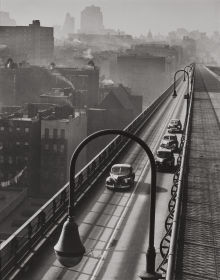
Lot 74045, Harold Roth, Williamsburg Bridge, 1947/1997 at $3585(image at right, top via Heritage)
Lot 74051, O. Winston Link, Birmingham Special, Rural Retreat, Virginia, 1957/1988, at $13145 (image at right, bottom, via Heritage)

Complete lot by lot results can be found here.
.
Heritage Auctions
The Fletcher-Sinclair Mansion
2 East 79th Street
New York, NY 10075

The Checklist: 05/06/11

DLK COLLECTION

Checklist 05/06/11

New reviews added this week in red.

Uptown

ONE STAR: Night Vision: Met: September 18: review
ONE STAR: After the Gold Rush: Met: January 2: review

Midtown

ONE STAR: Max Kozloff: Higher Pictures: May 7: review
TWO STARS: The Mexican Suitcase: ICP: May 8: review
TWO STARS: Wang Qingsong: ICP: May 8: review
ONE STAR: Staging Action: MoMA: May 9: review
ONE STAR: Georges Dambier: Bonni Benrubi: May 27: review
TWO STARS: Henry Wessel: Pace/MacGill: July 8: review

Chelsea

ONE STAR: Ruud van Empel: Stefan Stux: May 14: review
ONE STAR: Andreas Gefeller: Hasted Kraeutler: May 14: review
ONE STAR: Yuki Onodera: Yossi Milo: May 28: review
ONE STAR: Chris Marker: Peter Blum: June 4: review
ONE STAR: Shen Wei: Daniel Cooney: June 4: review
ONE STAR: Jo Ratcliffe: Walther Collection: July 15: review

SoHo/Lower East Side/Downtown

TWO STARS: Ray Mortenson: Janet Borden: May 27: review
ONE STAR: Alvin Baltrop: Third Streaming: May 28: review

Elsewhere Nearby

ONE STAR: Sam Taylor-Wood: Brooklyn Museum: August 14: review
TWO STARS: Lorna Simpson: Brooklyn Museum: August 21: review

Thursday, May 5, 2011

Henry Wessel, Vintage Photographs @Pace/MacGill

JTF (just the facts): A total of 30 black and white photographs, framed in white and matted, and hung against orange and almond colored walls in the main rooms of the gallery. All of the photographs are vintage gelatin silver prints, made between 1968 and 1987. Image dimensions range from 6x9 to 11x16 or reverse; no edition information was available. There is no photography allowed in the gallery, so the installation shots at right are via the Pace/MacGill website.

Comments/Context: When we look at all the stars of 1970s American photography, from the emerging color giants to the New Topographics photographers to a handful of other greats, I suppose it's not surprising that an artist like Henry Wessel has gotten a bit overlooked. His quirky pictures document the quintessential idiosyncrasies of life in California and the West, and capture those moments with a harsh bright whiteness that is wholly his own. I've always thought his work was a bit under appreciated, so I'm glad to see a well-selected group of his vintage pictures swing back through New York.

Well placed humor is rare in photography, but Wessel consistently finds flashes of wry visual wit hidden among seemingly ordinary situations: a woman drinking from a glass amid a riot of clashing bedding patterns, a solitary ice advertisement in the rocky desert, a heart shaped cactus, a weirdly groomed poodle, a single telephone pole in an expanse of dry land. He also has an eye for the strange absurdities of the California experience, from the muscled man in sunglasses in front of the Ocean Sands and the man watching a flock of pigeons taking off, to a thicket of grasses blocking the front of a house and the baton twirlers in white go-go boots. An over-manicured evergreen, a man staring at the desert between two houses, the blinding whiteness of vernacular architecture, it all has an undercurrent of the oddly surreal, as if something slightly off kilter was going on in this world of suburban bungalows and beaches.
 
I think Wessel's dry one-liners and visual eccentricities deserve more attention and acclaim that they have heretofore received. This show is an excellent sampler of Wessel's work and should provide a compelling introduction for those who have inadvertently passed him over chasing the more famous names of the 1970s.

Collector's POV: The photographs in this show are priced between $1000 and $20000. Wessel's prints are intermittently available in the secondary markets, with prices at auction ranging between $3000 and $16000 in recent years

My favorite image in the show was actually a series of four images hung together; they're in the center of the middle installation shot. It starts with the back of woman's platinum blond head, followed by the back of a suited man on the beach, followed by two sculpturally rounded front yard evergreens, followed by a woman in a bikini, once again from the back. Together, they create a whimsical, peculiar rhythm.

Rating: ** (two stars) VERY GOOD (rating system described here)

Transit Hub:
  • Feature: PDN Photo of the Day (here)
  • Exhibit: SFMOMA, 2007 (here)
  • Book: Five Books from Steidl (here)
Henry Wessel: Vintage Photographs
Through July 8th

Pace/MacGill Gallery
32 East 57th Street
New York, NY 10022 .

Wednesday, May 4, 2011

Shen Wei, Chinese Sentiment @Cooney

JTF (just the facts): A total of 19 color photographs, unmatted and framed in black, and hung in the single room gallery space. All of the works are digital c-prints, taken between 2008 and 2010. The prints come in two sizes: 16x20 (in editions of 8) and 24x30 (in editions of 3). The show includes 17 pictures in the smaller size and 2 in the larger size. A monograph of this body of work has recently been published by Charles Lane Press (here). (Installation shots at right.)

Comments/Context: Shen Wei's recent images of China fly in the face of the now familiar energetic, economic boom narrative that dominates the our media-saturated view of the Eastern giant. Whether his subject is a landscape, a still life, or a portrait, his images have a consistent emotional tenor, a formal sense of solitary, introspective reserve. There are no pictures of overcrowded chaotic streets filled with noisy bicycles here; instead Shen provides a sense of melancholy distance, where small moments of uncertain peace occur in the muted tones of a grey morning.
.
Shen's portraits capture his sitters alone in their rooms or in fleeting glimpses of thoughtful repose; they are at once intimate and unknowable, buried in private stillness. His landscapes find a similar mood: the enveloping mist of a fountain, the rain splattered surface of an ornamental pond, a single figure watching a red paddle boat disappear under a bridge, or the head of a ticket booth attendant in the dark of the early evening. Even his still lifes have a sense of dull ache: the gooey leftovers of a sugar candy stick, an unopened plastic bag of noodle soup on a window sill, or the box of fancy pears in protective sheaths bought for a special occasion. Seen together, the different compositional forms coalesce into an overall sensitivity to the subtle action on the periphery of life, an awareness of the shifts that happen just outside the norwal sweep of our gaze.
.
Overall, I liked the sense of understatement and restraint that Shen shows across this body of work. He successfully holds back from courting the obvious, and instead, dives deeper for something more durable and resonant.

Collector's POV: The prints in this exhibit are priced as follows: the 16x20 prints are $1500 each and the 24x30 prints are $2500 each. Shen's work has effectively no secondary market history, so gallery retail is likely the only option for interested collectors at this point. 20x200 (here) also has some of his work for sale.
.
My favorite image in the show was Tingwei, Shangahi, 2010; it's on the far left in the bottom installation shot and is also on the cover of the monograph. I like the quietly innocent, eyes-closed expression on her face and the way her hair spreads out on the long green grass; the image has a calm serenity, like the edge of a dream.

Rating: * (one star) GOOD (rating system described here)
.
Transit Hub:
  • Artist site (here) and blog (here)
  • Interview: Conscientious (here)
Shen Wei, Chinese Sentiment
Through June 4th

Daniel Cooney Fine Art
511 West 25th Street
New York, NY 10001

Tuesday, May 3, 2011

Auctions: Contemporary Art Evening and Day Sales, May 10 and 11, 2011 @Sotheby's

Sotheby's is up first in the Spring Contemporary Art season in New York next week, with Evening and Day auctions Tuesday and Wednesday. With over $10 million dollars of photographic value on offer, it's clear that consignments are way up, in both number and value. Led by a pair of top end Gurskys, there are more high end photographic lots in this set of sales (33) than in any auction in recent memory. All in, there are a total of 58 lots of photography available across the two sales, with a total High estimate for photography of $10114000.

Here's the statistical breakdown:

Total Low Lots (high estimate up to and including $10000): 0
Total Low Estimate (sum of high estimates of Low lots): NA

Total Mid Lots (high estimate between $10000 and $50000): 25
Total Mid Estimate: $744000
.
Total High Lots (high estimate above $50000): 33
Total High Estimate: $9370000
.
The top photography lot by High estimate is lot 9, Andreas Gursky, Rhein I, 1996, at $1000000-1500000. (Image at right, top, via Sotheby's.)

Here's the list of photographers represented by three or more lots in the two sales (with the number of lots in parentheses):

John Baldessari (4)
Andreas Gursky (4)
Vik Muniz (4)
Cindy Sherman (4)
Elger Esser (3)
Thomas Ruff (3)
Andres Serrano (3)
Hiroshi Sugimoto (3)
 
(Lot 563, Vik Muniz, Jackies (In Ketchup), 1999, at $150000-200000, image at right, middle, and lot 578, Olafur Eliasson, The Path Series, 1999, at $60000-80000, image at right, bottom, both via Sotheby's.)
 
The complete lot by lot catalogs can be found here (Evening) and here (Day).

Contemporary Art, Evening Sale
May 10th
.
Contemporary Art, Day Sale
May 11th
.
Sotheby's
1334 York Avenue
New York, NY 10021

Auction: L'Essential Heinz Hajek-Halke, May 10, 2011 @Sotheby's Paris

Preceding its various owner photographs sale in Paris next week, Sotheby's has a single artist sale of the work of German photographer Heinz Hajek-Halke on offer. Most of the works in the auction are experimental photomontages and avante-garde multiple negative images, with a heavy dose of double/layered nudes and portraits, most made between the late 1920s and the 1950s. Overall, there are a total of 78 lots available, all by Hajek-Halke, with a Total High Estimate of 625000€.
.
Here's the breakdown:

Total Low Lots (high estimate up to and including 7500€): 56
Total Low Estimate (sum of high estimates of Low lots): 309000€

Total Mid Lots (high estimate between 7500€ and 35000€): 22
Total Mid Estimate: 316000€

Total High Lots (high estimate above 35000€): 0
Total High Estimate: NA

The top lot by High estimate is tied between two lots: lot 76, Heinz Hajek-Halke, Sans Titre, 1930-1936, and lot 77, Heinz Hajek-Halke, Sans Titre, 1930-1936, image at right middle, via Sotheby's, both at 20000-30000€.

(Lot 34, Heinz Hajek-Halke, Sans Titre, 1927, at 5000-7000€, image at right, top, and lot 52, Heinz Hajek-Halke, Das Mauerlied, 1955, at 2000-
4000€, image at right, bottom, both via Sotheby's.)

The complete lot by lot catalog can be found here.

L'Essentiel Heinz Hajek-Halke
May 10th

Sotheby's
76, Rue Du Faubourg Saint-Honoré
75008 Paris

Auction: Photographies, May 10, 2011 @Sotheby's Paris

Sotheby's Paris has a various owner photographs sale scheduled for next week, headlined by a number of prints by Man Ray and Josef Sudek. It's a pretty straightforward selection, with few unexpected finds. Overall, there are a total of 83 lots on offer, with a Total High Estimate of 1537000€.
.
Here's the breakdown:

Total Low Lots (high estimate up to and including 7500€): 22
Total Low Estimate (sum of high estimates of Low lots): 127000€

Total Mid Lots (high estimate between 7500€ and 35000€): 52
Total Mid Estimate: 760000€

Total High Lots (high estimate above 35000€): 9
Total High Estimate: 650000€

The top lot by High estimate is lot 119, Man Ray, Sans Titre, Rayogramme, 1924, at 120000-150000€. (Image at right, top, via Sotheby's.)

Here is a short list of the photographers who are represented by four or more lots in the sale (with the number of lots in parentheses):

Josef Sudek (7)
Man Ray (6)
Heinrich Kühn (5)
Eugène Atget (4)
Valérie Belin (4)
Daido Moriyama (4)
Shirin Neshat (4)
.
(Lot 152, Irving Penn, Single Oriental Poppy, 1968/1987, at 40000-60000€, image at right, middle, and lot 182, Valérie Belin, Sans Titre (de la série Modèles), 2006, at 7000-10000€, image at right, bottom, both via Sotheby's.)

The complete lot by lot catalog can be found here.

Photographies
May 10th
.
Sotheby's
76, Rue Du Faubourg Saint-Honoré
75008 Paris

Georges Dambier: Who's That Girl? @Benrubi

JTF (just the facts): A total of 24 black and white and color photographs, framed in black with white mats, and hung in the main gallery space. The 8 black and white works are gelatin silver prints, made between 1953 and 1959. They are all 16x20 or reverse, printed in editions of 25. The 16 color works are archival pigment prints, made between 1953 and 1961. They are either 16x20, 20x20, or 20x24 (or reverse), also printed in editions of 25. All of the works on view are modern prints from restored negatives. (Installation shots at right.)

Comments/Context: French fashion photographer Georges Dambier made his mark working for Elle in the 1950s, taking famous models out of the studio and placing them in the streets. This small show is a mini retrospective of sorts, where solid examples in both black and white and color have been gathered together, showing Dambier's particular knack for the jaunty staged scene and his masterful use of splashes of bold color.

Dambier's black and white work is filled with posed scenes and feminine flourishes: a model nose to nose with a hackney horse, another daintily paying a gas station attendant, a third buying a goldfish in plastic bag. Broad fur collars, cigarette holders, and white gloves complement slyly exaggerated faces and dramatic gestures, in ways we have come to associate with 1950s fashion photography.

I found Dambier's color work to be far more striking. In three pictures, he captures Suzy Parker with flowers: one with an armload of bright yellow daffodils, a second with a pastel pink hydrangea bouquet that matches the ribbon on her white hat, and a third with a bunch of salmon pink tulips that echoes the flounce of her floppy pink brim; all three have an energy that is contagious. Other images on display have this same electricity: a red and white striped top paired with a huge blue surfboard, striped beach coverups in blue and orange, a red hat and red gloves flanked by the big red blob in a painting by Miro. Red coats and suits paired with matching red hats similarly stand out against the anonymous movement of the city in the background. In all of these these works, color has become the compositional anchor, rather than subject or form, and bright areas of saturated color grab your eye.

While many of the works on display seem like well-executed examples of a certain type from a certain time, a few of the color pictures are really quite timelessly stunning. So even if fashion photography isn't your passion, there are a couple of dazzling color photographs on view here that are worth a quick detour.

Collector's POV: The prints in this show are priced as follows: the 16x20 and 20x20 prints range in price from $2800 to $9500, based on the place in the edition; the single 20x24 print on view is $4000 (rising to $5000 as the edition sells). Dambier's work hasn't reached the secondary markets with any regularity, so gallery retail is likely the only option for interested collectors at this point.
 
My favorite image in the show was The Bikini Girl on the Boardwalk, pour Jour de France, Deauville, 1959; it's on the far left in the middle installation shot. This is the kind of image that should be used to illustrate the power of primary colors in photography. The crisp white polka dots on the blue bathing suit and the echo of matching yellow between the umbrella and the glass of juice really make this picture pop. Paired with the model's mischievous smile, the vibrant color turns a simple fashion scene into something sensational.

Rating: * (one star) GOOD (rating system described here)

Transit Hub:
  • Artist page (here)
  • Features: NOWNESS (here), On the Runway (here), La Lettre de la Photographie (here)
Georges Dambier: Who's That Girl?
Through May 27th

Bonni Benrubi Gallery
41 East 57th Street
New York, NY 10022

Monday, May 2, 2011

Night Vision: Photography After Dark @Met

JTF (just the facts): A group show consisting of 44 photographic works from 34 different photographers, generally framed in black and matted, and hung spotlit against dark blue walls in a series of three small connecting rooms. The prints were made between 1896 and 2000, mostly using the gelatin silver process. A glass case in the second room holds two bound volumes. (Installation shots at right.)
.
The following photographers have been included in the exhibit, with the number of images on view and their dates in parentheses:

First Room

Berenice Abbott (1, 1932)
Frances Allen (1, 1899)
Bill Brandt (1, 1936)
Brassai (1, 1932/1960)
Alvin Langdon Coburn (1, 1910)
John Cohen (1, 1960)
Gordon Coster (1, 1932)
Patrick Faigenbaum (1, 1977)
Knud Lonberg-Holm (2, 1923, 1924)
Edward Steichen (1, 1899)
Josef Sudek (1, 1948-1964)
Werner Mantz (1, 1928)

Second Room
Marcel Bovis (2, 1928, 1932)
Bill Brandt (1, 1942)
Brassai (2, 1931, 1934)
Louis Faurer (1, 1951)
Robert Frank (2, 1952, 1958)
Lewis Hine (1, 1906-1907)
William Klein (1, 1954)
Paul Martin (1 book, 1896 in glass case)
Otto Steinert (1, 1950)
Alfred Stieglitz (1 photogravure, 1897 in glass case)
Weegee (1, 1940)

Third Room

Robert Adams (1, 1981)
Guiseppe Albergamo (2, 1939)
Diane Arbus (3, 1958)
Bill Brandt (1, 1930s)
Gordon Coster (1, 1932)
David Deutsch (1 group of 16, 2000)
Sid Grossman (1, 1948)
Peter Hujar (1, 1981)
Andre Kertesz (1, 1940s)
Daido Moriyama (1, 1978)
Hiroshi Sugimoto (1, 1990)
Stephen Tourlentes (1, 1997)
Pim Van Os (1, 1950)
Garry Winogrand (1, 1955)
Kohei Yoshiyuki (1, 1971)
.
Comments/Context: The Met's eclectic new survey of night photography is a budget-friendly drawn-from-the-collection whirlwind, covering a century of work in the span of a few small darkened rooms. By definition, such a show cannot be comprehensive (as the Met cannot own everything of importance in every genre), and night photography doesn't appear to have been a particular collecting focus over the years. As a result, this show feels less like a directed scholarly argument about the important trends in night photography over time, and more like a higher-level gathering of like work culled from the storage boxes.

The exhibit begins with a selection of turn of the century Pictorialist night images, followed quickly by a larger sample of between the wars work from some of the usual nighttime masters and a few well chosen lesser knowns: Abbott's iconic New York, Brandt's darkened London, Brassai's foggy Paris, Mantz' German architecture etc. From here, the story gets more diffuse, mixing Weegee's grisly severed head with Frank's lyrical Coney Island beach sleeper, Arbus' carnival goers, and Winogrand's top-hatted socialites. Post 1960, the connecting narrative is lost entirely, jumping from Yoshiyuki's park couplings, to a Sugimoto night seascape, to Deutsch's terrific series of aerial views of LA homes lit by the intrusive glare of a police spotlight.

My point here is not that this exhibit isn't well selected or sequenced; in fact, from picture to picture along the wall, there are plenty of subtle visual connections that are evidence of curatorial care. I think it just tries to do too much with too little. Perhaps this idea should have been split into two shows, one before 1960 and one after (as an aside, there isn't a single color picture in this entire show, and there are many worthy candidates for inclusion, from Misrach to Ruff to many, many others). It might also have benefited from tighter subject matter grouping, from architectural views, to landscapes, to social life, to movie marquees and light abstractions, over time and photographic styles. The whole subject of surveillance is hardly touched upon.

I actually think the overall concept of a smart show about night photography is a really good one. The challenge is that this exhibit needed either much more breadth or a much tighter focus to make a scholarly contribution to the history of this photographic subgenre; its survey in-betweenness makes for some uneven transitions and a waning of coherent momentum, especially in the latter parts of the show. Instead, I think this show takes the easier path of a tasty night photography appetizer, with some diverting randomness and non-obvious choices to keep things lively; if you visit the show looking for a little slice of the unexpected, you'll probably come away satisfied.

Collector's POV: Given this is a museum show, there are obviously no posted prices for the works on display.

My favorite work in the show was George Coster's Impressions of Chicago - The Lights of Grant Park, 1932; it's not actually in any of the installation shots. I like the way the multiple angled lines of circular lights overlap to create an abstract impression of energy and movement. I also enjoyed the Kertesz skyscraper multiple from the 1940s, with its glowing bands of intersecting geometric light.
.
Rating: * (one star) GOOD (rating system described here)

Transit Hub:

  • Reviews: NY Times (here), Village Voice (here)
Night Vision: Photography After Dark
Through September 18th

Metropolitan Museum of Art
1000 Fifth Avenue
New York, NY 10028