 JTF (just the facts): A total of 15 large scale color photographs, framed in white and unmatted, and hung against white walls in the divided gallery space. All of the works are archival pigment prints, made in 2008 and 2009. The prints are available in two sizes: 30x45 or reverse (in editions of 6) and 40x60 or reverse (in editions of 3). A monograph of this body of work was published in 2008 by Photolucida (here). (Installation shots at right.)
Comments/Context: In recent years, the trend toward academic art making might easily have led us to conclude that increasing conceptual complexity was a requirement for some measure of artistic success. And yet, this backdrop of pervasive, brainy seriousness makes the elegant simplicity of Andy Freeberg's Guardians project all the more remarkable. At first glance, a series of photographs of museum guards and the artwork they protect seems a unlikely winner. We can quickly imagine the probable look alikes, the tedious boredom, and the quirky juxtapositions, and the premise itself seems like the kind of one-liner heavy thing someone else has already done.
But the images in Freeberg's series go far beyond this obviousness. They ask us to step back and consider art in context, to see the treasures of Russia's finest museums not just as items to be checked off after consulting the wall label, but as objects that stand in relation to everything around them: the wall colors, the light, the moldings, the frames, the position and gestures of the guards, and the people themselves. The art he sees is in the entire environmental experience, the back and forth dialogue between the "center" and the overlooked surroundings. There is a conceptual kinship with the work of Louise Lawler here, but with a softer, more human touch.
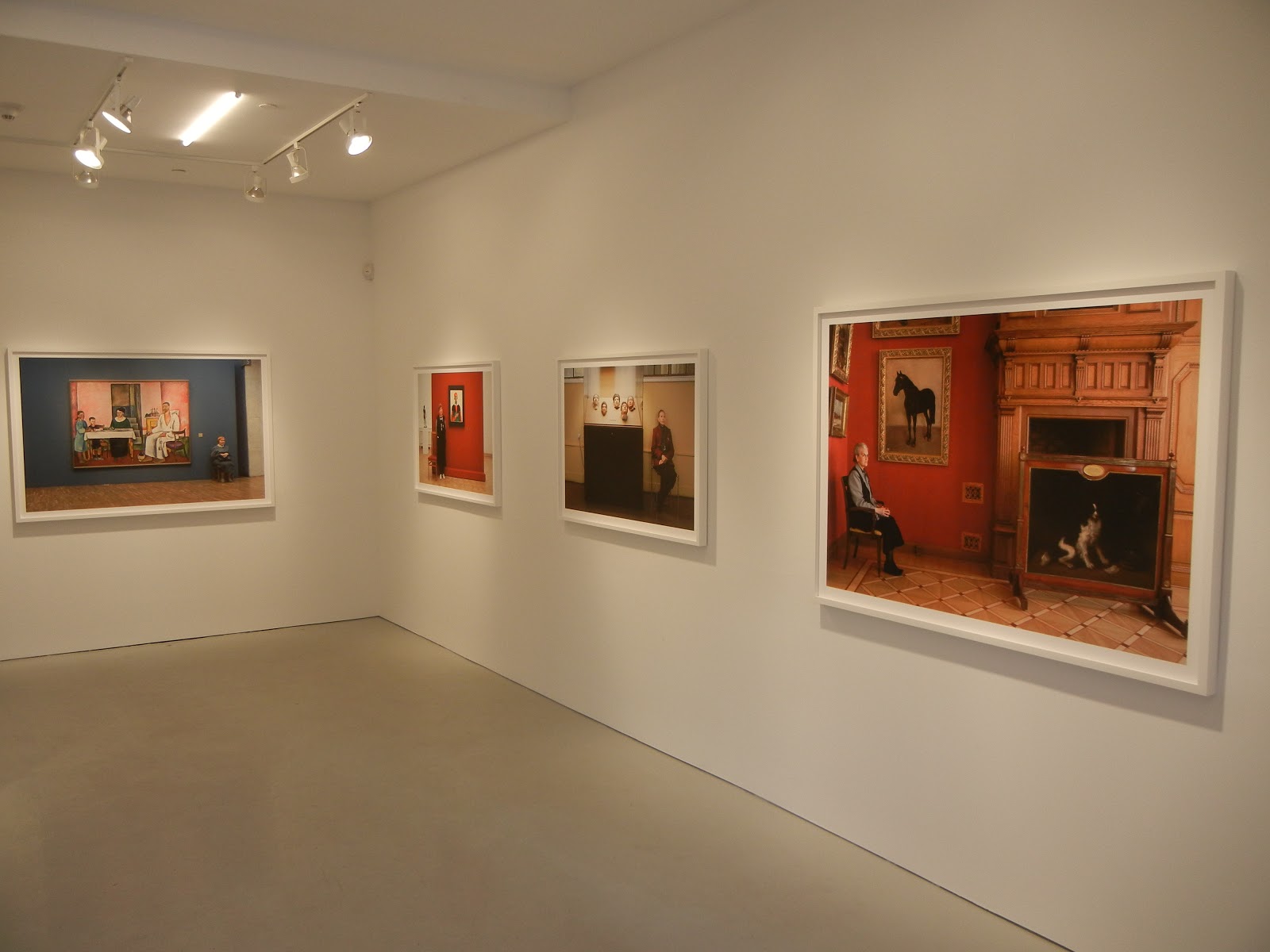 Freeberg's visual echoes between the retired Russian women and the nearby artworks cover a wide swath of ground, from hair styles and facial features to poses and clothing color. A glass case of wide eyed mummy masks is flanked by an equally alert guard, while the jowled cheeks of a Malevich self-portrait are surprisingly similar to those of his protector. The patterned shawl of a guard sits underneath an equally swirling blue Matisse tablecloth, just as a striped shirt recalls the sculpted sideways drapery of a nearby ancient statue. And a modest, hands-clasped guard is a doppelganger for the nervous young girls before a country dance in a painting by Kugach, almost as though she was an extension of the painted scene herself. In every case, the pairings are done with an eye for detail and a respect for the dignity of the guards; they never degrade into overly clever jokes made at the expense of the sitters. In unexpected ways, the presence of the guards enhances the overall of seeing the art, highlighting aspects of the work we might have missed.
What's exciting about these pictures is that they use photography to force a recalibration of seeing. They are less about the amazing paintings and sculptures on display and more about the space around them, and the shifting relationships between people and the installations of art. They are a "hiding in plain sight" revelation, innocuously simple but consistently rich and thought provoking.
 Collector's POV: The works in this show are priced based on size. The 30x45 prints are $6000 each and the 40x60 prints are $7500 each. Freeberg's work has not yet reached the secondary markets, so gallery retail remains the best/only option for those collectors interested in following up.
Rating: ** (two stars) VERY GOOD (rating system described here)
Transit Hub:
Andy Freeberg, Guardians
Through March 2nd
Andrea Meislin Gallery
534 West 24th Street
New York, NY 10011


