Showing posts with label Yossi Milo Gallery. Show all posts

Wednesday, June 26, 2013

Takuma Nakahira, Circulation: Date, Place, Events @Milo

JTF (just the facts): A total of 87 black and white photographs, framed in white and matted, and hung against white walls in the East and West gallery spaces. All of the works are modern gelatin silver prints, made from negatives taken in 1971. The prints are sized 20x24 (or reverse) and are available in editions of 15+2AP. A monograph of this body of work was recently published by Osiris (here) and is available from the gallery for $95. This is the artist's first solo show in the United States. (Installation shots at right.)

Comments/Context: There is something altogether astonishing about an important early 1970s project by a major Japanese photographer making its US debut in 2013. Beyond these sense that collectively we have been asleep at the historical wheel to some extent, it certainly reminds us that the history of photography is more serendipitous and incomplete that we might assume, especially for artists working outside our normal purview.

Takuma Nakahira is a clearly photographer that we should be more familiar with here in the US. He was a founding member of the late 1960s Provoke magazine, whose rough, grainy, blurred style marked a radical shift in both aesthetics and conceptual underpinnings from what had come before, and whose influence remains durably important some four decades later. This show recreates a project Nakahira did for the Seventh Paris Biennale in 1971, where he took pictures on the streets of Paris during the day, developed them at night, and displayed them all in an ever changing wall and floor exhibit that ran for several days. Stylistically, think of it as the dark, brash, moodiness of Provoke as applied to classic Parisian subject matter: Metro stations, street corner cafes, parked cars, vernacular signage, and pedestrian life. His images are full of shadows and eerie, feral glows, marked by haunting advertising fragments, the glare of fluorescent lights, and the dirty elegance of smashed taillights in watery gutters.

In addition to the many single images on view, the show also contains a handful of multi-image sequences that stop time down to fractions of a second. A man walks behind the trunk of a parked car, a woman looks at her wallet on a bright street corner, a dog sniffs the subway grates, and pedestrians gingerly step through the dark fingers of spilled water on the sidewalk. In each mini vignette, there is a cinematic sense of something happening, but a breakdown in the ability of the pictures to convey the entire narrative; the ordinariness of the everyday action is left to speak for itself. The parallels to Paul Graham's recent fragment of time street scenes are unmistakable, so much so that I wonder about whether Graham was aware of Nakahira or not.

The other fascinating thing about this particular project is how it prefigures many of the conceptual threads that would infiltrate photography in the coming years. Nakahira's effort is a mix of three distinctly separate parts: street photography with an eye for direct observation and reuse of media images, process-centrism in terms of his hand crafted approach to making and displaying the images, and an almost performance-like quality to the whole endeavor, as though the physical photographs were just part of the larger visual interaction he was having with the city around him. With the benefit of hindsight, the project looks remarkably innovative, its power and originality for the most part undiluted by the passing of time.

When an important talent like Nakahira is rediscovered (or reintroduced to a previously oblivious audience), I can't help but think of it as a jamming of a new puzzle piece into a previously completed scene, an action that forces all the other pieces to readjust and reconsider their own relationships and interconnections. Whether causality and influence can be traced through such a network is ultimately unknowable, but it certainly sets my mind on flights of fancy, weaving an artist like Nakahira back into brocades that hadn't previously included him.

Collector's POV: All of the prints in this show are priced at $3500. Aside from a few photobooks, Nakahira's photographs have been largely absent from the secondary markets, so gallery retail is likely the best/only option for those collectors interested in following up.

Rating: ** (two stars) VERY GOOD (rating system described here)

Transit Hub:
  • Features/Reviews: American Photo (here), American Suburb X (here), Wall Street Journal (here)

Through July 26th

Yossi Milo Gallery
245 Tenth Avenue
New York, NY 10001

Monday, April 29, 2013

Charles Fréger, Wilder Mann @Milo and @Hermès

JTF (just the facts): A pair of exhibits at separate locations, both showing examples from the same body of work. There are a total of 55 color photographs on view (27 at Milo and 28 at Hermès), framed in brown wood and variously matted (the large and medium prints are unmatted, the small prints are matted). All of the works are inkjet/archival pigment prints, made between 2010-2011. The prints come in three sizes: 57x43 and 40x33 (together in editions of 5+2AP), and 18x15 (in editions of 8+2AP or 2+2AP). A monograph of this body of work was recently published by Dewi Lewis (here). (Installation shots at right - the top two images are at Yossi Milo, the bottom two at Hermès.)

Comments/Context: Charles Fréger has built his photographic career on documenting human subcultures with an almost anthropological rigor. Water polo players, majorettes, sumo wrestlers, Chinese opera singers, French legionnaires, they've all been immersed in his close, analytical scrutiny. In his newest project, Fréger wanders the forgotten paths of tribal Europe, covering 19 countries and capturing the mythic beast costumes of pagan festivals and folk rituals. His portraits rediscover an enduring primal connection to animals and seasons, seen through the systematic deadpan gaze of August Sander or the Bechers.

Set against grassy hillsides, rocky mountains, or snowy meadows, Fréger's subjects stand like menacing statues, seemingly formed from the raw materials of the surrounding natural world. Fur, bones, racks of horns, evergreen boughs, woven straw, and clumps of hair are put together with beads, bells, sack cloth, streamers and other decorations, creating Earthy gods and goddesses born of traditional beliefs. In some cases, the resulting larger than life figures resemble a bear, a deer, or some other vaguely recognizable but stylized part-animal. In others, the bulky creatures seem to represent some aspect of man's relationship to the land or simply the trees and fields given a quasi-human form. The costumes are indeed wild (as the title of the show implies) and often scary, evoking respect for the rough, often uncontrollable power of the natural world. Together, they form a kind of typology of disappearing culture, as solstice myths and seasonal holidays are crowded out by the pace of modern life. Seen in Fréger's structured style, the portraits show off both the quirks of geographical regions and the universality of the underlying impulses.

One of the questions that Fréger's work raises for me is a more general one of how we are to critically judge what we might call "contemporary anthropological" photography, especially when it consistently opts for a straightforward, head-on visual style. Like Fréger, Phyllis Galembo has made similar kinds of pictures of the ritual costumes of Haiti and West Africa, while Katarzyna Majak has tracked down and photographed the traditional female healers of Poland (to name just two that have a seemingly direct link to Fréger's chosen subject matter here). In a certain way, nearly any kind of human subculture might potentially reveal interesting eccentricities, patterns and truths when examined in such a manner, but I think it's the in-between ideas and discoveries about ourselves that make the larger bodies of work durably memorable. As such, Fréger's images are less about frightening masks and furry beasts, and more about an elemental human wildness which refuses to be smoothed over by modernity. Across wide disparities of land and culture, our fundamental connection to the rhythms of the natural world is remarkably strong.

Collector's POV: The works in these shows are priced in as follows. At Yossi Milo, the 57x43 prints are $10500, the 40x33 prints are $5500, and the 18x15 prints are either $1400 or $1600 and are sold in groups of 4 or more. The works on view at Hermès have no posted prices. Fréger's work has not yet reached the secondary markets with any regularity, so gallery retail is likely the best/only option for those collectors interested in following up.

Rating: * (one star) GOOD (rating system described here)

Transit Hub:
  • Artist site (here)
  • Features/Reviews: National Geographic (here), NY Times Lens (here), Slate Behold (here), Guardian (here)
  • Interview: Artlog (here)
 
Charles Fréger, Wilder Mann
Through May 18th (Milo)
Through June 8th (Hermès)

Yossi Milo Gallery
245 Tenth Avenue
New York, NY 10001

The Gallery at Hermès
691 Madison Avenue
New York, NY 10065

Monday, April 1, 2013

Mike Brodie, A Period of Juvenile Prosperity @Milo

JTF (just the facts): A total of 30 color photographs, framed in white and matted, and hung against white walls in the East and West gallery spaces. All of the works are chromogenic color prints, made between 2006 and 2009. The prints are sized either 17x 24 (in editions of 7+3AP) or 14x20 (in editions of 10+3AP). A monograph of this body of work was recently published by Twin Palms Publishers (here). (Installation shots at right.)

Comments/Context: While road trip projects litter the history of photography, Mike Brodie's images of train hopping across America merit attention with the best of this genre. His pictures mix the excitement of youthful adventure and the quiet intimacy of shared experience, dousing the whole journey in a healthy dose of dirt and train grease and filtering it through the hardened eyes of John Steinbeck. Empty hopper cars, golden grasslands, and trackside gravel give texture to the lives of a loose band of wandering souls, whose stories play out as the trains rumble along.
 
While Brodie's subjects could hardly be grubbier, with blackened hands, greasy sleeping bags, rag tag backpacks, and grimy clothes, his photographs are consistently elegant, finding visual poetry without sacrificing honesty or authenticity. His camera peers down from the top of a train car, discovering two friends sleeping below; geometric edges are flattened into rectangles and bodies are innocently curled up with tenderness and vulnerability, a Hunter S. Thompson book peeking out from underneath a slumbering limb. In another image, three travelers share food while sitting on the back of a moving train; Brodie has cropped their heads out, leaving an interlocked tangle of dirty legs and arms, with the blurred rush of track below. Fresh blackberries in a hat, a swirl of wind blown hair, the golden yellow afternoon sun, a bloody pair of underpants, the headlights of an engine, they all provide the raw material for fleeting, but memorable vignettes. 
 
In general, Brodie's visual sense for point of view and perspective is consistently innovative - a worm's eye view of cowboy boots, a look down at a risky friend hanging off the back of train energetically giving him the finger, an upward view of climbing over a barbed wire fence, the tilted framing of a hopper car, the divergent angles of road and track, they all add interest and excitement to his photographs. Nearly every image in this smartly edited group not only documents a subculture with openness and verve, it offers unexpected compositional originality in its craft.
 
I like the sense of feral wildness in these pictures, of kids searching for something out there in the world and finding others along the way to share a bed or a meal. There is some kinship to the work of Ed Templeton to be found here, but the slice of youth culture is different, more transitory and relentlessly nomadic. The struggles and hardships of Brodie's uprooted existence are clearly real, but he has found a way to capture its subtle pleasures and learnings with equal success. Even at their most subdued and personal, these photographs crackle with life.
 
Collector's POV: The works in this show are priced in tiered editions, starting at $3500 for the 14x20 prints and $5000 for the 17x24 prints. Brodie's work has not yet reached the secondary markets with any regularity, so gallery retail is likely the best/only option for those collectors interested in following up. A concurrent show of Brodie's work is on view at M+B Fine Art in Los Angeles (here).
 
Rating: ** (two stars) VERY GOOD (rating system described here)
 
Transit Hub:
  • Artist site (here)
  • Features/Reviews: New Yorker (here), New Yorker PhotoBooth (here), Guardian (here)

Through April 6th
 
245 Tenth Avenue
New York, NY 10001

Monday, January 14, 2013

Chris McCaw, Marking Time @Milo

JTF (just the facts): A total of 21 black and white photographic works, framed in black and unmatted, and hung against white walls in the East and West gallery spaces. All of the works are made up of gelatin silver print paper negatives, consisting of between one and thirteen panels. Individual panels range in size from 5x4 to 40x30, and each of the works is unique. The images were taken between 2009 and 2012. A monograph of this body of work was recently published by Candela Books (here). (Installation shots at right.)

Comments/Context: Chris McCaw's photographs turn away from the traditional shutter-click decisive moment and measure time in much longer and more extended intervals. Using antique papers and custom built cameras, he patiently traces the path of the sun across the sky, mixing scientific precision with age-old elemental wonder. As the hours pass, the images overexpose and eventually burn, leaving seared holes and charred browned edges as evidence of something not only pleasingly visual but verifiably physical.
 
McCaw's works have the feel of experiments, starting with a calculated journey to some far off locale and ending with a trial of endurance between the artist and the sun. Depending on the location, the camera angle, and the special event (equinox, eclipse, etc.), the solar movements manifest themselves as variations of arcs and curves slashing across the sky, grounded by ghosts of mountain ranges or softly reflecting seascapes. At the equator, the sun streak is completely vertical; up above the Arctic Circle, the 24 hour line follows an undulatingly perfect up and down sine curve. When McCaw opts for intermittent exposures rather than continuous ones, the sun becomes a series of dots, like a string of ping pong balls following a controlled mathematical trajectory.
 
In many ways, McCaw's approach is a throwback to the 19th century, with its paper negatives, its can-do process centrism, and its amateur astronomy. Seen from the 21st century, his works seem more like a conscious reaction to the digital revolution, a celebration of what is still timeless and mysterious in this world. Even today, the strength of the sun is too much for our unprotected eyes to take in. McCaw's cameras show us the patterns and flows of things we can't otherwise see, the elegant scorched edges and burned scars reminding us of forces much larger and more powerful than ourselves.

Collector's POV: The works in this show were priced between $5000 and $42000, roughly based on size and number of panels. I use the past tense since nearly all of the works were already sold when I visited the gallery. McCaw's work has not yet reached the secondary markets, so gallery retail is the best option for those collectors interested in following up.

Rating: * (one star) GOOD (rating system described here)

Transit Hub:
  • Artist site (here)
  • Features/Reviews: NY Times (here), New Yorker (here)

Chris McCaw, Marking Time
Through January 19th

Yossi Milo Gallery
245 Tenth Avenue
New York, NY 10001

Tuesday, November 20, 2012

Doug Rickard, A New American Picture @Milo

JTF (just the facts): A total of 16 color photographs, framed in white and unmatted, and hung against white walls in the East and West gallery spaces. All of the works are archival pigment prints, made between 2009 and 2011. The prints come in three sizes: 26x42 (in editions of 5+3AP), 40x64 (in editions of 5+3AP), and 21x34 (in editions of 7+3AP, but not on view in this show). A monograph of this body of work was recently published by Aperture (here). (Installation shots at right.)
  
Comments/Context: Doug Rickard's A New American Picture is one of the most polarizing bodies of contemporary photography to surface in the past few years. While it is deeply and thoughtfully rooted the history of the medium, it aggressively pushes previously established boundaries and fundamental definitions. This has led to a wide spectrum of opinions on its merits, from ringing praise to scathing dismissal. In my view, heated arguments are a very good sign of something worth paying attention to - it's a sign that the establishment feels just a little bit threatened.
 
Part of what has caught the wider public's attention about this work is its unconventional process. All of the images are appropriated from Google Street View (the car mounted effort to mechanically photograph every street in America), then digitally tuned, reframed and edited by Rickard, and finally rephotographed from his computer screen. Supporters see these methods as an innovative extension of old school image appropriation, smartly matched to a 21st century flood of available digital files. They understand the pixelation and optical blur in the final works to be deliberate remnants of (and references to) their original quasi-surveillance function, and consider his archive mining as the natural next step in the onward progression of digital art. Detractors openly scoff at his tools, mocking him as an editor rather than a photographer and ridiculing the low fidelity image quality. They remind us of other artists doing similar things, characterize his interventions as less than original, and generally walk away underwhelmed.
 
The other part of the conversation that surrounds these pictures is their bleak, sometimes boring, often poverty laced content. For the most part, Rickard has selected uneventful scenes on the outskirts of our cities, where vacant lots grow weedy, street corners are closed or boarded up, and young men (virtually all black) wander in packs. Look closely and it will become apparent that Rickard has a well trained eye for overlooked detail: the billowing clouds over a cemetery, the shadow of a telephone pole, a blindingly white dog, the intense pop of a red wall flanked by a person in lime green pants, an overturned toy truck in a muddy yard at sunrise. And if you've ever read Rickard's excellent blog, American Suburb X, you will know that Rickard is undeniably informed by a sense of history. His body of work is not an accidental grouping of snapshots thrown together; he knows exactly which images he is referencing, from the FSA photography of Evans to the road trip images of Frank, and from the American color of Eggleston, Shore, and Sternfeld to the street photography of Winogrand. So I think it's an oversimplification to just see these as a newfangled extension of iconic street photography, dumbed down for a digital age. Given his raw material, he has carefully selected images that have echoes of the old but depict a very different, more modern existence and aesthetic.
 
Having heard both sides of the Rickard debate and looked closely at the pictures, I have to say that I come down on the side of being excited by what he's doing. Not every photograph on view here is wildly memorable or entirely pleasing, but I came away won over by the thoughtfulness with which he is breaking rules and extending limits. I hope that Rickard will not end up hopelessly branded as a "Google Street View" photographer, as his broader approach is applicable to more than just this one method. This body of work asks us to reconsider the definitional edges of image capture and artistic creation, and to think differently about how the avalanche of digital imagery we now create can be repurposed and recontextualized. This work is a sign post pointing toward the new. So even if we have the innate urge to pick it apart as something unlike what we're used to, we would be foolish not to watch closely.
 
Collector's POV: The prints in this show are priced as follows. The 26x42 prints are $6000 each, the 40x64 prints are $8000 each, and the smaller 21x34 prints (not on view) are $4500 each. Rickard's work has not yet reached the secondary markets with any regularity, so gallery retail is likely the best option for those collectors interested in following up.
 
Rating: ** (two stars) VERY GOOD (rating system described here)
 
Transit Hub:
  • Artist site (here)
  • American Suburb X (here)
  • Features/Reviews: Artforum (here), New Yorker PhotoBooth (here), Time LightBox (here), Believer (here), Daily Beast (here)
Through November 24th
 
245 Tenth Avenue
New York, NY 10001

Wednesday, September 12, 2012

Lise Sarfati, On Hollywood @Milo

 
JTF (just the facts): A total of 19 color photographs, framed in white and unmatted, and hung against white walls in the East and West gallery spaces. All of the works are digital c-prints, made in 2009 or 2010. The prints in the East gallery are sized 22x30, in editions of 5+2AP; the prints in the West gallery are somewhat larger (32x44), also in editions of 5+2AP. (Installation shots at right.)
 
Comments/Context: Lise Sarfati's images of Hollywood women are a far cry from anything that might be called glamorous. These aren't pictures of the already famous or the soon to be celebrities, they're spare photographs of the countless forgotten women who have set out to chase a dream and have found the path to stardom to be much harder and grittier than they ever imagined. Aspiration mixes with vulnerability, hope with despondency, frustration with weariness: these are some of the casualties in the heartless struggle for fame.
 
Sarfati has been making solitary images of men and women for years, often composed with indirect glances, empty settings, and an.adept eye for muted color. These new works certainly fall into this larger pattern, albeit with an even grimmer mood and a dirtier palette. The back gallery is filled with head shots taken from underneath, seen with city buildings and tired, rundown storefronts (drug stores, strip clubs) in the background. There is an echo of Callahan here, but with a more cinematic West coast mystery. The women alternate between quiet confidence and fragile despair, the sense of struggle apparent in everything from their body language to their blank expressions. A dreary cigarette is never far from view, taking the edge off on a random street corner or a washed out sidewalk.
 
The photographs in the front gallery step back a few paces, making the images into wider, more narrative scenes. A blond girl smokes a bored, languorous cigarette in a cheap poolside chaise, another lingers outside a convenience store next to a fluorescent-lit green wall, and a goth girl in black coolly poses outside a closed movie theater. Women stare into storefront windows, idle near chain link fences, and sit on seedy concrete stoops, always smoking, down on their luck and waiting for something that probably isn't going to arrive; a few might be credibly be mistaken for hookers, which makes the subtle desperation in the images even more discouraging.
 
Both sets of pictures have a quiet, downtrodden grace in the face of this unforgiving environment. In Sarfati's Hollywood, life on the fringes doesn't look too appealing, but there is a sense of moody perseverance in nearly every image, of making the best of it even if the self-delusions are wearing thin.
 
Collector's POV: The prints in this show are priced as follows. The 22x30 prints range from $6600 to $10600, while the 32x44 prints range from $9300 to $13200. Sarfati's work has only been sporadically available at auction in recent years, with secondary market prices ranging from roughly $3000 to $14000. This body of work was also on view at Rose Gallery in Santa Monica, CA (here) earlier this year.

Rating: * (one star) GOOD (rating system described here)

Transit Hub:
  • Artist site (here)
  • Magnum Photos page (here)
  • Features: Time LightBox (here), Le Journal de la Photographie (here)
Through October 13th
 
245 Tenth Avenue
New York, NY 10001

Tuesday, July 3, 2012

Matthew Brandt @Milo

JTF (just the facts): A total of 61 photographic works, variously framed and matted, and hung in the front and back galleries, the side viewing room, and the connecting hallway. (Installation shots at right.)

The works in the show come from four separate projects. The projects are listed below, followed by the number of works on view and the image details:
  • Honeybees: 6 gum bichromate with honeybees prints on paper, framed in white with no mat, sized either 59x100 or 59x40, unique, from 2012
  • Trees: 50 charcoal silkscreen prints with wood from George Bush Park, Texas, on handmade paper, framed in blond wood with no mat, each sized 19x13, in editions of 3, from 2009-2011 
  • Lakes and Reservoirs: 4 chromogenic prints soaked in lake water, framed in white with no mat, each sized 72x105, unique, from 2008-2011
  • Taste Tests in Color: 1 silkscreen with blue, red, yellow, and purple Gummy Bears on paper, framed in white with no mat, sized 40x30, unique, from 2012
Comments/Context: At a time when many in photography have looked back to antique processes in search of hand made, artisanal authenticity, Matthew Brandt has used process experimentation to look forward, mixing newfangled alchemical innovations with conceptual thinking in unexpected ways. He is at once a throw back to the photographers of the 19th century who were constantly tinkering with their chemistries and a contemporary artist who is comfortable with a new breed of photography that is more tactile and physical. The works in this show break down the barrier between the image and the process by both capturing a subject in the traditional manner and embedding the physical matter of that subject in the development process, making it a picture and a version of the thing itself at the same time. Depending on the series, this approach alternately feels truly inspired and transformative or too literal and overly conspicuous.
 
Brandt's landscapes of lakes are the most successful and visually gripping of the works in this show. Starting with fairly standard color views of lakeside scenes, he dips the prints in water scooped from the lake itself, allowing the layers of color in the chromogenic print to dissolve and swirl around. The photographs begin to wash away, leaving behind fragments of the original view covered in expressionistic splashes of watery brightness. The colors run, and spot, and look like manic sponge prints, whirling and eddying in churning pools and gullies. Given the chance effects at work here, some images are naturally more striking than others, but they all use fluid forms to explore a delicate balance between sharp reality and indistinct abstraction.

Brandt's images of swarms of bees made with real crushed up bee bodies mixed into the gum bichromate emulsion create gee whiz, open eyed astonishment when you really get up close. The bulbous forms of the insect body parts sit on top of the paper like they were meticulously glued in place one by one, giving the print a kind of bumpy topography. The problem is that from afar, it's hard to see much more than tiny black dots against a huge sheet of white. Brandt's images of trees also suffer from some compositional weakness; the paper made from wood and the ink made from charcoal provide the unusual physical connection to the trees, but I found the repeated deadpan images in shades of dirty brown to fade into a dull typological blur after the first dozen or so. The one work made out of Gummy Bears just felt too much like a gimmick to take very seriously.

All in, while this show is a bit uneven, there is plenty of evidence that Brandt has a surplus of original ideas. If he can match his novel process innovations with increasingly sophisticated and refined image making as he goes forward, he certainly has the potential to show us something durably new.

Collector's POV: The prints in this show are priced based as follows, based on the project/series.
  • Honeybees: $16000 or $22000 based on size
  • Trees: $5000 each
  • Lakes and Reservoirs: all sold
  • Taste Tests in Color: $5800
Brandt's work has very little secondary market history, so gallery retail is likely the best option for interested collectors at this point.
 
Rating: * (one star) GOOD (rating system described here)
 
Transit Hub:
  • Artist site (here)
  • Reviews/Features: New Yorker (here), Time LightBox (here), New Yorker PhotoBooth (here), DART (here), Daily Beast (here)
Through July 20th
 
245 Tenth Avenue
New York, NY 10001

Tuesday, April 24, 2012

Tim Hetherington @Milo

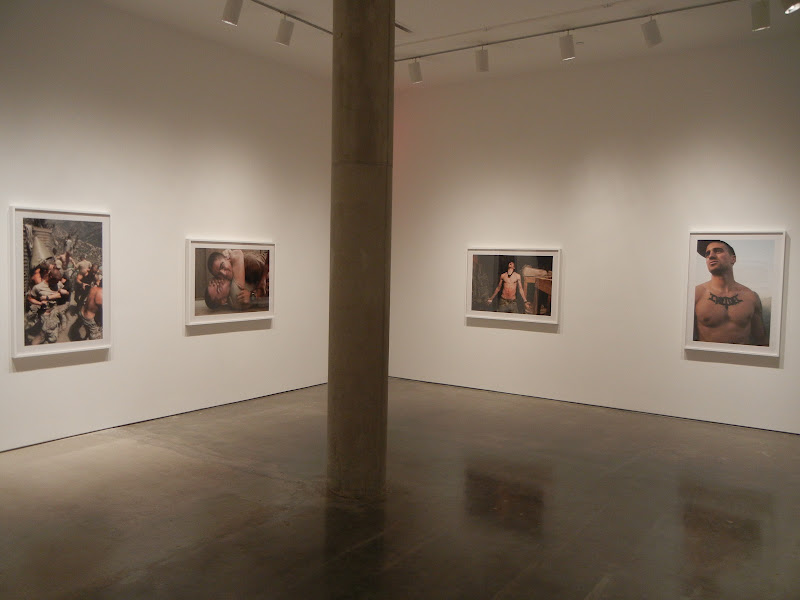
JTF (just the facts): A total of 35 color photographs and 2 videos,  hung in the front and back galleries and in a side viewing room. All of the prints are digital c-prints. The images from Liberia are framed in raw wood with no mat, and were taken between 2003 and 2007. The prints are sized 36x36 or 47x47, both in editions of 18+4AP. The images from Afghanistan are alternately framed in black and white with no mat, and were taken in 2008. The images are sized 18x24, 30x45, or 60x43 (or reverse), all in editions of 18+4AP. Both of these bodies of work have been released in book form: Long Story Bit by Bit: Liberia Retold published in 2009 by Umbrage (here) and Infidel published in 2010 by Chris Boot (here). (Installation shots at right.)
 
Comments/Context: Tim Hetherington's show at Yossi Milo is at once both triumphant and disheartening. I sure this audience is already completely familiar with Hetherington's tragic story, and of his death last year covering the uprising in Libya. Here was an artist who routinely took his life in his hands to tell stories he thought were important, and who ultimately paid a massive price for this dedication. When I saw these pictures more closely and in more depth, it was hard not to feel a huge amount of respect for his talent and sacrifice, while also being heavily weighed down by the thoroughly discouraging outcome.
 
Hetherington's images of the conflict in Liberia are open ended and diffuse in terms of their narrative. They seem less intent on furthering a certain point of view and instead center on turns of color and composition, in the context of an active rebellion. A splash of red carpet punctuates an airport military parade, a blue wall poses as a backdrop for a band of child soldiers, lush green tree limbs are framed by jagged white tiles, and a red jacket is interrupted by the circle of a rubber tire. Tiny details provide anchors for formal, single frame stories: a casually placed grenade, a bloody foot, a plastic spoon tucked in a waistband, or a patterned dress offset by rockets in both hands. Together, the whole body of work is atmospheric, the murky orange dusk and the penetrating gaze of a child soldier providing an overarching sense for the feel of the place.
 
I think that Hetherington's images from Afghanistan will end up being THE images from this particular war; put them on the shelf with icons by Capa and Smith and the rest of pantheon of great war photographers. What is astounding about these pictures is their sense of being inside the brotherhood. The playful wrestling, the roughly applied kiss to a reluctant recipient, the Infidel tattoo worn with pride and honor, these are stolen moments of relaxed downtime in an otherwise horrific situation. The series of sleeping soldiers captures the real vulnerability of these heroes; they're not standing at attention in perfect dress uniforms, they're asleep like any other young men, mouths open, bodies curled up, like boys in bunk beds. These works are particularly poignant when hung as a large group, when nearly the whole squad is seen at rest. The individuals then become something universal, a representation of the fragility of those we send off to fight our battles. A short film (also called Sleeping Soldiers) then juxtaposes these calm still frames with the out of breath anxiety and tension of a firefight, with bombs going off, helicopters passing overhead, and echoing chaos all around. Together, they provide an extremely strong, visceral sense of what this war feels/felt like for those on the ground. (Restrepo, Hetherington's documentary film made with Sebastian Junger, tells this story much more broadly and is a must see.)

To get such an unvarnished, unguarded look at the reality of contemporary war is rare indeed, and Hetherington clearly needed to establish an unusual bond of trust to make these photographs. This then brings us back to the sadness of this show. The work itself is evidence of an increasingly mature and original artistic voice, but the story abruptly ends here. So while we can be rightly angry and frustrated by this turn of events, Hetherington's many indelible images of the human side of the throes of war provide a permanent record we can respectfully celebrate and remember.
 
Collector's POV: The prints in this show are priced based as follows, based on the project/series. The images from both the Liberia series and the Afghanistan series range in price from $5000 to $9500, with multiple intermediate prices based on size and in ratcheting editions. Hetherington's work has very little secondary market history, so gallery retail is likely the best option for interested collectors at this point.
 
Rating: ** (two stars) VERY GOOD (rating system described here)
 
Transit Hub:
  • Magnum Photos page (here)
  • Reviews/Features: Washington Post (here), American Photo (here), Daily Beast (here), Stellazine (here), Examiner (here), Huffington Post (here)
Through May 19th

Yossi Milo Gallery
245 Tenth Avenue
New York, NY 10001

Monday, March 26, 2012

Mark Ruwedel, Records @Milo

JTF (just the facts): A total of 32 black and white works (including single images, diptychs, and groups), framed in white and matted, and hung in the front and back galleries. All of the works are gelatin silver prints, taken between 2005 and 2011. (Installation shots at right.)

The works in the show come from the following projects/series. For each, the number of images on view is followed by the print details:
  • Neighbors: 3 gelatin silver diptychs, each print 11x14 mounted on archival rag board, in editions of 5+2AP, from 2008-2011
  • Desert Houses: 14 gelatin silver prints, either 15x19 or 8x10, each print mounted on archival rag board, both sizes in editions of 10+2AP, from 2005-2011
  • Dusk: 10 gelatin silver prints, each print 11x14 mounted on archival rag board, in editions of 5+2AP, from 2006-2011
  • Built/Not Built: The Smithson Panorama: 2 sets of 8 gelatin silver prints, each print 8x10, mounted  together as a single work on archival rag board, in an edition of 5+2AP, from 2010
  • Records: 12 gelatin silver prints, each print 8x10 mounted on archival rag board, hung together as a single work, in an edition of 3+2AP, from 2009-2011
  • 1212 Palms: 9 gelatin silver prints, each print 11x14 mounted on archival rag board, hung together as a single work, in an edition of 5+2AP, from 2006-2007
  • Bomb Craters: 9 gelatin silver prints, each print 10x13 mounted on archival rag board, hung together as a single work, in an edition of 5+2AP, from 2008
  • Splitting: 1 gelatin silver diptych, each print 11x14 mounted on archival rag board, in editions of 5+2AP, from 2009
Comments/Context: Mark Ruwedel's photographs provide an answer to one of the most complicated questions facing contemporary American land (not necessarily landscape) photography: how do we thoughtfully engage photographic history? His last major project, Westward the Course of Empire, documented the path of the railway system, in conceptual dialogue with 19th century greats like Watkins, O'Sullivan, and others. His newest pictures take on the sprawling beast of the New Topographics. The problem of how to move forward visually and conceptually given the lasting influence of this stylistic juggernaut isn't by any means a simple one. Walking too close to the past generates work that is either plainly derivative ("stuck in the 70s") or calmly reverential. What I like best about Ruwedel's new pictures is that they aren't afraid of this history. Instead, each project or series is like a crisp, cerebral, insider conversation, referencing bodies of work that have come before (including various strains of conceptual art as well as Land/Earth Art) but asking new questions and providing contemporary answers.
.
A walk through the broader and taller galleries at Yossi Milo's new space is like a series of call and response discussions. Free standing houses alone in the desert (both in daylight and at dusk, taken with deadpan quiet formality) connect to any number of predecessors: John Divola, Robert Adams, and once again the Bechers. Other projects are more one-to-one: palm trees with Ed Rusha, split houses with Gordon Matta-Clark, warped vinyl LPs in the desert dirt with Lewis Baltz, and elegant salt encrusted bomb craters with scientific photography from the Manhattan Project. His investigation of Robert Smithson inverts The Spiral Jetty into a 360 degree panoramic view outward, and considers another location where a Smithson work was never built. Each series reprises characteristic motifs and styles, but unpacks them and pares them down further. The underlying ideas about land use, the built environment, reuse and waste, visual patterning and repetition, are all a continuation of the original concepts, but an extension and refinement rather than a hackneyed copy.
.
In a world where the typology format has spread like a disease, I came away impressed that these pictures didn't seem tired. Most of the subjects here are decayed, abandoned, falling down, or hollowed out, but there is an elemental beauty to the shapes and geometries, the mirror images and echoes; roof lines, wood framing, blackened windows and flat expanses of scrubby desert provide plenty of raw material for theme and variation exercises and tonal gradation. But my main takeaway was that Ruwedel has absorbed the lessons of the relevant photographic past, but not let them prevent him from carefully and critically thinking about those ideas further. Mindful of the many traps, he seems to have avoided them, and in the process, expanded the conversation.
.
Collector's POV: The prints in this show are priced based as follows, based on the project/series.
  • Neighbors: $7500 each
  • Desert Houses: $4500 or $2500, based on size
  • Dusk: $6500 or $4500
  • Built/Not Built: The Smithson Panorama: $20000
  • Records: $25000
  • 1212 Palms: $22000
  • Bomb Craters: $18000
  • Splitting: $9000
Ruwedel's work has very little secondary market history, so gallery retail is likely the best option for interested collectors at this point.

Rating: * (one star) GOOD (rating system described here)

Transit Hub:
  • Review: Artefuse (here)
  • Exhibit: Peabody Essex Museum, 2010 (here)
Through April 7th
.
245 Tenth Avenue
New York, NY 10001

Monday, October 17, 2011

Pieter Hugo, Permanent Error @Milo

JTF (just the facts): A total of 17 large scale color photographs, framed in white with no matting, and hung in the single room gallery space and the back viewing alcove. All of the works are digital c-prints, taken in Ghana in 2009 and 2010. The prints come in two sizes: 68x68, in editions of 3+2AP, and 39x39, in editions of 10+2AP; there are 2 large prints and 15 smaller prints in this show. Only the portraits come in the large size; the still lifes and landscapes are only available in the smaller size. A monograph of this body of work was published by Prestel (here) in 2011. (Installation shots at right.)

Comments/Context: The South African photographer Pieter Hugo is quietly building a superlative body of unconventional portraiture. From his hyena men and Nollywood actors to his most recent series depicting scavengers of electronic waste, he has routinely documented subjects on the margins and far outside the mainstream, each and every sitter peering straight into the camera with a penetrating, often confrontational gaze. Time and again, regardless of the strangeness of the circumstances (at least to Western eyes), he has captured faces both resolutely human and staggeringly otherworldly.

His newest pictures come from the Agbogbloshie Market near Accra, Ghana, where tons of cast off computers and electronics are unloaded daily, left to be broken down and separated from their valuable precious metals by a band of scraggly foragers. The site itself is a hellish, almost post-apocalyptic scene: burning heaps of discarded plastics, billows of toxic smoke, dark scorched earth, and acres of dusty greyness. Amidst this ugliness, small groups of hunters with long sticks dig through the piles and stand unsmiling and serious, covered in sweat and soot, breathing in the fog of noxious fumes.

The extremity of this place makes it seem almost like a fantasy, which of course, it is not. And while others have made successful pictures of trash heap scavengers (Zwelethu Mthethwa and Vik Muniz come to mind), Hugo's portraits have a stronger sense of powerful intensity, of having crossed into a world more shocking and disturbing than normal. The eye to eye connection between viewer and subject packs a memorable emotional wallop, and hidden traces of personality (an iPod tucked in a hat, a pink ribbon on a lacy white dress) peek from underneath the horror to make the subjects more real. While the commentary on our disposable culture and its impact on the environment is obvious, the strength of the photographs is in their human connection. What endures long after you've left the gallery is the hang wringing sense of both sympathy and outrage, felt for those who doggedly toil in dangerous obscurity.

Collector's POV: The prints in this show are priced based on size. The 68x68 prints are marked N/A, while the 39x39 prints are $12000 each. Hugo's work has begun to enter the secondary markets with more regularity in the past year or two, with prices ranging from $4000 to $27000. That said, very few lots have come up for auction, so gallery retail is likely the best option for interested collectors at this point.
.
Rating: ** (two stars) VERY GOOD (rating system described here)
.
Transit Hub:
  • Artist site (here)
  • Review: New Yorker (here)
  • Book reviews: BJP (here), Photo-eye (here)
Pieter Hugo, Permanent Error
Through October 29th

525 West 25th Street
New York, NY 10001

Thursday, July 14, 2011

Alejandro Chaskielberg, The High Tide @Milo

JTF (just the facts): A total of 12 large scale color photographs, framed in black with no matting, and hung in the single room gallery space in front. All of the works are digital c-prints, made between 2007 and 2010. The prints are displayed in three image sizes: 5 prints at roughly 32x40 (editions of 9+3AP or 12+3AP), 6 prints at roughly 44x56 (editions of 7+3AP or 9+3AP) and 1 print at 59x75 (edition of 5+2AP). A monograph of this body of work entitled La Creciente is forthcoming from Nazraeli Press (here). (Installation shots at right.)

Comments/Context: Alejandro Chaskielberg’s contemporary images of life along the Parana River Delta in Argentina begin with a context of documentary realism and then stylistically expand into the realm of impressionistic, cinematic staging. His works chronicle a river-centered life of logging and farming, using local inhabitants as actors in nighttime recreations of the everyday activities of the region. Farmers cut rushes along the river banks or transport timber in barges and smaller boats, while weathered elders and children perch on the banks watching the action.

Chaskielberg’s use of moonlight, lanterns, and other forms of illumination give his recreations a surreal sense of color, with washes of glow and haze enveloping his subjects in hollow shades of blue and orange. In combination with tilt shift flattening of the depth of field, the scenes mix a sense of hyper reality with unabashed romantic warmth and mystery; the focus often centers on the lonely toil of an individual (or ghost), with the rest of the scene stretched into a blurred, almost painterly backdrop.

I realize that I’ve been harping on the concept of photographic genre combination quite a bit in recent weeks, but here again, we have a contemporary photographer who is consciously mixing two worlds: taking an anthropological documentary tradition and placing it together with exaggerated staging and performance techniques. The effect is a set of pictures that go beyond reportage and cross into conscious control over our impression of the reality on the ground. Chaskielberg gives life on the river a mystical quality that transcends the mundane chopping and hauling that dominates its days, adding a sense of wonder to the hardships of the jungle existence.

Collector's POV: The works in this show are priced as follows. The 32x40 prints are $4500 each, the 44x56 prints are either $6500 or $9500 each, and the 59x75 print is marked “not available”. Chaskielberg’s work has not yet entered the secondary markets, so gallery retail is likely the best and only option for interested collectors at this point.

Rating: * (one star) GOOD (rating system described here)

Transit Hub:
  • Artist site (here)
  • Interview: Time LightBox (here)
Alejandro Chaskielberg, The High Tide
Through July 29th

Yossi Milo Gallery
525 West 25th Street
New York, NY 10001

Thursday, April 28, 2011

Yuki Onodera @Milo

JTF (just the facts): A total of 16 black and white photographs, alternately framed in black and blond wood and unmatted, and hung in the main gallery space and back alcove. All of the works are gelatin silver prints. The 8 images in the front room are from the Transvest series and were made between 2002 and 2009; these works range in size from 65x50 to 78x50, and have been printed in editions of either 5+3AP or 7+4AP. The other 8 images in the back are from the Eleventh Finger series and were made between 2006 and 2008; these works range in size from 24x24 to 69x48, and have been printed in editions of 7+3AP. Works from the Transvest series were collected in a monograph published by Nazraeli Press in 2004 (here). (Installation shots at right.)

Comments/Context: Japanese photographer Yuki Onodera's accomplished first solo show in the US brings together works from two recent projects and thoughtfully explores questions of identity via layers of intricate process. In both series, a straightforward idea is made more complex and nuanced by the introduction of an inversion, where what we expect is subtly undermined.

In the Transvest project, life-sized black silhouettes hover against lit grey backgrounds, offering easily identifiable stereotypes and clues: the cowboy, the sexy young girl, the mother and daughter, the urban youth, even Fred Astaire. From afar, they look like simple cut-outs of familiar outlines, but up-close, it becomes clear that each person is covered in mottled, shifting pinpricks of light. Get right next to the print and you can often identify a swirling mass of shadowy appropriated imagery, covering the bodies like dissolving tattoos: architectural interiors, flowers, a waterfall, trees, a chandelier, even a skeleton. It becomes clear that these figures are not types, but individuals with broader, more complicated stories made up of surprising component parts, many facets of their personalities hidden just on the edge of visual comprehension.

My first reaction to the works from the Eleventh Finger series in the back viewing area was that there was a strong echo of Baldessari in them, as both employ figures made anonymous by obscuring their faces with an unexpected, out of context blob, almost like a thought bubble. The difference here is that Onodera has used elaborate cut paper photograms that resemble lacy doilies to do her covering: intricate, graceful patterns of fish, flowers, and vaguely Asian geometric dots and dashes that subtly match their wearers. There's also an interesting contrast of textures going on, with the pure flatness of the cutouts juxtaposed with the graininess of the black and white photographs. What may sound like an odd combination is actually quite effective and elegant.

In both projects, it felt like Onodera was starting with images of empty human vessels and then filling and altering them with details introduced via various photographic processes. I liked this connection between the two series, even though they were executed in remarkably different ways. To me this is evidence of mature forethought, of starting with the underlying ideas and then developing original ways to articulate them, without regard to a common aesthetic framework. All in, I came away wanting to see more.

Collector's POV: The works in this show are priced as follows. The prints from the Transvest series are all $24000 each, although several are marked NA on the checklist. The prints from the Eleventh Finger series are either $7500, $9500, or $17500, based on size. A sprinkling of Onodera's prints have reached the secondary markets in the past decade, fetching prices between $1000 and $7000, but I wouldn't say this data is particularly representative of her more recent work. As such, I think gallery retail is likely the only option for interested collectors at this point.

My favorite image in the show was Rosa, 2009; it's the middle image in the middle installation shot. In this image, the sparkly details on the body are a bit more identifiable, with a string of riverfront lights and bunches of exotic jungle leaves running across her silhouette. I also thought it might be fun to pair one of these with a similar sized Robert Longo.

Rating: * (one star) GOOD (rating system described here)

Transit Hub:
  • Feature: Lens Culture (here)
Yuki Onodera
Through May 28th

Yossi Milo Gallery
525 West 25th Street
New York, NY 10001

Monday, March 28, 2011

Sze Tsung Leong, Cities @Milo

JTF (just the facts): A total of 20 color photographs, framed in brown wood and unmatted/matted based on size, and hung in the main gallery space and back alcove. All of the works are chromogenic color prints, made between 2006 and 2010. The prints come in two sizes: 48x59 (in editions of 5+2AP) and 20x24 (in editions of 10+2AP). The show includes 10 images in the large size and 10 images in the small size. (Installation shots at right.)
.
Comments/Context: Sze Tsung Leong's elevated images of some of the world's great cities add a new layer of deceptive conceptual rigor to the familiar genre of the broad expansive city view. At first glance, his images bring us back to the famous 19th century panoramas of San Francisco or Hong Kong harbor taken from nearby mountain tops, where impressive and vast industry were captured as history. But Leong's works go several steps further, placing diverse 21st century cities into a compositional framework that allows for easier side by side comparison, where a city is now simultaneously a very specific individual location and an iterative example of an abstract concept.

All of Leong's cityscapes have been composed using a similar formula, regardless of whether he was in Paris or Quito, Shenzen or Cairo. In every case, the camera has been positioned so that the breadth of the city is seen from above, with close up detail in the foreground of the image, and broader urban pattern and the larger geographical setting in the background, all in one self contained front to back continuum (the top quarter of the image is always undifferentiated sky with a generally flat horizon line). Each image contains a complete range of scales, from recognizable objects and buildings to more uniform geometries and textures of the overall aggregate architecture and site.

Seen in this context, each city has its own eccentricities and visual personality: the red tile roofs of Lisboa, the sand colored apartment blocks of Cairo, the peeling grey density of Havana, the modern glass and steel of Tokyo, the car culture flatness of Houston. Not all would qualify as beautiful exactly, but seen together, they seem like members of the same species, where quirks of geography, history, culture and zoning have created widely different endpoints; each city is like a formal natural selection experiment, where the underlying rules and constraints are generally the same, but the local conditions have forced the individuals to evolve in unexpected directions.

As a result, while I think there are several images in this series that offer the viewer an opportunity to get lost in their nooks an crannies (especially when printed in the large size), in general, I think this body of work will be more intriguing and instructive in book form, where the sequenced comparisons between widely divergent cities can be used highlight similarities and differences. Taken together, the project can almost be seen as the basis for an urban planning textbook, where lessons and variations from medieval to modern can be discovered from picture to picture. Most impressively, with a subtle sleight of hand, Leong has taken a cliche (the bird's eye city view) and remade it into an effective tool for exploring the evolution and ultimate meaning of our contemporary cities. All in, the series is a cerebral and quietly contrarian approach to a hackneyed photographic motif.

Collector's POV: The works in this show are priced as follows. The large 48x59 prints are available in ratcheting editions, starting at $12000, and moving up through $15000, $22000, and $25000. I'm assuming the smaller 20x24 prints also ratchet upwards, although they were all priced at $6000 on the checklist. Leong's work has not yet reached the secondary markets with any regularity, so gallery retail is likely the only option for interested collectors at this point.

My favorite image in the show was La Paz, 2010; it's on the left in the second installation shot. I liked the dense tactile texture of the city, nestled in the bottom of the valley. I also think this image was the most successful in capturing the impact of the specific local geography on the evolving sprawl of the city.
.
Rating: ** (two stars) VERY GOOD (rating system described here)

Transit Hub:

  • Artist site (here)
  • Reviews: Conscientious (here), TimeOut New York (here), Time LightBox (here)
Sze Tsung Leong, Cities
April 2nd

Yossi Milo Gallery
525 West 25th Street
New York, NY 10001