Showing posts with label French Photography. Show all posts

Monday, April 29, 2013

Charles Fréger, Wilder Mann @Milo and @Hermès

JTF (just the facts): A pair of exhibits at separate locations, both showing examples from the same body of work. There are a total of 55 color photographs on view (27 at Milo and 28 at Hermès), framed in brown wood and variously matted (the large and medium prints are unmatted, the small prints are matted). All of the works are inkjet/archival pigment prints, made between 2010-2011. The prints come in three sizes: 57x43 and 40x33 (together in editions of 5+2AP), and 18x15 (in editions of 8+2AP or 2+2AP). A monograph of this body of work was recently published by Dewi Lewis (here). (Installation shots at right - the top two images are at Yossi Milo, the bottom two at Hermès.)

Comments/Context: Charles Fréger has built his photographic career on documenting human subcultures with an almost anthropological rigor. Water polo players, majorettes, sumo wrestlers, Chinese opera singers, French legionnaires, they've all been immersed in his close, analytical scrutiny. In his newest project, Fréger wanders the forgotten paths of tribal Europe, covering 19 countries and capturing the mythic beast costumes of pagan festivals and folk rituals. His portraits rediscover an enduring primal connection to animals and seasons, seen through the systematic deadpan gaze of August Sander or the Bechers.

Set against grassy hillsides, rocky mountains, or snowy meadows, Fréger's subjects stand like menacing statues, seemingly formed from the raw materials of the surrounding natural world. Fur, bones, racks of horns, evergreen boughs, woven straw, and clumps of hair are put together with beads, bells, sack cloth, streamers and other decorations, creating Earthy gods and goddesses born of traditional beliefs. In some cases, the resulting larger than life figures resemble a bear, a deer, or some other vaguely recognizable but stylized part-animal. In others, the bulky creatures seem to represent some aspect of man's relationship to the land or simply the trees and fields given a quasi-human form. The costumes are indeed wild (as the title of the show implies) and often scary, evoking respect for the rough, often uncontrollable power of the natural world. Together, they form a kind of typology of disappearing culture, as solstice myths and seasonal holidays are crowded out by the pace of modern life. Seen in Fréger's structured style, the portraits show off both the quirks of geographical regions and the universality of the underlying impulses.

One of the questions that Fréger's work raises for me is a more general one of how we are to critically judge what we might call "contemporary anthropological" photography, especially when it consistently opts for a straightforward, head-on visual style. Like Fréger, Phyllis Galembo has made similar kinds of pictures of the ritual costumes of Haiti and West Africa, while Katarzyna Majak has tracked down and photographed the traditional female healers of Poland (to name just two that have a seemingly direct link to Fréger's chosen subject matter here). In a certain way, nearly any kind of human subculture might potentially reveal interesting eccentricities, patterns and truths when examined in such a manner, but I think it's the in-between ideas and discoveries about ourselves that make the larger bodies of work durably memorable. As such, Fréger's images are less about frightening masks and furry beasts, and more about an elemental human wildness which refuses to be smoothed over by modernity. Across wide disparities of land and culture, our fundamental connection to the rhythms of the natural world is remarkably strong.

Collector's POV: The works in these shows are priced in as follows. At Yossi Milo, the 57x43 prints are $10500, the 40x33 prints are $5500, and the 18x15 prints are either $1400 or $1600 and are sold in groups of 4 or more. The works on view at Hermès have no posted prices. Fréger's work has not yet reached the secondary markets with any regularity, so gallery retail is likely the best/only option for those collectors interested in following up.

Rating: * (one star) GOOD (rating system described here)

Transit Hub:
  • Artist site (here)
  • Features/Reviews: National Geographic (here), NY Times Lens (here), Slate Behold (here), Guardian (here)
  • Interview: Artlog (here)
 
Charles Fréger, Wilder Mann
Through May 18th (Milo)
Through June 8th (Hermès)

Yossi Milo Gallery
245 Tenth Avenue
New York, NY 10001

The Gallery at Hermès
691 Madison Avenue
New York, NY 10065

Wednesday, March 13, 2013

Valérie Belin @Houk

JTF (just the facts): A total of 8 black and white photographs, framed in white and unmatted, and hung in the main gallery space. 6 of the works on view are large scale pigment prints, sized 82x62 or 73x55 and available in editions of 3. The other 2 works are smaller gelatin silver prints, sized 5x7 and available in editions of 5. All of the works were made in 2012. (Installation shots at right.)

Comments/Context: Edwynn Houk has recently taken on representation of Valérie Belin and this show offers a small sampler of her most recent work. In the past few years, Belin's photography has taken on a consistent look and feel, settling into the dark middle tones of grey and black and sandwiching negatives together into dense, layered compositions. Her new pictures resist easy recognition and force closer inspection to unpack their rich, tactile mysteries.

The most successful images in this show are Belin's conflicted images of brides. Her images mix classic studio portraits of brides with princess tiaras and elaborate floral bouquets with storefront shots of adult DVD stores and sex shops covered in shouting neon. The effect is something akin to Robert Heinecken's magazine interventions, but with the harshness softened into something more inscrutable. Belin uses the same approach in a series of nudes, with a curvy burlesque performer juxtaposed with an array of backstage TV studio gear (including a flashing APPLAUSE sign) or the furniture of a stylish 70's living room. The final pair of images on display dive down the rabbit hole of cluttered, overstuffed, hoarder-style interiors, with walls and shelves filled to the breaking point with collected stuff. Belin's dark palette gives these intimate reflections of personality an ominous tint.

If Belin's multiple negative works had been printed smaller, they might have had a Surreal feel, but at such large scale, they become almost abstract, the interlocking images breaking down into fragments and snippets of something identifiable. The layered images fight with each other, struggling for visual dominance, pushing the viewer's ultimate conclusion back and forth between opposing poles. In the end, it's an uneasy balance, the images settling into intermingled uncertainty.

Collector's POV: The works in this show are priced as follows. The large pigment prints are $32000 each and the smaller gelatin silver prints are $7500 each. Belin's work has only been intermittently available in the secondary markets in the past few years, with prices ranging from roughly $5000 to $15000.

Rating: * (one star) GOOD (rating system described here)

Transit Hub:
  • Artist site (here)

Valérie Belin
Through March 30th

Edwynn Houk Gallery
745 Fifth Avenue
New York, NY 10151


Friday, February 17, 2012

Eugène Atget: Documents Pour Artistes @MoMA

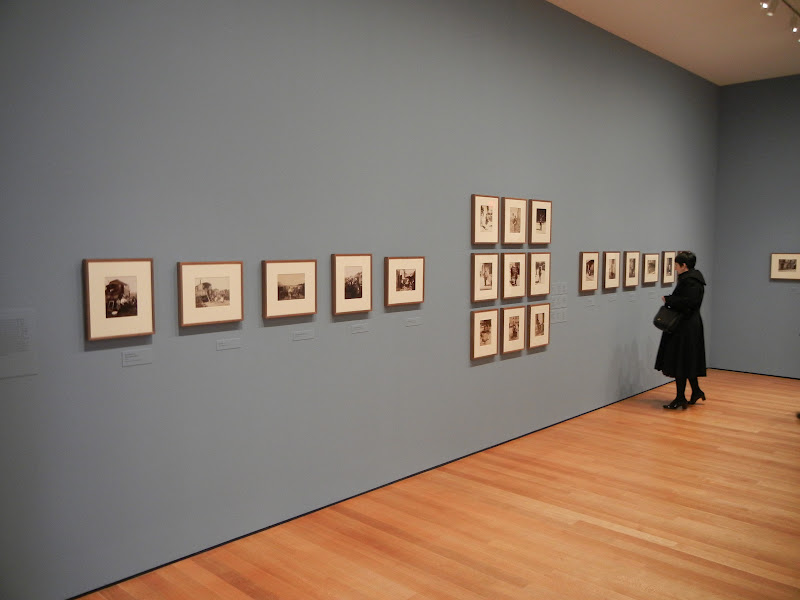
JTF (just the facts): A total of 107 photographs and 1 negative (in a lightbox), framed in brown wood and matted, and hung against light blue walls in a two room divided gallery on the 3rd floor. All of the works are gelatin silver printing out paper, matte albumen silver, or albumen silver prints, taken between 1898 and 1925. The works come from the Abbott-Levy Collection at MoMA. The exhibit was curated by Sarah Meister. (Installation shots at right.)

The show is divided into 6 sections, with the number of photographs on view in each in parentheses:

People of Paris (24)
Courtyards (14)
Jardin de Luxembourg (13)
Parc de Sceaux (24)
Surrogates and the Surreal (13)
Fifth Arrondissement (19)

Comments/Context: The encyclopedic 4 volume set, the single volume monograph with matching Szarkowski texts, countless exhibits over the years, it's hard to imagine a stronger champion for the work of Eugène Atget (beyond Berenice Abbott of course) than the photography department at MoMA. It might also be hard to fathom exactly what more there might be to say about Atget that hasn't already been said more eloquently elsewhere, and yet this new show does an admirable job of cutting a new cross section through the museum's Atget holdings and showing us a crisp mix of the known and unknown in equally thoughtful measure.
.
The title of the exhibition Documents Pour Artistes references Atget's own sign outside his humble place of business, and in a retro-chic kind of way announces him as being in on the appropriation joke far before almost everyone else. Indeed, his whole approach was predicated on the idea that artists would want to borrow from his photographs and use them as guides. For those visitors with a more contemporary postmodern bent, this positioning is a subtle reminder that Atget is still very relevant to the artistic issues of the day.
.
Several sections of the show will seem happily familiar: courtyards, doors, and entryways, surrounded by layers of interior and exterior space, the Luxembourg gardens, with statues, urns, roses, and reflecting pools, and the facades of buildings, complete with sculptural stonework and elaborate iron. These cobblestone Paris streets, angled buildings, and formal gardens are the Atget we know and love, and the power of these photographs has not dimmed with age or repeated viewing.
.
The other three sections take a slightly less traveled path through the Atget archive. One gathers together Atget's images of people, relative rarities in his prolific career. His portraits center on vendors (lampshades, wire baskets, figurines, bread), rag pickers, and prostitutes, subjects who could be easily found on the streets and in the alleys. The are mostly full length shots, often capturing idiosyncratic Parisian nuances and personalities. A second grouping follows the theme of Atget's unintentional popularity among the Surrealists. These photographs are quirky and odd, many of storefronts and dusty window displays: headless mannequins, a seance clock, taxidermy, a skeleton, hairdressers' wigs, corsets, and spooky merry go rounds. A third group collects many of his late images of the Parc de Sceaux. In comparison with the formality of the Luxembourg garden images, these pictures are moody and wild, with overgrown ivy, bare trees, broken statues, and crumbling stairways. His lakeside reflections and shadowy and atmospheric, darker and more romantic. The whole series is full of lovely decaying grandeur.

Even for those who think they already know Atget, this show will be both satisfying and perspective broadening. It's also a refreshing reminder that small, well curated shows of vintage photography can still be new and exciting.
.
Collector's POV: Given this is a museum show, there are of course no prices. Atget's works are consistently available in the secondary markets, with unknown images and later prints by Berenice Abbott selling at auction for as little as $2000, and iconic works finding buyers well into six figures; rare Atgets have recently pushed up towards $700000. In general, high quality vintage images of Paris street scenes are often priced in the low to mid five figure range.

Rating: ** (two stars) VERY GOOD (rating system described here)
.
Transit Hub:
  • Features/Reviews: Time LightBox (here), TimeOut New York (here), Capital New York (here)
Eugène Atget: Documents Pour Artistes
Through April 9th

11 West 53rd Street
New York, NY 10019

Tuesday, January 10, 2012

Pierre Gonnord, Relatos @Hasted Kraeutler

JTF (just the facts): A total of 16 large scale color photographs, framed in black or silver and unmatted, and displayed in the entry and three connected gallery spaces. The portraits are digital chromogenic prints, sized 65x49 or 58x49, in editions of 5+1AP. The landscapes are lightjet prints, each sized 71x98, also in editions of 5+1AP. There are 12 portraits and 4 landscapes on view. The images were taken between 2004 and 2009. (Installation shots at right.)
.
Comments/Context: French photographer Pierre Gonnord's gargantuan photographic portraits vacillate between the openly traditional and freshly contemporary. Their massive scale comes with a nod to Chuck Close and their extreme detail is reminiscent of any number of contemporary photographers pushing the edges of technology. But their head and shoulders poses look back centuries, drifting out of a dark gloomy blackness, reminiscent of Old Masters paintings and their singular power to capture the essence of an individual. The pictures therefore represent an uneasy visual compromise, at once both imposing and intimate, confrontational and humble.

Gonnord's subjects come not from the privileged classes, but from the realm of the ordinary and forgotten. Luis and Miroslaw are covered in inky, end-of-the-day coal dust, while Magdalena and Basilisa wear the rugged, weathered skin of old age. Krystov's penetrating glare and bushy beard make him a likely figure out of Dostoyevsky, while Konstantina's scarred but elegant nose opens up the unanswered questions of her past. Ali's big eyes, surrounded by a gaunt, muscular face, lock on and don't let go, engaging the viewer in an unencumbered and direct stare down. In each case, there is the sense of timelessness, of a figure drawn both from the distant past and the recent present, one side capturing an archetype and another documenting a real life individual.

Interspersed with the portraits are a handful of massive landscapes depicting wildfires and volcanic explosions, with spewing ash and choking smoke engulfing the scenes. At one point, I thought the soot stained faces nearby were those of firefighters of some kind, but I was told that the two bodies of work on display were unrelated. As such, I had a hard time making the connection or understanding the interrelationship between the two sets of images, and the landscapes left me a bit puzzled.

All in, I think the best of these Gonnord portraits hold the wall with authority, and will likely appeal most to the same slice of contemporary photo collectors who have gravitated toward the images of Bergman, Mikhailov, Grannan, Kerstens, Learoyd and others who have explored the intersection of the quietly marginal and the up close face.

Collector's POV: The works in the show are priced as follows. The monumental portraits are either $21750, $23750, $26700, or $29750, based on size and place in the edition. The large scale color fires/explosions are either $29700, $32700, or $34200, based on place in the edition. Gonnord's work has very little secondary market history, so gallery retail is likely the only option for interested collectors at this point.

Rating: * (one star) GOOD (rating system described here)
.
Transit Hub:
  • Artist site (here)
  • Feature: Time LightBox (here)
Pierre Gonnord, Relatos
Through February 4th

Hasted Kraeutler Gallery
537 West 24th Street
New York, NY 10011

Tuesday, May 3, 2011

Georges Dambier: Who's That Girl? @Benrubi

JTF (just the facts): A total of 24 black and white and color photographs, framed in black with white mats, and hung in the main gallery space. The 8 black and white works are gelatin silver prints, made between 1953 and 1959. They are all 16x20 or reverse, printed in editions of 25. The 16 color works are archival pigment prints, made between 1953 and 1961. They are either 16x20, 20x20, or 20x24 (or reverse), also printed in editions of 25. All of the works on view are modern prints from restored negatives. (Installation shots at right.)

Comments/Context: French fashion photographer Georges Dambier made his mark working for Elle in the 1950s, taking famous models out of the studio and placing them in the streets. This small show is a mini retrospective of sorts, where solid examples in both black and white and color have been gathered together, showing Dambier's particular knack for the jaunty staged scene and his masterful use of splashes of bold color.

Dambier's black and white work is filled with posed scenes and feminine flourishes: a model nose to nose with a hackney horse, another daintily paying a gas station attendant, a third buying a goldfish in plastic bag. Broad fur collars, cigarette holders, and white gloves complement slyly exaggerated faces and dramatic gestures, in ways we have come to associate with 1950s fashion photography.

I found Dambier's color work to be far more striking. In three pictures, he captures Suzy Parker with flowers: one with an armload of bright yellow daffodils, a second with a pastel pink hydrangea bouquet that matches the ribbon on her white hat, and a third with a bunch of salmon pink tulips that echoes the flounce of her floppy pink brim; all three have an energy that is contagious. Other images on display have this same electricity: a red and white striped top paired with a huge blue surfboard, striped beach coverups in blue and orange, a red hat and red gloves flanked by the big red blob in a painting by Miro. Red coats and suits paired with matching red hats similarly stand out against the anonymous movement of the city in the background. In all of these these works, color has become the compositional anchor, rather than subject or form, and bright areas of saturated color grab your eye.

While many of the works on display seem like well-executed examples of a certain type from a certain time, a few of the color pictures are really quite timelessly stunning. So even if fashion photography isn't your passion, there are a couple of dazzling color photographs on view here that are worth a quick detour.

Collector's POV: The prints in this show are priced as follows: the 16x20 and 20x20 prints range in price from $2800 to $9500, based on the place in the edition; the single 20x24 print on view is $4000 (rising to $5000 as the edition sells). Dambier's work hasn't reached the secondary markets with any regularity, so gallery retail is likely the only option for interested collectors at this point.
 
My favorite image in the show was The Bikini Girl on the Boardwalk, pour Jour de France, Deauville, 1959; it's on the far left in the middle installation shot. This is the kind of image that should be used to illustrate the power of primary colors in photography. The crisp white polka dots on the blue bathing suit and the echo of matching yellow between the umbrella and the glass of juice really make this picture pop. Paired with the model's mischievous smile, the vibrant color turns a simple fashion scene into something sensational.

Rating: * (one star) GOOD (rating system described here)

Transit Hub:
  • Artist page (here)
  • Features: NOWNESS (here), On the Runway (here), La Lettre de la Photographie (here)
Georges Dambier: Who's That Girl?
Through May 27th

Bonni Benrubi Gallery
41 East 57th Street
New York, NY 10022

Friday, April 29, 2011

Chris Marker: PASSENGERS @Peter Blum Chelsea

JTF (just the facts): A total of 136 color photographs, hung unframed in an up and down pattern throughout the four rooms of the gallery space. All of the works are digital pigment prints mounted on white Sintra, taken between 2008 and 2010 and printed in 2011. Physical dimensions range from roughly 13x16 to 13x21, and all of the images have been printed in editions of 3. A monograph of this body of work has recently been published by the gallery (priced at $95) and a companion exhibit of additional works is now on view at the gallery's Soho space. (Installation shots at right.)

Comments/Context: Between 1938 and 1941, Walker Evans made hundreds of images of passengers in the New York subways, using a hidden camera concealed in his coat. These images were later edited and sequenced into the famous book Many Are Called, with an introduction provided by James Agee. The project was ground-breaking for several reasons: it introduced an element of chance into the idea of portraiture, his sitters were caught unaware and therefore had no opportunity to put on a persona or otherwise compose themselves, and it created a collective snapshot of the diversity of the city at that time. The dark images of blank faces mix the up-close intimacy of the voyeur with the social distance of the stranger.
 
Celebrated French filmmaker Chris Marker has essentially made a remake of Evans' classic series in his new work PASSENGERS. He's substituted a watch camera, the Paris Metro, and the 21st century, but otherwise, the concept is exactly the same: make images of commuters on the train without their knowledge, catching them in those fleeting inward moments of privacy in a public place. Marker's pictures find the present world more crowded, more casual, and a more complicated melting pot of ethnicities and cultures (with a seemingly higher percentage of women). But even with the addition of the isolation inducing headphones of an iPod, we still behave in much the same manner as Evans' passengers did decades earlier: unfocused empty stares, careful silent distraction, looking away, or down, or off into the distance, in a kind of bored, personal reverie.
 
Stylistically, Marker has taken these rudimentary subway snapshots and then subtly reworked them in Photoshop, using filters of blurring and pixelation, creating a more impressionistic feeling. Some figures have an added aura of faint color, while others exhibit an exaggerated brightness or a slight fuzziness that feels like motion. These are not all-over effects, but localized splashes that take away photographic crispness and add an element of painterly texture or smudging, where a flash of red hair, the energy of a blue scarf, or the pattern of a dress becomes more moody or electric.
 
I'm not sure that many of these images can really stand on their own as individual photographs of durable merit. But when you see them displayed in massive groups, or gathered together in book form, the specific moments and anonymous individuals fade away, and Marker's pictures become a hypnotic, cinematic impression of both the commonality of our shared experience and the real separations and differences to be found in our jammed together overlapping lives. In this remake, the formality and honesty of Evans has been replaced by something altogether more fluid and chaotic.

Collector's POV: The works in this show are priced as follows. The first two prints from the edition are priced at $2800 and $3500 respectively, with the third print reserved to be sold as a full set. A group of 4 prints is also available in a larger size (I didn't get the dimensions) for $5800 each. Marker's work is not widely available at auction, so gallery retail is likely the only option for interested collectors at this point.

Rating: * (one star) GOOD (rating system described here)

Transit Hub:
  • Reviews: Flavorwire (here), Art Fag City (here), NY Photo Review (here), Spread Art Culture (here)
Through June 4th

Peter Blum Gallery
526 West 29th Street
New York, NY 10001

Monday, October 11, 2010

Bettina Rheims @Houk

JTF (just the facts): A total of 17 large scale color photographs, alternately framed in thick black and brown with no mats, and hung in the entry, main and side galleries. Neither process information nor physical dimensions were given on the gallery checklist. The works were made between 1991 and 2005 and are available in editions of either 3 or 5. (Installation shots at right.)

Comments/Context: The portraits and nudes of Bettina Rheims are a potent cocktail of celebrity, fashion, and tangled hair naturalness. Her images capture strong female personalities (known and unknown) in a kind of Annie Leibovitz meets Helmut Newton aesthetic, bringing together direct confrontation and edgy voyeurism, with a twist of subtle French seduction.

Her more commercial celebrity shots avoid obvious perfection, finding confident beauty in small staged moments: Monica Bellucci in a red shirt dress pouring ketchup on spaghetti (her jet black hair in a snarl), Marion Cotillard brazenly posing in lingerie and boots with a pool cue, model Anne Pedersen blowing a bubble while wearing green sparkly mascara around her intense blue eyes, and Heather Graham writhing on a white shag rug holding a crushed can of Tab. Rheims' glamour is messy and unkempt, bold and aggressive.

Her nudes are similarly disheveled, staged in flowery hotel rooms, but her quiet models display a more conflicted mix of emotional states. Reserved and demure partially clothed poses are punctuated with flashes of skin, taking ordinary scenes and amplifying their sexuality, the softly romantic settings becoming charged with surprising eroticism.

All of Rheims' images, even the most subtle and vulnerable, have a sense of unflinching defiance, of the women confidently taking on the gaze of whoever might be looking. As such, these pictures vigorously grab your attention, reversing the normal power of the viewer, forcing you into an interaction controlled by the self-assured subject on the wall.

Collector's POV: The works in this show are priced at either $22000 or $32000 depending on size. Rheims' work has become quite a bit more available at auction in recent years, with a number of lots up for sale every year. Prices have ranged between $2000 and $45000, with celebrity portraits (particularly of Madonna) at the top of that range.

Rating: * (one star) GOOD (rating system described here)

Transit Hub:
  • Artist site (here)
  • Book: Bettina Rheims: Retrospective (here)
  • Interview: Artinfo (here and here)
  • Feature: NY Times T Magazine (here)
Bettina Rheims
Through October 30th
745 Fifth Avenue
New York, NY 10151

Thursday, July 8, 2010

Auction Results: Jeanloup Sieff Photographies, Collection Gert Elfering, June 30, 2010 @Christie's Paris

The results from the Jeanloup Sieff sale at Christie's in Paris last week were generally right in line with expectations. The overall Buy-In rate was near 25% and the Total Sale Proceeds fell near the top end of the estimate range.

The summary statistics are below (all results include the buyer’s premium):

Total Lots: 67
Pre Sale Low Total Estimate: 304000€
Pre Sale High Total Estimate: 461000€
Total Lots Sold: 49
Total Lots Bought In: 18
Buy In %: 26.87%
Total Sale Proceeds: 416300€

Here is the breakdown (using the Low, Mid, and High definitions from the preview post, here):

Low Total Lots: 54
Low Sold: 40
Low Bought In: 14
Buy In %: 25.93%
Total Low Estimate: 293000€
Total Low Sold: 249500€

Mid Total Lots: 13
Mid Sold: 9
Mid Bought In: 4
Buy In %: 30.77%
Total Mid Estimate: 168000€
Total Mid Sold: 166800€

High Total Lots: 0
High Sold: NA
High Bought In: NA
Buy In %: NA
Total High Estimate: 0€
Total High Sold: NA

The top lot by High estimate was tied between four lots, all estimated at 10000-15000€:

  • Lot 9, Jeanloup Sieff, Hommage à Seurat (variant), New York, 1965, sold for 16250€
  • Lot 12, Jeanloup Sieff, Yves Saint Laurent, Paris, 1974, sold for 39400€ and was the top outcome of the sale (image at right, top, via Christie's)
  • Lot 16, Jeanloup Sieff, Grès #160, Harper's Bazaar, 1964, did not sell
  • Lot 67, Jeanloup Sieff, Corset, New York, 1962, sold for 18750€
87.76% of the lots that sold had proceeds in or above the estimate. There were a total of 8 surprises in the sale (defined as having proceeds of at least double the high estimate):

Lot 8, Jeanloup Sieff, Femme nue gravissant une dune, 1970, at 10625€
Lot 12, Jeanloup Sieff, Yves Saint Laurent, Paris, 1971, at 39400€
Lot 14, Jeanloup Sieff, Derriere Anglais, Paris, 1969/Later, at 27400€
Lot 22, Jeanloup Sieff, Par un jour pluvieux, Paris, 1975, at 22500€
Lot 33, Jeanloup Sieff, Ina, Angleterre, Queen, 1965/Later, at 6000€
Lot 41, Jeanloup Sieff, Jane Birkin, Paris, 1968/Later, at 10000€
Lot 47, Jeanloup Sieff, Le tapis volant, Normandie, 1988, at 22500€
Lot 57, Jeanloup Sieff, Alfred Hitchcock et Ina sur le plateau de 'Psycho', Harper's Bazaar, 1962, at 8125€

Complete lot by lot results can be found here.

Christie's
9 Avenue Matignon
75008 Paris

Tuesday, June 29, 2010

Valérie Belin, Recent Works @Sikkema Jenkins

JTF (just the facts): A total of 7 large scale black and white and color works, generally framed in black with no mat, and hung in the back two galleries. The images on view are a mix of pigment and c-prints, ranging in size from 49x39 to 71x71. All of the works were made between 2006 and 2008. (Installation shots at right.)
.
Comments/Context: The work of French photographer Valérie Belin seems to be popping up all over the place recently. A group of her color model portraits was included in Dress Codes at the ICP last year, and one of her black and white mannequin heads is now on display in the Pictures by Women show at MoMA. This small exhibit provides a sampler of her most recent work, covering four different projects, all from the past few years.
.
If there is a common theme to Belin's photography, it appears to be the exploration of the edge between the artificial and the real. In the past, she has made images of body builders and ballroom dancers, shop mannequins and Michael Jackson impersonators, all touching on the human impulse to manufacture identity. This concept is explored further in this show via three recent black and white images of Lido dancers, each wearing an outlandish and ornate costume (complete with leather, fur, or sequins), and punctuated by an identical plastic smile. These women look like stylized characters from a science fiction novel, simultaneously beautiful and altogether weird and unsettling in their perfection.

Belin has also considered the idea of artificiality in the context of the traditional still life. Two massive color images of fruit baskets dominate the first room of the show. These over-saturated pictures were paired with still lifes by Manet in a recent exhibition at the Musée d'Orsay (linked below). In Belin's compositions, the explosion of fruit has become so controlled that it has been transformed into luscious, comical kitsch; real fruits look like decorative imitations, displayed for maximum visual effect. While there are echoes of Baroque still life allegories of prosperity and abundance in these works (there is also a direct link to Roger Fenton's dense, exotic piles of fruit), her images are wonderfully over-the-top, bold and vibrant exaggerations of the importance of surface beauty. A black and white floral still life hangs on the back side of one wall, a dark and shadowy foil to the colorful chaos of the fruit baskets. The artful bouquet hovers in the air disembodied from any context, reminiscent of the delicate 19th century still lifes of Adolphe Braun, but somehow more puzzling and aggressive.

While I might have preferred to dig into any one of these projects more deeply by seeing a wider selection of images from the same series, this one-of-each style exhibit did successfully highlight a variety of her recent ideas. Having not seen a collection of her work in person before, I came away impressed by both the deceptive depth of her thinking and the quality of her execution. There is evidence of an original artistic voice coming into maturity here, building momentum with each successive project.
.
Collector's POV: The works in this exhibit range in price from $20000 to $34000. Belin's work does not have a deep history at auction; only a few of her works have come into the mainstream secondary markets in the past few years. Prices for these works have fallen between $5000 and $9000, but since the sample size is so small, they may not be entirely representative of the actual market reality. I do think that one of Belin's fruit baskets would hold an entire wall with startling ease.
.
Rating: * (one star) GOOD (rating system described here)
.
Transit Hub:
  • Artist site (here)
  • Exhibits: Musée d'Orsay, 2008 (here), Peabody Essex, 2009 (here)
  • Review: Time Out (here)
  • Feature: Guardian (here)
Through July 2nd

53o West 22nd Street
New York, NY 10011

Monday, June 28, 2010

Auction: Jeanloup Sieff Photographies, Collection Gert Elfering, June 30, 2010 @Christie's Paris

Before the summer season fully kicks in, Christie's has one last single owner/single photographer sale scheduled for later this week in Paris. The sale contains a selection of works by the French photographer Jeanloup Sieff, taken from the broad collection of Gert Elfering. The auction mixes nudes, fashion photography, portraits, and other subjects. While most of the works were made in the 1960s, the sale spans much of Sieff's long career. Overall, there are a total of 67 lots on offer, with a Total High Estimate of 461000€. (Catalog cover at right, via Christie's.)

Here's the statistical breakdown:

Total Low Lots (high estimate up to and including 7500€): 54
Total Low Estimate (sum of high estimates of Low lots): 293000€

Total Mid Lots (high estimate between 7500€ and 35000€): 13
Total Mid Estimate: 168000€

Total High Lots (high estimate above 35000€): 0
Total High Estimate: NA
.
The top lot by High estimate is tied between four lots, all estimated at 10000-15000€:
  • Lot 9, Jeanloup Sieff, Hommage à Seurat (variant), New York, 1965
  • Lot 12, Jeanloup Sieff, Yves Saint Laurent, Paris, 1974
  • Lot 16, Jeanloup Sieff, Grès #160, Harper's Bazaar, 1964 (image at right, via Christie's)
  • Lot 67, Jeanloup Sieff, Corset, New York, 1962
The complete lot by lot catalog can be found here. The eCatalogue is located here.

Jeanloup Sieff Photographies, Collection Gert Elfering
June 30th

9 Avenue Matignon
75008 Paris

Tuesday, June 8, 2010

Lucien Clergue @Throckmorton

JTF (just the facts): A total of 35 black and white photographs, framed in thick black and matted, and hung in the elevator lobby and main gallery space (divided by several linen interior walls). All of the works are gelatin silver prints, ranging in size from 8x10 to 20x24. The prints are a mix of vintage and later prints, taken between 1955 and 2009, and mostly printed in editions of 30. (Installation shots at right.)

Comments/Context: The French photographer Lucien Clergue is probably best known for his sculptural and sensual female nudes, often taken in the foam of the sea (like the Greek goddess Aphrodite), at the place where the water meets the sand. This exhibit brings together a variety of his work from several decades, including many nudes partially immersed in the sparkling surf and others covered by striped shadows, as well as a handful of portraits of Picasso and images of matadors and bullfights.

I think nudes are one of the most difficult subjects to get just right, and each viewer will have his or her own personal definitions of what is graceful, or tasteful, or altogether too much. To my eye, Clergue's nudes walk the knife edge. While I can certainly appreciate the photographer's craft in the making of these images, a few too many cross some invisible line for me into the realm of the posed and artificial. Some do have a simple and refined elegance, but many more fall into the slightly overdone and all-too-obvious, as if Weston's nudes were over amplified into a more full bodied and sometimes almost campy cliche.
.
Clergue clearly sees the body as natural landscape, where undulations and curves can be used compostionally. Whether covered by a veil of water or dappled by zebra-striped shadows coming through window blinds, the rounded forms of breasts, legs and bottoms sinuously rise and fall, creating lines and forms that look like hills and valleys. His meticulous use of contrasts, of highlights and deep shadows, gives Clergue yet another set of tools to expand the traditional vocabulary of the nude. All in, I came away impressed with Clergue's consistent execution, but still have lingering doubts about his eye and its likely overlap with our own sense of nude aesthetics.
.
Collector's POV: The prints in this show range in price from $3500 to $8500, driven both by size and print date (vintage/later). Clergue's work is generally available at auction, with typical selling prices between $1000 and $5000.
.
Rating: * (one star) GOOD (rating system described here)

Transit Hub:
  • Exhibit: UCR/California Museum of Photography, 1997 (here)
Lucien Clergue
Through July 3rd

Throckmorton Fine Art
145 East 57th Street
New York, NY 10022

Thursday, May 13, 2010

Mohamed Bourouissa, Périphéries @Milo

JTF (just the facts): A total of 9 large scale color works, framed in white with no mat, and hung in the single room gallery space. The digital c-prints were made between 2005 and 2008 and vary in size between 35x47, 42x63, and 53x64; all of the prints come in editions of 10. (Installation shots at right.)

Comments/Context: I first came across the work of the French photographer Mohamed Bourouissa at the Younger Than Jesus show at the New Museum last year (here). This exhibit contains the same body of work that was in that show (Périphéries), only in a much larger sample of images from the series.
.
Bourouissa's pictures are staged scenes of young people on the streets and in the suburban neighborhoods of Paris (banlieues). They take on plenty of complex issues: the mixing of cultures and races, the disparity of economic opportunity, the changing dynamics of French society, and the disaffection of youth. Nearly every vignette takes place at a moment of friction, that point where strong emotions and tense violence simmer beneath the surface ready to explode; many capture a stand-off between proud individuals, defending their turf.
.
Stylistically, even though the works are meticulously staged, the overall effect is more like a fleeting documentary snapshot, thick with gritty realism, taken just at the moment before the action gets heavy. As such, some of the images recall the poised paintings of the 19th century, where the story has been frozen at the height of emotion. Bourouissa's La République, from 2006, is just such a picture - a youth on a roof top holding a French flag over a night time mob of people; it's a dead ringer for Delacroix's Liberty Leading the People, from 1830 (here).
.
At a high level, Bourouissa is another example of a contemporary photographer who is using a more painterly approach and mind set in his photographic image making. He is starting with memory, reducing it down to its most important elements and gestures, and then composing the stylized scene for the camera, to give it an added layer of "truth". While not every scene in this show grabbed me by the throat, a few did, leaving me wondering what this young photographer will show us next.
.
Collector's POV: The prints in this show range in price from $4500 to $12000, with lots of intermediate prices along the way; it seems each piece has been priced individually. Since this is Bourouissa's first solo show in the US, it is not surprising that his work has not yet entered the secondary markets; gallery retail is therefore the only real option for those collectors that want to follow up.
.
Rating: * (one star) GOOD (rating system described here)

Transit Hub:
  • Features: Helsingin Sanomat, 2009 (here), Metro, 2008 (here), Portfolio, 2007 (here)
Through June 12th

525 West 25th Street
New York, NY 10001

Thursday, March 25, 2010

Atget, Archivist of Paris @ICP

JTF (just the facts): A total of 26 photographs, framed in brown wood and matted, and hung against light blue walls in a single room gallery on the lower level of the museum. All of the prints in the exhibit are albumen silver prints drawn from ICP's permanent collection and were made between 1898 and 1927. Christopher Phillips was the curator of this small exhibit. (Since photography is not allowed in the ICP galleries, there are unfortunately no installation shots for this show. Eugène Atget, Le parc du Saint-Cloud, 1905-1915, at right, via the ICP website.)

Comments/Context: This selection of Atget prints can best be thought of as an adjunct to the larger Twilight Visions show now on view at the ICP; it provides further background and precedent to the work from the 1920s and 1930s in the nearby rooms.
.
Many of the images on view are close-ups of architectural details: ornate and decorative staircase railings, lion-headed doorknockers, and elaborately carved stone figures attached to Parisian bridges and fountains. Another grid of works documents the towering iron gates of public parks, shop fronts, interior courtyards, doors, and houses with thatched roofs - the vanishing details of an older way of life.
.
What's important here is that this small group of pictures provides a clear representation of the "before": the straightforward (and masterful) documentation of the history of the city prior to the changes brought on by modernization. The works in the Twilight Visions show then deliver the "after": a look at how the vision of Paris was then transformed. While this show doesn't merit a special trip on its own, it does a good job of providing additional context for the main attraction.

Collector's POV: Atget's works are routinely available in the secondary markets at this point, with unknown images or later prints by Berenice Abbott selling for as little as $2000, and iconic works finding buyers well into six figures; a rare Atget nude was one of the top 10 photography lots of 2009, coming in at over $630000. High quality vintage images of Paris street scenes are consistently priced in the low to mid five figure range.

Rating: * (one star) GOOD (rating system described here)

Transit Hub:

  • Atget in public collections: George Eastman House (here), Getty (here), Met (here)
Through May 9th

1133 Avenue of the Americas
New York, NY 10036

Twilight Visions: Surrealism, Photography, and Paris @ICP

JTF (just the facts): A broad survey show, including photographs, films, books, magazines, and other ephemera, variously framed and matted, and hung against richly colored walls (dark blue, light purple, dark purple) in a series of five connected rooms and the entry on the lower level of the museum. In addition to the 104 photographs and 6 short films (displayed alternately on small monitors or large screens), there are 7 large glass cases located in the galleries that house groups of important or influential books, copies of magazines like Minotaur, Vu, Scandale, Allo Paris, Detective, and Voilà, postcards, and programs from the Folies Bergère. The exhibit was guest curated by Therese Lichtenstein. A catalog has been published in conjunction with the exhibition by the University of California Press (here). (Since photography is annoyingly not allowed in the ICP galleries, there are unfortunately no installation shots for this show. Ilse Bing, Eiffel Tower, 1934, at right, via the ICP website.)

The following photographers and filmmakers have been included in the exhibit, with the number of images/films on view in parentheses:

James Abbe (2)
Eugène Atget (10)
Hans Bellmer (4)
Ilse Bing (10)
Brassaï (23)
Josef Breitenbach (4)
Luis Buñuel and Salvador Dali (1 film)
Claude Cahun (5)
Nusch Eluard (1)
Georges Hugnet (6)
André Kertész (8)
Germaine Krull (3)
Dora Maar (2)
Charles Marville (1)
Lee Miller (1)
Gaston Paris (5)
Roger Parry (1)
Jean Painlevé (3 films)
Man Ray (14)
Jean Renoir and Jean Tedesco (1 film)
Jindřich Štyrský (2)
Raoul Ubac (1)
Jean Vigo (1 film)
Wols (1)

Comments/Context: Some of the most iconic and memorable pictures in the history of photography were made in Paris in the 1920s and 1930s, and this exhibit can best be described as a loving valentine to that vibrant place and time. The period between the wars was filled with transition and change, as traditional French culture was confronted by modernity and popular entertainment, with old and new mixing together in all facets of art and life. And while this is not a Surrealism show by strict definition, the curatorial choices clearly show that an acceptance of avant-garde experimentation was in the air, with the revolutionary ideas of André Breton and others influencing the output of the photographic community in both profound and subtle ways.

The images in this show are roughly grouped by subject matter. The exhibit begins with atmospheric architectural views: streets, gutters, stairs, fountains, and night views of the city's bridges, and continues with a small room filled of various vantage points of the Eiffel Tower and the Arc de Triomphe. Popular culture comes to the forefront in later rooms filled with pictures of the circus (particularly horses), patterned shop windows, advertising posters, life on the quais, and lively after hours images of prostitutes, dancers, and bar culture; a wall of pictures of the old, vanishing Paris (primarily by Atget) provides a juxtaposition of old and new. The final room dives deeper into pure Surrealism, with abstracted nudes, dolls, mannequins, unusual portraits, and examples of outlandish collage, distortion, solarization, and colored toning.

While I don't think this exhibit moves the scholarship on the period forward in any meaningful way, the fact remains that these are consistently great images. The show ties them together into a cohesive movement, where the commonality of vision, the interrelationships between the artists, and the overall context of the time period are all satisfyingly brought forth. As such, this tightly crafted show should be a crowd pleaser.

Collector's POV: For many collectors, the material on display here will be entirely familiar, but that doesn't reduce the impact of seeing so many high quality works from the same period hung together. The show does a good job of mixing well known masterworks with lesser known variants and rarities, so the narrative doesn't become too nostalgic or predictable. As always, we particularly enjoyed the foggy Brassaï night scenes, the Bing and Kertész city views, and the Brassaï nudes; the magazine spreads and Surrealist videos added some unexpected background threads to the already familiar story.

Rating: ** (two stars) VERY GOOD (rating system described here)

Transit Hub:
  • Reviews: NY Times (here), Daily Beast (here), GalleryCrawl (here), New York Photo Review (here)
Twilight Visions: Surrealism, Photography, and Paris
Through May 9th

International Center of Photography
1133 Avenue of the Americas
New York, NY 10036

Wednesday, February 10, 2010

Denis Darzacq, HYPER @Laurence Miller

JTF (just the facts): A total of 15 color images, framed in white with no mat, and hung in the entry/reception and main gallery spaces. All of the c-prints are 38x52 or reverse, made in editions of 8, and taken in 2007/2008. A monograph of this work has been published by Filigranes Editions (here). A supporting exhibition entitled "Body Language" hangs salon style on one wall in the entry. It contains a grouping of 16 vintage works depicting bodies in motion taken by a wide variety of photographers. (Installation shots at right.)

Comments/Context: A trip down the aisles of a large supermarket or big box store can often feel like an assault on the senses: walls of bright colors and eye catching graphics jostle for attention, offering a dizzying array of life changing features and suspect benefits. The choices attack from all sides, pummeling consumers with a nearly infinite number of ways to buy.
.
French photographer Denis Darzacq has extended this simple metaphor to its logical conclusion by making startling images of young people drifting through the air amidst the consumer excess of French hypermarkets. Dancers dressed in everyday clothes alternately hang listless in the refrigerated section, dive face first near the shampoo, and lunge near the toilet paper. Every picture features a different flavor of mid-air balletic grace: falling, flying, floating, twirling and soaring, with some of the moves looking more like the unexpected reaction to an explosion or a fight, with bodies blown back, hanging face down like corpses or twisted like rag dolls. Since these works are not digital Photoshop constructions but actual stop-motion photographs, some of these moments of quiet, angelic hovering likely ended in punishing falls. The message is elegantly and exuberantly clear: there's an invisible battle going on in aisle three, and relentless consumerism is delivering a potent barrage of body blows. While we've seen this theme explored in plenty of contemporary photography, these works have a freshness and vitality that separates them from the depressing and hectoring hordes.
.
Collector's POV: The prints in this show are priced in an escalating edition, starting at $7500, moving to $11500, and finishing at $15000, depending on the location in the edition. Darzacq's work has very little secondary market history, so gallery retail is likely the best option for interested collectors at this point. The various vintage prints hung in support of the main exhibit are priced between $2000 and $38000.

Rating: * (one star) GOOD (rating system described here)

Transit Hub:
  • Artist site (here)
  • Agence VU page (here)
  • Features/Reviews: Lens culture (here), The Daily Beast (here), Photograph (here), The Independent (here)
Through March 27th
20 West 57th Street
New York, NY 10019