 JTF (just the facts): A group show consisting of 8 individual photographers and 1 artistic pair who were asked to make new work inspired by an Aperture publication. The exhibit is divided into 9 sections, with each section containing the new works, a sample of the works which made up the original book/magazine, and a limited edition book combining the old and new. The exhibit was curated by Lesley Martin. (Installation shots at right.)
The following photographers have been included in the show, with their chosen influential publication as reference. The details on the works on view made by both the commissioned artists and the subjects are underneath.
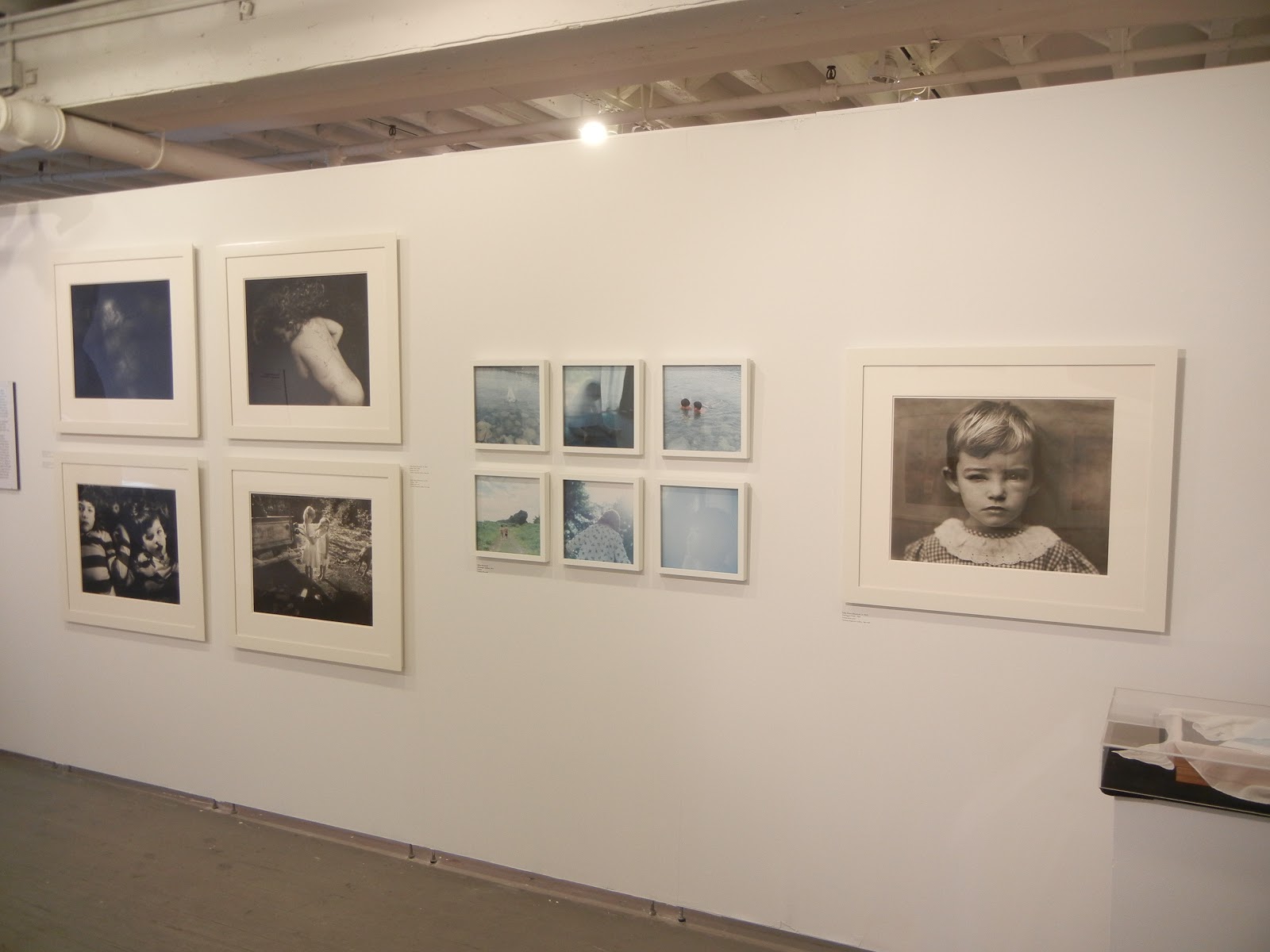
Rinko Kawauchi: Sally Mann, Immediate Family, 1992
- Mann: 5 gelatin silver prints, 1984-1989
- Kawauchi: 6 c prints, 2012
- Case with Kawauchi's limited edition book
Vik Muniz: Edward Weston, Daybooks, Volume 1, Mexico, 1973
- Weston: 3 gelatin silver prints, 1921-1924
- Muniz: 1 digital gelatin silver print, 2012, 1 copy of Daybooks cut up
- Onorato/Krebs: 1 camera made from a dozen cut through books, 1 archival pigment print
 Martin Parr: Aperture issue 103, 1986
- Nan Goldin: 2 cibachrome prints, 1977-1980
- Chris Killip: 2 gelatin silver prints, 1983-1984
- Larry Sultan: 2 digital c prints, 1984
- Parr: 3 digital c prints, 1990-2001
- Case with Parr's limited edition book
Doug Rickard: Stephen Shore, Uncommon Places, 1982
- Shore: 1 set of postcards, 1971-2000, 5 chromogenic prints, 1973-1975
- Rickard: 8 archival pigment pigment prints, 1971-1978/2012
- Case with Rickard's limited edition book
- Weston: 3 gelatin silver prints, 1 palladium print, 1927-1936
- Sassen: 5 archival pigment prints, 2003
- Case with Sassen's limited edition book
Alec Soth: Robert Adams, Summer Nights, 1985
- Adams: 4 gelatin silver prints, 1975-1980
- Soth: 1 video
- Case with letters and Soth's limited edition book
 Penelope Umbrico: Masters of Photography series, 1977-1999
- Group of source images: 2 Henri Cartier-Bresson gelatin silver prints, 1948 and 1964, 1 Wynn Bullock gelatin silver print, 1958, 2 Manuel Alvarez Bravo gelatin silver prints, 1966 and 1967, 1 Edward Weston gelatin silver print, 1935, 1 Alfred Stieglitz gelatin silver print, Eikoh Hosoe gelatin silver print, 1996, 1 Paul Strand gelatin silver print, plus other reproductions
- Umbrico: 87 iPhone images, manipulated by apps, hung as a single cluster
- Case with Umbrico's limited edition book and stack of original Masters of Photography series books
- Strand: 6 gelatin silver prints, 1928-1946
- Welling: 22 archival pigment prints, 1 diptych, and 3 texts, 2012
- Case with Welling's limited edition book
 Edward Weston provides the starting point for two of the photographers included. Viviane Sassen has made deceptive pink toned nudes in reference to Weston's iconic almost abstract creations, starting with a similar interest in the lines of the human form, but extending it in her own way into multi-body nudes that have a mysterious selection of extra limbs. Her images are both seductive and sculptural like Weston, but startlingly disconcerting and unexpected. Vik Muniz has also channeled Weston, immersing himself in the Daybooks and building one of his signature constructions out of text fragments from the book and other Weston imagery. His rework of Weston's elegant portrait of Tina Modotti holding a white iris is both reverential and also uniquely Muniz.
Alec Soth's homage to Robert Adams' Summer Nights is fascinating near failure. After backtracking from night photography to experimenting with his new camera's video function, Soth opted for still video clips of trees and their shadows, strip malls at twilight, and houses with lights in the windows; my first reaction was that it was all a little too literal for me, and not quite enough of Soth's own vision coming through. But then I stopped looking and started listening more actively: the rustling of the trees, the background noise of a town, the settling down for the night, all captured (perhaps inadvertently) by the video. It's an amazingly perfect soundtrack of summer nights, achingly evocative of Adams' own photographs.
 Other pairings are equally clever and thoughtful. Rinko Kawauchi reconsiders Sally Mann's images of her children, with her own ephemeral, atmospheric shots of kids: boys swimming, a splash of water, a baby behind a curtain, the soft sunlight streaming down behind a young girl. Penelope Umbrico dives into images of mountains made masters of the medium, and then reworks them using her iPhone, creating a candy colored array of the very same mountains, somehow made less imposing by tints, tiling, and reorientations. And Doug Rickard parrots Stephen Shore's own postcard idea back at him, discovering his own 1970s era postcards of motels, cars, and restaurants, and then further tuning them to accent the saturated yellow palette of the times; they're a smart homage, using Rickard's own affinity for found imagery.
What I like best about this show is its sense of honoring without fawning, of acknowledging influence while still staying true to original thinking. If all of our remixed, reshuffled, chopped, and appropriated digital art of the future is as shrewd as most of what is on view here, we need not ever fear that photography is somehow over.
 Collector's POV: One of the consistently puzzling things about this venue is that it is always a challenge to figure out what is actually for sale. For the most part, this is a non-selling environment more like a museum, so there is hardly ever an easily accessible checklist with ready price information and image details. What is perplexing about this approach is that often at least some of the works are really for sale or there are additional prints available in the print room, so it usually takes some initiative to get the answers. In the case of this particular show, it is not at all clear whether any of the photographs are available for purchase. My assumption is that at a minimum the limited edition collaborative books are for sale, but I didn't surface any prices, so interested collectors will need to follow up directly with Aperture or potentially with the various galleries that represent the artists.
Rating: * (one star) GOOD (rating system described here)
Transit Hub:
- Features/Reviews: CNN (here), Capital NewYork (here), New Yorker PhotoBooth (here), Time LightBox (here)
Through November 17th
547 West 27th Street
New York, NY 10001


