Showing posts with label Sara VanDerBeek. Show all posts

Wednesday, May 15, 2013

Sara VanDerBeek @Metro Pictures

JTF (just the facts): A total of 18 color photographs and 8 sculptures, hung against white walls in the three adjoining gallery spaces on the first floor. All of the photographs are digital c-prints made in 2013, framed in white and unmatted, in some cases covered by tinted Plexiglas (pink/blue) or mirrored Mirona glass. Sizes range from 20x16 to 96x48, and all the prints are available in editions of 3 (two of the works are diptychs). The modular sculptures are made from concrete and latex paint, and were also made in 2013. (Installation shots at right.)
 
Comments/Context: Sara VanDerBeek's new show is an exercise in atmosphere, where contrasts of shape, texture, color and scale are mixed with muted subtlety. Classical curves are matched by rough Minimalism, creating a back and forth dialogue between forms. The result is a loosely wandering rhythm, the whole of the installation trumping the power of any one contributing work.
 
The first room of the exhibit is balanced by four oversized images of Classical female sculpture, cropped down to sinuous bending torsos. Elegant bodies in soft white and enveloping black are paired with colorized partners in hybrid pink and blue, creating a calm sense of elemental grace. Flanked by tall corner-shaped concrete columns in stark white, the visual conversation moves between simple refinement and pared down, blunt geometry. The last room in the show follows this same pattern, capturing rounded female heads in bronze and marble in similar dusky pink and blue tonalities, once again offset by the rigid, rectilinear lines of the nearby sculpture.
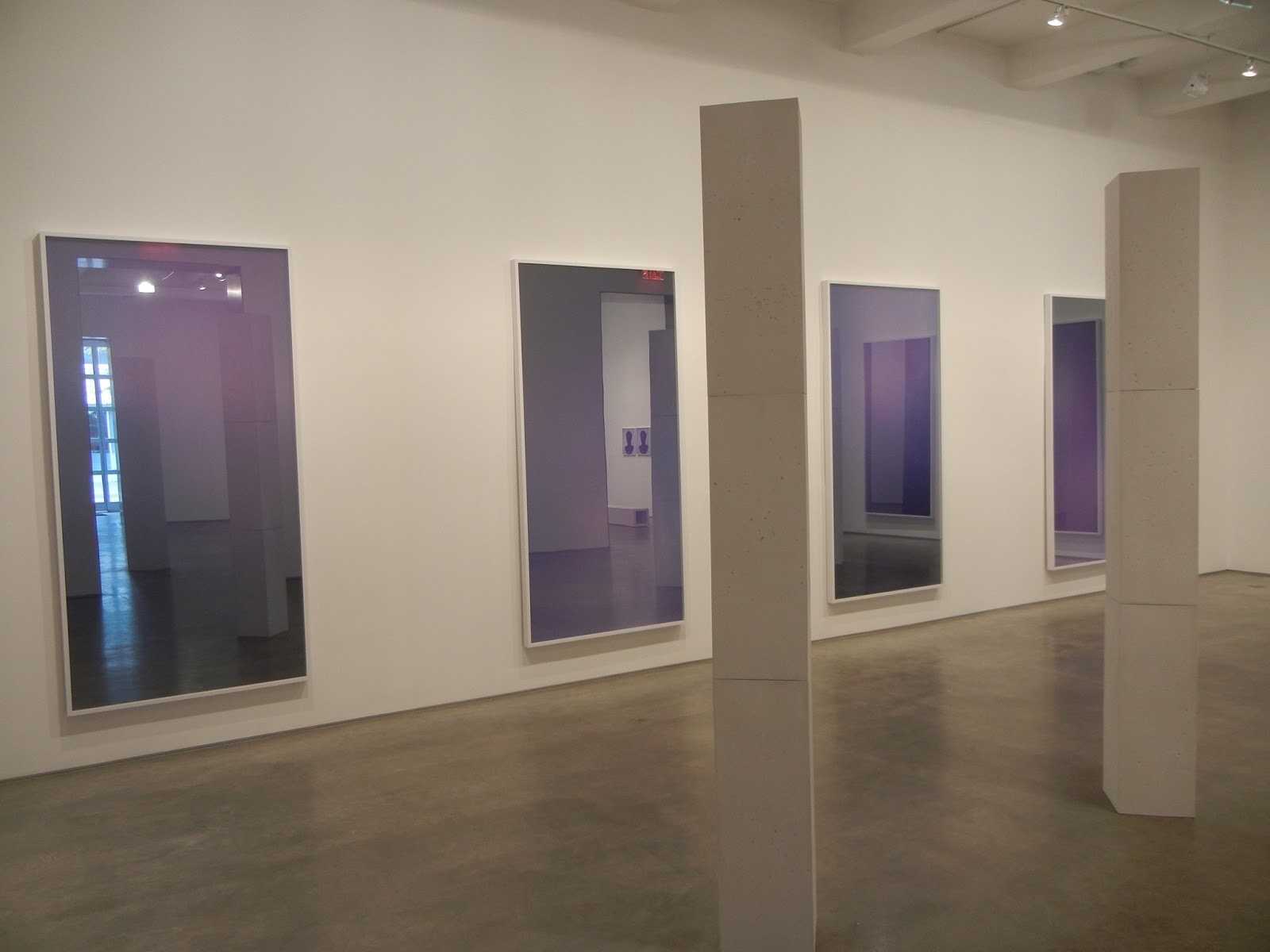
 
The works in the main gallery space take these contrasts in a more abstract and ephemeral direction, combining a colonnade of vertical blocks with a series of shifting color studies in pink and blue. Up close, the photographs are full of grainy splashes and misty gradients, drifting between foggy billows and textural oxidations. From afar, their surfaces are mirrored, so they bounce reflections around the room, echoing the spatial relationships between the visitors, the color fields, and the white concrete pillars. While I think I understood the intention here, to my eye, this mirroring became a distraction, making it nearly impossible to see the nuanced variations in the photographs with any clarity; the photographs lost their diaphanous mystery when covered up by recognizable reflections, especially when the gallery was crowded.
 
While this installation is successful in creating a dreamlike mood and making a visual point about contrasts, I think only a handful of the torso images can really function successfully as stand alone photographs; the rest really require the proximity of the columnar sculptures to resonate fully. Overall, I came away more intrigued by what VanDerBeek was discovering in the fleeting in-between spaces between these artworks than with the individual pieces themselves.
 
Collector's POV: The photographs in this show are priced between $6000 and $30000 based on size. VanDerBeek's work has not yet reached the secondary markets with any regularity, so gallery retail is still likely the best/only option for those collectors interested in following up.
 
Rating: * (one star) GOOD (rating system described here)
 
Transit Hub:
  • Feature/Review: New York Times (here)
  • Interview: Aperture (here)
 
Through June 8th
 
519 West 24th Street
New York, NY 10011

Monday, May 13, 2013

Photography in the 2013 Frieze New York Art Fair, Part 5 of 5

Part 1 of this five-part Frieze report can be found here. Start there for introductory background and explanatory notes.

Galleri Nicolai Wallner (here): Joachim Koester, $8000. In a fair full of bright, shiny things, Koester's all white snowscapes stood out in quiet, nuanced, contrarian defiance.


ProjecteSD (here): Jochen Lempert, €7000. A simple, well executed exercise in dappled light, leafy shadow, and shimmering all over movement.


Altman Siegel (here): Sara VanDerBeek, $16000. While VanDerBeek's Metro Pictures show is already in my review queue, this elegant tilted sculptural interpretation isn't part of that exhibit. The skewed frame aligns with the angles of the arms and offsets the verticality of the subject.


Sprüth Magers (here): Thomas Demand, €75000. Indoor plants in fancy modern planters for a windowless office are already an odd creation, but when they are abstracted even further into cut-paper constructions by Demand, controlled nature becomes even more artificial.


Team Gallery (here): Ryan McGinley, $50000. This whole booth was filled with recent large scale McGinley nudes, with young men and women in various states of falling, lying, and running around. This nighttime mix of fire and water is certainly dramatic and full of exuberance, like some secret ritual.


Alexander Gray Associates (here): Lorraine O'Grady, $25000. Up-close hair becomes an undulating textural landscape.


Murray Guy (here): Zoe Leonard, $25000. This booth had a selection of mid-1990s animal images by Leonard, taken during a multi-year stay in Alaska. While the animals were hunted by the artist, the images have the feel of taxidermy or staged diorama, but with an edge of rawness.


White Cube (here): Jeff Wall, $450000. This was the only work by Wall I saw at Frieze, a small backyard study of poppies and scrubby greenery.


Sfeir-Semler Gallery (here): Walid Raad, $25000. Images of minimal paintings hung in white, formless, galleries, the corollary of Louise Lawler, where context tells us nothing.

Friday, October 29, 2010

Sara VanDerBeek: To Think of Time @Whitney

JTF (just the facts): A total of 29 color works, framed in black with no mats, and hung in the single room gallery on the first floor of the museum. All of the works are chromogenic prints, sized 20x16, and made in 2010. This is the photographer's first solo museum show. The Whitney does not allow photography in the galleries, so unfortunately, there are no installation shots of this show. The single images at right are taken from the Whitney website. (Sara VanDerBeek, Foundation, Reynes Street, 2010, at right.)

Comments/Context: Sara VanDerBeek's small solo show at the Whitney is modulated and meditative, an atmospheric exercise in muted color. In a departure from her photographs of carefully constructed conceptual sculptures of appropriated/collaged images, these works rhythmically alternate between images of pitted concrete foundations unearthed in the Lower Ninth Ward of New Orleans, angular, geometric sculptures made in her studio, and details found in her childhood home of Baltimore. The entire project is wrapped in the mantle of Walt Whitman, borrowing its group titles from Leaves of Grass.
.
While this exhibit has all the trappings of a deeply personal investigation of time and memory, it somehow falls flat in terms of showing us something new. I found the images of gritty, textured poured concrete to be the most aesthetically interesting, with their all-over abstractions in scratched grey and blue, but it would be hard not to see obvious connections to the explorations of surface by Aaron Siskind and Minor White here. VanDerBeek's pared down studio sculptures of roughly hewn nested rectangles, chevrons, and boxes have been photographed with moody shadows (a little reminiscent of Brancusi's photographs), in the same washed out palette as the images of concrete; the effect is subdued and quiet, the works isolated and drained rather than elevated. These two groups of images are then intermingled with a handful of more personal icons (in the same natural light tonalities), and then sequenced into juxtaposed groups that repeat around the room. (Sara VanDerBeek, Blue Caryatid at Dusk, 2010, at right.)

In general, while these works have a lovely pale serenity, I think the overall experience misses the mark a bit. My enjoyment of the soft, diffused feeling of the photographs was disrupted by an underlying sense of the artist trying too hard, of a self-conscious, conceptual artiness that seemed too contrived. But this same knock could be leveled at any number of inward looking, mystical or symbolic photographers across the decades (Szarkowski's "mirrors"), especially those who have regularly employed abstraction. These new works do successfully create a mood, I'm just not sure it is one that we haven't felt before.
.
Collector's POV: None of the images in this museum show are for sale. Van DerBeek is represented by Metro Pictures in New York (here, with some installation shots) and Altman Siegel Gallery in San Francisco (here). Her work has not yet reached the secondary markets, so gallery retail is likely the only option for interested collectors at this point. (Sara VanDerBeek, Foundation, Dorgenois Street, 2010, at right.)

Rating: * (one star) GOOD (rating system described here)

Transit Hub:

  • Review: New Yorker (here)
  • Feature: NY Times (here)
Sara VanDerBeek: To Think of Time
Through December 5th

Whitney Museum of American Art
945 Madison Avenue
New York, NY 10021

Wednesday, October 28, 2009

New Photography 2009 @MoMA

JTF (just the facts): A group show of the work of six contemporary photographers, variously framed, and hung in a two room divided gallery on the 3rd floor. The exhibit was curated by Eva Respini. (Installation shots at right.)

The following photographers have been included in the show, with the number of works on view in parentheses:
  • Walead Beshty (4), all from 2008
  • Daniel Gordon (4), from 2008 and 2009
  • Leslie Hewitt (6 as 3 works), from 2002-2008
  • Carter Mull (5), from 2008 and 2009
  • Sterling Ruby (4), from 2005-2007
  • Sara VanDerBeek (4 as 1 work), all from 2006
Comments/Context: This year's New Photography exhibit at the MoMA takes us far out beyond the traditional boundaries of conventional straight documentation, and emphatically declares that the museum's 21st century definition of "photography" will be broad and inclusive.
.
I actually believe that this definitional discussion is long overdue and much needed at this point in the medium's history. Since the beginning of photography, there have always been subcultures of artists who rejected the sharp reality of what a camera could capture, and spent their time and energy exploring how the various technologies could be used to create wholly unreal worlds. Out of this experimentation came multiple negatives, collaged and photomontaged works, images of staged performances, ephemeral sculptures and conceptual hoaxes, appropriated images and rephotography, camera-less darkroom creations and photograms, etc. etc. All of these were generally still gathered under the umbrella of "photography", perhaps because their endpoint output was a photographic print of some kind.
.
As we cross into the digital age, new tools have expanded the number of degrees of freedom artists can now play with; there are now even more variables that can be tweaked and modified. Many of the works in this show might be best called mixed media contemporary art, as they bear little resemblance to the black and white masters of traditional photography. But while most of the works don't look familiar, nearly all of them are further extensions of practices and ideas with roots found decades ago, just supercharged and taken way out into the unknown, often bridged into this white space by the additional of computer-based manipulation. But it seems the definitional construct is still the same: if the product is a photographic print, no matter how it was created or how unorthodox it may seem, it's still "photography".
.
I'd say it's impossible to walk into these galleries and not notice Walead Beshty's huge floor-to-ceiling photograms; they are so blindingly colorful, full of electric magenta and bold yellow, that they drown out everything else. Abstract lines and rectangles cluster into dense overlapping layers. Beshty's work is clearly a distant relative of Man Ray's and Laszlo Moholy-Nagy's photograms, albeit with a much more expressionistic palette.
.
Daniel Gordon's cut paper collages of disturbing figures have a Picasso-esque feeling to them, adapted to the culture of image appropriation. Hair, eyes, and other random body parts have been assembled into unsettling and Surreal hybrid characters, not exactly funny, just odd. These piece part people and their flattened surroundings finally emerge as photographs, documents of the elaborate tableaux that have been painstakingly constructed.
.
Sterling Ruby's images seem the farthest from "photography" as we know it. These seem to be pure digital creations: a gathering of found images collaged together with seamless perfection and then covered with computer generated "effects" like drips of paint/blood and sprayed on scrawls, creating a violent mood. While the output is still a photographic print, these works seem to have no relationship to the old school operation of a camera; we're in the realm of digital wizardry here and the opportunities for artistic expansion seem limitless.
.
The works of Carter Mull, Leslie Hewitt and Sara VanDerBeek travel some of these same experimental roads, but to lesser effect in my opinion. LA Times spreads are washed with distorted colors and patterns of martini glasses and roses become swirls of darkroom effects, staged tabletop still lifes adorned with old photographs are turned upside down, and elaborate temporary sculptures of found pictures and dripping white paint become a patchwork of symbols and inside references.

While overall this exhibit is a mixed bag of work, I enjoyed the fact that this annual show was once again being used to dig a little deeper into a topic of current importance to the medium, rather than simply a gathering of fresh but unrelated imagery. The discussion of what "photography" is or isn't is far from over, but this show is at least a stake in the ground for people to consider.
.
Collector's POV: The photographers in the show are represented by the following galleries:
  • Walead Beshty is represented by Wallspace in New York (here).
  • Daniel Gordon is represented by Claudia Groeflin Galerie in Zurich (here).
  • Leslie Hewitt is represented by D'Amelio Terras in New York (here).
  • Carter Mull is represented by Marc Foxx in Los Angeles (here).
  • Sterling Ruby is represented by Metro Pictures in New York (here). (UPDATE: I've been told this may not be the case anymore, and that the right pointer should be to Pace Wildenstein (here))
  • Sara VanDerbeek is represented by D'Amelio Terras in New York (here).

None of these artists has any significant secondary market track record, so gallery retail will likely be the only option for acquiring their work in the short term. While none of this work is a fit for our particular collection, I enjoyed Beshty's eye-popping photograms the most.

Rating: * (one star) GOOD (rating system described here).
.
Transit Hub:

  • Walead Beshty: Directions @Hirshhorn Museum 2009 (here)
  • Daniel Gordon: artist site (here)
  • Leslie Hewitt: artist site (here)
  • Carter Mull: former Rivington Arms site (here)
  • Sterling Ruby: The Masturbators @Foxy Production, 2009 (here)
  • Sara VanDerBeek: NY Times review 2006 (here)
Through January 11th
.
11 West 53rd Street
New York, NY 10019