Showing posts with label Japanese Photography. Show all posts

Friday, August 2, 2013

Book: Motoyuki Daifu, Project Family

JTF (just the facts): Published in 2013 by Dashwood Books (here and here). Softcover, 50 pages, with 35 color images. There are no texts or essays included. (Spread shots below.)
 
Comments/Context: Motoyuki Daifu's flash lit photographs of his overstuffed family apartment in Yokohama easily cross over into visual chaos. The place itself is filled to the brim with parents, brothers and sisters, laundry, dirty dishes, cats, and the ever multiplying clutter of daily life. His images take a diaristic look at life in these cramped quarters, using a loose snapshot aesthetic to capture the eye popping density of color and texture seemingly found in every direction. Stepping into this environment full of visual stimuli for even just a moment is a bit overwhelming.

The best images in this thin volume reduce the mess into barely controlled still lifes, where a sink overflowing with dishes, a kitchen table of condiments, or a pile of bagged garbage and recycling turns into an overlapping riot of bright color. In these works, the jumbled too muchness of the stuff fills the frame to the breaking point. Other photographs introduce family members into this busy world, where open mouthed sleepers lie sprawled amid the debris and a snatched bowl of noodles offers a fleeting moment of peace. Daifu's photographs of his siblings add a sliver of surreal humor to the proceedings: three full-mouthed teenagers stare in the same direction with stunning similarity and the seemingly rolled back eyes of a brother punctuate tooth brushing and the face down passed out end of a meal. Even in all this claustrophobic, right-on-top-of-it chaos, there is a surprising amount of quiet tolerance and easy going joy.

Part of the charm of this book is its endearing warmth; the glare of Daifu's flash never turns harsh or particularly critical. (This was also true of his last project, Lovesody, reviewed here.) Rather than turn these pictures into pared down formal exercises, he has embraced the rush of cacophonous energy found in his home and let it run free. His photographs reject the entire notion of deadpan observation, and instead bring some low key personality back into the artistic discussion.

Collector’s POV: Motoyuki Daifu is represented by Lombard-Freid Projects in New York (here). His work has not yet reached the secondary markets with any regularity, so gallery retail remains the best option for those collectors interested in following up.
 
Transit Hub:
  • Artist site (here)
  • Feature: American Photo (here)


Friday, July 19, 2013

Book: Daido Moriyama: Sunflower

JTF (just the facts): Published in 2011 by Match and Company (here). Hardcover, 88 pages, with 64 black and white images. The photographs included were taken between 1965 and 2009. There are no essays or texts. (Spread shots below.)

Comments/Context: Daido Moriyama's photographs of flowers aren't like most floral pictures. They aren't intricate botanical specimens, up-close geometries, or bright blossoms captured at the peak of their freshness and beauty. Moriyama's flowers are much darker and edgier, turning floral innocence into something alternately sultry, menacing, decaying or decidedly urban. This book brings together a broad sample of Moriyama's flowers, taken over four prolific decades, offering a subject matter-based view into his singular aesthetic.

This edit applies perhaps the loosest possible definition of "floral" to the photographs that have been included here. While there are a handful of single images of sunflowers, roses, hydrangeas, tulips, and the like, as well as some wider shots of fields and cherry trees, for the most part, Moriyama has avoided straight-on floral portraits. Instead, his flowers are found in the flow of daily life, in bursting bouquets wrapped in plastic and tin foil, reflected in shop windows, and discarded in dingy gutters and alleys. They are often seen in flash lit glare, looming out of the surrounding darkness with out of place, tactile seductiveness.

Moriyama's restless eye for the contrast between flowers and their surroundings extends in all directions, from printed floral clothing and tawdry motel furnishings to funeral wreaths and elaborate tattoos. Patterned blouses and skirts, swimsuits and shoulder bags all add a pop of flower power to an otherwise shadowy world, while bedspreads, curtains, and worn carpet with floral prints add a touch of faded energy to empty rooms. Hints of floral motifs show up in even more subtle and unexpected places in Moriyama's world, in lace lingerie and underwear and on ironwork benches and shop awnings. Even fireworks, dancefloor confetti, and nighttime snowflakes become vaguely floral when seen from the right angle.

The best of Moriyama's flowers have a lush eroticism that feeds on his dark palette; whether literal or figurative, they have a lurking sense of knowing danger or spent beauty. Even the cheapest and ugliest of his flowers have some seedy come hither attraction, trading pure elegance for something a little grittier.

Collector’s POV: Daido Moriyama has been a prolific book maker, and the specialized secondary markets and photobook auctions are routinely stocked with vintage rarities for deep pocketed collectors. Morimaya's photographs have also become more widely available at auction in recent years, with print prices generally ranging from $2000 and $40000.

Transit Hub:
  • Artist site (here)
  • Features/Reviews: Japan Exposures (here)


Wednesday, June 26, 2013

Takuma Nakahira, Circulation: Date, Place, Events @Milo

JTF (just the facts): A total of 87 black and white photographs, framed in white and matted, and hung against white walls in the East and West gallery spaces. All of the works are modern gelatin silver prints, made from negatives taken in 1971. The prints are sized 20x24 (or reverse) and are available in editions of 15+2AP. A monograph of this body of work was recently published by Osiris (here) and is available from the gallery for $95. This is the artist's first solo show in the United States. (Installation shots at right.)

Comments/Context: There is something altogether astonishing about an important early 1970s project by a major Japanese photographer making its US debut in 2013. Beyond these sense that collectively we have been asleep at the historical wheel to some extent, it certainly reminds us that the history of photography is more serendipitous and incomplete that we might assume, especially for artists working outside our normal purview.

Takuma Nakahira is a clearly photographer that we should be more familiar with here in the US. He was a founding member of the late 1960s Provoke magazine, whose rough, grainy, blurred style marked a radical shift in both aesthetics and conceptual underpinnings from what had come before, and whose influence remains durably important some four decades later. This show recreates a project Nakahira did for the Seventh Paris Biennale in 1971, where he took pictures on the streets of Paris during the day, developed them at night, and displayed them all in an ever changing wall and floor exhibit that ran for several days. Stylistically, think of it as the dark, brash, moodiness of Provoke as applied to classic Parisian subject matter: Metro stations, street corner cafes, parked cars, vernacular signage, and pedestrian life. His images are full of shadows and eerie, feral glows, marked by haunting advertising fragments, the glare of fluorescent lights, and the dirty elegance of smashed taillights in watery gutters.

In addition to the many single images on view, the show also contains a handful of multi-image sequences that stop time down to fractions of a second. A man walks behind the trunk of a parked car, a woman looks at her wallet on a bright street corner, a dog sniffs the subway grates, and pedestrians gingerly step through the dark fingers of spilled water on the sidewalk. In each mini vignette, there is a cinematic sense of something happening, but a breakdown in the ability of the pictures to convey the entire narrative; the ordinariness of the everyday action is left to speak for itself. The parallels to Paul Graham's recent fragment of time street scenes are unmistakable, so much so that I wonder about whether Graham was aware of Nakahira or not.

The other fascinating thing about this particular project is how it prefigures many of the conceptual threads that would infiltrate photography in the coming years. Nakahira's effort is a mix of three distinctly separate parts: street photography with an eye for direct observation and reuse of media images, process-centrism in terms of his hand crafted approach to making and displaying the images, and an almost performance-like quality to the whole endeavor, as though the physical photographs were just part of the larger visual interaction he was having with the city around him. With the benefit of hindsight, the project looks remarkably innovative, its power and originality for the most part undiluted by the passing of time.

When an important talent like Nakahira is rediscovered (or reintroduced to a previously oblivious audience), I can't help but think of it as a jamming of a new puzzle piece into a previously completed scene, an action that forces all the other pieces to readjust and reconsider their own relationships and interconnections. Whether causality and influence can be traced through such a network is ultimately unknowable, but it certainly sets my mind on flights of fancy, weaving an artist like Nakahira back into brocades that hadn't previously included him.

Collector's POV: All of the prints in this show are priced at $3500. Aside from a few photobooks, Nakahira's photographs have been largely absent from the secondary markets, so gallery retail is likely the best/only option for those collectors interested in following up.

Rating: ** (two stars) VERY GOOD (rating system described here)

Transit Hub:
  • Features/Reviews: American Photo (here), American Suburb X (here), Wall Street Journal (here)

Through July 26th

Yossi Milo Gallery
245 Tenth Avenue
New York, NY 10001

Tuesday, May 14, 2013

Toshio Shibata and Toeko Tatsuno: Given @Miller

JTF (just the facts): A two artist show containing a total of 13 black and white and color photographs by Toshio Shibata and 12 paintings by Toeko Tatsuno. Shibata's photographs are a mix of c-prints and gelatin silver prints, framed in white and matted/unmatted, and made between 1989 and 2008. His prints come in three sizes: 20x24 (in editions of 25), 32x40 (in editions of 10), and 40x50 (in editions of 10). There are 9 color works and 4 black and white works on view, split between the main gallery space, the entry area, and the smaller print room. (Installation shots at right.)

Comments/Context: Toshio Shibata doesn't come from the cherry blossom in springtime school of Japanese landscape photography. His interest lies the intersection of the man-made and the natural, not so much the harsh contrasts of the American New Topographics photographers but something more tightly integrated and humanized. Paired with the geometric abstractions of Toeko Tatsuno in this back and forth show, his eye for linear pattern and sculptural form comes through even more clearly.

Stone retaining walls, concrete spillways, landslide nets, and reservoir dams are the main characters in Shibata's natural drama. Patchwork combinations of bricks, squares, and herringbone patterns dot the hillsides, intermixed with scrubby greenery and erosion mediating trees. His waterscapes turn man-made waterfalls into flat curtains of flowing white, adding an element of passing time to his images; concrete blocks and other debris bob in swirling eddy pools and at the bottom of still runoff areas. Whether using the girders of a bridge or the edge of a waterfall, Shibata manages his lines and angles with precision, seeing landscape as rigid structure, even when it is a line of trees or the rusty residue falling from a drainpipe.

Toeko Tatsuno's blocky stacks and ladder-like bookcase forms provide an insightful foil for Shibata's focus on man-made abstraction. In this context, his compositions resolve even further into systems of line, a rope of buoys becoming a graceful arc and a tethered net turning into an obtuse triangle. Shibata's landscapes depict this strict human-imposed order not as ugliness or interference, but as something graceful and well-integrated, finding harmony where others have found dissonance.

Collector's POV: The Shibata photographs in this show are priced between $3500 and $25000, based on size and place in the edition. His prints have not developed a consistent presence in the Western secondary markets; only a handful of lots have come up for recent public sale, fetching prices between $1500 and $7500, but these prices may not be entirely representative of the broader market for his work. As such, gallery retail may be the best/only option for those collectors interested in following up.

Rating: * (one star) GOOD (rating system described here)

Transit Hub:
  • Shibata exhibit: @Peabody Essex Museum, 2013 (here)
  • Shibata interview: Eyecurious (here)
 
Through May 25th
 
20 West 57th Street
New York, NY 10019

Wednesday, April 10, 2013

Daido Moriyama: Now and Now @Kasher

JTF (just the facts): A total of 59 black and white and color photographs, variously framed and matted, and hung against white walls in the North and South gallery spaces and the side alcove. The exhibit also includes 7 silkscreen paintings on canvas and a glass case containing a selection of Moriyama's photobooks. Most of the photographs on view are arranged into three contiguous bands of images, hung edge to edge and pinned directly to the wall, unframed but under plexiglas. There are 2 sets of black and white works and 1 set of color works. The black and white images are a mix of gelatin silver and archival pigment prints, all made recently from negatives taken between 1971 and 2011. The color images are all archival pigment prints, made recently from negatives taken in 2010 and 2011. Print sizes for all three sets are either roughly 17x13 or 17x22. The exhibit also includes 4 larger archival pigment prints, ranging in size from 22x33 to 41x55. The alcove holds a selection of earlier Moriyama favorites, all gelatin silver prints made recently from negatives taken between 1969 and 2001. Moriyama doesn't edition his prints, so there is no edition information available for any of the photographic works on view. The silkscreen paintings were made between 2007 and 2012; they range in size from 43x54 to 43x65 and are available in editions of 3 or 5. (Installation shots at right.)

Comments/Context: If the new photographs in this show are any indication, Daido Moriyama is leading quite a jet set life these days. While Tokyo and New York might be expected locales, his destination list goes quite a bit further, to Los Angeles and Italy, Taipei and Antwerp, all seen with Moriyama's signature shadowy grittiness. Like a visual DJ, he has then sequenced these images into linear strips, mixing old and new, West and East, into one continuous, global mashup. The high contrast graininess he perfected in his Provoke days is still there, but his photographic world has now grown larger and more multicultural.

The darkness in Moriyama's images gives the impression that we are traveling through the underbelly of life, so when his eye catches on something and brings it into brightness, it's hard not to be captivated. A tanned back in a shining dress, a blurred baby's face, a feral kitten, a pair of eyes on a TV screen, the edge of a truck tire, they all draw your attention with muscular roughness. Whether its a girl on the side of a bus in Taipei, lingerie in a window in Italy, sunglassed women in LA, or a tangle of overhead wires in Osaka, Moriyama has a knack for sifting cultural signifiers through his own filter, finding the eclectic and the universal in equal measure. There is a noticeable rhythm to these series, with beggars and street sleepers sharing the same space with shining skyscrapers and glorious city lights, a swaying from high to low and back again. His color sequence of Times Square, an alligator, an up-close doll's face, a bloody Christian Louboutin shoe, a nude Japanese stripper, and a bunch of yellow irises mixes seemingly disconnected moments into a surreal summary of modern life, altogether familiar but vaguely unsettling.

The back gallery shows another new body of work - silkscreened Warholian enlargements of some of Moriyama's most famous images. Given their graphic power, the menacing dog, the abstracted tights, and the extra large lips all function effectively in this medium, and the tiny bit of sparkle in the grey paint adds a dose of glamour to Brigitte Bardot posed on a motorcycle. That said, these images are aimed at a different person than a photography collector, and I couldn't help but come away with a bit of a feeling that some of his most iconic images were undergoing a poster shop style dilution.

All in, this show does a solid job of presenting Moriyama's newest work while also providing some background and context to help trace his ongoing artistic evolution. It's clear that his eye continues to be restlessly original, turning increasingly broad and varied subject matter into a brash, uneasy meditation on 21st century urban existence.

Collector's POV: While many of the works on view are shown in carefully sequenced series, all of the images are available as individual prints. The photographs in the three series are either $4000 or $5000 each. The handful of larger photographs are either $7500 or $10000, based on size. The gelatin silver prints in the alcove are all $6800 each. And the silkscreen paintings range from $13000 to $25000. Moriyama's work has become more available in the secondary markets in the past year or two. Recent prices have ranged between $2000 and $40000.

Rating: * (one star) GOOD (rating system described here)

Transit Hub:
  • Features/Reviews: Wall Street Journal (here), Animal New York (here)
 
Through May 4th

Steven Kasher Gallery
521 West 23rd Street
New York, NY 10011

Friday, October 19, 2012

Yasuhiro Ishimoto, Gifts to a Friend @Stephenson

JTF (just the facts): A total of 22 black and white and color photographs, framed in black and matted, and hung against white walls in the main gallery space and the smaller viewing room. The images in the show were taken between 1948 and and 1996 and are a mix of vintage and later prints. There are 19 gelatin silver prints and 3 Type C prints on view. Sizes range from 8x10 to 11x14 (or reverse); no edition information was available. 15 of the prints come from a single collection and were gifts directly from Ishimoto. (Installation shots at right.)

Comments/Context: Yasuhiro Ishimoto is probably best known to American audiences for his 1940s/1950s Chicago street photography. Ishimoto studied at the Institute of Design under Harry Callahan and Aaron Siskind, and returned to the city on an artistic fellowship a decade later. This small show brings together a few prints from this early period and a tight cross section of work he made in subsequent years while living in Japan. It's a terrific one-stop introduction to a photographer who smartly harmonized his Japanese and American aesthetic influences.

Ishimoto's street shots cover familiar territory, but with an eye for layered compositions of people at different depths. Kids wear Halloween masks and pose on sidewalks or front stoops, while other images flatten adjacent strangers into intricate, interlocking spatial relationships. The later works on display here cover a broad swath of photographic genres: cut paper and light-on-water abstractions, elegant up-close still life florals, ephemeral melting footprints in snow and flimsy grass silhouettes, and even a single nude/rock study with echoing rounded forms. These pictures feel rooted in both his American artistic education and the intrinsic natural beauty of unbalanced Japanese forms. The exhibit also includes a few experimental multiple exposure color works that merge dark trees and cloudy skies with bright washes of overlaid expressionistic color, showing that Ishimoto continued to innovate even when he was exploring relatively traditional subject matter.

It's great to see an Ishimoto sampler on view here in New York, since his work has generally been more accessible in Chicago (where he has long been represented by Stephen Daiter (here)). He is a bridge figure, one who fills in gaps in the ID history, as well as connecting to Japanese photographic ideas. Overall, this small overview covers a lot of ground, but is full of intimate, well crafted 20th century photographs.

Collector's POV: The prints in the show are priced as follows. The black and white prints range in price from $2500 to $6000; the color prints are $800 each. The entire set of 15 gift images (sold as a single collection) is priced at $22000. Ishimoto's work has only been intermittently available in the secondary markets over the years; his well regarded book Chicago, Chicago is more often found in photobook sales. Prices have generally ranged between $500 and $3000, but this may not be entirely representative of his best or most notable work.

Rating: * (one star) GOOD (rating system described here)

Transit Hub:
  • Obituary: Le Journal de la Photographie, 2012 (here)
Yasuhiro Ishimoto, Gifts to a Friend
Through November 3rd

L. Parker Stephenson Photographs
764 Madison Avenue
New York, NY 10065

Wednesday, February 8, 2012

Motoyuki Daifu, Lovesody @Lombard-Freid

JTF (just the facts): A total of 25 color works (22 single images and 3 diptychs), framed in white and unmatted, and hung in the main gallery space. All of the works are c-prints taken in 2011. The prints come in three sizes: 14x17, 20x24, and 30x40 (or reverse), all in editions of 10. The diptychs are made up of 11x14 or 20x24 photographs. There are 7 small images, 11 medium sized images, and 4 large images in the show, plus the 3 diptychs. A monograph of this body of work was published in 2011 by Little Big Man (here) and is available from the gallery for $75. (Installation shots at right.)

Comments/Context: The history of photography is filled with photographers and their muses: Stieglitz, Strand, Callahan, Gowin, the list goes on and on. Motoyuki Daifu follows in these weighty footsteps, making affectionate pictures of a young single mother during her pregnancy and the subsequent birth of her second child. He is undeniably smitten with his subject, and his playful images feel like snapshots from an intimate family album. While the infatuation only lasted six months, the warm energy of his crush lives on in the pictures.

These are casual images, unconstrained by typical Japanese formality and societal control. The young mother shows off her pregnant belly flanked by a pile of garbage bags, hangs up laundry and Hello Kitty baby blankets in the cramped bedroom, cooks a meal wearing only a towel (exposing her bare bottom), and takes a bath with her son in the tub. Half eaten toast, cigarette ashes in a plastic Winnie the Pooh bowl, leftover breakfast dishes, and a tornado of discarded toys decorate her small chaotic apartment. His images of her wander between the trials of motherhood (breastfeeding, exhaustion, crying children) and the reality of her attractiveness (clutching a microphone on the floor of a karaoke room or splayed suggestively on a mattress). Whatever she does, he finds it cute and endearing.

Even though many of these photographs seem quick and ephemeral, quite a few capture a surprising depth of emotion. He is enamored, charmed, and thoroughly fascinated by this woman, and his fondness has the ring of authenticity. We're voyeurs taking in the action second hand, but Daifu's charged atmosphere is a vivid reminder of the spellbound state of young love.
.
Collector's POV: The photographs in this show are priced as follows. The unframed single images are priced based on size: the 14x17 prints are $1000, the 20x24 prints are $1600, and the 30x40 prints are $3000. The unframed prices of the diptychs are also based on component size: the works made up of 11x14 prints are $1800 and those made up of 20x24 prints are $3200. Daifu's photographs have not yet entered the secondary markets, so gallery retail is likely the only option for interested collectors at this point.

Rating: * (one star) GOOD (rating system described here)
.
Transit Hub:
Motoyuki Daifu, Lovesody
Through March 3rd

Lombard-Freid Projects
518 West 19th Street
New York, NY 10001

Tuesday, November 15, 2011

Hiroshi Sugimoto: Lake Superior @Pace/MacGill

JTF (just the facts): A total of 12 black and white photographs, framed in black wood and matted, and hung against grey and dark grey colored walls in the main rooms of the gallery. All of the photographs are gelatin silver prints mounted to board, made in either 1995 or 2003. Each mounted image is 20x24; no edition information was available. There is no photography allowed in the gallery, so the installation shots at right are via the Pace/MacGill website.

Comments/Context: Hiroshi Sugimoto's photographic seascapes have become so iconic that at this point, I'm ashamed to say that I think I take them a bit for granted. This isn't to say that I adore or admire them any less, it's just that my brain uses some kind of mental shorthand that assumes I've already absorbed most of what they have to offer, and thereby often skips over them in search of something else. In the past few years, Sugimoto's seascapes have been shown at monumental scale in New York gallery shows, and at that size, their largeness becomes enveloping and almost spiritual. In contrast, this show gathers together images taken of Lake Superior and displays them in the smaller size, forcing the viewer into an entirely different and much more intimate, one-on-one interaction.

The sequencing of this show is important to notice, as there is a careful progression along a spectrum of color and mood. The first image the visitor encounters when coming out of the elevators is an almost pure white on white picture (the best in the show, in my opinion), which is then followed around the wall by whites that become more foggy and unstable, and waves and undulations that become more noticeable. As the viewer passes into the adjoining room, the bisected images become more contrasty, the water darker, sometimes grey and soft, sometimes smooth, sometimes crisp and almost sharp against the featureless sky, ending with a single night seascape with its tonalities of light and dark reversed. Seen together at this size, the changing weather conditions generate forward motion through the gallery, and the subtle gradation enables a meditative flow of muted emotion.
.
Sugimoto's seascapes are a tremendous reminder of the power of pared down, photographic simplicity. His views of the water offer endless variations, combining both a cerebral quality of conceptual thinking and a deeply human sense of timeless, elemental purity. Even if you're sure you've seen them before, they undeniably merit a second (or third, or fourth) look.
.
Collector's POV: The photographs in this show are priced at $35000 each. Sugimoto's work is routinely available in the secondary markets, in various sizes and at various price points. Images of equivalent size (20x24) as those on display here (seascapes, as well as other subjects/projects) have generally been available at auction at prices ranging between $10000 and $90000.
.
Rating: ** (two stars) VERY GOOD (rating system described here)
.
Transit Hub:
Hiroshi Sugimoto: Lake Superior
Through December 3rd

Pace/MacGill Gallery
32 East 57th Street
New York, NY 10022

Friday, June 10, 2011

Rinko Kawauchi: Illuminance @Hermes

JTF (just the facts): A total of 15 large scale color photographs, framed in white with no mat, and hung in the atrium gallery space at the top of the store. All of the works are chromogenic prints made between 2009 and 2011. The prints on display are square format, each 40x40; no edition information was available. A monograph of this body of work is forthcoming from Aperture (here). (Installation shots at right.)
.
Comments/Context: Every time I see Rinko Kawauchi's work, I am reminded that photography has not lost its ability to capture the pure unadulterated wonder of the world around us. Her images of seemingly mundane objects and fleeting moments are radical in their effortless simplicity and genuine freshness, her optimistic curiosity discovering child-like interest in things most of us would pass by without a second glance. Her shows have the effect of stripping away jadedness and cynicism, taking us back to a view of the world that is more naturally engaged and actively inquisitive.

What I like about this newest selection of images is that they have been edited with much tighter hand, making the whole much more thematically coherent than previous shows I've seen, which have tended to wander with more randomness from subject to subject. Virtually all the pictures on view turn on their use of light. What might seem like a ridiculously overused photographic construct actually works here, as the images sparkle with flashes and beams of immaculate whiteness, on surfaces, in the air, and through the frame. Kawauchi's light glistens through watery mist, glances off of a scooter side mirror, stripes a sidewalk, gets lost in the smoke of fireworks, slips through the forest, and passes through a transparent bubble. She jumps from the immensity of a solar eclipse to the minuteness of a tiny frog perched on a thumb, touching the tenderness of a dead swallow and the poetry of a swirling sea in between.

Regardless of her subject, Kawauchi never seems to lose sight of delicacy and openness. At first, a blast of flash against an ordinary pink rose at night seems harsh and amateurish; look again and it has a quiet haze that is quite remarkable. Even shots that might be mistaken for stock photography are somehow infused with her life affirming attention; it's like we are being taught to see all over again. Kawauchi's work doesn't fit into any neat categories or curatorial frameworks; hers is an authentically original vision, and this well chosen small show is evidence of the power of an alternate viewpoint.

Collector's POV: This isn't a selling show, so no prices were available. Kawauchi's work has only recently entered the secondary markets; with only a few lots sold in various sizes, it's hard to draw many pricing trends from so few outcomes. As a result, gallery retail is still the best option for interested collectors. I don't believe Kawauchi has gallery representation in New York at the moment, so FOIL Gallery in Tokyo (here) will be the place to go.  
 
Rating: ** (two stars) VERY GOOD (rating system described here)

Transit Hub:
  • Reviews/Features: T Magazine (here), Time Light Box (here)
Rinko Kawauchi: Illuminance
Through July 16th

The Gallery at Hermès
691 Madison Avenue
New York, NY 10065

Monday, May 16, 2011

Japan Today @Amador

JTF (just the facts): A group show consisting of a total of 33 black and white and color photographs from 3 photographers. The front gallery space contains the work of Taiji Matsue and Mikiko Hara. Hara's works are square format type c prints from the series Hysteric Thirteen, each 14x14 and framed in white with white mats, printed in editions of 10. The 8 images on view were made between 1996 and 2005. Matsue's works are type c prints, 20x24 and framed in white with white mats, printed in editions of 5. The 8 images on view from the JP-22 series were all made in 2005; a single image from the Cell series is also on display; it is an 18x18 digital type c print, available in an edition of 15. The back gallery contains 16 images by Osamu Kanemura. All of these works are gelatin silver prints, each 20x24 and framed in black with no mat, printed in editions of 5. 7 of the works come from the 1995 series Today's Japan; the other 9 works come from the 2007 series My Name is Shockhammer. (Installation shots at right.)

Comments/Context: In the wake of the recent earthquake and tsunami in Japan, there have been countless efforts to provide support, assistance and awareness to the people suffering through the devastation. In reaction to the events on the ground, this show gathers together the work of three contemporary Japanese photographers from the gallery's stable and provides a pre-disaster view of Japan in the last decade.

The exhibit begins with the pared down aerial photographs of Taiji Matsue. Taken from a helicopter, these images document a single Japanese province, capturing details from urban and factory zones, wide expanses of agriculture, and deep blue areas of water. At these heights, pure abstraction reigns, with grids of city streets and rectangular buildings boiled down to rigid geometries. Rice paddies are cut into angular forms, often covered in tiny stripes of green. And the immensity of the sea is dotted with minuscule kayaks and strips of fishing traps, or decorated by lines of cut logs gathered in perfect alignment like matchsticks. There is a strong sense of order and organization in these pictures, of a people efficiently managing the land. The best are those that take some time to decipher; when the subjects become too obvious (like the golf course), the images lose a bit of their power to startle.

Osamu Kanemura's black and white images get down into the crowded infrastructure of Tokyo city streets, where tangles of overhead wires clash with architectural geometries and neon signage. His photographs have a dark compactness, a sense of overlapping, constricting tightness, where the shadowy layers of the city pile one upon another, creating narrow alleyways and overwhelming mazes. There is something wonderful about Kanemura's messiness, where visual ideas intrude on each other like an unruly brawl.

Mikiko Hara's color photographs go yet another level deeper, finding women in moments of uncertainty in the subways and on the streets. Isolated women stand in long lines, buy tickets, wait for trains, and linger on sidewalks, their everyday narratives open ended and ambiguous. Gazes are averted, gestures are muted, and the scenes are unknowable. What seem at first glance like simple snapshots are found to have a deeper sense of mystery, a nagging undercurrent of tension lurking just beneath the surface. The more I looked at these images, the more they seemed to have to offer, if only in my imagination.

Overall, this show provides three markedly different perspectives on contemporary Japan: the cleaned-up, orderly perfection from the air, the tumultuous ferment of the city, and the weary uncertainty of the inhabitants. It's a diverse and thoughtful combination, creating a multi-faceted portrait of the time before the storm.

Collector's POV: The prints in this show are priced as follows. The Kanemura images are either $2500 or $3000, based on the series the image is from. The Hara images are either $2500 or $3000. The Matsue images are either $4000 or $5000, and the single image from the Cell series is $2500. The work of these three photographers has not been widely available in the secondary markets, so gallery retail is likely the only option for interested collectors at this point.
.
I have long thought that a dense, chaotic Kanemura would make a good addition to our city/industrial genre, and this show was a good reminder of how just many of his images would fit neatly into our collection. With so many solid choices, we'll need to invest some time in looking through all the images from the various series to select one with the right balance of complex skewed angles.
.
Rating: * (one star) GOOD (rating system described here)
.
Transit Hub:
  • Reviews: New Yorker (here), DART (here), Woman Around Town (here)
Through June 30th
.
Amador Gallery
41 East 57th Street
New York, NY 10022

Thursday, April 28, 2011

Yuki Onodera @Milo

JTF (just the facts): A total of 16 black and white photographs, alternately framed in black and blond wood and unmatted, and hung in the main gallery space and back alcove. All of the works are gelatin silver prints. The 8 images in the front room are from the Transvest series and were made between 2002 and 2009; these works range in size from 65x50 to 78x50, and have been printed in editions of either 5+3AP or 7+4AP. The other 8 images in the back are from the Eleventh Finger series and were made between 2006 and 2008; these works range in size from 24x24 to 69x48, and have been printed in editions of 7+3AP. Works from the Transvest series were collected in a monograph published by Nazraeli Press in 2004 (here). (Installation shots at right.)

Comments/Context: Japanese photographer Yuki Onodera's accomplished first solo show in the US brings together works from two recent projects and thoughtfully explores questions of identity via layers of intricate process. In both series, a straightforward idea is made more complex and nuanced by the introduction of an inversion, where what we expect is subtly undermined.

In the Transvest project, life-sized black silhouettes hover against lit grey backgrounds, offering easily identifiable stereotypes and clues: the cowboy, the sexy young girl, the mother and daughter, the urban youth, even Fred Astaire. From afar, they look like simple cut-outs of familiar outlines, but up-close, it becomes clear that each person is covered in mottled, shifting pinpricks of light. Get right next to the print and you can often identify a swirling mass of shadowy appropriated imagery, covering the bodies like dissolving tattoos: architectural interiors, flowers, a waterfall, trees, a chandelier, even a skeleton. It becomes clear that these figures are not types, but individuals with broader, more complicated stories made up of surprising component parts, many facets of their personalities hidden just on the edge of visual comprehension.

My first reaction to the works from the Eleventh Finger series in the back viewing area was that there was a strong echo of Baldessari in them, as both employ figures made anonymous by obscuring their faces with an unexpected, out of context blob, almost like a thought bubble. The difference here is that Onodera has used elaborate cut paper photograms that resemble lacy doilies to do her covering: intricate, graceful patterns of fish, flowers, and vaguely Asian geometric dots and dashes that subtly match their wearers. There's also an interesting contrast of textures going on, with the pure flatness of the cutouts juxtaposed with the graininess of the black and white photographs. What may sound like an odd combination is actually quite effective and elegant.

In both projects, it felt like Onodera was starting with images of empty human vessels and then filling and altering them with details introduced via various photographic processes. I liked this connection between the two series, even though they were executed in remarkably different ways. To me this is evidence of mature forethought, of starting with the underlying ideas and then developing original ways to articulate them, without regard to a common aesthetic framework. All in, I came away wanting to see more.

Collector's POV: The works in this show are priced as follows. The prints from the Transvest series are all $24000 each, although several are marked NA on the checklist. The prints from the Eleventh Finger series are either $7500, $9500, or $17500, based on size. A sprinkling of Onodera's prints have reached the secondary markets in the past decade, fetching prices between $1000 and $7000, but I wouldn't say this data is particularly representative of her more recent work. As such, I think gallery retail is likely the only option for interested collectors at this point.

My favorite image in the show was Rosa, 2009; it's the middle image in the middle installation shot. In this image, the sparkly details on the body are a bit more identifiable, with a string of riverfront lights and bunches of exotic jungle leaves running across her silhouette. I also thought it might be fun to pair one of these with a similar sized Robert Longo.

Rating: * (one star) GOOD (rating system described here)

Transit Hub:
  • Feature: Lens Culture (here)
Yuki Onodera
Through May 28th

Yossi Milo Gallery
525 West 25th Street
New York, NY 10001

Thursday, December 2, 2010

Hiroshi Sugimoto: The Day After @Pace

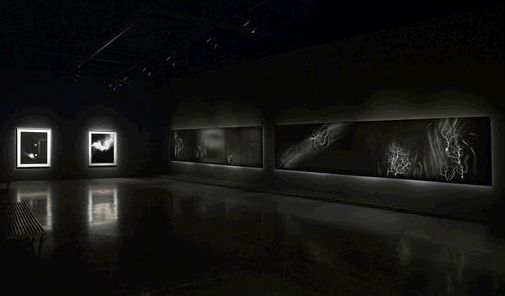
JTF (just the facts): A total of 21 black and white photographs, 2 fossils in glass cases, and 1 sculpture, displayed against grey and black walls in a winding series of four connected spaces. The first small room contains 3 gelatin silver prints (from the diorama series), framed in black, and two fossils (one meteorite fragment and one slab of Mississippi sea bottom), displayed in low light against grey walls. 2 of the prints are 20x24 from 1992, in editions of 25, the other is 47x73, in an edition of 5. The larger front and back rooms have black walls and are completely dark, with bright spot lights on the works. In each room, a pair of monumental gelatin silver panoramas are hung side by side, covering an entire long wall. Each unframed panorama is made up of 6 panels, each entire work measuring 59x23 and 1/2 feet, printed in editions of 5. There are a total of 7 single image gelatin silver lightning field prints spread across the two rooms, framed in silver with no mat, each 59x47, also printed in editions of 5. The sculpture is set apart in the front room, a Tesla coil in birdcage on a stand. A narrow room is situated between the front and back rooms, with grey walls and bright natural light from the overhead skylight. This room contains 7 gelatin silver seascapes from 1987-1993, framed in silver with no mat, each 47x59, printed in editions of 5. A catalogue of the exhibition is available from the gallery for $50. (Installation shots at right, via Pace.)

Comments/Context: Hiroshi Sugimoto's first show at Pace (having recently joined the stable from Gagosian) is a potent reminder of the power of presentation. Rather than offer a predictable sampler of new and old work in this cavernous space, the artist has used architecture (dividing walls and rooms) and lighting (both dark and light) to transform the viewer's experience, controlling the narrative flow and recontextualizing the prior work in new and unexpected ways. The gallery has evolved from a formless white space into a rich storytelling environment to be experienced, where the production values of the entertainment have become almost as important as the work itself.
.
The two largest rooms in the show are broad open spaces, subdued by the blackness that envelops them. The only light in these two rooms is provided by the spot lights on the artworks, highlighting the bright flashes of white energy that emerge from the darkness. These Lightning Fields are Sugimoto's newest works, made by using a spark generator to deliver blasts of energy to the film's surface. The artist has likened these images to the crashing of meteorites into the Earth's original primordial soup, introducing energy and foreign chemical compounds into our environment and sparking the creation of life. His monumental panoramas stretch across two long walls (nearly 50 feet), mixing flashes of brightness with textured glimmers and black spots, like growths emerging from the nothingness. Some of the single images are mostly dark, with just a small cluster of delicate incandescent white, while others have evolved into long, thick tendrils of light, like arteries or serpents or ropes, often with tiny fingers branching out and extending from the sides. A few even look like aerial landscapes of dry river beds, with washes of sizzling whiteness cut into the blackness of the land. While many of these works have an organic, natural violence to them, the less successful ones look more like scientific figures from a scholarly paper in Science or Nature, showing some arcane but beautiful properties of electromagnetism. Sugimoto is walking the fine line between art and science here, with varying degrees of memorable aesthetic success. And just when I thought I had absorbed it all, the gallery experience was punctuated by the buzzing crackle of the Tesla coil sculpture, which explodes into a flash of blue light every few minutes, jolting and attacking the viewer with its raw, dangerous power. All I needed was a shard of meteor to crack me on the head in the dark and the visceral experience would have been complete.
.
The show also contains a selection of seascapes and dioramas, work we have seen many times before, but which has been reimagined here in the context of Sugimoto's "beginning of the world" narrative. The seascapes have been hung a narrow room with heavenly pure light, all of them day views, including the one at the end of the space which is bathed in glare. What I found fascinating is that they no longer seemed to me to be sublime exercises in timeless meditative contemplation. Instead, these images were transformed by the installation into documents of a specific ancient place and time, when the world was covered by seas in every direction, a kind of alien water planet. The tight installation creates the feeling of being in the middle of it all, surrounded by the flat expanse as far as the eye can see. Similarly, the small room at the entry of the show gathers a few of Sugimoto's natural history dioramas. But there are no familiar polar bears and jackals here, only puzzling biological forms attached to sandy sea bottoms. Juxtaposed with a few fossils (not unlike his spectacular show at the Japan Society a few years ago), and once again, the images have been reimagined. Now instead of a witty inversion of fake and real, the dioramas are documenting yet another period of specific time, as the first organisms started to form and develop. The show thus becomes a continuous historical timeline, from the first sparks of unruly energy to the evolution of life in many forms. While there is still a bit of the "old wine in a new bottle" feel here, I was amazed at how thoroughly the old work could be successfully reconsidered in relation to the new images.
.
Overall, this show gets high marks for its careful construction, and for creating a whole that ingeniously integrates several disparate bodies of work that were previously unconnected. Given the chance element associated with the creation of the lightning field images, it is not at all surprising that some bolts of light are much more interesting than others. That said, I once again came away genuinely impressed with Sugimoto, both as a risk taking scientifically-minded artist and as a surprisingly talented and original showman.
.
Collector's POV: The works in this show are priced as follows. The large panoramas are $750000 each, the seascapes are $400000, the single image lightning fields are $80000, and the dioramas are either $120000 or between $20000 and $25000 based on size. Sugimoto's work is readily available at auction, at a variety of price points. His Time Exposed portfolio can generally be had at auction for between $3000 and $11000. Small individual prints (in the range of 20x24) typically range between $10000 and $90000. The largest prints (seascapes, wax portraits and architecture) have recently started at $100000 and continued all the way up to over $1 million.

Rating: *** (three stars) EXCELLENT (rating system described here)

Transit Hub:
  • Artist site (here)
  • Reviews/Features: NY Times (here), New Yorker (here)
Through December 24th

The Pace Gallery
545 West 22nd Street
New York, NY 10011

Friday, September 10, 2010

Izima Kaoru, One Sun @Von Lintel

JTF (just the facts): A total of 6 large scale color images, displayed in artist-designed white frames with no mat in the single room gallery space. All of the works are c-prints with acrylic diasec from 2006 and 2007. The circular prints are each 47 inches in diameter, in editions of 5. A thin monograph of this body of work was published by Akio Nagasawa Publishing in 2009. (Installation shots at right.)

Comments/Context: Japanese photographer Izima Kaoru is perhaps best known for his series of cinematic images where models imagine their own ideal deaths, complete with dramatic locations, fabulous couture fashions, and elegant pools of blood. After more than a decade of staged death, his new body of work, entitled One Sun, is a radical departure from this morbid fascination, a life-affirming look skyward.

Using a fish-eye lens and day-long exposures, Kaoru's images trace the path of the sun across the sky, resulting in images of sparkling bright lines against light blue orbs of hazy color. Depending on his location (near the Equator, in the northern Norway, or at various other locations around the globe) and the time of year/season, the sun creates a variety of concave and convex arcs, straight lines and even perfect circles, with cloudy weather periodically adding a dashed effect. These beams of light parade across a spectrum of soft blue, light purple and fuzzy pink pastel backgrounds, with only a few silhouetted palm tress, buildings, or other minuscule points of landscape around the edges to provide local context. They are like big blue marbles, or vibrating discs, or portholes.

In the past few years, we have seen quite a few photographers point their cameras up, following stars, satellites, and the sun and moon, mixing science and abstraction to generate unexpected landscapes or simulated line drawings. Kaoru's images bear some resemblance to the recent Sunburn pictures by Chris McCaw, but their glossy object quality, large size and strict conceptual geometries create an altogether different feeling than McCaw's intimate chance-driven solarized burns. The works feel much wider, capturing the incandescent radiance of the sun and the immense 360 degree breadth of the sky. I think the layers of roundness (the fish-eye distortion, the underlying shape of the earth and sun, the shape of the physical prints themselves) all contribute to making the conceptual construct effective.

Overall, while we have seen variations on these ideas before, Kaoru has added some new twists to the tracking of the sun, creating contemporary photographs that pulsate with collective optimism. He reminds us that wherever we might be on this diverse planet, the sun puts on a spectacular show if we would only take the time to look up and notice.

Collector's POV: The prints in this show are priced in rising editions, starting at $16000 and moving up to $19500 and eventually to $23000. Kaoru's work has only recently come into the secondary markets, with a few of his large scale images from the Landscapes with a Corpse series coming up for sale in the past few years. Prices for these works have ranged between $9000 and $30000.

Rating: * (one star) GOOD (rating system described here)

Transit Hub:
  • Reviews: DLK COLLECTION, 2009 (here), NY Times, 2004 (here)
Izima Kaoru, One Sun
Through October 9th

Von Lintel Gallery
520 West 23rd Street
New York, NY 10011