Showing posts with label Brassaï. Show all posts

Friday, April 5, 2013

Every Booth at the 2013 AIPAD Photography Show, Part 1 of 6

In direct defiance of all the art fair haters out there, I will readily admit to thoroughly enjoying the annual AIPAD Photography Show here in New York. For a handful of intense days, it brings  a significant portion of the subculture we call fine art photography into one single expansive room, mixing the hard nosed wrangling of buying and selling with the lively sociability of a huge cocktail party. For me, it's one of the few times during the year when I can catch up with out of town dealers, collectors, curators, artists, and other photography world folk, all while scouring each and every booth for things that would fit into our own personal collection. It's a busy exercise in switching hats, from collector to critic and back again.

Walking the halls of any art fair is an exhausting overload of sensory inputs, but when every booth is filled with art of the same medium like it is at AIPAD, it's even easier for eyes to get glassy. At least for me, after a dozen booths or so, the art turns into a seemingly endless rushing river that flows by with such force and velocity that most of it turns into a blur. It's just not possible to process every single image with care and attention, so my brain clicks over to pattern matching mode and looks for outliers that catch my glance for one reason or another, letting the rest happily drift by. In previous years, I have tallied up each and every photograph in select booths, generally covering about half the fair in exhaustive detail. This year, I have opted for a different, more inclusive, and less data intensive strategy; instead of endlessly counting and tabulating, I vowed to select one single image that I found of particular interest from each and every exhibitor booth (sorry AXA). What I was looking for was something exciting, surprising, unexpected, or astonishing, a search for the non-obvious among the greatest hits, the Bill Brandts unearthed to cash in on the MoMA exhibit, and the second tier Irving Penns. This was actually trickier than I expected, as in a number of booths, the embarrassment of riches on offer made choosing only one print downright painful, while in a few others, I struggled to find even one image that I could reasonably highlight. So with a nod to Ed Ruscha, I give you Every Booth at the 2013 AIPD Photography Show, a rambling story of 81 photographs in 81 booths, told in six parts.

The organization of these posts is straightforward: gallery name (and link), artist name, price (sometimes already sold), some comments or logic as appropriate, followed by the image itself. The list follows my path through the fair, starting left from the entry and wandering up and down the aisles, eventually returning to the entrance once again from the other side.

Edwynn Houk Gallery (here): Valérie Belin, $34000. This huge image came from a series I hadn't seen before. The flowers are actually quite painterly, as though they have been outlined. I like the way the foreground and background shift back and forth.


Howard Greenberg Gallery (here): John Vanderpant, $6500. I think Vanderpant is one of those lesser known, generally under appreciated Modernists that deserves some more attention. This one is just gorgeous.


Daniel Blau (here): Robert Wiles, $4500. Blau had an entire booth of press photography. While a bit gruesome, I thought this woman smashed onto the roof of a car was quite elegant.


Bryce Wolkowitz Gallery (here): Ola Kolehmainen, $17000. I'm a fan of Kolehmainen's work, especially when it pushes towards abstraction like this one.


Lisa Sette Gallery (here): Damion Berger, $25000. This booth was a solo show of Berger's Black Powder series of firework explosions. I preferred the frenetic, all-over quality of this image to the ones that were more recognizable.


SAGE Paris (here): Karl Blossfeldt, $85000. This was the best Blossfeldt at the show. Hard to beat.


Lee Gallery (here): Joe Deal, $25000. While all of Deal's backyard scenes are conceptually interesting, only a handful are as visually strong as this one.


L. Parker Stephenson Photographs (here): Sherril Schell, $22000. Very few Schell's find their way into the market and this one throttled me from twenty paces. Classic New York Modernism.


Gitterman Gallery (here): Roger Fenton, $32000. A vintage print of a photography history book classic, The Valley of the Shadow of Death. Great to see up close, hiding on an interior side wall.


Gary Edwards Gallery (here): Juan Laurent, $2500. Bridge pictures have the kind of linear formality that always catches my eye. This latticed viaduct is from Spain.


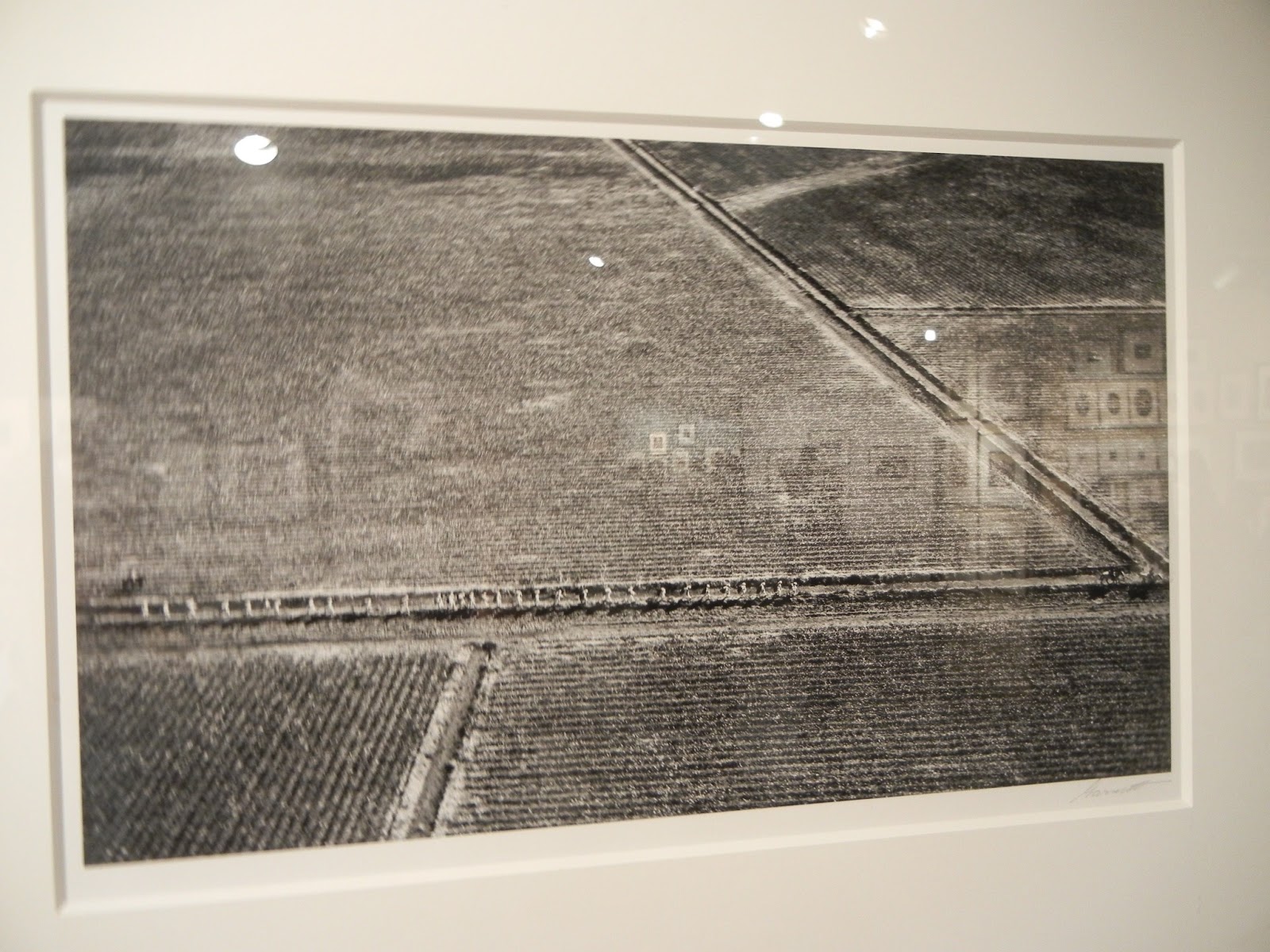
Scott Nichols Gallery (here): William Garnett, $35000. If you look closely in this aerial image, beyond the straight geometries of the fields, you can see a line of tiny men picking the cotton. I'm consistently impressed by Garnett's work and always wonder why I don't see more of it.

Robert Koch Gallery (here): Brassaï, $60000. After I commented on a Brassaï nude that was on the wall, this one was unearthed from a box. He didn't made many nudes, so it's always a treat to see even one.


Robert Morat Galerie (here): Christian Patterson, $4000. I enjoyed both the tangle of wires and the tremendous color tonality in this print.


Continue to Part 2 here.

Wednesday, March 10, 2010

Photography at the 2010 ADAA Art Show

In contrast to the bustling chaotic supermarket of the Armory, the ADAA Art Show was a decidedly more serene affair. Most of the exhibitors opted for solo shows or tightly edited groups of work, meticulously hung against colored walls or linen wallpaper (no hand scrawled wall labels here). The overall mood was much more urbane and serious, the hushed voices appropriately reverent.

The photography displayed in this controlled environment was generally of very high quality; lots of big prices and top names, with a minimum of secondary clutter and distraction. Like our Armory posts, for each booth, a list of photographers has been provided, with the number of works on display in parentheses. Additional commentary, prices, editions, and pictures of the installation are also included where specific images stood out.

Fraenkel Gallery (here): Hiroshi Sugimoto (12). This booth was a sophisticated solo show of Sugimoto's work, with a selection of images from a variety of different projects. There were 5 seascapes (4 small in a grid and 1 large), 2 lightning fields (1 small and 1 large), 2 theaters, 1 mechanical still life, 1 blurry building, and 1 Fox Talbot floral. This was the first time I had seen the lightning fields in person; up close the electricity branches out like the wash of a river, or feathers into delicate traceries. The large lightning field image (see below) was $80000 (and already sold); the small lightning field was $18000.


Weinstein Gallery (here): Alec Soth (14). This booth was a solo show, displaying Soth's Fashion Magazine work from 2007. I have to say it was a totally unexpected and yet thoroughly pleasant (and appropriate) surprise to find Soth's work in this rarefied environment. The work held its own with the rest of the art world elite arrayed nearby, and I imagine there were plenty of well heeled collectors in this crowd who had never heard of Soth but came away suitably impressed. All of the prints were pigmented ink prints, in editions of 7. There were three sizes on display (36x30, 40x48, and 58x48) with three sets of prices ($9000 or $10000, $13000, and $17500 respectively, helpfully printed right on the wall labels). In addition to the fashion project (which included the Chanel runway, Yves Saint Laurent's dog, Sophia Loren, lavish meals and interiors, backstage fussing, and up close portraits), I was also able to see some of Soth's mini-projects and recent commissions in a soft portfolio on the table. These included Goth women from the South, the Most Beautiful Woman in Georgia (the country), and the Loneliest Man in Missouri - there is a particularly poignant/sad image from this last project where the man sits in front of a birthday cake, flanked by a woman straight out of a strip club.


Howard Greenberg Gallery (here): Edward Weston (3), Charles Sheeler (1), Jacques-Henri Lartigue (1), Man Ray (2 rayographs), Laszlo Moholy-Nagy (1 photogram), Frantisek Drtikol (1 nude), Edward Steichen (1), Robert Frank (2), Saul Leiter (3 color images, 1 painted diptych), Miroslav Tichy (5), William Klein (1). This booth was a carefully selected group of vintage rarities. The stand out image for me among these astonishing treasures was the Sheeler stairway (priced at $600000, see below); I could have stood and looked at it all day. The elegant Weston still lifes were priced at $475000, $450000, and $190000. The 2 Man Ray rayographs were $390000 and $250000 respectively; the Moholy-Nagy was also $250000. The Drtikol nude was $90000.


Metro Pictures Gallery (here): Cindy Sherman (2), Olaf Breuning (1), Louise Lawler (1). The Sherman history portrait below was priced at $300000.


Skarstedt Gallery (here): Barbara Kruger (1), Richard Prince (1), Cindy Sherman (1). Both the Kruger and the Sherman were priced at $275000 (see below).


Barbara Mathes Gallery (here): Hiroshi Sugimoto (1). This was the single most expensive photograph I saw for sale during the entire week of fairs; it was priced at $650000.


Zabriskie Gallery (here): Alfred Stieglitz (3), Constantin Brancusi (1), Edward Steichen (1), Paul Strand (2). This booth was a tribute to 291, Alfred Stieglitz' famous gallery. Drawings, prints and pages from the various gallery magazines were displayed, along with a selection of photographs. My favorite image was the platinum print of Taos by Strand (priced at $100000, see below).


Hans P. Kraus Jr. Fine Photographs (here): Edouard-Denis Baldus (1), Frederick Evans (2), Roger Fenton (2), Joseph Vicomte Vigieur (2), Felix Teynard (2), Gustave Le Gray (1), Alvin Langdon Coburn (1), Humphrey Lloyd Hime (2), Louis-Constant De Clercq (1), Carleton Watkins/Eadward Muybridge (1), Charles Negre (1), Erneste Benecke (1), William Henry Fox Talbot (2), Eugene Cuvelier (1), Dr. John Murray (2). This booth was an edited group show called The Horizon in 19th Century Photographs, and included a selection of images bisected by the line of the horizon. The most startling of these works was the print by Humphrey Lloyd Hime, where the land and horizon became solid areas of black and white, the black land decorated by a small skull and bones (priced at $95000 and already sold, see below).


Pace/MacGill Gallery (here): Brassai (1), Diane Arbus (1), Philip-Lorca DiCorcia (1), Paul Graham (1 series), Garry Winogrand (1), Weegee (1), Henri Cartier-Bresson (1), Robert Frank (1), Harry Callahan (1), Lucas Samaras (1). This booth was a collection of top tier images. I enjoyed seeing the large Brassai exhibition print out front (priced at $70000, see below) and the Callahan head from the 1950s.


McKee Gallery (here): Richard Learoyd (1)

David Zwirner Gallery (here): Christopher Williams (8). This was a solo booth, filled with Williams' recent conceptual works (2007-2009). There were cut away cameras and lenses, upside down shoes on a large format camera, and socks being put on feet. Each of the prints was priced at $32000, in editions of 10+4.


Thursday, October 1, 2009

Brassaï, Paris in the 30's, Early Prints @Houk

JTF (just the facts): A total of 37 black and white images, framed in black and matted, and hung in the entry and main gallery space. All of the prints are gelatin silver enlargement prints on ferrotyped paper, ranging in size from approximately 7x5 to 20x16 (or reverse). All of the images were taken in the 1930s; most of the prints are vintage, with some printed by the artist in the 1940s/1950s/1960s. (Installation shots at right.)

Comments/Context: Brassaï's images of 1930's Paris at night clearly belong among the masterworks of photography; they have become emblematic of the alluring and bewitching lights of the city and the provocative nightlife that goes on in the cafes and bars. This fabulous show includes a variety of Brassaï's signature nocturnal subjects: couples in cafes (alternately happy, bored, dancing, or blithely smoking), backstage shots of cabaret shows and dancers, semi-nude women in brothels, and shadowy dark views of foggy illuminated bridges and street corner assignations.
.
While many of the images on display will be familiar to most collectors, there are also a few surprises mixed in. Several of the cafe images were printed somewhat larger than normal, making the intimate vignettes of private encounters more striking; the larger size seems to have transformed them from stolen moments to spotlit studies in human interaction. There are also a handful of unexpected pure abstractions, made from soap and cotton, and a pair of scarce formal nudes.
.
This show is a great reminder that vintage work isn't by definition tired and stuffy, or somehow distant and unrelated to the world of contemporary art. There are plenty of masterclass lessons to be drawn from this show, especially for those who seek to document the seamy underbelly of life.

Collector's POV: The prints in the exhibit are priced between $11500 and $95000, with one image "price on request". Works by Brassaï are readily available in the secondary markets, with prices generally ranging from approximately $2000 to $60000, with a few outliers in six figures. The huge Brassaï sale at Millon in 2006 brought a lot of material into the market, so collectors can certainly access prints at auction, as well as in galleries.

For our collection, the lovely nude, Torse, from 1934 would be the best fit, although we already own one Brassaï nude which is quite similar (here); we also have an unexpected outlier for Brassaï - a floral (here).
.
Rating: ** (two stars) VERY GOOD (rating system described here)

Transit Hub:

  • The Eye of Paris retrospective, 1999, @NGA (here)
  • Review of 1999 show in Time (here)
  • 2006 sale review in NYTimes (here)

745 Fifth Avenue
New York, NY 10151

Monday, September 28, 2009

Charles Marville, Paris Before Lartigue @Greenberg

JTF (just the facts): A total off 11 albumen prints (from wet collodion negatives), framed in brown and matted, and hung in the book alcove. The images were taken and printed in the 1860s/1870s, and are approximately 11x14 or reverse. (Installation shot at right, top.)

There are three other supporting exhibits also on view in the side galleries:
  • Eugène Atget: 8 images, a mix of albumen, arrowroot and gelatin silver chloride prints, taken between 1900 and 1926, all approximately 9x7 or reverse, framed in black and matted, against green walls. (Installation shot at right, bottom.)
  • Brassaï: 9 images, all gelatin silver prints, taken in the 1930s and mostly printed later, generally 12x9, framed in black and matted, in one of the viewing rooms.
  • John Collins: 10 images, all gelatin silver prints, taken in 1917, all approximately 4x5, framed in black and matted, in the other viewing room.

Comments/Context: The Marville exhibit now on view at Greenberg is really just one of four supporting shows that give the larger Lartigue exhibit some historical and visual context. The Marville works are the earliest in terms of chronology, documenting Paris in the mid-19th century; most are from his series of streetlamps (some free standing, others attached to gates, fences and railings), while the rest are empty street scenes, full of cobblestone intersections, horse carriages, and patterned buildings. Marville is perhaps my favorite 19th century architectural photographer; the crispness of his images has a "modern" feeling that foreshadows what would come along decades later and the tonalities of his prints are always rich and tactile.

The back room near Greenberg's office holds a group of Atget street scenes from the early 20th century (a few park and quay images are also mixed in), dark and shadowy views of inward leaning alleys and dense building facades. One of the side viewing rooms holds a group of Brassaï cafe scenes and night views from the 1930s, the other an earlier set of small Paris views (the Arc de Triomphe, the Seine etc.) by John Collins.

While none of these mini-shows really merits a special visit on its own, together they provide an excellent backdrop and contrast for the Lartigue show. In particular, they highlight how different Lartigue's approach really was; while the others were captivated by the details of the changing architecture of Paris, Lartigue was seeing the people, brimming with energy and life.

Collector's POV: The Marville images in the show are priced between $15000 and $40000. In the side galleries, the Atgets are priced between $12000 and $30000, the Brassaïs are $8000 to $25000, and the works by John Collins are $1000 each.

Rating: * (one star) GOOD (rating system described here)

Transit Hub:

  • Marville in MoMA collection (here), in SFMOMA collection (here)
  • Book: John F. Collins Photographs, 1904-1946 (here)
Charles Marville, Paris Before Lartigue
Through October 24th

Howard Greenberg Gallery
41 East 57th Street
New York, NY 10022