Showing posts with label Joachim Brohm. Show all posts

Monday, June 6, 2011

Auction: Photographie, June 10, 2011 @Van Ham

Later this week in Cologne, Van Ham finishes up the Spring season in Germany with a various owner Photographs sale. As usual, there is a generous selection of lower end German/European material, with a special section of vintage architectural images of Cologne headlined by Werner Mantz and Hugo Schmölz. Overall, there are a total of 398 lots on offer in this sale, with a Total High Estimate of 793380€.

Here's the breakdown:

Total Low Lots (high estimate up to and including 7500€): 383
Total Low Estimate (sum of high estimates of Low lots): 626380€

Total Mid Lots (high estimate between 7500€ and 35000€): 15
Total Mid Estimate: 167000€

Total High Lots (high estimate above 35000€): 0
Total High Estimate: NA
.
The top lot by High estimate is lot 1146, Floris Neusüss, Sabine, 1961, at 16000-18000€.

Here is the list of the photographers who are represented by five or more lots in the sale (with the number of lots in parentheses):

Hugo Schmölz (21)
Albert Renger-Patzsch (16)
Werner Mantz (14)
August Sander (11)
Weegee (7)
Margaret Bourke-White (6)
Brassai (6)
Germaine Krull (6)
Paul Wolff (5)
.
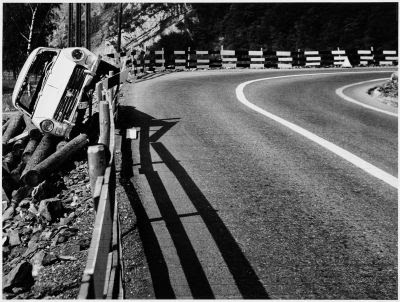
(Lot 1035, Joachim Brohm, Franzosische Zeitzone, 1985, at 2800€ , at right, top, lot 1074, Frank Gohlke, Landscape, Moorhead, MN, 1977, at 2800€, at right, bottom, and lot 1149, Arnold Odermatt, Stansstad, 1966/Later, at 2800€, at right, middle, all via Van Ham.)

The complete lot by lot catalog can be found here.

Photographie
June 10th
.
Van Ham Kunstauktionen
Schönhauser Straße 10 - 16
D - 50968 Köln

Thursday, July 29, 2010

Book: Joachim Brohm, Ohio

JTF (just the facts): Published in 2009 by Steidl (here). 120 pages, with 55 color images. Includes essays in English and German by Thomas Weski and Vince Leo. The images from this project were taken between 1983 and 1984. (Cover shot at right, via Amazon.)

Comments/Context: In the early 1980s, German photographer Joachim Brohm took a Fulbright year at Ohio State University in Columbus. This tightly edited monograph gathers together the work he made during his stay and introduces another voice into the discussion of the early development of color photography.

Brohm's images of Ohio seem to have a mix of influences and connections (the celebration of vernacular American culture as captured by Walker Evans, the ugly underbelly of development as exposed by the New Topographics photographers, and the exploration of new color ideas by William Eggleston, Stephen Shore and Joel Sternfeld), all tied together and synthesized with a slightly more aloof German aesthetic. Most of these images have a dingy, muted palette, and have been composed at eye-level, with an almost snapshot-like directness. Brohm pointed his camera primarily at back alleys and forgotten urban landscapes: parking lots, chain link fences, dated cars, dumpsters, dog runs, and clusters of overhead telephone wires, pausing to take in the array of junk left on a dashboard, a rubble strewn vacant lot, an unused basketball hoop, a window reflection, a defunct drive-in, or a car engulfed in flames. The pictures are consistently understated and unassuming, but the guard dogs, Keep Out signs, cinder blocks and broken fencing leave a lingering sense of emptiness and subtle threat.

What I found interesting here is that if Brohm had made these pictures in black and white, they would have had a stronger sense of abstracted, formal elegance. But the introduction of the often drab, cheerless color has the effect of heightening the reality of the depressed mood of the environment; it's not color for the sake of color, or color as an exercise in showing-off, but color masterfully used in a supporting role to achieve the desired temperament. Then look again, and suddenly, the red of a Cadillac tail light, the yellow of a dog house, the brown of a painted railing, or the pale green of a garage seem like perfectly calibrated eye-catching details.

For those of you busy praying to the pantheon of American gods of color, I'd thoroughly recommend taking a closer look at this body of Brohm's early work, as it attacks many of the same aesthetic questions, but upon patient inspection, offers surprisingly different and satisfying answers.

Collector’s POV: Joachim Brohm is represented by Gallery Luisotti in Santa Monica, CA (here, on artnet) and Galerie Michael Wiesehöfer in Cologne (here). Brohm's work has become somewhat more available in the secondary markets of late, particularly at the German auction houses. According to the notes in the back of the book, prints from Ohio are available in two sizes (24x30cm and 50x60cm) on Kodak Ektacolor paper (vintage) and Fuji Crystal Archive paper (modern).

Transit Hub:

  • Book review: Conscientious (here)
  • Ohio at Museum for Contemporary Art Leipzig, 2008 (here)
  • Fotografie at Kunsthalle Mainz, 2009 (here)

Wednesday, July 29, 2009

Book: Joachim Brohm, Areal

JTF (just the facts): Published in 2002 by Steidl (here). 265 pages, with 206 color images. Includes essays in English and German by Urs Stahel and Regina Bittner. The images in the book were taken between 1992 and 2002. (Cover shot at right, via Amazon.)

Comments/Context: In the past few decades, cities all over the world have worked to transform themselves, clearing away their old industrial infrastructure in favor of new business parks and planned communities designed for the knowledge economy. German photographer Joachim Brohm has been a careful witness to one of these slow moving redevelopment projects (on the periphery a German city), documenting the unspectacular evolution of the site across many years, through all its ugly intermediate stages.

While there are certainly plenty of stand out images in this volume, this body of work is better thought of as an extended essay, where the images work together to tell a multi-faceted layered narrative. The chronological sequencing of the pictures leads to a meditative flow of time, where the site is slowly redefined, from its original function, through demolition and clearing, to the first stages of its eventual reconstruction. Each image is a small piece of the larger puzzle, a captured fragment of what happened along the way. There is no obvious beginning or end to this project, no ground breaking or champagne ribbon cutting; instead, the process seems to drag on (the seasons pass again and again), with inertia as the driving force, and the completion of small tasks as the activity. Progress is slowly made, and at the end, the buildings look mostly completed, although most are still covered by plastic sheeting or scaffolding, the small details still unfinished.
.
Brohm's images are a mixture of bird's eye views (presumably from nearby buildings) and deadpan frontal shots at ground level; his subjects are trucks and back lots, sheds and temporary structures, discarded items and construction rubble, an unspecific view of a generic process that could be happening almost anywhere (and is). He comes back to the same locations time and again, the same diamond shaped blue clock often hovering somewhere in the distance. His compositions are dense, often disorienting, with echoes of Lee Friedlander's all over chaos.

If you pick this book up and flip through it in a hurry, I think there is a good chance you'll miss the subtleties of Brohm's approach; it will look like a grab bag of snap shots from the faceless construction project just down the road from where you live. Given some time however, the complexities of the individual images will start to reveal themselves and the story he's telling will resonate much more profoundly. The more I look at this book, the more impressed I am with its contents.

Collector’s POV: Joachim Brohm is represented by Gallery Luisotti in Santa Monica, CA (here, on artnet) and Galerie Michael Wiesehöfer in Cologne (here). Brohm's work has recently become more available in the secondary markets, particularly at Van Ham. Images from Areal are Fuji Crystal archive prints made in 2002, in editions of 11; prices have generally been under $2500. It appears that prints from other projects were made in editions of 8 or 12; they too have sold in this affordable range.

Transit Hub:

  • Artforum feature, 1993, via American Suburb X (here)
  • Ruhr on We English (here)
  • Ohio at Museum for Contemporary Art Leipzig, 2008 (here)
  • Fotomuseum Winterthur collection (here)