Part 1 of this five-part Frieze report can be found here. Start there for introductory background and explanatory notes.
Galleri Nicolai Wallner (here): Joachim Koester, $8000. In a fair full of bright, shiny things, Koester's all white snowscapes stood out in quiet, nuanced, contrarian defiance.
ProjecteSD (here): Jochen Lempert, €7000. A simple, well executed exercise in dappled light, leafy shadow, and shimmering all over movement.
Altman Siegel (here): Sara VanDerBeek, $16000. While VanDerBeek's Metro Pictures show is already in my review queue, this elegant tilted sculptural interpretation isn't part of that exhibit. The skewed frame aligns with the angles of the arms and offsets the verticality of the subject.
Sprüth Magers (here): Thomas Demand, €75000. Indoor plants in fancy modern planters for a windowless office are already an odd creation, but when they are abstracted even further into cut-paper constructions by Demand, controlled nature becomes even more artificial.
Team Gallery (here): Ryan McGinley, $50000. This whole booth was filled with recent large scale McGinley nudes, with young men and women in various states of falling, lying, and running around. This nighttime mix of fire and water is certainly dramatic and full of exuberance, like some secret ritual.
Alexander Gray Associates (here): Lorraine O'Grady, $25000. Up-close hair becomes an undulating textural landscape.
Murray Guy (here): Zoe Leonard, $25000. This booth had a selection of mid-1990s animal images by Leonard, taken during a multi-year stay in Alaska. While the animals were hunted by the artist, the images have the feel of taxidermy or staged diorama, but with an edge of rawness.
White Cube (here): Jeff Wall, $450000. This was the only work by Wall I saw at Frieze, a small backyard study of poppies and scrubby greenery.
Sfeir-Semler Gallery (here): Walid Raad, $25000. Images of minimal paintings hung in white, formless, galleries, the corollary of Louise Lawler, where context tells us nothing.
From one photography collector to another: a venue for thoughtful discussion of vintage and contemporary photography via reviews of recent museum exhibitions, gallery shows, photography auctions, photo books, art fairs and other items of interest to photography collectors large and small.
Showing posts with label Jeff Wall. Show all posts
Monday, May 13, 2013
Friday, February 8, 2013
Auctions: Post-War and Contemporary Art Evening and Day Auctions, February 13 and 14, 2013 @Christie's London
An early black and white Gilbert & George leads the photography offerings in Christie's Post-War and Contemporary Art Evening and Day auctions in London next week. Other top lots include works by Wall, Gursky, and Sherman. Overall, there are 43 photography lots available across the two sales, with a Total High Estimate for photography of £3182000.Here's the statistical breakdown:
Total Low Lots (high estimate up to and including £5000): 3
Total Low Estimate (sum of high estimates of Low lots): £10000
Total Mid Lots (high estimate between £5000 and £25000): 19
Total Mid Estimate: £267000
Total High Lots (high estimate above £25000): 21
Total High Estimate: £2905000
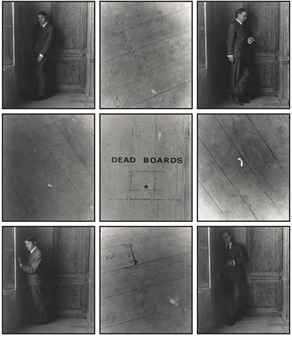
The top lot by High estimate is lot 11, Gilbert & George, Dead Boards No. 11, 1976, at £350000-450000. (Image at right, top, via Christie's.)
Here is the list of photographers who are represented by two or more lots in the two sales (with the number of lots in parentheses):Andreas Gursky (4)
Cindy Sherman (4)
Gilbert & George (3)
Hiroshi Sugimoto (3)
Diane Arbus (2)
Gabriel Orozco (2)
Gerhard Richter (2)
Other lots of interest include lot 69, Jeff Wall, The Arrest, 1989, at £250000-350000 (image at right, middle) and lot 240, Rodney Graham, Oak, Kaggevinne, 1989, at £60000-80000 (image at right, bottom, both via Christie's.)
The complete lot by lot catalogs can be found here (Evening) and here (Day).Post-War and Contemporary Art Evening Auction
February 13th
Post-War and Contemporary Art Day Auction
February 14th
Christie's
8 King Street, St. James's
London SW1Y 6QT
Tuesday, January 17, 2012
Jeff Wall @Goodman: A Review Conversation with A.D. Coleman
One of the challenges of trying to consistently write gallery show reviews, day in and day out, is that there is a tendency over a long period of time for the form to take over and for the structure of the essay to start to stifle the content. This is especially true in the kind of reviews I write, since I have a fairly rigid formula that I use to provide comparability between reviews. This scaffolding helps readers to easily find what they are looking for, but it creates the danger of a one-size-fits-all approach to looking at photography. It also lures me into a kind of auto-pilot state where I am filling in blanks rather than really thinking critically.
This year, I’ve decided to try some new approaches which will hopefully break some of these routines and open up some alternate avenues for discussion. Instead of the usual format, today’s review of the new Jeff Wall show at Marian Goodman is going to take the form of a back and forth conversation, the kind you might have with a friend, beginning with the normal question “What did you think of the new Jeff Wall show?” and continuing on from there, wherever the discussion might lead. Perhaps my companion and I will together pick this show clean, cut it to shreds, agree to disagree, or join hands in triumphant wonder; there is no pre-conceived path or self-fulfilling conclusion. The format will allow both of us to wander wherever the work and its underlying ideas may take us.
.
My co-conspirator today is the esteemed photography critic A.D. Coleman. I’ve read all of Coleman’s books of essays and I’ve found his writing to be among the most approachable and lucid in the world of photography criticism. This isn’t to say he treads lightly, in fact, just the opposite; his analysis and arguments are clear and penetrating, leaving little room for waffling around. In recent years, Coleman has moved away from the gallery show review as a means of contributing to the photographic conversation, and instead leaned toward more critical reporting on the medium, from the Polaroid sale and the Adams negative scandal, to more recent posts on the pepper spray meme. But I’ve convinced him to join me today to examine the Wall gallery show, and I’m hoping I’ll be up to the challenge.
.
DLK: My first reaction to this show was very similar to my reaction to Wall’s show from the fall of 2009: it feels sharply uneven. Even more so this time, I think this is a result of Wall going in many artistic directions at once. This isn’t a tight body of work, representative of a particular moment in time, self-contained and complete in its artistic statement. Instead, it is a gathering of pictures that are all traveling down different intellectual paths at different speeds. There are several large-scale color staged tableaux (perhaps what he is best known for), a large black and white portrait, a pair of landscapes (one in color and one in black and white), a still life (if we can call the grave image a still life), and a group of images that functions as a single unit (surprising for an artist who has so forcefully been a proponent of the individual, stand-alone picture). To my eye, there is a decently wide disparity in these works between those that are successful and those that are less so. Each genre or format seems to present Wall with unique visual challenges which he is dutifully exploring, but the whole doesn’t converge for me toward something I can easily make sense of.
ADC: There is indeed a sense here of someone cleaning out the fridge. The show contains 12 images all told: a four-image sequence and 8 autonomous pieces, two of them in b&w, the others in color. Four of the stand-alone works are typical Wall tableaux vivants: a rock-club scene, a boy falling out of a tree, a lecturer at a museum costume display, two boys boxing in a living room. Then there's a b&w full-length portrait of a "young man wet with rain," the four-image sequence, and three images made in Sicily in 2007 and, according to the gallery, shown here for the first time. The gallery has segregated the latter (presumably at Wall's request), presenting them separately in an immediately adjacent space: two landscapes -- one in color, one b&w -- and a study of a grave and tombstone. Impressive scale aside, these Sicilian pieces are utterly nondescript variants of images made many times before by many others. The gallery's spin control on this assortment hails Wall's "hybrid integration of the documentary and the cinematographic, the 'street' and the monumental, two directions he has pursued simultaneously, while being partial to neither." Yet I'm reminded of the Canadian humorist Stephen Leacock's impetuous young nobleman who "rode madly off in all directions."
.
DLK: That side room was a head scratcher for me as well. While it might be possible to connect these new pictures to some of Wall’s earlier straight landscapes under the umbrella of man’s impact on the land (slightly New Topographics-ish), I agree that the execution here didn’t show much that we haven’t seen before: rocky hillsides and flat sky, punctuated by electric wires. By hanging them together as a Sicilian suite, there is an implication of a larger narrative, which seems counter to most everything I assume about Wall and his artistic process. The moss-covered tombstone, with its loose brick paving and wires draped over the wall (on the left, at right), has more potential for a richer individual reading, perhaps connecting it to his earlier The Flooded Grave, but if the tombstone is to be part of this interconnected threesome, then its meaning as a single picture is given a different, presumably more Sicilian or historical, context. For me, it all arrived with a mystifying thud.
The other work which I thought missed the mark was the large black and white full length portrait (on the right, in the third installation shot). Wall’s previous works in black and white have seemed to aim for the margins of life, capturing mundane transitional moments with an inexplicable, understated, almost Hitchcockian drama. This image, while certainly detailed, didn’t offer enough of a gesture to allow me a way into some kind of narrative. The young man is standing still, dripping. Fair enough, but it certainly didn’t grab me or make me wonder what was going on. Or perhaps that’s the point: a strange kind of edge-of-life nothing is going on?
ADC: Not nearly strange enough, if so. With one exception, which I'll get to, the dramaturgy fails to persuade me. Everything's stilted, frozen, like those scenarios I remember from childhood visits to the American Museum of Natural History: mannequin Native Americans and stuffed dogs around a teepee. Even in the most ostensibly dramatic of these scenes, a boy falling from a tree, just a few feet away from a potentially injurious crash, I didn't get caught up in the potential tragedy for a second. Instead, I found myself wondering only how Wall had engineered the effect. Not because I'm jaded; I'm not immune to convincing theater. But Wall's theater doesn't persuade me to suspend my disbelief. Nor, from a Brechtian standpoint, does it in any provocative way breach the fourth wall. (Pun unintended but unavoidable).
And I'm perplexed by the claim to cinematographic concern on Wall's part, because I don't know of any cinematographer who uses, or would approve the use of by others, a visual strategy that invariably places the subject front and center in the frame, with no significant use of the edge of the frame, no selective depth of field, no activation of the foreground, no foreground-background relationships . . . it's a banal and tedious POV, one of the first habits they get you to break in film school. Even the purists at Dogme 95 gave themselves more latitude.
DLK: I agree that I didn’t exactly believe that the boy falling from the tree (on the left, in left, in the top installation shot) would imminently crash into the grass or bounce off the upturned wheelbarrow. But the best of Wall’s staged events do make me wonder about the nature of the reality that he is depicting or that I am seeing secondhand; I know it is an artificial world (at least partially) and yet the fidelity to reality makes me question this intellectual conclusion, at least for a moment. This leaves me trying to unpack what is going on, separating likely fact from likely fiction. I did find the falling boy a little reminiscent of a stop-motion Muybridge, where a physical gesture is captured photographically that we have never really seen or looked at carefully before. As with Milk, I’d say I had a sense of astonished amazement with the technical aspects of the picture, rather than a true engagement with the proposed story.

I thought both Boxing and Band & Crowd were successful tableaux in a manner we have generally come to expect from Wall. The boxing image (on the left, in the bottom installation shot) juxtaposes the quiet control of the brightly lit modern interior with the physicality of the boys’ lunging movement, while the band image (on the left, at right) has the feeling of multiple, independent vignettes compressed into one frame. I found the first very rigid and composition driven but still lyrical in its own way, while the second drew me more deeply into the small lives of the bored crowd and the earnest band members. I think the framing of the band image unbalances the natural tendency to focus on the performers, instead giving equal weight to front and back, forcing the viewer to take it all in at one glance and then move across the frame from left to right. I can easily imagine wandering around in the shifting empty space with a beer in my hand, paying only passing attention to the odd gyrations on stage, so Wall got me play along just enough to identify with his version of stitched together reality.
ADC: The only piece in the show that engaged me was what I sense is among your unfavorites -- the sequence of four comparatively small images (on the right, in the top installation shot), revolving around a battered old suitcase covered with 1930s travel stickers and the period catalogue for the Berlin-based custom tailor N. Israel, titled Authentication: Claus Jahnke, costume historian, examining a document relating to an item in his collection, 2010. Conceivably this is a fiction, the props all invented, but that would involve more elaborate forgery than anything Wall has produced before. These objects seem authentic, and I take them as such, which adds to the power of the piece.
In the first image, Wall's camera looks down on the exterior of the suitcase, whose frayed ID sticker indicates that its owner, one Hermann Rosenthal, traveled with it cabin class in a stateroom on the Holland-America line to Vancouver in 1932, presumably from Rotterdam, that company's home port. On top of the suitcase lies the catalogue, its cover showing N. Israel's line of winter clothing, in the upper right-hand corner an autographed image of Leni Riefenstahl endorsing his product line and presumably wearing one of his ski outfits. In the second, a man in his forties sits in an armchair with a box of memorabilia on his lap, studying the same catalogue; the open suitcase and several other costumes appear in the background. In the third, we see the catalogue open to a two-page spread of shirts; and in the fourth we see a real-life example of one of those shirts on a hanger, bearing the N. Israel label.
On one level, then, we have a humdrum scene, an archivist verifying an item against its available documentation. But you don't need to know a lot of history to recall that Riefenstahl was then the sexy outdoorsy star of a series of German mountaineering movies, with Adolf Hitler already among her fans; that in 1932 she'd direct her first movie, while also reading Mein Kampf and hearing Hitler speak live at a rally for the first time, becoming entranced with him; that Hitler would become chancellor of Germany in January 1933; and that all hell would then break loose. Riefenstahl certainly wouldn't be buying any more clothing from high-end German-Jewish tailors, much less serving as cover girl for their brochures. Hermann Rosenthal didn't need a weatherman. He had enough money to buy custom-tailored clothes, so he got out early, making his way to the Netherlands and thence to Canada. N. Israel most probably wasn't so savvy, or so lucky.
Thus there's a multilayered narrative within this quiet piece, one that unfolds gradually. Unlike most of Wall's work, which asks the viewer to read things into the images (preferably intentionalist readings based on the photographer's statements of purpose), this piece requires the viewer to read things out of the images, to decipher the embedded content by bringing to it not what the photographer says it means but what 20th-century history imposes on it as meaning. As that's my preferred relationship to photographs, this piece satisfies me as none of the others do.
DLK: You are right that the four-image group isn’t among my favorites, but this opinion has less to do with the content of the supposed narrative and more with the conceptual approach he is employing. For the first time, Wall has gone beyond the single image narrative and is tying multiple individual pictures together via the kind of competing, simultaneous perspectives that Barbara Probst has explored. But instead of the technical rigor and investigation into the nature of seeing that makes Probst’s works intriguing, Wall’s use of this method seems altogether quaint. We move in and around the room, zooming in and out, catching repeat glimpses or close-ups of certain details. I realize that this is all in the name of advancing a certain non-linear narrative style, but I couldn’t get past the thought that I had seen this idea done better elsewhere, and that Wall’s interpretation of the process didn’t push the concept in any new directions. It just felt derivative, not transformative, and so I didn’t engage with the story being told with the same excitement that you did.

My favorite image in the show was the extra-longly titled Ivan Sayers, Costume Designer, Lectures at the University Women’s Club, Vancouver, 7 December 2009. Virginia Newton-Moss Wears a British Ensemble c.1910 from Sayers’ Collection (on the right, at right). What I found captivating in this picture was the complexity of the glances and angles on display underneath the ordinariness of the fashion setting. Sayers is looking in one direction (apparently at the seated audience), and the model is staged a bit in front of him and looking at a slight angle to his glance, almost across the audience and to her right. The viewer looks on these two subjects from a sideways nearly tangential view, and the audience (two different sets, alternately reflected in the mirrored doors) sits to our effective left, opposite Sayers. I stood in front of this picture for several minutes trying to work it all out. To me, this kind of multiple viewpoint control is much more effective than what Wall was trying to accomplish in the multi-image set. Packing all those angles into one frame creates some durable tension (I can imagine admiring this image in a decade and still finding it entertaining), whereas separating them out and cutting our food for us takes all the fizz out, at least for me.
ADC: I don't find the Authentication series as busy as you suggest; where you see the camera "zooming in and out," I see it dwelling calmly on the minimal but telling details. Nor is it narrative in the traditional sense; it's three simple still lifes and a profile study of a man in a chair. In fact, I consider the progression as presented in the gallery arbitrary, making it a suite rather than a sequence; its content wouldn't shift radically if you reshuffled the order. But that content, and the story I sketched based on it, is inherent in the material, inescapable -- at least to anyone who recognizes the sociopolitical context of these relics. So the title becomes richly ironic, the costume historian's process of "authentication" presumably completed by locating the clothing items within the catalogue, whereas a less narrowcast historical method, such as that of Fernand Braudel, would deepen our grasp of the past century by locating all of it -- catalogue, clothing, suitcase, travel labels, even the costume historian as a type of cultural artifact -- within their respective times and places.
In fact, I could argue that this suite is the linchpin of the show (the front room's images, anyhow), with the others -- the young boxers, the boy falling from the tree, the rock club, and the small-group fashion lecture you admire most, even the b&w portrait of the wet young man -- as present-day events linked to that specific past, the boys and the costume historians conceivably descendants of Rosenthal's, living safely (or facing their own vicissitudes) in Vancouver today. But that would be a stretch.
In any case, I'm not suggesting that this little suite breaks new ground either stylistically or conceptually. Indeed, it's possible to read it as retrograde in relation to Wall's practice. Be that as it may, it's the one I've carried away with me and will think further about.
DLK: The fact that you and I have both identified at least one image (if not more than one) that we think merits some further consideration is probably the best possible place to wrap up our discussion. Wall has clearly been experimenting with a variety of storytelling elements in these pictures, some old and some new, and with varying degrees of success. But if he can come up with a small number of enduringly intriguing images on a time scale of every two years (the general span of his recent gallery shows), I am left asking myself: what more can we reasonably expect? Perhaps this particular batch wasn’t as broadly innovative as others before (maybe the problems and solutions have evolved more slowly and incrementally), and perhaps the secondary images on view here will ultimately be left in the margins, but aren’t a couple of solid outcomes every few years a standard to which many contemporary photographers would happily aspire? In the end, this show was decidedly a mixed bag, but there were just enough subtle, unexpected gestures on display here to keep me off balance, leaving me to wonder where Wall’s exacting exploration of photographic narrative might take him next.
ADC: As a critic, I try to approach each project (a book, a show) as an entity in itself, to gauge whatever satisfactions it affords and dissatisfactions it provokes, and only then to add it to the larger oeuvre in order to weigh it in relation to the whole. The question of expectations re quantity of output depends so much on the mode within which the photographer works and the processes of production within that mode that I hesitate to answer this last question. Had Robert Frank returned from the two-year period during which he generated The Americans with "a couple of solid outcomes" -- say, a dozen of the very best images in that sequence -- he surely wouldn't have had a transformative impact on his medium. On the other hand, Frederick Sommer's total redacted photographic body of work (leaving aside the late collages, the quasi-musical "scores," etc.) probably comes to less than 150 images, made over half a century -- perhaps 3 images a year on average.
And now to the usual supporting sections:
JTF (just the facts): A total of 12 large scale black and white and color works, framed in silver or brown and unmatted, and hung in the North gallery and an adjacent viewing room. 8 of the works are single images; the other is a group of four images hung together as a unit. The color works are described as either “color photographs” or inkjet prints, while the black and white works are gelatin silver prints. The prints range in size from relatively small (between 18x18 and 42x27 for the sub-parts of the four image group) to mural sized (93x169).The edition sizes include 3+1AP, 4+1AP, and 5+2AP, generally based on the physical dimensions of the work (smaller editions for larger works). All of the images were taken between 2007 and 2011. (Installation shots at right.)
Collector's POV: The works in this show are priced as follows. The single images range in price from $300000 to $700000; the four image group is $350000. Wall’s prints have only been intermittently available in the secondary markets in the past few years, with none of his best known works coming up for public sale. Recent prices have ranged between roughly $50000 and $425000, but this is more a reflection of the specific lots that have been sold at auction than a representative data set of the entire breadth of Wall’s best work.
Rating: * (one star) GOOD (rating system described here)
.
This year, I’ve decided to try some new approaches which will hopefully break some of these routines and open up some alternate avenues for discussion. Instead of the usual format, today’s review of the new Jeff Wall show at Marian Goodman is going to take the form of a back and forth conversation, the kind you might have with a friend, beginning with the normal question “What did you think of the new Jeff Wall show?” and continuing on from there, wherever the discussion might lead. Perhaps my companion and I will together pick this show clean, cut it to shreds, agree to disagree, or join hands in triumphant wonder; there is no pre-conceived path or self-fulfilling conclusion. The format will allow both of us to wander wherever the work and its underlying ideas may take us.
.
My co-conspirator today is the esteemed photography critic A.D. Coleman. I’ve read all of Coleman’s books of essays and I’ve found his writing to be among the most approachable and lucid in the world of photography criticism. This isn’t to say he treads lightly, in fact, just the opposite; his analysis and arguments are clear and penetrating, leaving little room for waffling around. In recent years, Coleman has moved away from the gallery show review as a means of contributing to the photographic conversation, and instead leaned toward more critical reporting on the medium, from the Polaroid sale and the Adams negative scandal, to more recent posts on the pepper spray meme. But I’ve convinced him to join me today to examine the Wall gallery show, and I’m hoping I’ll be up to the challenge.
.
DLK: My first reaction to this show was very similar to my reaction to Wall’s show from the fall of 2009: it feels sharply uneven. Even more so this time, I think this is a result of Wall going in many artistic directions at once. This isn’t a tight body of work, representative of a particular moment in time, self-contained and complete in its artistic statement. Instead, it is a gathering of pictures that are all traveling down different intellectual paths at different speeds. There are several large-scale color staged tableaux (perhaps what he is best known for), a large black and white portrait, a pair of landscapes (one in color and one in black and white), a still life (if we can call the grave image a still life), and a group of images that functions as a single unit (surprising for an artist who has so forcefully been a proponent of the individual, stand-alone picture). To my eye, there is a decently wide disparity in these works between those that are successful and those that are less so. Each genre or format seems to present Wall with unique visual challenges which he is dutifully exploring, but the whole doesn’t converge for me toward something I can easily make sense of.
ADC: There is indeed a sense here of someone cleaning out the fridge. The show contains 12 images all told: a four-image sequence and 8 autonomous pieces, two of them in b&w, the others in color. Four of the stand-alone works are typical Wall tableaux vivants: a rock-club scene, a boy falling out of a tree, a lecturer at a museum costume display, two boys boxing in a living room. Then there's a b&w full-length portrait of a "young man wet with rain," the four-image sequence, and three images made in Sicily in 2007 and, according to the gallery, shown here for the first time. The gallery has segregated the latter (presumably at Wall's request), presenting them separately in an immediately adjacent space: two landscapes -- one in color, one b&w -- and a study of a grave and tombstone. Impressive scale aside, these Sicilian pieces are utterly nondescript variants of images made many times before by many others. The gallery's spin control on this assortment hails Wall's "hybrid integration of the documentary and the cinematographic, the 'street' and the monumental, two directions he has pursued simultaneously, while being partial to neither." Yet I'm reminded of the Canadian humorist Stephen Leacock's impetuous young nobleman who "rode madly off in all directions."
.
DLK: That side room was a head scratcher for me as well. While it might be possible to connect these new pictures to some of Wall’s earlier straight landscapes under the umbrella of man’s impact on the land (slightly New Topographics-ish), I agree that the execution here didn’t show much that we haven’t seen before: rocky hillsides and flat sky, punctuated by electric wires. By hanging them together as a Sicilian suite, there is an implication of a larger narrative, which seems counter to most everything I assume about Wall and his artistic process. The moss-covered tombstone, with its loose brick paving and wires draped over the wall (on the left, at right), has more potential for a richer individual reading, perhaps connecting it to his earlier The Flooded Grave, but if the tombstone is to be part of this interconnected threesome, then its meaning as a single picture is given a different, presumably more Sicilian or historical, context. For me, it all arrived with a mystifying thud.
The other work which I thought missed the mark was the large black and white full length portrait (on the right, in the third installation shot). Wall’s previous works in black and white have seemed to aim for the margins of life, capturing mundane transitional moments with an inexplicable, understated, almost Hitchcockian drama. This image, while certainly detailed, didn’t offer enough of a gesture to allow me a way into some kind of narrative. The young man is standing still, dripping. Fair enough, but it certainly didn’t grab me or make me wonder what was going on. Or perhaps that’s the point: a strange kind of edge-of-life nothing is going on?
ADC: Not nearly strange enough, if so. With one exception, which I'll get to, the dramaturgy fails to persuade me. Everything's stilted, frozen, like those scenarios I remember from childhood visits to the American Museum of Natural History: mannequin Native Americans and stuffed dogs around a teepee. Even in the most ostensibly dramatic of these scenes, a boy falling from a tree, just a few feet away from a potentially injurious crash, I didn't get caught up in the potential tragedy for a second. Instead, I found myself wondering only how Wall had engineered the effect. Not because I'm jaded; I'm not immune to convincing theater. But Wall's theater doesn't persuade me to suspend my disbelief. Nor, from a Brechtian standpoint, does it in any provocative way breach the fourth wall. (Pun unintended but unavoidable).
And I'm perplexed by the claim to cinematographic concern on Wall's part, because I don't know of any cinematographer who uses, or would approve the use of by others, a visual strategy that invariably places the subject front and center in the frame, with no significant use of the edge of the frame, no selective depth of field, no activation of the foreground, no foreground-background relationships . . . it's a banal and tedious POV, one of the first habits they get you to break in film school. Even the purists at Dogme 95 gave themselves more latitude.
DLK: I agree that I didn’t exactly believe that the boy falling from the tree (on the left, in left, in the top installation shot) would imminently crash into the grass or bounce off the upturned wheelbarrow. But the best of Wall’s staged events do make me wonder about the nature of the reality that he is depicting or that I am seeing secondhand; I know it is an artificial world (at least partially) and yet the fidelity to reality makes me question this intellectual conclusion, at least for a moment. This leaves me trying to unpack what is going on, separating likely fact from likely fiction. I did find the falling boy a little reminiscent of a stop-motion Muybridge, where a physical gesture is captured photographically that we have never really seen or looked at carefully before. As with Milk, I’d say I had a sense of astonished amazement with the technical aspects of the picture, rather than a true engagement with the proposed story.
I thought both Boxing and Band & Crowd were successful tableaux in a manner we have generally come to expect from Wall. The boxing image (on the left, in the bottom installation shot) juxtaposes the quiet control of the brightly lit modern interior with the physicality of the boys’ lunging movement, while the band image (on the left, at right) has the feeling of multiple, independent vignettes compressed into one frame. I found the first very rigid and composition driven but still lyrical in its own way, while the second drew me more deeply into the small lives of the bored crowd and the earnest band members. I think the framing of the band image unbalances the natural tendency to focus on the performers, instead giving equal weight to front and back, forcing the viewer to take it all in at one glance and then move across the frame from left to right. I can easily imagine wandering around in the shifting empty space with a beer in my hand, paying only passing attention to the odd gyrations on stage, so Wall got me play along just enough to identify with his version of stitched together reality.
ADC: The only piece in the show that engaged me was what I sense is among your unfavorites -- the sequence of four comparatively small images (on the right, in the top installation shot), revolving around a battered old suitcase covered with 1930s travel stickers and the period catalogue for the Berlin-based custom tailor N. Israel, titled Authentication: Claus Jahnke, costume historian, examining a document relating to an item in his collection, 2010. Conceivably this is a fiction, the props all invented, but that would involve more elaborate forgery than anything Wall has produced before. These objects seem authentic, and I take them as such, which adds to the power of the piece.
In the first image, Wall's camera looks down on the exterior of the suitcase, whose frayed ID sticker indicates that its owner, one Hermann Rosenthal, traveled with it cabin class in a stateroom on the Holland-America line to Vancouver in 1932, presumably from Rotterdam, that company's home port. On top of the suitcase lies the catalogue, its cover showing N. Israel's line of winter clothing, in the upper right-hand corner an autographed image of Leni Riefenstahl endorsing his product line and presumably wearing one of his ski outfits. In the second, a man in his forties sits in an armchair with a box of memorabilia on his lap, studying the same catalogue; the open suitcase and several other costumes appear in the background. In the third, we see the catalogue open to a two-page spread of shirts; and in the fourth we see a real-life example of one of those shirts on a hanger, bearing the N. Israel label.
On one level, then, we have a humdrum scene, an archivist verifying an item against its available documentation. But you don't need to know a lot of history to recall that Riefenstahl was then the sexy outdoorsy star of a series of German mountaineering movies, with Adolf Hitler already among her fans; that in 1932 she'd direct her first movie, while also reading Mein Kampf and hearing Hitler speak live at a rally for the first time, becoming entranced with him; that Hitler would become chancellor of Germany in January 1933; and that all hell would then break loose. Riefenstahl certainly wouldn't be buying any more clothing from high-end German-Jewish tailors, much less serving as cover girl for their brochures. Hermann Rosenthal didn't need a weatherman. He had enough money to buy custom-tailored clothes, so he got out early, making his way to the Netherlands and thence to Canada. N. Israel most probably wasn't so savvy, or so lucky.
Thus there's a multilayered narrative within this quiet piece, one that unfolds gradually. Unlike most of Wall's work, which asks the viewer to read things into the images (preferably intentionalist readings based on the photographer's statements of purpose), this piece requires the viewer to read things out of the images, to decipher the embedded content by bringing to it not what the photographer says it means but what 20th-century history imposes on it as meaning. As that's my preferred relationship to photographs, this piece satisfies me as none of the others do.
DLK: You are right that the four-image group isn’t among my favorites, but this opinion has less to do with the content of the supposed narrative and more with the conceptual approach he is employing. For the first time, Wall has gone beyond the single image narrative and is tying multiple individual pictures together via the kind of competing, simultaneous perspectives that Barbara Probst has explored. But instead of the technical rigor and investigation into the nature of seeing that makes Probst’s works intriguing, Wall’s use of this method seems altogether quaint. We move in and around the room, zooming in and out, catching repeat glimpses or close-ups of certain details. I realize that this is all in the name of advancing a certain non-linear narrative style, but I couldn’t get past the thought that I had seen this idea done better elsewhere, and that Wall’s interpretation of the process didn’t push the concept in any new directions. It just felt derivative, not transformative, and so I didn’t engage with the story being told with the same excitement that you did.
My favorite image in the show was the extra-longly titled Ivan Sayers, Costume Designer, Lectures at the University Women’s Club, Vancouver, 7 December 2009. Virginia Newton-Moss Wears a British Ensemble c.1910 from Sayers’ Collection (on the right, at right). What I found captivating in this picture was the complexity of the glances and angles on display underneath the ordinariness of the fashion setting. Sayers is looking in one direction (apparently at the seated audience), and the model is staged a bit in front of him and looking at a slight angle to his glance, almost across the audience and to her right. The viewer looks on these two subjects from a sideways nearly tangential view, and the audience (two different sets, alternately reflected in the mirrored doors) sits to our effective left, opposite Sayers. I stood in front of this picture for several minutes trying to work it all out. To me, this kind of multiple viewpoint control is much more effective than what Wall was trying to accomplish in the multi-image set. Packing all those angles into one frame creates some durable tension (I can imagine admiring this image in a decade and still finding it entertaining), whereas separating them out and cutting our food for us takes all the fizz out, at least for me.
ADC: I don't find the Authentication series as busy as you suggest; where you see the camera "zooming in and out," I see it dwelling calmly on the minimal but telling details. Nor is it narrative in the traditional sense; it's three simple still lifes and a profile study of a man in a chair. In fact, I consider the progression as presented in the gallery arbitrary, making it a suite rather than a sequence; its content wouldn't shift radically if you reshuffled the order. But that content, and the story I sketched based on it, is inherent in the material, inescapable -- at least to anyone who recognizes the sociopolitical context of these relics. So the title becomes richly ironic, the costume historian's process of "authentication" presumably completed by locating the clothing items within the catalogue, whereas a less narrowcast historical method, such as that of Fernand Braudel, would deepen our grasp of the past century by locating all of it -- catalogue, clothing, suitcase, travel labels, even the costume historian as a type of cultural artifact -- within their respective times and places.
In fact, I could argue that this suite is the linchpin of the show (the front room's images, anyhow), with the others -- the young boxers, the boy falling from the tree, the rock club, and the small-group fashion lecture you admire most, even the b&w portrait of the wet young man -- as present-day events linked to that specific past, the boys and the costume historians conceivably descendants of Rosenthal's, living safely (or facing their own vicissitudes) in Vancouver today. But that would be a stretch.
In any case, I'm not suggesting that this little suite breaks new ground either stylistically or conceptually. Indeed, it's possible to read it as retrograde in relation to Wall's practice. Be that as it may, it's the one I've carried away with me and will think further about.
DLK: The fact that you and I have both identified at least one image (if not more than one) that we think merits some further consideration is probably the best possible place to wrap up our discussion. Wall has clearly been experimenting with a variety of storytelling elements in these pictures, some old and some new, and with varying degrees of success. But if he can come up with a small number of enduringly intriguing images on a time scale of every two years (the general span of his recent gallery shows), I am left asking myself: what more can we reasonably expect? Perhaps this particular batch wasn’t as broadly innovative as others before (maybe the problems and solutions have evolved more slowly and incrementally), and perhaps the secondary images on view here will ultimately be left in the margins, but aren’t a couple of solid outcomes every few years a standard to which many contemporary photographers would happily aspire? In the end, this show was decidedly a mixed bag, but there were just enough subtle, unexpected gestures on display here to keep me off balance, leaving me to wonder where Wall’s exacting exploration of photographic narrative might take him next.
ADC: As a critic, I try to approach each project (a book, a show) as an entity in itself, to gauge whatever satisfactions it affords and dissatisfactions it provokes, and only then to add it to the larger oeuvre in order to weigh it in relation to the whole. The question of expectations re quantity of output depends so much on the mode within which the photographer works and the processes of production within that mode that I hesitate to answer this last question. Had Robert Frank returned from the two-year period during which he generated The Americans with "a couple of solid outcomes" -- say, a dozen of the very best images in that sequence -- he surely wouldn't have had a transformative impact on his medium. On the other hand, Frederick Sommer's total redacted photographic body of work (leaving aside the late collages, the quasi-musical "scores," etc.) probably comes to less than 150 images, made over half a century -- perhaps 3 images a year on average.
And now to the usual supporting sections:
JTF (just the facts): A total of 12 large scale black and white and color works, framed in silver or brown and unmatted, and hung in the North gallery and an adjacent viewing room. 8 of the works are single images; the other is a group of four images hung together as a unit. The color works are described as either “color photographs” or inkjet prints, while the black and white works are gelatin silver prints. The prints range in size from relatively small (between 18x18 and 42x27 for the sub-parts of the four image group) to mural sized (93x169).The edition sizes include 3+1AP, 4+1AP, and 5+2AP, generally based on the physical dimensions of the work (smaller editions for larger works). All of the images were taken between 2007 and 2011. (Installation shots at right.)
Collector's POV: The works in this show are priced as follows. The single images range in price from $300000 to $700000; the four image group is $350000. Wall’s prints have only been intermittently available in the secondary markets in the past few years, with none of his best known works coming up for public sale. Recent prices have ranged between roughly $50000 and $425000, but this is more a reflection of the specific lots that have been sold at auction than a representative data set of the entire breadth of Wall’s best work.
Rating: * (one star) GOOD (rating system described here)
.
Transit Hub:
- Reviews: NY Times (here), Artforum (here), New Yorker (here), ARTINFO (here), ArtObserved (here), Economist (here), Photograph (here), Capital New York (here)
- A.D. Coleman’s blog, Photocritic International (here)
Through January 21st
.
.
24 West 57th Street
New York, NY 10019
Monday, May 3, 2010
Auctions: Post-War and Contemporary Art, Including Works from the Collection of Michael Crichton, May 11 and 12, 2010 @Christie's
Christie's begins the main Spring Contemporary Art season in New York next week with two days of single collection and various owner sales. There is plenty of top tier art on offer, including works from the collection of author Michael Crichton. In terms of photography, it's a mixed bag, with a handful of high priced works (Prince, Wall, Gursky), some usual suspects, and some more random inclusions. There are a total of 44 lots of photography available in these sales, with a total High estimate for photography of $6684000. Here's the simple statistical breakdown:
Total Low Lots (high estimate up to and including $10000): 1
Total Low Estimate (sum of high estimates of Low lots): $3000
Total Mid Lots (high estimate between $10000 and $50000): 22
Total Mid Estimate: $621000
Total High Lots (high estimate above $50000): 21
Total High Estimate: $6060000
There are two lots that are tied for the top photography lot by High estimate. They are: lot 69, Richard Prince, Untitled (Cowboy), 1999, (image at right, top) and lot 73, Jeff Wall, Adrian Walker, artist, drawing from a specimen in the Dept. of Anatomy at the University of British Columbia, Vancouver, 1992, (image at right) both at $800000-1200000. We've only had two photo lots cross the million dollar threshold this year, so if both of these perform well (and/or the Gursky outperforms), that total will rise. Here's the complete list of photographers represented by two or more lots in the sales (with the number of lots in parentheses):
Hiroshi Sugimoto (6)
Vik Muniz (5)
Cindy Sherman (5)
Mike Kelley (3)
Richard Prince (3)
Jeff Wall (3)
Gregory Crewdson (2)
Tom Friedman (2)
Thomas Ruff (2)
The complete lot by lot catalogs can be found here (Evening), here (Crichton), and here (Morning/Afternoon). The eCatalogues are here (Evening), here (Crichton), and here (Morning/Afternoon).
Post-War and Contemporary Art, Including Works from the Collection of Michael Crichton
May 11th and 12th
May 11th and 12th
Friday, October 2, 2009
Jeff Wall @Marian Goodman
JTF (just the facts): A total of 13 large scale black and white and color images, framed in silver with no mat, and hung in the North and South galleries, as well as an additional small viewing room. The prints range in size from relatively small (31x24) to mural sized (93x116); unlike other previous installations of Wall's work, these images are not backed by lightboxes; they are normal prints. The edition sizes range from 2+1 for the largest works, through 3+1, 4+1, 8+2 and eventually 10+2 for the smallest works. Most of the negatives are from 2008 or 2009, with two outliers from 2007 and 1998. Photography was not allowed in the galleries, so unfortunately, there are no installation shots for this show.
Comments/Context: Jeff Wall is perhaps the most intellectual of the top tier contemporary photographers at work today; it only takes a few moments with some of his writings and interviews to recognize that this is an artist who has meticulously thought his images through ahead of time, systematically placed them in a larger art historical framework, and thoroughly analyzed his own approach in a depth of detail normally reserved for scholars and historians. For many younger photographers, Wall is a kind of God; a distant icon to be revered and emulated, an emblem of how the traditions of documentary photography and cinematography can be merged, and with a splash of technical perfection, can produce hyper real narratives that tell expansive stories in a single frame.
The selection of Wall's most recent works now on view at Marian Goodman is unfortunately a lopsided group of pictures; there are a handful of stand out images, mixed in with others that seem to miss the mark. I use the word "seem" here with some care - Wall's well known intellectual approach sets a sort of challenge for the viewer; none of what he has done is in the least bit random (these are not aimless snapshots), and his pictures are normally made up of complex layers of meaning and reference. So as I stood before the many works that didn't move me much, I couldn't help but ask myself the question: am I just too dumb to understand what Wall is doing here? Unable to parse many of the images into some kind of significance or meaning, and given the massive prices on the sheet in my hands, I had the distinct feeling of being talked down to.
There are however a few truly extraordinary images buried amid the less inspiring pictures. I thoroughly enjoyed Siphoning Fuel, an image of an older man in a Hawaiian shirt, on his knees siphoning gas from an old Chrysler, while a young girl squats down nearby; it's the kind of picture that I associate with Wall - careful narration and composition, full of pregnant possibilities. Knife Throw tells the story of two young men practicing their knife throwing skills, launching pocket knives into a battered and scarred pink wall in a dark garage or warehouse; again Wall has taken a complicated situation and pared it down into a memorable moment.
I therefore came away from this show somewhat conflicted: there are certainly a few images here that merit inclusion among Wall's best works; there are also quite a few that left me unmoved or puzzled, trying to figure out what an empty spider web jungle gym or a woman walking on the street with a green building in the background were supposed to be telling me. When he gets it right, Wall is the master of turning the mundane into something theatrical; unfortunately, when he misses, there isn't much to hold your attention.
Collector's POV: The smallest works in this exhibit are priced at either $110000 or $120000; after that, the prices jump to $385000 and then range all the way up to $550000. Wall's images have not been widely available at auction in the past few years; the few works that have come up for sale brought in between $70000 and $220000, but none of his iconic works were among this group, so this price range is likely suspect as a result.
Collectors are always making trade-offs, and given these huge prices, I certainly found myself thinking about all of the amazing work that could be acquired for the price of just one of these murals. If we had a world class contemporary collection, perhaps one of the best from this show would be a welcome addition; but for our modest collection, our dollars would clearly be better spent elsewhere.
Rating: * (one star) GOOD (rating system described here)
Transit Hub:
Through October 30th
Marian Goodman Gallery
24 West 57th Street
New York, NY 10019
Comments/Context: Jeff Wall is perhaps the most intellectual of the top tier contemporary photographers at work today; it only takes a few moments with some of his writings and interviews to recognize that this is an artist who has meticulously thought his images through ahead of time, systematically placed them in a larger art historical framework, and thoroughly analyzed his own approach in a depth of detail normally reserved for scholars and historians. For many younger photographers, Wall is a kind of God; a distant icon to be revered and emulated, an emblem of how the traditions of documentary photography and cinematography can be merged, and with a splash of technical perfection, can produce hyper real narratives that tell expansive stories in a single frame.
The selection of Wall's most recent works now on view at Marian Goodman is unfortunately a lopsided group of pictures; there are a handful of stand out images, mixed in with others that seem to miss the mark. I use the word "seem" here with some care - Wall's well known intellectual approach sets a sort of challenge for the viewer; none of what he has done is in the least bit random (these are not aimless snapshots), and his pictures are normally made up of complex layers of meaning and reference. So as I stood before the many works that didn't move me much, I couldn't help but ask myself the question: am I just too dumb to understand what Wall is doing here? Unable to parse many of the images into some kind of significance or meaning, and given the massive prices on the sheet in my hands, I had the distinct feeling of being talked down to.
There are however a few truly extraordinary images buried amid the less inspiring pictures. I thoroughly enjoyed Siphoning Fuel, an image of an older man in a Hawaiian shirt, on his knees siphoning gas from an old Chrysler, while a young girl squats down nearby; it's the kind of picture that I associate with Wall - careful narration and composition, full of pregnant possibilities. Knife Throw tells the story of two young men practicing their knife throwing skills, launching pocket knives into a battered and scarred pink wall in a dark garage or warehouse; again Wall has taken a complicated situation and pared it down into a memorable moment.
I therefore came away from this show somewhat conflicted: there are certainly a few images here that merit inclusion among Wall's best works; there are also quite a few that left me unmoved or puzzled, trying to figure out what an empty spider web jungle gym or a woman walking on the street with a green building in the background were supposed to be telling me. When he gets it right, Wall is the master of turning the mundane into something theatrical; unfortunately, when he misses, there isn't much to hold your attention.
Collector's POV: The smallest works in this exhibit are priced at either $110000 or $120000; after that, the prices jump to $385000 and then range all the way up to $550000. Wall's images have not been widely available at auction in the past few years; the few works that have come up for sale brought in between $70000 and $220000, but none of his iconic works were among this group, so this price range is likely suspect as a result.
Collectors are always making trade-offs, and given these huge prices, I certainly found myself thinking about all of the amazing work that could be acquired for the price of just one of these murals. If we had a world class contemporary collection, perhaps one of the best from this show would be a welcome addition; but for our modest collection, our dollars would clearly be better spent elsewhere.
Rating: * (one star) GOOD (rating system described here)
Transit Hub:
- Exhibit review, NYTimes, 2009 (here, scroll down a bit)
- MoMA retrospective, 2007 (here)
- NYTimes Magazine feature, 2007 (here)
Through October 30th
Marian Goodman Gallery
24 West 57th Street
New York, NY 10019
Subscribe to:
Posts (Atom)