Showing posts with label Danziger Projects. Show all posts

Tuesday, March 5, 2013

Christopher Bucklow @Danziger

JTF (just the facts): A total of 19 color photographs, framed in white and unmatted, and hung against white walls in the two room divided gallery space. Aside from one fujiflex print, all of the works are unique cibachrome prints made between 2004 and 2012. 12 of the works are from the Tetrarch series and are each sized 60x40 (or reverse). The rest of the works are sized either 19x15 or 38x29. The show also includes a small sample of Bucklow's paintings and watercolors, shown in a side room. (Installation shots at right.)

Comments/Context: Christopher Bucklow's second show at Danziger Gallery combines a large selection of his now well-known radiant silhouettes with a new group of abstract works that leverage the same underlying technique but abandon the human form as a subject. It gives us a plentiful dose of what we already know and like, while also offering some new extensions to his signature aesthetic.

Bucklow has been making images in his Tetrarch series for the better part of a decade at this point, so there isn't much to say about these works (and their process) that hasn't already been said. To my eye, a few of the details have gotten a bit crisper in this bunch, with the curve of a breast or a wisp of hair providing a stronger sense of femininity. Pairs of figures have also been explored in more depth, with embracing male and female forms doubling the light output where they overlap. Tight hugs become largely indistinguishable blobs, while looser connections work like the intersection of a Venn diagram. In general, the best of these works remain graceful and elegant, glowing in fields of diffused color.

The other works on view take us down a decidedly different path. In these images, Bucklow's pinhole sunlight photogram technique becomes something more akin to the visual effect of a Lite Brite toy or an ancient green screen computer monitor (albeit in different colors). Delicate lines of abstract geometric patterns cover the surface, their rigid repeating forms shining like bright Islamic window screen arabesques. In a few cases, the intricate pattern begins to break down, allowing jagged lines to unravel down the page like loose threads of otherworldly technology or glitched code running amok. These forms seem strangely alive, thin tentacles of lines extending beyond the edges of the frame.

I think these new pictures open up some artistic doors for Bucklow, allowing him to draw with light in unexpected and original ways. As much as the ghostly silhouettes continue to be lovely (and saleable I imagine), it's probably time to move on and follow this new path wherever it might lead.

Collector's POV: The works in this show are priced as follows. The prints from the Tetrarch series are priced at either $19000 or $21000 (up from $15000 in Bucklow's 2010 show). The 19x15 works are $8000 each and the 38x29 work is $12000. Bucklow's prints are intermittently available in the secondary markets, with prices generally ranging between $5000 and $14000.

Rating: * (one star) GOOD (rating system described here)

Transit Hub:
  • Artist site (here)

Christopher Bucklow
Through March 23rd

Danziger Gallery
527 West 23rd Street
New York, NY 10011

Tuesday, January 29, 2013

Hendrik Kerstens @Danziger

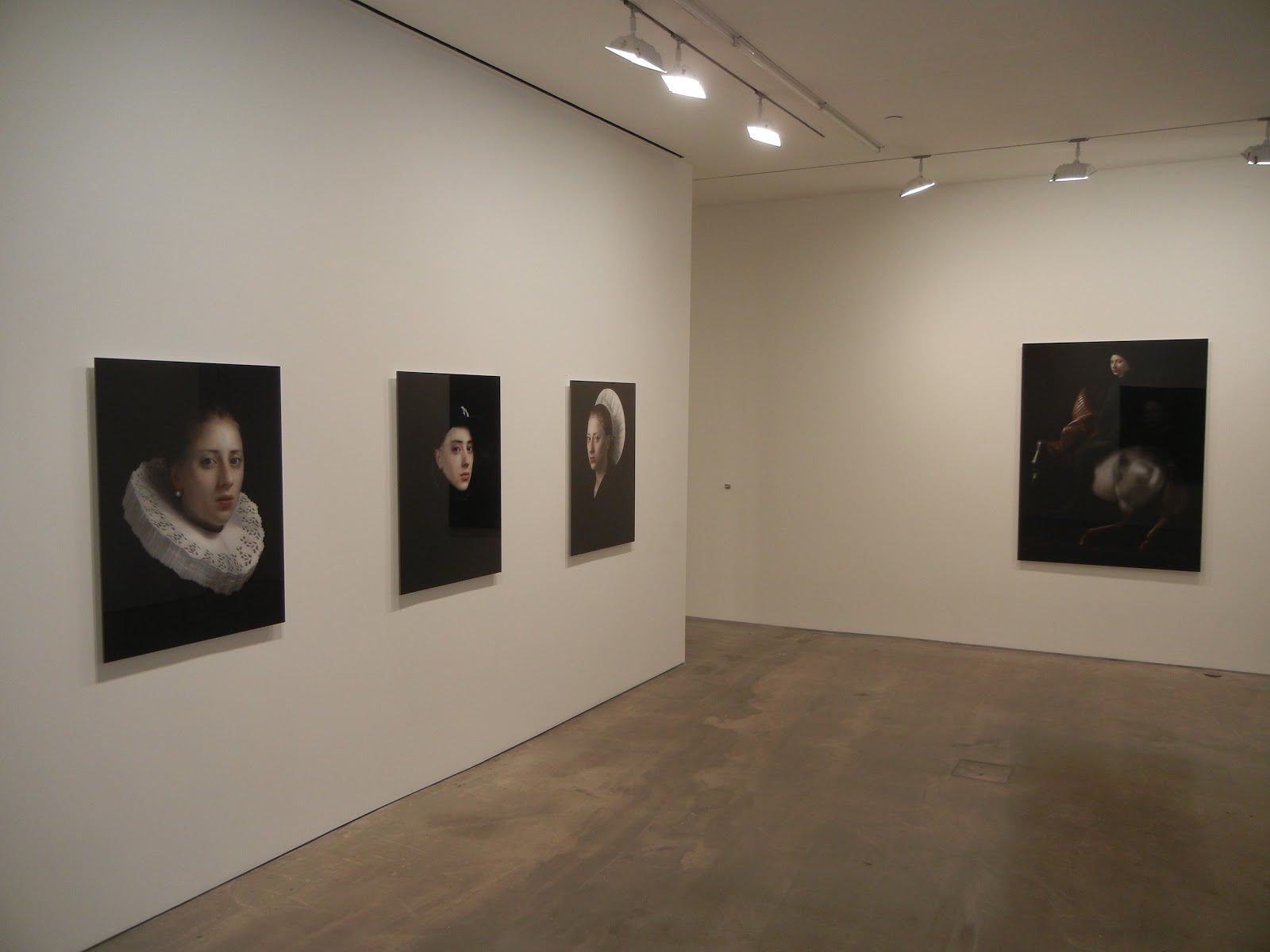
JTF (just the facts): A total of 17 large scale color photographs, mounted and unframed, and hung against white walls in the two room gallery space. All of the works are pigment prints face mounted to Diasec, made between 1994 and 2012. The prints are shown in three different sizes: 24x20 (in editions of 5 or 6+2AP), 40x30 (in editions of 6 or 10+2AP) and 60x50 (in editions of 5 or 6+2AP). there are 6 prints in the largest size, 7 prints in the middle size, and 4 prints in the smallest size on display. (Installation shots at right.)

Comments/Context: I have seen and written about the work of the Dutch photographer Hendrik Kerstens several times over the past few years, so I was certainly aware of what I would likely encounter when visiting his newest show (post Sandy flooding) at Danziger Gallery. But I have to say I was totally and utterly surprised when I walked into the gallery. His portraits have been transformed into glossy objects - rather than being shown in traditional nondescript black frames, they are printed large and face mounted to Diasec like the work of many of the Dusseldorf and Helsinki school graduates. For me, it was an electric wow moment, the push and pull of old and new in his photographs energized and amplified by the modern presentation.

The show is a mini-retrospective sampler of Kerstens' work, going all the way back to his early portraits of his daughter Paula and mixing in brand new images from the past year or two. It traces both her transformation (from young girl into young woman) and his ongoing refinement of craft and technique. For those unfamiliar with Kerstens' approach, suffice it to say that he has brewed up an original alchemical mix of painting and photography, borrowing traditional dark background poses, the careful handling of light, and the subtle treatment of skin from the masters of Dutch portraiture and blending them together with anachronistic modern props and accessories, creating graceful photographic portraits that look and feel like museum treasures and then abruptly upend your sense of order. At this point, the Marie Antoinette bubble wrap headdress, the plastic shopping bag cap, the cloth napkin wimple, and the paper towel roll turban have all become contemporary classics.
 
The good news is that Kerstens' pictures are getting better and better. New portraits of Paula find her sporting a drooped cake icing spout, a thick stack of paper doilies that perfectly mimics a starched lace collar, and a flyaway high pointed bonnet in silvery aluminum foil. There's even a rearing equestrian portrait (with a nod to David) with Paula calmly looking over her shoulder. Given the large size of these prints and the new mounting approach, the works hold the wall with tremendous authority, while still retaining their sense of reserve and refinement.
 
I think the durable excitement of these works lies in their uncertain, shifting dialogue between competing forces: painting and photography, traditional cultural icons and modern realities, sober seriousness and sly wit, celebrating and undermining. They are at once classically beautiful and sublimely ridiculous, which ensures they won't ever be boring.
 
Collector's POV: The images in this show are priced based on size and place in the edition. The 24x20 prints range from $8000 to $18000, the 40x30 prints start at $12000 and go up to $75000, and the 60x50 prints begin at $22000 and rise to a lofty $160000. These prices are a significant step up from previous prices I have seen and likely represent broadening demand for his work. Kerstens' work has not yet reached the secondary markets with any regularity, so gallery retail remains the best option for those collectors interested in following up.
 
Rating: ** (two stars) VERY GOOD (rating system described here)

Transit Hub:
  • Artist site (here) and Facebook page (here)
  • Feature/Review: New Yorker (here)

Hendrik Kerstens
Through February 16th

Danziger Gallery
527 West 23rd Street
New York, NY 10011

Wednesday, October 24, 2012

Robert Frank, From the Penwick Foundation Collection @Danziger

JTF (just the facts): A total of 42 black and white photographs, framed in dark brown and matted, and hung against white walls in the two room gallery space. All of the works are gelatin silver prints (some vintage, some later), taken between 1949 and 1962. No physical dimensions or edition sizes were available on the checklist, but many of the prints looked to be roughly 9x13 (or reverse). All of the prints come from the Penwick Foundation Collection, which acquired them in 1978. (Installation shots at right.)
 
Comments/Context: This show brings together prints from three of Robert Frank's classic geographies (Paris, London/Wales, and America), mixing the known with the unknown in equal measure. Drawn from a single collection amassed in the late 1970s, the prints provide a concise, lively summary of Frank's photographic approach.
 
The handful of Paris pictures capture some of the city's romance (a box of tulips, a baguette-holding child, a couple taking a posed photo with the camera perched on a metal chair) without becoming overly saccharine. A burly weight lifter balancing a pole on his chin and a tiger at the zoo provide some unexpected grittiness. The London and Wales images are a parade of chauffeurs and fancy cars, flanked by serious men in long black coats and top hats. A perplexing flying dog, somehow hurled through a back alley courtyard, upends the upper class sense of decorum.
 
The back room contains images from Frank's travels through America, some of which found their way into The Americans, while others are more surprising and obscure. A sea of audience faces peer forward (with one hiding behind a program), a man holds an armful of quirky plastic dolls on a sidewalk, Park Avenue awnings cover a building with geometric precision, and the fins of a Cadillac poke out from the back of a Chicago parking garage. Better known images like the juxtaposition of Jesus and a beer drinking woman, the endless line of mailboxes, and the cigar smoking rodeo cowboy provide familiar anchor points for Frank's overall mood.


As a single owner collection, this group of Frank prints is certainly an impressive gathering; as a show, I'm not sure it really teaches us anything we didn't already know about the artist. That said, there's never anything wrong with seeing a well-edited selection of Frank's superlative photographs, and the few lesser known gems found here offer some unusual revelations.

Collector's POV: The prints in this show are priced between $25000 and $195000, with the majority under $40000. Frank's work is routinely available in the secondary markets, where recent prices have ranged between $5000 and $600000.

Rating: * (one star) GOOD (rating system described here)

Transit Hub:
  • Features/Reviews: New Yorker (here), Le Journal de la Photographie (here)
Robert Frank, From the Penwick Foundation Collection
Through October 27th

Danziger Gallery
527 West 23rd Street
New York, NY 10011
Tuesday, May 29, 2012

Evelyn Hofer @Danziger

JTF (just the facts): A total of 41 black and white and color photographs, alternately framed in white and black and matted, and hung against white walls in the two room gallery space. 21 of the prints are dye destruction prints, sized 16x20 or somewhat larger (24x30?). The other 20 are gelatin silver prints, sized 16x20. The images were taken between 1962 and 1997, with most made in the 1960s. No edition information was available. (Installation shots at right.)

Comments/Context: Danziger Projects has recently taken on the representation of the estate of Evelyn Hofer, so this exhibit covers her work in a retrospective manner, a first pass over a variety of projects, locations and subjects across roughly forty years. The images show a fundamental understanding of the technical and compositional differences between black and white and color photography, and a thoughtful approach to picture making that played to the strengths of each palette and process.

The straightforward formality of Hofer's black and white portraits bears a certain resemblance to those of August Sander, but her subjects are captured with a bit more environment around them, making their personal stories richer and more evocative. Gravediggers in long black coats armed with unusually long shovels pose in a narrowing alle of dark evergreens, while the headwaiter at a London Club stands with extreme seriousness and competence in his waistcoat and medals amid the hunting paintings and dark wood paneling. Mods in skinny jeans, a girl with a beehive harido, and even a quirky man in a dog funeral parlor (complete with flowers and caskets) get equally structured and formal treatment, keeping these portraits fresh and lively while still giving them a sense of universal timelessness.

Hofer's color work builds on the same sense of exacting precision, but she deploys it in these images with much more awareness of the balance of color across the frame. A man's lime green pants pop next to a bright pink door, and the bold target and red lettering on the yellow sign of a Coney Island shooting gallery is set off by a royal blue sky and the pink wall below. Policemen alternately pose in front of frothy pink cherry blossoms and the intense red of a beer billboard, while women in funky hats and sunglasses stand outside a Harlem storefront church, flanked by a kaleidoscope of colored windows. Given that these images were taken in the mid-1960s, Hofer was clearly on the cutting edge in terms of understanding how color would permanently change the nature of photography. Like the black and whites, they remain crisp and effective, particularly since their use of color is so strong.

I came away from this exhibit impressed both by Hofer's consistent sense of control and by her obvious adaptability. She clearly understood which tools worked best in which circumstances, using shadowy black and white for a dapper Parisian guard, and color for the silvery flash of a Cadillac tailfin. Very, very few photographers working during this same time period straddled black and white and color with such success. This quiet, unassuming show is proof positive of her steady versatility.
.
Collector's POV: The images in this show are priced between $9000 and $18000. Hofer's work has only been sporadically available in the secondary markets in recent years. Prices have ranged between $1000 and $11000, but this range may not be entirely representative of the true market for her best work.

Rating: * (one star) GOOD (rating system described here)
.
Transit Hub: 
  • Obituary: NY Times (here)
Evelyn Hofer
Through June 22nd
.
527 West 23rd Street
New York, NY 10011

Tuesday, June 21, 2011

The Kate Moss Portfolio and Other Stories @Danziger

JTF (just the facts): A total of 37 black and white and color photographs, variously framed without mats, and hung against white walls in the two room gallery space. (Installation shots at right.)

The Kate Moss portfolio consists of 11 signed pigment prints, each 30x24 (or reverse), packaged in a box. Each of the images in the portfolio is framed in white and displayed in the front gallery space, in chronological order from left to right. The portfolio is available in an edition of 30. The photographers included and relevant dates are listed below:

Mario Sorrenti (1993)
Glen Luchford (1994)
Terry Richardson (1997)
Bruce Weber (1999)
Annie Leibovitz (1999)
Juergen Teller (2000)
Chuck Close (2005)
David Sims (2006)
Inez Van Lamsweerde and Vinoodh Matadin (2007)
Mario Testino (2008)
Mert & Marcus (2008)

The back gallery space contains additional images of Moss not included in the portfolio. Details on these images are below, as available:

Gene Lemuel (9 black and white images, each 11x14, in editions of 9, from 1988)
Glen Luchford (3 black and white images, 30x40, in editions of 10+2AP and 2 black and white images, 20x24, in editions of 15+4AP, all from 1994)
Herb Ritts (4 gold toned gelatin silver prints, in editions of 3, from 1997)
Mary McCartney (3 color images, in editions of 10, from 2004)
Peter Blake (5 images, from 2010)

Comments/Context: This review of the collected images of Kate Moss now on view at Danziger Projects desperately wanted to write itself with the painfully obvious "model as muse" story line, placing the celebrity supermodel at the center of it all for the better part of two decades, with the photographers who made the images in her shadow, paying tribute to her unforgettable, easygoing beauty. Such is the power of massive fame that its force sucks all the air out of the room.

What struck me most, however, about this new 11 image portfolio (and the supporting images in the adjoining room) was just how diverse the pictures really were, given that they are all variations on the same subject. Circling the walls, Moss is alternately quietly vulnerable, playfully brash, classically innocent, confidently elegant, deadpan blunt, low-down trashy, fashionably seductive and just plain glamorous. Depending on your perspective, this might be attributed to Moss' substantial range, her ability to shape shift, or her flexible talent for looking fantastic whatever the circumstances. On the other hand, perhaps the recognition ought to lie with the photographer's themselves, and their ability to successfully imprint their own artistic vision on such a wildly famous face.

While paring down to Moss' simple natural beauty is perhaps the most straightforward approach taken here, in a few cases, particularly the works by Juergen Teller, Terry Richardson and Chuck Close, the fact that the model is Kate Moss is almost incidental to the overall visual statement, so strong and recognizable is their control of the aesthetics. In these cases, there is a kind of ironic inversion that goes on (is that really Kate Moss?), where the fact that Moss has been taken so far outside the norms of how we typically see her plays with our now well ingrained expectations of how she is supposed to look. This acknowledgement of her role as a cultural icon makes this exhibit less a parade of glamour shots and more a layered picture of the evolution of a public persona over twenty years. She starts out as a certain young type, and the proceeds to both reinforce and play against that type over the succeeding decades, to the point where she has become both all of them and none of them at the same time.

This changeable morphing is at the heart of this show. Beauty is where it starts, but in the hands of so many talented photographers, that simplistic image of Kate Moss diverges, leaving behind something both durably memorable and oddly ephemeral. Fragments of personalities, both real and imagined, hang in the air, with the unseen Kate Moss hiding somewhere in between. And the underlying question with which I began remains stubbornly unanswered: is that a Mario Testino or a Kate Moss up there on the wall?
 

Collector's POV: The images in the Kate Moss portfolio are not available individually; the entire 11 print portfolio starts at $75000 and will ratchet to $100000 and $125000 as the portfolio sells. The other images in the show are priced as follows:

Gene Lemuel: $3500 each, with set of 9 for $22500
Glen Luchford: $7500 each for 20x24 prints, $15000 each for the 40x30 prints
Herb Ritts: either $8000 or $10000
Mary McCartney: $3000 to $4000
Peter Blake: $2500 to $4000

Rating: * (one star) GOOD (rating system described here)

Transit Hub:
  • Feature/Interview: New York Times T Magazine (here)
The Kate Moss Portfolio and Other Stories
Through June 30th

Danziger Projects
527 West 23rd Street
New York, NY 10011

Tuesday, February 15, 2011

Big Shots: Andy Warhol's Portraits of Celebrities @Danziger

JTF (just the facts): A total of 38 color photographs, framed in white and matted, and hung in the single room gallery space. All of the works are unique Polacolor Type 108 Polaroid prints, each roughly 4x3; the images were taken between 1971 and 1986. (Installation shots at right.)

Comments/Context: By now, it's common knowledge that Andy Warhol used photography as an intermediate process step in making many of his paintings, particularly his commissioned portraits. This small show gathers together a selection of his head shot Polaroids from the 1970s and 1980s, capturing the biggest celebrities of the times from the worlds of fashion, music, art, and politics, reflected in the glow of his own massive fame.

While these pictures were originally taken as source material for later manipulation and appropriation, they have a compelling and unmistakable style; Warhol clearly had a aubtle eye for the composition of photographic portraits and imposed that originality on his subjects, making them his own. Given that the images would later be pared down to lines and then screen printed, the compositions needed to have strong formal outlines. To heighten the contrast, many of the women were made up in bright red lipstick and white foundation, or have billowing explosions and swirls of hair; Diane von Furstenberg, Diana Ross and Jane Fonda all look particularly extreme. The men are often seen from the side or in profile, sometimes with a prop, like Arnold Schwarzenegger's bulging arm or Truman Capote's fedora.

As I have seen more and more of these portraits over the years, I have come to the conclusion that while his signature style has become overexposed and ubiquitous, we discount Warhol's talents at our own peril. Think about what he accomplished with these pictures: he took the most famous and most photographed people of the decade, sat them down, and in a matter of moments, transformed them into something completely new with a seemingly simple head shot. Perhaps we can call this a situation where his fame superseded that of his sitters (an amazing feat of its own), but I remain impressed by his ability to consistently place his carefully controlled artistic mark on rock stars, presidents and other icons who would normally resist such treatment. Try this test when you're in the gallery: block out who the famous person actually is and just look at the way each portrait is structured. Yes, this show is a parade of incandescent stars, but in the end, it's Warhol on display, not his subjects.

Collector's POV: The prints in this show are priced between $10000 and $15000. Warhol's Polaroid portraits can be regularly found in the secondary markets, with prices ranging between $3000 and $21000 in recent years, mostly based on the relative fame of the person pictured.

My favorite image(s) in the show were the group of four images each entitled Self Portrait in Fright Wig, 1986; they're on the right in the bottom installation shot. The background for these pictures is black, so Warhol, his wild wig and big black sunglasses emerge from the darkness; when he later turned them into two color paintings, the portraits became even freakier.

Rating: * (one star) GOOD (rating system described here)

Transit Hub:
  • Review: Flavorwire (here)
  • Exhibit: @Nasher, 2009 (here)
Big Shots: Andy Warhol's Polaroids of Celebrities
Through February 26th

Danziger Projects
534 West 24th Street
New York, NY 10011

Thursday, November 18, 2010

Garry Fabian Miller @Danziger

JTF (just the facts): A total of 15 color photographs, variously framed in black and white frames and unmatted, and hung in the single room gallery space and the display area facing the street. All of the works are unique cibachrome prints, made between 2007 and 2008. There are 13 single images and 2 diptychs; 5 of the images are part of a single group. No dimensions were given. (Installation shots at right.)

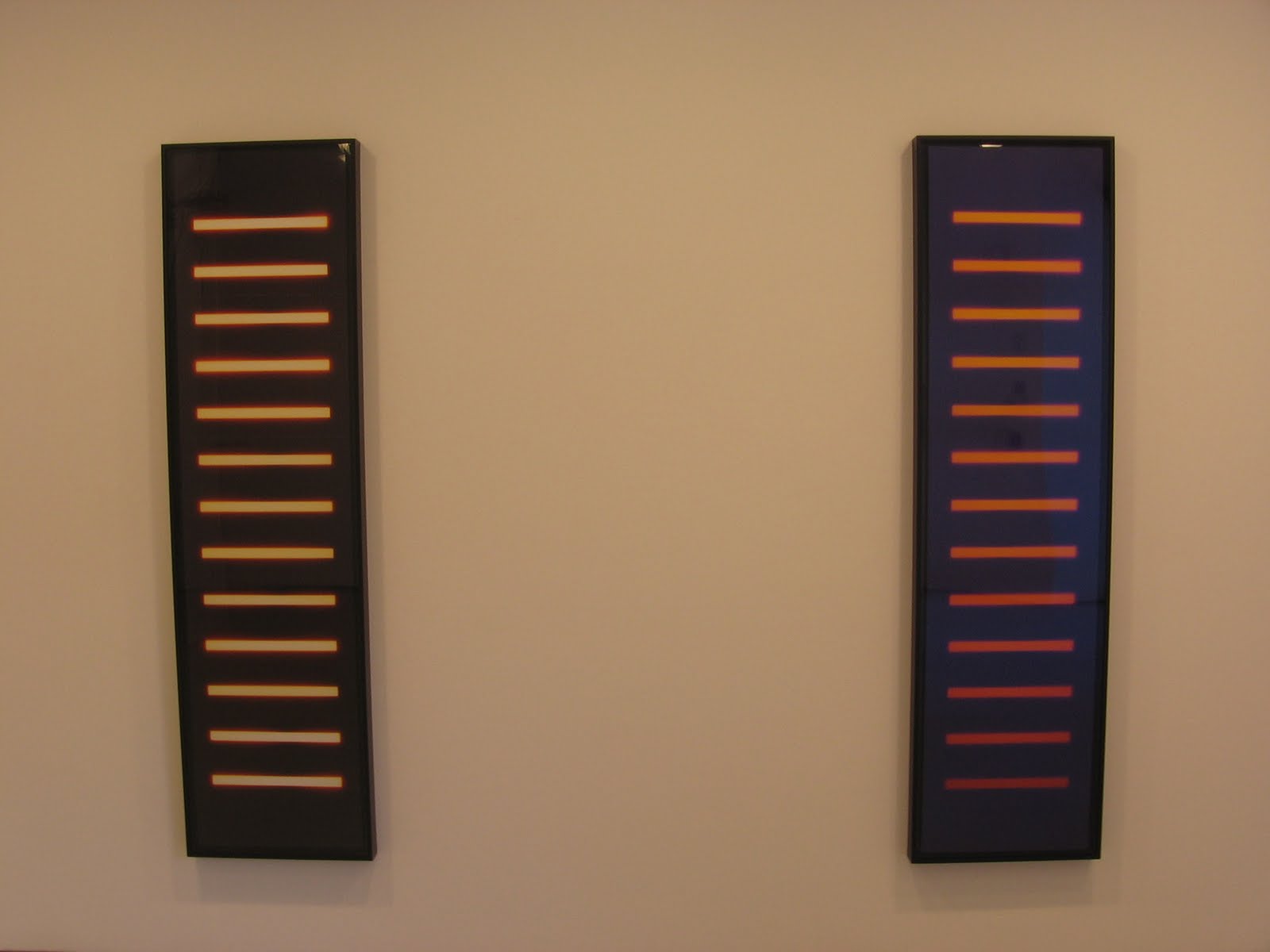
Comments/Context: Garry Fabian Miller's abstract camera-less photograms are like meditative exercises in color theory. Squares and rectangles in saturated primary colors float on backgrounds of pure black, buzzing with blurred energy at the edges.

I think it would be nearly impossible to see this show and not come up with connections to the disciplined, minimal forms of Josef Albers and Donald Judd. While there are plenty of familiar layered squares and ladders of rectangles, I think the difference lies within the intensity of the light that emanates from Miller's richly colored prints. These are not flat studies in red versus yellow or blue versus pink; on the contrary, the perfect geometric shapes seem to vibrate, as though filled with electricity. The edges throb as purple and orange intersect and repel each other.
.
While some of the formal characteristics of these images have echoes in the realms of painting and sculpture, there are likely other tangents to follow (Dan Flavin, James Turrell) that consider the qualities of light itself. Miller has clearly immersed himself in light sensitivity, and in the particular way color is created and captured photographically. I think his work will be best understood not when it is lumped in with other photogram artists across the history of photography (which it often is), but when it is placed within the larger context of hard edged abstraction, regardless of medium.

Collector's POV: The prints in this show are priced as follows. The group of 5 prints on the first wall is being sold together as a group for $45000. The single images of roughly equivalent size near the reception desk are $9000 each. The largest vertical images are $35000 each, and the diptychs are $17500 as pairs. The medium sized prints in the window are $11500 each. Miller's work has very little secondary market history. For the handful of lots that have sold at auction in recent years, prices have ranged between $1000 and $12000.

Rating: * (one star) GOOD (rating system described here)

Transit Hub:
  • Review: Artinfo (here)
  • Exhibit: Shadow Catchers: Camera-less Photograhy @V&A (here)
Through December 23rd

Danziger Projects
534 West 24th Street
New York, NY 10011

Monday, September 20, 2010

Christopher Bucklow @Danziger

JTF (just the facts): A total of 7 large scale color photographs, framed in thin white and hung in the single room gallery space. All of the works are unique cibachrome prints from the Tetrarch series, each 60x40 (or reverse). The images were made between 2005 and 2009. (Installation shots at right.)

Comments/Context: Christopher Bucklow's radiant silhouettes of light have become a kind of signature style - even from across a large room, a Bucklow photogram sticks out and is instantly recognizable. I suppose that this kind of popularity is both a blessing and a curse: good, in that people find the work memorable and original, and bad, in that it's hard to get away from the aesthetic that has made his pictures so easily identifiable.
.
The images on view in this small show continue down the path we have come to expect, albeit on a slightly larger scale. Lithe young bodies made of brilliant light once again stand against rich colored backgrounds, like auras or aliens or futuristic ghosts. Much has been made of Bucklow's unusual photogram process (aluminum foil, holes punched for each day of the sitter's life, sunlight), but I think it is the resulting visual effect that matters: Pointillist dots of light that coalesce into recognizable forms, sometimes with uneven textural roughness, sometimes with overwhelming, overflowing brightness. The works seem to breathe or pulsate, adding a sense of luminous mystery and fuzzy dreaminess to the otherwise simple forms.

While I remain a fan of these pictures simply due to their wow factor, I don't think Bucklow has shown us anything particularly surprising in these most recent works; a bit bigger yes, perhaps in some distinctive colors, but not wildly different from his previous successful images. I'm most interested by the innovative aesthetic idea at the root of his artistic approach, and would very much like to see him expand and explore its edges in new and radical ways.
.
Collector's POV: The works in this show are each priced at $15000. Bucklow's prints can be found in the secondary markets from time to time, perhaps a handful of lots in any given year; prices have generally ranged between $5000 and $14000.
.
Rating: * (one star) GOOD (rating system described here)
.
Transit Hub:
  • Artist site (here)
  • Book: Guest, 2004 (here)
Through October 23rd
534 West 24th Street
New York, NY 10011

Friday, August 6, 2010

Book: Scott Schuman, The Sartorialist

JTF (just the facts): Published in 2009 by Penguin (here). 512 pages, with a roughly equivalent number of color images. Includes a small number of short captions by the photographer. The book itself is small and thick, with the most of the images printed all the way to the edges. The works in this book were made between 2005 and 2008. (Cover shot at right, via Amazon.)

Comments/Context: I've been thinking about Scott Schuman's The Sartorialist for a while now, trying to put my finger on why his daily images have become such a pop culture phenomenon, why they seem to capture the spirit of our times so well. On first glance, it would be easy to dismiss these pictures as the straight forward snapshots of a fashion obsessive, of people watching taken to some logical extreme. But I actually think the reason these pictures are so successful is that they combine ideas from a variety of photographic genres and place them in a new 21st century context, riding the coattails of a wave of interest in authentic individual expression. This book gathers together a gargantuan sample of images taken from Schuman's popular blog, and provides a terrific summary of his aesthetic approach.

In many ways, Schuman's images lie at the confluence of three photographic styles: frontal portraiture, fashion photography, and street photography. While the full body or three-quarters frontal portrait goes back to the beginning of art history, its photographic roots are often laid at the feet of August Sander and his monumental effort to document the people of the 20th century. Since that time, we have seen photographers as diverse as Irving Penn, Thomas Ruff, Rineke Dijkstra, Hiroh Kikai, and Albrecht Tübke use the straightforward portrait to explore types and categories of people, the oddities and eccentricities of individuals, the evolution of personalities, and even more abstract conceptual topics (often with deadpan facial expressions). What's interesting here is while Schuman has borrowed the traditional form, he is using it an an entirely different manner. His search is for those moments when the choices and combinations of color, texture, volume, and contrast found in our attire suddenly manifest themselves as a coherent personal style, when the parts come together in surprising and unexpected harmony. His portraits are intensely individual, but in a way that is universal; we can all look at these pictures and imagine incorporating some small piece of what we see into our own self-image, where the cut of a coat, the silhouette of a dress, the angle of pocket square, or the fabulousness of a pair of shoes can represent a piece of our own personality.

Schuman's pictures are of course at some literal level fashion photographs. But his pictures have not been staged or constructed in an effort to highlight the dramatic elegance of a couture evening gown or the simmering beauty of a model, in the manner of an Avedon or Penn. Even when these greats of fashion photography worked in the streets, everything was minutely controlled to achieve the desired look: the pose, the lighting, the backdrop, the styling, every detail was tuned to achieve maximum glamour. While Schuman's subjects are clearly collaborating with the photographer, and some effort has obviously been made to improve the overall composition or lighting of the found environment, for the most part, it seems the goal is not perfection, but more a genuine documentation of the uniqueness of the subject. In some sense, it is an exercise in one artist capturing the subtle originality of another.

The final piece of the artistic puzzle is the energy of the streets, the act of discovery that is the hallmark of great street photography, the recognizing and picking out of something exciting amidst the chaos that passes by in every moment. Schuman's subjects are mostly "found objects", chance encounters and random connections, here now and gone in the blink of an eye, hiding in plain sight, bustling by on the sidewalk. It takes a tuned eye to discern the patterns of fashion inspiration in a split second, to see the new or innovative and separate it out from the noise.

All of these photographic threads come together in Schuman's deceptively simple images. But what I think has most influenced his meteoric rise is his timing; his artistic approach came along just as we entered the Facebook era, when the cult of the individual and the democratization of fashion came fortuitously together to make celebrities and reality show stars out of everyday people. Suddenly, it was entirely acceptable to get an authentic view of personal style from a well dressed stranger, perhaps even preferable to employing one cooked up by fashion editors who were far too removed from everyday reality. Schuman's images have become an outlet for more voices in the fashion conversation, a way for diversity, quirkiness, and vitality to be more easily integrated into any one person's view of fashion. There is something vibrant and liberating about seeing fashion in this way, and it's likely the reason his approach has spawned so many imitators - it's really a new genre that he has created.

Regardless of whether curators and collectors ever see Schuman's works as part of the continuum of great photography (fashion or otherwise), there is something infectious and relentlessly positive about this body of work. Pick up this book and you'll be hard pressed to put it down without picking favorites, while perhaps discovering some new ideas for finding your own individuality along the way.

Collector’s POV: Scott Schuman is represented by Danziger Projects in New York (here). Schuman's work has not yet become available in the secondary markets, so gallery retail is likely the only option for interested collectors. Given how prolific Schuman is, I expect that print prices are generally quite reasonable.

Transit Hub:
  • The Sartorialist blog (here)

Monday, January 11, 2010

Milton Rogovin, In Celebration of His 100th Birthday @Danziger

JTF (just the facts): A total of 18 photographic works (including 1 triptych and 1 quartet) and 1 limited edition poster, framed in black and matted, and hung in the single room gallery space. Except for the poster, all of the photographs are square format (no dimensions were given, but each is roughly 8x8) vintage gelatin silver prints. The works are drawn from a variety of projects: Store Front Churches (1958-1960), East Side, Buffalo (1960s), Lower West Side (1967-1973), Triptychs (1970s-1990s) and Quartets (1960s-1990s); most of the images on view come from the Lower West Side body of work. The signed poster comes from the 2007 show at Danziger, in an edition of 50. (Installation shots at right.)

Comments/Context: I think that when the history books are written, Milton Rogovin will ultimately be remembered for his ability to capture the subtle joy buried in the lives of everyday people. Unlike the vast majority of the photography we categorize as "social documentary", his work isn't full of the depressing stares or guarded poses of those being inspected, even though the circumstances in 1960s and 1970s Buffalo, NY, were certainly no rosier than most working class towns in America at the time. Instead, his straightforward, surprisingly formal portraits of ordinary folks have a warmth and authentic casualness, giving the work an aura of genuine and optimistic sympathy rather than indirect critique.

This small show, organized in honor of Rogovin's 100th birthday, brings together a sampler of vintage material from across his long career. The exhibit itself is too small to make a compelling and thorough case for the value of Rogovin's art; instead, it serves as more of a reminder that Rogovin can and should be relevant to today's contemporary photography; his portraits have plenty to teach contemporary artists about how to tell stories with trust and compassion, and can set a good example for how reassuring comfort and real concern can be used to uncover moments of grace in the midst of potentially dispiriting and gloomy environments.

Collector's POV: The prints in this show are mostly priced at $4500, with a few at $5000, $6000, or $7000; the triptych is priced at $10000 (the quartet was already sold) and the poster is $1000. Rogovin's work is surprisingly absent from the secondary markets, given his long career. Only a handful of lots have come up for sale in the past few years, selling between $2000 and $10000, but I wouldn't say this has really been a representative sample of his work.

Rogovin's frontal portraits bear obvious comparison with those of August Sander, albeit with a more funky American feel. I found the triptych which begins with a portrait of a couple (the man sporting a big afro, a turtleneck sweater, and plaid pants with suspenders) and ends with the now older parents surrounded by a gaggle of children of various ages to be a classic American story told in just three images. Rogovin's work also reminds me of Hiroh Kikai's portraits of Japanese temple-goers, where the quirkiness of the individuals comes through with acceptance rather than oblique mockery.

Rating: * (one star) GOOD (rating system described here)

Transit Hub:
  • Artist site (here)
  • Interview with Robert Hirsch, 2004 (here)
  • Lens feature, 2009 (here)
Milton Rogovin, In Celebration of His 100th Birthday
Through January 16th

Danziger Projects
534 West 24th Street
New York, NY 10011

Tuesday, October 6, 2009

Weston's Westons @Danziger

JTF (just the facts): A total of 40 black and white images, framed in black and matted, and hung in the single room gallery. The prints in the show were made by Cole Weston from Edward Weston's negatives; the negatives were taken between 1920 and 1941; the posthumous prints were made in the 1960s/1970s/1980s (Weston died in 1958). All of the prints are gelatin silver contact prints, ranging in size from 4x5 to 8x10 or reverse. (Installation shots at right.)

Comments/Context: I have to admit up front that, as a collector, I've always been a bit skeptical of the Edward Weston images printed by his son, Cole Weston. Over the years we have owned a few (now no longer in our collection), but I've never really felt like they were truly authentic somehow; after all, they were made after Edward Weston's death. They always felt a little like cheating; even though the images were undeniably beautiful, I always knew (even if others didn't) that they weren't the "real" ones.
.
This uneasiness had nothing whatsoever to do with the quality of the prints; on the whole, the Cole prints are brilliantly executed, with exacting craftsmanship and rigorous attention to Edward Weston's printing instructions. And this exhibit is an excellent reminder of just how breathtaking the prints can be. Danziger has selected a lovely mix of iconic images and lesser known variants to show off this work, many of which are slightly purer in their blacks than the originals printed by Edward Weston himself. I am a particular fan of the small 4x5 nudes Weston did in the 1930s, all fragmented body parts, transformed into exercises in form and line. There are also a group of nudes of Charis on the sand, as well as some earlier studio nudes that are slightly broader in composition than the later close ups. Mixed in among the nudes are a few vegetables and flowers, some dunes, a couple of shells, and a few other miscellaneous works.
.
Since we have been on the lookout for vintage versions of the small nudes for years now, I can say with some confidence that there really aren't that many floating around in the market, and the prices for those that are available have been driven up substantially in the past few years as the scarcity factor increases. The iconic works are all well into six figures, and many of the best prints are now in museums or large private collections.
.
Which makes me think that this show at Danziger has a surprising stroke of genius to it. While the Cole prints have long been stigmatized as a lesser substitute, the time may now be right for many collectors to revisit these prints as a viable alternative to the effectively unavailable vintage Weston work. The prices are generally still reasonable, the prints are gorgeous, and the Cole prints in and of themselves are rising in value as they too become less available. I guess that I remain conflicted on the ultimate verdict on these prints, but seeing the elegant grids of nudes that we have coveted for so many years hanging so invitingly on the walls made me wonder if it wasn't time for us to stop being such righteous purists and start thinking a little differently.

Collector's POV: The prints in this show are priced between $5000 and $15000, with many already sold when I visited the show. A few EW/CW prints seem to be available in nearly every auction; they have become widely available in the secondary markets in the past decade. During that time, prices typically ranged between $1000 and $5000. Today, most images remain in this range, but in the past year or two, many have started to creep upward, once in a while crossing the $10000 threshold for the most iconic images.

Rating: * (one star) GOOD (rating system described here)

Transit Hub:

  • Weston family website (here)

Danziger Projects
534 West 24th Street
New York, NY 10011

Monday, April 6, 2009

Tanyth Berkeley, Grace @Danziger

JTF (just the facts): A total of 11 color images, framed to the edge in either black or white, with no mat, displayed in the single room gallery space. Sizes range from 24x20 to 63x28 (full body size), and are printed in editions of 5. (Marginal installation shots at right.)

Comments/Context: I was first exposed to the work of Tanyth Berkeley at the New Photography 2007 exhibit at the MoMA, where her portraits had an electricity that monopolized the available attention. Continuing a line of thinking drawn back through Diane Arbus and Lisette Model, Berkeley makes realist portraits of unusual people with a sense of intimate care and genuine curiosity. She has pointed her camera at transgendered people, people with albinism, and a whole range of folks who fall outside society's normal definitions of beauty, finding unique stories to tell in each and every one.
.
In the show at the MoMA, while there were plenty of startling full body portraits, I remember being completely awestruck by a smaller image of a woman named Grace, seated by a window with an ethereal light coming from behind, as though she was glowing. It was like a Renaissance portrait of a saint or angel, at the very moment of some kind of spiritual ecstasy. (Grace in Window, 2006, at right.) It struck me then, as it does now, as one of the best contemporary portraits I've seen in a very long time, likely to age well and remain inspiring over many years. As an aside, a print of this image went into the MoMA's permanent collection.

This image is on display at Danziger Projects as part of larger body of Berkeley's recent work focused on this woman. Grace Longoria's albinism makes her skin and hair radiantly white, and she is often photographed with her eyes closed, due to her increased intolerance of bright light. The images in the show find her in different poses and clothes, but always with the same delicacy and fragility. Not all of the images rise to the same lofty heights as her portrait by the window, but clearly, the artist and muse have found a working relationship that allows them to take some risks.

Collector's POV: The images in the show are reasonably priced between $2800 and $6800. Berkeley's work doesn't even remotely fit into our particular collection; contemporary color portraits are about as far from our specific genres as one could imagine.
.
But I can say with some conviction that I believe Grace in Window will end up being among the hallmark contemporary portraits of this decade. (Stop and digest that comment for a moment, as it's a real whopper.) Since there is only one left, priced at $6800, if we were contemporary photography collectors looking for signature images from these times, I'd pick up the phone right now and put in on hold before it vanishes.

Rating: * (one star) GOOD (rating system described here)

Through April 25th

534 West 24th Street
New York, NY 10011