Showing posts with label Metro Pictures. Show all posts

Wednesday, May 15, 2013

Sara VanDerBeek @Metro Pictures

JTF (just the facts): A total of 18 color photographs and 8 sculptures, hung against white walls in the three adjoining gallery spaces on the first floor. All of the photographs are digital c-prints made in 2013, framed in white and unmatted, in some cases covered by tinted Plexiglas (pink/blue) or mirrored Mirona glass. Sizes range from 20x16 to 96x48, and all the prints are available in editions of 3 (two of the works are diptychs). The modular sculptures are made from concrete and latex paint, and were also made in 2013. (Installation shots at right.)
 
Comments/Context: Sara VanDerBeek's new show is an exercise in atmosphere, where contrasts of shape, texture, color and scale are mixed with muted subtlety. Classical curves are matched by rough Minimalism, creating a back and forth dialogue between forms. The result is a loosely wandering rhythm, the whole of the installation trumping the power of any one contributing work.
 
The first room of the exhibit is balanced by four oversized images of Classical female sculpture, cropped down to sinuous bending torsos. Elegant bodies in soft white and enveloping black are paired with colorized partners in hybrid pink and blue, creating a calm sense of elemental grace. Flanked by tall corner-shaped concrete columns in stark white, the visual conversation moves between simple refinement and pared down, blunt geometry. The last room in the show follows this same pattern, capturing rounded female heads in bronze and marble in similar dusky pink and blue tonalities, once again offset by the rigid, rectilinear lines of the nearby sculpture.
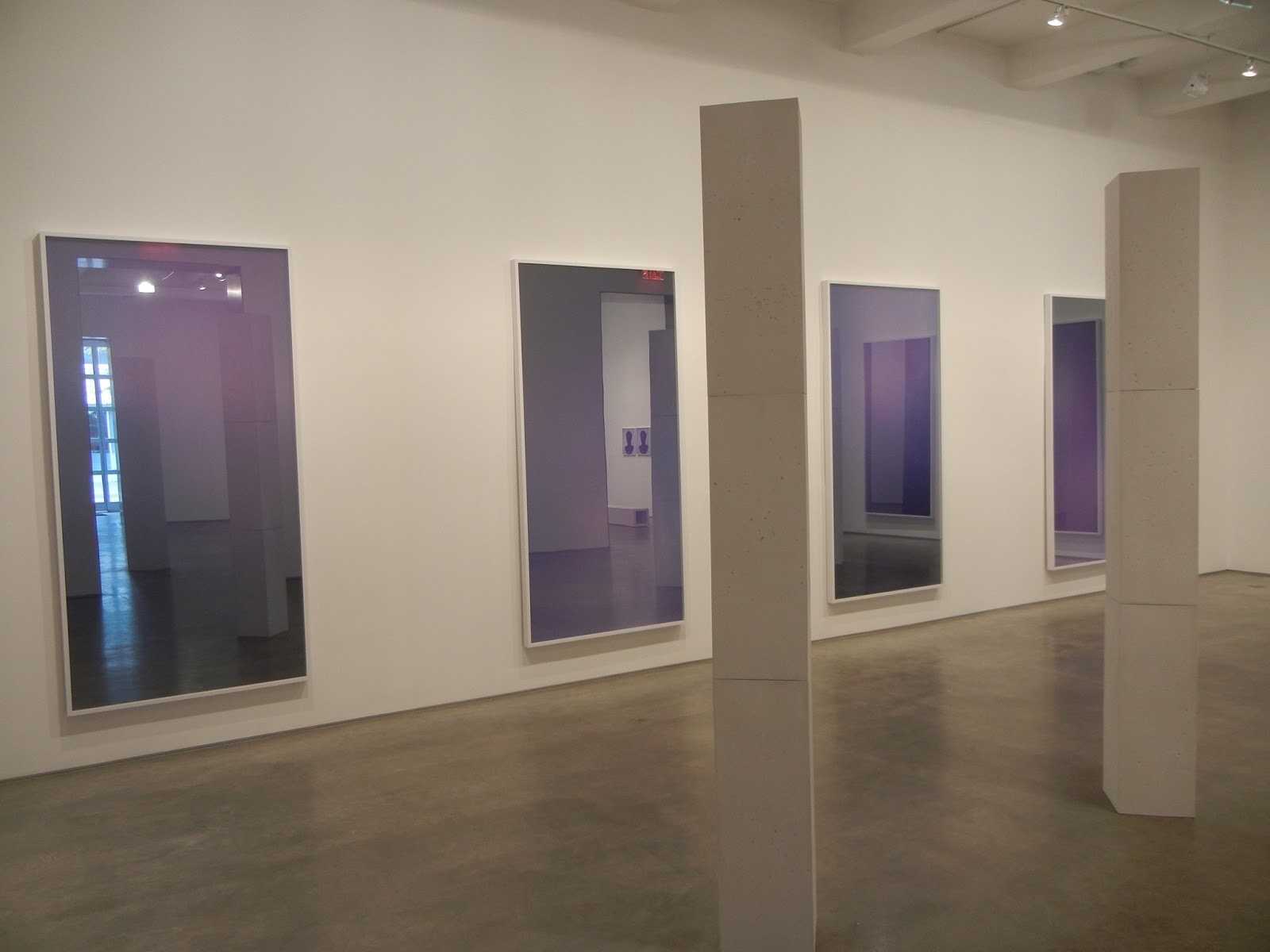
 
The works in the main gallery space take these contrasts in a more abstract and ephemeral direction, combining a colonnade of vertical blocks with a series of shifting color studies in pink and blue. Up close, the photographs are full of grainy splashes and misty gradients, drifting between foggy billows and textural oxidations. From afar, their surfaces are mirrored, so they bounce reflections around the room, echoing the spatial relationships between the visitors, the color fields, and the white concrete pillars. While I think I understood the intention here, to my eye, this mirroring became a distraction, making it nearly impossible to see the nuanced variations in the photographs with any clarity; the photographs lost their diaphanous mystery when covered up by recognizable reflections, especially when the gallery was crowded.
 
While this installation is successful in creating a dreamlike mood and making a visual point about contrasts, I think only a handful of the torso images can really function successfully as stand alone photographs; the rest really require the proximity of the columnar sculptures to resonate fully. Overall, I came away more intrigued by what VanDerBeek was discovering in the fleeting in-between spaces between these artworks than with the individual pieces themselves.
 
Collector's POV: The photographs in this show are priced between $6000 and $30000 based on size. VanDerBeek's work has not yet reached the secondary markets with any regularity, so gallery retail is still likely the best/only option for those collectors interested in following up.
 
Rating: * (one star) GOOD (rating system described here)
 
Transit Hub:
  • Feature/Review: New York Times (here)
  • Interview: Aperture (here)
 
Through June 8th
 
519 West 24th Street
New York, NY 10011

Monday, February 25, 2013

Trevor Paglen @Metro Pictures

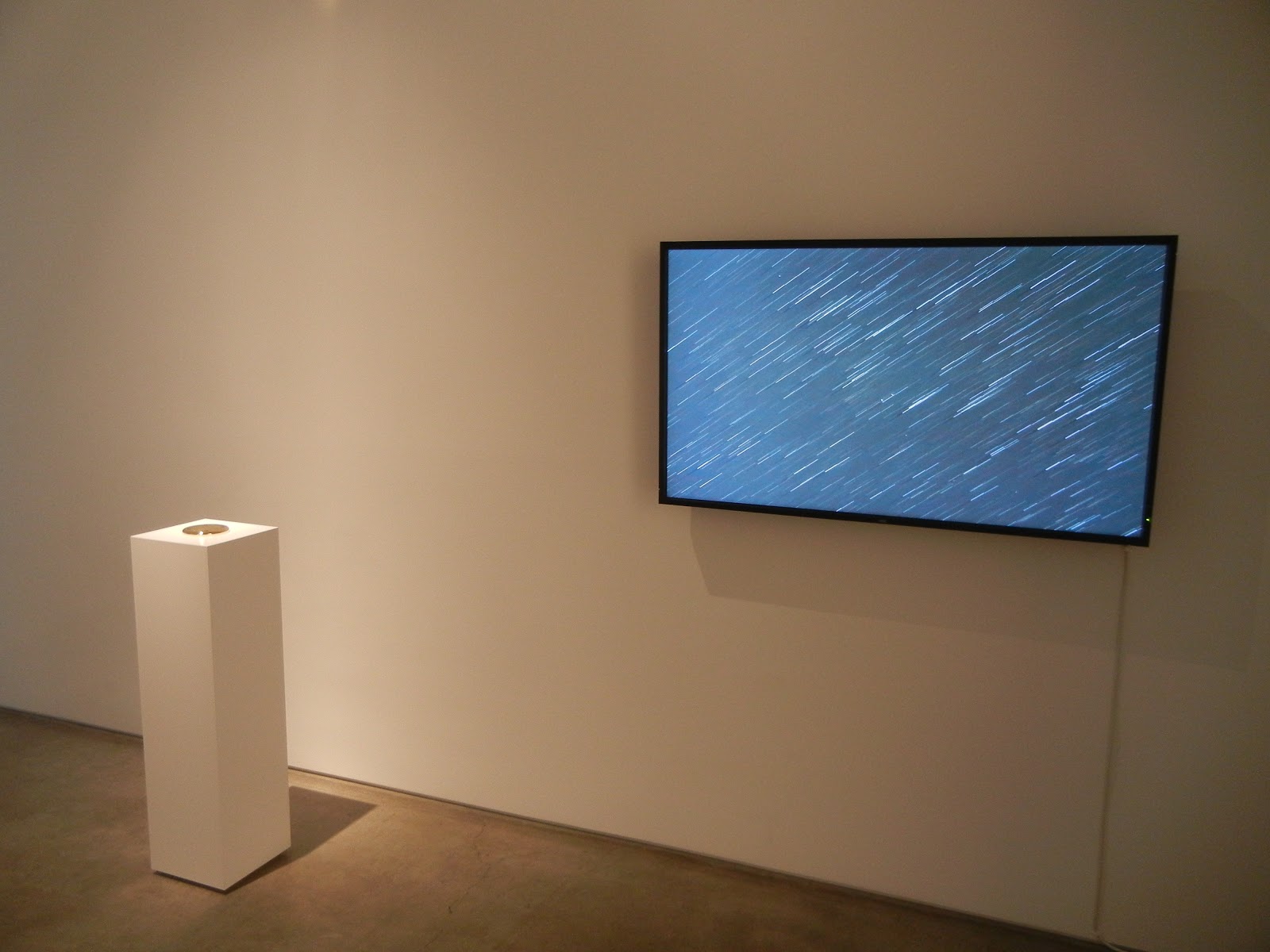
JTF (just the facts): A total of 11 single image photographs, 4 photographic diptychs, 2 videos and other various ephemera, framed in black/white and unmatted, and hung against white walls in the three adjoining gallery spaces on the first floor. All of the single image photographs are c-prints, ranging in size from 42x34 to 70x91 or reverse, each available in an edition of 5. The diptychs are either gelatin silver prints (each panel 24x32) or c-prints (each panel 38x43), also available in editions of 5. The show also includes 1 framed postcard, an array of 182 images pinned to the wall, a small model of the EchoStar communications satellite, 2 scrapbooks, 1 reference volume of satellite launches, 2 etched artifacts, 1 video containing 100 still images, and 1 video of the moving satellite against a starry backdrop. No specific date information was provided on the checklist. A monograph of this body of work was recently published by Creative Time and the University of California Press (here) and is available from the gallery for $25. (Installation shots at right.)
 
Comments/Context: Trevor Paglen's newest project, The Last Pictures, is one of the most intellectually complex photographic endeavors I've run across in many years. On the surface, the plan seems remarkably straightforward - select a group of photographic images to be stored as a documentary artifact and bolt them on the side of a communcations satellite as a kind of message from humanity for future discovery by spacefaring aliens. This kind of thing has been done before by well-meaning scientists hoping to communicate something of our existence to those who might run across our deep space probes, but this is the first time an artist has driven the process, and it's clear that Paglen's rigorous and thoughtful approach quickly drove the effort into the conceptual weeds, where the problems of long time scale durability, engineering, and design quickly morphed into meticulous investigations of mathematics, philosophy, anthropology, linguistics, and a whole host of less defined but equally thorny questions and concerns.
 
Given the scientific facts of geosynchronous orbits and their propensity to stay stable, the time scale of this project is truly staggering - it is altogether possible that if left unperturbed, Paglen's selections will remain in place until the sun explodes, an event scheduled for billions of years from the present; in all likelihood, humanity will be long gone. Questions of communication, and meaning, and interpretation, and intelligibility become almost imponderable across such a distance of time. But instead of leaving behind a bread crumb trail of smiling happy people and a politically correct selection of world music and cultural signifiers, Paglen has chosen to try to tell a story of how a civilization dies, of how its grand gestures, its hubris, and its collective narcissism become inherently suicidal.
 
Paglen mixes his own photographs with many more gleaned from various archives, so once again, we find a contemporary photographer less concerned with the functioning of his camera and more interested in using existing imagery to craft his chosen narrative. In this case, if you put yourself into the mindset of trying to discern meaning from his choices an eternity in the future, the project starts to feel a little like Mike Mandel and Larry Sultan's Evidence - something certainly happened in these pictures, but what it was and why it was important is altogether less clear. Given the benefit of our current context, Paglen's view of technology, our relationship with nature, the pace of change, and our disregard for consequences is full of a quiet sense of creeping pessimism; it we assume the human race has extinguished itself on the time scale of this artifact, then many of the causes, reasons, and contradictions of our doomed choices are to be found here. Images of people fleeing drone strikes, cave paintings documenting the Spanish massacre of the Navajo, overgrown riverside greenery, the immense construction complexity of the Hoover Dam, and Bruegel's painting of the Tower of Babel offer a subtle undercurrent of ominous foreboding.
 
As an intellectual exercise, this project is deeply and almost impossibly rich and challenging, but as stand alone art objects, Paglen's photographs are a bit underwhelming. I think the folks at Metro Pictures chickened out a bit with the installation, adding a room full of Paglen's earlier images of government black sites and spy satellites as background. These works are more mysteriously graphic and eye-catching, and likely more saleable, so I certainly understand the logic for their inclusion, but they take up valuable space that could have been used to show more of the 100 selections. I also think the corner of outtakes and images that didn't make the cut is a colorful distraction; while the in-versus-out decision making is an intriguing process (the cute kittens, the Goya firing squad, and the Japanese woodcut of a woman being erotically devoured by a squid didn't make it), I wish the show had committed to giving us Paglen's entire distilled vision rather than showing the cycle on a video screen. As it is, there are only roughly a dozen of his selections on view as prints, which is a pretty small sample of the whole. This makes his choices seem even more random and disconnected than I think they really are - check out the accompanying book for a better and more comprehensive understanding of the recurring themes and the interlinked motifs.
 
In a certain way, I am deeply conflicted by this show. Its brainy relentlessness, its willingness to travel down esoteric intellectual backroads, and its intense thoughtfulness about unanswerable human questions make its underlying conceptual framework undeniably brilliant. There are clearly hours and hours to be spent pondering the intricacies of this extremely smart project. And yet, I found most of the images on display somewhat forgettable, as if I needed the context of the larger project to find enhanced meaning in the individual images. Which of course pulls me down the rat hole of how an alien race would figure out anything from these same photographs and how one might communicate nuances of meaning across such unfathomable divisions of space and time. In the end, my head scratching conclusion is that this show is truly brimming with ideas (and wholeheartedly worth a visit), if only for its ability to ask questions that will rattle around in your head for weeks to come.
 
Collector's POV: The photographs in this show are generally priced between $10000 and $40000 based on size. Paglen's work has not yet reached the secondary markets with any regularity, so gallery retail is likely the best/only option for those collectors interested in following up.
 
Rating: ** (two stars) VERY GOOD (rating system described here)
 
Transit Hub:
  • Artist site (here)
  • Creative Time project site (here)
  • Features/Reviews: E-Flux (here), New Yorker (here), NY Times T magazine blog (here), Time LightBox (here)

Through March 9th
 
519 West 24th Street
New York, NY 10011

Friday, May 18, 2012

Cindy Sherman @Metro Pictures

JTF (just the facts): A total of 9 large scale color photographs, framed in brown wood and unmatted, and hung against white walls in the three adjoining gallery spaces on the first floor. No specific print process information was given beyond "color photograph" on the checklist. The works are available in editions of 6, and range in size from 64x91 to 80x140. The images are dated either 2010/2011 or 2010/2012. (Installation shots at right.)

Comments/Context: Cindy Sherman's current show of new work is surprisingly full of risks and experiments, announcing with authority that whatever you may have seen over at the MoMA, there will be no resting on her laurels; she is still challenging herself to extend the boundaries of her artistic practice. In these photographs, Sherman's picture making approach has been more directly influenced by new digital tools, impacting both the look of her characters and the scope and texture of their surroundings.
.
For the first time, Sherman has used broad natural landscapes as backdrops to her portraits. Taken primarily in Iceland after the recent volcanic eruption, her photographic views are full of rocky hillsides, barren river valleys, and open pastures weighed down by moody grey skies. Dusty flat plains give way to mossy outcroppings, the exploding ash in the sky swirling like the clouds in a Turner painting. Sherman's characters float in front of these bleakly beautiful settings, seemingly disconnected from their environments. The landscapes provide some clues (or blind alleys) for potential narratives, but the characters themselves make no attempt to clarify any meaningful connections. Unlike the interiors from the recent society portraits (which provided some useful context), the landscapes upend our ability to find any thread of a plausible story.

Sherman's use of fine-grained digital manipulation is also much more pronounced in these works. The landscapes have been minutely textured to look like painterly brush strokes, softening their harshness just a bit, and the faces of Sherman's characters have been digitally altered to elongate noses, widen eyes, and flatten severe expressions. While she has substituted post-production editing for her previous eccentricies of makeup and stagecraft, as always, her handiwork is still somehwat visible, intentionally reminding us just how far from reality these people are. Dour bloodless faces peer down with steely intensity, with just a touch of puzzling distorted detail to keep us off balance.
.
I haven't yet mentioned the elaborate and often delightfully improbable costumes these women are wearing, and here again we see some experimentation by Sherman. All of these gowns and outfits came from the Chanel archive, but these images don't look anything like traditional fashion photographs. The poses are wrong, the scenes totally incongruous; the haute couture fashions are at once entirely misplaced and quietly celebrated. A yellow and green  belted jacket and puffy skirt combination takes on a prim Western pioneer look against its mountainous backdrop, while a shimmery gold and blue concoction looks like the ceremonial garb of some nomadic tribeswoman when set against furrowed grassy hills. The lush intricacy of the fashions and the starkness of the terrain make for odd bedfellows.

The end result of all this innovation is a set of intense pictures that have some of the trappings of broad, romantic landscape scenes of the past, but with an overall feeling that lies somewhere between defiant loneliness and quirky, confrontational glamour. All of the component parts are inconclusive and disconnected, leaving the viewer incapable of really figuring out what is going on. While Sherman is clearly exploiting some of the aesthetic freedoms that these larger digital tableaux can offer, she continues to purposefully avoid giving us any easy answers, forcing us to find our own meanings amid the feathers and the dirt.

Collector's POV: The photographs in this show are priced at either $400000 or $450000 based on size. With Sherman's excellent retrospective still on view at the MoMA (review here), there has been a flood of her works into the secondary markets this spring, likely hoping to capitalize on all the attention. I believe there were 26 different Shermans for sale in the Contemporary Art sales at the big three auction houses, plus countless others at the various New York art fairs, particularly the Armory. In general, recent auction prices have ranged from as low as roughly $2000 (for one of her large edition prints) to as high as her then world record $3.89 million price set in 2011. A print from that same edition (the orange sweater centerfold) was sold this spring by the Akron Art Museum and fetched roughly $1 million less than the record, perhaps a sign that prices are stabilizing with so much material now becoming available.

Rating: ** (two stars) VERY GOOD (rating system described here)

Transit Hub:
  • Features/Reviews: NY Times (here), New Yorker (here)
Cindy Sherman
Through June 9th

Metro Pictures
519 West 24th Street
New York, NY 10011
Tuesday, October 25, 2011

Olaf Breuning, The Art Freaks @Metro Pictures

JTF (just the facts): A total of 22 large scale color photographs, framed in back and unmatted, and densely hung in the small, single room gallery space upstairs. All of the works are c-prints made in 2011, each 75x34 and printed in editions of 3. (Installation shots at right.)
.
Comments/Context: Olaf Breuning's larger-than-life-sized, body painted nudes in homage to famous artists are the artistic equivalent of the street corner performer dressed as the Statue of Liberty: they're instantly recognizable, clever and entertaining, but ultimately pretty light fare. Using male and female bodies as his canvas, he's painted each one either as an exaggerated copy of a well-known work, a visual appropriation of the artist's style, or a riff on a thematic idea used by that particular artist. They're a little like the endless stream of Van Gogh tote bags, umbrellas, scarves, and t-shirts found at museums - a readily identifiable re-interpretation of "high" art in a different form.
.
This isn't to say that it isn't fun to circle the gallery and discover the connection in each one. In the "famous artwork" category, there's Munch's The Scream, Man Ray's Le Violon D'Ingres, and Jasper John's Flag. Those primarily done as a stylistic homage include Yves Klein (all in blue), Damien Hirst (colored polka dots), Francis Bacon (distorted body parts), and Jackson Pollock (drips) among many others. And thematically, Louise Bourgeois is covered by a black spider and Andy Warhol is dripping with banana peels. Each and every picture is witty recreation, some more "insider" to the art world than others. By the way, the only other photographer (besides Man Ray) included in this parade is Cindy Sherman, and this got me thinking about how it is much more difficult to pigeon-hole photographers by a simplistic visual shorthand, especially those whose work is not primarily about a signature style.

In any event, Breuning's tributes are certainly playful and amusing, in a teasing manner sure to evoke a smile or a chuckle. This makes them hard to take seriously as anything more than a send-up, but their mischievous joy is hard to resist.

Collector's POV: The photographs in this show are each priced at $18000. Breuning's works have very little secondary market history, so gallery retail is likely the only option for interested collectors at this point.

Rating: * (one star) GOOD (rating system described here)

Transit Hub:
Through October 29th

Metro Pictures
519 West 24th Street
New York, NY 10011

Wednesday, May 18, 2011

Louise Lawler: Fitting at Metro Pictures

JTF (just the facts): A total of 14 color photographs, hung against white walls in the entry and the three adjoining gallery spaces on the first floor. 10 of the works are made of an adhesive wall material (similar to vinyl) that has been stretched to different proportions and sizes based on the installation and mounted directly on the wall without any framing. These particular instances of the images range in size from roughly 10x7 to 150x397. The images themselves were made between 2005 and 2010 and printed in 2011. The other 4 works are more traditional photographs: 3 are cibachrome prints face mounted on Plexi on museum boxes, 1 is a Fujiflex print laminated on plywood. Physical dimensions range from 12x10 to 42x42, in editions of 5+1 or 10+2. These works are dated between 2008 and 2010. (Installation shots at right.)

Comments/Context: Louise Lawler has made a long and successful photographic career out of thinking about art in context. She has explored how it is displayed and arranged in different settings, how it interacts with its environment and modifies the space around it, and how juxtapositions of artworks can add layers of intended and unintended meanings. Over the years, I have found her work alternately witty and a bit obtuse, but mostly subtle and surprisingly complex.

Prior to seeing this show, I was wondering whether Lawler had exhausted the fruitful avenues for exploring the relationships of art hung against white walls. What I found amazing about this show is that these new works actually explore not one, but three new conceptual lines of thinking within her defined playing field. She deftly introduces and incorporates the ideas of scale, flatness and distortion (all at the same time) in these images, while still riffing on many of the foundation art-about-art concepts that have made her justifiably famous.

In terms of scale, the images on display run the gamut from a few inches square to one room sized image larger than 30 feet on one side. In some cases, extremely large and extremely small are hung next to each other, both being out of proportion to their "normal" size and to the room that surrounds them. The effect is something like telescoping, where the viewer is forced to both move in close and stand way far back to engage with the works, changing the nature of their relationship to each other and the gallery space. There are even a few duplicates in different sizes and form factors, which create visual echoes across the rooms. The manipulation that is going on is overt, but powerful just the same.
.
The adjustable works also have an unusual degree of flatness, in that they are applied directly to the walls (without any frames or implied thickness), making them extremely one dimensional, even though they depict the deeper space of artworks in galleries. This flatness is then combined with obvious horizontal and vertical stretching and compression, where the proportions are twisted and exaggerated. Placed in the context of their own gallery show, the distortions pile up, and the works self-referentially bend in on themselves.

While not every image in this show is completely compelling in and of itself photographically, when the pictures are executed and displayed in this extreme manner, the conceptual ideas they explore start to trump the specific content. As such, I found this show to be intellectually engrossing. What at first glance could be mistaken for a gimmick turns out to be something altogether more advanced and intriguing.
.
Collector's POV: The photographs in this show are priced based as follows. The images on adhesive wall material are priced at $150000 each. The more traditional mounted photographs range from $12000 to $50000, roughly based on size. Lawler's work is generally available in the secondary markets, with a handful of lots coming up for sale in any given year. Recent prices have ranged between roughly $5000 and $125000.

My favorite image in the show was Marie (Adjusted to Fit), 2010/2011; it's on the right in the top installation shot. I like the idea of distorting/fragmenting this iconic Degas sculpture, where something easily recognizable is reformulated and transformed.

As an aside, as a collector, I'm not sure I follow the logistics of these adjustable images. If I buy one, can I have it resized once a year if I rehang my collection, indefinitely? Is that included in the price? Are the previous instances destroyed (I assume so)? If I lend it to a museum for an exhibition, and they resize and install it particularly well (somehow optimizing the distortion), when I take it back, is that "good" version forever lost? In 50 years, if adhesive vinyl is no longer around, can I have it printed on something else? Do I get a digital file? I'm sure there are answers to these questions - it just seems like the details would be complicated.

Rating: ** (two stars) VERY GOOD (rating system described here)

Transit Hub:
  • Reviews: New York (here), TimeOut New York (here)
  • Feature: Frieze (here)
Louise Lawler: Fitting at Metro Pictures
Through June 11th

Metro Pictures
519 West 24th Street
New York, NY 10011

Friday, October 29, 2010

Sara VanDerBeek: To Think of Time @Whitney

JTF (just the facts): A total of 29 color works, framed in black with no mats, and hung in the single room gallery on the first floor of the museum. All of the works are chromogenic prints, sized 20x16, and made in 2010. This is the photographer's first solo museum show. The Whitney does not allow photography in the galleries, so unfortunately, there are no installation shots of this show. The single images at right are taken from the Whitney website. (Sara VanDerBeek, Foundation, Reynes Street, 2010, at right.)

Comments/Context: Sara VanDerBeek's small solo show at the Whitney is modulated and meditative, an atmospheric exercise in muted color. In a departure from her photographs of carefully constructed conceptual sculptures of appropriated/collaged images, these works rhythmically alternate between images of pitted concrete foundations unearthed in the Lower Ninth Ward of New Orleans, angular, geometric sculptures made in her studio, and details found in her childhood home of Baltimore. The entire project is wrapped in the mantle of Walt Whitman, borrowing its group titles from Leaves of Grass.
.
While this exhibit has all the trappings of a deeply personal investigation of time and memory, it somehow falls flat in terms of showing us something new. I found the images of gritty, textured poured concrete to be the most aesthetically interesting, with their all-over abstractions in scratched grey and blue, but it would be hard not to see obvious connections to the explorations of surface by Aaron Siskind and Minor White here. VanDerBeek's pared down studio sculptures of roughly hewn nested rectangles, chevrons, and boxes have been photographed with moody shadows (a little reminiscent of Brancusi's photographs), in the same washed out palette as the images of concrete; the effect is subdued and quiet, the works isolated and drained rather than elevated. These two groups of images are then intermingled with a handful of more personal icons (in the same natural light tonalities), and then sequenced into juxtaposed groups that repeat around the room. (Sara VanDerBeek, Blue Caryatid at Dusk, 2010, at right.)

In general, while these works have a lovely pale serenity, I think the overall experience misses the mark a bit. My enjoyment of the soft, diffused feeling of the photographs was disrupted by an underlying sense of the artist trying too hard, of a self-conscious, conceptual artiness that seemed too contrived. But this same knock could be leveled at any number of inward looking, mystical or symbolic photographers across the decades (Szarkowski's "mirrors"), especially those who have regularly employed abstraction. These new works do successfully create a mood, I'm just not sure it is one that we haven't felt before.
.
Collector's POV: None of the images in this museum show are for sale. Van DerBeek is represented by Metro Pictures in New York (here, with some installation shots) and Altman Siegel Gallery in San Francisco (here). Her work has not yet reached the secondary markets, so gallery retail is likely the only option for interested collectors at this point. (Sara VanDerBeek, Foundation, Dorgenois Street, 2010, at right.)

Rating: * (one star) GOOD (rating system described here)

Transit Hub:

  • Review: New Yorker (here)
  • Feature: NY Times (here)
Sara VanDerBeek: To Think of Time
Through December 5th

Whitney Museum of American Art
945 Madison Avenue
New York, NY 10021

Tuesday, April 13, 2010

Book: Robert Longo, Men in the Cities

JTF (just the facts): Published in 2009 by Schirmer/Mosel (here). The book is subtitled Photographs 1976-1982. 128 pages, with 93 color and black and white images. Includes a short essay by Cindy Sherman and an artist interview with Richard Price. In both English and German. (Cover shot at right, via Amazon.)

Comments/Context: Until I recently came across this excellent book, I had no idea that Robert Longo had used photographs as the source material for his famous drawings of lunging 1980s men in skinny ties; I had always assumed that the pictures were appropriated from somewhere or just imagined in his own mind. In fact, Longo set up his camera on the rooftop of his apartment and threw a variety of objects at his friends, capturing their violent reactions in these amazing photographs, that he then turned into his now iconic monochrome drawings.

What is altogether surprising about these pictures is that they rival the best dance photographs that have ever been made - Martha Graham never looked so good. The jerks and spasms of Longo's subjects have an elegance and grace that is entirely unexpected; protective reactions and exaggerated gestures have been turned into effortless and authentic choreography, a ballet of falls and stumbles, leaps and trips. While the business suits and skirts have a retro film noir look, the movements are fresh and vital, full of energy and life, even when they mockingly portray the agonizing arrival of a bullet to the chest or a fist to the jaw. Thirty years in the drawer have failed to dampen the impact of these "death dance" pictures - they document an essence of human motion, boiled down to pure expression.

Collector’s POV: Robert Longo is represented in New York by Metro Pictures (here). Digital prints of these photographs were produced in 2009, but they have yet to reach the secondary markets; as such, gallery retail is really the only option for interested collectors at this point.

Transit Hub:

  • Artist site (here)
  • Video interview (here)

Friday, November 13, 2009

Olaf Breuning: Small Brain Big Stomach @Metro Pictures

JTF (just the facts): The entry and first two large gallery spaces are filled with Breuning's monochrome wood sculptures and wall drawings. The third gallery contains the photography: a total of 11 color images, spotlit and hung against black walls. Eight of the works are framed in black with no mat; they are printed in editions of 3 and are all 25x33. The other 3 works are much larger (each 62x77, also printed in editions of 3), and are framed in white with no mat. All of the images are c-prints mounted on sintra and were made in 2009. (Installation shots at right.)

Comments/Context: While the main attractions in this playful exhibit are Breuning's quirky, childlike sculptures and wall drawings, the real reason I came was for the photography (no surprise there I'm sure). In these images, Breuning has been experimenting with paint in primary colors (red, blue, yellow, and green), laid against contrasting black and white backgrounds; the photographs are documents of the results.
.
The smaller images in the show all begin with a black palette and indistinct black backgrounds. Many use models painted/clothed entirely in black (with black hair/wigs) who are then variously splattered with blotches of the primary colors. There are alternately colored painted faces (eyes and mouths), figures covered in paint ball polka dots, a reclining nude with bold stripes poured over her body, and model moving her arms like a snow angel, smearing the colored paint across the wall. The interleaved images are long stripes of dripped paint in alternating colors, one with a series of concentric circles scratched in the center. The final black-based image depicts bubbles, flying through lights in the same four primary colors.

The larger works are all variations on the idea of a geometric wood grid, painted white against a white background wall, and then sprayed and splattered in bright color, either by painting in horizontal lines (creating a plaid, interwoven effect) or by dripping blobs of color onto the grid (as seen from both the front and back). To my eye, these abstractions are reminiscent of the energetic all-over feel of Mondrian's Broadway Boogie Woogie (here), and are generally more successful than the black pictures.

Breuning calls these photographs "color studies", and indeed, that's what they feel like - explorations into the nature of color and how it reacts in different situations. The bold and patterned images are light-hearted and fun, just like the wild sculptures and striking drawings in the nearby galleries.

Collector's POV: The photographs in this show are priced based on size: the smaller ones are $8000 and the larger ones are $15000. Breuning's photographs have been only intermittently available in the secondary markets; prices have ranged between approximately $1000 and $5000.

Rating: * (one star) GOOD (rating system described here)

Transit Hub:

  • Artist site (here)
  • Video interview @Cool Hunting (here)
Olaf Breuning: Small Brain Big Stomach
Through December 5th

Metro Pictures
519 West 24th Street
New York, NY 10011

Monday, December 1, 2008

Cindy Sherman @Metro Pictures

JTF (just the facts): A total of 14 color portraits, of varying sizes, all larger than life size, hung in gilded frames throughout the first and second floor galleries. (Installation shot at right.) All from 2008 and in editions of 6.

Comments/Context: We tend to visit gallery shows at odd hours (mostly to avoid crowds), and as a result, once in a while, we run into a group tour of "society ladies". These are typically wealthy women in their 50s and 60s, dressed up with fancy furs and handbags, with a little too much makeup and hairspray, listening to the "art consultant" drone on about contemporary art, as they move from gallery to gallery in Chelsea.

We ran into just such a group at the Cindy Sherman show at Metro Pictures, and instead of this being an annoyance, an astonishing "happening" seemed to take place. Sherman's pictures (her first new work since 2004) are once again portraits of herself in a dizzying array of costumes and looks, but this time, her keen observations are focused on women of privilege. They are staged in the time worn tradition of "family portraits", with the matriarchs and spouses outfitted in their fanciest clothes and jewelry (and a few with some obvious "body work" and Botox), with stately settings and soft focus backgrounds. Sherman's exaggerations make most of these pictures amusing, over the top, and a little ridiculous at first, but the irony fades quickly and the images are hauntingly real (even with their crazy distortions) and in the end, many are quite unhappy. Her dismantling of the conventions of beauty and aging are thorough and unflinching, and yet there is an undercurrent of empathy here (these women are trying their best and are still trapped) that has been missing from many of her other works.

So imagine then the tour group faced with these pictures: the unflattering portraits on the walls look surprisingly like them. I watched their faces as they wandered around, and these pictures clearly hit home, perhaps a little too close for comfort for many. None of these women found the pictures funny or light hearted (think of the rehearsal dinner "roast" that falls flat and you'll know what I mean). The crowd had nothing but furrowed brows and frowns. It was truly a wild experience to look back and forth from the walls to the "patrons" and see the reactions.

Over the years, not all of Cindy Sherman's impersonations and staged scenes have worked for us. But these new pictures are consistently successful and thought provoking. There seems to be a more real identification with the conventions that bind these women, and Sherman's response seems more intimate and genuine.

Collector's POV: This is the best show of new work we have seen this season (by quite a large margin). These are extremely well made, original images that will likely become iconic pictures in Sherman's body of work. This is an important show by an artist at the top of her game. Don't miss it.

Rating: *** (three stars) EXCELLENT (rating system described here)

Cindy Sherman
Through December 23rd

Metro Pictures
519 West 24th Street
New York, NY 10011