Showing posts with label Thomas Ruff. Show all posts

Tuesday, May 21, 2013

Auctions: Photography and Contemporary Art, May 24, 2013 @Lempertz

Kunsthaus Lempertz has both a various owner Photography sale and a Contemporary Art sale this Friday in Cologne. The photo auction is headlined by a series of mushroom cloud images from the atomic bomb tests in the Bikini Islands in 1946, but together the two sales cover a wide range of styles and periods. Overall, there are a total of 227 lots of photography on offer, with a Total High Estimate of €556200.

Here's the statistical breakdown:

Total Low Lots (high estimate up to and including €7500): 214
Total Low Estimate (sum of high estimates of Low lots): €389200

Total Mid Lots (high estimate between €7500 and €35000): 13
Total Mid Estimate: €167000

Total High Lots (high estimate above €35000): 0
Total High Estimate: NA

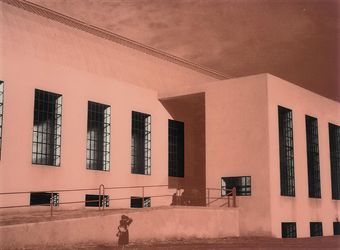
The top lot by High estimate is tied between two lots: lot 22, Laszlo Moholy-Nagy, Portrait Ellen Frank, 1929, and lot 560, Thomas Ruff, Ohne Titel (B. Junger), 1985 (image at right, top, via Lempertz), both estimated at €20000-25000.

Here's the list of photographers who are represented by three or more lots in the sales (with the number of lots in parentheses):

Joint Army Task Force One (12)
Thomas Struth (5)
Max Baur (4)
Bernd and Hilla Becher (4)
Gisele Freund (4)
Jörg Sasse (4)
Jan Saudek (4)
Ilse Bing (3)
Henri Cartier-Bresson (3)
William Klein (3)
Heinrich Kühn (3)
David LaChapelle (3)
Joel Meyerowitz (3)
Thomas Ruff (3)
Toni Schneiders (3)
Wolfgang Tillmans (3)
Weegee (3)

Other works of interest include lot 110, Jaroslav Rössler, Reflexionswinkel, 1960, estimated at €1500-2000 (image at right, middle, via Lempertz) and lot 196, Jörg Sasse, S-89-07-01. Giessen, 1989, estimated at €1200 (image at right, bottom, via Lempertz).

The complete lot by lot online catalogs can be found here (Photography) and here (Contemporary Art).

Photography
May 24th

Contemporary Art
May 24th

Kunsthaus Lempertz
Neumarkt 3
D-50667 Köln

Monday, May 13, 2013

Photography in the 2013 Frieze New York Art Fair, Part 1 of 5

In just two short years, Frieze has quickly become the gold standard for art fairs in New York. Its soaring white tent offers the best visitor experience by far, with an abundance of bright airy light and wider aisles that lessen the feeling of being cramped into an endless rabbit warren. While too much time in any fair can generate sensory fatigue, a wandering amble through the booths at Frieze is about as good as it gets for all-in-one smorgasbord fair going.

Photography-wise, Frieze offers an almost perfect foil to the AIPAD photography fair. While there isn't a single photography specialist booth on the map here, photographs are on display in abundance, with work on view from the top contemporary art galleries and lesser known venues from all over the world. For those interested in photography, Frieze becomes like a kind of treasure hunt, where each booth needs to be scoured for photographs that might be hiding somewhere. Since the photographs are not isolated out in a special section, they are seen in the messy, chaotic context of everything else that is going on in contemporary art, which provides some refreshing juxtapositions and unexpected visual connections. It's an energetic, exciting slice of the medium.

This report is divided into five sections of image highlights. I have consciously avoided selecting works that have recently been on view in New York gallery shows or that I have already reviewed in another context, instead opting for fresh images new to the market or surprising finds from the past. Gallery names/links are followed by the artist/photographer name, the price of the work (in a dizzying array of currencies), and some notes and comments as appropriate. The booths are organized in my path through the fair, beginning at the South entrance.

GB Agency (here): Robert Breer, $91500. This work was made up of Kodachrome film strips laid between sheets of Plexiglas. It's a jittering, almost blinking, series of fragments of Breer's paintings.


Freymond-Guth Fine Arts (here): Stefan Burger, $4500. Sculptural still life assemblages, with an echo of Elad Lassry's matchy-matchy colors and frames.


Victoria Miro (here): Alex Hartley, $30000. A diptych of rocky cave dwellings, with the surface of the print built up and carved out to provide selected areas of hand-crafted three dimensionality.


Galeria Fortes Vilaça (here): Mauro Restiffe, $2700. A layered geometric composition of wood inlay, wall molding, and linear white pipes.


303 Gallery (here): Collier Schorr, $26000. New work by Schorr, and no, I haven't mistakenly rotated the image - it's intensely vertical, almost like a crucifixion.


Galerie Mezzanin (here): Gerald Domenig, $7000. Conceptual exercises in formal balance and unexpected optical illusion.


Lisson Gallery (here): Richard Wentworth, £5500. A complex combination of found textures from his series of Occasional Geometries. Notice the print has been nailed to the supporting board (underneath a deep custom wood frame), giving it a more physical presence.


Galerie Martin Janda (here): Alessandro Balteo Yazbeck, $10500. A scanned book image, with areas of angled distortion and pixelized colored squares. This was the only piece of glitch photography I saw in the entire fair, which was a bit of a surprise.


David Zwirner (here): Thomas Ruff, $2800 each (open editions). This booth was a solo sampler of Thomas Ruff, with mini rooms of the new photograms and blurred nudes, and selected works from other parts of his career (substrat, mars, interiors, large portraits, etc.) hung on side walls. I continue to find his early 1980s portraits to be among his best work.


Alison Jacques Gallery (here): Birgit Jürgenssen, $60000. Feminist social critique with an edge of almost Surreal dark humor.


Continue to Part 2 here.

Friday, April 12, 2013

Thomas Ruff: photograms and ma.r.s. @Zwirner: A Review Conversation with Richard B. Woodward

JTF (just the facts): A total of 22 large scale color photographs, framed in black and unmatted, and hung in two pairs of large divided rooms and two smaller transitional spaces. All of the works are chromogenic prints, made between 2010 and 2013. The photograms are sized 95x73 and are available in editions of 4. The images from the ma.r.s. series (including the 3D images) are sized 100x73 and are available in editions of 3. A small selection of vintage work can be found in a side gallery. (Installation shots at right.)
 
Comments/Context: It is altogether fitting that in the wake of the recent death of film critic Roger Ebert that today’s review of Thomas Ruff’s new show at David Zwirner should take the form of a back and forth exchange between two arts writers. The format Ebert perfected with his longtime partner Gene Siskel offers the freedom to actively (and sometimes aggressively) exchange ideas in a casual, approachable atmosphere, without getting mired in dumbed down platitudes and boring background description. While their face-offs were great for the movies, the direct discussion format is also a terrific match for a lively, open-ended conversation about contemporary art.
 
Last year, Richard B. Woodward and I talked through Alec Soth’s newest show at Sean Kelly Gallery (here), and when I saw the Ruff show appear on the forward calendar, I knew it wouldn’t fail to give us plenty of fodder for another wide-ranging discussion. As a reminder, Rick contributes regularly to the Wall Street Journal, where he covers major museum shows of photography all over the US. His crisp, well-argued essays can also be found in scores of photobooks and exhibit catalogues going back several decades.
 
Happily, Rick agreed to join me for a discussion once again, and graciously allowed me the first bite at the apple.
 
DLK: The work in this show can quite easily be divided into three discrete groups (photograms, Mars images, and 3D Mars images), so I propose that we take each in turn and cover them as individual projects before we jump up and talk about the connections between them. I have to say from the outset that I think Ruff’s photograms are nothing short of revolutionary. They innovate in radical ways on at least three different aesthetic axes: the unprecedented scale/size, the painterly use of color, and the creation of richly nuanced overlapping layers. Add to that the development of the underlying technical mechanisms that made it all possible, and we’ve absolutely traveled somewhere we’ve never been before.
 
What I think is fascinating is that Ruff has found a way to stay observant of the traditions of the genre while at the same time exploding its previous boundaries. Looking up at his massive works (and you have to look up given their scale), I could still see the remnants of Schad, Moholy-Nagy, and Man Ray, but their foundation ideas have been transformed into something modern and machined. Enlarged to roughly 8 by 6 feet, typical photogram ovals, swirls, and silhouettes take on different characteristics, the intimacy of hand-crafted darkroom experimentation and simple chance traded for bold, expansive gestures and increased compositional complexity. They’re truly immersive in a way utterly different than photograms have ever been before.
 
RBW: I hadn’t thought about them as revolutionary in terms of scale, but you’re right. All the previous examples by 19th century pioneers William Henry Fox Talbot and Anna Atkins, as well as the modernists you mention, are quite a lot smaller.
 
About your other claims, though, I’m more dubious. First of all, they’re not photograms in the traditional sense. Those were unique prints created by the laws of chance in a darkroom. These are multiples (limited to editions of 4) created inside a computer. His process allows for a degree of serendipity dictated by the algorithms of his software program. But I’m assuming he knows pretty much how the image will look on the screen before he hits “print.”
 
Yes, they’re suavely handsome. Their illusory depths are soothing, like watching translucent jellyfish in an aquarium or a giant lava lamp. But they are ultimately decorative and nothing more, the sorts of photographs that would look spectacular at night on the walls of a rotating restaurant high above a city or in a Richard Neutra house.
 
They’re just abstract photographs, not unlike what a dozen other photographers have done (including the recent work of James Welling, to name another Zwirner artist), and I don’t think he should be allowed to call them photograms when, by our usual definition, they’re not. What's more, they’re only big because digital printers now can handle huge amounts of information that Man Ray’s enlarger couldn’t.
 
DLK: I think you make a fair definitional point about the word photogram, but to discount their connection to the history of the genre and simply call them abstractions is overly dismissive. I see the works as deeply rooted in the visual vocabulary of the photogram process, but Ruff’s innovative computerized approach has opened up some degrees of freedom that weren’t previously available. We’ve already touched on the scale, but I think there are several more ideas embedded in the pictures that are worth kicking around.
 
The first is simply the idea of introducing color into these compositions and the quality of the color that Ruff has chosen to employ. The icons of this genre had no ability to use color (except cyanotype), so all the early works, those made between the wars, and even those made in the decades that followed were all constrained by the high contrast white on black palette (or the reversed positive). While some layering and transparency was possible, it wasn’t easy to collapse more than a couple layers without everything turning into a muddle. Fast forward to the present and we find artists like Walead Beshty bringing bold color into the mix. But to my eye, this type of color has a bright, machined saturation that is different than what Ruff has developed here. Ruff’s color billows and diffuses, minutely shifting and washing across his compositions. And the perceived distance between “front” and ”back” seems larger to me, so there is more area to traverse and filter through, more dimensional space for shadows and halos to wander. It’s a soft, hazy, diaphanous color, seemingly mysterious and painterly even though it is entirely digital.
 
The second point I would make is that I think there is a meaningful conceptual change going on here. Previous photograms draw some of their power from their existence as Duchampian readymades and the immediate physicality of their presence as objects. Ruff has moved away from that tangibility and the direct connection to identifiable forms; those “laws” have been broken now that we are in the digital realm, even though some visual echoes remain. Seeing these huge prints, I’m less focused on the physicality of the original items or worried about trying to identify the jaunty silhouette of a tea strainer, and more interested in how the shapes have been broken down and reconnected. Perhaps, as you say, we are simply talking about abstraction now, but I can’t help looking back to the old way of thinking and seeing just how much Ruff has disrupted our foundation assumptions.
 
RBW: I’m not dismissing them as photographs--the “billows and diffuses,” to quote from your apt description, are lushly handsome--I just don’t think they are what they claim to be. Unpredictability is part of the charm and risk of a photogram by Schad or Man Ray. They didn’t know what kind of shadows and forms would suggest when they assembled mismatched crap--bits of hair and a comb and thumbtacks and netting--on a piece of photographic paper and exposed it to light. They were making one-offs and, like automatic writing and other surrealist experiments, sometimes the surprise was so much more than anyone could have anticipated that the gamble paid off. And sometimes the results were so clotted or literal that they were thrown out.
 
Ruff isn’t making one-offs. They’re not unique photographs. His software does the work and when it produces a set of whirling shapes he likes, he stops the process and prints as many as he (or his dealer) wants. He’s using his computer as an optical printer, the way many filmmakers and videographers have done before him. The associations created by the unexpected collisions in a great Man Ray were often funny. Ruff’s “photograms” lack a sense of humor, and the chaos he harnesses is safer for being entirely virtual and situated in the realm of mathematical algorithms, not those of a three-dimensional world of objects acted upon by time and gravity.
 
I also don’t see his use of color as innovative either. Color was integrated into the abstract photographs of Moholy-Nagy in the 1930s and ‘40s and Henry Holmes Smith in the 1950s. I think what Penelope Umbrico and Marco Breuer have done with abstract color and computers is more interesting that what Ruff is doing with his software program.
 
Or maybe I'm being too fussy about terminology. Ruff’s photographs aren’t much different from Welling’s recent series Fluid Dynamics, which were also sold by Zwirner as photograms. Or the Gerhard Richters at Marian Goodman last fall, computer samples of his abstract paintings—which were printed on photographic paper and even more outrageously sold as unique “paintings”!
 
DLK: I absolutely agree with your point about the lack of humor in these Ruff photograms. The whole Dada photogram subgenre (and its randomly clever juxtapositions) has been forgotten here, as has the more general appearance of spontaneity and serendipity. But I think that’s OK. At least in my own mind, I haven’t come to terms with how to think about “algorithmic chance” or the idea that the software is recreating uncertainty. I think this is an area where the technology is likely far ahead of the viewer, and I need to get better educated about how digital photographers are implementing chance and what it looks like in the end product, so that I can identify real innovation more readily.
 
Let’s move on to the Mars landscapes. I use the word landscape with some hesitation, as I still haven’t exactly come to grips with the fuzzy line between fact and fiction Ruff is walking in these pictures. While he has begun with authentic NASA footage, his cropping, compressing, and coloration move the final results pretty far away from documentation in my mind. It reminds me of a discussion I was having with another writer who was troubled by Michael Benson’s recent space images, mostly because it seemed like they were too close to the scientific “truth” and that his original artistic input was less visible. In this case, I think it is clear that Ruff has used the Mars images as raw material for his own flights of fancy, and that we shouldn’t be confused about being somewhere “real”. That said, the windblown dunes, the tactile crater pocked expanses, and the sandy eroded washes are undeniably texturally seductive.
 
While space always has the potential to astonish, I have to admit to being a little underwhelmed by many of these photographs, even with their imposing, otherworldly presence. Ultimately, I think the intellectual questions Ruff is raising about the boundaries of the landscape genre and way artists can digitally interpret the land (or space) are much more interesting than the images themselves.
 
RBW: I much preferred the Mars landscapes so I guess we are fulfilling the tetchy Ebert-Siskel roles you invoked in your introduction. Ruff’s decision to make photographic works of art by rephotographing images of a place that no human being has visited and that we have seen only in photographs struck me as wonderfully perverse—smart and amusing.
 
Unlike the photograms, there are solid, if ghostly, referents here that his own artistic interpretations can play against. I saw the works as not only commenting on the new worlds we are exploring with cameras attached to wheeled and tractor vehicles and orbiting telescopes but a wry salute to the Internet itself, as a place where objects float around without boundaries and swim into our view without our having much control, like the objects that appear in the night sky.
 
Taken together, though, the photograms and the Mars landscapes have a lot of geometry in common—and that may be the point he is making and one that I was too grumpy or obtuse to recognize in my earlier posts. The two bodies of work reinforce each other. That said, don’t you think that the “real” images that the Rover has beamed back to us from the Red Planet offer more to ponder and decipher than Ruff’s pictures?
 
DLK: I like that connection you’re making between space and the Internet. There is a certain poetry to seeing the Internet in that way.
 
The conceptual connection I see between the two bodies of work is something akin to an ongoing (some might say relentless) investigation of machine seeing, or perhaps another way to think about it is an incremental deconstruction of photography. If you page back through Ruff’s career with the benefit of hindsight, it all starts to fit together as part of a larger pattern, at least to my eyes. The cropped starry skies, the newspaper rephotographs, the green night vision images, the composite face portraits, the pixelated porn nudes, the JPEGs, even the zycles, they’re all exercises in technology mediated vision, or images coming from somewhere else and becoming source material for further experimentation and technical manipulation. I think the new photograms and Mars images fit into that overarching logic as well, and of the two, I personally find the photograms much more daring.
 
Since we haven’t touched on them yet, I think a few words are in order on the 3D images. For me, these were the weakest works on view, mostly because they seemed the most literal and obvious, even though we haven’t seen many photographers embrace the technology yet. I won’t dispute that there is a gee whiz factor at work when seeing these vertiginous Martian craters and spires (get up close and it feels like you’re really falling in), but I worry that their power to surprise us will be severely diminished in a decade or two. They don’t seem as inherently smart as the others, but I appreciate that Ruff is taking risks with the new tools and trying to figure out what they can and can’t do. The images seem a little more like a work in progress, a necessary intermediate step, or a set of ideas that haven’t yet converged exactly, a little like the first round of candy colored space images (Cassini) that now seem like a preface to the Mars work. And who, by the way, keeps 3D glasses handy for home viewing? Without them, the 3D prints are a headache inducing blur.
 
RBW: I liked the 3D photographs of craters. They reminded me of flowers blooming on the bottom of the ocean—and hokey, like all 3D. The attempt by media conglomerates to sell us on 3D movies and TV feels like an act of desperation: the best, if panicky, solution they can devise for now to compete with free streaming content from the Internet. As you say, not many collectors are going to keep glasses around for their guests to admire 3D anything on their walls. It’s a losing technology, like stereography in the 19th century. You’re too young to remember but in the 1970s some critics and dealers thought that holograms were going to replace photography as the “next big thing.” We know how that turned out.
 
You’re right that Ruff’s interest in this technology and computer-generated abstraction is part of a pattern and dovetails with his fascination with other mediated imagery. He is a brainy, wayward artist and I like that about him. A previous show of his is never predictive of his next one. Zwirner has a small room that contains examples of four groups of pictures: a starry night sky, a portrait head, a building, and JPEG porn. They could be the work of four different photographers.
 
DLK: In general, I think my overall takeaway from this show is more positive than yours. I walked out of the gallery convinced that Ruff continues to be one of the most compelling and challenging artists working in contemporary photography, and one that we ignore at our peril. Even if I might quibble with the durability of some of his end results, the behind–the-scenes thinking that has gone into his projects is consistently smart and perceptive. His view point continues to evolve as he plays through different sourced imagery variations, getting more complex and nuanced as he dives deeper. More than many of his well-known contemporaries, he’s always testing limits, enlarging our understanding of the medium. Yes, he’s brainy, and brilliant, and sometimes inscrutably obtuse, but that’s what makes his work so important.
 
I think these new photograms continue to blur the line between photography and computer-based art, and I think we’re just at the beginning of that ongoing combination. Ruff is no dummy; he’s going where the largest unexplored white space is in photography, and he’s aggressively starting to map the territory.
 
RBW: I agree that his willingness to go in new directions and not to stay in a critically proven or popular style is admirable. But I’m not sure what “peril” we risk if we don’t honor everything he does and regard some of these directions as dead ends. His subjects change but the underlying message doesn’t. I don’t see any strong or unforeseen connections between Internet porn and outer space—except that he happened upon these images on the Internet. The JPEG nudes were big and boring and he seemed to think they would be less boring by making them big—a common mistake of our age. Artists who work with found imagery had better tell me something new and provocative about mediation other than the obvious point, reiterated constantly in postmodern theory, that we’re living in a time when pictures and text often originate from an unknown source and arrive on our screens without an author etc. etc. It may be unjust to club one German artist with another, but I find the material Thomas Demand finds on the Internet, and what he does with it, much more unexpected and obsessively crazy—in a good way—than what Ruff does with the stuff he fishes out of the water.
 
I don’t think Ruff has done anything as finished as those first huge portraits of young good-looking European men and women. They were simple head shots but the quality of detail and light gave them a quivering presence. I wanted to know what might happen to those kids in 10 years. The pictures weren’t about their own construction i.e. not like Chuck Close’s giant heads. Ruff himself seemed engaged by what he was photographing instead of out to prove how alienated we are from the source reality of pictures. He needs to get off his computer for a year or so and go play outdoors.
 
Incidentally, I first saw those portraits in the late ‘80s, when he was represented by 303. The gallery was then located in Soho and one of my strongest memories of that show was the hilariously snooty attitude of the young woman behind the desk. I asked her where the photographs were taken. Instead of telling me that she didn’t know, she decided to put me in my place and in that blasé voice that New York and L.A. gallery assistants wield to intimidate visitors, she said, “I don’t think it matters.”
 
Is it any wonder that so many people loathe and fear the art world? Thank goodness, people who work in galleries seem generally friendlier today—at least they are at Zwirner. That’s been one of the few benefits of the recession and the growth of art fairs: galleries need us to stop by and keep them company.
 
Speaking of company, I’ve enjoyed yours, if only online. We should meet up soon at a bar in Chelsea and resume the conversation in person.
 
Collector's POV: The prints in this show (both the photograms and the images from the ma.r.s. series) are priced at $95000 each. Ruff's work has become consistently available in the secondary markets in the past decade, with plenty of prints up for sale in any given auction season. Prices have generally ranged from roughly $2000 (lesser known early works or large editions) to $150000. 
 
Rating: ** (two stars) VERY GOOD (rating system described here)
 
Transit Hub:
  • Interviews: Conscientious (here), Aperture (here)

Thomas Ruff: photograms and ma.r.s
Through April 27th
 
525 West 19th Street
New York, NY 10011

Thursday, June 23, 2011

Auction Results: Photographie, May 26, 2011 @Villa Grisebach

The results of the recent Photography sale at Villa Grisebach in Berlin were generally quite positive. With a the Buy-In rate just over 20% , a solid number of upside surprises, and Total Sale Proceeds that came in near the top of the estimate range, the sale performed well by most measures.

The summary statistics are below (all results include the buyer’s premium):

Total Lots: 190
Pre Sale Low Total Estimate: 492200€
Pre Sale High Total Estimate: 673500€
Total Lots Sold: 151
Total Lots Bought In: 39
Buy In %: 20.53%
Total Sale Proceeds: 643489€

Here is the breakdown (using the Low, Mid, and High definitions from the preview post, here):

Low Total Lots: 176
Low Sold: 139
Low Bought In: 37
Buy In %: 21.02%
Total Low Estimate: 442500€
Total Low Sold: 379969€

Mid Total Lots: 14
Mid Sold: 12
Mid Bought In: 2
Buy In %: 14.29%
Total Mid Estimate: 231000€
Total Mid Sold: 263520€

High Total Lots: 0
High Sold: NA
High Bought In: NA
Buy In %: NA
Total High Estimate: 0€
Total High Sold: NA

The top lot by High estimate was lot 1409, Oskar Schlemmer/Kurt Bryner, Zwei Alben mit Photographien der familie Schlemmer und Freunden, 1937-1940, at 25000-30000€; it sold for 29280€. The top outcome of the sale was lot 1434, Bernd and Hilla Becher, Forderturme, Schuylkill County, PA, USA, 9-teilige Photoarbeit, 1974-1978, at 70760€ (image at right, top, via Villa Grisebach)

95.36% of the lots that sold had proceeds in or above the estimate. There were a total of 12 surprises in this sale (defined as having proceeds of at least double the high estimate):

Lot 1310, Ilse Bing, Self Portrait, 1931/1996, at 7320€
Lot 1316, Bill Brandt, Nude, Baie des Anges, France, 1958/Later, at 3416€
Lot 1325, Robert Doisneau, Le manege de Monsieur Barre, Place de la Mairie, Paris, 1925/Later, 10370€
Lot 1428, Paul Wolff, Ohne Titel (Frankfurt am Main: Hute im Waldstadion), 1929 at 3172€
Lot 1429, Paul Wolff, Ohne Titel (Start zum Segelfliegen), 1933-1945, at 3660€
Lot 1430, Paul Wolff, Ohne Titel (Frankfurt am Main, Blick auf den Burgersteig von oben), 1933-1945, at 3904€ (image at right, bottom, via Villa Grisebach)
Lot 1432, Yva, Vornehmer hut aus blauer Seide mit doppelter, weisser Krempe und schwal aus gleichem Material. Modell: Gurau-Friedrich, 1932, at 3172€
Lot 1433, Yva, Den Schuh schmuckt die schnalle, den Fuss der...Strumpf, 1934-1938, at 3294€
Lot 1434, Bernd and Hilla Becher, Forderturme, Schuylkill County, PA, USA, 9-teilige Photoarbeit, 1974-1978, at 70760€ (image at right, top, via Villa Grisebach)
Lot 1462, Ken Probst, Tattooed Twins, San Diego, 1989/2001, at 4880€
Lot 1468, Thomas Ruff, Interieur 1D (Tegernsee) aus der Serie "Interieurs", 1982, at 3050€ (image at right, middle, via Villa Grisebach)
Lot 1476, Michael Schmidt, o.T., 1998, at 1708€

Complete lot by lot results can be found here.

Villa Grisebach Auktionen
Fasanenstraße 25
D-10719 Berlin

Tuesday, January 4, 2011

A Grab Bag of Holiday Photobooks

Over the holidays, I was lucky enough to receive a handful of photobooks, both old and new, as gifts. Rather than embark on full reviews for them all, I've added a few thoughts and reactions to each below:


Thomas Ruff, Surfaces, Depths, Kunstahalle Wien, 2009.
.
I first saw this book on a display shelf at David Zwirner, during Ruff's show there last spring (review here). What is striking about this book is that although it is bound like a regular retrospective catalogue, inside it is printed on newsprint, giving the pages a more fragile feel. This presentation totally recontextualizes many of his older projects, especially those that appropriate black and white imagery. The book is the first place I have found that publishes his new Cassini and Zycles works, and it also includes stereo photographs, interiors, newspaper images, and "portraits" of Herzog & De Meuron buildings that I had never seen before. All in, an unexpectedly terrific addition to the discussion of Ruff's work.
.
Barbara Crane: Chicago Loop, LaSalle Bank, N.A., 2001. (here)
.
Kim Bourus of Higher Pictures (which represents Crane) showed me this book a year or so ago, and I have been wanting a copy for our library ever since. It gathers together a group of black and white images that Crane made of the Chicago Loop between 1976 and 1978, and the works could hardly be a better fit for our particular collecting affinities. Each is a textural mix of geometric layers, where grids of windows and edges of skyscrapers are deftly juxtaposed and flattened into intricate patterns and abstractions. It's a spectacular exercise in compositional control.
.
Irving Penn, Still Life, Bullfinch Press, 2001.
.
I'm not exactly sure why we've never acquired a copy of this Penn standard, but I was nevertheless glad to see it emerge from under the tree on Christmas morning. I was most excited to see some of the less familiar images that are mixed in among the greatest hits, and for the first time, I started to understand Penn's still life work within a stronger sense of chronology, starting in the late 1940s and moving back and forth between commercial and more personal work through the decades.
.
William Abranowicz, Hellas, Hudson Hills Press, 2010.
.
Abranowicz' new images of modern Greece are filled with warmth and affection. Elderly men and women tend goats and sheep or idle in the streets and cafes, while still lifes of fish and tomatoes pop with mouth-watering exuberance. The enveloping blue of the Mediterranean is rarely far from view, and cloudless skies range from washed out pastel to almost purple. What keeps these pictures from becoming a travel brochure is their subtle mixing of the modern and ancient: religious icons, church spires and island landscapes are juxtaposed with kisses on the beach in Mykonos, tourist postcards, and active nightlife. The story keeps shifting, with moments of subtle realism poking through the veil of obvious expectations.

Thursday, September 9, 2010

Auction: Post-War and Contemporary Art, September 16, 2010 @Christie's South Kensington

The upcoming Post-War and Contemporary Art sale at Christie's South Kensington office in London marks the opening of the second half of the auction year for photography, and can be thought of as a warm-up for the heavier action which will take place later in October and November. Mixed in with works from a variety of other mediums, there are a total of 46 lots of photography on offer in this auction, with a Total High Estimate of £337700.

Here's the statistical breakdown:
.
Total Low Lots (high estimate up to and including £5000): 27
Total Low Estimate (sum of high estimates of Low lots): £83700
.
Total Mid Lots (high estimate between £5000 and £25000): 16
Total Mid Estimate: £144000
.
Total High Lots (high estimate above £25000): 3
Total High Estimate: £110000
.
The top lot by High estimate is lot 160, David LaChapelle, Deluge: Museum, 2007, at £35000-45000. (Image at right, top, via Christie's.) The next highest lot by High estimate is lot 14, Thomas Ruff, m. d. p. n. 28, 2003, at £25000-35000. (Image at right, via Christie's.)

Here is the list of the photographers who are represented by two or more lots in the sale (with the number of lots in parentheses):

Nobuyoshi Araki (6)
Garry Fabian Miller (3)
Cindy Sherman (3)
Richard Artschwager (2)
Zarina Bhimji (2)
John Coplans (2)
Elger Esser (2)
Robert Mapplethorpe (2)
Thomas Ruff (2)
Andy Warhol (2)

The complete lot by lot catalog can be found here. The eCatalogue is located here.


Christie's
85 Old Brompton Road
London SW7 3LD

Tuesday, May 18, 2010

Auction: Photographs, May 20, 2010 @Bonhams London

Following up on its New York Photographs sale earlier in the week, Bonhams has scheduled a twin Photographs auction in London for this coming Thursday. This sale has primarily lower end and lesser known material, with a healthy mix of British photographers. Overall, there are a total of 137 lots on offer, with a Total High Estimate of £490400. (Catalog cover at right, via Bonhams.)

Here's the statistical breakdown:

Total Low Lots (high estimate up to and including £5000): 109
Total Low Estimate (sum of high estimates of Low lots): £219400

Total Mid Lots (high estimate between £5000 and £25000): 27
Total Mid Estimate: £236000

Total High Lots (high estimate above £25000): 1
Total High Estimate: £35000

The top lot by High estimate is lot 125, Thomas Ruff, Porträt (V. Liebermann), 1998, at £25000-35000. (Image at right, via Bonhams.)

Here is the list of the photographers who are represented by three or more lots in the sale (with the number of lots in parentheses):

Horst P. Horst (9)
Thurston Hopkins (6)
Nobuyoshi Araki (5)
Ken Griffiths (5)
O. Winston Link (5)
Wolfgang Suschitzky (5)
Brassaï (4)
Norman Parkinson (4)
Grace Robertson (4)
Sebastião Salgado (4)
Jock Sturges (4)
André Villers (4)
Andy Warhol (4)
David Bailey (3)
Lillian Bassman (3)
Terence Donovan (3)
Mario Giacomelli (3)

The complete lot by lot catalog can be found here.
May 20th

Bonhams
101 New Bond Street
London W1S 1SR

Friday, March 5, 2010

Photography at the 2010 Armory, Part 2 of 6

Part 1 of this multi-part Armory review post can be found here. This post refers to the first section of the longest hall of Pier 94.

Lisson Gallery (here): Rodney Graham (1 lightbox)

Victoria Miro (here): Isaac Julien (1 diptych), Francesca Woodman (2), Idris Khan (1), Thomas Demand (1)

David Zwirner (here): The entire David Zwirner booth is dedicated to the work of Philip-Lorca DiCorcia. There are 8 large images on the exterior of the booth, 7 more images in the back room, and 100 small Polaroids resting on a metal ledge surrounding the interior of the main space. These are different works from images of a similar size and display (Thousand) shown at David Zwirner previously. Unlike that body of work (available only as one set), these images are being sold individually for $4000 each. The larger works are a selection of well known work (strippers, heads, interior portraits etc.), with some newer larger landscapes with small figures.

Murray Guy (here): Moyra Davey (11), Barbara Probst (4)

Galleria Raffaella Cortese (here): Anna Maria Maiolino (2), Marcelllo Maloberti (2)

Alison Jacques Gallery (here): Hannah Wilke (4), Ana Mendieta (1)

Tanya Bonakdar Gallery (here): Olafur Eliasson (1 group of 12 prints), Tomas Saraceno (1 group of 6 prints)

Andréhn-Schiptjenko (here): Anna Kleberg (1 group of 9 images)

Carolina Nitsch (here): Alyson Shotz (1 set of 6 prints). These works were constructed by taking a group of metallic silver balls of different sizes (the same ones used in Shotz' sculptures), laying them on a film of mylar, and using a strong magnet to draw the metal balls to the center. The result is a collection of reflective objects on a puckered surface, full of abstract refractions and reflections. The group of prints is priced together at $9000.

Rhona Hoffman Gallery (here): Luis Gispert (1)

Galerie Krinzinger (here): Frank Thiel (1), Chris Burden (1), Rudolf Schwartzkogler (2), Hans Op de Beek (2 lightboxes)

White Cube (here): Gilbert & George (1 multipanel work), Darren Almond (2)

Lehmann Maupin (here): Mickalene Thomas (1 image, 1 montage with layers of frames)

Kukje Gallery (here): Hein-Kuhn Oh (2), Yeondoo Jung (1), Kira Kim (1)

Galleria Lia Rumma (here): Thomas Ruff (3), Mimmo Jodice (1), Vanessa Beecroft (5), Marina Abramovic (1), Alfredo Jaar (1). The image at right is from Thomas Ruff's JPEG series. I enjoyed seeing this up close, as the pixelization is more layered than I imagined; large boxes dissolve into grids of smaller boxes. This is particularly noticeable in this image, given its sharp areas of black and white. The print is priced at 85000€.

Galerie Thaddaeus Ropac (here): Robert Mapplethorpe (6 Lisa Lyon images), Terrence Koh (2)

Galleria Continua (here): Carlos Garaicoa (1 triptych), Shilpa Gupta (3)

Boers-Li Gallery (here): Liang Yuanwei (6 groups of images)

Continue to Part 3 here.

Wednesday, March 3, 2010

Thomas Ruff @David Zwirner

JTF (just the facts): A total of 18 color works, hung in a series of three interconnected gallery spaces. The show is comprised of images from two different projects (cassini and zycles) both executed in 2009. The 9 cassini images are all chromogenic prints, framed in brown wood and matted, and printed in editions of 6. For the most part, these prints are approximately 43x43 square, with some small variations in size from image to image. The 9 zycles works are either chromogenic prints or pigment prints on canvas. The 5 c-prints are face mounted to Plexi (making them very glossy), framed in brown wood and not matted, and printed in editions of 4. These prints are all approximately 73x73 square. The 4 paintings are framed in brown wood and made in editions of 3. Most of these works are approximately 101x81; one is 101x101 square. (Installation shots at right.)

Comments/Context: A common way to read the broad history of photography is to see it as a long series of technical inventions, the artistic wave being driven forward by the varied responses photographers have had to the availability of new tools. At every fork in the endless technology road, photographers have taken one of two divergent paths: using the tools to explore risky new frontiers, or using them to build upon what has come before, but with new twists and capabilities. At one end of the spectrum, we have disruptive innovation (which often fails, but generates radical change when it succeeds), and at the other, something altogether more incremental (which is generally much safer).
.
Thomas Ruff has been out on the bleeding edge, exploring the boundary lands of the contemporary photographic medium for the better part of the past thirty years. Starting with his experiments with large scale back in the 1980s, he has since tested a wide variety of visual and theoretical approaches: appropriation, stereo imaging, superimposition, blurring, and night vision, expanding these ideas using recent digital and computer-based systems, and adding in new concepts like Internet-based imagery, pixelization, and compression algorithms and artifacts. As the technology has changed, he has always looked forward, trying to think his way through the intellectual thicket of what these new approaches might mean for photographic image making. Underneath it all, there has been a constant objectivity, a search for the underlying structure of photography.
.
Ruff's newest work has almost entirely escaped from any traditional definition of the medium. In his cassini series, Ruff has appropriated black and white digital feed images of Saturn and its moons from NASA and transformed them into pictures that go beyond the scientific, into a realm of indefinite lyricism. Ruff has heavily processed the raw images: adding layers of color, cropping the pictures down to simple orbs, dense all-over cloud banks or slashes of line and curvature, and controlling the pixelization with precision to create up-close pointillism. The effect of all this modification is a feeling of otherworldly grace and elegance. But what struck me in these works was not their decorative quality, but the conceptual questions underneath: a stream of bits radioed back from the far reaches of our galaxy has now been manipulated and converted into a new physical art object hanging in a white cube gallery - which part of that is photography? And what might it foretell about where we go next?
.
I think the answer to these questions comes in the form of the companion works from Ruff's series zycles. In these images, Ruff has captured three-dimensional mathematical curves (based on cycloids) that spiral and intersect in layers of line and volume. The swirling patterns have been toned neon purple or bright yellow against opaque black backgrounds; the patterns jump out from the darkness with musical intensity (close-up detail images at right; the one above is unfortunately quite reflected by the Plexi). What's important here is that Ruff has abandoned the camera entirely - these are computer-generated visual manifestations of the inherent beauty of mathematical algorithms. The fact that the final art object is a photograph, or even a painting, seems irrelevant. Ruff has used the digital technology to get beyond photographs of "things" to explore pictures of abstract functions, expressions, or even computer code. As such, while these works might be visually reminiscent of Op Art, Minimalism, or even computer screen savers, these works seem to be a logical extension of the artist's effort to peel back the layers of photography to its inner technological core; the underlying structure of the medium is being revealed by the newest wave of tools, and Ruff is grasping for ways to expand the art-making capabilities of these exposed foundations.
.
On the surface, you may wander through these galleries and find these works pleasingly scientific and coolly intellectual, but I think this misses the importance of this show. These works are not attempts to recreate past masters using digital technology; they are not newfangled riffs of Wall, Sherman, Sternfeld, Eggleston or whoever else we might currently admire. Ruff is out in the hinterland, trying the to find the path to the future. One way forward is via the computer (this has become obvious), and he's already neck deep in his explorations. While these newest documents of his travels may not be thoroughly exciting as endpoints, they are likely a bridge to somewhere we haven't been before. As such, the reason to see this show is less about these specific works, but because the show signals a schism coming soon, a rupturing of what we call photography and the birth (or rebirth) of something that draws on the traditions of all the visual media, but manifests itself in the world of the computer.
.
Collector's POV: The works in this show are priced as follows:
  • cassini chromogenic prints: $30000 each
  • zycles chromogenic prints: $90000 each
  • zycles pigment prints on canvas: $120000 each
Ruff's work has become widely available in the secondary markets in the past decade, with many prints up for sale in any given auction season. Prices have generally ranged from $2000 (lesser known early works, or large editions) to $150000, with a sweet spot between $20000 and $60000.

Rating: ** (two stars) VERY GOOD (rating system described here)
.
Transit Hub:
  • Lecture @Aperture, 2010 (complete videos here)
  • Surfaces, Depths @Kunsthalle Wien, 2009 (here)
  • Review: Art Observed (here)
Through March 13th
.
David Zwirner
533 West 19th Street
New York, NY 10011

Wednesday, February 3, 2010

Book: The Düsseldorf School of Photography, Stefan Gronert (ed.)

JTF (just the facts): Published in 2010 by Aperture (here). 320 pages, with 162 color and black and white images by 11 different photographers. Includes a foreword by Lothar Schirmer, an essay by Stefan Gronert, and summary biographies, exhibition lists and bibliographies for each of the artists. The German version of the book is being published by Schirmer/Mosel (here). (Cover shot at right, via Amazon.)

The photographers included/discussed are:

Bernd & Hilla Becher
Laurenz Berges
Elger Esser
Andreas Gursky
Candida Höfer
Axel Hütte
Simone Nieweg
Thomas Ruff
Jörg Sasse
Thomas Struth
Petra Wunderlich

Comments/Context: The Düsseldorf school of photography is probably the largest topic in contemporary photography that has yet to receive the kind of in-depth scholarly treatment we would expect for such an important and influential artistic movement. While I'm sure there have been quite a few masters and Ph.D. theses that have been written about the Bechers and their students, until the publication of this book, there have been effectively no survey style volumes brought to market with the broader public in mind. Given the many monographs and exhibition catalogues that have been written about these photographers individually, the gathering of a representative sample of the various artists' work is the lesser of the challenges here; the real test falls to the essay and how coherently and insightfully it ties together what heretofore have been generally separate but parallel narratives. We have all been searching for someone to help connect the dots and fill in the gaps; I'm happy to report that this book is certainly a good start.

One important semantic definition is required before we get to the analysis: what is it we mean by the term the "school"? In general, I think there are two possible answers as applied to artistic movements: the narrow - the education derived from a specific set of teachings/learnings (i.e. the how/what of the curriculum at the Düsseldorf Kunstakademie or the Yale School of Art and how it was absorbed by specific students), and the broad - the larger geographic and temporal phenomenon (i.e. Düsseldorf or Helsinki as the umbrella term for a common style of working).

This volume (and its keystone essay) has chosen to focus on the Düsseldorf school in the broad sense, looking for the larger commonalities seen in its most successful and best known adherents. It lays at the feet of the Bechers the "emancipation of photography": the critical artistic mindset that photography was fully equal to painting, the results of which are embodied in the downstream success of the students who wholeheartedly embraced this unorthodox-at-the-time concept. It also implies an amorphous teaching by osmosis approach, where the Bechers were effectively leading by example: off doing their own highly stringent and objective documentary work, using the series and typology as modes for working and comparison, all underneath a rigid conceptual framework, with the students watching and absorbing some or all of what they saw as they saw fit. The narrative is thus one of commonality rather than causation: the students all started from a generally similar location; as they grew and matured as artists and selectively incorporated the Bechers' teachings over time, they went off in different but often parallel directions.

While there are some anecdotal comparisons and back and forth between the artists, in general, the book follows each photographer down his or her own particular evolutionary path, often starting prior to their involvement with the Bechers, and running to the present, now decades after the teacher/student relationship has ended. Each photographer gets a short biographical analysis, often through the lens of the Düsseldorf similarities. We see some exploring the limits of conceptual ideas (Ruff, Hütte, Esser, Struth, Sasse), while others have consistently worked in subject matter based series (Höfer, Wunderlich, Nieweg, Struth); over time, many have experimented with the use of large formats and prints (Höfer, Hütte, Nieweg, Struth, Berges, Ruff, Esser, Gursky). The challenge here is that most of these artists have worked through a handful of different projects over their careers to date, moving back and forth between working styles and approaches - the Düsseldorf narrative is therefore circular and cyclical rather than strictly linear, the Bechers' influence waxing and waning as the artists continually evolve and reinvent themselves.

As such, the story of the Düsseldorf school is not nearly as neat and tidy as one might expect from the rigid Germans; the Bechers put down some foundation concepts, but their students have long since moved beyond those initial ideas. Perhaps it is the mark of great teachers that they imparted their wisdom and experience about successful methods for discovering one's artistic voice through photography, without imposing their own specific vision too strongly.

While this book provides the satisfying summary and overview I have outlined, I found myself still wishing for more specifics; perhaps the next scholarly book on the Düsseldorf school needs to limit its scope to the period when the photographers were actually studying with the Bechers, and needs to cover in more detail how the curriculum was embodied in the early pictures. I'd also like to see more work from a broader range of the students (not just the "winners") to see how the teachings got applied in different ways. Similarly, I think some commentary from the artists themselves on what they took away from the Becher experience would be enlightening. Clearly, all of these photographers have long since moved beyond their early education, but I for one would be interested to hear what if anything they still find of value.

Overall, this book fills a gaping hole in the history of photography. It provides a well-selected sampler of the work of the best known members of the Düsseldorf school and offers a readable explanation of how it all fits together. While I have an insatiable appetite for more on this group of photographers, this volume certainly delivers a solid and thoughtful introduction to one of the most important movements in contemporary photography.

Collector’s POV: In many ways, there isn't much "new" information to be found in this book on the best known photographers in the group. It was therefore the sections on Petra Wunderlich, Simone Nieweg, Jörg Sasse, and Laurenz Berges that were the eye openers for me, in terms of exposing me more fully to some of the other students who are a little further out of spotlight. I also think the essay was helpful in clarifying my rudimentary understanding of the evolution of both Axel Hütte and Elger Esser, neither of which I have felt particularly comfortable with in the past.

Transit Hub:
  • Review: Conscientious (here)