Showing posts with label Steidl. Show all posts

Monday, June 17, 2013

Tom Wood, Men and Women @Erben

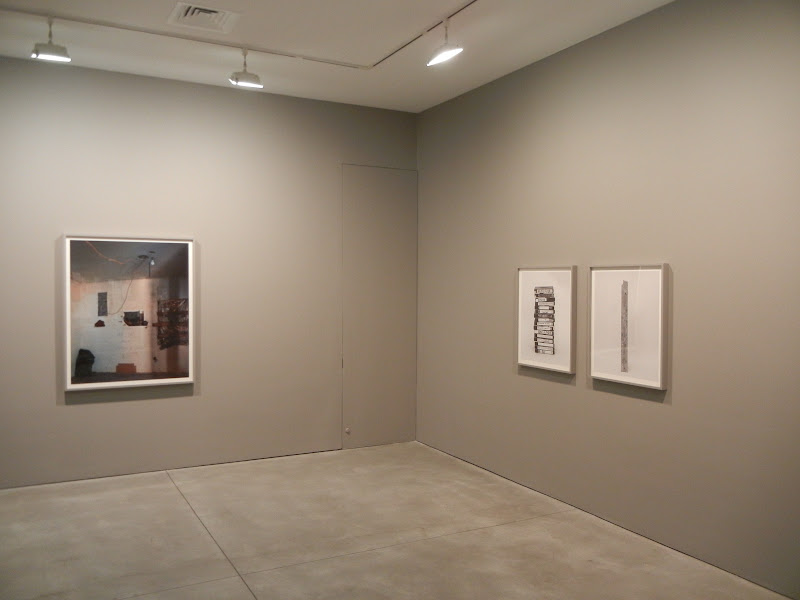
JTF (just the facts): A total of 36 color photographs, framed in white and unmatted, and hung against white walls in the single room gallery space. The works on view are a mix of gelatin silver and c-prints, taken between 1975 and 2012. All of the prints come in three sizes: 12x16, 16x24, and 24x35 (there is one outlier print sized 15x15), in aggregate editions of 7+2AP (a few prints are available in editions of 12+1AP or 15+1AP). Apparently, a monograph of Men and Women will be released by Steidl later this year (here). (Installation shots at right.)

Comments/Context: The British photographer Tom Wood is having a bit of a revival of late. With a recent series of gallery shows and museum retrospectives in the UK and Europe and a new book coming from Steidl, Wood is being more clearly recognized as one the early pioneers of British color (along with Paul Graham and Martin Parr). This broad show brings together work from the better part of thirty years, providing ample evidence for Wood's eye for color as well as his consistent interest in the everyday lives of the inhabitants of New Brighton, just across the river Mersey from Liverpool.

It's clear from the works on view here that not only was Wood making color pictures as early as the mid 1970s, there are plenty of examples where color was the driving force behind his compositional decisions: an older woman peers out from behind a lace curtain door window, framed by the bright blue bars of stained glass, the "mother of the cleverest boy in England" wears a bright orange blazer that is exactly matched by the poster board behind her, and two sassy young women with feathered hair perch provocatively on the hood of a shiny red car, with the back end of a lemon yellow trunk intruding from the side. Wall colors, subway tiles, matching shirts, an orange coat here, some red pants there, color was clearly a integral part of how Wood was seeing and framing his surroundings.

Wood also had a street photographer's eye for the serendipitous moment. He captures a whisper between girlfriends, an illicit handoff between street corner hustlers, and a man pointing to his chin in the pub, presumably remembering where he was punched in the face. Fleeting tender gestures abound: a boy touches his father's hair, a mother shelters her child underneath her white sweater, and a woman takes a summertime rest in the heather. Wood alternates between an energetic snapshot aesthetic and something slower and more formal, nimbly matching his methods to the circumstances on the ground.

Part of what makes these photographs so successful is their relaxed ease; Wood was clearly a known quantity in his community and his subjects were comfortable with his camera. That he could move easily from shirtless lads in the streets to old women with their shopping bags and capture the swagger of one and the weary shuffle of the other shows his breadth as careful observer. This show makes a quietly compelling case for Wood's rediscovery, reestablishing his position in the larger sweep of recent British photography.

Collector's POV: The works in this show are priced based on size. The 12x16 prints are $2400 each, the 16x24 prints are $3000 each, and the 24x35 prints are $4200 each.  Wood's prints have been inconsistently available in the secondary markets in recent years. Prices for those lots that have come up for sale have ranged from roughly $1000 to $4000.

Rating: * (one star) GOOD (rating system described here)

Transit Hub:
  • Features/Reviews: New Yorker (here)
  • The Photographers' Gallery, 2012 (here)

Tom Wood, Men and Women
Through July 12th

Thomas Erben Gallery
526 West 26th Street
New York, NY 10001

Monday, April 9, 2012

August Sander/Boris Mikhailov: German Portraits @Pace MacGill

JTF (just the facts): A total of 23 black and white and color photographs, hung against grey walls in the main rooms of the gallery. All of the works by August Sander (11 prints in total) are gelatin silver prints hinged to board, framed in blond wood, and taken between 1924 and 1943. Each image is sized roughly 10x7, in an edition of 12. All of the works by Boris Mikhailov (12 prints in total) are archival pigment prints mounted to Sintra, framed in white, and taken in 2008. Each image is sized 29x20, in an edition of 5. A monograph of Mikhailov's body of work, Maquette Braunschweig, was published by Steidl in 2009 (here). There is no photography allowed in the gallery, so the installation shots at right are via the Pace/MacGill website.

Comments/Context: The pairing of contemporary portrait photography with the work of August Sander has now become a kind of subculture of exhibition all its own. Given Sander's wide ranging influence in the genre, showing paired juxtapositions of old and new offers an opportunity to set a baseline and provide aesthetic comparisons. Using Sander's formal portraits as a kind of gold standard, these exhibits both reinforce Sander's importance, and provide visual connections across photographic history.
.
Sander's foil in this show is Ukranian photographer Boris Mikhailov, and the pairing is particularly apt since Mikhailov just did a recent series of portraits of German citizens from the town of Braunschweig. So not only are their stylistic parallels to discover, but their are also social and cultural angles to be explored, separated by 70 years. The selection of Sander images has been meticulously edited and hung, placing like poses and profiles in small groups, rigidly reinforcing commonality and repetition in the gestures and looks.
.
Mikhailov's newer portraits are even more strict in their composition: crisp head shot profiles against deep black backgrounds. This approach accents the line of the profile, and the details of chins, noses and foreheads become more prominent, like a figure and ground illusion. Mikhailov's portraits take Sander's idea of the subject who is both an individual and a type to its logical extreme, where images of the men and women show quirks of hair style, skin, personality and genetics, while seeming anthropologically scientific at the same time. The portraits are simultaneously wholly contemporary and unabashedly classic, connecting to Ruff's deadpan frontal portraits from the late 1980s and Old Masters paintings with equal power.
.
In general, this is a thoughtful, subdued pairing, which to some degree mutes in the freshness of Mikhailov's works. This duet highlights ties to the past, reinforcing historical links and echoes, where a more contemporary pairing might have given the Mihkailov portraits a more radical frame. Regardless, it's a refreshingly solid one two punch of German portraiture.
.
Collector's POV: The photographs in this show are priced at as follows. The Sander prints are $4500 each. Sander's photographs are widely available in the secondary markets, including portraits, landscapes, and later prints/portfolios made by both Gunther and Gerd Sander. As a result, prices vary widely, from as little as $1000 for lesser known images to more than $100000 for iconic vintage portraits. The Mikhailov prints are $7500 each. Mikhailov's work has only been sparsely available at auction; prices have ranged between roughly $3000 and $30000, but the number of lots up for sale has been small. As a result, gallery retail may still be the best option for those collectors interested in his work.
.
Rating: * (one star) GOOD (rating system described here)
.
Transit Hub: 
  • Exhibit: August Sander: People of the Twentieth Century @Getty, 2008 (here)
  • Mikhailov Feature: Deutsche Bank ArtMag (here)
Through March 5th

32 East 57th Street
New York, NY 10022

Wednesday, February 15, 2012

Alec Soth, Broken Manual @Kelly: A Review Conversation with Richard B. Woodward

Rather than following my normal format, today’s review of Alec Soth’s new show at Sean Kelly will once again take the form of a casual, but hopefully thoughtful, conversation. Regular readers might remember that I experimented with this collaborative approach in a recent review of the Jeff Wall show at Marian Goodman (here), where I went back and forth with longtime photo critic AD Coleman. As a reminder, this structure has no pre-sets – it’s an open ended discussion that leads wherever the ideas might take us.

I’m happy to say that Richard B. Woodward has decided to join me for today’s conversation. Woodward is an arts critic who contributes regularly to the Wall Street Journal, where he often covers major museum shows of photography from around the US, normally in longer format reviews containing a mix of historical background and artistic explication. His writing is also easily found in any number of photo books and exhibit catalogues from the past decade or two, where his essays provide lucid context and critical interpretation. I’m overjoyed to have lured him away from the tactile pleasures of the printed page and into the freewheeling online realm, at least for the moment.

DLK: I have to admit up front that I didn’t come into this show completely cold. Like many other collectors I’m sure, I had seen several prints from this series in the Weinstein Gallery booth at last year’s AIPAD and had also encountered a number of reproductions in the exhibition catalog from Soth’s retrospective at the Walker Art Center in 2010, so at some level, I knew what I was in for before I arrived. But with that caveat, I will say that I most certainly got a fuller experience of the work in this gallery show than I had previously felt.

My first reaction was at some level less about the photographs themselves as individual works (we’ll get to that in a moment I’m sure) and more about the overall mood that they create in tandem. To me, Broken Manual is an obvious progression from and intensification of the atmosphere of The Last Days of W (Soth’s previous project). We’ve clearly moved on from exhaustion (in many forms), political cynicism, tempered anger, and angst to something altogether more desperate and personal. While there is of course something action oriented about the desire to flee and disappear, I felt the heavy weight of powerlessness in this show. It’s as if these people (all men that I could see) have banged their heads against the metaphorical wall for so long (without anyone listening) that they have finally given up and retreated to the margins and wastelands of America. Whether they’re hermits, survivalists, hippies, government haters, conspiracy theorists or just plain crazy (by some definition), they’re living in a roughly similar emotional landscape, and Soth seems to have found a sense of deep empathy for parts of what made these men want to be alone. So my point is that the pictures are really capturing an abstract state of mind, and any particular authentic reality in the photographs is just a symbol of that frustrated psychological atmosphere.

RBW: I appreciate your asking me to trade fours with you on the bandstand in your club. I’m new and somewhat averse to on-line media (I don’t even have a Facebook page) but your blog is among the few that I regularly read, both to catch myself up on shows I’ve missed (you see everything) and to compare my reactions to your intelligent takes.

Like you, I had seen this body of Soth’s work before. I saw his retrospective last year at the Walker Art Center in Minneapolis, his home town, and Broken Manual was installed as part of that. The selection was, if I remember, somewhat larger but also presented in a subdued, grayish atmosphere. There were probably 10 pictures from the series in the catalog, From Here to There: Alec Soth’s America, that aren’t here.

I like this version better. It is, as you say, a deepening and a concentration of the glib and cynical tone in The Last Days of W and it’s also a logical progression from Sleeping by the Mississippi. The mood here is more crushingly sad than at the Walker. (I’ll see if I can explain why later.) We can talk in another exchange about his techniques for treating people who are not as economically advantaged or emotionally stable as he is, how he has earned their trust and whether or not you think he has betrayed it, and whether or not that’s inevitable.

But his choice to focus on men who choose to live apart from American society was smart and full of photographic possibilities. As types, they populate both our 19th century history (the Western prospector, the crazy hermit, persecuted religious sects such as the Mormons, various utopian communards) and our tabloid culture of paranoid loners and political lunatics. There was Eric Rudolph who blew up abortion clinics and attacked the Atlanta Olympic Games and went on to survive in the North Carolina woods for years. And, of course, there was “Unabomber” Ted Kaczynski who is alluded to a couple of times in the show.

Soth is one of the most thoughtful photographers around, a guy who is always wrestling with the question of where to stand in relation to his subjects and how to keep the documentary tradition vital so that he can poke his nose where it doesn’t belong and still have a clear conscience. I wonder if you felt, as I did, that one of the strengths of the show is that one feels Soth is tempted by the idea of abandoning his life as a dutiful Magnum member and breadwinner in order to go off and live in a cave. He’s trying to empathize with these men, even a skinhead neo-Nazi, and, like Arbus, he keeps asking himself, “hmm, what would happen to me if?” He sees the appeal of getting away from home, and working. In fact, that’s what he’s doing here. How different is a photographer on the road from a guy holed up in the desert? Being both inside and outside is always a hard act to pull off. How do you think he succeeds at that?

DLK: Watching parts of the documentary running in the darkened side room made me conclude that Soth got the balance generally right, not too far in (thereby losing a sense of wider perspective), and not too far apart (with the danger of a smug mocking eye). The trust he built with his subjects seems to have been easy going and genuine. That said, the installation of ephemera in the first room wouldn’t look as manic and serial killer crazy as it does unless Soth had become somewhat fascinated by the whole culture he was exploring; I don’t want to speculate on exactly how far he was drawn in, but I think he imbibed enough of the kool aid to at least intellectually understand some of the motivations. I thought some of the best moments in the film are when nothing happens, and Soth is wandering frustrated in search of something or someone he can’t seem to find; the project takes a more obsessive tone at that point, which seems somehow appropriate for the subject matter. I do agree that Soth’s overall commitment to and engagement with “disappearing” makes these pictures more successful than they would have been at arm’s length.

The only image in the whole show that I think comes to close to the exploitation line is the portrait of the tanned, naked man standing in the water lily pond (the titles of these images are universally unhelpful for identification purposes). I actually think this is a very powerful image (especially printed as large as it is), juxtaposing the swastika tattoo and Garden of Eden setting, but I do wonder a bit about the coaxing that occurred to get this shot. Of course, I don’t know the back story to the photograph, but it seems pretty unlikely to me that the man came up with standing naked in the pond all by himself. That isn’t to say that he wasn’t a willing participant; on the contrary, I think he probably was, and the starved for attention quality that many of the men have is an important and unexpected discovery that Soth makes in these pictures. While the other portraits in the show are of course somewhat posed (he’s using a large format camera after all), this is the only one that seemed a bit unnatural to me. But maybe that risk taking (by both sides) is what makes it more memorable.

RBW: I think the project is rife with exploitation, as is any project with a gross imbalance of power between photographer and subject. And most projects are! That’s the nature of photography. The opening for the show at Sean Kelly was packed with friends of Soth and other photographers who were a world apart from the subjects in the pictures. I wonder if any of the lost souls featured here has seen the work and, if they have, I’d be curious what they thought of it. I doubt any of them would be too upset. Even the fellow standing naked in the water, with shaved head and swastika tattoo, seems proud of himself and would be probably be OK with seeing himself on the walls of a Chelsea gallery.

One of the many things I like about Broken Manual is that Soth has recognized this problem of the portrayer and the portrayed, and his photographs reflect that. There is a blurry portrait that suggests it was taken with a long lens, as though these are men of whom we are slightly afraid and who are slightly afraid of us. There’s a surveillance quality to the picture. Or it could indicate an early phase of his getting to know these guys: he could only see them from afar, stalking them in the woods as though they were Bigfoot. Other pictures, including the one you cite, and another of a bearded man sleeping, show a much greater degree of trust.

He has approached these men as if he were an anthropologist. He reveals not only their portraits but their abodes, reading matter, tools (including a sex toy) and their attempt to dress up or glamorize their surroundings. The saddest picture in the show to me was the mirrored globe hanging off a branch in the middle of nowhere. Soth has photographed it in the grayest, flattest light so that it barely reflects anything. Not many disco parties in that neck of the woods, I’m guessing.

DLK: I very much agree that the grainy, out of focus photo of the bearded man in the woods captures something important about this whole project. I think you’re right on as far as the feel of voyeuristic surveillance it employs, as well as the stalking, fleeting glimpse it offers. It’s indistinct, and marginal, and just out of reach, and yet the American flag bandanna around the man’s neck somehow opens up other narrative possibilities: is this a veteran, or perhaps someone fiercely patriotic, troubled by an America that seems to have lost its way, whose only logical response was to reject it and head for the hills?

The still life images are a bit of a departure for Soth I think. Not only are they in black and white, but they are set against blank backgrounds, just like Taryn Simon’s Contraband series. And in a sense, they have an affinity with that project, in that the objects are outside societal norms in one way or another: conspiracy videos, a makeshift knife, a welded iron helmet almost medieval in its roughness, a slug dragging a trail of slime, a sex toy. I absolutely see the resonance of these objects as part of the larger story, but I wonder if they would all be as powerful if taken out of context and forced to stand alone.

I also agree that both the disco ball and the light bulb in the lonely woods are achingly sad. Here I think the return to black and white is very effective; draining away the color makes the blanket on the forest floor or the rocky camp site seem even more dismal and gloomy. Here’s where the glamour and romance of disappearing really meet the harsh reality of being alone; time seems to stand still in these pictures, in a bone tired, dispiriting way.

I’m not sure if it’s just a quirk of this particular hanging, but with fewer portraits as a percentage of the whole, I think the places (the white cave with hangers, the house built into the rock wall, the dome in the desert, the house boat covered in lights, the single light bulb interior with graffiti) and objects start to act like stand-ins for invisible people. The eccentricities pile up, but they are harder to hold on to. The photographs are indirect portraits of their owners, which when taken together as a group, takes me back to the project as an exercise in abstraction, of using symbols to document a continuum of specific behavior that all converges on an underlying set of interlocking emotions.

RBW: I like your idea that the objects are stand-ins for people. The things these guys have taken with them into the woods are not only tools, they’re also totems. A single light bulb would be a fairly grim source of illumination in a room. Hanging from a tree it’s both a surreal symbol of civilization and an indication of one man’s extreme isolation.

But I don’t understand what you mean by “exercise in abstraction.” Soth is trying to evoke a sense of loneliness and rejection and self-exile strictly through traditional documentary means: portraits, forensic or evidentiary pictures of habitat and possessions. One of those techniques would only take us so far in setting a mood about a way of life. Portraits alone couldn’t transport us to that emotional place without a lot of obtrusive text telling us what to think about the economic plight of these guys. And the light bulb, mirror globe, sex toy, boat, coat hangers, slimy slug would be too allusive--too Taryn Simon--if seen alone. You’re right that what power these objects have derives from the context and conjunction with the portraits.

The published survivalist material stacked against one wall is another documentary technique, even if it’s not photographic. The array of pamphlets and books is a sign, as you say, that Soth has burrowed deeply into this culture. He also may want to show us how many kinds of crazy there are. As I wrote before, hermits have existed throughout our history and developed their own eccentric culture. In the 1950s and ‘60s men built fall-out shelters as they prepared for nuclear war. The survivalists in Soth’s photos don’t seem to conform to any single political philosophy. They’re not all neo-Nazis or Tea Party extremists or disappointed Left-wing radicals or hippies gone to seed. But many are clearly paranoid. I was interested to hear in the documentary from the old guy who expected Obama to be assassinated as a pretext by a cabal for a government take-over.

The books help to show that these men aren’t just camping and they’re not homeless. They’re serious and determined to live apart, and they have allies in the fringes of the business world. Preaching the apocalypse can be profitable. On various radio stations and on the Internet you can find advertisements now for a Food Insurance outlet selling “gourmet” meals guaranteed to last for 25 years. The company is endorsed by Sean Hannity and Glenn Beck. Economic or ecological collapse is not as unthinkable as it was 20 years ago, and some people have already begun to build their arks for the hard rain that’s gonna fall.

DLK: I like the way Soth has captured the broad diversity of these characters, but still retained their elusiveness. Most of the photographs are the opposite of traditional portraits: eyes closed, walking away into a thicket of brambles, camouflaged in a ghillie suit, dwarfed by towering trees or overgrown greenery. Soth has effectively matched his unconventional compositions to the marginal nature of his subjects.

By the way, I didn’t mean “abstraction” to represent anything more than the simple idea that all of the works here attempt to depict something which is underneath and invisible, and therefore a step away from the literalness of what they are and a leaning toward the metaphorical of what they might represent. The pictures themselves are of course not abstract in the visual sense, they are documentary (broadly defined) as you point out. All I was trying to get at was the representational aspect of trying to convey complex emotion, which to me ends up being somewhat “abstract”. I’m probably in the semantic weeds here, so let’s move on.

Overall, I came away from this show impressed with Soth’s dedication to an unruly project, and with his ability to consciously broaden his photographic toolkit to include more subject matter types and aesthetic approaches; I certainly got the impression he was pushing himself beyond his comfort zone. From my vantage point as a collector, I’m always trying to get my head around the difference between the durable and the forgettable, and I think there are at least half a dozen photographs on view here that will likely age very well indeed, that will retain their power to startle far into the future (even when taken out of context) and will be emblematic of the particular embittered times from which they came. Many of the others will likely fill the role of quirky supporters, especially in book form where they can be additive to the overall mood. I imagine a certain slice of collectors will find this work too far out there, a bit puzzling and hard to categorize. For the most part, I found Broken Manual compelling and original, and I was left wondering whether this body of work is the terminal end point to a line of thinking that began many years ago for Soth, or whether it is some kind of intermediate transitory stage, where he has been flexing his artistic muscles a bit with a tough problem, only to pivot and apply those new strategies and techniques to something altogether different in the future. As a show, I think it cements his reputation as a leader, and leaders don’t always take the obvious path.

RBW: Here are a few last thoughts.

I agree that Soth is working on the edge of where his core artistic beliefs and training have taken him. He and several other members of Magnum, including Susan Meiselas and Jim Goldberg, are rethinking what it means to document a culture. The danger is that in trying to encompass more by nibbling around the edges of a subject to get at “an overall mood,” you take a lot of lesser photographs instead of a few dazzling ones. I don’t see any great pictures in the show, although I see a number of good ones that mesh nicely and, as you say, “half a dozen photographs on view here will likely age very well.”

He’s also, as you say, “a leader.” From what I observe and hear, he’s very generous to other photographers. His drive to succeed to work hard has not blinkered him or turned him into an egomaniac. He has an expansive attitude about what documentary photography can be and he seems dissatisfied with the status quo. I expect lots more good work from him.

We haven’t talked much about the size of the prints and how unexpectedly large or small some of them are. My first reaction upon seeing the print of the ship was, ‘why so big?’ Then, on closer inspection, it won me over. If it were smaller, you wouldn’t see the detail of the jerry-rigged wiring on the masts and the quite unglamorous domesticity that life on the water affords. (Soth must be attracted to living on a boat or being near water, as the theme turns up repeatedly in his work.)

I wasn’t sure what he gained by mixing black-and-white and color. (The black-and-white prints here are actually, as I understand, just dialed down color negatives, not made from “true” black-and-white negatives.) Then, I decided this is another way for him to keep us on our toes and not let us think we could immerse ourselves in this alien world. If everything were color or everything were black-and-white it would be much easier to feel he was a reliable guide around these men. To revert for a moment to artspeak, he was revealing his camera and photography as a mediator, and not an inclusive or impartial one.

I was a little disappointed that he didn’t include here any of the videos he has made. Several were in the Walker retrospective and they revealed what a smart, goofball he can be. They might have disrupted the sobriety of this show and we can see those aspects of his personality in the film about him that’s playing in the first gallery. Still, I thought he could have mixed up his approach and complicated the mood even further with more irreverence.

The subject of men driven by a need to remove themselves from society has been taken up by writers (Jon Kracauer’s Into the Wild) and by movie makers (Jeff Nichols’s Take Shelter) but I don’t know that many photographers have attempted it. Joel Sternfeld’s Utopia project is much more sociable. Soth has to solve the problem of showing absence and emptiness and anomie and detachment and hostility, and that’s hard to do in a photograph. Too many others, when they decide to document, say, the homeless, will take portraits and maybe the makeshift shelters they construct, leave it at that.

Soth has tried to come up with a more nuanced solution and I applaud him for it. Like you, I see it as transitional in his development. I’ll be curious to see what his next project will be. The choice of subject often determines what you photograph and how, and it’s usually the hardest decision to make. I have a hunch we’re going to see more video.

Thanks again for inviting me for a chat in your digital man cave. Let’s do it again.


And now the usual supporting sections:

JTF (just the facts): A mixed group of 26 black and white and color photographs, framed in grey wood and unmatted, and hung against grey walls in the main gallery space, the entry, and a single side room. All of the works are archival pigment prints, mounted either to paper or 4 ply museum board, all in editions of 7+3AP. Sizes range from 10x8 to 70x56 (or reverse). There are 13 black and white and 13 color images in the show. The images were taken between 2006 and 2008. The exhibit also includes an installation of Broken Manual limited editions and other ephemera related to the project. In a darkened side room, a 57 minute documentary called Somewhere to Disappear (here) is on view. A trade edition of Broken Manual is apparently forthcoming from Steidl (here). (Installation shots at right.)

Collector's POV: The prints in this show are priced as follows. The smallest 10x8 images start at $5000, and generally increase in price according to size, reaching $28000 for the largest 70x56 prints. Intermediate prices include $6000, $9000, $15000, and $20000, with a couple of images NFS. Soth's work has begun to appear in the secondary markets more consistently in recent years (a handful of lots each year), with prices ranging from roughly $4000 to $22000.

Rating: ** (two stars) VERY GOOD (rating system described here)

Transit Hub:
  • Interview: Interview (here)
  • Artist site (here)
  • Magnum Photos page (here)
  • Soth’s book publishing arm, Little Brown Mushroom (here)
Through March 11th
.
528 West 29th Street
New York, NY 10001

Wednesday, January 11, 2012

Joel Sternfeld, First Pictures @Luhring Augustine

JTF (just the facts): A total of 72 color photographs, framed in white and unmatted, and displayed in the entry, the main gallery space and the smaller back room. All of the works are modern pigment prints, sized roughly 9x13, in editions of 5+2AP. The images were taken between 1971 and 1980. The show is divided into four separate projects:

Nags Head, 1975
At the Mall, New Jersey, 1980
Rush Hour
Happy Anniversary Sweetie Face!

A monograph of this body of work has been published by Steidl (here). (Installation shots at right.)
 
Comments/Context: Looking at the early pictures of any artist offers the chance to go back to the beginning and see the experiments and false starts that ultimately evolved into a mature style. Inherent in this kind of analysis is a form of selection bias, where we already know what we are looking for, and so select those images that fit our knowledge of what came later. The opportunity to examine four of Joel Sternfeld's early photographic projects provides just this type of historical pattern matching, where we search the past for signs of the future, discovering visual ideas that were still rough and incompletely formed, but harbingers of later paths and explorations.

My initial impression of these first pictures is that they are looser and more fluid than Sternfeld's later work. His use of a hand held 35mm camera instead of the view camera he adopted later gives these images much more freedom. Some border on a snapshot aesthetic (especially the ones taken on the streets of New York and Chicago), and even the most formal of the compositions are not as strict and rigid as what would come later. In the context of this more forgiving approach, it's absolutely possible to see Sternfeld testing the limits of color, refining the idea of a carefully composed self contained narrative, and playing with subtle visual irony and cynicism, sewing the seeds of the stylistic hallmarks of his successful mature work.

There are many color exercises on these walls, both tighter still lifes and broader scenes that use color as a defining element. Chunky red high heels compete with blue woven polyester pants, a green dress balances a yellow cab, a striped bathing suit sets off deep tan lines, and a flash of blond hair piled up in a beehive has a honey glow. More complex color compositions find a boy with green shoes posed outside a suburban home of the same color (set off by bright pink flowers), a woman riding in a sky blue convertible with matching blue sunglasses, and a neon juke box flanked by lingering men and Playboy centerfolds. Sternfeld was clearly examining the play of different colors, and considering how those weights impacted the underlying structure of his pictures.

There are also plenty of stories and narratives here, many with a nuanced undercurrent of skepticism or humor. Boys with Farrah Fawcett t-shirts pop wheelies on their bikes in the driveway, a baby is carried in a laundry basket mixed in with the dirty clothes, a cop questions a ramshackle beach house resident, and an old man in sunglasses peers with trepidation at an ominously dark sky. Many of the images from Sternfeld's series of mall shots take this further, with lots of men with center-parted feathered hair, moustaches, chest hair, and gold chains posed in odd interior settings, one with an array of wigs and a fluffy dog as props. The beginnings of formality are in evidence in many of these pictures, where compositions are being pared down to their essentials. An emerging political or social edge is also apparent: smoke stacks outside the parking lot of the Tropicana, an oil tank in the window of an empty diner, or a Christina's World echo facing the Sears Auto Service building.

These early images grew more striking as I gave them more looking time. At first they seemed appropriately uneven, with a good number of misses. But even these weaker outcomes show Sternfeld pushing and trying, and the best of the lot absolutely foreshadow the Sternfeld pictures we all know. I came away extremely impressed with the rigor of Sternfeld's trial and error in his early years, his inquiries and questions given visual form, his preliminary steps thoughtful and appropriately risky.

Collector's POV: The prints in the show are priced at $7500 each. Sternfeld's work is widely available in the secondary markets, particularly his most famous images, which have been printed in editions of 50 or even 100. Recent prices have ranged between $2000 and $100000, with his most famous pictures generally in a zone between $10000 and $30000.

Rating: ** (two stars) VERY GOOD (rating system described here)
.
Transit Hub:
  • Reviews/Features: PhotoBooth (here), Capital New York (here), Guardian (here), Time LightBox (here), Wayne Ford (here), TimeOut New York (here)
  • Exhibition: FOAM, 2012 (here)
Joel Sternfeld, First Pictures
Through February 4th
.
531 West 24th Street
New York, NY 10011

Tuesday, December 14, 2010

Anders Petersen, City Diary @Marvelli

JTF (just the facts): A total of 100 unframed black and white photographs, hung edge to edge in grids covering the walls in the main gallery space. All of the works are digital prints on matte paper, sized 38x26, and printed in editions of 10. The images were taken between 2000 and 2008, with most made in the second half of that period. A monograph of this body of work is forthcoming from Steidl (here). (Installation shots at right via Marvelli Gallery.)

Comments/Context: Swedish photographer Anders Petersen's new show crackles with raw, gritty energy, assaulting the viewer with an enveloping array of disconnected moments. The works jump from the unsettling and explicit to the more intimate and vulnerable, documenting the shadowy underbelly of life in nameless European cities.

Petersen's sooty aesthetic was immediately reminiscent for me of the work of Daido Moriyama and other Provoke-era Japanese photographers. His shadowy interiors are often harshly lit by a blast of light, capturing everyday scenes and objects with a mood of disturbing darkness. Muzzled, mangy dogs and bright eyed cats become sinister and threatening. Close-up faces are scarred and bloodied, weary and angry, the sitters unperturbed by the invasion of the camera. His nudes are casual and direct, bodies bluntly exposed. Even his images of brides, cupcakes, flowers and goldfish seem to have a rough edge, finding an undercurrent of something brusque and unpleasant in subjects that would normally be warm and inviting. Dead bugs cluster on a windowsill, a woman sticks out her black tongue, a left-over sausage is tangled on a plaid dinner plate, and a dog hobbles along with a broken leg near a dated van. Europe is seen as a collection of marginal subcultures, a veil of charcoal giving each moment a sense of struggle.

This body of work is successful as an overpowering installation, and will likely be equally potent in book form. Even with their unwavering directness, these pictures never seem voyeuristic, cheap or even particularly pessimistic; instead they have that memorable empathy and stylized realism that can be found in the work of Nan Goldin or Diane Arbus, albeit with a slightly darker point of view. This is a jolting show, one that is not always safe or easy, but one that forces the viewer to see a slice of our world that hides in the shadows.

Collector's POV: All of the works on display priced at 5000€ each. Petersen's work has not yet become reliably available in the secondary markets, so gallery retail is likely the only option for interested collectors at this point.

Rating: * (one star) GOOD (rating system described here)

Transit Hub:
  • Artist site (here)
  • Review: New Yorker (here)
  • Interview: Lens Culture (here)
Anders Petersen, City Diary
Through December 30th

Marvelli Gallery
526 West 26th Street
New York, NY 10001

Thursday, December 9, 2010

Arnold Odermatt, On Duty @Amador

JTF (just the facts): A total of 18 color photographs, mounted and framed in black without mats, and hung against cream and grey walls in the main gallery spaces. All of the works on display are modern digital type c prints, made from negatives taken between 1964 and 1986. The images are generally 19x19 (two are sized 19x14), and all are printed in editions of 15. A monograph of this body of work was published by Steidl in 2006 (here). (Installation shots at right.)

Comments/Context: With easy mockery becoming a pervasive lowest common denominator in recent photography, finding subtle undercurrents of genuine, non-ironic humor has proven to be particularly elusive of late. Arnold Odermatt's staged photographs of Swiss policemen in action are the welcome exception to this unfortunate rule. Made with the help of his fellow officers, his images were designed to expose new potential recruits to the positive aspects of police work. They combine a careful documentary aesthetic with an underlying feeling of the absurd, as if the serious policemen pictured were stifling their urges to burst out laughing.

The show gathers together a collection of different police tasks: directing traffic, fingerprinting, stamping passports, checking travel paperwork, setting radar traps, photographing accident scenes, and training police dogs, each depicted in vivid 1960s color. In every scene, the policemen wear their finest uniforms, complete with white leather sashes, red collars, and crisp white hats. Several images capture the men earnestly racing ahead in their sleek police speed boats, like a chase scene from a James Bond movie. The pictures stand right on the edge of deliberate camp, the posing done with a nuanced mix of studious diligence and not-quite-acknowledged fun.

The rest of the exhibit is peppered with images of oddities: the crumpled remains of sculptural car crashes, the globular wavy forms of melted plastic tail lights, and the unexpected landing of a light plane in the middle of the roadway (with a spectacular snowy mountain vista in the background). Together they are overwhelming evidence that Swiss police work is anything but dull and boring.

Overall, this body of work can't help but make you smile. It's advertising of course, but it's done with such affection that it's hard not to be seduced by its warmth.

Collector's POV: All of the prints in this show are priced at 5000€ each. Odermatt's work has not been widely available in the secondary markets, although a handful of prints have come up for auction in the past few years; prices for these lots have ranged between $2000 and $4000.

By the way, these are some super color prints (particularly the first car crash as you enter the exhibit and the two melted tail lights across from it), even if they are modern. They have none of the faded, dated look that you might expect from negatives from the 1960s and 1970s. Some of these pictures really explode off the wall with the intensity of their colors, making the images surprisingly fresh and timeless.

Rating: * (one star) GOOD (rating system described here)

Transit Hub:
  • Koenig Projekte show, 2010 (DLK COLLECTION review here)
Through January 22nd

Amador Gallery
41 East 57th Street
New York, NY 10022

Tuesday, November 9, 2010

Tina Barney, Players @Borden

JTF (just the facts): A total of 11 large scale color works, generally framed in black and not matted, and hung against pink and white walls in the main gallery space. All of the works are chromogenic color prints and were made between 1998 and 2010. Barney's prints come in two sizes: 30x40, in editions of 5, and 48x60, in editions of 10; there are 10 images in the large size and 1 image in the small size on display. A monograph of this body of work is should be available from Steidl soon (here). (Installation shots at right.)

Comments/Context: In the past decade, Tina Barney has spent much of her time making commissioned work, doing magazine shoots, fashion editorials, family portraits and other commercial assignments, in short, applying the special "Tina Barney look" to a spectrum of different subjects. This show gathers together examples from a multitude of recent projects, loosely tying together images of actors and actresses at work, celebrities, fashion models, and various other staged scenes into a broader exploration of the ideas of drama, artifice and theatrical role playing.
.
The best of the works on view here recreate some of the same tension and intensity found in her portraits of her own family, and leverage many of her trademark compositional and aesthetic approaches: the subtle gestures and expressions that tell complex quirky stories, the layered insights to be found in furnishings and environments, the psychology of interaction, and the importance of rituals and traditions. Leo Castelli and his young wife (holding a black cat) pose in their modern living room, surrounded by art that echoes the sweep of her hair. A staged family portrait includes a defiant daughter in a white prom dress holding a snake, a bored brother, and a delusionally proud mother, all set among a floral couch and grandfather clock. A daughter carefully applies bright red lipstick in a mirror while her perfectly-coiffed mother (also dressed in black) looks on in boredom. They are classic examples of multi-generational, nuanced moments of Tina Barney insight.
.
The images of actors and fashion models at work have a little less emotional punch; the play acting is more overt and the scenes are less tiered and layered with information. An up-close image of two women from The Wooster Group is the most bold and unsettling of the group - a female face adorned with devil horns, arched eyebrow makeup and a mess of lipstick is perfectly jolting and creepy. Rock star Michael Stipe sits on a leather couch with a dog on his lap, squinting at his glasses held in his outstretched arms, with the black molding on the wall behind him running right through his head - it's an odd, out-take kind of moment that somehow coalesces into something more. I think the staged fashion shots are the least successful: beautiful facades, yes, but generally hollow of meaning or tension. They are almost like caricatures in their moody seriousness.
.
With these pictures, Barney has taken the artistic methods she developed by looking inward at her own immediate family and applied them by looking outward at strangers playing at roles. Is the conclusion that we are all "playing", all the time? By mixing these various genres and projects together as one intermingled whole, she has made a compelling case that the lines get quite a bit blurrier than we might like to believe.

Collector's POV: The works in this show have two prices: the larger 48x60 prints are $30000 each and the smaller 30x40 prints are $20000 each. Given Barney's long and successful career, the secondary market for her work is surprisingly thin. Only a few prints seem to change hands at auction in any given year, with prices ranging from $3000 to $42000; the collectors and institutions that bought her work years ago seem to be happily holding on to it. As such, gallery retail is likely the best (and only) option for those who want to follow up.

Rating: * (one star) GOOD (rating system described here)

Transit Hub:

  • 2010 Lucie Award for Achievement in Portraiture (here)
  • Interview: BOMB, 1995 (here)
  • Review: Wall Street Journal (here, scroll down), NY Times, 2007 (here)
Tina Barney, Players
Through December 18th
.
Janet Borden, Inc.
560 Broadway
New York, NY 10012

Friday, November 5, 2010

Taryn Simon: Contraband @Lever House

JTF (just the facts): A total of 1075 color photographs, mounted on archival paper, and hung in Plexiglas frames on three, two-sided walls in the single room lobby space. Each of the individual images is sized roughly 6x6. They are then grouped by subject matter onto 16 panels, each 95x71. All of the works were taken in 2009 and printed in 2010. A complete monograph of this project was recently published by Steidl (here). (Installation shots at right.)

Comments/Context: Taryn Simon's approach to photography mixes a deadpan documentary style with an undercurrent of cerebral, conceptual ideas that tests the limits of what a photograph can see and communicate. In previous projects, she has photographed people wrongly convicted of crimes at the scenes of their undoing, and made images of objects that have a hidden or indecipherable purpose. In her newest work, she spent five days in the bowels of JFK airport, taking pictures of all the items that were confiscated from passengers and express mail packages. The result is a taxonomy of contraband, a snapshot catalogue of all of the things that fall outside the approved and acceptable.

In this series, Simon's images are basically commercial still lifes: frontal shots of various objects set against neutral white backgrounds. This aesthetic approach depersonalizes the items, making them cold, pared down, documentary facts. Photographically, the images themselves aren't particularly interesting.

But taken together, seen as an extremely long and eclectic list of things that are prohibited, illegal, counterfeit, unlicensed, or undeclared, the objects start to take on a different resonance. They start to create a picture of the edges of our culture, telling stories of the forbidden and illicit, of people who pursue activities that fall outside the norms. They paint a picture of a melting pot of puzzling cultural influences and traditions. They tell us about the global commerce that flows in and out of America like a flood each and every day, meeting our demands, fueled by our desires. They highlight what we find threatening or scary. In short, they provide a surprisingly direct social commentary on what we have decided we are not (and yet we still are).
.
So what's on this exhaustive list? Deer blood, Cuban cigars, pirated DVDs, counterfeit Beanie Babies, peyote, moon cakes, pharmaceuticals of various kinds, leaves from endangered species, nesting dolls, bongs, skeletons, berries, chicken feet, sugar cane, unidentified meats, fake watches, seeds, eggshells, pirated handbags, bags of fat, and cigarettes, among many, many others. It's a parade of oddities and curiosities, a set of both the bizarre and the mundane.

This is a show where the backstory is everything, where the context provides the spark of ideas. It's a thoughtful conceptual exercise, bounded by a particular slice of time, and it successfully focuses the viewer on a striking inversion. It forces us to look closely at how we have defined our world by seeing what falls outside its boundaries.

Collector's POV: Taryn Simon is represented by Gagosian Gallery in New York (here) and Almine Rech Gallery in Paris and Brussels (here). Simon's work has only just begun to enter the secondary markets in the last year or so, and no definitive price pattern has yet emerged. As such, gallery retail is likely the only real option for interested collectors at this point.

Rating: * (one star) GOOD (rating system described here)

Transit Hub:

  • Artist site (here)
  • Feature: NY Times Lens (here)
  • Current exhibitions: Gagosian Beverly Hills (here) and Almine Rech Brussels (here)
Taryn Simon: Contraband
Through December 31st
.
390 Park Avenue
New York, NY 10022

Wednesday, November 3, 2010

The Mexican Suitcase @ICP

JTF (just the facts):
A total of 70 black and white photographs (framed in black and matted) and 102 contact sheets (unframed and pinned directly to the walls), hung against yellow walls in all of the gallery rooms on the main floor of the museum. The photographs are a mix of vintage and modern gelatin silver prints; the contact sheets are modern pigment prints. 20 glass cases circle the galleries, displaying relevant magazine spreads, letters, telegrams, notebooks, and other ephemera. The exhibit also includes selections of newsreels, a map of the various travels of the photographers, and a computer area for further study. All of the works were made during the period between 1936 and 1939. The exhibit was curated by Cynthia Young. A two-volume monograph, cotaining a full reproduction of all the images in the Mexican Suitcase, has recently been published by Steidl (here) and is available in the store for $98. (Since photography is not allowed in the ICP galleries, there are unfortunately no installation shots for this show. The images at right come via the ICP website.)

The following photographers were included in the show, with the number of works on display in parentheses:

Robert Capa (24 prints, 37 contact sheets)
Robert Capa/Gerda Taro (9 prints, 9 contact sheets)
David "Chim" Seymour (21 prints, 31 contact sheets)
Fred Stein (1 print, 2 contact sheets)
Gerda Taro (15 prints, 23 contact sheets)

Comments/Context: When the mystery "suitcases" finally found their way to the ICP in 2007, the unexpected rediscovery of the three boxes of long lost Spanish Civil War negatives had the photography world aflutter. Were the images all by Robert Capa? Did they definitively tell us whether Capa's famous The Falling Soldier was authentic or staged? The photo world waited with bated breath. In the end, the "Mexican Suitcase" didn't hold answers to this one controversial Capa question, but provided a surprisingly thorough picture of what it was like to be a war correspondent armed with a hand camera during the Spanish Civil War. Containing a mix of negatives from Robert Capa, David "Chim" Syemour, Gerda Taro and Fred Stein, the boxes tell the story of the origins of embedded photojournalism, where the photographers actively participated in the action, had clear biases and sympathies, and chose different narratives to follow. (Robert Capa, Exiled Republicans being marched on the beach from one internment camp, Le Barcarès, France, March 1939, at right top, via ICP.)

Robert Capa's images of the war are filled with up-close activity and movement. Young soldiers race into the blurred, smoky front line action of the Battle of Rio Serge, with others stand and peer out of rubble strewn bombed out windows. Recruits are mobilized in Barcelona, and refugees are herded down the beach or holed up in tent camps in France. Gerda Taro's images also track the battle, from attacking soldiers to burning trucks. The wounded and dead lay in plain sight, and the families in Valencia are left to helplessly wait for information. Shooting together, Capa and Taro also captured gunstocks stuck in the trench sandbags near Madrid and the destroyed walls of buildings torn apart, some left standing, others leveled to the ground. David "Chim" Seymour's photographs are less concerned with the immediacy of battle, and instead turn toward the more subtle consequences of the war. His camera is variously pointed at outdoor masses, Basque markets, anguished faces at a land reform meeting, and soldiers protecting art, capturing military and civilian expressions with equal candor.

What I liked most about this exhibit was the meticulousness with which the contact sheets and prints were matched with the magazine spreads. This detail work enables the viewer to see how the stories got constructed, how the photographers created the narrative lines via the types of images that they took. Even though the small contact sheets require some patience to pore over, they do provide the sequential context for how the photographers were "seeing" the chaos around them, and how they were framing the eventual history that would be written. Given the political viewpoints of the photographers, the line between reportage and propaganda gets a little muddy in some places, and the contact sheets make these choices more obvious.

Overall, this is a very visceral show, and all the outtakes make for a down and dirty picture of war. While there are some standout single images buried in among these thousands of frames, I was more struck by the overall sense that I myself was standing with a camera, immersed in the dizzying heat of the battle (or its aftermath), trying to make sense of it all and looking for a thread of a story to follow. The show is an amazingly potent dose of the challenges faced by these war-time photojournalists, their successes and failures vibrantly real even decades later.

Collector's POV: Since these negatives were recently rediscovered, it is not surprising that vintage prints of works from this period are scarce. More generally, of these photographers, Robert Capa has the most robust secondary market, with plenty of images coming up for sale in any given year; prices have typically ranged between $2000 and $22000, with most under $5000. Works by David "Chim" Seymour can be found only intermittently, the few lots that have sold finding buyers between $1000 and $4000. The works of Gerda Taro and Fred Stein have very little, if any, auction history. Since Capa and Seymour were members of Magnum, modern prints of their images can be acquired directly via the Mangum Photos store (here). (Gerda Taro, Crowd at the gate of the morgue after the air raid, Valencia, May 1937, at right bottom, via ICP.)

Rating: ** (two stars) VERY GOOD (rating system described here)
.
Transit Hub:
Through January 9th

1133 Avenue of the Americas
New York, NY 10036

Tuesday, September 7, 2010

Arnold Odermatt @Koenig Projekte

JTF (just the facts): A total of 30 black and white photographs, pinned directly to the wall under glass, and hung in the simple single room gallery space. All of the works are vintage gelatin silver prints, made in editions of 8 between 1953 and 1983. Most of the prints are sized at 12x16 or reverse, with a few at 12x12, and one at 7x16. A monograph of this body of work, entitled Karambolage, was published by Steidl in 2003 (here).

Comments/Context: The unlikely back story to the work of Swiss photographer Arnold Odermatt makes his black and white sculptural images of car crashes all the more unusual. During his long career, Odermatt was the official police photographer in the canton of Nidwalden, where he documented everyday auto accidents for police and insurance files. When he finished with his work, he often took another set of images of the crash site for himself, and it is these images that have resurfaced in the last decade, eventually finding their way to the Venice Biennale and a solo show at the Art Institute of Chicago.

Unlike the gritty urban voyeurism of Weegee's crime scenes, Odermatt's car crashes are pensive and wistful, where crumpled hoods, broken barriers, and snowy skid marks are captured with crisp, pared down elegance. His photographs document the moment after the ambulance has gone and the glass has been swept up, leaving just the quiet aftermath of the car abandoned in the roadway, flipped over down a hill side, or filled with water in the river. While people are generally absent from these pictures, their lush tonalities somehow prevent the images from becoming too clinical or antiseptic. Chalk lines on the road are swirling and gestural, a knocked down light pole creates compositional chaos, and a boat in the roadway or a police officer doing a handstand offer a few moments of subtle and unexpected comic relief. Evidence has been turned into quiet art, the personal tragedy moved into the background, allowing the formal beauty of muddy roads, spin outs, and crushed cars to come forward.

Collector's POV: The vintage prints available in this show are priced between $3200 and $4500. Odermatt's work has not been widely available in the secondary markets, although a handful of prints have come up for auction in the past few years; prices for these lots have ranged between $2000 and $4000.

Rating: * (one star) GOOD (rating system described here)

Transit Hub:
  • Reviews: Artforum (here, scroll down), New Yorker (here), NY Times (here), Flavorwire (here)
Arnold Odermatt
Through September 10th

Leo Koenig Inc. Projekte
541 West 23rd Street
New York, NY 10011

Tuesday, August 10, 2010

Book: Joel Sternfeld, iDubai

JTF (just the facts): Published in 2010 by Steidl (here). 96 pages, with 243 color images. Includes an essay by Jonathan Crary. All of the images were taken using an Apple iPhone camera. The book itself is small, thin, and rectangular, with the images printed in sets of three per page, each picture roughly the size of an iPhone display. The book is covered in gold sparkled cloth, with a huge gold bar code on the back. (Cover shot at right, via Amazon.)

Comments/Context: If you take a step back and look at Joel Sternfeld's photography over the past decade or so, human sustainability, in the form of how we live our lives, comes back again and again as an undercurrent of exploration. He has documented utopian communities, delegates at climate change conferences, and the subtle nuances of his local Massachusetts landscape (review here). His newest collection of work, found in the book iDubai, takes these ideas even further, via the ubiquity of his mobile phone camera. It is a sustained indictment of consumption as a way of life, a penetrating critique of the excesses and rootless materialism of modern living.

Virtually all the images in this book were taken inside one of Dubai's many over the top shopping malls, where marble floors and glass elevators connect an endless stream of affluent shops, food courts, and indoor entertainments. Basking in the glow of gaudy fluorescent lights, his subjects wander around in a trance, alternating between boredom and apathy, slumping listlessly in pre-arranged seating areas or emotionlessly pushing strollers and shopping carts from one artificial diversion to the next. His pictures document the apex (or ultimate limits) of globalization, where men in robes and headscarves can go bowling, shop at IKEA, get a sandwich from Subway, and take their kids to the Elmo show. After we get past the initial surprise of seeing Middle Eastern families juxtaposed with Western commerce, the pictures take us back to a relentless sameness, the stale, ordinary, mindless repetition of teen fashions, luxury jewelry, and high-end coffee that has blanketed the world.

When the first handheld cameras were introduced many decades ago, many ridiculed them as toys, but some artists found freedom in the movement they allowed and discovered new and exciting pictures that were enabled by the small form factor. We are now in the midst of a new revolution, where the mobile phone camera has empowered an entirely new generation of people to make pictures, and once again, the establishment has scoffed at what a "citizen journalist" might accomplish with such a dumbed down tool. Armed with his iPhone, Sternfeld has made his photographs with the ultimate consumer device, making himself part of the culture of aspirational consumption he is trying to document. He has clearly captured the feeling of his subject, leveling his criticism with sharp effectiveness. The question remains, however: are these great photographs?

In general, it would be hard not to characterize these images as snapshots, and given the sheer number of pictures included in the book, it seems the camera phone encourages a prolific approach to image making. More than any one particular image, iDubai is about the piling up of imagery into a larger whole, of catching hundreds of snippets of the story and weaving them together, of everything adding up to rich portrait of mall life. When Walker Evans made pictures with a Polaroid SX-70, even though the technology was wholly different than what he had used previously, the pictures he made still bore the hallmark of his eye. When Sternfeld uses an iPhone, the formal clarity that I associate with his view camera pictures is gone, replaced by a more fleeting attempt to resolve his compositions; his originality as a photographer seems to have been diluted by these "always on" tools - I can't discern a signature Sternfeld look, even though the narrative as a whole coalesces strongly.

Overall, I think this is the kind of project that is most successful in book form, or when displayed as a dense, atmospheric installation of many images, where the whole is far more interesting and memorable than any one picture on its own. What I take away is Sternfeld's view of how depressing, homogenized mall culture has permeated every corner of the globe, and how it creates a collective unreality where we lose sight of our connections to our communities. While this book is shiny and luxurious on the outside, it delivers a scathing censure of the global culture we are so actively building.

Collector’s POV: Joel Sternfeld is represented by Luhring Augustine in New York (here). At this point, Sternfeld's work is readily available in the secondary markets, especially his most famous images (which have been printed in editions of 50 or even 100). In recent years, prices have ranged between $2000 and $100000, with a sweet spot for the greatest hits between $10000 and $30000.

Transit Hub:
  • Review: The National (here)
  • Feature: New Yorker Photo Booth (here)