 JTF (just the facts):
 A group show containing 24 works from 6 different photographers, variously framed and matted, and hung in the entry and main gallery spaces. The show was organized by collector Michael
Hoeh, who writes the Modern Art Obsession blog (
here). (Installation shots at right.)
The following photographers have been included in the exhibit, with the details of the works on view to follow:
- Matthew Albanese: 3 c-prints on plexi, unframed, sized either 20x30, 40x21, or 50x33, in editions of 10+2 or 5+2, made in 2009/2010.
- Jowhara AlSaud: 3 c-41 prints, mounted but unframed, either 30x40 or 50x60, in editions of 5+3 and 5+2 respectively, made in 2009.
- Jeremy Kost: 3 Polaroid collages, framed in white with no mat, ranging in size from 17x23 to 25x50, each unique, made in 2010.
- Mark Lyon: 4 archival pigment prints mounted to poly metal, framed in white with no mat, ranging in size from 36x23 to 36x54, in editions of 8+3 or 8+2, made in 2009/2010.
- Curtis Mann: 7 works made of synthetic polymer on bleached chromogenic prints, framed in white with no mat, each 19x23, each unique, made in 2010.
- Cara Phillips: A total of 4 works from two different projects. 2 of the works are digital c-prints mounted on cintra, framed in white with no mat, 30x38 or reverse, in editions of 5+1, made in 2006 and 2010. The other 2 works are gelatin silver prints, framed in black with no mat, each 30x24, in editions of 5+1, made in 2010.
 Comments/Context: The abstract idea of constructing something - a truth, an identity, an environment, or a picture - has become an entire subculture of 21st century art and life. We're constantly building - walls, facades, worlds - recreating and seeing ourselves in ways that go beyond the simple outward appearance. We've been given the tools to remake ourselves and our surroundings, and we're busy doing it in a myriad of ways. This smart collection of new photography comes at this rather broad concept from a variety of angles, weaving disparate ideas and bodies of work back into a more complex fabric of current photographic practice.
The "constructions" in this show span both the literal and the figurative. Matthew Albanese's spewing volcanoes, angry tornadoes, and broken ice sheets are actually carefully built tabletop models, photographed in a way that mixes the appearance of truth and the obvious details of artifice. Curtis Mann's works are also deeply rooted in process; he takes images found on the Internet (in this case of the Golan Heights), and subjects them to bleaching, which alternately leaves parts of the picture visible and obscure. These particular works have been folded, creating elegant mirror image blobs and smears, allowing us to glimpse only portions of the underlying story.
Other works delve into the "construction" of self and personality. Jowhara AlSaud uses a darkroom process to eliminate the faces of her subjects, replacing them with large etched line drawings, soberly commenting on the practice of censorship (and how it affects the development of individuality) in Saudi Arabia. Cara Phillips comes at this same idea of creating an identity via her images of creepy plastic surgery offices (trying to change the surface appearance) and her unsettling ultraviolet portraits (uncovering what lies beneath the skin).
 Jeremy Kost's collaged portraits of drag queens and young men have many layers of staging and construction: the staging of the scenes, the creating of new identities, and the Cubist layering of pictures reminiscent of David Hockney's photographic collages from the 1980s. And Mark Lyon's photographs of unlikely places covered by landscape mural wallpapers get at our desire to remake spaces in ways that mask their actual use; brightly colored outdoor scenes are oddly juxtaposed with the trappings of a nail salon, a laundromat, and a YMCA exercise room.
To my eye, the works by Curtis Mann, Mark Lyon and UV portraits by Cara Phillips are the most memorable and original of those on view. The others certainly fit the thematic structure of the show and interconnect tightly in terms of extrapolating on the main organizational idea, but impressed me less in terms of their ultimate durability. By design, group shows are supposed to bring together disparate works and provide alternate perspectives, nearly always leaving viewers with a sense of unevenness based on their own preferences. As such, I found this show to be thoughtfully organized and well "constructed", but naturally somewhat mixed in terms of the spread of likely longevity.
Collector's POV: The prices for the various works in the show are as follows, organized by photographer:
- Matthew Albanese: $1000, $1300 or $2000, based on size
- Jowhara AlSaud: $3500 or $6800, based on size
- Jeremy Kost: $3750, $4500, or $8000, based on size
- Mark Lyon: $1200, $1700, or $1800, based on size
- Curtis Mann: each $3000 (and most already sold)
- Cara Phillips: $2800 or $2900
None of these photographers has any secondary market history to date, so gallery retail will be the only option for interested collectors at this point. Curtis Mann was also included in the Whitney Biennial 2010 (
here), and seems to be on a bit of a hot streak.
Rating: * (one star) GOOD (rating system described
here)
Transit Hub:
- Review: Conscientious (here)
- Matthew Albanese artist site (here)
- Jowhara AlSaud artist site (here)
- Jeremy Kost artist site (here)
- Mark Lyon artist site (here)
- Curtis Mann artist site (here)
- Cara Phillips artist site (here)
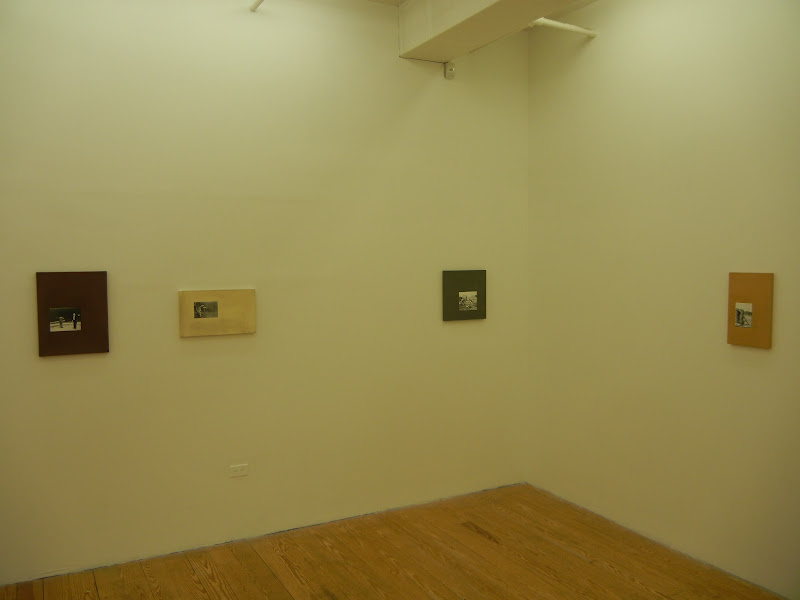 JTF (just the facts): A total of 13 photographic works hung unframed in the entry and the main gallery space. All of the works are gelatin silver prints mounted to Dibond, with cardboard, MDF, wallpaper, lacquer and/or linen, and were made in 2012. Physical dimensions range from 9x11 to 23x15, and each work is available in an edition of 3+1AP. (Installation shots at right.)
 While a trainer holding a hoop for a jumping dog or using a fish to entice a seal to do tricks in the air might seem like ordinary events, when the animal is erased, the narrative is interrupted and left unresolved, the human stuck in a kind of awkward, surreal pantomime. People call and pet invisible dogs, feed invisible horses, and stand back apprehensively, with sticks and whips at the ready for who knows what kind of invisible animals. Our gestures in this absence are disorienting, oddly formal, and often completely ridiculous. Instead of matting and framing these manipulated black and white photographs in a traditional manner (which would have made them look like a 1970s conceptual throwback), Gebert has embedded the photographs in off center rectangular canvases, which have been painted in muted colors. The effect is to make the works feel more like objects, reducing their tendency to seem like inexplicable documentary evidence.
 Collector's POV: The works in this show are priced at either $2800 or $3300 each, based on size. Gebert's work is not yet available in the secondary markets, so gallery retail is likely the only option for interested collectors at this point.


