Showing posts with label Joe Deal. Show all posts

Friday, April 5, 2013

Every Booth at the 2013 AIPAD Photography Show, Part 1 of 6

In direct defiance of all the art fair haters out there, I will readily admit to thoroughly enjoying the annual AIPAD Photography Show here in New York. For a handful of intense days, it brings  a significant portion of the subculture we call fine art photography into one single expansive room, mixing the hard nosed wrangling of buying and selling with the lively sociability of a huge cocktail party. For me, it's one of the few times during the year when I can catch up with out of town dealers, collectors, curators, artists, and other photography world folk, all while scouring each and every booth for things that would fit into our own personal collection. It's a busy exercise in switching hats, from collector to critic and back again.

Walking the halls of any art fair is an exhausting overload of sensory inputs, but when every booth is filled with art of the same medium like it is at AIPAD, it's even easier for eyes to get glassy. At least for me, after a dozen booths or so, the art turns into a seemingly endless rushing river that flows by with such force and velocity that most of it turns into a blur. It's just not possible to process every single image with care and attention, so my brain clicks over to pattern matching mode and looks for outliers that catch my glance for one reason or another, letting the rest happily drift by. In previous years, I have tallied up each and every photograph in select booths, generally covering about half the fair in exhaustive detail. This year, I have opted for a different, more inclusive, and less data intensive strategy; instead of endlessly counting and tabulating, I vowed to select one single image that I found of particular interest from each and every exhibitor booth (sorry AXA). What I was looking for was something exciting, surprising, unexpected, or astonishing, a search for the non-obvious among the greatest hits, the Bill Brandts unearthed to cash in on the MoMA exhibit, and the second tier Irving Penns. This was actually trickier than I expected, as in a number of booths, the embarrassment of riches on offer made choosing only one print downright painful, while in a few others, I struggled to find even one image that I could reasonably highlight. So with a nod to Ed Ruscha, I give you Every Booth at the 2013 AIPD Photography Show, a rambling story of 81 photographs in 81 booths, told in six parts.

The organization of these posts is straightforward: gallery name (and link), artist name, price (sometimes already sold), some comments or logic as appropriate, followed by the image itself. The list follows my path through the fair, starting left from the entry and wandering up and down the aisles, eventually returning to the entrance once again from the other side.

Edwynn Houk Gallery (here): Valérie Belin, $34000. This huge image came from a series I hadn't seen before. The flowers are actually quite painterly, as though they have been outlined. I like the way the foreground and background shift back and forth.


Howard Greenberg Gallery (here): John Vanderpant, $6500. I think Vanderpant is one of those lesser known, generally under appreciated Modernists that deserves some more attention. This one is just gorgeous.


Daniel Blau (here): Robert Wiles, $4500. Blau had an entire booth of press photography. While a bit gruesome, I thought this woman smashed onto the roof of a car was quite elegant.


Bryce Wolkowitz Gallery (here): Ola Kolehmainen, $17000. I'm a fan of Kolehmainen's work, especially when it pushes towards abstraction like this one.


Lisa Sette Gallery (here): Damion Berger, $25000. This booth was a solo show of Berger's Black Powder series of firework explosions. I preferred the frenetic, all-over quality of this image to the ones that were more recognizable.


SAGE Paris (here): Karl Blossfeldt, $85000. This was the best Blossfeldt at the show. Hard to beat.


Lee Gallery (here): Joe Deal, $25000. While all of Deal's backyard scenes are conceptually interesting, only a handful are as visually strong as this one.


L. Parker Stephenson Photographs (here): Sherril Schell, $22000. Very few Schell's find their way into the market and this one throttled me from twenty paces. Classic New York Modernism.


Gitterman Gallery (here): Roger Fenton, $32000. A vintage print of a photography history book classic, The Valley of the Shadow of Death. Great to see up close, hiding on an interior side wall.


Gary Edwards Gallery (here): Juan Laurent, $2500. Bridge pictures have the kind of linear formality that always catches my eye. This latticed viaduct is from Spain.


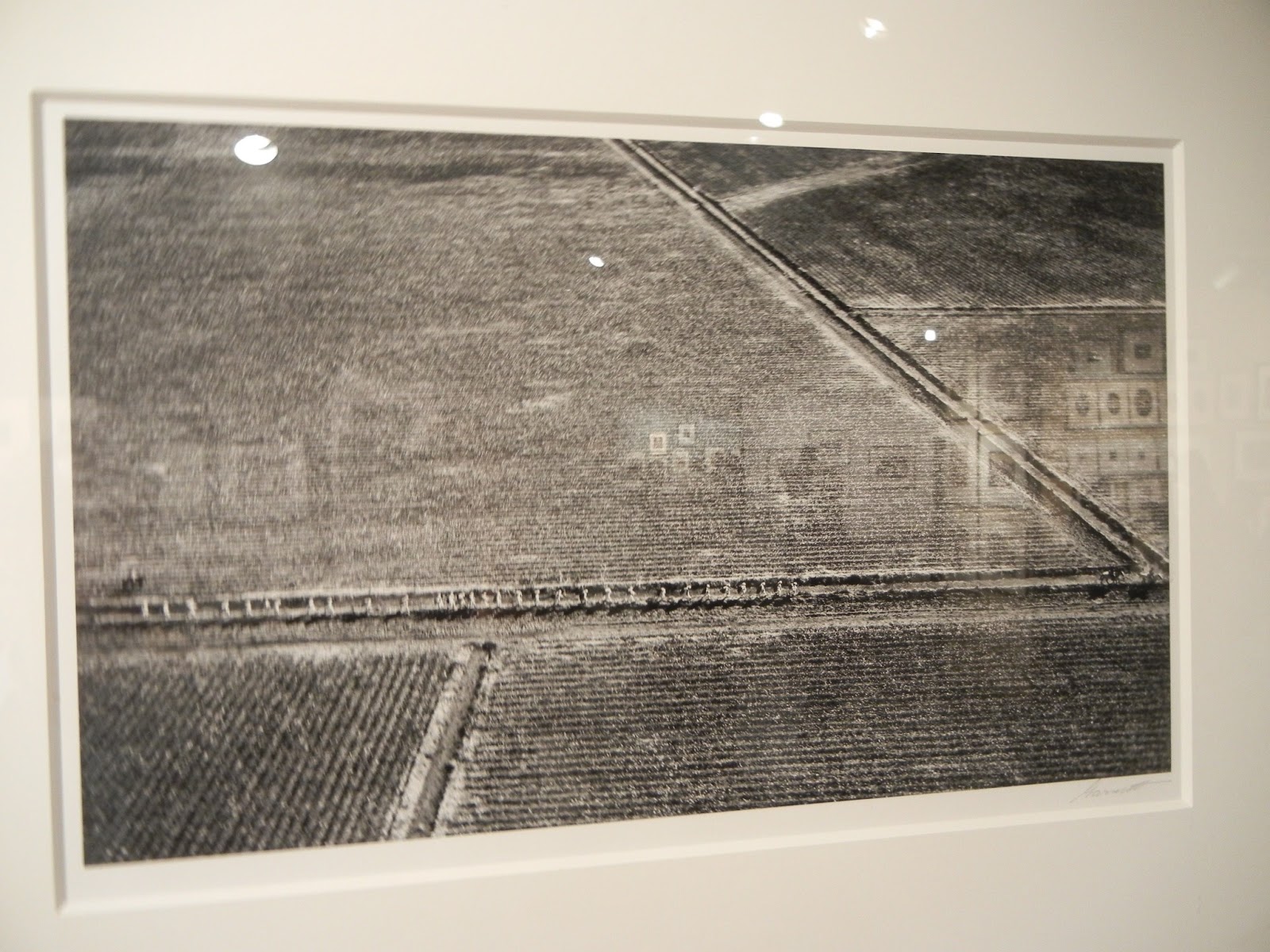
Scott Nichols Gallery (here): William Garnett, $35000. If you look closely in this aerial image, beyond the straight geometries of the fields, you can see a line of tiny men picking the cotton. I'm consistently impressed by Garnett's work and always wonder why I don't see more of it.

Robert Koch Gallery (here): Brassaï, $60000. After I commented on a Brassaï nude that was on the wall, this one was unearthed from a box. He didn't made many nudes, so it's always a treat to see even one.


Robert Morat Galerie (here): Christian Patterson, $4000. I enjoyed both the tangle of wires and the tremendous color tonality in this print.


Continue to Part 2 here.

Wednesday, April 7, 2010

Joe Deal: West and West @Mann

JTF (just the facts): A total of 21 black and white images, framed in white and matted, and hung in the single room gallery space. All of the prints are square format carbon pigment prints, sized 24x24, in editions of 5. The images were taken between 2005 and 2007. A monograph of this body of work was published in 2009 by The Center for American Places at Columbia College Chicago (here). (Installation shots at right.)

Comments/Context: With our cities made of towering skyscrapers and our natural world hemmed in by dense forests, it's easy for Northeasterners like ourselves to forget just how big the sky really is; whenever we look up, our view is constrained by something taller or more massive. Joe Deal's elegant pictures of the Midwestern prairies and grasslands are a jolting reminder of the immensity of the sky, the kind that can be seen for miles and miles in every direction, uninterrupted by the nuances of the flat landscape, the kind that reminds us of our paltry insignificance in relation to the endless emptiness that stretches to the horizon.

Like the grids of property lines laid down by surveyors more than a century ago (cutting up the empire using the rigidity of latitude and longitude rather than the natural breaks in the land itself), Deal has also imposed a geometry of his own on these broad views, a consistent square bisecting land and sky, like a Sugimoto seascape. With the eye of a geologist, he has documented sinkholes and glacial depressions, rolling hills and plateaus dotted by scrub and rock, and lonely buttes and cottonwood trees breaking up the perfect symmetry. Dust storms, smoke, stormy skies and wind across the grass are the only points of movement. The quiet compositions are spare and meditative, the light and shadow falling on the land in a thousand subtle variations from white to black.

Beyond the fact that these are perhaps the best black and white pigment prints I have seen lately, especially in terms of their richness of tonality and timbre (in other words their craft), what I like most about this body of work is that Deal has seemingly found a way out of the conceptual cul-de-sac of the New Topographics. Rather than repeat once again even more dire views of current suburban sprawl and environmental damage (only for them to fall on increasingly deaf ears), he has gone back to the land itself, and asked himself some more personal questions about his own memories of his Kansas roots and his evolving perceptions of the land he grew up on. While these pictures tie back to the 19th century images of the master wilderness photographers, in the end, I think they are about mature and sophisticated balance, about the relationship between earth and sky, and the relationship between man and earth.

Collector's POV: All of the prints in this exhibit are priced at $8000 each. Deal's work is rarely available in the secondary markets; only a very few prints have come up for sale in recent years. Prices for those prints ranged between $1000 and $4000.

Rating: ** (two stars) VERY GOOD (rating system described here)

Transit Hub:
  • Exhibit: RISD Museum of Art 2009 (here); Providence Journal review (here); Brian Sholis review (here)
Joe Deal: West and West: Reimagining the Great Plains
Through May 8th

Robert Mann Gallery
210 Eleventh Avenue
New York, NY 10001

Wednesday, August 5, 2009

Book: Joe Deal, Southern California Photographs 1976-1986

JTF (just the facts): Published in 1992 by the University of New Mexico Press in association with the Los Angeles Municipal Art Gallery. 150 pages, with 68 black and white images. Includes essays by J.B. Jackson, Mark Johnstone and Edward Leffingwell. (Cover shot at right.)

Comments/Context: Joe Deal has been on my hit list for quite a while now. He's one of those photographers that I felt like I needed to know more about, even though he wasn't exactly a household name. Deal was of course part of the now landmark New Topographics: Photographs of a Man-Altered Landscape exhibit at the George Eastman House in 1975, along with other notable photographers Robert Adams, Lewis Baltz, Bernd and Hilla Becher, and Stephen Shore. At least for us, of this group, Deal has always been the most elusive; there just seem to be less of his books and prints running around in the circles in which we travel, less discussion of his work in the press and among collectors we know.

I've actually been thwarted at least twice in trying to acquire this book; Internet booksellers who thought they had it on the shelf and had it listed in in their database somehow didn't actually have it when our order came in. Only recently have I successfully got my hands on a copy. I'm happy to report that it was thoroughly worth the wait, and I now feel like I have a much better understanding of why he was included in New Topographics in the first place, and how his perspective is distinct from the others who also took on the subject matter of suburbanization at that time.

In my view, Deal's images are mostly about the process of human settlement, about the underlying land and how we have built our lives upon it. They chronicle our occupation of the land, the tensions between the land and our chosen way of life, and the process of socialization and division that we impose upon our cities and communities as we create them. What I found most surprising in seeing a larger group of his work together in book form is that his viewpoint seems much less ominous and scolding than Baltz or Adams; his focus on the instabilities or ironies of our lives is subtler, perhaps bit less obviously judgmental.

The book is divided into three sections: The Natural Environment, The City, and The City's Edge, with work from several different projects getting rolled up under each of the headings. The images from The Natural Environment are primarily of the unique geography of Southern California: rocky hillsides, scrub brush, sand, wild scraggly trees and tangled bushes. In most of the pictures, an intrusion in the form of a dirt road or other human presence in the distance disturbs the otherwise pristine view of the untamed wilderness; we're clearly encroaching on the natural environment, and doing it in a way that detracts from its rugged beauty.

If there is any nature at all in the images in the section entitled The City, it was likely put there by someone. There are images of downtown construction projects, as well as of beach communities. There is a terrific sequence of images in this group that brings home the nature of our relationship to the natural world: a concrete patio overlooking the ocean, followed by synchronized swimmers in a suburban pool, followed by a lone man lying on the beach in the blinding sun, followed by families watching the twisting plastic forms of water slides, followed by trailers parked edge to edge along the coastline. The land has been domesticated for our entertainment and recreation (or so it seems).

The most powerful of the images in this book are the ones in The City's Edge. Here Deal has focused on single family suburban homes (and their occupants), built in planned communities and neighborhoods, backing up to the bone dry desert. Often the images peer into deserted back yards, where the formal perfection of the front yard is gone, where sun beaten lawn furniture, abandoned toys and trash cans take center stage. At one level, there is an amazing futility in these pictures, a ridiculousness found in watering a patch of lawn under the punishing sun, or sitting on a chaise amidst the dirt. And yet, the kids are flying a kite or playing happily in a plastic pool in the driveway, and there is some sense that these people have found a degree of happiness in having a place of their own, even if it is in this inhospitable and likely unsustainable environment.

This is what I mean about how Deal has approached his subjects. These suburban tract homes were an easy target; it would have been relatively straightforward to make them look ugly (and he does this to some extent). Deal has however found a way to make the point about the inherent problems with this kind of development, and the need to build communities that are in better balance with their natural environment, but he's done so without the overt harshness and lecturing that turns people away. He's left in some of the optimism that got us into trouble in the first place; the feeling that we can remake this world into a place that fulfills our dreams. He's just pulled back the curtain to remind us that this new life, on this stange land, is not turning out quite how we had envisioned.

This is a fine monograph of an often overlooked photographer, well worth adding to your library.

Collector’s POV: Joe Deal is represented by Robert Mann Gallery in New York (here). Very few prints by Deal have found there way into the secondary markets in recent years; those that have come up for sale have ranged in price between $1000 and $4000.

Transit Hub:
  • RISD profile (here)
  • West and West, Reimagining the Great Plains, 2009 (here)
  • NY Times review, 2004 (here)
  • LA Times review, 1992 (here)