Showing posts with label Dutch Photography. Show all posts

Tuesday, July 23, 2013

Book: Melanie Bonajo, Furniture Bondage

JTF (just the facts): Published in 2009 by Kodoji Press (here). Softcover, 52 pages, with 17 color and 8 black and white images. The book also includes a list of model's names and a short text by the artist. (Spread shots below.)
 
Comments/Context: For the past several months, a vision of contemporary photography as a series of interlocked Venn diagrams has been percolating around in my head. The gist of this thinking is that to a greater and greater degree, we are seeing overlap between previously separate artistic mediums, creating intersections zones where multiple media are mixing in unexpected ways, all of which is then upended by the underlying digital revolution which affects nearly everything. While there is certainly some slower step evolution taking place inside the formal boundaries of the contemporary photography bubble (most of it driven by the ongoing absorption of digital thinking and tools), much of the most drastic artistic mutation that is twisting the medium is taking place in these nether edges, where the rules are looser and the traditions less solidified. To my eye, these radical combination areas are where much of the most creative action is taking place, and where we ought to be paying attention if we want to see where the medium is really going.
 
Melanie Bonajo's Furniture Bondage series is just the kind of hybrid work I am interested in thinking more about. It brings together photography, sculpture, and performance in almost equal parts, the result being something a little of each but altogether new. Her photographs are images of staged constructions, where anonymous nude female models are tied up and otherwise bound and burdened with a dizzying array of mundane household objects. My first reaction to the works was that they were a little like the precariously balanced found object sculptures of Fischli & Weiss, but with the scaffolding of a human body added to the complex physics equation. With faces turned away or hidden by hair, the bodies become malleable objects, jammed into the space made by a desk chair, tied up with a phone cord, folded into an aluminum ladder, or bent into a wooden shelf unit. They act like center of gravity towers that hold the sculptures together, with any number of additional objects added on or perched on top. In this sense, the bodies are remarkably mute and inert, just one more limp sculptural object in a gathering of textures, colors, and jutting lines.
 
But if we step back and see these assemblages as performances, an entirely different reading of the works can take place. The female subjects are wrapped up and trapped by their possessions (the bondage motif), literally carrying the heavy load of their stuff. There is an innate physicality to what's going on, a bearing of weight and a contorting of bodies. Without much imagination, these images can be easily connected to a long line of body-based performance artists, both those who explored the limits of the flesh and those who had a more direct feminist angle, the suffocating cleaning products, kitchen utensils, and laundry racks offering biting commentary on traditional gender roles.
 
And depending on our vantage point, we might simply characterize these works as straightforward photographic nudes, albeit with a conceptual feel. The material objects and additional items surround the sitters like a still life, a mountain of daily clutter giving context and implied narrative to the elegance of the nude form. The photographs might feel equally at home with the witty early 1970s conceptual experiments of William Wegman or Robert Cumming or at the end of a comprehensive nude retrospective, in visual dialogue with a Dada nude from Man Ray, a bondage nude from Araki, and an interrupted windowsill and coffee table nude from Friedlander.
 
I like the back and forth instability of this mixed media approach, the alchemy of borrowing from various aesthetic tool boxes. It allows for multiple readings of the imagery and multiple placements within different cultural and artistic frameworks, all with a freshness that only comes from deliberately coloring outside the lines. If we're looking for the next set of photographic disruptions, I'm becoming increasingly convinced that they will come not from within, but from the external friction zones, where chaotic idea recombination like Melanie Bonajo's is the norm.

Collector’s POV: Melanie Bonajo is represented by PPOW Gallery in New York (here), where this body of work was shown in 2009. Bonajo's work has very little secondary market history, so gallery retail remains the best/only option for those collectors interested in following up.
 
Transit Hub:
  • Artist site (here)
  • Interview: I Heart Photograph, 2008 (here)


Tuesday, January 29, 2013

Hendrik Kerstens @Danziger

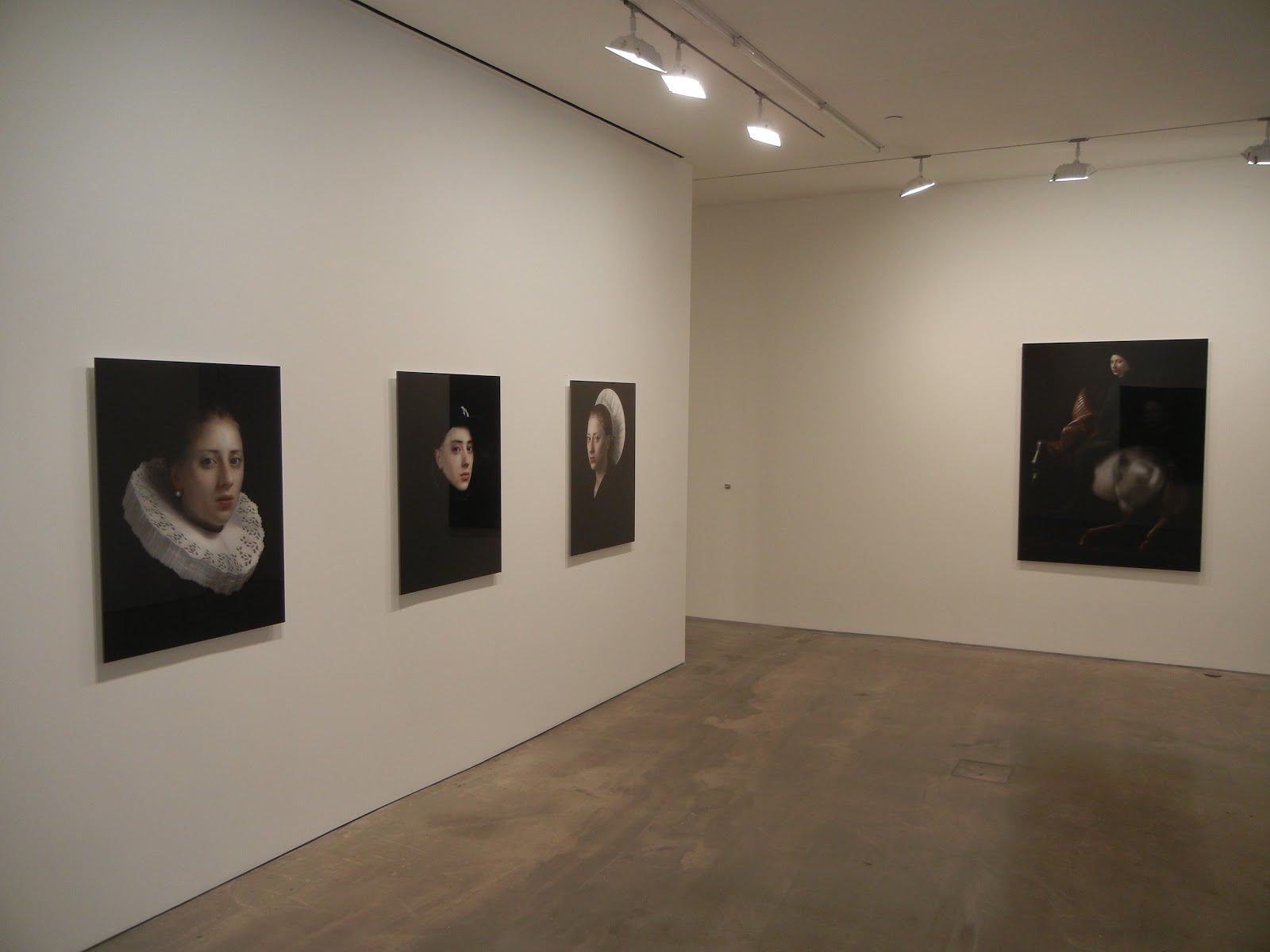
JTF (just the facts): A total of 17 large scale color photographs, mounted and unframed, and hung against white walls in the two room gallery space. All of the works are pigment prints face mounted to Diasec, made between 1994 and 2012. The prints are shown in three different sizes: 24x20 (in editions of 5 or 6+2AP), 40x30 (in editions of 6 or 10+2AP) and 60x50 (in editions of 5 or 6+2AP). there are 6 prints in the largest size, 7 prints in the middle size, and 4 prints in the smallest size on display. (Installation shots at right.)

Comments/Context: I have seen and written about the work of the Dutch photographer Hendrik Kerstens several times over the past few years, so I was certainly aware of what I would likely encounter when visiting his newest show (post Sandy flooding) at Danziger Gallery. But I have to say I was totally and utterly surprised when I walked into the gallery. His portraits have been transformed into glossy objects - rather than being shown in traditional nondescript black frames, they are printed large and face mounted to Diasec like the work of many of the Dusseldorf and Helsinki school graduates. For me, it was an electric wow moment, the push and pull of old and new in his photographs energized and amplified by the modern presentation.

The show is a mini-retrospective sampler of Kerstens' work, going all the way back to his early portraits of his daughter Paula and mixing in brand new images from the past year or two. It traces both her transformation (from young girl into young woman) and his ongoing refinement of craft and technique. For those unfamiliar with Kerstens' approach, suffice it to say that he has brewed up an original alchemical mix of painting and photography, borrowing traditional dark background poses, the careful handling of light, and the subtle treatment of skin from the masters of Dutch portraiture and blending them together with anachronistic modern props and accessories, creating graceful photographic portraits that look and feel like museum treasures and then abruptly upend your sense of order. At this point, the Marie Antoinette bubble wrap headdress, the plastic shopping bag cap, the cloth napkin wimple, and the paper towel roll turban have all become contemporary classics.
 
The good news is that Kerstens' pictures are getting better and better. New portraits of Paula find her sporting a drooped cake icing spout, a thick stack of paper doilies that perfectly mimics a starched lace collar, and a flyaway high pointed bonnet in silvery aluminum foil. There's even a rearing equestrian portrait (with a nod to David) with Paula calmly looking over her shoulder. Given the large size of these prints and the new mounting approach, the works hold the wall with tremendous authority, while still retaining their sense of reserve and refinement.
 
I think the durable excitement of these works lies in their uncertain, shifting dialogue between competing forces: painting and photography, traditional cultural icons and modern realities, sober seriousness and sly wit, celebrating and undermining. They are at once classically beautiful and sublimely ridiculous, which ensures they won't ever be boring.
 
Collector's POV: The images in this show are priced based on size and place in the edition. The 24x20 prints range from $8000 to $18000, the 40x30 prints start at $12000 and go up to $75000, and the 60x50 prints begin at $22000 and rise to a lofty $160000. These prices are a significant step up from previous prices I have seen and likely represent broadening demand for his work. Kerstens' work has not yet reached the secondary markets with any regularity, so gallery retail remains the best option for those collectors interested in following up.
 
Rating: ** (two stars) VERY GOOD (rating system described here)

Transit Hub:
  • Artist site (here) and Facebook page (here)
  • Feature/Review: New Yorker (here)

Hendrik Kerstens
Through February 16th

Danziger Gallery
527 West 23rd Street
New York, NY 10011

Friday, September 28, 2012

Ruud van Empel, Sunday @Stux

JTF (just the facts): A total of 7 color works, hung in the upper viewing area in the back of the gallery. 5 of the works are archival pigment prints, framed in brown wood, from 2012. These prints are sized 28x20, and are available in editions of 7+2AP. The other 2 works are archival pigment prints mounted to Dibond and Plexiglas, unframed, also from 2012. These works are sized 59x41, and are available in editions of 5+2AP. (Installation shots at right.)

Comments/Context: Ruud van Empel's small show provides two new bodies of work to contemplate, both in his now-signature style of flawlessly stitched together, composite imagery. At this point, van Empel's digital collages of meticulously rendered but somehow surreal children are immediately identifiable, and these new projects don't stray too far from his proven visual formula.
 
Most of the images in the exhibit substitute a backdrop of manicured, formal gardens for the lush jungle vegetation the artist has regularly employed as a setting. But there is something over-the-top and manic about these manufactured gardens filled with endless topiaries, pruned evergreens, boxwood hedges and shrubbery specimens. Kids primly stand in their Sunday best (thus the title of the series), freckly red haired boys in proper coats and ties, and black children in snappy blazers and bow ties or sweater dresses and mary janes. As they pose on the gravel paths, with a stray peacock or dove nearby, the gardens engulf and overtake them, controlled nature on the verge of out of control. For the first time, van Empel has also introduced an older lady as a subject, seen up close, in a fur collared coat. The background of her portrait explodes with angular, geometric forms in green, with a nod to the Renaissance, but inexplicably dense and layered.
 
The other two images on view play with linear perspective in new ways. A crowd of kids of varying sizes (and varying outfits) is arrayed against a formless grey background, seemingly following the rules of aerial depth perception but floating unrooted to any landscape. Shadows are cast by the children (so there is a consistent light source), but otherwise they have no connection to a setting or narrative. The works almost seem like a temporary peg board resting place for van Empel's fancy fabricated kids, as though he was simply waiting to insert them into some other elaborate scene but they have been stranded in this endless netherworld in the meantime. While the colors are bright and energetic, the works felt oddly dispiriting, like the well-meaning kids were trapped in some kind of cleaned-up stylish hell.
 
Part of what I like about van Empel's work is this sense of discomfort that grows as you look as his photographs. The first glance always seems placid and inviting, but a closer examination always seems to uncover an undercurrent of the threatening, the puzzling, or the unsettlingly mismatched. It's a hyper-perfect world, where the fastidious, glossy detail is often slightly disturbing.

Collector's POV: The works in this show are priced as follows. The smaller 28x20 prints are $24000 and the larger 59x41 prints are $32000. Van Empel's prints have become more consistently available in the secondary markets in recent years. Prices at auction have ranged between roughly $15000 and $120000.
 
Rating: * (one star) GOOD (rating system described here)
 
Transit Hub:
  • Artist site (here)
  • Exhibit: MOPA, San Diego, 2012 (here)
  • Feature: Trendland (here)
Ruud van Empel, Sunday
Through October 20th
 
530 West 25th Street
New York, NY 10001

Monday, July 30, 2012

Rineke Dijkstra: A Retrospective @Guggenheim

JTF (just the facts): A total of 69 color photographs and 5 videos, variously framed and matted, and hung in a winding series of rooms on the four floors of the annex galleries. All of the photographs are chromogenic prints, made between 1991 and 2009. Physical dimensions and edition information were not available on the wall labels. The show was curated by Sandra Phillips of SFMOMA and Jennifer Blessing of the Guggenheim. A hardback exhibition catalogue is available the museum shop for $55 (here). (Installation views of Rineke Dijkstra: A Retrospective, Solomon R. Guggenheim Museum, June 29–October 8, 2012 at right, courtesy of David Heald © Solomon R. Guggenheim Foundation.)

Dijkstra's works can be easily categorized by subject matter. For each series, the title of the series is followed by the number of photographs/videos on view and their details:

Annex 2nd Floor
Beach Portraits: 13 photographs, framed in dark brown and unmatted, 1992-1998
Bullfighters: 4 photographs, framed in dark brown and matted, 1994, 2000
Tia: 2 photographs, framed in light brown and matted, 1994
New Mothers: 3 photographs, framed in light brown and matted, 1994

Annex 4th Floor
Olivier: 7 photographs, framed in dark brown and matted, 2000-2003
Almerisa: 11 photographs, framed in brown and unmatted, 1994-2008
The Buzz Club: 3 photographs framed in brown and unmatted, 1995, 1 2-channel video (26 minutes 40 seconds), 1996-1997
Chen and Efrat: 5 photographs, framed in white and matted, 1999-2005
High School: 1 photograph, framed in white and unmatted, 1994
Self Portrait: 1 photograph, framed in brown and matted, 1991
Annemiek: 1 video (4 minutes), mounted into gallery wall, 1997

Annex 5th Floor
Parks: 8 photographs, alternately framed in brown and matted/unmatted, 1998-2000, 2005-2006
Ruth Drawing Picasso: 1 single-channel HD video (6 minutes 33 seconds), shown in darkened room, 2009
I See a Woman Crying: 1 3-channel HD video (12 minutes), shown in darkened room, 2009

Annex 7th Floor
The Krazyhouse: 4 photographs, framed in white and unmatted, 2008-2009, 1 4-channel HD video (32 minutes), shown in darkened room, 2009
Israeli Soldiers: 7 photographs, framed in brown and matted/unmatted, 1999-2003

Comments/Context: Rineke Dijsktra's brilliant mid-career retrospective at the Guggenheim is proof positive of just how consistently smart her twenty year investigation of photographic portraiture has been. In series after series, she has rigorously probed the edges and boundaries of the genre, producing a body of work that shows a continuing progression of increasingly original conceptual innovations. For the first time, I was able to trace the evolution of her underlying ideas, and to see how she has refined and evolved those constructs over time. It's nothing short of a bravura performance, and I came away deeply impressed with the precision of both her observation and her thinking.

Unfortunately, the wacky configuration of the annex rooms at the Guggenheim makes following in her footsteps nearly impossible; the flow of the show is frustratingly broken up by the space again and again. While the exhibit might be characterized as roughly chronological, the limitations of the rooms lead to a few time jumps and misorderings that are distracting. To try to clarify the action, I've created a simple timeline that lists each project/series on view and the years in which Dijkstra made the pictures (small type, I know):


Dijkstra's small self portrait, taken poolside in 1991 after a grueling rehab training session, is the "aha" moment that kicks off her career as an artist and holds the flash of insight that has informed her work ever since. In it, she stands exhausted and unadorned, with an almost feral intensity, unable to pose for the camera or compose herself. For the first time, Dijkstra had found a way to make a portrait of someone with their guard truly down; like Halsman's jump portraits, this is not a fake smile or a pretend posture - it is the real person, open and honest, and it is mesmerizing.

Dijkstra's now iconic Beach Portraits were the first photographs she made building on this newly discovered approach to photographic authenticity. She placed her subjects on the sand at the shoreline, standing in nothing but their bathing suits against the minimal backdrop of the sea and sky. Dijkstra consciously chose adolescent boys and girls for these images, avoiding older people who were already adept at concealing and protecting themselves in front of the camera. The result is a series of pictures that are intimate and personal, mixing timidity with gawky confidence, awkwardness with self-conscious striving. American kids try a little too hard, imitating the curvy pose of a fashion model or the male swagger of long hair and cut off shorts, while the Eastern European kids seem less spoiled, standing unapologetically in their underwear or a dated speedo, fidgeting and looking for a place for their hands. At nearly life size and with a strict attention to detail, the prints offer nowhere to hide; all the imperfections come through. The differences in how these teens present themselves are fascinating sociology, but each one tells the same uncomfortable story of a child trying to figure out who he or she is going to be.

1994 turned out to be an important year in Dijsktra's early career. While working on the Beach Portraits, she was also simultaneously pursuing several other conceptual approaches to getting her sitters to reveal themselves more fully. One was an extension of the idea found in her self portrait: the exhaustion and conflicted emotion of an extreme physical experience. In her series of Bullfighters, she made pictures of the forcados just as they left the ring, their faces bloodied and their brocade jackets sweaty and torn. And in her series of New Mothers, she captured women naked with their newborns, just after they had given birth. In both cases, the portraits are alive with a kind of wide eyed shock, where pain and pride mix together with euphoric intensity. Another approach from this same year involved using an expanded idea of the element of time to uncover changes in a sitter's personality. On a small scale, Dijkstra's portraits of Tia (another new mother) taken five months apart show the minute, barely observable changes taking place, from her hairstyle to the freshness in her eyes. On a larger scale, Dijkstra's multi-year (and ongoing) portrait of Almerisa tracks more complex adaptations. It chronicles both the growth from young girl through teenager to young mother, and the more subtle changes in clothing, appearance, and attitude coming in her transformation from lost refugee to assimilated Dutch citizen.

In this same year, she also began a preliminary investigation of uniforms, via portraits of high school kids in Liverpool, and soon afterward, she expanded and evolved this concept in her first video piece, The Buzz Club. In many ways, this video is the combination of several of Dijkstra's existing conceptual threads, with a few new ideas thrown in for good measure. Club kids stand against a stark white background, dancing, smoking, drinking beers, chewing gum, and making out, while the soundtrack of the techno music thumps overhead. The girls and boys follow obvious patterns in outfitting themselves (thus the connection to "uniforms"): the girls have long hair and wear skimpy, come hither dresses (mostly black), while the boys have shaved heads and sport zipped up tracksuits. Instead of using still frames across time as she had done with Almerisa, Dijkstra has transitioned to video, creating a "moving" portrait that waits to uncover moments when authenticity intermittently shines through the role playing. Music is used as device to both relax the sitter and as something to focus on and get lost in; dancing becomes a way to break down the formality of the session. The overall effect is a swirling mix: shyness, boredom, swaying and hip shaking, bobbing heads and punching arm moves, staring down the camera and looking away in a trance. It's an exercise in controlled appearances (slinky females, tough guy males) and the split second breaking down of inhibitions.

Through the end of the decade, Dijkstra continued to refine many of her original ideas: Annemiek was another video piece, where a lip synching girl in braces timidly alternates between being painfully self-conscious and being absorbed by the music, and the Parks series used calm groups of young people in leafy natural settings to look for glimpses of honest connection. Three new projects dominated the first years of the next decade and further evolved the time-based concepts from the Almerisa-series, but with a tighter focus on people undergoing a specific life-changing process or rite of passage. Twin sisters (Chen and Efrat) are followed year to year through puberty (with an echo of Nixon's The Brown Sisters), young enlisted recruits in the Israeli army are seen side by side in their army uniforms and later in civilian clothes, and a young man in the French Foreign Legion (Olivier) is followed from his first day (and his subsequent military haircut) through to his emergence as a hardened, serious soldier three years later. In each series, nuanced shifts in maturity can be seen only by comparing the adjacent portraits; we see their emotions and personalities shining through in the cracks.

Dijkstra's most recent works have once again returned to video, pushing further toward moments of intense concentration to look for unguarded personal revelations. In both Ruth Drawing Picasso and I See a Woman Crying, Dijkstra follows school children as they participate in art exhibitions. In their grey sweaters and red ties (uniforms as a motif once again), they engage the art through drawing and group discussion, and in both cases, the action starts out slow and tentative and builds to a crescendo of intense fixation and inventive, exuberant brainstorming, where hidden individual personalities start to take shape. The Krazyhouse reprises many of the the themes from The Buzz Club, but narrows down to explore the intensity of dancing more deeply. As I said in my original review of 2010 show at Marian Goodman (here), this is one of the most exciting pieces of contemporary art made so far in this century. Each of the longer length portraits of the five club goers has something to slowly reveal, and there is contagious joy to be found in the thrashing hair, the ecstatic air guitar, the sultry swing of arms, the frenetic chopping of hands, and the biggest smile you've seen in ages (not that any of the dumbfounded deadpan drones watching the video in the museum while I was there seemed to notice). Each dancer finally gives in to the music, lets go, and the flimsy walls of controlled self-presentation come down in triumphant warmth; it's hard not to be amazed and inspired by such an intimate spectacle.

What I found most impressive about this consistently superlative body of work is how Dijkstra's underlying ideas about the nature of portraiture have been evolving. While much has been made of her historic ties to Sander and Arbus, I think Dijkstra's portraits start with these influences and then quickly move somewhere new. There is an enormous amount of experimentation and innovation visible here, all of it closely clustered around the challenge of getting people to show their true selves. Look closely and there are half a dozen important and original ideas: the aftermath of an intense experience, elapsed time and personal adaptation, the use of video as a patient way to let hidden nuances reveal themselves, uniforms and how personalities are influenced by them, the trance inducing power of music and how to incorporate it into portraiture, etc. etc. Don't be fooled by the seemingly endless stream of classic-looking portraits - there are as many pyrotechnics to be seen here as in any photographic show in recent memory. For me, this retrospective helped me to see the entire spread of Dijkstra's genius (not just her greatest hits) and to more fully appreciate just how much she has successfully challenged and expanded the traditions of photographic portraiture.

Collector's POV: Given this is a museum retrospective, there are, of course, no posted prices. Dijkstra's photographs have become generally available in the secondary markets in the past few years, with prices ranging from roughly $4000 to $180000, with a sweet spot between $10000 and $50000. Dijkstra is represented by Marian Goodman Gallery in New York (here), Galerie Max Hetzler in Berlin (here) and Galerie Jan Mot in Brussels (here).

Rating: *** (three stars) EXCELLENT (rating system described here)

Transit Hub:
  • Reviews: NY Times (here), Village Voice (here), Wall Street Journal (here), New Yorker (here), American Photo (here), TimeOut New York (here), Capital New York (here)
  • Interview: ARTINFO (here)
  • Exhibit: SFMOMA, 2012 (here)
Through October 8th

Solomon R. Guggenheim Museum
1071 Fifth Avenue 
New York, NY 10128

Friday, January 13, 2012

Bertien van Manen: Let's sit down before we go @Richardson

JTF (just the facts): A total of 19 color photographs, framed in white and matted, and hung in the main gallery space. All of the prints are chromogenic prints, sized 16x20, in editions of 5. The images were taken between 1991 and 1994. A monograph of this body of work (edited by Stephen Gill) was published by Mack Books in 2011 (here), and is available from the gallery for $45. (Installation shots at right.)
.
Comments/Context: Bertien van Manen's images from the former Soviet republics have the intimate feel of family snapshots. They get inside the lives of the subjects, capturing them in quiet, unguarded moments, where the routines of ordinary life give way to small, personal joys. Unassuming and understated, the photographs are deceptively mundane.
.
And yet, in a handful of these images, there is a glorious and enveloping warmth, made stronger by careful composition. At a summer campsite, young men wander between cloth tents, picnic tables covered with the remnants of meals passed and empty vodka bottles hanging from the trees. In winter, a nighttime snowball fight catches sparkling flash-lit flakes in mid-air. Inside a house, pink leggings hang from the ceiling, flanked by a pair of boots, a green table, and a child wearing a pacifier hung by a string. And in the soft summer evening, a woman gives a man a haircut, bathed in the yellow light across the green pasture. All of these are fleeting moments that might have gone unnoticed, but to van Manen's eye, they become something altogether more powerful and memorable.
.
Other images in the show give supporting glimpses of everyday life in this particular time and place: a posed family surrounded by snowbanks, the bright red lipstick favored by the young women, skiing in bikinis and bathing suits, or groups casually hanging out on park benches. They are pictures that capture misjudged details, forgotten gestures, and small interactions, and together, they tell a nuanced story of life in 1990s Russia and its neighbors. All in, these are photographs full of subtleties, telling the other side of a better known story.
.
Collector's POV: The prints in this show are priced at $3800 each. Van Manen's work has little or no secondary market history, so gallery retail is likely the only viable option for interested collectors at this point.
 
Rating: * (one star) GOOD (rating system described here)
.
Transit Hub:
  • Artist site (here)
  • Feature: Time LightBox (here)
  • Interview: Bint PhotoBooks (here)
Bertien van Manen: Let's sit down before we go
Through February 11th
.
535 West 22nd Street
New York, NY 10011

Monday, June 13, 2011

Ellen Kooi, Out of Sight @PPOW

JTF (just the facts): A total of 11 large scale color photographs, hung unframed in the front gallery space, a second adjoining room, and in the office area. All of the prints are either Ilfoarchive on dibond or Enduraprint on plexiglas, made between 2007 and 2011. Physical dimensions range from 27x45 to 31x107, with editions either 10+2, 12+2 or 20+2. A monograph of this body of work was published in 2010 by Filigranes Editions (here). (Installation shots at right.)

Comments/Context: Dutch photographer Ellen Kooi can neatly be categorized as one of the increasing number of contemporary photographers employing cinematic staging as a signature technique. Her images of children set amid flat Dutch landscapes sit roughly in the middle along the spectrum of realistic recreation and obvious fabrication, using theatrical lighting and unexpected perspectives to create open ended scenes and narrative fragments that reference childhood fairy tales with a sense of heightened realism.

While stories and dreams can of course take place anywhere, these pictures are firmly rooted in the Dutch soil and in the visual traditions of Dutch landscape painting across the centuries. Children in rubber boots squish across mudflats, a girl stands tall on a tree stump over looking a misty expanse of farmland, and another hides her face near a drainage canal flanked by weeds. With a compositional nod to Wyeth, a girl peers up at a lonely house perched on the hillside, carrying what looks to be a dead seagull. And we are left to only imagine why the boy sitting in the amazingly tall weeds is bathed in an alien green glow or why the girl is scrambling across the roadside in the twilit night.

In each of these images, the land itself plays much more than just a supporting role; it often dominates the figures, creating a sense of expansive natural scale and power compared to the children. Kooi has taken the realistic genre painting of the past and infused it with some modern mystery and uncertainty, taking idyllic landscape formulas and overlaying them with moods a bit more menacing.
.
Collector's POV: The works in this show are priced between $8000 and $16000, based on size and the place in the edition. Kooi's work has not yet entered the secondary markets in any significant manner, so gallery retail is likely the only option for interested collectors at this point.

Rating: * (one star) GOOD (rating system described here)

Transit Hub:

Ellen Kooi, Out of Sight
Through June 18th

PPOW Gallery
535 West 22nd Street
New York, NY 10011

Monday, April 25, 2011

Ruud van Empel, Wonder @Stux

JTF (just the facts): A total of 11 large scale color works, hung unframed in the entry, the two main gallery spaces, and the upper viewing area in the back of the gallery. All of the works are chromogenic prints mounted to Dibond and Plexiglas. Physical dimensions range from 33x24 to 49x130 (yes, wider than 10 feet); the larger images are printed in editions of 7+2AP, and the smaller images are printed in editions of 10+2AP. All of the works on view were made in 2010. A catalog of the exhibition is available from the gallery. (Installation shots at right.)
.
Comments/Context: This show gathers together a variety of fresh work from the Dutch photographer Ruud van Empel, and finds him both continuing down old paths and evolving new but related ones to explore. Process-wise, we are still in the realm of elaborate composite images, where thousands of visual fragments have been Photoshopped together into van Empel's signature otherworldly hyper-reality, full of unnerving children portrayed in a combination of perfect detail and odd flatness.

Three of the images on view extend his popular World series, where black kids sit submerged in verdant, idealized pools (complete with lily pads and tropical flowers), or stand in plaid sport coats and party dresses amidst the clean, leafy eden. His Generation series of children in the rigid rows of a traditional school picture also has a new member; this time the risers are populated with a majority of Jewish kids. Other new works seem to riff on existing ideas, but expand them in new directions. The Theatre series takes the night time palette of the Moon series and applies it to dark, wooded scenes (almost like the forbidden forest of fairy tales), thick with tree trunks edge to edge. Connection seems to jump off from the Dawn series, but in an up-close panorama format, while Wonder seems descended from the Generation pictures, but is exploded outward to cram faces together in a crowded all-over pattern of childhood diversity. Brothers & Sisters takes some of the formality of the paired portraits of World, and adds the simple idea of family resemblance.

As a result, this show has the feeling of something altogether familiar, of van Empel subtly tuning and editing, but not changing the overall formula much; if you liked his prior work, you'll probably like these images as well, and if you didn't, you'll probably feel like these are more of the same. These recent pictures are not radical, frame-breaking experiments, but more a consolidation of the artist's complex visual toolkit, or perhaps better, a lively sprinkling of nuanced iterations.

Collector's POV: The works in this show are priced between $25000 and $98000, depending on size and on the location in the edition. In the past year or so, Van Empel's prints have found secondary market buyers between roughly $16000 and $35000.

My favorite image in the show was Brothers and Sisters 3, 2010; it's the picture on the left in the bottom installation shot. I like the idea of moving away from the consciously exotic; here van Empel has traded the lush, succulent jungle of the World series for the Northern forest in spring, placing two pale skinned, red haired children in 3/4 pose among the leaves. Even with the dated turtleneck sweater, it has an almost Victorian quality to it that I found intriguing.

Rating: * (one star) GOOD (rating system described here)

Transit Hub:

Ruud van Empel, Wonder
Through May 14th
.
Stefan Stux Gallery
530 West 25th Street
New York, NY 10001

Tuesday, January 11, 2011

Wijnanda Deroo: Inside New York Eateries @Mann

JTF (just the facts): A total of 23 color photographs, framed in white and hung throughout the main gallery space. The chromogenic dye coupler prints come in three sizes: 16x29, 36x43, and 48x57, each in editions of 10. There are 16 in the small size (matted) and 7 in the medium size (unmatted) on display. All of the images were taken in 2009. (Installation shots at right.)

Comments/Context: Wijnanda Deroo's images of New York restaurants are a short-hand catalog of the diversity of this great city: its traditions and routines, its ethnicities and neighborhoods, its celebrations and memories. Her quiet, unpeopled interiors capture the essence of the dining experience at each individual place, from table settings and surrounding decorations, to exuberant colors or muted light, running the gamut from down-and-dirty to over-the-top extravagant.

Deroo's pictures document these rooms on a human scale, at eye level, often looking straight at a geometrically balanced group of tables, or down a long bar or counter. Many seem to have been taken in the purity of the morning, when the light is bright and the tables are neatly set. Her photographs are like formal portraits of these spaces, rich in color and texture, some "personalities" crisp and starched, others worn and smooth. The Russian Tea Room and 21 Club are darkly opulent, while Milon and Papaya Dog have ebullient effervescence to spare.

When taken as a series, the works provide a historical (sometimes almost nostalgic) snapshot of the nature of dining in New York; as restaurants age and mature, or come and go, they reflect the aspirations, moods, and tastes of those they serve. Deroo's formal compositions etch these quintessential places in memory, removing the cacophony of the babbling customers, leaving behind silent, studied environments and surfaces, each patiently waiting for its next jolt of life.

Collector's POV: The works in this show are priced as follows. The small 16x20 prints are $3500 each; the medium 36x43 prints are $5000 each; and the large 48x57 prints are $8500 each. Very little of Deroo's work has appeared in the secondary markets, so gallery retail is likely the only option for interested collectors at this point.

My favorite image in this exhibit was Jerry's, 90 Chambers Street, 2009; it's the coffee shop image on the left in the group of three at right. I like the breaking up of the picture plane and the way the light falls on the red leather of the booth.

Rating: * (one star) GOOD (rating system described here)

Transit Hub:
  • Artist site (here)
  • Review: Wall Street Journal (here)

Through January 29th

210 Eleventh Avenue
New York, NY 10001

Monday, October 18, 2010

Ruud van Empel, Generation @Stux

JTF (just the facts): A total of 4 color works, hung unframed in the upper viewing area in the back of the gallery. All of the works are chromogenic prints mounted to Dibond and Plexiglas. The two large works, each 49x130, are printed in editions of 7+2AP, and were made in 2010; the two smaller works, each 24x17, are printed in editions of 10+2AP, and were made in 2009.(Installation shots at right.)
.
Comments/Context: In Ruud van Empel's newest works, the Dutch photographer has moved away from the lush leafiness of his previous jungle settings and has opted for the buttoned-up formality of the traditional class portrait, with rows of school children in their picture day best outfits, standing on risers against a yellow curtain. Squint your eyes to blur the details and his ten foot wide panoramas look like any school picture taken in the past 50 years.
.
But when your eyes come back into focus, it becomes clear that van Empel's children are unlike any you have seen before. Using Photoshop to composite together hundreds of images, he has created a signature style that has become the hallmark of his work: glossy perfected children with big eyes, staring out from the plane of the picture with an almost surreal oddness - what seems at first glance to be idealized comes out more than a bit unsettling. In past works, he has highlighted a single child, or perhaps a pair of kids, sometimes in matching fancy dresses or sport coats, sometimes with bare skin. These new works amplify and expand his cast of characters, allowing him to play with clothing, hairstyles, and facial features to create a kaleidoscope of different personalities.
.
On one wall, all of the school children are black; on the other, it's a predominantly white class with a lone black student. Subtleties of culture come out in bow ties and sweater vests, braids and barrettes, Peter Pan collars, striped turtlenecks, and bold, candy colored patterns, a range of faces lit by sparkly eyes and hiding underneath big glasses. In his prior work, van Empel used the natural environment of lily pads and flowers to create a kind of protected paradise for his subjects; in these works, he pushes on this concept of childhood innocence, but from a less fanciful and whimsical perspective; the formality of school creates boundaries and limits. The flatness of the compositions and the "optimized" children still make for an unnerving scene, but the entire effect seems better balanced with reality, closer to real life to make his tweaks and constructions all the more resonant.
.
This show only contains a couple of works and its location in the galleries in the back tests the viewer's willingness to wander through another larger show to find the pictures. That said, I was intrigued to see how van Empel is evolving his style and finding new ways to situate his instantly recognizable characters.
.
Collector's POV: The works in this small show are priced as follows. The two large images are priced between $59000 and $69000, depending on the location in the edition; the two small images are priced between $12000 and $14000, again in a rising edition. Van Empel's work has recently become more consistently available in the secondary markets, with a handful of lots coming up for sale in any given year. Prices have been steadily rising, from roughly $15000 to up over six figures, with a sweet spot in the low 30s. Van Empel is also represented by Flatland Gallery in Utrecht (here).
.
As an aside, I think it would be fascinating to hang one of these van Empel school portraits together with one of Tomoko Sawada's class pictures (all of herself) to see the contrasts/commonalities in style and message.
.
Rating: * (one star) GOOD (rating system described here)

Transit Hub:
Ruud van Empel, Generation
Through October 23rd

Stefan Stux Gallery
530 West 25th Street
New York, NY 10001

Thursday, July 8, 2010

Rineke Dijkstra @Marian Goodman

JTF (just the facts): A total of 3 videos and 4 large scale color portraits, displayed in separate darkened video rooms and hung in the north and south galleries. All of the photographs are larger than life size archival inkjet prints, each 48x40, in editions of 10, made in 2008 or 2009. The videos are:
  • 3-channel HD, 12 minutes, in an edition of 6, from 2009
  • 1-channel HD, 6 minutes, 36 seconds, in an edition of 6, from 2009
  • 4-channel HD, 25 minutes, in an edition of 6, from 2009
Unfortunately, no photography was allowed in the galleries; as a result, there are no installation shots for this exhibit. The images at right were taken from the gallery website. (Still from The Krazy House, Liverpool, UK, 2008- 2009, at right.)

Comments/Context: If you actually take the time to watch all five segments of Rineke Dijkstra's The Krazy House, to patiently stand there in the dark for the entire 25 minutes and drink it all in, I think it would be nearly impossible to leave the gallery without a broad smile on your face. Without a doubt, it is the warmest, most compelling and uplifting time I have had in an art gallery all year.
.
The artistic conceit at work here is relatively straightforward. Dijkstra constructed an all-white room in a Liverpool dance club, and she invited club goers to come and dance to their favorite tracks when the club was closed. At first glance, you might think that this concept has echoes of the simple, unadulterated joy of dancing found in the early Apple iPod ads or those from the Gap featuring swing dancers from a few years back, and on the surface, there are some parallels in terms of look and feel. But what is altogether more surprising is that Dijkstra's video is actually about a process, like the fantastic transformation of a caterpillar into a butterfly. In each segment, the young person starts out timid, self-conscious, painfully aware of the ridiculousness of dancing alone in front of white wall for a camera. They are all shy and tentative, unsure of themselves, only trying out the simplest of their moves. But in each case, as they get more comfortable and feel empowered by the music, something spectacular happens: they blossom into amazingly beautiful individuals, giddy with freedom and lost in themselves.
.
What is fascinating is how each person responds to the music, making movements that match their range of emotions. A young girl with lilting blond braids pulled back from her face slowly swings her hips, her bare arms waving over her head in a mellow trance. A young guy in jeans and a t-shirt rips his moves with choreographed precision, aggressively jerking his body up and down, exploding with energetic hand positions. Another young girl mouths the words, acts out the lyrics, and makes a heart with her fingers, as her bright laughter and huge contagious smile fill the room. And a young guy with long greasy black hair slashes his head back and forth with rhythmic, twisting drama, adding in ecstatic snippets of earnest air guitar for flair. The classic motif of the whole piece is at the end of his session, when the music stops and he closes himself back up: he lets slip a sly goofy grin, acknowledging his stolen moment of letting it all hang out. (Still from The Krazy House, Liverpool, UK, 2008-2009, at right.)
.
There are plenty of meaty ideas and questions buried in these dances, from how we attract others using constructed behaviors to how young people search for outlets for expressing themselves, and from how we assert our own personalities to how we protect ourselves from our own doubts and insecurities. In each case, the music takes over and the subject eventually lets his or her guard down to reveal something special and otherwise hidden. Dijkstra has also made still portraits of many of the women club goers, arrayed in their cheap finery and posed against uniform grey backgrounds in classic grace. These reveal much less than the videos, but raise many of the same subtle questions about the process of creating our identities.
.
The other two videos in the show capture an array of children responding to art at the Tate Liverpool: in one, the kids verbally respond to Picasso's Weeping Woman, and in the other, a single girl sits on the floor and makes a drawing in response to the painting. The first is particularly engrossing, as the children try to explain what they see. Like the dancers, in the beginning, the children are shy and uncomfortable, chewing on their fingernails, looking around, yawning, and fidgeting. Soon, they being to reluctantly talk about the colors they have picked out, and all at once, they seem to explode into a flood of increasingly fanciful ideas that build upon each other (the sliced three-screen display makes this interchange all the more swirling and chaotic). Like a wild jazz improvisation, the kids throw their ideas back and forth, connecting and embellishing them into imagined stories and creative vignettes, their individual personalities coming out from behind their common grey sweaters, white shirts, and red ties. In the abstract, Dijkstra seems to have captured the very essence of brainstorming, the uncontrolled conversational exchange where multiple perspectives interact and converge. In the second video, this coalescing occurs more subtly, as the single school girl sits quietly on the floor, looking back and forth between the picture and her pencil drawing, intermittently distracted by students nearby, until she finally becomes completely engrossed in her drawing and hardly notices the action around her. (Still from I See a Woman Crying (Weeping Woman), Tate Liverpool, 2009, at right.)
.
In all of these works, Dijkstra creates an inversion for the viewer, where the obvious subject turns out not to be the subject at all. These works are not about dancers or school kids exactly, but about the more complex idea of how we create and explore who we are, how we get immersed in something that lets us be free, if only for a moment. While some readers here might quibble that these artworks are mostly video not photography, I would respond that these videos are entirely photographic in their approach. The difference comes in that Dijkstra has tried to capture an invisible process not a subject, something that is fleeting and amorphous not stable, and a still frame just doesn't provide the richness needed to describe the changing and morphing she is trying to document.
.
Overall, I found this to be a tremendously impressive and entirely thought-provoking show, full of original conceptual ideas, expressed with maturity and executed with confidence. Simply put, to my eyes, this is the most exciting and memorable body of new contemporary work I have seen this year.
.
Collector's POV: The four photographs in this show are priced at 22000€ each. The three videos are respectively 65000€ (I See a Woman Crying), 50000€ (Ruth Drawing Picasso), and 85000€ (The Krazy House). Dijkstra's photographic work has become generally available at auction in the past few years, with prices ranging widely, from roughly $4000 to $180000, with a sweet spot between $10000 and $50000. She is also represented by Galerie Max Hetzler in Berlin (here) and Galerie Jan Mot in Brussels (here).
.
Rating: *** (three stars) EXCELLENT (rating system described here)
.
Transit Hub:

  • Exhibit: Tate Liverpool, 2010 (here)
  • Review: Frieze, 2010 (here)
  • Features: Almerisa @MoMA (here), Guardian, 2010 (here)
Through August 21st

24 West 57th Street
New York, NY 10019

Tuesday, March 2, 2010

Erwin Olaf, Hotel, Dusk & Dawn @Hasted Hunt Kraeutler

JTF (just the facts): A total of 21 color images and 2 videos, alternately framed in black or white with no mat, and hung the entry and three main rooms of the gallery. (Installation shots at right.) The works were all made in 2009 and are broken into three separate projects. The details for each are as follows:

Dusk: 6 Lambda prints on Kodak Endura. The portraits and still lifes come in two sizes: 29x18, in editions of 12, and 50x31, in editions of 10. The large interior scenes also come in two sizes: 32x57, in editions of 12, and 52x94, in editions of 10.
.
Dawn: 6 Lambda prints on Kodak Endura. The portraits and still lifes come in two sizes: 29x18, in editions of 12, and 50x31, in editions of 10. The large interior scenes also come in two sizes: 32x57, in editions of 12, and 52x94, in editions of 10.
.
Hotel: 9 Lambda prints on Kodak Endura. The portraits come in two sizes: 32x24, in editions of 12, and 54x41, in editions of 10. The wider room scenes also come in two sizes: 25x44, in editions of 12, and 41x72, in editions of 10.

The Dusk/Dawn videos come in an edition of 5.

Comments/Context: In the past decade, we have seen a flowering of photographic work that is overtly staged and constructed, where narratives have become more cinematic and controlled, far beyond the reaches of simple documentary truth. In his previous work, the Dutch photographer Erwin Olaf has used this style of picture making to create a wide variety of unsettling and tension filled scenes; regardless of the specifics of the scene he has set, there is always a sense of mystery and ambiguity, of not being able to entirely understand exactly what is going on. Anxiety, restlessness, agitation, and yearning are repeatedly mixed together into a potent cocktail of pregnant emotional overtones, sometimes amplified to the point of caricature.
.
The three new projects on view in this show continue in this same general direction, although with more nuance. The Dusk and Dawn series pair opposites of white and black, creating an environment reminiscent of a 19th century gothic novel or fairy tale. The Dusk series is entirely black: dark black rooms, black people, black clothing, black furnishings; the Dawn series takes the corollary - white rooms, white people, white details and accoutrements. And yet the scenes are perfectly paired and synchronized (as seen in the double video); both mothers try to put their babies down (singing lullabys, rocking the crib, reading) amid the racket of boys playing ball and fathers sawing wood, all within a stiflingly upper class setting. The effect is uneasy and disconcerting, full of indefinite hesitation and fidgety waiting.
.
The Hotel series carries a heavier weight, dragged down by weary indifference, but is more successful in terms of creating a sustained sensibility. In these scenes, beautiful women (most nude or semi-clothed) are posed in timeless boring hotel rooms, languishing on tacky bedspreads or lounging on forgettable desk furniture. A few of the scenes have a stylized Helmut Newton feel, but most are full of monotony and apathy, the tedium of the dated noir setting dampening any eroticism that might have been present in the scantily clad tenants. Again, the images have Olaf's signature tension, the clever mix of listlessness and uncertain anticipation.

All of these images have a dreamy, almost airbrushed perfection to them; the narratives and characters have been formalized to the point of convention or ritual - they are no longer specific people or events, but generalized representations of something more abstract. Put in the context of his previous work (like the projects Grief or Hope), Olaf seems to be working his way down a long list of subtle human emotions, creating allegorical depictions of invisible feelings and conflicting moods that typically resist easy documentation. When he gets the disquiet just right, his works are the exact opposite of cool, unemotional contemporary photography; the images shimmer with stylized charged atmosphere, strong emotions teetering on the edge of breaking through the self-imposed restraint.

Collector's POV: All of the works in this show are priced in escalating editions, with various intermediate prices along the way depending on the location in the edition. The Dusk and Dawn series images are priced in the same way, as follows:

Portraits/still lifes:
29x18 - $5500 to $12000
50x 31 - $8250 to $12750

Large interiors:
32x57 - $8250 to $14000
52x94 - $14000 to $21000

The Hotel images are priced as follows:

Portraits:
32x24 - $10250 to $13500
54x41 - $16250 to $21000

Wide rooms:
25x44 - $10250 to $13500
41x72 - $16250 to $21000
.
The pair of Dusk/Dawn videos is priced between $17500 and $24500.

Olaf's work has just started to enter the secondary markets in the past few years. Prices have ranged from $2000 to $40000.

Rating: * (one star) GOOD (rating system described here)

Transit Hub:
  • Artist site (here)
  • Reviews: Style.com (here), New York (here), T Magazine blog (here), NY Times, 2006 (here)
Erwin Olaf, Hotel, Dawn & Dusk
Through March 20th

Hasted Hunt Kraeutler
537 West 24th Street
New York, NY 10011

Tuesday, February 23, 2010

Jan Dibbets, New Horizons @Gladstone

JTF (just the facts): A total of 19 works, each made up of two color photographs mounted together on mat board within a thin graphite outline, framed in brown wood, and hung in the four main rooms of the gallery. The title, date (all from 2007), and artist's signature are also inscribed near the bottom of each image. Each work is unique (not editioned); sizes vary from approximately 31x42 to 56x87. (Installation shots at right.)

Comments/Context: Jan Dibbets has long been interested in the nature of perception, how perspective alters our view of space, and how the optics of the camera transform what is seen. In his newest works, the straight line of the horizon provides a perfect subject for his meticulous conceptual experiments. In each work, two color photographs (one of a blue seascape with waves, the other of a green and yellow landscape, both against pure light blue skies) are carefully aligned to connect the the two adjacent horizons, creating an unbroken single line that traverses land and water.
.
This is the starting point for a wide variety of permutations on this theme, where proportions change, angles tilt, and rectangles and squares move above and below or side to side. In most cases, the spare horizon line runs parallel to the floor, and the geometries and triangulations occur in relation to the constant flat level point; in a few however, the horizon is jarringly slanted, sloping or ascending in an unexpected vertigo-inducing inclination, jolting the viewer out of the soothing simplicity of the construct.
.
The most successful works in the show are those that are the most asymmetrical, where the weights of the two parts of the image are exaggeratedly uneven, or perhaps where the limits of the strict compositional device have been tested most. The chunky blocks of uniform sky reminded me of Josef Albers' exercises with squares, and I saw photographic relationships to both John Pfahl's altered landscapes to Hiroshi Sugimoto's seascapes.
.
Overall, I found this show to be a satisfying and sophisticated mix of intellectual exploration and meditative repose. The works exhibit a level of craftsmanship and refinement that goes far beyond simple optical trickery and provide a fine example of the subtle power of well-executed conceptual photography.

Collector's POV: While a detailed price list wasn't available, I was told prices for the images in the show generally range between $30000 and $97000. Dibbets' work isn't widely available in the secondary markets for photography; only a few lots have come up for sale in each of the past several years. While prices have ranged between $2000 and $50000, this data may not be entirely representative of his overall output.
.
Given the right display environment, I think one of these constructions would hold an entire wall with ease, and would age well without looking dated. The challenge is that work like this doesn't interact particularly well with mainstream vintage or contemporary photography; the visual contrasts are just too great. As such, these works will I think be a better fit for contemporary art collectors interested in optical geometries (and with modern houses) or for photography collectors who have a special interest in conceptual or abstract photography.

Rating: * (one star) GOOD (rating system described here)

Transit Hub:
  • Colour Chart @ Tate Liverpool, 2009 (here)
  • Review: NY Times, 1987 Guggenheim show (here)
Through March 13th
515 West 24th Street
New York, NY 10011