Showing posts with label Pace Gallery. Show all posts

Tuesday, June 18, 2013

Richard Misrach, On the Beach 2.0 @Pace

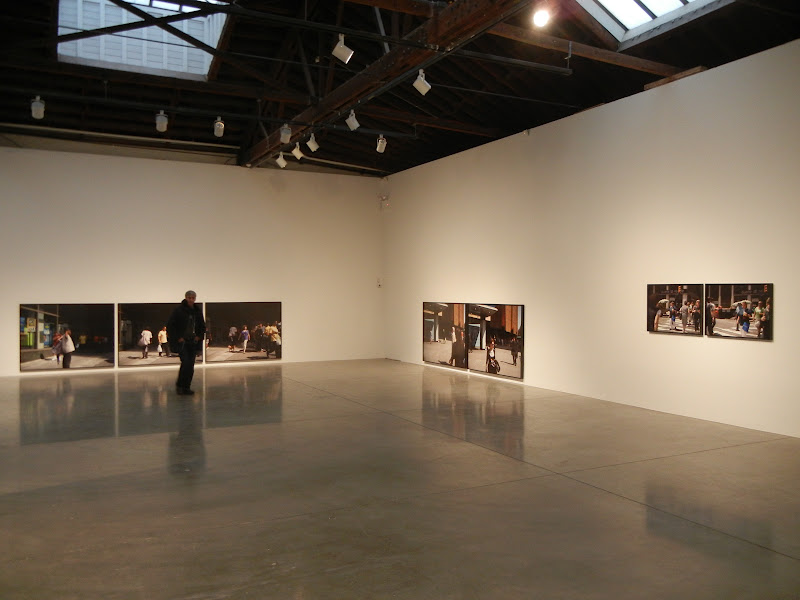
JTF (just the facts): A total of 13 large scale color photographs, framed in either off white, blond or black wood and unmatted, and hung in the single large gallery space, which is divided into three separate viewing areas. All of the works are pigment prints mounted to either aluminum or Dibond, and made in 2011 or 2012. Physical sizes range from 63x83 to 88x146; the largest of the prints are available in editions of 3+1AP, while the rest are available in editions of 5+1AP. (Installation shots at right.)

Comments/Context: It's been nearly a decade since Richard Misrach surprised us all with his On the Beach series. Made in reaction to the September 11th attacks, his aerial images of Hawaiian beaches astounded us with their enveloping, monumental scale and subtly reminded us of our vulnerability out there alone in the water. While many of the images were bright and sunny, with clusters of colorful beachgoers arrayed at the water's edge, there was a sense of something vaguely unsettling lurking underneath, adding a layer of tension to the idyllic vacation paradise. Misrach recently went back to his Honolulu hotel room perch and made a new series of bird's eye view pictures of the sea and sand. While the subject matter is arguably the same and the massive scale has been repeated, the mood of these pictures is subtly different, slightly more relaxed and meditative.

There are really two sets of photographs in this show, one with figures and one without. The images without tiny isolated people expand into all over abstractions, where dappled light bounces off the wave tops creating endless patterns of ripples. Misrach's palette is quietly muted, running from soft blues, greens, greys and tans, to darker bronzes and blacks. Given their size, standing in front of one of these ocean images is like getting lost in painterly texture, the entire surface an amorphous, undulating series of blobs and squiggles. While their detail is staggeringly precise up close, the sense of scale is lost without any identifiers; the water fans out like a series of dunes, stretching on for what might be feet or miles.

When even a single small figure is introduced to the sea or sand, the abstraction collapses and our eye is drawn to the central character. Now we're drawn back into the realm of narrative, where a guy with a book over his face, a determined swimmer, or a body wrapped in a pink towel becomes the tentative basis for a story. The best image in this group captures a solitary woman on a surfboard, looking away to the expanse of ocean in the darkening afternoon; her wistful presence turns the scene into something out of a 19th century Romantic painting, with the tiny figure in the foreground to remind us of the awe inspiring majesty of the vista. While Misrach has retained the sense of separation and distance in these pictures, the foreboding feeling of the previous works has been replaced with a more easy going mood - instead of struggling against the endless water, his figures execute perfect handstands and playfully perch on each other's shoulders.

In revisiting this series, Misrach seems to have been less concerned with recapturing a certain temperament and more seduced by the nuances of detailed texture. The subtle undercurrent of menace that permeated the first project is generally gone, replaced by a deeper interest in the changing surface of the water and the shifting footprints in the sand. With the setting afternoon sun comes a sense of contemplation, a slow mulling over of the endless cycles of ebb and flow.

Collector's POV: The works in this show are priced as follows. The smallest 63x83 (plus or minus an inch or two in either direction) are priced at $55000 each. Intermediate sized works are either $65000 or $850000, and the largest works (88x146) are $90000 each. While this show is taking place at the Pace Gallery space on 25th Street, it is being jointly organized by Pace and Pace/MacGill Gallery (here). Richard Misrach is also represented on the West coast by Fraenkel Gallery (here).

Rating: * (one star) GOOD (rating system described here)

Transit Hub:
  • Features/Reviews: Daily Serving (here)
 
Through June 29th

Pace Gallery
510 West 25th Street
New York, NY 10001

Tuesday, November 27, 2012

Lee Friedlander: Nudes @Pace

JTF (just the facts): A total of 74 black and white photographs, framed in white/black and matted, and hung against white and grey walls in the large two room gallery space. The 56 prints by Lee Friedlander are all modern gelatin silver prints, taken between 1977 and 1991. The works are sized either 11x14 or 16x20 and are uneditioned. The 9 works by Bill Brandt are vintage gelatin silver prints, each sized roughly 9x8, and taken between 1947 and 1959. The 9 works by Edward Weston are vintage gelatin silver prints, sized either 4x5 or 8x10, and taken between 1933 and 1936. (Installation shots at right. There is no photography allowed in the gallery, so the images are courtesy of the Pace/MacGill website.)
 
Comments/Context: For many years after first seeing Lee Friedlander's nudes, I had a hard time enjoying them. As I look back now, I'm not sure I ever really even saw them in some sense. They were just too hairy, too confrontationally real in a way that I found unsettling, and as a result, I didn't engage them enough. It wasn't that they were excessively aggressive or explicit exactly, but more that they seemed to fly in the face of everything I thought I knew (and valued) about the elegant photographic nude. That joltingly contrarian book (Lee Friedlander Nudes) sitting on our shelves was somehow radioactive, bursting with an energy that was too far out of control for me. I would take it down and look at it from time to time with the trepidation of handling a ticking time bomb, quickly flipping through it and putting it back before it could explode.
 
This show brings together a selection of these challenging Friedlander nudes and places them on equal footing with works by the two most important and influential photographers of the nude from the 20th century, Edward Weston and Bill Brandt. A side room plays host to this brilliant juxtaposition, teasing out the visual ideas and motifs that tie Friedlander to his predecessors. Weston's nudes turn on close in framing to create unexpected body abstractions and employ plenty of elongated lounging forms (on the famous sand) built on sinuous lines. Brandt's early pictures use shadowy interiors to host mysterious models in chairs, while later images create their magic with the bold, fragmented distortion of curves and overexposed whites. With these two sets of images as a historical backdrop and artistic foil, it's possible to carefully follow the aesthetic connections and pathways between the photographers and to pinpoint Friedlander's new and original innovations.
 
While the often disorienting twisting and turning of bodies in Friedlander's nudes certainly has parallels in both Weston and Brandt, Friedlander's approach is neither sculpted perfection nor full force abstraction. His pictures are rooted in the mundane and the everyday, in real individuals rather than dreamy ideals. Young bodies sprawl on couches and chairs with effortless ease, spread across messy beds and bent over crumpled blankets, not far from cluttered coffee tables filled with cosmetics and ashtrays. The camera spins and looms, often lingering from above or cropping out the head. His flash creates brash highlights that bounce off up-close hips, breasts and flanks, with dark hairy armpits and crotches offset by the dated patterns of woven upholstery and fringed pillows. Just when you've been distracted by the intrusion of a clip-on lamp, the interruption of a protruding window frame, or the swirl of a floral patterned bedsheet, Friedlander delivers an unexpectedly graceful curve or arched arm that takes your breath away; his nudes move back and forth between direct, honest, small apartment realism and compositionally complex formal exercises. In every picture, the casual and ordinary have been transformed into something striking, a jumble of overlapping female limbs, crowded and serenely chaotic rather than merely pared down.
 
What's most important about this exhibit is how it so successfully shows both Friedlander's respect for the past and his own one-of-a-kind rule breaking vision. There are obvious echoes of Weston and Brandt here, but those influences have been thoroughly digested, incorporated by Friedlander and then evolved in his own direction for several more iterative generations. The result is a body of work that is at once familiar and foreign, reverent and shockingly irreverent. All in, this is a show worth making a detour for. It finally led me to get over my own preconceived notions and prejudices about what the photographic nude is supposed to be, and to embrace Friedlander's nudes for the genius that they are.
 
Collector's POV: The prints in this show are generally priced based on size, with the 11x14 prints at $6800 each and the 16x20 prints at $8500 each. Outliers from this overall price pattern include the 11x14 image from the cover of the original Lee Friedlander Nudes book (at $7400) and the 16x20 images of Madonna (at $9500). Friedlander's work is routinely available in the secondary markets, with recent prices at auction ranging from roughly $2000 on the low end to as much as $80000 for his most iconic vintage prints. The Brandts (from David Dechman's collection) and Westons (from MoMA) are not for sale.
 
Rating: *** (three stars) EXCELLENT (rating system described here)
 
Transit Hub:
  • Features/Reviews: Daily Beast (here), NY Photo Review (here)
Lee Friedlander: Nudes
Through December 22nd

Pace Gallery
32 East 57th Street
New York, NY 10022

Monday, October 22, 2012

Lucas Samaras: XYZ @Pace

JTF (just the facts): A total of 17 large scale color photographs, mounted and unframed, and hung against white walls in the main gallery space and the smaller front room. All of the works are pure pigment on paper mounted on Dibond, made in 2012. Each print is sized 35x62 and is unique. The works come from four separate series: Flea (6 works), Pixel Cock & Bull (3 works), Chinoiserie (2 works), and Razor Cut (6 works). (Installation shots at right.)

Comments/Context: Given Lucas Samaras' history as a consistently innovative photographic manipulator and his repeated use of chaotic distortions and bright psychedelic colors, it seems only natural that he would eventually fully embrace the power offered by the digital realm. His newest works show his gradual conversion to the religion of Photoshop, starting with relatively tame and simple effects and quickly progressing to wilder and more outlandish all-digital flights of fancy. Like Gerhard Richter (here) and Alfred Leslie (here), Samaras is yet another well established artist extending his aesthetic into computer-based imagery.

The works in the front gallery still have some ties to a real world camera. Starting with photographs taken at flea markets, Samaras has used mirroring and partial pixelization to deform the existing images. Army coats, colorful fabrics and leather boots are broken up into small tiles, almost like irregular painted mosaics or armadillo skin. Sophisticated Photoshop jockeys will likely be underwhelmed by these transformations.

Samaras has completely abandoned his camera in the works in the main gallery, diving into the uncharted depths of in situ digital creation. In the Pixel Cock & Bull series, a radiant rainbow of colored squares is twisted and squished into a dense kaleidoscope of graphics. The same pattern is wrapped around an orb, wallpapered down a perspective driven hall, and mirrored into slashing Xes. In the Chinoiserie series, multiple layers of undulating lines are woven into monochome grids and plaids, which are then punctuated by beaming blobs of psychedelic brightness. Samaras takes these ideas even further in the Razor Cut works, where vaguely human forms have been built out of abstract graphics and gradients. Is that a pirate with dreadlocks standing on a flat line beach? Or a feathered Native American dancing like a digital Kachina doll? Are those other "bodies" insectile aliens with long fingers? The graphics explode with unreal neon craziness, the hint of a face traced onto a spinning cluster of flashy lines. He takes the most risks with these images, and the best ones get beyond winking, paint program trickiness to something more fast and furious.

One of the challenges I think a lot of artists are facing when using Photoshop and other digital manipulation tools is that the resulting pictures become tool-driven rather than artist-driven. What I mean is that the artist is so excited and energized by what the software engineers have developed that they fail to really make the tools their own. The danger is work that ends up looking like a great example of how the tool can be used rather than something personal and durably original. With the benefit of hindsight in a few years, I think we will see these particular works by Samaras as a transition point, caught between the old and the new and not yet fully realized in terms of a true and radical Samaras vision of digital composition. But as signposts pointing to the future, I think we can now expect something appropriately remarkable yet to come.

Collector's POV: Each of the works in this show is priced at $38000. Samaras' work has only been sporadically available in the secondary markets in recent years. Aside from the Polaroid sale a few years ago, where a new record was set for his work ($194500) and many of his other vintage images sold for five figure prices, Samaras' work has been relatively affordable, with most lots selling at auction for under $10000.

Rating: * (one star) GOOD (rating system described here)

Transit Hub:
  • Reviews/Features: W (here), Garage (here)
Lucas Samaras: XYZ
Through October 27th

Pace Gallery
508 West 25th Street
New York, NY 10001

Monday, March 5, 2012

Paul Graham: The Present @Pace

JTF (just the facts): A total of 16 color works, framed in black and unmatted, and displayed in the entry and a winding series of three large rooms. There are 14 diptychs and 2 triptychs in the show, many hung very near the floor. All of the prints are pigment prints mounted on Dibond, with individual panels sized either 28x38 or 56x74. The works were made between 2009 and 2011, and are all available in editions of 3+2AP. The images are titled precisely by location, date, and exact time of day, down to the second. A monograph of this body of work is being published by Mack Books (here). (Installation shots at right.)
.
Comments/Context: Paul Graham's new street photographs are undeniably the most thoughtful body of new photography I have seen this year. I use the word thoughtful with special care in this case, in that there is a sense of deep, persistent, historically-aware thought that lies as a backdrop to these images. Graham has taken the traditions of the genre of street photography and systematically and meticulously destroyed them. This disassembly exercise is not a rebellious, thumbing his noise at history stunt, but instead a cerebral investigation of and meditation on the true nature of street photography. These pictures break every rule about what masters like Winogrand, Callahan, Meyerowitz, Friedlander and others have trained us to expect, and thus require a kind of mental rebooting to get into them. But once inside, there is a strong sense of Graham innovating within the confines of photography, rather than trying to show that he can go somewhere else. He is firmly rooted in the nature of straight photographic seeing, but he continues to ask questions about its limits.

My first reaction to these pictures was a profound sense of being entirely underwhelmed. The images are extremely unassuming, stepped back in space, with subjects basically centered, with a narrow band of focus positioned on the main figure. People walk past on sidewalks, exit from banks and fast food restaurants, cross streets, and linger outside landmarks like Penn Station. Aside from one woman who trips and falls, there is a singular lack of noteworthy action. Unlike every other street photograph you have ever seen, there is no coalescing of something dramatic, no juxtaposition of something ironic, no lucky matching of something happening. Most notably, there is no obvious narrative, no succinct, lucid story being neatly told in a single frame. In fact, nothing happens at all - people pass and move on; the flow of time continues.

Using pairs and triplets of images taken in the span of a few seconds, Graham shifts our attention away from traditional storytelling, making us see how his eye has wandered. His focus moves from one figure to the next, or to one in the foreground or background, quickly shifting and darting from moment to moment. A woman eating a banana traverses a crosswalk; a fraction of a second later, a blind man with a cane is right behind her. In the span of three frames, his focus moves from an apparently homeless man, a man with a plastic shopping bag, and a woman with a poodle, a bunch of tourists getting a sidewalk pitch from a tour salesman lingering in the blurry periphery. There is no clever connecting theme, no visual thread to unravel. Graham is exploring both the nature of eye movement and the compressing and expanding of time. Let me be clear, this is not cinematic. It is a jumpy, erratic progression, elusive and imperfect.

This is not to say that these selections are void of wit. Some of the pairings are quietly tricky: a man with an eye patch followed by a man winking, a woman with bright orange hair followed by another drinking orange soda, a man in a dapper suit followed by his alter ego in rags (in exactly the same spot), a policeman leaving a drugstore followed moments later by a mailman. Graham's powers of observation are clearly on high. But he has refused to follow the agreed upon rules. His pictures are about the interaction of time and photography, and about the uncertainty of selective focus. It's as though there is a "normal" street photograph to be had in all these fragmentary scenes, and yet Graham has opted instead for its alter ego, its negative.

For those who would claim that everything has been done in a genre like street photography, Graham's work is proof positive that there is always room for frame-breaking, original innovation. His images are both an homage and a deconstruction, an appreciation and a rejection. In some ways, they aren't about the images at all, but about capturing the in-the-moment present tense of the street that swirls and changes continually around us without ever being actively noticed. The only reason I can't find my way to three well-deserved stars for this show is that I find the pictures so disposable and boring. Of course, I know, this is exactly and entirely the point, but my mind is hard wired to seeing in the old way, and I need some more time to get my head around experiencing the world as gaps and absences. But without a doubt, the ideas here are revolutionary, and they merit a robust, public airing, if only to show that we can still coherently parse this ever-changing medium. This is the kind of show we should be talking about, folks, not the packaged-for-easy-consumption art with which we are all too familiar.

Collector's POV: The works in this show are priced as follows. The smaller "stacked" diptychs (28x38 panels) are $35000 each. The larger diptychs (56x74 panels) are $65000 each. The triptychs are $80000 each. Graham's images (from all periods of his career) have been remarkably absent from the secondary markets for photography, so gallery retail is still likely the best option for interested collectors at this point.
.
Rating: ** (two stars) VERY GOOD (rating system described here)
.
Transit Hub:
  • Artist site (here)
  • The Unreasonable Apple essay (here)
  • Artforum 500 words (here),
  • Reviews/Features: Financial Times (here), LPV (here)
Paul Graham: The Present
Through April 21st

The Pace Gallery
545 West 22nd Street
New York, NY 10011

Thursday, December 2, 2010

Hiroshi Sugimoto: The Day After @Pace

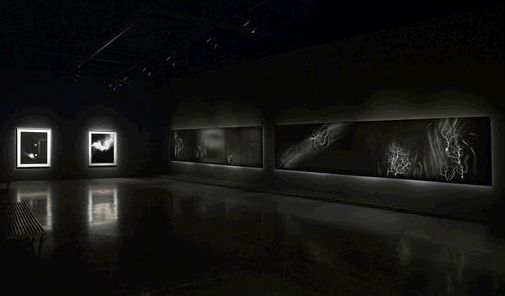
JTF (just the facts): A total of 21 black and white photographs, 2 fossils in glass cases, and 1 sculpture, displayed against grey and black walls in a winding series of four connected spaces. The first small room contains 3 gelatin silver prints (from the diorama series), framed in black, and two fossils (one meteorite fragment and one slab of Mississippi sea bottom), displayed in low light against grey walls. 2 of the prints are 20x24 from 1992, in editions of 25, the other is 47x73, in an edition of 5. The larger front and back rooms have black walls and are completely dark, with bright spot lights on the works. In each room, a pair of monumental gelatin silver panoramas are hung side by side, covering an entire long wall. Each unframed panorama is made up of 6 panels, each entire work measuring 59x23 and 1/2 feet, printed in editions of 5. There are a total of 7 single image gelatin silver lightning field prints spread across the two rooms, framed in silver with no mat, each 59x47, also printed in editions of 5. The sculpture is set apart in the front room, a Tesla coil in birdcage on a stand. A narrow room is situated between the front and back rooms, with grey walls and bright natural light from the overhead skylight. This room contains 7 gelatin silver seascapes from 1987-1993, framed in silver with no mat, each 47x59, printed in editions of 5. A catalogue of the exhibition is available from the gallery for $50. (Installation shots at right, via Pace.)

Comments/Context: Hiroshi Sugimoto's first show at Pace (having recently joined the stable from Gagosian) is a potent reminder of the power of presentation. Rather than offer a predictable sampler of new and old work in this cavernous space, the artist has used architecture (dividing walls and rooms) and lighting (both dark and light) to transform the viewer's experience, controlling the narrative flow and recontextualizing the prior work in new and unexpected ways. The gallery has evolved from a formless white space into a rich storytelling environment to be experienced, where the production values of the entertainment have become almost as important as the work itself.
.
The two largest rooms in the show are broad open spaces, subdued by the blackness that envelops them. The only light in these two rooms is provided by the spot lights on the artworks, highlighting the bright flashes of white energy that emerge from the darkness. These Lightning Fields are Sugimoto's newest works, made by using a spark generator to deliver blasts of energy to the film's surface. The artist has likened these images to the crashing of meteorites into the Earth's original primordial soup, introducing energy and foreign chemical compounds into our environment and sparking the creation of life. His monumental panoramas stretch across two long walls (nearly 50 feet), mixing flashes of brightness with textured glimmers and black spots, like growths emerging from the nothingness. Some of the single images are mostly dark, with just a small cluster of delicate incandescent white, while others have evolved into long, thick tendrils of light, like arteries or serpents or ropes, often with tiny fingers branching out and extending from the sides. A few even look like aerial landscapes of dry river beds, with washes of sizzling whiteness cut into the blackness of the land. While many of these works have an organic, natural violence to them, the less successful ones look more like scientific figures from a scholarly paper in Science or Nature, showing some arcane but beautiful properties of electromagnetism. Sugimoto is walking the fine line between art and science here, with varying degrees of memorable aesthetic success. And just when I thought I had absorbed it all, the gallery experience was punctuated by the buzzing crackle of the Tesla coil sculpture, which explodes into a flash of blue light every few minutes, jolting and attacking the viewer with its raw, dangerous power. All I needed was a shard of meteor to crack me on the head in the dark and the visceral experience would have been complete.
.
The show also contains a selection of seascapes and dioramas, work we have seen many times before, but which has been reimagined here in the context of Sugimoto's "beginning of the world" narrative. The seascapes have been hung a narrow room with heavenly pure light, all of them day views, including the one at the end of the space which is bathed in glare. What I found fascinating is that they no longer seemed to me to be sublime exercises in timeless meditative contemplation. Instead, these images were transformed by the installation into documents of a specific ancient place and time, when the world was covered by seas in every direction, a kind of alien water planet. The tight installation creates the feeling of being in the middle of it all, surrounded by the flat expanse as far as the eye can see. Similarly, the small room at the entry of the show gathers a few of Sugimoto's natural history dioramas. But there are no familiar polar bears and jackals here, only puzzling biological forms attached to sandy sea bottoms. Juxtaposed with a few fossils (not unlike his spectacular show at the Japan Society a few years ago), and once again, the images have been reimagined. Now instead of a witty inversion of fake and real, the dioramas are documenting yet another period of specific time, as the first organisms started to form and develop. The show thus becomes a continuous historical timeline, from the first sparks of unruly energy to the evolution of life in many forms. While there is still a bit of the "old wine in a new bottle" feel here, I was amazed at how thoroughly the old work could be successfully reconsidered in relation to the new images.
.
Overall, this show gets high marks for its careful construction, and for creating a whole that ingeniously integrates several disparate bodies of work that were previously unconnected. Given the chance element associated with the creation of the lightning field images, it is not at all surprising that some bolts of light are much more interesting than others. That said, I once again came away genuinely impressed with Sugimoto, both as a risk taking scientifically-minded artist and as a surprisingly talented and original showman.
.
Collector's POV: The works in this show are priced as follows. The large panoramas are $750000 each, the seascapes are $400000, the single image lightning fields are $80000, and the dioramas are either $120000 or between $20000 and $25000 based on size. Sugimoto's work is readily available at auction, at a variety of price points. His Time Exposed portfolio can generally be had at auction for between $3000 and $11000. Small individual prints (in the range of 20x24) typically range between $10000 and $90000. The largest prints (seascapes, wax portraits and architecture) have recently started at $100000 and continued all the way up to over $1 million.

Rating: *** (three stars) EXCELLENT (rating system described here)

Transit Hub:
  • Artist site (here)
  • Reviews/Features: NY Times (here), New Yorker (here)
Through December 24th

The Pace Gallery
545 West 22nd Street
New York, NY 10011

Friday, November 19, 2010

Lucas Samaras: Poses/Born Actors @Pace

JTF (just the facts): A total of 118 color photographs, framed in black and matted, and hung against grey walls in a winding series of connected spaces. All of the works are pure pigment on paper, each sized 32x18 and printed in editions of 3. The images were made in 2009 and 2010. A catalogue of the exhibition is available from the gallery for $40. (Installation shots at right.)

Comments/Context: Lucas Samaras has made a career out of transforming portraiture, extending its boundaries in new and unexpected directions. Long before the advent of Photoshop, he was playing with ways to alter reality, from distorted manipulated emulsions to wild colored stage lighting. His newest works continue to upend conventions, taking the standard beauty of the headshot portrait and digitally recasting it as a buoyantly ghoulish riff.
.
Gathering his subjects from the art world, Samaras has amplified the photographic drama by lighting the faces from below, creating weird shadows and exaggerated highlights. Many of his sitters have agreed to wear glasses, either normally or perched lower on their noses, adding another layer of reflection and refraction, often drawing angled shadows like horns or wings across their faces. While these effects might be enough to add an element of theatrical performance, it is Samaras' splashes of outrageous color that create the eye-popping oddities. In otherwise normal black and white images, metallic, opalescent color is selectively introduced, making irises bright yellow or lime green, the edge of a shirt neon blue or hot pink, the shadow under a chin a psychedelic rainbow of heat. Swirling oil slicks of color are poured into neutral backgrounds and shimmering streaks are applied to powerful, wrinkled faces like crazy eye makeup or lipstick. Normal faces become diabolical and demonic, surreal in their hidden malevolence. In one startling distorted portrait, a man's neon yellow face peels away to reveal another layer underneath, his eyes blue in one layer and green in the next.

Samaras' approach has been applied to a parade of famous artists, collectors, curators, writers, gallery owners, and museum trustees, creating a gallery of well known faces, from Jasper Johns, Chuck Close and Cindy Sherman, to Leonard Lauder, Agnes Gund and Glenn Lowry, seen not with perfect respect, but with a tinge of playful malignancy. It's a thoroughly entertaining approach, for those both known and unknown, as the series of everyday faces becomes something altogether more alien and sinister. The show is certainly one of the most gleefully mischievous exhibits I've been to in quite a while, showing once again that Samaras has a nearly endless reserve of ways to undermine traditional portraiture.

Collector's POV: All of the works in this show are priced at $16000 each. Samaras' work has not been widely available in the secondary markets in recent years, with only a few lots coming up for sale here and there. Aside from the recent Polaroid sale, where a new record was set for his work ($194500) and many of his other vintage images sold for five figure prices, Samaras' work has been relatively affordable, with most lots selling at auction for under $10000.

In my view, these Samaras portraits have the potential to be the next hot commission, the must have of the moment for many collectors. I suppose that for those that take themselves too seriously, there is the potential to hate these pictures. But for others with a more playful sense of humor, a portrait in this freakish style could become an amazingly fun family heirloom.

Rating: ** (two stars) VERY GOOD (rating system described here)
.
Transit Hub:
  • Reviews/Features: Artinfo (here), Daily Beast (here), Vanity Fair (here), Interview (here), W (here)
Lucas Samaras: Poses/Born ActorsThrough December 24th

534 West 25th Street
New York, NY 10001