Showing posts with label Chuck Close. Show all posts

Monday, June 24, 2013

The Polaroid Years: Instant Photography and Experimentation @Lehman Loeb Art Center/Vassar

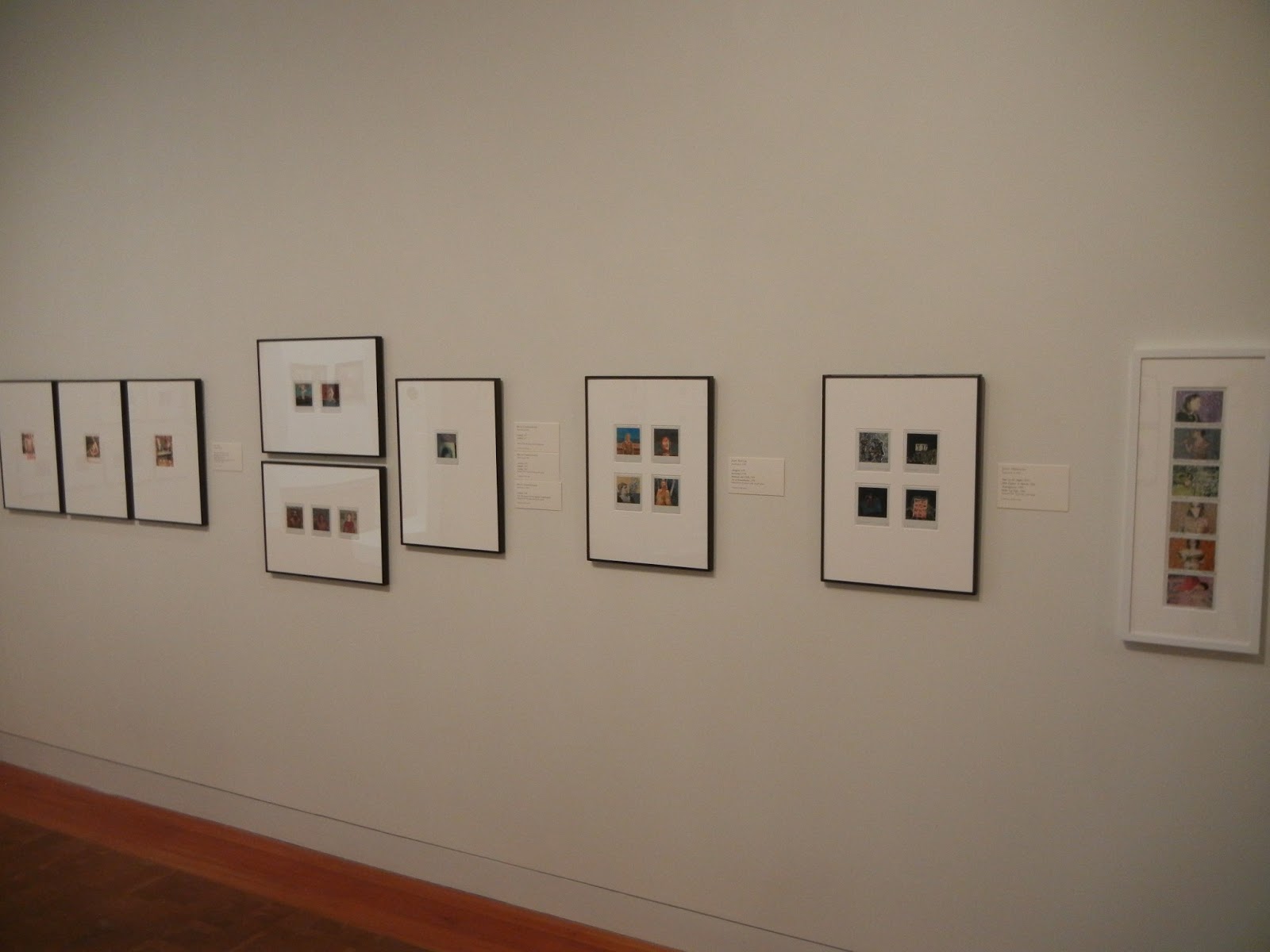
JTF (just the facts): A group show of 41 artists/photographers, variously framed and matted, and hung against white walls in a series of four dimly lit rooms on the first floor of the museum and in one small gallery on the second floor. The works use a variety of Polaroid processes and were made between 1969 and 2013; nearly all of the works on view are unique. Physical sizes range from roughly 4x3 to 77x62 (multiple images). A catalog of the exhibit was recently published by Delmonico Books/Prestel (here) and is available in the bookshop for $50. (Installation shots at right.)

The following artists/photographers have been included in the show, with numbers of works on view, print details and dates as reference:
  • Ansel Adams: 4 SX-70 prints, 1972
  • Jack Butler: 5 SX-70 prints, 1978
  • Ellen Carey: 1 set of 6 Polacolor Type 108 prints with nail polish, 1977, 1 large format Polaroid ER print, 1994, 1 large format Polaroid print, 2003
  • Carter: 8 Polaroid prints (4 diptychs), 1970-2007, 2 Polaroid prints, 2005 (in glass case)
  • Bruce Charlesworth: 6 SX-70 prints with acrylic paint (1 triptych, 1 diptych, 1 single image), 1977-1980
  • Chuck Close: 1 set of large format Polacolor prints, 1979, 1 set of 9 dye diffusion transfer prints, 1979, 1 large format Polacolor print, 1980
  • Anne Collier: 5 Polaroid prints, 2004
  • Laura Cooper/Nick Taggart: 1 set of 120 Polaroid Type 667 prints, 1993-2013
  • John Coplans: 1 three paneled frieze of 9 Type 55 prints, 1997, 1 set of 5 dye diffusion transfer prints, 1986
  • Marie Cosindas: 2 dye diffusion transfer prints, 1966
  • Philip-Lorca diCorcia: 9 Polaroids, n.d.
  • Charles and Ray Eames: 1 color film, 1972
  • Walker Evans: 8 SX-70 prints, 1973/1974 (in glass case), 1 SX-70 camera (in glass case)
  • Bryan Graf: 9 Polaroid Type 600 prints, 2008-2013, 1 Polaroid print and 1 black and white Fiber print, 2010
  • Richard Hamilton: 4 artist's books with Polaroid plates, 1968-2001 (in glass case)
  • Robert Heinecken: 8 SX-70 prints with offset lithography, 1979 (in glass case), 5 large format Polacolor prints, 1983
  • David Hockney: 2 composites of SX-70 prints, 1982
  • Barabara Kasten: 1 large format Polacolor print, 1982
  • Andre Kertesz: 4 SX-70 prints, 1979/1984
  • Les Krims: 3 archival pigment prints from SX-70 prints, 1974/later
  • David Levinthal: 1 large format Polacolor ER Land print, 1990, 4 SX-70 prints, 1983-1985
  • Miranda Lichtenstein: 5 Polaroid prints, 2002-2005
  • John Maggiotto: 8 SX-70 prints, 1983
  • Andreas Mahl: 1 SX-70 emulsion transfers with hand coloring, 1981/1984
  • Robert Mapplethorpe: 4 Polaroid prints (1 diptych, 2 single images), 1972-1974
  • Joyce Niemanas: 4 SX-70 prints with paint, 1979-1980, 1 montage of SX-70 prints, 1981
  • Catherine Opie: 14 Type 600 prints (1 set of 9, 1 set of 4, 1 single image), 2004
  • Lisa Oppenheim: 5 c-prints, 2008
  • Beatrice Pediconi: 6 Polaroid prints, 2009-2011
  • Victor Raphael: 1 Polaroid 600 print with acrylic, 1985, 3 Polaroid Spectra prints with metal leaf, 1990-1997
  • John Reuter: 4 SX-70 prints with acrylic paint, 1978
  • Lucas Samaras: 7 SX-70 prints, 1973/1974, 3 dye diffusion transfer prints with applied color, 1970/1971, 1 collage of Polaroid type 808 prints, 1984
  • Dash Snow: 2 Polaroid prints with masking tape and paint, n.d., 11 SX-70 Prints, n.d. (in glass case)
  • Paul Thek: 3 Polacolor prints, 1969 (in glass case)
  • Mungo Thomson: 10 Polaroid Type 600 prints, and 1 cartridge card, 2009
  • Andy Warhol: 3 Polacolor Type 108 prints, 1977, 3 Polacolor 2 prints, 1981, 2 Polacolor prints, 1981-1982/1986
  • William Wegman: 2 large format Polacolor prints, 2005
  • James Welling: 4 chromogenic prints from original Polaroids, 1975/1976
  • Grant Worth: 4 Polaroid Type 600 prints, 2006
  • Grant Worth/Micki Pellerano: 2 Impossible Project Fade to Black prints, 2010
  • Grant Worth/Mark Spalding: 4 Type 600 Wild Sides prints, 2005 (in glass case)

Comments/Context: The long sweep of photographic history can in many ways be boiled down to a never ending series of experiments with processes and materials for image making; technology has never been very far from the center of the medium. From the daguerreotype to the digital file, artists have continually embraced new technical innovations, only to immediately try to break them, defining their strengths and weaknesses and testing their limits. In each case, the question of "what is it good for" has been explored with relentless imagination. This show follows the winding path of Polaroid, from its hand held SX-70 instant camera to its massive large format cameras and films, tracing singular experiments by a variety of artists across nearly four decades. The exhibit doesn't try to be a comprehensive history of the company, its inventions, or the best artworks made by its many users, but instead offers a tight sampler of how artists' have pushed and pulled at the constraints of the Polaroid technologies and exploited the specific properties of its many photographic processes.
 
Starting in the early 1970s, he develop before your eyes process of the SX-70 was a major source of creative destruction for a wide range of artists. After the prints were ejected from the camera, they were subjected to a dizzying array of manipulations, breaking down the chemistries in unintended ways to create expressionistic gestures and chance-driven alterations. Lucas Samaras transformed nude self-portraits into swirling, melting body parts, while John Reuter cooked his prints and then split them apart to add paint inside the sandwich. Les Krims poked and prodded, while Bruce Charlesworth erased and over painted; Victor Raphael added metal leaf, while Dash Snow experimented with burning - the SX-70 encouraged a flourishing of active modification, both in the past and more recently. 
 
The immediacy of the small square format image of SX-70 was also a compositional challenge for many photographers. Recognized masters like Ansel Adams, Walker Evans, and Andre Kertesz, embraced the SX-70 and found ways to make pictures in their own styles within its limitations. Others (like Philip-Lorca diCorcia and Andy Warhol) used the camera for test shots and intermediate images that later became the raw material for finished artworks. David Hockney and Joyce Neimanas took hundreds of prints and collaged them into jittering, multi-perspective mosaics. And both Robert Heinecken and Catherine Opie pointed the camera at the television, fitting fragments of the screen into the tiny frame.
 
At the other end of the size spectrum, Polaroid's large format cameras opened up new avenues for experimentation with photographic scale. Chuck Close's massive self portraits are perhaps the most well known example of this explosion in size (and there are several big faces on view here), but many other artists also embraced the precision of the 24x20 camera. Solid examples from David Levinthal, William Wegman, and Barbara Kasten point to a diversity of styles and approaches, and Ellen Carey took the issue to its extreme with her Pull series, where monumental 40x80 emulsions are stretched and elongated into surfboard like abstract forms.
 
Interspersed among these larger themes are surprising one-offs and unexpected twists: frozen prints, photographs of photographs, sexy bodies and porn, overpainted nail polish, silky emulsion transfers, experiment after experiment. While not every work in this show is entirely memorable, there is something invigorating about such a blossoming of trial and error. Artists of all shapes and sizes took the Polaroid processes through their paces and did things the inventors would never have dreamed were possible. The show is an insightful reminder that deliberately exceeding the posted limits and purposely getting it exactly wrong can often be the road to something new and original.
 
Collector's POV: Given this is both a diverse group show with many artists' work on view and an exhibit taking place in a museum venue (thereby no posted prices), a discussion of specific prices and secondary market history will be omitted for this review.
 
Rating: ** (two stars) VERY GOOD (rating system described here)
 
Transit Hub:
  • Features/Reviews: New York Times (here), Wall Street Journal (here), Economist (here), PetaPixel (here)

Through June 30th
 
Vassar College
124 Raymond Avenue
Poughkeepsie, NY 12604

Friday, May 10, 2013

Photography in the 2013 Pulse Contemporary Art Fair, Part 1 of 2

After stepping out of the drenching late morning rain with squelching shoes, I hit the ground running at Pulse yesterday and was surprised to find plenty of noteworthy photography on view. The mix was decidedly new and emerging, with very little vintage work and few marquee names on display. I've broken the report into two parts, given the large group of photographs worth talking about.

My approach to fair reporting continues to evolve, and following up on the positive feedback from my recent more image-centric AIPAD summary (here), I have once again opted for less tallying and counting of every last picture, spending more time on image highlights. What you'll find below is an edited sample of what I found unusual or unexpected, with gallery names/links followed by the artist/photographer name, the price of the work, and some notes as appropriate.

z20 Galleria/Sara Zanin (here): Beatrice Pediconi, €8500. What looks like a misty Donald Sultan smoke ring is actually a diffusing paint in water motion study.


Steven Kasher Gallery (here): Daido Moriyama, $12000. Gritty checkerboard tile turned into a subtly shifting texture exercise.


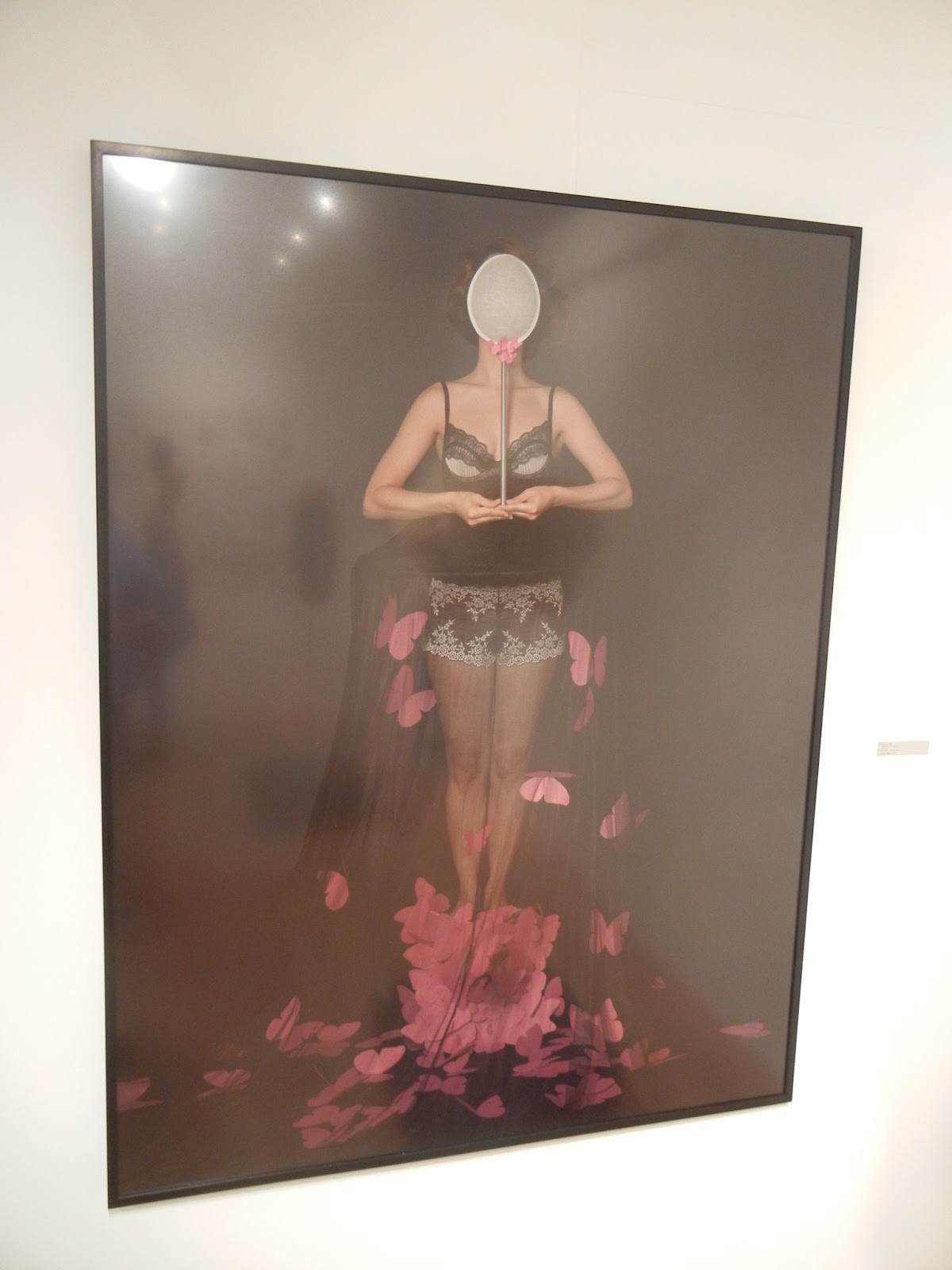
Nohra Haime Gallery (here): Natalia Arias, $10000. A hybrid concoction of female imagery and transforming butterfly motifs.


Pablo's Birthday (here): Thorsten Brinkmann, $16200. Elegant portraiture cleverly upended by found object sculptural assemblage.


Adamson Gallery (here): Chuck Close, $25000. The mottled, shifting color background of this daguerreotype silhouette of Kara Walker gives it a mysterious mood.


Galerie Stefan Röpke (here): Aitor Ortiz, $7250. Futuristic wire mesh abstraction, full of waves and overlaps. A bit reminiscent of Moriyama's legs in mesh tights.


Von Lintel Gallery (here): Amanda Means, $4900. I liked the chance splash technique in this gridded off darkroom abstraction, almost an echo of Chuck Close's painting approach but reconsidered in a photographic process context. From afar, the work looks like it is fluttering in the wind.


Galeria Habana (here): Liset Castillo, $8500. Sand sculptures that show off smart texture contrast, from smooth molded forms to rough remainder.


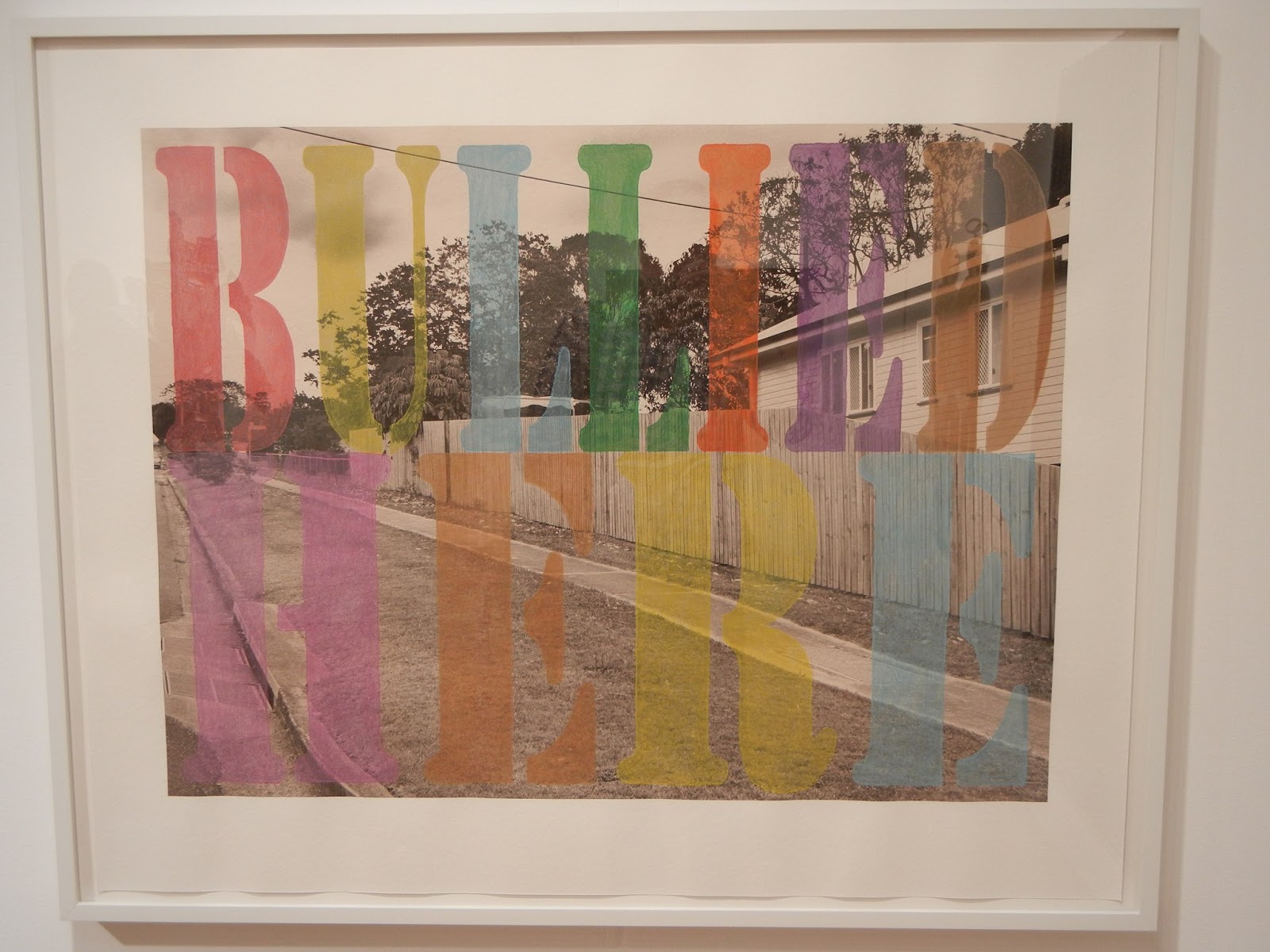
Tyler Rollins Fine Art (here): Tracey Moffatt, $10000. Seemingly mundane black and white scenes overlaid with colored stencils implying hidden histories. Deborah Luster has been here already, but the letters add a bold graphic element.


Waltman Ortega Fine Art (here): Rune Guneriussen, $6900 and Aleix Plademunt, $3600. Both of these artists are playing with performative interventions in landscape. Guineriussen's winding path of man-made lights through the nighttime snow is jarringly magical, while Plademunt's array of chairs flanking the nuclear power plant seems more confrontationally conceptual.


Continue to Part 2 of this report here.

Wednesday, April 24, 2013

Chuck Close Photo Maquettes @Eykyn Maclean

JTF (just the facts): A total of 26 black and white and color works, framed in white/blond wood and unmatted, and hung in the front and back galleries and the connecting hallway space. The show also includes 1 silkscreen, 1 woodcut, 1 etching, and several studio photographs of the artist at work on specific paintings. The unique photo maquettes are either gelatin silver, black and white Polaroid, or color Polaroid prints, often mounted to foamcore and covered with tape, ink, graphite and other materials. The final works range in size from roughly 6x5 to 40x30, and were made between 1975 and 2012. In general, the maquettes are single images, although there is one set of 4 maquettes hung as a group. No photography is allowed in the galleries, so the installation shots at right are courtesy Eykyn Maclean; the artworks themselves are ©Chuck Close, courtesy Pace Gallery. A catalog of the exhibit is available from the gallery for $40.
 
Comments/Context: This tightly controlled retrospective of Chuck Close's intermediate photo maquettes is a crash course in artistic decision making. The works are the physical remains of his systematic process, the evidence of in-between steps and conceptual iterations along the way to the creation of his larger paintings. Seeing four decades of this richly physical raw material hung together highlights the evolving "how" of Close's work and gives clues to the changing nature of his artistic eye.

Aside from the precise detail afforded by his 24x20 Polaroid camera, Close's photographic portraits aren't particularly memorable, even when they capture the faces of famous artists or his own. Straight-on head shots against blank backgrounds are the norm, with slight variations in the turn of a head, a full profile, the angle of the light, or the color the backdrop the only tweaks to his consistent approach. Masking tape is used to crop in from the edge of the image, in some cases allowing the subject a little space to breathe, while in others, the frame squeezes in with claustrophobic snugness.

But the real interest in these maquettes lies in the grid lines. Starting in the mid 1970s, Close overlaid the source photographs with graphpaper-like pencil-thin grids, cutting the facial imagery into discrete boxes, each an individual fragment of visual information. His grids began as rigidly horizontal and vertical patterns, like a screen door, and over the early years, he experimented with different square sizes and spacings, generating varying sized image elements that could then be executed in sharp detail or more abstract blurs (like fingerprints or pigment marks). Seen up close, the decisions he had to make about where grid lines intersected in relation to the features of his subjects are fascinating (i.e. does the pupil of an eye fall in the center of the square or is it split between two squares? and how does that decision impact other joints and edges in the rest of the composition?). By the mid 1980s, Close turned the axis and introduced angled lines that rotate the squares into diamonds. Again, he iteratively tuned the spacing of the grids into smaller and larger elements, and placed line intersections at exact points, allowing the individual elements to be built into larger adjacent forms or forcing them into new shatter systems. The result is an approach that is at once elegantly simple in its conception, but that allows for nearly infinite complexity in its application.

Taken together, the maquettes prove that Close's career long study of analog pixelization has been extremely rigorous and thoughtful. In an age when photographic pixelization has become so commonplace, these works show that Close was way ahead of his time in terms of carefully puzzling over the problems of (and opportunities in) image fragmentation, taking foundation ideas from Pointillism and Impressionism and reconsidering them in a more machined manner. In the end, what's exciting is that there is still more conceptual exploring to do in this area - hang one of these maquettes next to a massive Thomas Ruff JPEG and there will be plenty of common thinking to be observed.

Collector's POV: The individual maquettes in this show are priced at either $85000 or $125000, with the set of 4 maquettes of Keith priced at $225000. Several of the works are NFS. Close's photographs have become more consistently available in the secondary markets in recent years, with prices ranging between roughly $2000 (works in large editions) and $300000 (generally large multi-part works).

Rating: * (one star) GOOD (rating system described here)

Transit Hub:
  • Artist site (here)
  • Features/Reviews: Elle (here), Interview (here), Huffington Post (here)
Through May 24th
 
23 East 67th Street
New York, NY 10065

Thursday, September 23, 2010

Auction Results: Post-War and Contemporary Art, September 16, 2010 @Christie's South Kensington

It was a lackluster start to the Fall photography season at the recent Post-War and Contemporary Art sale at Christie's in London last week, with only 2 of the top 7 photography lots finding buyers and the Total Sale Proceeds for photography missing the Total Low Estimate by a decent margin.

The summary statistics are below (all results include the buyer’s premium):

Total Lots: 46
Pre Sale Low Total Estimate: £231000
Pre Sale High Total Estimate: £337700
Total Lots Sold: 34
Total Lots Bought In: 12
Buy In %: 26.09%
Total Sale Proceeds: £159813

Here is the breakdown (using the Low, Mid, and High definitions from the preview post, here):

Low Total Lots: 27
Low Sold: 21
Low Bought In: 6
Buy In %: 22.22%
Total Low Estimate: £83700
Total Low Sold: £61813

Mid Total Lots: 16
Mid Sold: 12
Mid Bought In: 4
Buy In %: 25.00%
Total Mid Estimate: £144000
Total Mid Sold: £73000

High Total Lots: 3
High Sold: 1
High Bought In: 2
Buy In %: 66.67%
Total High Estimate: £110000
Total High Sold: £25000

The top lot by High estimate was lot 160, David LaChapelle, Deluge: Museum, 2007; it did not sell. The next highest lot by High estimate was lot 14, Thomas Ruff, m. d. p. n. 28, 2003; it too failed to find a buyer. The top outcome of the sale fell to lot 20, Chuck Close, Self-Portrait, 1980, at £25000. (Image at right, top, via Christie's.)

79.41% of the lots that sold had proceeds in or above their estimate. There was only one surprise in this sale (defined as having proceeds of at least double the high estimate):

Lot 151, Larry Clark, Teenage Lust, 1983, at £8125

Complete lot by lot results can be found here.
85 Old Brompton Road
London SW7 3LD

Wednesday, June 23, 2010

Auction Results: Photographs from the Polaroid Collection, June 21 and 22, 2010 @Sotheby's

The Polaroid sale earlier this week at Sotheby's turned out to be the feeding frenzy we all imagined it might be. In the evening portion of the sale, all 99 lots sold in a perfect "white glove" outing. The following day, the momentum continued through three more sessions, with an overall Buy-In rate just over a paltry 10% and Total Sale Proceeds that topped the estimate range by a wide margin. New auction records were set for both Ansel Adams ($722500) and Lucas Samaras ($194500).

Nine lots were withdrawn prior to the beginning of the sale, and so I have stripped them out of the analysis, as though they had never been offered. The revised summary statistics are below (all results include the buyer’s premium):

Total Lots: 473
Pre Sale Low Total Estimate: $6974800
Pre Sale High Total Estimate: $10661200
Total Lots Sold: 420
Total Lots Bought In: 53
Buy In %: 11.21%
Total Sale Proceeds: $12467622

Here is the breakdown (using the Low, Mid, and High definitions from the preview post, here). As you can see, the sale was strong across all price points:

Low Total Lots: 288
Low Sold: 256
Low Bought In: 32
Buy In %: 11.11%
Total Low Estimate: $1930700
Total Low Sold: $2422372

Mid Total Lots: 158
Mid Sold: 138
Mid Bought In: 20
Buy In %: 12.66%
Total Mid Estimate: $3890000
Total Mid Sold: $4610250

High Total Lots: 27
High Sold: 26
High Bought In: 1
Buy In %: 3.70%
Total High Estimate: $4840500
Total High Sold: $5435000
.
The top photography lot by High estimate was tied between three lots, all by Ansel Adams: lot 94, Ansel Adams, Moonrise, Hernandez, Mexico, 1941/1950s or 1960s, lot 97, Ansel Adams, Winter Sunrise, Sierra Nevada, From Lone Pine, California, 1944/1950s or 1960s, and lot 100, Ansel Adams, Clearing Winter Storm, Yosemite National Park, 1938/1950s or 1960s, each at $300000-500000. The top outcome of the sale was the Clearing Winter Storm mural at $722500 (image at right, bottom, via Sotheby's); the Moonrise mural went for $518500 and the Winter Sunrise mural brought in $482500.

Interestingly, only 67.62% of the lots that sold had proceeds in or above the estimate range, so there were clearly plenty of lesser known lots that didn't exactly fly off the shelves. Particularly for Adams, we may have seen the market struggle a bit to absorb all the work being offered. On the flip side, there were an astounding 77 "surprises" in this sale (defined as having proceeds of at least double the high estimate), with 35 of these bringing in more than triple the high estimate. These explosive lots are listed below:
.
Lot 1, William Wegman, Avalanche, 1982, at $30000
Lot 2, Lucas Samaras, Untitled (Self-Portrait with Hands), 1990, at $56250
Lot 3, Chuck Close, 9 Part Self-Portrait, 1987, at $290500 (image at right, middle, via Sotheby's)
Lot 5, Robert Rauschenberg, Japanese Sky I (from the Bleachers series), 1988, at $242500
Lot 6, David Hockney, Imogen+Hermiane, Pembroke Studios, London, 30th July, 1982, at $194500
Lot 13, Robert Frank, New York, 1972, at $46875
Lot 24, Lucas Samaras, Ultra-Large (Hands), 1983, at $194500 (image at right, top, via Sotheby's)
Lot 25, Lucas Samaras, Ultra-Large (Self-Portrait), 1983, at $122500
Lot 29, David Levinthal, Selected studies from Modern Romance, 1983-1985, at $23750
Lot 31, Lucas Samaras, Panorama, 1983-1986, at $62500
Lot 33, Robert Heinecken, Lessons in Posing Subjects, 1981-1982, at $98500
Lot 49, Andy Warhol, Bianca Jagger, 1979, at $25000
Lot 51, Andy Warhol, Farrah Fawcett, 1979, at $43750
Lot 52, Andy Warhol, Self-Portrait (Grimace), 1979, at $146500
Lot 53, Andy Warhol, Self-Portrait (Eyes Closed), 1979, at $254500
Lot 76, Imogen Cunningham, Unmade Bed, 1957/1960, at $146500
Lot 78, Minor White, Barns (Two Barns, Dansville, New York), 1954/1957, at $53125
Lot 83, William Garnett, Plowed Field, Arvin, Calif (Vertical Aerial 500 ft.), 1952/1957, at $50000
Lot 84, William Garnett, Nude Dune, Death Valley, Calif (Vertical Aerial about 500 ft.) (Sand Dune #1), 1953/1957, at $37500
Lot 115, Peter Beard, Selected Images, 1988/1993, at $31250
Lot 124, Lucas Samaras, Photo-Transformation, 1973, at $31250
Lot 130, Robert Mapplethorpe, Untitled (Spanish Woman), early 1970s, $12500
Lot 134, Joyce Tenneson, Suzanne (In Chair), 1986, at $28125
Lot 141, David Levinthal, Selected images from American Beauties, 1989, at $16250
Lot 173, Lucas Samaras, Selected Still Life Studies, 1978-1979, at $31250
Lot 177, David Levinthal, Selected images from Wild West, 1986-1987, at $17500
Lot 185, David Levinthal, Selected images from American Beauties, 1989-1990, at $34375
Lot 195, Robert Rauschenberg, North Carolina (from the Bleachers series), 1991, at $116500
Lot 210, Luigi Ghirri, From Still Life (3-D Glasses), 1980, at $34375
Lot 292, Various Photographers, Selected Portraits of Ansel Adams, 1960s, at $20000
Lot 336, Ansel Adams, Aspens, Northern New Mexico, 1958, at $46875
Lot 366, Laura Gilpin, The Rio Grande Yields its Surplus to the Sea, 1947/1957, at $28125
Lot 390, Minor White, Peeled Paint, Rochester, New York, 1959, at $43750
Lot 457, Walker Evans, Junked Cars, Connecticut, 1973-1974, at $6875
Lot 485, Ansel Adams, Sentinel Rock, Yosemite, 1981, at $31250

Complete lot by lot results can be found here.

Sotheby's
1334 York Avenue
New York, NY 10021

Friday, June 5, 2009

Chuck Close, Maquettes and Multi-Part Work (1966-2009) @Pace/MacGill

JTF (just the facts): A total of 17 works, many of which are diptychs or multi-part photographs, hung against white and yellow walls in the entry and two main gallery rooms. Most are framed in blond wood with no mat, with several pinned directly to the walls. The prints are a mixture of unique images and works made in editions of 7, 10, 15, and even 100, ranging from the mid-1960s to the present. (No photography is allowed at Pace/MacGill, so the installation shot at right is taken from their website.)

Comments/Context: I have had the good fortune to see Chuck Close make remarks at a few receptions and lectures in the past few years, and I am always surprised by both his crusty "seen-it-all" world weary demeanor and his repeated dismissals of photography as a medium; his comments have seemed a mixture of utter boredom with the discussion (and people) at hand and a desire to spark up a fire with some controversial zinger to keep the audience on its toes. In one room full of photography collectors and aficionados I was in, he started by saying the photography was easy to master, and ended by concluding that very few photographers ever found any original voice; perhaps both altogether true at some level, but certainly not what the crowd was expecting.

I suppose when you have been as successful as Close has for so many years, and with his fame surely generating incessant (and often annoying) demands on his time, it isn't altogether unexpected that caring much what other people think seems to have drifted down toward the bottom of his concerns. What is puzzling however is that given his rich knowledge of photography in myriad forms that he has decided not to engage in many meaningful public dialogues about the nuances of the process choices he has made over the years.

This show would be a fine setting for such a discussion: there are black and white and color Polaroids (taken with his massive Polaroid cameras), monochrome and color pigment prints, gelatin silver prints, Iris prints, daguerreotypes and lithographs all on view. To consistently use such a wide range of approaches can only be evidence of an artist who has become an expert in the technical and visual details of each and every one of them (and many others not on display which were likely reviewed and discarded), and who then thoughtfully chooses which process fits his vision of any particular work.

In fact, the whole premise of this exhibit is to untie the knots of Close's processes, to see the intermediate maquettes, working models, gridded proofs, and other photographic mock-ups he used, many of which became the basis for larger paintings. While a skeptic might call this group of works the recasting of in-process drafts as final artworks (complete with large swirling signatures for the status conscious), I saw it as a chance to see how Close had expanded the boundaries of his art by exploring all kinds of non-traditional photographic approaches that offered him different sets of tools to render his chosen subject matter.

While there are plenty of extra large, extreme closeups of various famous people (mostly artists) on view, I was most interested to see both a pair of nude torso daguerreotypes along with monochrome pigment prints made from daguerreotypes of Kate Moss (also nude); there were very real differences in scale, detail, tonality and overall viewer experience in these works, given their common heritage.

Overall, with some persistent looking, I found this exhibit to offer some subtleties that hadn't been covered elsewhere. Close clearly continues to have a unique vision, and even if photography is a side show in his own mind, it can still be exciting for the rest of us.

Collector's POV: The prices of the works in this show range all over the map, from $7500 for the lithograph to $175000 for the largest works; most range between $45000 and $85000. Close's photographs have become more available in the secondary markets in recent years, finding buyers under $10000 on the low end up (works in large editions) toward $200000 at the high end. In general, we continue to hold Close's work in high regard. Of late, we have spent some time considering a digital print of a Hydrangea daguerreotype Close made in recent years, as it would fit well with our collection of other florals and botanicals; we haven't gotten to purchasing one yet, but perhaps we will at some point in the future.

Rating: ** (two stars) VERY GOOD (rating system described here)

Transit Hub:

  • Hilton Kramer, NY Times 1981 (here)
  • Chuck Close: Self-Portraits 1967–2005, SFMOMA (here)
  • Lens Culture review of A Couple of Ways of Doing Something (here)
  • Daguerreotypes (here)


Chuck Close, Maquettes and Multi-Part Work (1966-2009)
Through June 6th

Pace/MacGill Gallery
32 East 57th Street
New York, NY 10022