Friday, November 12, 2010

Bernd and Hilla Becher, Water Towers @Sonnabend

JTF (just the facts): A total of 26 single image black and white photographs and 6 black and white typologies, individually framed in white and matted, and hung in the entry gallery and two of the rooms in the rear. All of the single image works are gelatin silver prints in editions of 5, made between 1978 and 1995 in New York city (while no dimensions were given, I believe these works are roughly 24x20). There are five 9-image typologies and one 15-image typology, again consisting of gelatin silver prints, made between 1972 and 2009 (the individual prints in these works appear to be roughly 20x16); the combinations in the typologies are never repeated, so they are all unique works. (Installation shots at right.)

Comments/Context: Grids of water towers by the Bechers have become so common that it's pretty hard to visit a major contemporary art museum and not bump into one. With such universal acclaim and ubiquitous display, it seems altogether possible that these works would somehow become overexposed, losing their visual power due to sheer repetition. And yet, their cool conceptualism and crisp execution keep them startlingly fresh; they never fail to stand out in a crowd.

My first reaction when I heard about this show was: what more can Sonnabend have to say about the revolutionary Becher water towers? Haven't they been completely covered already? And one of the back rooms of the show does provide a sampler of familiar typologies, the kind of work we have come to know and love: groups of bulb towers, concrete cylinders, towers with geometric bases or ones that open upward like funnels, some striped with vertical lines, all arrayed in rigid grids to highlight their architectural variations.

But what is both surprising and exciting are the other images that make up most of the show: iconic New York rooftop water tanks. I had never seen these pictures before; it's like the Bechers have made a conceptual valentine to the city. In each image, a single cone-topped wood barrel tank sits centered on some kind of iron mounting or platform. The cylindrical banded barrels are generally the same, except for the finials on the top that distinguish the two main manufacturers. But the Bechers theme and variation style finds hundreds of small details worth noting: tubes that run down the sides or from the bottom, arched ladders, brick backgrounds, sculptural frameworks of girders that hold the tanks in the air, patterns and geometries in the angles of bases. In nearly every picture, the dark black form of the tank looms against the white sky of the city, often with a contextual frame of surrounding buildings.

For the Bechers, these tanks are likely just another piece of vernacular industrial architecture to be codified and preserved, another form to be documented and explored. But I think local New Yorkers will find much more to connect with in these pictures. They combine both the exacting standards of the Bechers artistic vision with a tiny twinge of nostalgia for something authentic and original to this city, overlooked subject matter that is deep in the fabric of this particular, crazy place.

Collector's POV: The works in this show are priced as follows. The single image water towers from New York are $25000 each. The 9-image typologies are $117000 and the 15-image typology is $195000. The Bechers' work is consistently available at auction, with prices for single images ranging from $3000 to $34000 in recent years; typologies (including diptychs of two images as well as much larger groups) have ranged between $23000 to $176000. We continue to covet images by the Bechers for the city/industrial genre of our collection; what we'd really like to find is one of the smaller, earlier diptychs (with one large image on one side and a grid of nine smaller images as one on the other), but both locating such a piece and then having it be the right price (for us) have so far been elusive. But we keep looking.

Rating: ** (two stars) VERY GOOD (rating system described here)
.
Transit Hub:

  • Museum Collections: Met (here), Getty (here), Guggenheim (here), Walker (here)
  • Feature: Tate (here)
  • Interview: Art in Amercia, 2002 (here)
Through December
.
Sonnabend Gallery (artnet page here)
536 West 22nd Street
New York, NY 10011

Thursday, November 11, 2010

Auction: Photographies, November 19, 2010 @Sotheby's Paris

Sotheby's Paris has put together a strong various owner photographs sale to coincide with this year's Paris Photo. The auction of primarily vintage material is anchored by a deep selection of works by Edward Weston and Tina Modotti from their years in Mexico. (The prints come from the collection of Anita Brenner, who sat for the stunning nudes on offer.) There are also solid groups of images by Eugène Atget and Heinz Hajek-Halke, as well as standout vintage prints by Gustave Le Gray, Richard Avedon, and Manuel Alvarez Bravo. Overall, there are a total of 152 lots on offer, with a Total High Estimate of 3228300€.

Here's the breakdown:
.
Total Low Lots (high estimate up to and including 7500€): 39
Total Low Estimate (sum of high estimates of Low lots): 223300€

Total Mid Lots (high estimate between 7500€ and 35000€): 98
Total Mid Estimate: 1605000€

Total High Lots (high estimate above 35000€): 15
Total High Estimate: 1400000€
.
The top lot by High estimate is lot 41, Edward Weston, Nu (Anita Brenner), 1925, at 150000-200000€. (Image at right, top, via Sotheby's.)

Here is a short list of the photographers who are represented by five or more lots in the sale (with the number of lots in parentheses):

Edward Weston (23)
Eugène Atget (15)
Heinz Hajek-Halke (12)
Irving Penn (8)
Tina Modotti (7)
Josef Sudek (7)
André Kertész (5)
Heinrich Kühn (5)

Since we are flower collectors, we are particularly interested by lot 63, Karl Blossfeldt, Bullota Ruperstris, c1920 (image at right, bottom, via Sotheby's). While we already own one image by Blossfeldt, his work does not come up at auction very often, so we are always keen to check out those prints that do surface from time to time.
.
The complete lot by lot catalog can be found here.

November 19th

76, Rue Du Faubourg Saint-Honoré
75008 Paris

Auction: Photographs, November 16, 2010 @Bonhams London

Following up on its New York Photographs sale last week, Bonhams has another Photographs auction scheduled for London next week. The sale includes mostly lower end material, with a solid helping of British photography. Overall, there are a total of 150 lots on offer, with a Total High Estimate of £477000.

Here's the statistical breakdown:

Total Low Lots (high estimate up to and including £5000): 130
Total Low Estimate (sum of high estimates of Low lots): £285000

Total Mid Lots (high estimate between £5000 and £25000): 19
Total Mid Estimate: £162000

Total High Lots (high estimate above £25000): 1
Total High Estimate: £30000

The top lot by High estimate is lot 43, Frantisek Drtikol, Nude Study, 1927, at £25000-30000. (Image at right, top, via Bonhams.)

Here is the list of the photographers who are represented by four or more lots in the sale (with the number of lots in parentheses):

Willy Ronis (15)
Brassaï (6)
Henri Cartier-Bresson (6)
Peter Henry Emerson (5)
Wolfgang Suschitzky (5)
Mario Giacomelli (4)
Horst P. Horst (4)
Angus McBean (4)
Sebastião Salgado (4)
Jürgen Schadenberg (4)
Jock Sturges (4)
André Villers (4)
.
Since we have a collection of vintage Brandt nudes, we would likely be interested in lot 77, Bill Brandt, St. John's Wood, London, 1958. (Image at right, bottom, via Bonhams.)
.
The complete lot by lot catalog can be found here.

Photographs
November 16th
101 New Bond Street
London W1S 1SR

Wednesday, November 10, 2010

Marco Breuer, Nature of the Pencil @Von Lintel

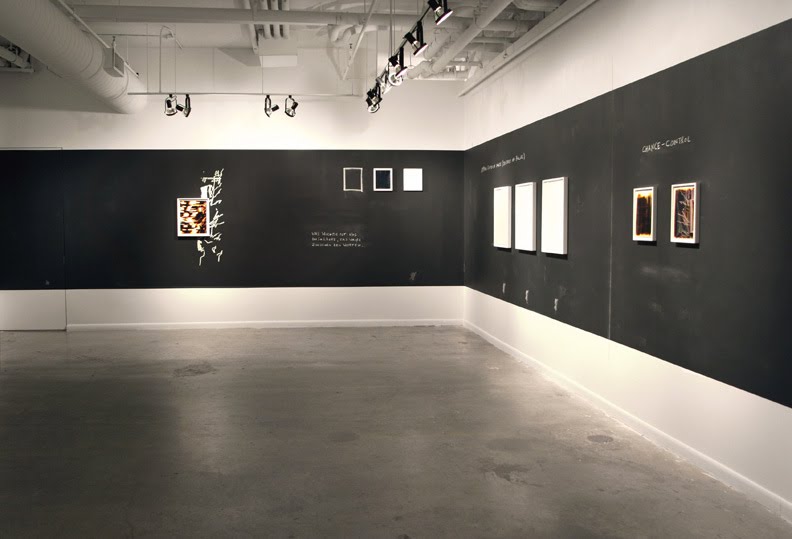
JTF (just the facts): A total of 16 works, framed in white and unmatted, and hung in the single room gallery. The gallery space has been painted with a thick band of dark grey chalkboard paint. The prints have been hung against this background, and Breuer has added (and subsequently erased in some cases) various notations in chalk. A pair of photocopied images have also been taped to the wall. The unique chromogenic prints come in various sizes, from roughly 9x7 to 24x20, and were all made in 2009 or 2010. (Installation shots at right, via Von Lintel.)

Comments/Context: Marco Breuer's last show at Von Lintel (roughly a year and a half ago, here) was hung in a generally conventional manner: framed images were placed at eye level against the white walls of the gallery. The installation focused the viewer's attention on the finished product, object quality of the artworks, and on the underlying physical processes that were used to create their abstract colors and patterns.

Fast forward to Breuer's newest show, and something altogether different is going on. The artist is still hard at work in the darkroom, taking light sensitive papers and experimenting with a dizzying array of loosely controlled scrapes, scratches, and cuts, searching for new visual outcomes. What's new this time around is that Breuer has installed the recent pictures in a way that invites us into his brain, to watch as he improvises and iterates on ideas. In many ways, it is almost an exhibition of the remnants of a cerebral performance piece more than it is an exhibition of photographs.

Each image or set of images has a series of cryptic annotations written in chalk near the framed works. The analytical, puzzle solver in me felt challenged to figure out what each one meant. Were they dimensions? Or commentary? Or symbolic references? 4.6.6 is scrawled above one of the pastel, geometric abstractions. I stood for a few moments before I figured it out: 4 lines, 6 colors, 6 shapes. Under a spider web of scratchings are images of a light bulbs with strike through slashes. Aha, these works were made by scratching the paper with a piece of glass, trying to find the approximate center of the paper, completely in the dark. As you walk around the room, there is a distinct sense of intellectual art in progress, of process being figured out along the way, with a little help from both chance and craft.

I found the images of vibrant blue and yellow, almost like folded, interrupted waves across the surface of the paper, to be the most visually compelling; they really stick out from far away. The others require a more intimate look: tiny lines that shuttle and wiggle across the image as though they were raked by an array of manic seismograph needles. What I liked best, however, was the exposition of Breuer's thoughts, the ability to see how he makes aesthetic connections. The unconventional installation gives the artworks a more personal grounding and backstory, opening up an unusual opportunity for the viewer to appreciate the thinking that has gone on.

Collector's POV: The prints in this show are priced between $5900 and $12500, based on size. (In fact, I was told that there is a mathematical equation for pricing, based on a price per square inch.) Breuer's work has very little secondary market history, gallery retail remains the best option for collectors interested in following up.

Rating: * (one star) GOOD (rating system described here)

Transit Hub:
  • Review: New Yorker (here)
  • Upcoming Talk @SVA, November 16th (here)
  • Exhibition: New Pictures 2 @Minneapolis Institute of Arts, 2010 (here)
Marco Breuer, Nature of the Pencil
Through December 4th

Von Lintel Gallery
520 West 23rd Street
New York, NY 10011

Tuesday, November 9, 2010

Auction Results: Photographs, November 3, 2010 @Phillips London

The results for Phillips' recent various owner photographs sale in London generally met expectations. While the Total Sale Proceeds fell at the low end of the range, they did cover the low estimate, even with an overall Buy-In rate just under 45%. Irving Penn's images of the hands of Miles Davis once again proved to be enticing for buyers, the lot here (see below) more than tripling its pre-sale high estimate; a variant image from the same series performed similarly well at Christie's last month.
.
The summary statistics are below (all results include the buyer’s premium):
.
Total Lots: 192
Pre Sale Low Total Estimate: £1092900
Pre Sale High Total Estimate: £1552600
Total Lots Sold: 106
Total Lots Bought In: 86
Buy In %: 44.79%
Total Sale Proceeds: £1143863
.
Here is the breakdown (using the Low, Mid, and High definitions from the preview post, here):

Low Total Lots: 106
Low Sold: 47
Low Bought In: 59
Buy In %: 55.66%
Total Low Estimate: £351100
Total Low Sold: £156563
.
Mid Total Lots: 72
Mid Sold: 49
Mid Bought In: 23
Buy In %: 31.94%
Total Mid Estimate: £656500
Total Mid Sold: £522100
.
High Total Lots: 14
High Sold: 10
High Bought In: 4
Buy In %: 28.57%
Total High Estimate: £545000
Total High Sold: £465200
.
The top lot by High estimate was lot 115, Edward Steichen, Charlie Chaplin, 1925, at £50000-70000; it did not sell. The top outcome of the sale was lot 121, Irving Penn, The Hand of Miles Davis (B), New York, 1986/1992, at £99650. (Image at right, middle, via Phillips.)

93.40% of the lots that sold had proceeds above or in the estimate range. There were a total of six surprises in this sale (defined as having proceeds of at least double the high estimate):
.
Lot 23, Herb Ritts, Sand Breasts, Hawaii, 1988, at £8125
Lot 41, Werner Bischof, Courtyard of the Meiji Temple, Tokyo, 1951/Later, at £5750
Lot 81, Frank Thiel, Stadt 2/41 (Berlin), 1999/2002, at £32450 (image at right, top, via Phillips)
Lot 102, Peter Beard, Maureen Gallagher and a night feeder at Hog Ranch, February, 1987/Later, at £79250 (image at right, bottom, via Phillips)
Lot 121, Irving Penn, The Hand of Miles Davis (B), New York, 1986/1992, at £99650
Lot 186, Iwao Yamawaki, Untitled, 1932, at £9375
.
Complete lot by lot results can be found here.

Howick Place
London SW1P 1BB

Tina Barney, Players @Borden

JTF (just the facts): A total of 11 large scale color works, generally framed in black and not matted, and hung against pink and white walls in the main gallery space. All of the works are chromogenic color prints and were made between 1998 and 2010. Barney's prints come in two sizes: 30x40, in editions of 5, and 48x60, in editions of 10; there are 10 images in the large size and 1 image in the small size on display. A monograph of this body of work is should be available from Steidl soon (here). (Installation shots at right.)

Comments/Context: In the past decade, Tina Barney has spent much of her time making commissioned work, doing magazine shoots, fashion editorials, family portraits and other commercial assignments, in short, applying the special "Tina Barney look" to a spectrum of different subjects. This show gathers together examples from a multitude of recent projects, loosely tying together images of actors and actresses at work, celebrities, fashion models, and various other staged scenes into a broader exploration of the ideas of drama, artifice and theatrical role playing.
.
The best of the works on view here recreate some of the same tension and intensity found in her portraits of her own family, and leverage many of her trademark compositional and aesthetic approaches: the subtle gestures and expressions that tell complex quirky stories, the layered insights to be found in furnishings and environments, the psychology of interaction, and the importance of rituals and traditions. Leo Castelli and his young wife (holding a black cat) pose in their modern living room, surrounded by art that echoes the sweep of her hair. A staged family portrait includes a defiant daughter in a white prom dress holding a snake, a bored brother, and a delusionally proud mother, all set among a floral couch and grandfather clock. A daughter carefully applies bright red lipstick in a mirror while her perfectly-coiffed mother (also dressed in black) looks on in boredom. They are classic examples of multi-generational, nuanced moments of Tina Barney insight.
.
The images of actors and fashion models at work have a little less emotional punch; the play acting is more overt and the scenes are less tiered and layered with information. An up-close image of two women from The Wooster Group is the most bold and unsettling of the group - a female face adorned with devil horns, arched eyebrow makeup and a mess of lipstick is perfectly jolting and creepy. Rock star Michael Stipe sits on a leather couch with a dog on his lap, squinting at his glasses held in his outstretched arms, with the black molding on the wall behind him running right through his head - it's an odd, out-take kind of moment that somehow coalesces into something more. I think the staged fashion shots are the least successful: beautiful facades, yes, but generally hollow of meaning or tension. They are almost like caricatures in their moody seriousness.
.
With these pictures, Barney has taken the artistic methods she developed by looking inward at her own immediate family and applied them by looking outward at strangers playing at roles. Is the conclusion that we are all "playing", all the time? By mixing these various genres and projects together as one intermingled whole, she has made a compelling case that the lines get quite a bit blurrier than we might like to believe.

Collector's POV: The works in this show have two prices: the larger 48x60 prints are $30000 each and the smaller 30x40 prints are $20000 each. Given Barney's long and successful career, the secondary market for her work is surprisingly thin. Only a few prints seem to change hands at auction in any given year, with prices ranging from $3000 to $42000; the collectors and institutions that bought her work years ago seem to be happily holding on to it. As such, gallery retail is likely the best (and only) option for those who want to follow up.

Rating: * (one star) GOOD (rating system described here)

Transit Hub:

  • 2010 Lucie Award for Achievement in Portraiture (here)
  • Interview: BOMB, 1995 (here)
  • Review: Wall Street Journal (here, scroll down), NY Times, 2007 (here)
Tina Barney, Players
Through December 18th
.
Janet Borden, Inc.
560 Broadway
New York, NY 10012

Monday, November 8, 2010

Auction: Photographies Modernes et Contemporaines, November 9, 2010 @Yann Le Mouel

Yann Le Mouel kicks off the Paris auction season for photographs tomorrow with its various owner sale. As usual, the material is mostly French/European and nearly all at the lower end of the market. Overall, there are a total of 250 lots on offer, with a Total High Estimate of 464130€.

Here's the breakdown:

Total Low Lots (high estimate up to and including 7500€): 245
Total Low Estimate (sum of high estimates of Low lots): 401130€

Total Mid Lots (high estimate between 7500€ and 35000€): 5
Total Mid Estimate: 63000€

Total High Lots (high estimate above 35000€): 0
Total High Estimate: NA
.
The top lot by High estimate is tied between three lots, all at 10000-15000€: lot 91, Andreas Feininger, The Photojournalist, 1955, lot 214, Kimiko Yoshida, La Mariée abelam au masque d'initiation baba, East Sepik, Papouasie-Nouvelle-Guinée, Autoportrait, 2005, (image at right, bottom, via Yann Le Mouel) and lot 226, Peter Lindbergh, Naomi Campbell, Vogue US, Los Angeles, USA, 1990 (image at right, top, via Yann Le Mouel).
.
Here is a short list of the photographers who are represented by four or more lots in the sale (with the number of lots in parentheses):

Robert Doisneau (16)
Henri Cartier-Bresson (9)
Andre Kertesz (8)
Izis (7)
Rene-Jacques (7)
David Bailey (6)
Elliott Eriwtt (5)
Francois Kollar (5)
Willy Ronis (5)
Nicolas Yantchevsky (5)
Edouard Boubat (4)
Raoul Hausmann (4)
.
The complete lot by lot catalog can be found here.

Photographies Modernes et Contemporaines
November 9st

22, Rue Chauchat
75009 Paris

Kim Joon, Fragile @Sundaram Tagore

JTF (just the facts): A total of 22 large scale color works, each face mounted to Plexiglas and unframed, and hung in the two entry areas, the main gallery space, and a smaller back room. All of the prints are digital chromogenic prints, in editions of 5 or 8. The works range in size from 35x21 to 83x47 (or reverse), and were made between 2008 and 2010. A thin catalogue of the exhibit is available from the gallery. (Installation shots at right.)

Comments/Context: Korean photographer/artist Kim Joon's eye-catching images venture into the unexplored edges of what we call photography, looking for wholly original aesthetics that go beyond the boundaries imposed by the use of a camera. Using the powerful digital tools found in computer labs and animation studios, Kim has pushed the nude figure somewhere unexpected, morphing it into an undulating, intertwined foundation for intense decoration and patterning.
.
I think Kim's work brings forward many of the same underlying ideas and questions that were raised by Thomas Ruff's show at David Zwirner earlier this spring (here), albeit with an entirely different visual output. While Ruff made images of abstract mathematical equations, he too was working inside the realm of the computer, extending his visual vocabulary into uncharted white spaces. Kim has taken the freedom generated by the technology and used it to re-imagine human bodies, covering them with a heady mix of colorful Asian and Western iconography, like tattoos or body paint. Rendered in 3D and then "skinned" with his choice of coverings, the bodies become an impossible tangle of male and female limbs, a theme and variation exercise in repetition and geometry, with stylized fish, cats and birds mixing with corporate logos (Donald Duck, Mini Cooper and Honda).
.
Kim's newest works trade the look and feel of human skin for the alabaster shine of fine porcelain. Bodies have been broken open, revealing hollow insides like headless figurines. Traditional china patterns from Villeroy & Boch, Limoges and Royal Copenhagen cover the cropped torsos and echo across nearby plates and saucers. Floral designs with gold leaf edges and blue and white butterflies wander across clusters of fallen bodies.
.
I think an overly simple reading of Kim's work would be to highlight the clash of cultures that can be found a great deal of contemporary Asian art today and conclude that he too is working this same set of "East meets West" ideas, albeit in a more boldly colorful manner, printed big and glossy to attract a certain kind of collector. When I look at these works, however, I am more interested in where his compositional explorations might be taking us, and how to better interpret his computer-generated visual innovation. We're a long way from clumsy appropriation and photocollage - in fact, we're somewhere entirely new, with inherently different risks and challenges for those who employ these revolutionary tools. Do it "wrong" and it's a throwaway gimmick, do it "right" and it breaks all the rules.
.
To my eye, while not every one of the works in this show hits the mark, there are certainly moments when the swirl of bodies or the arrangements of china are wonderfully woven together. Give them the backhanded compliment of "decorative" if you must, but when these interlaced forms/patterns find just the right balance of fluidity and refinement, there is something here that we haven't seen anywhere before.
.
Collector's POV: The works in this show are generally priced by size, with the smallest images at $7000 or $10000, and the largest either $23000 or $25000, with a number of intermediate sizes and prices. Kim's work has recently become more consistently available in the secondary markets for photography, particularly in the past year or two. Prices at auction have ranged between $5000 and $16000.

Rating: * (one star) GOOD (rating system described here)

Transit Hub:
  • Artist site (here)
  • Interview: Art Radar Aisa (here)
  • Feature: CNN (here)
Through November 13th

547 West 47th Street
New York, NY 10001

Friday, November 5, 2010

Taryn Simon: Contraband @Lever House

JTF (just the facts): A total of 1075 color photographs, mounted on archival paper, and hung in Plexiglas frames on three, two-sided walls in the single room lobby space. Each of the individual images is sized roughly 6x6. They are then grouped by subject matter onto 16 panels, each 95x71. All of the works were taken in 2009 and printed in 2010. A complete monograph of this project was recently published by Steidl (here). (Installation shots at right.)

Comments/Context: Taryn Simon's approach to photography mixes a deadpan documentary style with an undercurrent of cerebral, conceptual ideas that tests the limits of what a photograph can see and communicate. In previous projects, she has photographed people wrongly convicted of crimes at the scenes of their undoing, and made images of objects that have a hidden or indecipherable purpose. In her newest work, she spent five days in the bowels of JFK airport, taking pictures of all the items that were confiscated from passengers and express mail packages. The result is a taxonomy of contraband, a snapshot catalogue of all of the things that fall outside the approved and acceptable.

In this series, Simon's images are basically commercial still lifes: frontal shots of various objects set against neutral white backgrounds. This aesthetic approach depersonalizes the items, making them cold, pared down, documentary facts. Photographically, the images themselves aren't particularly interesting.

But taken together, seen as an extremely long and eclectic list of things that are prohibited, illegal, counterfeit, unlicensed, or undeclared, the objects start to take on a different resonance. They start to create a picture of the edges of our culture, telling stories of the forbidden and illicit, of people who pursue activities that fall outside the norms. They paint a picture of a melting pot of puzzling cultural influences and traditions. They tell us about the global commerce that flows in and out of America like a flood each and every day, meeting our demands, fueled by our desires. They highlight what we find threatening or scary. In short, they provide a surprisingly direct social commentary on what we have decided we are not (and yet we still are).
.
So what's on this exhaustive list? Deer blood, Cuban cigars, pirated DVDs, counterfeit Beanie Babies, peyote, moon cakes, pharmaceuticals of various kinds, leaves from endangered species, nesting dolls, bongs, skeletons, berries, chicken feet, sugar cane, unidentified meats, fake watches, seeds, eggshells, pirated handbags, bags of fat, and cigarettes, among many, many others. It's a parade of oddities and curiosities, a set of both the bizarre and the mundane.

This is a show where the backstory is everything, where the context provides the spark of ideas. It's a thoughtful conceptual exercise, bounded by a particular slice of time, and it successfully focuses the viewer on a striking inversion. It forces us to look closely at how we have defined our world by seeing what falls outside its boundaries.

Collector's POV: Taryn Simon is represented by Gagosian Gallery in New York (here) and Almine Rech Gallery in Paris and Brussels (here). Simon's work has only just begun to enter the secondary markets in the last year or so, and no definitive price pattern has yet emerged. As such, gallery retail is likely the only real option for interested collectors at this point.

Rating: * (one star) GOOD (rating system described here)

Transit Hub:

  • Artist site (here)
  • Feature: NY Times Lens (here)
  • Current exhibitions: Gagosian Beverly Hills (here) and Almine Rech Brussels (here)
Taryn Simon: Contraband
Through December 31st
.
390 Park Avenue
New York, NY 10022

Thursday, November 4, 2010

Auction Results: Photographs, November 2, 2010 @Bonhams

Bonhams had a generally uneventful outcome at its Photographs sale in New York earlier this week. The auction had a Buy-In rate over 45% and Total Sale Proceeds that missed the low estimate by a decent margin. With few in the way of positive surprises, there just wasn't much to write home about.

The summary statistics are below (all results include the buyer’s premium):
.
Total Lots: 110
Pre Sale Low Total Estimate: $506500
Pre Sale High Total Estimate: $748500
Total Lots Sold: 60
Total Lots Bought In: 50
Buy In %: 45.45%
Total Sale Proceeds: $423767

Here is the breakdown (using the Low, Mid, and High definitions from the preview post, here):

Low Total Lots: 100
Low Sold: 53
Low Bought In: 47
Buy In %: 47.00%
Total Low Estimate: $517500
Total Low Sold: $287127
.
Mid Total Lots: 9
Mid Sold: 7
Mid Bought In: 2
Buy In %: 22.22%
Total Mid Estimate: $171000
Total Mid Sold: $136640
.
High Total Lots: 1
High Sold: 0
High Bought In: 1
Buy In %: 100.00%
Total High Estimate: $60000
Total High Sold: NA
.
The top lot by High estimate was lot 38, Ansel Adams, Parmelian Prints of the High Sierras, 1927, at $40000-60000; it did not sell. The top outcome of the sale was lot 33, Ansel Adams, Clearing Winter Storm, Yosemite National Park, California, 1944/1970s, at $39650.

70.00% of the lots that sold had proceeds in or above the estimate range. There were a total of 2 surprises in this sale (defined as having proceeds of at least double the high estimate):

Lot 13, Edward Curtis, The Vanishing Race, Navajo, 1904, at $15860
Lot 89, Duane Michals, Magritte with Hat, 1965/1989, at $5795 (image at right, top, via Bonhams)

Complete lot by lot results can be found here.
.
Bonhams
580 Madison Avenue
New York, NY 10022

Auctions: Post-War and Contemporary Art, Evening, Morning, and Afternoon Sales, November 10 and 11, 2010 @Christie's

Christie's has the final slot in the Fall Contemporary Art season in New York next week with two days of various owner sales. Works by Cindy Sherman and John Baldessari fill all five of the top photo lots by High estimate. Overall, there are a total of 35 lots of photography available in these sales, with a total High estimate for photography of $4030000.

Here's the simple statistical breakdown:

Total Low Lots (high estimate up to and including $10000): 0
Total Low Estimate (sum of high estimates of Low lots): NA

Total Mid Lots (high estimate between $10000 and $50000): 17
Total Mid Estimate: $540000

Total High Lots (high estimate above $50000): 18
Total High Estimate: $3490000

The top photography lot by High estimate is lot 58, Cindy Sherman, Untitled (#88), 1981, at $400000-600000. (Image at right, top, via Christie's.)

Here's the complete list of photographers represented by three or more lots in the sales (with the number of lots in parentheses):

Cindy Sherman (4)
Hiroshi Sugimoto (4)
John Baldessari (3)
Vik Muniz (3)
Jeff Wall (3)

The complete lot by lot catalogs can be found here (Evening), here (Morning), and here (Afternoon). The eCatalogues are here (Evening), here (Morning), and here (Afternoon).
.
Post-War and Contemporary Art Evening Sale
November 10th
.
Post-War and Contemporary Art Morning Session
November 11th
.
Post-War and Contemporary Art Afternoon Session
November 11th
.
Christie's
20 Rockefeller Plaza
New York, NY 10020

Wednesday, November 3, 2010

The Mexican Suitcase @ICP

JTF (just the facts):
A total of 70 black and white photographs (framed in black and matted) and 102 contact sheets (unframed and pinned directly to the walls), hung against yellow walls in all of the gallery rooms on the main floor of the museum. The photographs are a mix of vintage and modern gelatin silver prints; the contact sheets are modern pigment prints. 20 glass cases circle the galleries, displaying relevant magazine spreads, letters, telegrams, notebooks, and other ephemera. The exhibit also includes selections of newsreels, a map of the various travels of the photographers, and a computer area for further study. All of the works were made during the period between 1936 and 1939. The exhibit was curated by Cynthia Young. A two-volume monograph, cotaining a full reproduction of all the images in the Mexican Suitcase, has recently been published by Steidl (here) and is available in the store for $98. (Since photography is not allowed in the ICP galleries, there are unfortunately no installation shots for this show. The images at right come via the ICP website.)

The following photographers were included in the show, with the number of works on display in parentheses:

Robert Capa (24 prints, 37 contact sheets)
Robert Capa/Gerda Taro (9 prints, 9 contact sheets)
David "Chim" Seymour (21 prints, 31 contact sheets)
Fred Stein (1 print, 2 contact sheets)
Gerda Taro (15 prints, 23 contact sheets)

Comments/Context: When the mystery "suitcases" finally found their way to the ICP in 2007, the unexpected rediscovery of the three boxes of long lost Spanish Civil War negatives had the photography world aflutter. Were the images all by Robert Capa? Did they definitively tell us whether Capa's famous The Falling Soldier was authentic or staged? The photo world waited with bated breath. In the end, the "Mexican Suitcase" didn't hold answers to this one controversial Capa question, but provided a surprisingly thorough picture of what it was like to be a war correspondent armed with a hand camera during the Spanish Civil War. Containing a mix of negatives from Robert Capa, David "Chim" Syemour, Gerda Taro and Fred Stein, the boxes tell the story of the origins of embedded photojournalism, where the photographers actively participated in the action, had clear biases and sympathies, and chose different narratives to follow. (Robert Capa, Exiled Republicans being marched on the beach from one internment camp, Le Barcarès, France, March 1939, at right top, via ICP.)

Robert Capa's images of the war are filled with up-close activity and movement. Young soldiers race into the blurred, smoky front line action of the Battle of Rio Serge, with others stand and peer out of rubble strewn bombed out windows. Recruits are mobilized in Barcelona, and refugees are herded down the beach or holed up in tent camps in France. Gerda Taro's images also track the battle, from attacking soldiers to burning trucks. The wounded and dead lay in plain sight, and the families in Valencia are left to helplessly wait for information. Shooting together, Capa and Taro also captured gunstocks stuck in the trench sandbags near Madrid and the destroyed walls of buildings torn apart, some left standing, others leveled to the ground. David "Chim" Seymour's photographs are less concerned with the immediacy of battle, and instead turn toward the more subtle consequences of the war. His camera is variously pointed at outdoor masses, Basque markets, anguished faces at a land reform meeting, and soldiers protecting art, capturing military and civilian expressions with equal candor.

What I liked most about this exhibit was the meticulousness with which the contact sheets and prints were matched with the magazine spreads. This detail work enables the viewer to see how the stories got constructed, how the photographers created the narrative lines via the types of images that they took. Even though the small contact sheets require some patience to pore over, they do provide the sequential context for how the photographers were "seeing" the chaos around them, and how they were framing the eventual history that would be written. Given the political viewpoints of the photographers, the line between reportage and propaganda gets a little muddy in some places, and the contact sheets make these choices more obvious.

Overall, this is a very visceral show, and all the outtakes make for a down and dirty picture of war. While there are some standout single images buried in among these thousands of frames, I was more struck by the overall sense that I myself was standing with a camera, immersed in the dizzying heat of the battle (or its aftermath), trying to make sense of it all and looking for a thread of a story to follow. The show is an amazingly potent dose of the challenges faced by these war-time photojournalists, their successes and failures vibrantly real even decades later.

Collector's POV: Since these negatives were recently rediscovered, it is not surprising that vintage prints of works from this period are scarce. More generally, of these photographers, Robert Capa has the most robust secondary market, with plenty of images coming up for sale in any given year; prices have typically ranged between $2000 and $22000, with most under $5000. Works by David "Chim" Seymour can be found only intermittently, the few lots that have sold finding buyers between $1000 and $4000. The works of Gerda Taro and Fred Stein have very little, if any, auction history. Since Capa and Seymour were members of Magnum, modern prints of their images can be acquired directly via the Mangum Photos store (here). (Gerda Taro, Crowd at the gate of the morgue after the air raid, Valencia, May 1937, at right bottom, via ICP.)

Rating: ** (two stars) VERY GOOD (rating system described here)
.
Transit Hub:
Through January 9th

1133 Avenue of the Americas
New York, NY 10036

Tuesday, November 2, 2010

Auctions: Contemporary Art Evening and Day Sales, November 9 and 10, 2010 @Sotheby's

Sotheby's is up second in the Fall Contemporary Art season in New York next week, with Evening and Day auctions Tuesday and Wednesday. With a high priced Gursky anchoring the photography offerings, for the most part, it's a gathering of usual suspects. There are a total of 39 lots of photography available across the two sales, with a total High estimate for photography of $4351000.

Here's the statistical breakdown:

Total Low Lots (high estimate up to and including $10000): 0
Total Low Estimate (sum of high estimates of Low lots): NA

Total Mid Lots (high estimate between $10000 and $50000): 21
Total Mid Estimate: $641000

Total High Lots (high estimate above $50000): 18
Total High Estimate: $3710000

The top photography lot by High estimate is lot 8, Andreas Gursky, Frankfurt, 2007, at $1200000-1800000. (Image at right,top, via Sotheby's.)

Here's the list of photographers represented by three or more lots in the two sales (with the number of lots in parentheses):

Vik Muniz (5)
Hiroshi Sugimoto (4)
Andreas Gursky (3)
Thomas Ruff (3)

The complete lot by lot catalogs can be found here (Evening) and here (Day).


Sotheby's
1334 York Avenue
New York, NY 10021

New York: A Bird's Eye View @De Lellis

JTF (just the facts): A group show including a total of 48 black and white and color photographs, mostly framed in black and matted, and hung in the main gallery space. All of the images are vintage aerial photographs of New York city, and were taken between roughly 1875 and 1960. (Installation shots at right.)

The following photographers have been included in the show, with the details of the works on view in parentheses:
  • Berenice Abbott (3 gelatin silver prints, 16x16, 14x10 or 16x5, 1932-1938, and 1 photogravure, 13x10, c1932/later)
  • American Illustrated Stereograph (1 albumen print, 4x7, c1876)
  • Anonymous (2 bromide prints, 6x8, 1884, 1 albumen print, 5x10, c1876, 1 albumen print, 9x16, c1900, and 1 group albumen prints, 6x8, c1876)
  • Margaret Bourke-White (1 gelatin silver print, 9x13, c1930)
  • Charlotte Brooks (1 gelatin silver print, 13x10, 1943)
  • Harold Haliday Costain (3 gelatin silver prints, 9x20, c1930)
  • John Paul Edwards (1 gelatin silver print, 9x20, c1925)
  • Fairchild Aerial Surveys (1 gelatin silver print, 14x18, 1931)
  • W. Gray (2 albumen prints, 6x8 or 7x9, c1890)
  • Horsman's Cabinet Photographs (1 albumen print, 4x6, c1875)
  • International News Photo (1 gelatin silver print, 10x8, 1930)
  • J.S. Johnston (1 albumen print, 7x9, 1893 and 1 bromide print, 8x6, c1890)
  • Keystone View Company (1 gelatin silver print, 5x7, 1937)
  • Arthur Lavine (1 gelatin silver print, 13x9, 1965)
  • Ben Judah Lubschez (1 gelatin silver print, 6x9, c1925)
  • Nickolas Muray (1 gelatin silver print on gold paper, 4x4, 1927)
  • Fritz Neugass (1 gelatin silver print, 10x8, 1947)
  • Peyser & Patzig (1 gelatin silver print, 10x7, 1930)
  • Press Photo (1 gelatin silver print, 7x10, 1945)
  • George Rockwood (1 albumen print, 7x9, c1880)
  • Charles Rotkin (2 gelatin silver prints, 10x13, c1950)
  • Edward Scherck (1 gelatin silver print, 8x10, c1930)
  • William Gordon Shields (4 gelatin silver prints, 14x11, 13x10 or 9x19, 1915-1917)
  • Samuel Stebbins (1 gelatin silver print, 14x11, c1934)
  • Fred Stein (2 gelatin silver prints, 14x11 or 9x7, 1940-1945)
  • Howard Suchurek (1 chromogenic print, 19x9, c1960)
  • Todd Webb (1 gelatin silver print, 8x9, 1947)
  • Paul Woolf (5 gelatin silver prints, 8x6, 9x7, 8x7 or 8x10, 1935-1940)

Comments/Context: As collectors of city and industrial images, we're fascinated by the geometric patterns that are created by the interactions of architecture and by the density of built structures that make up all kinds of cities. This show brings together nearly a century of aerial views of New York city, providing both a rich historical record and an evolving survey of how landmarks and urban buildings were used as the raw material for photographic experimentation.

Chronologically, the show begins with 19th century views of the city, when the tallest structures were the church spires that poked up through the uniformity of squat warehouses and apartment blocks. With the advent of the skyscraper, the skyline took shape, and steep views downward into the concrete canyons below became more possible - instead of looking up into the sky at the outlines of famous buildings, artists were looking down into the chaos of the streets. Actual aerial surveys (shot from airplanes) were also taken from even higher vantage points, putting the tall buildings in wider panoramic context. As expected, the Empire State Building and Chrysler Building make repeated appearances in these photographs, providing a visual anchor against hazy clouds or the dark shadows of dusk.

My favorite images in the show are those that induce a bit of vertigo, where the angles get distorted and the walls of buildings bend in unexpected ways. They forgo the heroic romance of the broad vista and instead give us the frenetic, spine tingling energy of the city.

Collector's POV: For the most part, the prints in this show are reasonably priced, ranging from $150 to $8500, with a sweet spot between $2000 and $5000. The outliers are the vintage Berenice Abbott prints, which are priced between $18000 and $26000.

Rating: * (1 star) GOOD (rating system described here)

Transit Hub:

  • Reviews: Gothamist (here), Wall Street Journal (here, scroll down)
  • Feature: NY Times (here)
New York: A Bird's Eye View
Through November 20th

Keith De Lellis Gallery
1045 Madison Avenue
New York, NY 10075

Monday, November 1, 2010

Auctions: Carte Blanche and Contemporary Art, Parts I and II, November 8 and 9, 2010 @Phillips

Phillips kicks off the Fall Contemporary Art season in New York next week, with the Carte Blanche sale (curated by Philippe Segalot) and a two-part various owner sale. The big news photography-wise is the sale of Cindy Sherman's Untitled #153, with a jaw-dropping estimate of $2-3 million; in an edition of 6, it is the last print still in public hands (the rest are in museum collections I believe), so the bidding will likely be fierce. If that wasn't enough, there is also a Richard Prince cowboy in this set of sales, with a hefty estimate of $1-1.5 million. All in, there are a total of 88 lots of photography available across the three sales, with a total High estimate for photography of $7804500.

Here's the statistical breakdown:

Total Low Lots (high estimate up to and including $10000): 29
Total Low Estimate (sum of high estimates of Low lots): $194500

Total Mid Lots (high estimate between $10000 and $50000): 46
Total Mid Estimate: $1100000

Total High Lots (high estimate above $50000): 13
Total High Estimate: $6510000

The top photography lot by High estimate is lot 14, Cindy Sherman, Untitled #153, 1985, at $2000000-3000000. (Image at right, top, via Phillips.) The next highest lot by High estimate is lot 113, Richard Prince, Untitled (Cowboy), 1998-1999, at $1000000-1500000. (Image at right, bottom, via Phillips.)

Here's the list of photographers represented by three or more lots in the sales (with the number of lots in parentheses):

Gabriel Orozco (5)
Thomas Ruff (4)
Hiroshi Sugimoto (4)
Gregory Crewdson (3)
Marilyn Minter (3)
Vik Muniz (3)
Richard Prince (3)
.
The complete lot by lot catalogs can be found here (Carte Blanche), here (Part I) and here (Part II).

November 8th

November 8th

November 9th

450 Park Avenue
New York, NY 10022

and

450 West 15th Street
New York, NY 10011

Abelardo Morell: Groundwork @Benrubi

JTF (just the facts): A total of 10 large scale color works, framed in black with no mats, and hung in the entry and main gallery spaces. All of the works are archival pigment prints, made in 2010. The images are available in three sizes: 24x30 (in editions of 10), 30x40 (in editions of 8), and 50x60 (in editions of 6). There are 2 works in the smallest size, 3 in the middle size, and 5 in the largest size on display. (Installation shots at right.)

Comments/Context: This show of recent work continues Abelardo Morell's explorations of the boundaries of the camera obscura process. Several of the images on view repeat the room-as-camera motif for which he is so well-known: views of Rome and Florence, projected into hotel rooms and cluttered offices, the Duomo or the Roman Forum seen in bold layered color, upside down on the walls.

A new twist on his technical method comes in the form of an unusual apparatus: a tent camera with a periscope lens that projects the image onto the floor. This takes us away from backdrops of walls and doorways with fancy moldings and introduces new textures: the rocky dirt ground of the desert, a carpet of pine needles, streets of pockmarked cobblestones and old bricks, and even the crackled surface of a tar roof. The surfaces are matched to the landscapes that adorn them, providing both deeper context and an additional layer of visual complexity: Acadia National Park in Maine on the needles, the Brooklyn Bridge on the tar roof, the Florence Bapistery on the cobbles.

Most importantly, this new approach flattens out the picture plane, removing the undulating distortions created by the physical depth of the rooms, as well as eliminating the mystery of what the room is "seeing". The result is a much more painterly feel, the texture mixing with the image itself, becoming almost Vik Muniz-like: a postcard picture of a desert landscape made out of rocks. I think this will open up a whole new area of experimentation for Morell, where unexpected juxtapositions of image and texture might generate new visual effects. Who knew the ancient camera obscura had so much more to offer?

Collector's POV: The prints in this show are priced as follows: the 24x30 prints are $11000 each, the 30x40 prints are $17000 each, and the 50x60 prints are $24000 each. Morell's work has been available in the secondary markets fairly regularly in recent years, with a handful of lots up for sale in any given year. Prices at auction have ranged between $2000 and $17000.

Rating: * (one star) GOOD (rating system described here)

Transit Hub:
  • Artist page (here)
  • Feature: New York (here)
Through December 19th

Bonni Benrubi Gallery
41 East 57th Street
New York, NY 10022