Monday, October 22, 2012

Lucas Samaras: XYZ @Pace

JTF (just the facts): A total of 17 large scale color photographs, mounted and unframed, and hung against white walls in the main gallery space and the smaller front room. All of the works are pure pigment on paper mounted on Dibond, made in 2012. Each print is sized 35x62 and is unique. The works come from four separate series: Flea (6 works), Pixel Cock & Bull (3 works), Chinoiserie (2 works), and Razor Cut (6 works). (Installation shots at right.)

Comments/Context: Given Lucas Samaras' history as a consistently innovative photographic manipulator and his repeated use of chaotic distortions and bright psychedelic colors, it seems only natural that he would eventually fully embrace the power offered by the digital realm. His newest works show his gradual conversion to the religion of Photoshop, starting with relatively tame and simple effects and quickly progressing to wilder and more outlandish all-digital flights of fancy. Like Gerhard Richter (here) and Alfred Leslie (here), Samaras is yet another well established artist extending his aesthetic into computer-based imagery.

The works in the front gallery still have some ties to a real world camera. Starting with photographs taken at flea markets, Samaras has used mirroring and partial pixelization to deform the existing images. Army coats, colorful fabrics and leather boots are broken up into small tiles, almost like irregular painted mosaics or armadillo skin. Sophisticated Photoshop jockeys will likely be underwhelmed by these transformations.

Samaras has completely abandoned his camera in the works in the main gallery, diving into the uncharted depths of in situ digital creation. In the Pixel Cock & Bull series, a radiant rainbow of colored squares is twisted and squished into a dense kaleidoscope of graphics. The same pattern is wrapped around an orb, wallpapered down a perspective driven hall, and mirrored into slashing Xes. In the Chinoiserie series, multiple layers of undulating lines are woven into monochome grids and plaids, which are then punctuated by beaming blobs of psychedelic brightness. Samaras takes these ideas even further in the Razor Cut works, where vaguely human forms have been built out of abstract graphics and gradients. Is that a pirate with dreadlocks standing on a flat line beach? Or a feathered Native American dancing like a digital Kachina doll? Are those other "bodies" insectile aliens with long fingers? The graphics explode with unreal neon craziness, the hint of a face traced onto a spinning cluster of flashy lines. He takes the most risks with these images, and the best ones get beyond winking, paint program trickiness to something more fast and furious.

One of the challenges I think a lot of artists are facing when using Photoshop and other digital manipulation tools is that the resulting pictures become tool-driven rather than artist-driven. What I mean is that the artist is so excited and energized by what the software engineers have developed that they fail to really make the tools their own. The danger is work that ends up looking like a great example of how the tool can be used rather than something personal and durably original. With the benefit of hindsight in a few years, I think we will see these particular works by Samaras as a transition point, caught between the old and the new and not yet fully realized in terms of a true and radical Samaras vision of digital composition. But as signposts pointing to the future, I think we can now expect something appropriately remarkable yet to come.

Collector's POV: Each of the works in this show is priced at $38000. Samaras' work has only been sporadically available in the secondary markets in recent years. Aside from the Polaroid sale a few years ago, where a new record was set for his work ($194500) and many of his other vintage images sold for five figure prices, Samaras' work has been relatively affordable, with most lots selling at auction for under $10000.

Rating: * (one star) GOOD (rating system described here)

Transit Hub:
  • Reviews/Features: W (here), Garage (here)
Lucas Samaras: XYZ
Through October 27th

Pace Gallery
508 West 25th Street
New York, NY 10001

Friday, October 19, 2012

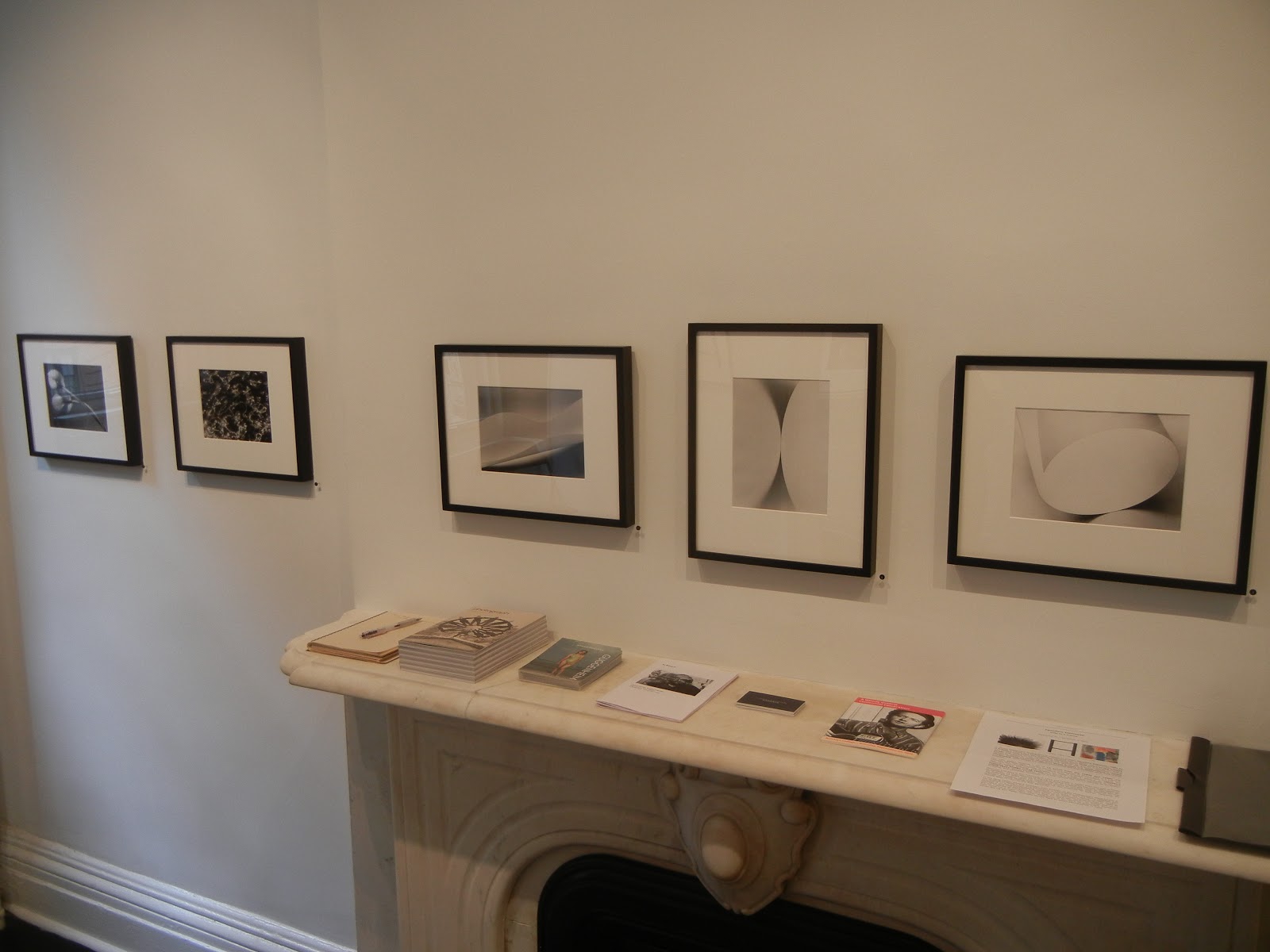
Yasuhiro Ishimoto, Gifts to a Friend @Stephenson

JTF (just the facts): A total of 22 black and white and color photographs, framed in black and matted, and hung against white walls in the main gallery space and the smaller viewing room. The images in the show were taken between 1948 and and 1996 and are a mix of vintage and later prints. There are 19 gelatin silver prints and 3 Type C prints on view. Sizes range from 8x10 to 11x14 (or reverse); no edition information was available. 15 of the prints come from a single collection and were gifts directly from Ishimoto. (Installation shots at right.)

Comments/Context: Yasuhiro Ishimoto is probably best known to American audiences for his 1940s/1950s Chicago street photography. Ishimoto studied at the Institute of Design under Harry Callahan and Aaron Siskind, and returned to the city on an artistic fellowship a decade later. This small show brings together a few prints from this early period and a tight cross section of work he made in subsequent years while living in Japan. It's a terrific one-stop introduction to a photographer who smartly harmonized his Japanese and American aesthetic influences.

Ishimoto's street shots cover familiar territory, but with an eye for layered compositions of people at different depths. Kids wear Halloween masks and pose on sidewalks or front stoops, while other images flatten adjacent strangers into intricate, interlocking spatial relationships. The later works on display here cover a broad swath of photographic genres: cut paper and light-on-water abstractions, elegant up-close still life florals, ephemeral melting footprints in snow and flimsy grass silhouettes, and even a single nude/rock study with echoing rounded forms. These pictures feel rooted in both his American artistic education and the intrinsic natural beauty of unbalanced Japanese forms. The exhibit also includes a few experimental multiple exposure color works that merge dark trees and cloudy skies with bright washes of overlaid expressionistic color, showing that Ishimoto continued to innovate even when he was exploring relatively traditional subject matter.

It's great to see an Ishimoto sampler on view here in New York, since his work has generally been more accessible in Chicago (where he has long been represented by Stephen Daiter (here)). He is a bridge figure, one who fills in gaps in the ID history, as well as connecting to Japanese photographic ideas. Overall, this small overview covers a lot of ground, but is full of intimate, well crafted 20th century photographs.

Collector's POV: The prints in the show are priced as follows. The black and white prints range in price from $2500 to $6000; the color prints are $800 each. The entire set of 15 gift images (sold as a single collection) is priced at $22000. Ishimoto's work has only been intermittently available in the secondary markets over the years; his well regarded book Chicago, Chicago is more often found in photobook sales. Prices have generally ranged between $500 and $3000, but this may not be entirely representative of his best or most notable work.

Rating: * (one star) GOOD (rating system described here)

Transit Hub:
  • Obituary: Le Journal de la Photographie, 2012 (here)
Yasuhiro Ishimoto, Gifts to a Friend
Through November 3rd

L. Parker Stephenson Photographs
764 Madison Avenue
New York, NY 10065

Thursday, October 18, 2012

The Checklist: 10/18/12

Current New York Photography Shows
New reviews added this week in red.
(Rating: Artist/Title: Venue: Closing Date: link to review)

Uptown

ONE STAR: Artie Vierkant: Higher Pictures: October 27: review

Midtown

ONE STAR: Fazal Sheikh: Pace/MacGill: October 20: review
ONE STAR: Andres Serrano: Edward Tyler Nahem: October 26: review
ONE STAR: Judy Fiskin: Greenberg Van Doren: October 27: review
ONE STAR: Gordon Parks (Centennial): Howard Greenberg: October 27: review
TWO STARS: Gordon Parks (Ligon): Howard Greenberg: October 27: review
ONE STAR: Sally Mann: Edwynn Houk: November 3: review
TWO STARS: The Shaping of New Visions: MoMA: April 29: review

Chelsea

ONE STAR: Rosemary Laing: Galerie Lelong: October 20: review
ONE STAR: Laura Letinsky: Yancey Richardson: October 20: review
ONE STAR: Ruud van Empel: Stux: October 20: review
TWO STARS: Bernd and Hilla Becher: Sonnabend: October 27: review
ONE STAR: Barney Kulok: Nicole Klagsbrun: October 27: review
ONE STAR: Shen Wei: Daniel Cooney: October 27: review
ONE STAR: James Welling: David Zwirner: October 27: review

SoHo/Lower East Side/Downtown

ONE STAR: Erica Baum: Bureau: October 21: review
ONE STAR: Bruce Haley: Anastasia: October 26: review
ONE STAR: Sam Samore (1973): Team: October 27: review
ONE STAR: Daniel Joseph Martinez: Simon Preston: October 28: review
ONE STAR: Kate Steciw: Toomer Labzda: October 28: review

Elsewhere Nearby

THREE STARS: Robert Adams: Yale: October 28: review

Forward Auction Calendar
New auctions added this week in red.
(Sale Date: Sale Title: Auction House: link to catalog)

October 30: Photographs (New York): Bonhams: catalog
October 30: Photographs - Man Ray (Barcelona): Soler y Llach: catalog
October 31: Photographs (London): Christie's: catalog
November 8: Photographs (London): Phillips de Pury: catalog

Wednesday, October 17, 2012

Daniel Joseph Martinez, I Want to Go to Detroit; Cheerleaders CHEER @Preston

JTF (just the facts): A total of 28 black and white photographs, framed in bond wood and unmatted or framed in white and mounted, and hung against white walls in the divided gallery space. The images in the show were taken in 1978 and 1979. The 13 prints in the front gallery area are modern light jet prints, each sized 40x29, in editions of 3+1AP. The 15 prints in the back gallery area are vintage gelatin silver prints, each sized 16x19; these prints are unique. (Installation shots at right.)

Comments/Context: Looking at Daniel Joseph Martinez' photographs in this show is a little like traveling back in time to the Southern California of the late 1970s. But while these images are rich in details and atmosphere from that period, this smart pairing of two complementary projects (male body builders and female beauty pageant contestants) opens up a complex conversation about the extremes of human body image that continues today.
 
Martinez' body builders have been captured just off stage before a competition. They stand flash lit against a simple white backdrop (almost Avedon style), strutting and posing, but doing so with a bit more relaxed naturalness than they might exhibit in the heat of battle. Exaggerated muscular bodies ripple in the bright light, their curves accented by a sheen of oil. Obvious pride mixes with oversized freakishness in an over-the-top display of survival of the fittest strength taken to the limits of plausibility. There is something both impressive and sadly desperate about the life these pictures depict.
 
Martinez' backstage photographs of California beauty pageants are more candid and less centered. Young women with sashes (Apple Valley, Barstow, Santa Barbara, South Coast) wear sparkly evening gowns, swimsuits, and tiaras, complemented by wavy blond Farrah Fawcett hair, feathers, and chunky heels; mothers hover on the fringes. Many of the moments have a deer in the headlights feel, the flash pulling a contestant's vulnerable frown or unguarded glower into high contrast relief, with creepy grinning men never far from view. The sense that it is all a stage managed production comes through clearly; this is a show and not everyone is entirely keen to play along with the constant illusion of perfection.
 
Both bodies of work push hard on the underlying societal why of such behavior, both on the level of the individual and in the broader cultural context. They combine a documentary process with a conceptual overlay, capturing the genuine effort and the subtle comedy of these unnatural bodies and situations. While the scenes may seem plucked from times long gone, the underlying ideas are remarkably fresh and vibrant. Decades later, we're still modifying our bodies, in ever more extreme ways, and Martinez' 1970s critique still hits home.
 
Collector's POV: The works in the show are priced as follows. The 40x29 body builder prints are $7000 each. The 16x19 beauty pageant images are being sold as a single set of 15, priced at $120000. Martinez' work has very little secondary market history, so gallery retail likely remains the best option for those collectors interested in following up.

Rating: * (one star) GOOD (rating system described here)
 
Transit Hub:
  • Features/Reviews: Art in America (here), Huffington Post (here)
Through October 28th
 
301 Broome Street
New York, NY 10002

Tuesday, October 16, 2012

Gordon Parks: Centennial @Greenberg

JTF (just the facts): A total of 51 black and white and color photographs and 1 video, variously framed and matted, and hung against light brown walls in the main gallery space, the book alcove, the small back gallery, and one of side viewing rooms. The works in the show were made between 1941 and 1970. The black and white images are a mix of vintage and modern gelatin silver prints, sized between 9x12 and 30x20 (or reverse); no edition information was available for these prints. The color images are later pigment or Ektacolor prints; the pigment prints are sized 24x24 or 20x16 (in editions of 10 and 25 respectively), while the Ektacolor prints are sized 14x19 (with no edition information). The book alcove also includes a display case with 3 LIFE magazines. (Installation shots at right.)

Comments/Context: This centennial exhibit, in honor of the 100th anniversary of the birth of Gordon Parks, successfully gives the viewer an idea of the photographer's tremendous range and talent. The show includes photo essays and street photography made on assignment for LIFE, incisive portraits of artists and celebrities, and even a few fashion shots. Never seen color rarities from the 1950s round out the four decade selection, a treat for those already familiar with Parks and his work. And a mini-retrospective like this one would be incomplete without Parks' now iconic American Gothic, but not to worry, it hides on a side wall, tucked into one of the viewing rooms.

Parks' documentary work and photo essays are full of simmering tension and emotion. The Fontenelle family stands together at the poverty board desk, clinging to each other, exhausted and grimly resigned to the ruling of the bureaucracy. Gang members openly fight in Harlem streets, followed either by a tender embrace or attendance at a wake. Dirty children in Rio de Janeiro favelas play with spiders and carry water in makeshift parades. And his recently rediscovered color works capture the realities of small town segregation, picking out separate "colored" entrances at the theater, the ice cream shack, and storefront drinking fountains.

Parks' portraiture is equally accomplished. The show includes powerful images of black leaders and celebrities, from Malcolm X and Stokely Carmichael in the passion of speech making, to a sweaty, meditative Muhammad Ali and a somber Eldridge Cleaver. Duke Ellington is artfully reflected in his piano, a shadowy Langston Hughes stands with an empty picture frame, and Sugar Ray Robinson plays golf with muscular style. These portraits are consistently atmospheric, personal, and full of life.

All in, this is a solid gathering of work from Parks' many projects and interests, and it provides an impressive and useful introduction to one of the most influential African-American photographers of the past century.

Collector's POV: The works in the show are priced as follows. The gelatin silver prints range in price from $8500 to $25000. The pigment prints range from $5000 to $10000, and the Ektacolor prints are $12000 each. Parks' work has only been sporadically available in the secondary markets in recent years, and many of his most famous images have not come up for sale at auction during that time. Recent prices have ranged between $1000 and $9000, but this may not be entirely representative of the market for his most important photographs.

Rating: * (one star) GOOD (rating system described here)

Transit Hub:
  • Parks Foundation site (here)
  • Features/Reviews: New Yorker (here), Le Journal de la Photographie (here), Elizabeth Avedon (here)
  • Companion Exhibit: Contact: Gordon Parks, Ralph Ellison and "Invisible Man" (DLK COLLECTION review here)
Through October 27th

Howard Greenberg Gallery
41 East 57th Street
New York, NY 10022

Monday, October 15, 2012

Body and Spirit: Andres Serrano 1987-2012 @Nahem

JTF (just the facts): A total of 19 large scale color photographs, framed in black and unmatted, and hung against white walls in the entry and the divided gallery space. All of the works are Cibachrome prints with silicone and acrylic, made between 1987 and 2002. The prints on view range in size from 40x28 to 60x50 (or reverse) and are available in editions of 3, 4, 7, and 10, depending on the series. The show was curated by Walter Robinson. (Installation shots at right.)

Comments/Context: If we were to gather together the names of the most controversial photographers in the history of the medium, Andres Serrano would certainly be on the short list. While his now infamous Piss Christ would have singlehandedly been enough to earn him a coveted spot on the team, his entire artistic career has been full of provocative, often challenging, and sometimes disturbing work. Many viewers have been deeply offended by Serrano's imagery, and he has been roundly and repeatedly condemned over the years. In project after project, he has pushed the boundaries of acceptability and taste, confronting a litany of taboos, religion, race, and death being just a few of the highly charged subjects he has openly tackled. The consistency of his point of view across the decades has in many ways worked against him I think; it has turned many people off before they even bothered to look closely. Prior to this show, I will certainly admit to having offhandedly dismissed him as a shock for shock's sake grandstander, an opinion I unfortunately derived mostly from others rather than from my own experience of the work.

One of the unexpectedly important things to come from writing about photography on a daily basis has been that it has forced me out my own safe, self-fulfilling bubble of seeing things I already know I will like, dragging me to shows I would have never gone to otherwise. While I have of course encountered plenty of individual Serranos at auctions, art fairs, and museums over the years, this was the first time I had actively engaged an entire gallery show full of his work. The exhibit spans the last three decades, bringing together a mini-sampler from some of his best known series.

Every individual body of work on view here finds its own way to upend and unsettle, testing limits and forcing uncomfortable dialogues. A swirling bubbled abstraction from the Bodily Fluids series is made of semen and blood, a smiling African-American man is dressed in a pointed Ku Klux Klan robe, a pair of serene folded hands turn out to belong to an AIDS corpse from The Morgue series, and homeless people are photographed with the rugged glamour of a fashion shoot in three images from Nomads. I now understand both the knee-jerk reaction of finding these images deplorable and a contrasting view which finds them thoughtfully out on the edge. The late 1980s Immersion series, which is represented here by Piss Christ as well as images of the Madonna, Moses, a discus thrower and the baby Jesus, walks this same bright line, at once confrontationally crass and surprisingly vital. And a group of pictures from the more recent America series traverses a variety of societal stereotypes via uniforms and clothing, starting with the All-American fireman and boy scout, continuing with a procurement analyst and investment bank sales assistant in unexpectedly traditional African garb, and closing with a Playboy bunny and a covert to Islam in headscarf and veil. Serrano is reminding us that they are all "America"; sure they're heavy handed and exaggerated, but his point about diversity is succinctly delivered.

I can't say that I came away from this show a Serrano fan; I still find too many moments in his work where the effect seems too self-consciously outrageous. But the best of these works deserve respect for the real thrumming electricity that he has managed to create. We all know that he's actively pushing our buttons and trying to get a rise out of us, but realizing that, if he can still successfully get us to stop and think once in a while, isn't that what art is all about?

Collector's POV: The prints in this show range in price from $22000 to $120000, with most between $30000 and $40000; Piss Christ is on loan and NFS. Serrano's work is consistently available in the secondary markets, with recent prices ranging from roughly $5000 to $160000.

Rating: * (one star) GOOD (rating system described here)

Transit Hub:
  • Features/Reviews: New Yorker (here), Huffington Post (here), NY Post (here)
Body and Spirit: Andres Serrano 1987-2012
Through October 26th

Edward Tyler Nahem Fine Art
37 West 57th Street
New York, NY 10019

Friday, October 12, 2012

Artie Vierkant @Higher Pictures

JTF (just the facts): A total of 6 sculptural photographic objects, mounted unframed and unmatted, and hung against white walls in the single room gallery space. All of the works are UV prints on thick machine cut sintra, made in 2012. Five of the works are roughly rectangular, ranging in size from 14x59 to 19x55; the other work on display is roughly square, at 54x56. All of the works are unique. This is Vierkant's first solo show in New York. (Installation shots at right.)
 
Comments/Context: While my itinerant wanderings through the galleries and museums of New York are mostly about looking at and thinking about the art, I would be a liar if I didn't say that there is a healthy component of socialization and information transfer that goes on as well. From time to time, the endless chatter inside the photography bubble converges around certain ideas or artists that seem to be particularly relevant or of the moment. In my experience, for the past few months, the work of Artie Vierkant has been one of those recurring themes, his images popping up in group shows and his name echoing in idle conversation. Folks are paying attention more than you might expect for a generally unknown artist.
 
In a certain way, I think this is happening more for the elegance and timeliness of his ideas than for the end points of his artworks. For nearly its entire history, photography has been concerned with the final print as the ultimate and definitive expression of the will of the artist. In our post Internet digital age, Vierkant calls this whole mindset into question, cutting the Gordian knot of what digitization means with a single easy stroke. His view is that the art object now floats between multiple instantiations, unlimited by the traditional boundaries of medium. In this world, there is no original or better copy, the digital file (or software code) being just as valid or important as the gallery print. The "data" of the art is simply presented or represeneted in different ways, moving back and forth between the logical and the physical, taking into account the nature of the communities with which it is interacting.
 
The works on the walls at Higher Pictures were constructed in PhotoShop, starting with geometric forms and straightforward gradients. The colorful abstractions were then layered iteratively, using filters, skew angles and color mixing to create stuttering, overlapped shapes built from shared elements. Different "final" compositions have been time stamped, as the process continued and additional incarnations/versions were conceived. There are fades, blurs, wipes, and arcs, both pure in their brightness and perfectly flat, the appearance of space squashed into a single plane. As objects, the prints have an unexpected texture, a matte finish that somehow seems sparkly without being glossy; as digital files on the gallery website, they pop with eye-boggling crispness.
 
As abstractions, I think Vierkant's images feel like first steps; I think he can (and likely will) go much further in terms of complexity and risk taking in the future. What I find exciting is the idea of the mediumless artist who moves effortlessly from one output form to another, equally happy in video, sculpture, photography or the open ended, shared, remixed, reworked data file. Some might argue that we are no longer in the realm of pure photography, but likely that definition doesn't really matter any more. Vierkant seems to be a model for a new kind of artistic thinking, one that embraces and extends the fluidity of the digital world rather than fighting it.
 
Collector's POV: The 5 rectangular pieces on view were priced at $6000 each and the larger square piece was $10000. I use the past tense on purpose here, since all of the works were sold before the show even opened. Vierkant's work has not yet reached the secondary markets, so gallery retail is likely the only option for those collectors interested in following up.
 
Rating: * (one star) GOOD (rating system described here)
 
Transit Hub:
  • Artist site (here)
Artie Vierkant
Through October 27th

Higher Pictures
980 Madison Avenue
New York, NY 10075

Thursday, October 11, 2012

The Checklist: 10/11/12

Current New York Photography Shows
New reviews added this week in red.
(Rating: Artist/Title: Venue: Closing Date: link to review)

Uptown

No reviews at this time.

Midtown

THREE STARS: Gerhard Richter: Marian Goodman: October 13: review
ONE STAR: Fazal Sheikh: Pace/MacGill: October 20: review
ONE STAR: Judy Fiskin: Greenberg Van Doren: October 27: review
TWO STARS: Gordon Parks (Ligon): Howard Greenberg: October 27: review
ONE STAR: Sally Mann: Edwynn Houk: November 3: review
TWO STARS: The Shaping of New Visions: MoMA: April 29: review

Chelsea

ONE STAR: Lise Sarfati: Yossi Milo: October 13: review
ONE STAR: Rosemary Laing: Galerie Lelong: October 20: review
ONE STAR: Laura Letinsky: Yancey Richardson: October 20: review
ONE STAR: Ruud van Empel: Stux: October 20: review
TWO STARS: Bernd and Hilla Becher: Sonnabend: October 27: review
ONE STAR: Barney Kulok: Nicole Klagsbrun: October 27: review
ONE STAR: Shen Wei: Daniel Cooney: October 27: review
ONE STAR: James Welling: David Zwirner: October 27: review

SoHo/Lower East Side/Downtown
ONE STAR: Erica Baum: Bureau: October 21: review
ONE STAR: Bruce Haley: Anastasia: October 26: review
ONE STAR: Sam Samore (1973): Team: October 27: review
ONE STAR: Kate Steciw: Toomer Labzda: October 28: review

Elsewhere Nearby

THREE STARS: Robert Adams: Yale: October 28: review

Forward Auction Calendar
New auctions added this week in red.
(Sale Date: Sale Title: Auction House: link to catalog)

October 11: Contemporary Art Day (London): Phillips de Pury: catalog
October 11: Post-War & Contemporary Art Evening (London): Christie's: catalog
October 12: Post-War & Contemporary Art Day (London): Christie's: catalog
October 12: Contemporary Art Evening (London): Sotheby's: catalog
October 13: Contemporary Art Day (London): Sotheby's: catalog
October 30: Photographs (New York): Bonhams: catalog
October 30: Photographs - Man Ray (Barcelona): Soler y Llach: catalog

Wednesday, October 10, 2012

Bruce Haley @Anastasia

JTF (just the facts): A total of 12 panoramic black and white photographs, mounted unframed and unmatted, and hung against grey walls in the single room gallery space. All of the works are Epson archival pigment prints on Museo silver rag paper, made between 2007 and 2010. Each of the black bordered prints is sized 14x60 and is available in an edition of 5. The show also includes a short video on the artist which is displayed on a small monitor. (Installation shots at right.)

Comments/Context: Bruce Haley is probably best known as an award-winning conflict photojournalist, taking pictures of wars, famine, and destruction in Burma, Somalia, Afghanistan and the former Soviet states. His newest work brings him back to the United States and to the dusty, desolate wastelands of Nevada, where marginal mining towns sprang up during boom times and now hold on with hardscrabble tenaciousness.

The twelve pictures in this show are arranged in a progression, almost like a time lapse recreation of the history of the region. The first few are geology and geography centric, like survey pictures from the 19th century, capturing the looming black cone of a small mountain and the vast, scrubby flatness of the empty valley below. Soon, the hand of man starts to appear: a lonely cinder block shed, mining walls, open pit holes, and the beginnings of a haphazard settlement of low rise buildings, temporary trailers, and pickups. Haley then moves in closer, making elegant, high contrast images of the geometric out buildings. Edges zig zag in and out, boxes and rectangles pile up on each other, scrap wood and winding towers create dense black angles, and tin siding adds vertical striping. The final photographs in the series move back to an elevated vantage point, taking in the sweep of the sprawling towns, with their dense clusters of houses, telephone poles, and decaying structures. The mining activity may have moved on to the next rich site, but these towns have endured with remarkable frontier stubbornness. So while there is clearly an echo of the ugly suburban menace of the New Topographics in a few of these images, I took away a bit more survivalist desperation, the unlikely scratching out of a life in the harshest of conditions.

I have to admit that I am a bit of skeptic when it comes to the panorama format; I think too many of these wide pictures seem gimmicky. My favorite panoramas are those made by Art Sisabaugh decades ago, where the strengths of the format were smartly matched with the superflat land of the Midwest. So I was somewhat surprised to like Haley's panoramas as much as did. Both the pure landscapes and the city vistas play off the bigness of the sky and the horizontals of the land, and the up-close buildings have been carefully composed to take advantage of an enveloping edge to edge movement. I think part of their success also lies in their narrowness, which keeps the images tightly hemmed in even when they depict something grand and effusive. All in, Haley deftly engages the history of American landscape photography in these images, while still bringing his own voice to the ongoing dialogue.

Collector's POV: All of the 14x60 prints in this show are priced in ratcheting editions, starting at $6500 and rising to $9000. The images are also available in a smaller 9x40 size (not on display, in a larger edition of 10); prices for these prints start at $4000 and rise to $8000. Haley's work has not yet reached the secondary markets, so gallery retail is likely the best option for those collectors interested in following up.

Rating: * (one star) GOOD (rating system described here)

Transit Hub:
  • Artist site (here) 
  • Interviews: Conscientious (here), Lenscratch (here)
  • Exhibit: Fresno Art Museum, 2012 (here)
Bruce Haley
Through October 26th

Anastasia Photo
166 Orchard Street
New York, NY 10002

Tuesday, October 9, 2012

Kate Steciw: Boundless Hyper @Toomer Labzda

JTF (just the facts): A total of 3 large scale photographic works, framed in custom oak and unmatted, and hung in the small single room gallery space. All of the works are c-prints with additional mixed media elements, made in 2012. Each of the prints is sized 60x44 and is unique. The show also includes 2 twisted metal sculptures, shown on white pedestals near the front window. (Installation shots at right.)
 
Comments/Context: Ever since Marcel Duchamp took an ordinary white porcelain urinal, turned it upside down, painted a fictitious name on it, and boldly stated it was art, the readymade object has been part of the artistic conversation. Fast forward a century, overwhelm our society with consumer goods, and flood us with overly perfect digital imagery, and the time has certainly come for an exploration of the "Internet readymade". Kate Steciw's new works dive down this dark rabbit hole, combining manipulated image data and found objects into three dimensional abstractions brimming with vitality.
 
The three works on display in this show all begin with commercial stock photography as source material. These images are flashy and eye catching, full of saturated professional color, soulless and yet somehow with a point of view that says these unblemished manufactured things ought to be of interest to you. Steciw has taken these photographs and thrown them into the digital blender, twisting and stretching, interleaving and swirling, recombining and reassembling with facile skill, ending with fluidly chaotic flat abstractions that nearly defy identification: a bright yellow egg mixes with a fitness machine, orange fire blends with pipe fittings, and watery blue textiles intermingle with bubbled glass. These compositions are then decorated with seemingly random objects, which have been stuck directly onto the print and its frame. I can just image the AI code out in the cloud churning out the recommendations: "if you like these opalescent glass pebbles, you might also like this blue painter's tape!" or "if you like these faux marble tiles, you should try this adhesive gauze bandage!" I'm sure that there is some hidden logic connecting all these sculptural and collage items, and yet the puzzling mystery of the Infidel decal in Arabic, the cartoon horse sticker, and the Mason symbol seems oddly appropriate in our opaquely complex digital age.

I think these works place Steciw in a different category than the countless digital image appropriators and manipulators at work today; I think she is coming from a different conceptual place. She's way out on the edge where the photographs have become cold objects and the digital transformations have become a dance recognizable to the computer savvy. She's playing with both virtual and physical space, with texture and surface, the stock photographs and the other accoutrements abstracted and yet still somewhat representative of their original selves. It's a new aesthetic, with new associations, firmly rooted in our ever evolving Internet reality.

Collector's POV: The 3 mixed media prints in this exhibit are priced at $6500 each. Steciw's work has not yet reached the secondary markets, so gallery retail is likely the best option for those collectors interested in following up.
 
Rating: * (one star) GOOD (rating system described here)
 
Transit Hub:
  • Artist site (here) and tumblr (here)
  • Feature/Review: Hyperallergic (here)
Through October 28th
 
100A Forsyth Street
New York, NY 10002

Monday, October 8, 2012

Erica Baum, Naked Eye Anthology @Bureau

 
JTF (just the facts): A total of 12 black and white and color photographs, framed in white and matted, and hung in the single room gallery space and the smaller annex next door. All of the works are archival pigment prints, made between 2010 and 2012. The works come from two separate projects: Naked Eye Volume Two and Naked Eye Anthology. The prints range in size from roughly 15x16 to 19x13 (or reverse) and are each available in editions of 6+2AP. (Installation shots at right.)

Comments/Context: Erica Baum's recent photographs examine the interplay between the physical reality of yellowing paperback books and the two dimensional flatness of a camera-mediated image. The result is a set of abstract images that provide elusive hints at context or narrative but remain pleasingly compressed and tactile.

The dominant visual motif in these pictures is repeated vertical striping, made by fanning out the inked page edges of the books and splaying them at differing widths like a Minimalist line drawing. The aging paperbacks are tinted in purple and red, green and faded orange, offset by the darkening of the paper itself. Between these areas of lines and a sprinkling of cut off letters, small snippets and scraps of halftone imagery peek out: a man sitting in a chair, Brigitte Bardot, a woman smoking, a terrier, a leg, the face of Jean Moral. The story they might have been illustrating (trashy or serious) is unknowable, so the pictures have become separated from any particular context and immersed in the overall abstraction. In a few images, wider strips of adjacent photographs have been laid edge to edge in triangles and trapezoids like a collage, creating a rebus of unrecognizable image fragments that interconnect with surprising harmony.

What I find intriguing about these photographs is that Baum has appropriated the entire book form (not just an image or a passage of text), and then manipulated that form in ways that take advantage of its inherent physical properties. Barbara Astman did a similar thing with newspapers a few years ago, but Baum's works feel both more reverently literary and more richly conceptual.

Collector's POV: The prints in this exhibit are priced at $3300 each. Baum's work has not yet reached the secondary markets, so gallery retail is likely the best option for those collectors interested in following up.

Rating: * (one star) GOOD (rating system described here)

Transit Hub:
  • Interview: Mousse (here)
  • Review: New Yorker (here)
Through October 21st

Bureau
127 Henry Street
New York, NY 10002

Friday, October 5, 2012

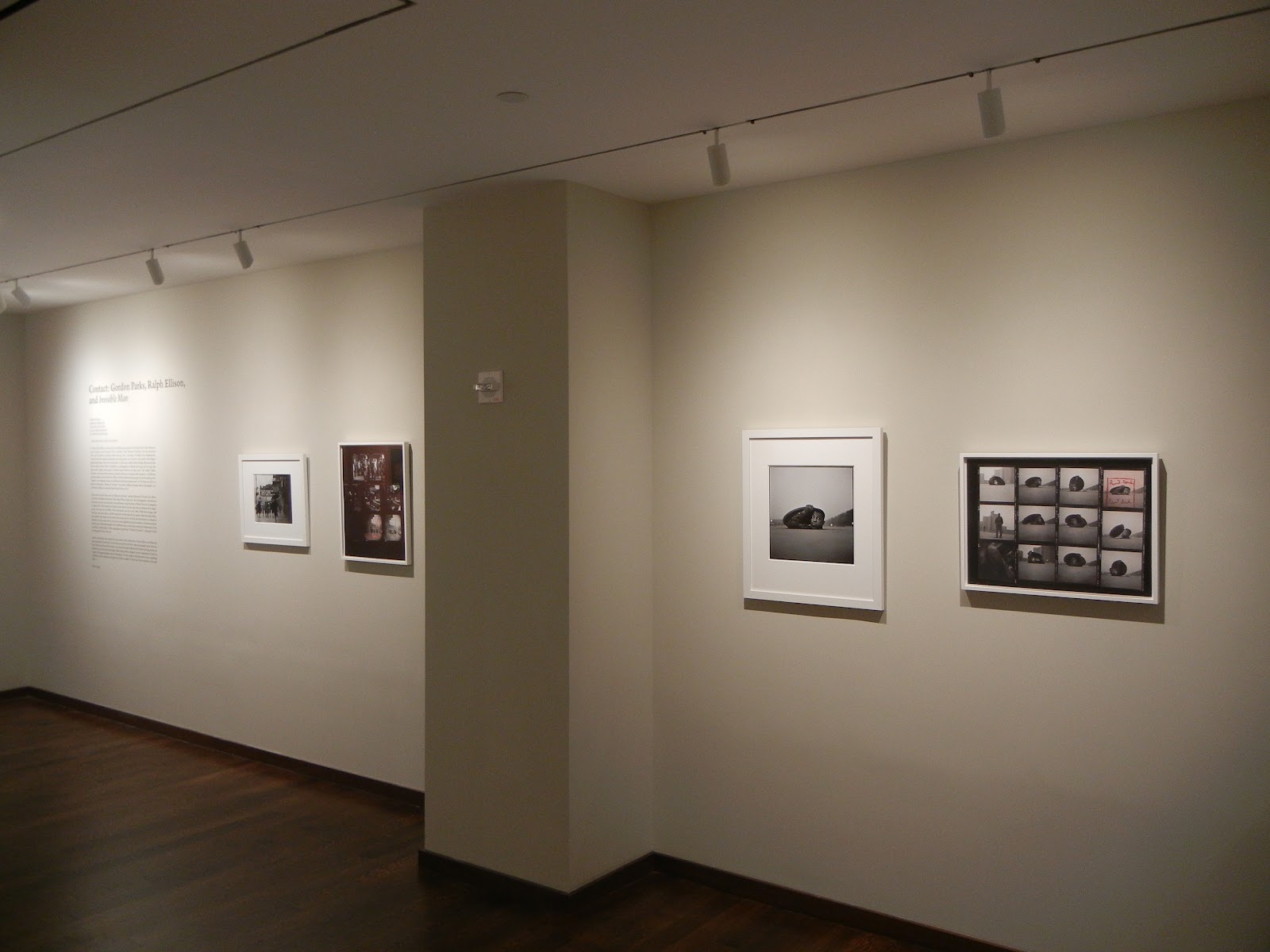
Contact: Gordon Parks, Ralph Ellison, and "Invisible Man" @Greenberg

JTF (just the facts): A total of 25 black and white photographs, framed in white and variously matted, and hung in the second gallery space to the left of the main entrance. The show combines prints and contact sheets made between 1948 and 1952; there are 13 individual prints and 12 contact sheets on display. The single images are a mix of vintage gelatin silver prints and more recent pigment prints, sized between 8x10 and 20x16 (or reverse); the later prints are available in editions of 5 or 10. The contact sheets are all recent pigment prints, sized 24x20 (or reverse). The show also includes 3 magazine spreads from LIFE, displayed directly on the wall under plexiglas. (Installation shots at right.)
 
Comments/Context: Of all the exhibits dedicated to the work of Gordon Parks on view in the city right now (and there are several), this small show is my favorite. Curated by the artist Glenn Ligon, it primarily examines the images Parks made in 1952 to illustrate some of the scenes from Ralph Ellison's ground-breaking book Invisible Man. The exhibit dives deep into important single images from the project and the related contact sheets that show Parks' artistic process, and then pairs them with more documentary-style street photographs made by Parks in Harlem a few years earlier (again with the associated contact sheets). The result is a show that smoothly moves back and forth between fact and fiction, between real life and literature, all within the context of Parks' compositional eye.
 
The images Parks made for Invisible Man have a definite sense of the staged or the imagined. A man peers out from under a manhole cover in the middle of the street with an uncertain, fugitive look in his eye, another works turntables amid a light blub covered underground retreat (complete with superimposed city lights above), and various suited men dash with suitcases on darkened sidewalks. The contact sheets show Parks experimenting with poses and angles, looking for just the right range of quietly surreal tension and contrast.
 
What's amazing is that many of Parks' street scenes from Harlem exhibit some of these same kind of moments, albeit drawn from everyday life. Pedestrians trudge in the rain under a movie marquee announcing Dealers in Crime and Hoodlum Empire, while lines of abandoned shoes lie on the sidewalk. Most of these photographs document lingering life on stoops and outside storefronts: watching the world go by, yawning, arguing, in front of the Indian herb store or the grocer advertising neck bones. The contact sheets show Parks making multiple exposures of each chosen vignette, refining the spatial relationships until the gestures coalesced.
 
Seeing these two sets of photographs intermingled, along with their respective outtakes, helped me to see the literary in Parks' street pictures, to understand how his selections from the bustle of life were informed by an aim for a certain tone. His editing wasn't just a search for the cleanest negative or the crispest composition, but was often keyed by an atmospheric connection of some kind; he was looking for something in particular when he was out there with his camera. Overall, not only does this small show deliver some fantastic images, it opens up a window into Parks' working process, which was far more nuanced and complex than I had ever understood.

Collector's POV: The works in the show are priced as follows. The vintage gelatin silver prints range in price from $8500 to $15000, while the more recent pigment prints are either $5000 or $6500. The contact sheets are $2400 each. Surprisingly, Parks' work is only intermittently available in the secondary markets, and many of his best known works have not come up for sale at auction in a long time. Recent prices have ranged between $1000 and $9000, but this may not be entirely representative of the market for his most iconic photographs.
  
Rating: ** (two stars) VERY GOOD (rating system described here)

Transit Hub:
  • Parks Foundation site (here)
  • Review: New Yorker (here)
Through October 27th

Howard Greenberg Gallery
41 East 57th Street
New York, NY 10022

Thursday, October 4, 2012

The Checklist: 10/4/12

Current New York Photography Shows
New reviews added this week in red.
(Rating: Artist/Title: Venue: Closing Date: link to review)

Uptown

THREE STARS: Rineke Dijkstra: Guggenheim: October 8: review

Midtown

THREE STARS: Gerhard Richter: Marian Goodman: October 13: review
ONE STAR: Fazal Sheikh: Pace/MacGill: October 20: review
ONE STAR: Judy Fiskin: Greenberg Van Doren: October 27: review
ONE STAR: Sally Mann: Edwynn Houk: November 3: review
TWO STARS: The Shaping of New Visions: MoMA: April 29: review

Chelsea

ONE STAR: Richard Misrach: Aperture: October 6: review
ONE STAR: Lise Sarfati: Yossi Milo: October 13: review
ONE STAR: Rosemary Laing: Galerie Lelong: October 20: review
ONE STAR: Laura Letinsky: Yancey Richardson: October 20: review
ONE STAR: Ruud van Empel: Stux: October 20: review
TWO STARS: Bernd and Hilla Becher: Sonnabend: October 27: review
ONE STAR: Barney Kulok: Nicole Klagsbrun: October 27: review
ONE STAR: Shen Wei: Daniel Cooney: October 27: review
ONE STAR: James Welling: David Zwirner: October 27: review

SoHo/Lower East Side/Downtown

ONE STAR: Sam Samore (1973): Team: October 27: review

Elsewhere Nearby

THREE STARS: Robert Adams: Yale: October 28: review

Forward Auction Calendar
New auctions added this week in red.
(Sale Date: Sale Title: Auction House: link to catalog)

October 4: Fine Photographs & Photobooks (New York): Swann: catalog
October 4: Richard Avedon (New York): Christie's: catalog
October 4/5: Photographs (New York): Christie's: catalog
October 10: Contemporary Art Evening (London): Phillips de Pury: catalog
October 11: Contemporary Art Day (London): Phillips de Pury: catalog
October 11: Post-War & Contemporary Art Evening (London): Christie's: catalog
October 12: Post-War & Contemporary Art Day (London): Christie's: catalog
October 12: Contemporary Art Evening (London): Sotheby's: catalog
October 13: Contemporary Art Day (London): Sotheby's: catalog
October 30: Photographs (New York): Bonhams: catalog
October 30: Photographs - Man Ray (Barcelona): Soler y Llach: catalog

Wednesday, October 3, 2012

Shen Wei, I Miss You Already @Cooney

JTF (just the facts): A total of 10 large scale color photographs, framed in black and unmatted, and hung in the divided gallery space. All of the works are digital chromogenic prints, made between 2009 and 2012. The prints come in two sizes: 20x30 (in editions of 5) and 30x45 (in editions of 3). The show includes 4 pictures in the smaller size and 6 in the larger size. (Installation shots at right.)
 
Comments/Context: Given that there aren't many male nudes in contemporary Chinese photography, Shen Wei's new self-portraits could certainly be called cultural outliers. His documents of self expression follow the path of the calm and the understated rather than the overtly provocative or the knowingly political, tracing an inward-looking personal exploration with remarkably restrained sensitivity. There is still, of course, tension in these pictures, but it is reserved and quiet, open but uncertain.

Most of Shen's images play with the angles of his body: bent knees on a window sill, an arched back bend, a straight leg interrupting a table top still life, a triangular elbow propping up his head. His graceful stance in a submerged boat, using his outstretched leg to make concentric ripples in the light dappled water reminded me of Thomas Eakins. A few others offer complex, unknowable situations and interactions: a hand on his neck that might be either a caress or a choke, a bedside scene flanked by a nude woman and a sprawled man that offers any number of possible explanations. Shadows engulf many of the photographs, drawing our attention to the central figure in the light and adding a layer of introspective melancholy.

The best of these photographs left me impressed with Shen's growing compositional talents. When the pictures work, he successfully walks the line between realism and lyricism, all within the context of something genuinely personal.
 
Collector's POV: The prints in this exhibit are priced in ratcheting editions, as follows: the 20x30 prints start at $2500 each and the 30x45 prints start at $3500 each (one print in this size had already reached $4500). Shen's work has very little secondary market history, so gallery retail is still likely the best option for those collectors interested in following up.
 
Rating: * (one star) GOOD (rating system described here)
 
Transit Hub:
  • Artist site (here)
  • Review: New Yorker (here)
Shen Wei, I Miss You Already
Through October 27th
 
508 West 26th Street (new location)
New York, NY 10001

Tuesday, October 2, 2012

Bernd and Hilla Becher @Sonnabend

JTF (just the facts): A total of 28 black and white photographic typologies, individually framed in white and matted, and hung against white walls in the entry gallery, the two side rooms in the front, and two of the rooms in the rear. All of the works are made up of gelatin silver prints, in groups of 2 to 15 prints, made between 1963 and 1998 and printed recently. The combinations in the typologies are never repeated, so they are all unique works. (Installation shots at right.)

The works on view come from three different subject matter series, with a mix of traditional typologies (one image per location) and other works which combine multiple perspectives of a single structure or site. For each series, the number of typologies, their makeup (number of prints), and the overall dimensions are provided below:

Industrial Facades:
6 nine image typologies, each sized 56x68

Coal Bunkers:
1 two image typology, sized 37x22
2 four image typologies, each sized 38x46 (or reverse)
3 six image typologies, each sized 37x55
2 eight image typologies, each sized 38x76
2 nine image typologies,each sized 68x55

Stone Works:
1 two image typology, sized 22x41
5 three image typologies, each sized 22x64 or 38x42
5 four image typologies, each sized 38x46 (or reverse)
1 fifteen image typology, sized 68x94

Comments/Context: What struck me most about the new show of photographs by Bernd and Hilla Becher at Sonnabend is something I really should have realized a very long time ago. Drag your hand across the volumes of their work on our library shelves and the idea starts to take hold: gas tanks, water towers, blast furnaces, framework houses, industrial facades, coal mine tipples, mineheads, and even a few industrial landscapes. To gather enough pictures to make their signature typologies, to find half a dozen or a dozen structures which exhibit the same underlying architectural forms so they can be grouped together for comparison, the sheer vastness of their artistic effort has to have been truly staggering. Across forty years and countless miles, they built up a vernacular archive like no other. And here we have a show of coal bunkers and stone works (with their own architectural idiosyncrasies), plus some more industrial facades, evidence that the archive was even bigger than we had assumed.

The large typologies of industrial facades in the entry gallery will feel the most familiar to Becher-philes. They use boxy factories and warehouses to highlight stepped roof lines in brick, curved barrel roofs, arched windows, rectangular boxes with repeating window patterns, peaked roofs with vertical striping, and buildings decorated with external pipes running horizontally. The theme and variation style of the typology structure focuses crisp attention on these overlooked details.

While traditional typologies have also been employed for the coal bunkers and stoneworks, with their boxy squared off forms, train tracks running underneath, angled chutes/conveyors, and cylindrical holding areas, the Bechers also used an organizational form called the "development" that instead collects multiple views of the same structure into one stand alone architectural portrait. Some of the images are frontal (on each side) while others use angled perspectives. The effect is almost like a stop motion circular panorama, where the viewer moves around the site to see the building from every vantage point. These works are not collections of like objects, but an in-depth examination of one place. The Bechers' rigid conceptual approach still comes through, but the intimate attention being paid somehow seems more intense. Trapezoidal shapes, arched concrete, graduated angled roof lines, wood siding in vertical and horizontal directions, these all seem more like personality traits of an individual rather than commonalities of a group. When hung together in a room, these "developments" tell a very different story about the evolution of functional motifs than the typologies; they provide a closer investigation of both similarities to and deviations from a common form, and they seem to imply both cross pollination of architectural ideas as well as elemental, universal styles that evolve strictly from local usage.

So for those of you who may think you have already seen everything the Bechers had to offer, this show brings together both lesser known subject matter and an unexpected conceptual twist on their signature typology. As always, the work is exquisitely crafted and meticulously considered; what I appreciated here was the sense of smart freshness that seemed to reanimate their much celebrated and highly influential photographic approach.

Collector's POV: The works in this show are priced as follows, and have stayed consistent (without price escalation) over the past few years. The works are priced based on the number of prints in the typology. As such:

2 image typologies: $26000
3 image typologies: $39000
4 image typologies: $52000
6 image typologies: $78000
8 image typologies: $104000
9 image typologies: $117000
15 image typologies: $195000

The Bechers' work is now consistently available at auction, in every season and every geography. Prices for single images have ranged from roughly $3000 to $35000 in recent years; typologies have ranged between roughly $25000 to $180000 during that same time.

Rating: ** (two stars) VERY GOOD (rating system described here)
 
Transit Hub:
Through October 27th

Sonnabend Gallery
536 West 22nd Street
New York, NY 10011

Monday, October 1, 2012

Barney Kulok, Building @Klagsbrun

JTF (just the facts): A total of 23 black and white photographs, framed in black and unmatted, and hung in the main gallery space and the smaller back room. All of the works are gelatin silver prints, made in 2011 or 2012. The prints are sized either 20x28 or 29x40 (or reverse) and are available in editions of 6+4AP. There are 12 prints in the small size and 11 prints in the large size on view. A monograph of this body of work was recently published by Aperture (here) and is available from the gallery for $80. (Installation shots at right.)

Comments/Context: Just prior to his death, the famed architect Louis Kahn designed a memorial park for Franklin D. Roosevelt, fittingly to be placed on the then recently renamed Roosevelt Island here in New York. Nearly forty years later, that park has finally been built and is scheduled to open to the public later this month. During its recent construction, Barney Kulok made in-progress photographs of the site, the rough chaos of building pared down to richly dark black and white pictures, full of attention to texture and surface.

At first glance, Kulok's photographs feel like a throwback to the early days of Callahan, Siskind and Metzker, where light and shadow were used explore the abstraction of simple city forms. A squiggly bent wire and its shadow, the dense black shadow of a hammer and chisel, a tight mesh pattern on a white wall, Kulok's images seem cut from this same Modernist cloth, albeit in larger contemporary sizes. Several of the works linger over Kahn's smooth geometries, playing with contrasts in tonality of edging and in finished/unfinished materials: a rectangular block in white offset by a dark trapezoidal shadow, perfect cubes of grey granite thrown haphazardly over the finished cobblestone walkway, a circular pile of sandy joint filler against the graph paper squares of the granite, alternating stripes of black shadow on a concrete stair interrupted by a short plank of wood. Construction debris is found to be surprisingly elegant: a leaning 2x4, a brick plumb line, a bent corner hinge, a sponge, they all become quiet still lifes when seen in tactile isolation.

In general, I found it surprisingly satisfying to see that well-executed black and white can still be relevant to the contemporary discussion. These photographs are crisp and defined without seeming overly old school or derivative. The subject matter lent itself well to a high contrast study, and Kulok has delivered a set of images that are graceful and luxurious.

Collector's POV: The works in this show are priced as follows. The smaller 20x28 prints are $4500 and the larger 29x40 prints are $6000. Kulok's work has only just begun to enter the secondary markets, so gallery retail is likely the only option for those collectors interested in following up.
  
Rating: * (one star) GOOD (rating system described here)
  
Transit Hub:
  • Artist site (here)
  • Review: New Yorker (here)
  • FDR Four Freedoms Park (here)
Through October 27th
 
534 West 24th Street
New York, NY 10011