Friday, February 8, 2013

Max Warsh: BILDER @Toomer Labzda

JTF (just the facts): A total of 5 photographic collages, framed in walnut and unmatted, and hung in the small single room gallery space. All of the works are combinations of color photographs and acrylic on wood panel, made in 2012. 4 of the collages are made of a single panel and sized 25x21; the other work consists of four panels and is sized 49x41 overall; all of the works are unique. The show also includes 2 polypropylene conveyor belts, hung floor to ceiling in strips. This is Warsh's first solo show in New York. (Installation shots at right.)

Comments/Context: Max Warsh's photographic collages break down images of architectural ornamentation into studies of flat, all-over pattern, transforming them into jagged shards of geometric wallpaper that are fit together with interlocking precision. Combined with painted areas of more organic empty space, the works use contrasts of implied texture and scale to create abstract compositions full of swirling, shifting movement. They're fresh and energetic, with repeated visual motifs chasing themselves across the picture plane.

Warsh's photographic raw material is the stuff of building decoration: stucco walls, painted breeze blocks, arcs of terracotta tiles, billows of carved vegetation, and squares and triangles of concrete piled into perforated barriers and patterned fences. His pictures bring out the inherent order and repetition of such structures, and when scissored together, they become swatches of fabric in stark white or pastel salmon pink, mixed and layered into busy combinations. In between areas of black, brown or grey negative space give the eye a break from the frenetic geometries, slowing the jittering down to a more manageable pace and making the contrasts less intense. The result is a set of systematic abstractions that are well balanced, that draw the eye around the compositions following the transitions in texture.

These works feel like the beginning point for a line of artistic thinking that will inevitably get more complex and sculptural; as the panels multiply, the works will likely move from closed and intimate to more open ended and iterative, allowing the patterns more freedom to roam. Warsh's vertical zip conveyor belt readymades imply further extensions of texture and materials, broadening the scope far beyond the normal boundaries of simple photographic collage.

Collector's POV: The works in this show are priced as follows. The smaller 25x21 collages are $2400 each, while the larger 49x41 collage is $8800. Warsh's work has not yet reached the secondary markets, so gallery retail is likely the best/only option for those collectors interested in following up.

Rating: * (one star) GOOD (rating system described here)

Transit Hub:
  • Artist site (here)
  • Feature: ArtFCity (here)

Through February 24th

Toomer Labzda
100A Forsyth Street
New York, NY 10002

Thursday, February 7, 2013

The Checklist: 2/7/13

Current New York Photography Shows
New reviews added this week in red.
(Rating: Artist/Title: Venue: Closing Date: link to review)

Uptown

ONE STAR: After Photoshop: Met: May 27: review

Midtown

ONE STAR: Sissi Farassat: Edwynn Houk: February 16: review
ONE STAR: Philip Trager: NY Public Library: February 17: review
TWO STARS: The Shaping of New Visions: MoMA: April 21: review

Chelsea

ONE STAR: Thomas Barrow: Derek Eller: February 9: review
ONE STAR: Diana Cooper: Postmasters: February 9: review
ONE STAR: David Hilliard: Yancey Richardson: February 16: review
TWO STARS: Hendrik Kerstens: Danziger: February 16: review
ONE STAR: Niko Luoma: Bryce Wolkowitz: February 16: review
TWO STARS: Zwelethu Mthethwa: Jack Shainman: February 23: review
ONE STAR: Robin Rhode: Lehmann Maupin: February 23: review
TWO STARS: Andy Freeberg: Andrea Meislin: March 2: review
ONE STAR: Distance and Desire, Part II: Walther Collection: March 9: review

SoHo/Lower East Side/Downtown

ONE STAR: Jaimie Warren: The Hole: February 9: review
ONE STAR: Narcissister: Envoy Enterprises: February 10: review
ONE STAR: Chris Buck: Foley: February 24: review

Elsewhere Nearby

No reviews at this time.

Forward Auction Calendar
New auctions added this week in red.
(Sale Date: Sale Title: Auction House: link to catalog)

February 12: Contemporary Art (Evening): Sotheby's (London): catalog
February 13: Contemporary Art (Day): Sotheby's (London): catalog
February 13: Post-War and Contemporary Art (Evening): Christie's (London): catalog
February 14: Post-War and Contemporary Art (Day): Christie's (London): catalog
February 14: Contemporary Art (Evening): Phillips (London): catalog
February 15: Contemporary Art (Day): Phillips (London): catalog
February 26: Fine Photographs: Swann (New York): catalog
February 26-March 5: Andy Warhol: Christie's (Online): catalog

Wednesday, February 6, 2013

Auctions: Contemporary Art Evening and Day Auctions, February 12 and 13, 2013 @Sotheby's London

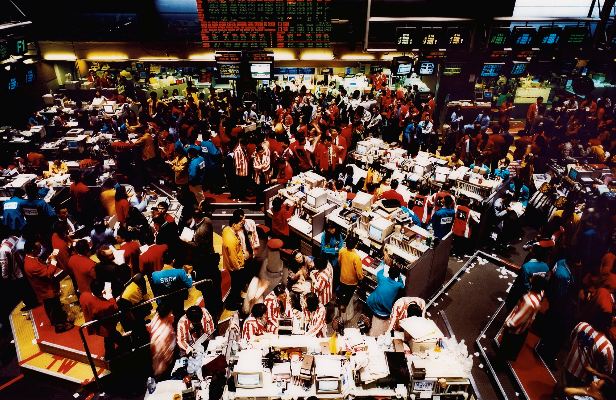
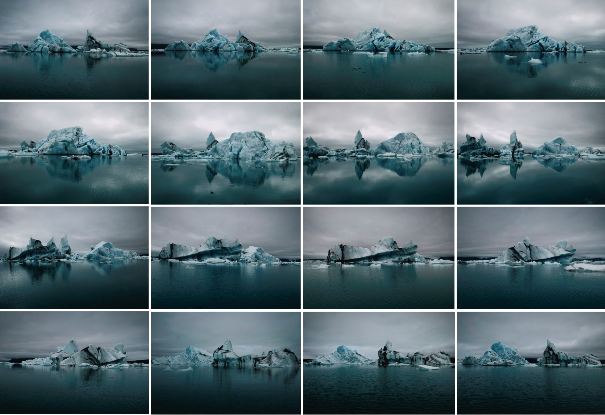
Sotheby's kicks off the 2013 Spring Contemporary Art season with Evening and Day sales next week in London. The top photography lots include works by Gursky, Prince, and Gilbert & George. Overall, there are a total of 34 photography lots available across the two sales, with a Total High Estimate of £1901000.

Here's the statistical breakdown:

Total Low Lots (high estimate up to and including £5000): 0
Total Low Estimate (sum of high estimates of Low lots): NA

Total Mid Lots (high estimate between £5000 and £25000): 21
Total Mid Estimate: £321000

Total High Lots (high estimate above £25000): 13
Total High Estimate: £1580000

The top lot by High estimate is lot 37, Andreas Gursky, Singapore Börse, 1997, at £350000-550000. (Image at right, top, via Sotheby's.)

Here is a list of the photographers who are represented by more than one lot in the two sales (with the number of lots in parentheses):

Candida Höfer (3)
Thomas Ruff (3)
Gilbert & George (2)
Andreas Gursky (2)
David LaChapelle (2)
Cindy Sherman (2)

Other lots of interest include lot 294, Richard Prince, Untitled (Pens), 1979, at £120000-180000 (at right, middle) and lot 228, Olafur Eliasson, 360° Crystal Palace, 2007, at £60000-80000 (at right, bottom, both images via Sotheby's).

The complete lot by lot catalogs can be found here (Evening) and here (Day).

Contemporary Art Evening
February 12th

Contemporary Art Day
February 13th

Sotheby's
34-35 New Bond Street
London W1A 2AA

Chris Buck, Presence @Foley

JTF (just the facts): A total of 13 large scale color photographs, framed in white and unmatted, and hung in the single room gallery space in the back. All of the works are chromogenic prints, made in 2011. The prints come in two sizes: 20x24 (in editions of 10) and 42x50 (in editions of 1, accompanied by an original signed witness testimony). There are 12 images in the small size and 1 image in the large size on display. A monograph of this body of work has recently been published by Kehrer Verlag (here). (Installation shots at right.)

Comments/Context: In our celebrity crazed culture, we have been trained to wait obsessively for images of our favorite bold faced stars and froth at the mouth with frenzy over outrageous pictures of the famous and important. As a result, a veritable army of talented and creative celebrity photographers has sprung up, continually pushing the edge of the visual envelope in the name of ever increasing publicity and promotion. This is what makes Chris Buck's Presence project so unexpected. The big name celebrities are here all right, but they're hiding from view, leaving us with empty rooms and vacant spaces, a sly conceptual middle finger raised to the audience.

My first, and admittedly infantile reaction to these pictures was to try to break the code, to locate the place where in the bathroom where Robert de Niro was concealed or to figure out how Jay Leno hid behind his car in the parking lot, my brain still wired to maniacally search for the star, to hit the button for the endorphin reward. As I circled the gallery and frustration gave way to failure, I began to see the real power of the images. We subconsciously attribute value to places graced by the presence of celebrities, going all the way back to the George Washington slept here phenomenon. Somehow David Lynch's back yard, John Hamm's cinder block parking space, or David Byrne's office (complete with a flat packed Big Suit) seems full of some kind of special essence; we care more about a hotel foyer because Russell Brand is hiding there or are suddenly more interested in a striped shower curtain because Weird Al Yankovic is standing behind it. This is, of course, completely crazy, and yet, the weird aura effect remains - we absolutely see these places differently. The photographs are therefore both of the celebrities and not, simultaneously pictures of their obvious absence and their lingering influence.

I think Buck's inversions are clever and will likely be durably insightful; I can certainly imagine a big museum exhibit of celebrity portraiture ending with one of Buck's images, deftly pulling the rug out from under the previously contented viewers. It's a great example of photographing the unphotographable, exposing the quirky passions and fixations that lurk in our minds.
 
Collector's POV: The prints in the show are priced based on size. The 20x24 prints are $2500 each and the 42x50 prints are $5000 each. Buck's work has little secondary mark history, so gallery retail remains the best/only option for those collectors interested in following up.
 
Rating: * (one star) GOOD (rating system described here)
 
Transit Hub:
  • Artist site (here)
  • Book site (here)
  • Features/Reviews: A Photo Editor (here), Telegraph (here), Cool Hunting (here), ArtINFO (here), Huffington Post (here)

Chris Buck, Presence
Through February 24th
 
97 Allen Street
New York, NY 10002

Tuesday, February 5, 2013

Andy Freeberg, Guardians @Meislin

JTF (just the facts): A total of 15 large scale color photographs, framed in white and unmatted, and hung against white walls in the divided gallery space. All of the works are archival pigment prints, made in 2008 and 2009. The prints are available in two sizes: 30x45 or reverse (in editions of 6) and 40x60 or reverse (in editions of 3). A monograph of this body of work was published in 2008 by Photolucida (here). (Installation shots at right.)

Comments/Context: In recent years, the trend toward academic art making might easily have led us to conclude that increasing conceptual complexity was a requirement for some measure of artistic success. And yet, this backdrop of pervasive, brainy seriousness makes the elegant simplicity of Andy Freeberg's Guardians project all the more remarkable. At first glance, a series of photographs of museum guards and the artwork they protect seems a unlikely winner. We can quickly imagine the probable look alikes, the tedious boredom, and the quirky juxtapositions, and the premise itself seems like the kind of one-liner heavy thing someone else has already done.

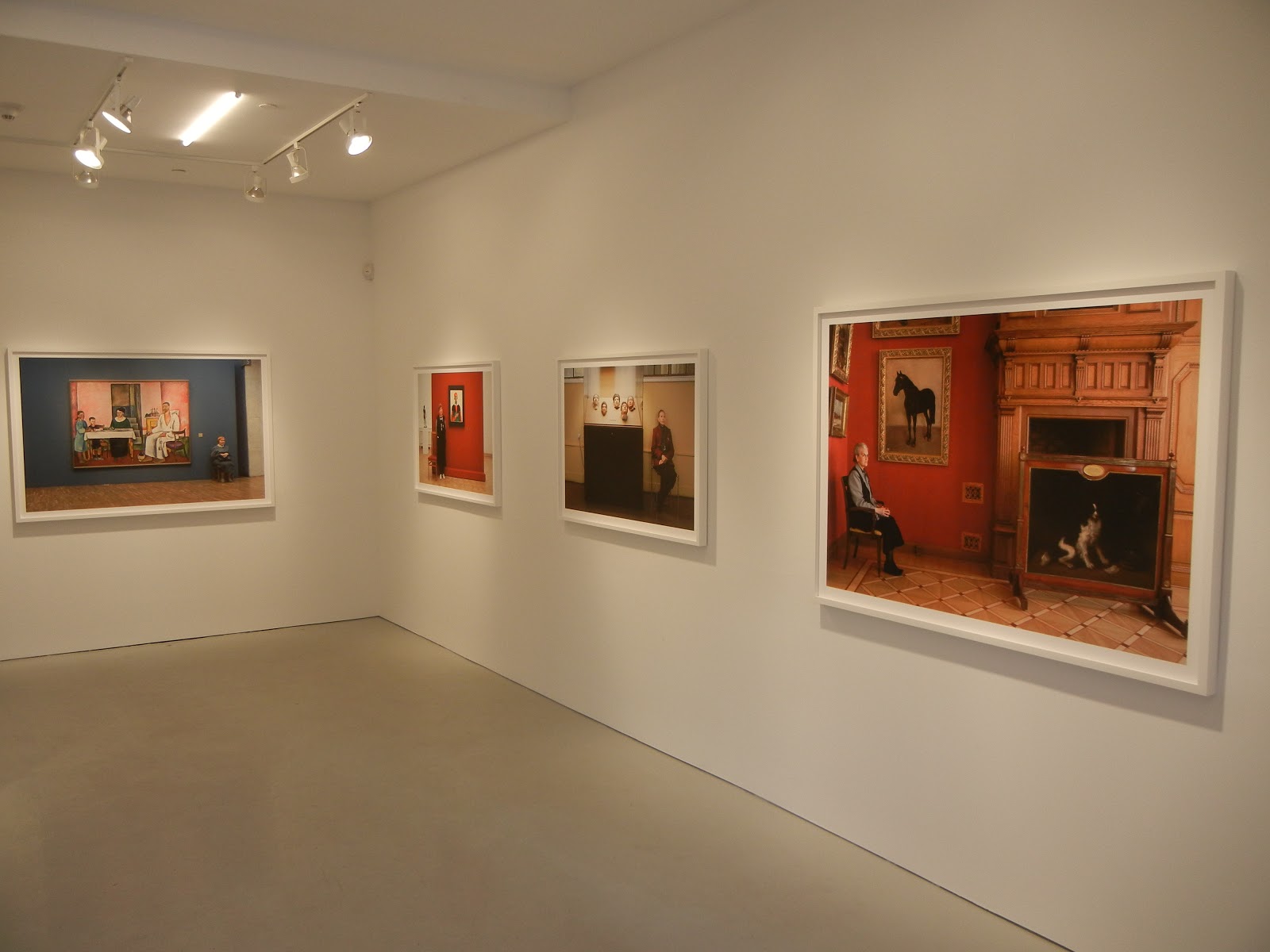
But the images in Freeberg's series go far beyond this obviousness. They ask us to step back and consider art in context, to see the treasures of Russia's finest museums not just as items to be checked off after consulting the wall label, but as objects that stand in relation to everything around them: the wall colors, the light, the moldings, the frames, the position and gestures of the guards, and the people themselves. The art he sees is in the entire environmental experience, the back and forth dialogue between the "center" and the overlooked surroundings. There is a conceptual kinship with the work of Louise Lawler here, but with a softer, more human touch.

Freeberg's visual echoes between the retired Russian women and the nearby artworks cover a wide swath of ground, from hair styles and facial features to poses and clothing color. A glass case of wide eyed mummy masks is flanked by an equally alert guard, while the jowled cheeks of a Malevich self-portrait are surprisingly similar to those of his protector. The patterned shawl of a guard sits underneath an equally swirling blue Matisse tablecloth, just as a striped shirt recalls the sculpted sideways drapery of a nearby ancient statue. And a modest, hands-clasped guard is a doppelganger for the nervous young girls before a country dance in a painting by Kugach, almost as though she was an extension of the painted scene herself. In every case, the pairings are done with an eye for detail and a respect for the dignity of the guards; they never degrade into overly clever jokes made at the expense of the sitters. In unexpected ways, the presence of the guards enhances the overall of seeing the art, highlighting aspects of the work we might have missed.

What's exciting about these pictures is that they use photography to force a recalibration of seeing. They are less about the amazing paintings and sculptures on display and more about the space around them, and the shifting relationships between people and the installations of art. They are a "hiding in plain sight" revelation, innocuously simple but consistently rich and thought provoking.

Collector's POV: The works in this show are priced based on size. The 30x45 prints are $6000 each and the 40x60 prints are $7500 each. Freeberg's work has not yet reached the secondary markets, so gallery retail remains the best/only option for those collectors interested in following up.

Rating: ** (two stars) VERY GOOD (rating system described here)

Transit Hub:
  • Artist site (here)
  • Features/Reviews: Slate Behold (here), American Photo (here), SF Gate (here)

Andy Freeberg, Guardians
Through March 2nd

Andrea Meislin Gallery
534 West 24th Street
New York, NY 10011

Monday, February 4, 2013

Robin Rhode: Take Your Mind Off the Street and Paries Pictus @Lehmann Maupin

JTF (just the facts): A total of 9 multi-panel works and 1 single image photograph, framed in white and unmatted, and hung against white walls in the two separate gallery venues. Each of the multi-panel works is made up of a series of 16x24 c-prints, gathered into sets of 8, 9, 12, 15, or 16 prints. All of the works were made in 2012-2013 and are available in editions of 5+2AP. The round single image photograph is sized 73x73. The show also includes 2 metal sculptures suspended from the ceiling in the 26th Street location and a series of crayon-colored wall decals in the Chrystie Street location. All of the photographs are on view at the 26th Street location, except for 1 set of 8 prints (switchblade) shown on the second floor balcony at Chrystie Street. (Installation shots at right.)

Comments/Context: Robin Rhode's photographic works distill an unlikely mash-up of artistic styles and genres into cleverly simple visual vignettes. Mixing equal parts hip-hop street art and active performance with a photographic approach that reaches back to Marey and Muybridge, his mini-stories play out with flip book style lightness and ease. Told against the backdrop of anonymous walls and using himself as a kind of subtly comic straight man, his works play with camera-viewed flatness and perspective, using iterative stop motion steps to create a linear progression of time and narrative.

Most of Rhode's series are step-by-step charcoal drawings (black on white or white on black) that find the artist interacting with the evolving hand-drawn scene behind him. Huge feathers fan out in an arc, a car spanner spirals overhead, and a massive comb makes crossed striations on the wall. Unexpected scale and optical trickery often play a part: an oversized afro pick pumps up a tangled ball into a big circle, birds fly over a barbed wire fence, and ships multiply across a wavy sea tracked by sight lines drawn straight from Rhode's eyes. Motion is indicated by cartoon swooshes, giving the bounce of a basketball, the curved climb of a bicycle, and the speed of a car the appearance of movement. Rhode's works give the one-liner of street art more degrees of freedom, allowing basic visuals to morph and change.

These recent works feel slightly less subversive and reactionary than previous works I have seen by Rhode; they have less political edge and more carefree wit. I think this softens their impact, tipping the balance away from social critique and toward nimble ingenuity. This doesn't diminish their imagination or originality, but it reduces their perceived weight. These works ask less of us, and as a result, feel more like exercises in whimsy.

Collector's POV: The photographic works in these shows range in price from 50000€ to 75000€ based on size/number of panels. Rhode's work has not been consistently available in worldwide photography auctions; when it has shown up, it has generally been placed in the Contemporary Art sales. Recent prices have ranged between $30000 and $35000, but these numbers should be taken with a degree of caution as my data from these sales is less comprehensive.

Rating: * (one star) GOOD (rating system described here)

Transit Hub:
  • Features/Reviews: TimeOut New York (here), ArtFCity (here), ArtINFO (here), GalleristNY (here)

Robin Rhode: Take Your Mind Off the Street and Paries Pictus
Through February 23rd and March 16th

Lehmann Maupin
540 West 26th Street
New York, NY 10001

Lehmann Maupin
201 Chrystie Street
New York, NY 10002

Friday, February 1, 2013

Zwelethu Mthethwa, New Works @Shainman

JTF (just the facts): A total of 18 large scale color photographs, framed in white and unmatted, and hung against white walls in the entry, the divided main gallery space, and the two smaller side rooms. All of the works are digital c-prints, made in 2010 or 2012. There are three projects represented in the show: The Brave Ones, Hope Chest, and The End of An Era, and each of the images in each series comes in a large and small size, as follows - The Brave Ones (54x72 in an edition of 1+1AP and 27x36 in an edition of 3+1AP), Hope Chest (60x80 in an edition of 1+1AP and 24x33 in an edition of 3+1AP) and The End of an Era (49x67 in an edition of 1+1AP and 24x33 in an edition of 3+1AP). (Installation shots at right.)

Comments/Context: Zwelethu Mthethwa's newest show of portraits certainly ranks among the best work he has produced in his already successful career. In three separate projects, the South African photographer probes the subtleties and depths of personal identity, via the unlikely costumes of members of the Nazareth Baptist Church, the battered hope chests of elderly women, and the hostel room furnishings of anonymous migrant workers. The pictures tell rich stories of the past, the present, and an aspirational future, consistently bursting with thick, astonishing color.

Making the choice to reject your traditional Zulu heritage and join an insurgent Christian church is likely a hard one for any young man. But to do so and then proudly wear the hybrid British/Scottish garb of kilts and bow ties, knee socks and puffy yarn head pieces is enough to test anyone's resolve, especially in a culture with such strong definitions of masculinity. No wonder Mthethwa called these sitters The Brave Ones. Posing in the verdant green of the bush under solitary shade trees, young men stand with languorous defiance, in pith helmets and green ribbons or sporting red checked skirts and starched white shirts. It's a smart inversion of the stereotypical tribal pose, capturing an unexpected willingness (or need) to break from the crowd.

Mthethwa's portraits of women with their hope chests are even more confident and powerful. Weathered women who have seen it all pose with their chests, often resting on them or guarding them with reverent attention. The wooden boxes are heavy and solid, filled with treasures and possessions reaching back to the hopeful time before the woman was married. Many miles have clearly passed since then for all of the subjects, but even though times have changed, the chests have lost none of their traditional importance. One woman in a shiny orange and black dress sits atop her chest flanked by her matching tractor, while another wearing a bright red hat with silver rivets waits primly alongside hers under a blue umbrella. The dusty red earth tries to swallow up one woman's padlocked chest, and a jumbled pile of luggage and blankets threatens that of another. Interior wall colors throb with bold intensity, the sparse painted rooms often organized with the chests as their centerpiece furnishing. The simple image of a woman in a pink headscarf sitting in a green plastic chair before her chest, drenched in a flood of peach light, is at once penetratingly poignant and quietly breathtaking.

Mthethwa's third project, The End of an Era, reprises his earlier images of empty interiors, allowing the details of a tidy room to tell its inhabitant's story. Here one room is covered edge to edge in World Cup team shots and soccer cutouts from newspapers, while another is a study in the contrasting patterns of a blanket, a wooden divider, and a painted wall. Others focus down on specific objects: the orderliness of a set of combs and toiletries (the soap delicately paced and a shard of mirror carefully centered on the table) or the solitary candle on a makeshift bedside table. The pictures are clear evidence that even in the humblest of conditions, people find ways to make a place personal, leaving behind traces of themselves.

More generally, I think this show cements Mthethwa's position as one of the important innovators in contemporary photographic portraiture. He has a brilliant sense for how clothing, objects and environments are representative of a sitter's most strongly held beliefs, and how the subtle interaction between them can reveal something that would otherwise be hidden.

Collector's POV: The works in this show are priced based on size and series. Prints from The Brave Ones are either $26000 or $18000, those from Hope Chest are either $28000 or $18000, and the ones from The End of an Era are either $26000 or $18000. Mthethwa's work has become more available in the secondary markets in recent years, with prices ranging from roughly $5000 to $28000.
 
Rating: ** (two stars) VERY GOOD (rating system described here)

Transit Hub:
  • Artist Facebook page (here)
  • Features/Reviews: NY Times T magazine blog (here), Cool Hunting (here)

Zwelethu Mthethwa, New Works
Through February 23rd

Jack Shainman Gallery
513 West 20th Street
New York, NY 10011

Thursday, January 31, 2013

The Checklist: 1/31/13

Current New York Photography Shows
New reviews added this week in red.
(Rating: Artist/Title: Venue: Closing Date: link to review)

Uptown

ONE STAR: After Photoshop: Met: May 27: review

Midtown

ONE STAR: New Photography 2012: MoMA: February 4: review
ONE STAR: Sissi Farassat: Edwynn Houk: February 16: review
ONE STAR: Philip Trager: NY Public Library: February 17: review
TWO STARS: The Shaping of New Visions: MoMA: April 21: review

Chelsea

ONE STAR: Thomas Barrow: Derek Eller: February 9: review
ONE STAR: Diana Cooper: Postmasters: February 9: review
ONE STAR: David Hilliard: Yancey Richardson: February 16: review
TWO STARS: Hendrik Kerstens: Danziger: February 16: review
ONE STAR: Niko Luoma: Bryce Wolkowitz: February 16: review
ONE STAR: Distance and Desire, Part II: Walther Collection: March 9: review

SoHo/Lower East Side/Downtown

ONE STAR: Jaimie Warren: The Hole: February 9: review
ONE STAR: Narcissister: Envoy Enterprises: February 10: review

Elsewhere Nearby

No reviews at this time.

Forward Auction Calendar
New auctions added this week in red.
(Sale Date: Sale Title: Auction House: link to catalog)

February 12: Contemporary Art (Evening): Sotheby's (London): catalog
February 13: Contemporary Art (Day): Sotheby's (London): catalog
February 13: Post-War and Contemporary Art (Evening): Christie's (London): catalog
February 14: Post-War and Contemporary Art (Day): Christie's (London): catalog
February 14: Contemporary Art (Evening): Phillips (London): catalog
February 15: Contemporary Art (Day): Phillips (London): catalog
February 26-March 5: Andy Warhol: Christie's (Online): catalog

Wednesday, January 30, 2013

David Hilliard, The Tale is True @Richardson

JTF (just the facts): A total of 13 multi-panel photographic works, mounted and unmatted, and hung against white walls in the main gallery space and the back project room. All of the works are made up of between 2 and 4 archival pigment print panels and were made in 2011 and 2012. The individual panels come in two sizes: 20x24 or reverse (the works in editions of 12) and 40x30 or reverse (the works in editions of 7). The are 9 small panel works and 4 large panel works on display. (Installation shots at right.)

Comments/Context: David Hilliard's newest works have a uniquely East Coast American feel. Set in and around his family's Cape Cod house, his quiet narratives capture the essence of Yankee thriftiness and its deeply held belief in the simple, the functional, and the unassuming. The pictures are rooted in the charm of the unchanging and the patina of age, but also tell the story of unspoken familial distance and stubborn ritual.

The word panorama tends to get thrown around a lot when describing Hilliard's multi-panel works, but I'm not convinced that this characterization is entirely accurate. A panorama sweeps and pans, moving from edge to edge in one continuous motion. What Hilliard is doing is something more akin to standing in one place and letting your attention wander - your eye turns along a single axis, connecting adjacent but discrete frames into one perception. Each scene has multiple parts, where details come to the forefront in sequence. In these pictures, the details are richly emblematic of a certain kind of life. Inside the house, it's dusty sailing paintings, mismatched crockery, worn threadbare rugs, faded toile wallpaper, and the practicality of a tea kettle and a crackling wood stove. Outside, it's weathered shingles, rusty yard tools, and a wicker chair pulled down onto the dock. The bright light of the morning is never far away, streaming in through the crackled paint of the window frames and offering an ever present vista to the sea.

Hilliard uses the trappings of the house to help chart the emotional landscape of the family, particularly the tenuous, formal relationship between father and son. Lone figures rattle around in the old empty rooms, following the patterns and common behaviours of past generations. The connections are few and far between and time is slowed down to a crawl, where a solitary swim, a slowly smoked cigarette, or a rest on the dock is a moment of reflection or meditation. Reading a left behind book fills the afternoon, and rebellion is measured out by taking one impractical bite from every fruit on the table.

I like the restraint found in these new photographs, where the muted tones of the enduring setting are part and parcel of the subdued human relationships. Hilliard's narratives are often open ended, but their mood here is surprisingly complex and conflicted, built on the steadiness of a family that is at once comforting and stifling.

Collector's POV: The prints in this show are priced based on the size and number of panels in the work. For the works based on 24x20 panels, prices are $3100 (2 panels), $4600 (3 panels), or $6200 (4 panels). For the works based on 40x30 panels, prices are either $5600 (2 panels) or $8300 (3 panels). Hilliard's work has recently begun to show up in the secondary markets, with prices ranging between roughly $2000 and $6000.

Rating: * (one star) GOOD (rating system described here)

Transit Hub:
  • Artist site (here)
  • Feature/Review: New Yorker (here) 
 
David Hilliard, The Tale is True
Through February 16th

Yancey Richardson Gallery
535 West 22nd Street
New York, NY 10011

Tuesday, January 29, 2013

Hendrik Kerstens @Danziger

JTF (just the facts): A total of 17 large scale color photographs, mounted and unframed, and hung against white walls in the two room gallery space. All of the works are pigment prints face mounted to Diasec, made between 1994 and 2012. The prints are shown in three different sizes: 24x20 (in editions of 5 or 6+2AP), 40x30 (in editions of 6 or 10+2AP) and 60x50 (in editions of 5 or 6+2AP). there are 6 prints in the largest size, 7 prints in the middle size, and 4 prints in the smallest size on display. (Installation shots at right.)

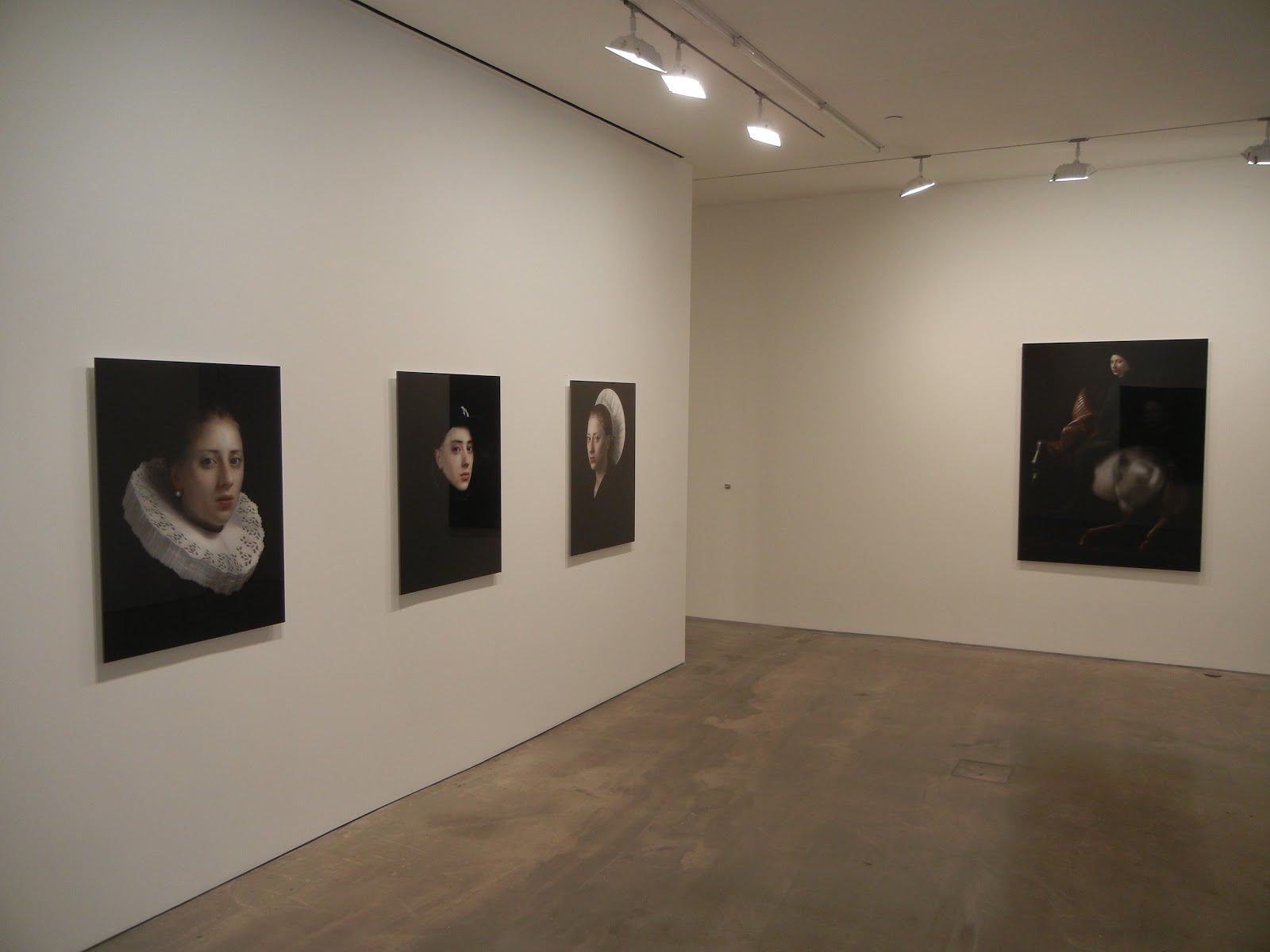
Comments/Context: I have seen and written about the work of the Dutch photographer Hendrik Kerstens several times over the past few years, so I was certainly aware of what I would likely encounter when visiting his newest show (post Sandy flooding) at Danziger Gallery. But I have to say I was totally and utterly surprised when I walked into the gallery. His portraits have been transformed into glossy objects - rather than being shown in traditional nondescript black frames, they are printed large and face mounted to Diasec like the work of many of the Dusseldorf and Helsinki school graduates. For me, it was an electric wow moment, the push and pull of old and new in his photographs energized and amplified by the modern presentation.

The show is a mini-retrospective sampler of Kerstens' work, going all the way back to his early portraits of his daughter Paula and mixing in brand new images from the past year or two. It traces both her transformation (from young girl into young woman) and his ongoing refinement of craft and technique. For those unfamiliar with Kerstens' approach, suffice it to say that he has brewed up an original alchemical mix of painting and photography, borrowing traditional dark background poses, the careful handling of light, and the subtle treatment of skin from the masters of Dutch portraiture and blending them together with anachronistic modern props and accessories, creating graceful photographic portraits that look and feel like museum treasures and then abruptly upend your sense of order. At this point, the Marie Antoinette bubble wrap headdress, the plastic shopping bag cap, the cloth napkin wimple, and the paper towel roll turban have all become contemporary classics.
 
The good news is that Kerstens' pictures are getting better and better. New portraits of Paula find her sporting a drooped cake icing spout, a thick stack of paper doilies that perfectly mimics a starched lace collar, and a flyaway high pointed bonnet in silvery aluminum foil. There's even a rearing equestrian portrait (with a nod to David) with Paula calmly looking over her shoulder. Given the large size of these prints and the new mounting approach, the works hold the wall with tremendous authority, while still retaining their sense of reserve and refinement.
 
I think the durable excitement of these works lies in their uncertain, shifting dialogue between competing forces: painting and photography, traditional cultural icons and modern realities, sober seriousness and sly wit, celebrating and undermining. They are at once classically beautiful and sublimely ridiculous, which ensures they won't ever be boring.
 
Collector's POV: The images in this show are priced based on size and place in the edition. The 24x20 prints range from $8000 to $18000, the 40x30 prints start at $12000 and go up to $75000, and the 60x50 prints begin at $22000 and rise to a lofty $160000. These prices are a significant step up from previous prices I have seen and likely represent broadening demand for his work. Kerstens' work has not yet reached the secondary markets with any regularity, so gallery retail remains the best option for those collectors interested in following up.
 
Rating: ** (two stars) VERY GOOD (rating system described here)

Transit Hub:
  • Artist site (here) and Facebook page (here)
  • Feature/Review: New Yorker (here)

Hendrik Kerstens
Through February 16th

Danziger Gallery
527 West 23rd Street
New York, NY 10011

Monday, January 28, 2013

Narcissister, Narcissister is You @Envoy Enterprises

JTF (just the facts): A total of 8 large scale color photographs, framed in white and unmatted, and hung against white walls in the single room gallery space. All of the works are c-prints made in 2012. Each is sized 40x30 and comes in an edition of 2+1AP. The exhibit also includes 2 sculptures (masks arranged in front of mirrors) and 1 video. (Installation shots at right.)

Comments/Context: At first glance, it might be tempting to label the photographic self-portraits of the performance artist Narcissister as contemporary derivatives of Cindy Sherman and dismiss them outright without much consideration. And while the kinship with Sherman's work is undeniable (particularly the challenging late 1980s/early 1990s work which was largely left out of the recent touring retrospective), I found Narcissister's parade of thrown together personas to be authentically creepy, beginning with a playful campy lightness, and with further looking, slowly becoming quietly pathetic and disturbing. It may seem like we've seen this work before, but I think there's a nugget of something new here worth exploring.

All of Narcissister's self-portraits feature the blocking mechanism of a facial mask, in this case a Barbie-style, flat-eyed painted plastic face, often broken, roughly cut in half, or taped together along scarred edges. The obscuring effect is straightforward (we can't see who she really is), but somehow the glamorous mannequin mask ends up being off-putting, the sitters trying so hard to be perfect but ultimately failing. Her characters are all exercises in personal exaggeration (the overbig afro, the gaudy pink nails, the matchy matchy hat and dress, the enormous fake breasts, the platinum blonde wig, the big gold earrings), and her backgrounds are rumpled and makeshift, as though the studio was a thrown together afterthought. The whole set-up flows neatly into the obsessive, distracted world of narcissism, of self-interest taken to extremes and of excessiveness that turns into something a bit ugly. The two sculptures allow the viewer to fleetingly peer into this world, to see out through the eyes of the Narcissiter masks - and yes, that's me in the bottom image, sporting an enticingly grotesque new look.

In the end, I liked the balance between hiding and revealing in these pictures and the undercurrent of broken desperation that palpably flows from each constructed character. While photography may not be Narcissister's primary artistic mode, each of her personas arrives with a subtle jolt: flashy, eye catching, and unexpectedly emotionally layered.
 
Collector's POV: The photographs in this show are priced at either $4000 or $4500, depending on the place in the edition. The sculptures are priced at $5000 each and the video is NFS. Narcissister's work has not yet reached the secondary markets, so gallery retail is still likely the best/only option for those collectors interested in following up.
 
Rating: * (one star) GOOD (rating system described here)
 
Transit Hub:

Narcissister, Narcissister is You
Through February 10th

Envoy Enterprises
87 Rivington Street
New York, NY 10002

Friday, January 25, 2013

Jaimie Warren, The Whoas of Female Tragedy II @The Hole

JTF (just the facts): A total of 33 photographic works, generally framed in white and unmatted, and hung in the multi-room main gallery space. 21 of the works are single image digital c-prints; sizes include 20x24/20x30 (in editions of 8), 30x40 (in editions of 5), and 40x53 (in editions of 3). 11 of the works are digital c-print diptychs, in 20x24/20x30 (edition of 8) and 30x40 (edition of 5) sizes. The final work is a large four panel digital print on canvas mural, sized 8x4 feet. All of the works were made in 2011 and 2012. (Installation shots at right.)

Comments/Context: What is it about fine art photography, and perhaps fine art more broadly, that seems to make it immune from the kind of rampant, viral Internet spreading that has overtaken other cultural genres? We now routinely uncover fresh faces in books, music, and videos that have grown up outside the existing "normal" distribution systems and brazenly charge into our consciousness on the back of a tidal wave of social interchange. Aside from a single image photographic meme that flashes and then disappears, or the video phenomenon that was Hennessy Youngman/Jayson Musson, I can't point to very many examples of artists/photographers who have built a following Gangnam Style. And yet, the Internet is all about disintermediation and connection, so the potential certainly exists for viral exchange, if we can get over the rigidities in how we look at, discuss, share, and ultimately "consume" art.

Against these odds, Jaimie Warren's photographs feel like kind of work that could create a viral sensation. They swirl together unpretentious humor, sketch comedy goofiness, and an avalanche of pop culture references into images that beg to be forwarded on to your friends. In a smart conceptual inversion, she takes Photoshopped images found on the Internet and then restages them with makeshift sets and costumes (using herself as the primary model), making self-portraits that put her personal stamp on the scavenged cleverness of bored people everywhere. Yoda photoshopped into a leafy Bouguereau gathering of nudes was probably funny to start with, but with Warren sporting big green ears and her friends playing the other roles, the crass campiness is turned up a notch further.

The show combines several different subject matter projects, each built on multiple levels of ridiculous celebrity distortion. Warren's art history insertions find her naked in a Rembrandt, dressed as Data from Star Trek in a Bellini, or posing as Santa in an Egyptian papyrus. Recreations of breadpeople and food'lebrities memes have her covered in strawberry rainbow sprinkle icing as Madonut, sporting a pastry face as JonBeignet Ramsay, and neck stretched into Pretzel Rod Stewart. Borrowings from totallylooksalike.com pair Warren as Grilled Cheese Virgin Mary and Bernadette Peters, a dog and Shelley Duvall in The Shining, and Female Gremlin and Li'l Kim. Each constructed performance is wacky, imperfect, and low-tech genuine.

Lest my comments come off as a kind of backhanded low culture compliment, there is an entirely different but equally valid review to be written of this show that places Warren in the academic context of Cindy Sherman and Gillian Wearing, centering on performance and female identity, and expanding on the traditions of staged self-portraiture in a celebrity-driven Internet age. But such high minded self-important talk, however well intentioned or thoughtfully reasoned, drains all the life out of these pictures and misses the joy of their oddball absurdity. Photographic humor is surprisingly rare, and Warren's best pictures deliver unexpectedly layered farce with an endearingly personal touch. Let the contagious forwarding begin.

Collector's POV: The works in this show are priced as follows, generally based on size. The single image prints range in price from $580 to $3000, the diptychs start at $900 and move up to $1400, and the four panel mural is $7500. Warren's work has not yet reached the secondary markets, so gallery retail is still likely the best option for those collectors interested in following up.

Rating: * (one star) GOOD (rating system described here)

Transit Hub:
  • Artist site (here)
  • Interview: Huffington Post (here)
 
Through February 9th

The Hole
312 Bowery
New York, NY 10012

Thursday, January 24, 2013

The Checklist: 1/24/13

Current New York Photography Shows
New reviews added this week in red.
(Rating: Artist/Title: Venue: Closing Date: link to review)

Uptown

ONE STAR: Letha Wilson: Higher Pictures: January 26: review
TWO STARS: Faking It: Met: January 27: review
ONE STAR: After Photoshop: Met: May 27: review

Midtown

ONE STAR: New Photography 2012: MoMA: February 4: review
ONE STAR: Sissi Farassat: Edwynn Houk: February 16: review
ONE STAR: Philip Trager: NY Public Library: February 17: review
TWO STARS: The Shaping of New Visions: MoMA: April 21: review

Chelsea

ONE STAR: Thomas Barrow: Derek Eller: February 9: review
ONE STAR: Diana Cooper: Postmasters: February 9: review
ONE STAR: Niko Luoma: Bryce Wolkowitz: February 16: review
ONE STAR: Distance and Desire, Part II: Walther Collection: March 9: review

SoHo/Lower East Side/Downtown

TWO STARS: Mary Ellen Mark: Janet Borden: January 26: review

Elsewhere Nearby

No reviews at this time.

Forward Auction Calendar
New auctions added this week in red.
(Sale Date: Sale Title: Auction House: link to catalog)

No sales at this time.

Wednesday, January 23, 2013

Niko Luoma, And Time is No Longer an Obstacle @Wolkowitz

JTF (just the facts): A total of 18 large scale photographs, variously framed and matted, and hung in the entry gallery, the hallway, and the main gallery space in the back. 13 of the works are archival pigment prints, unframed and mounted on Diasec, and made between 2009 and 2012. These prints are sized 67x55 or reverse and are available in editions of 5+2AP. The show also includes 5 smaller archival pigment prints, framed in black and unmatted, and made in 2011. These prints are sized 14x13 and are also available in editions of 5+2AP. A monograph of this body of work was recently published by Hatje Cantz (here). This is Luoma's first solo show in the United States. (Installation shots at right.)

Comments/Context: "Drawing with light" is one of those overly mystical honeyed chestnuts I associate with bad writing about photography. But in the case of Finnish photographer Niko Luoma, drawing with light may indeed be an apt description of what he is actually doing. Using an entirely analog process, he methodically exposes his negatives to hundreds of individual lines of light, building up dense thickets of pulsing linear abstraction. His works have faint echoes of Minimalism, iteratively evolved into compositions brimming with futuristic energy.

The smaller works displayed in the hallway of the gallery have the most direct connection to a familiar Minimalist aesthetic. Thin almost invisible white lines arrange themselves with mathematical precision against a dark black background, becoming intimate arrays of horizontal and vertical stripes. It's easy to see a conceptual kinship with Frank Stella's black paintings or with Agnes Martin's delicate strips and bands.

Luoma's larger works are presented as glossy objects, scaled up in wall power and intensity. Straight school bus yellow lines radiate outward from a criss-crossed center and circular black swirls overlap into a bird's nest of interlocked basket weave curves. Most of the works play on ram rod straight horizontals and verticals, piled up and layered into symmetrical thatched rectangles and woven angled patterns. Their color is pure and electric, almost as if it is backlit or lasered, from blinding monochrome contrast to intense multicolored lines in rainbow hues. The works feel modern and machined, like the output of code running open loop or a controlled, systematized process that has been allowed to wander.

I think Luoma's brand of geometric abstraction is full of freshness and vitality. His lines flutter and palpitate with a precise cadence, drawing the viewer into their seemingly endless mathematical repetitions. And it is this mix of brashness and order that gives them their originality and punch, keeping them from becoming something we have seen before.

Collector's POV:  The works in this show are priced as follows. The large 67x55 prints are $17000 each, and the smaller 14x13 prints are $6500 each. These prices represent a small bump up from prices I have encountered at recent art fairs. Luoma's work is not yet consistently available in the secondary markets, so gallery retail is still likely the best option for those collectors interested in following up.
 
Rating: * (one star) GOOD (rating system described here)
 
Transit Hub:
  • Artist site (here)
  • Feature: Photo District News (here)
 
Through February 16th
 
505 West 24th Street
New York, NY 10011

Tuesday, January 22, 2013

Thomas Barrow, Works: 1974-2010 @Eller

JTF (just the facts): A total of 24 photographs and mixed media works, variously framed/matted or unframed, and hung/displayed in the entry area, the main gallery space, and the smaller North gallery. 9 of the works are toned gelatin silver prints made in 1974 or 1975; they are each sized 11x14 and come in editions of 5 or 10. The rest of the works combine toned gelatin silver prints, Polaroids, and photograms with silicone caulk, spray paint, and other found materials; they range in size from 14x12 to 28x25 and are each unique. All of the works on view were made between 1974 and 2010. A monograph of the Cancellations series was recently published by powerHouse Books (here). (Installation shots at right.)

Comments/Context: While the current crop of gallery shows has us all thinking about the evolving intersections of photography and sculpture, Thomas Barrow has been experimenting with many of these same ideas for the better part of the last 40 years. This show provides a succinct sampler of his investigations, from a healthy group of works from his Cancellations series from the mid 1970s (for which he is likely best known) to a handful of increasingly three dimensional pieces from each of the following decades. Taken as a whole, it's an eclectic, uneven body of work, but it certainly provides a broad catalog of original ideas of how the object quality of photographs can be exploited in art making.

When I first encountered Barrow's Cancellations at AIPAD several years ago, my initial reaction to them was that they seemed conceptually flip, the slashing X across the images a kind of academic joke. But seeing them again here and looking more closely this time, I found them much richer and more intriguing than I had originally understood. The images themselves traverse now familiar 1970s New Topographics ground: roadsides, construction sites, chain link fencing, and ugly strip malls, captured in elegant black and white. Barrow then took his negatives and carved urgent gestural lines across the images, making variations on straight and squiggled Xs (along with a few dark circular dots), often playing against the planes and lines in the underlying image. The effect is two-fold: it's a bold negation/rejection of the content of the pictures, and it simultaneously transforms the photographs from being windows on a particular suburban landscape into physical objects with a conscious element of surface texture. It's an unexpected and smart intervention that gives the works a jolt of conceptual vigor.

In the early 1980s, Barrow extended this cancellation idea by physically tearing his photographs into pieces and reassembling them with thick gooey silicon caulk; the effect is even more deconstructed and Matta-Clark incised, the images falling apart and being held together. He then turned to messy overlapped photograms often covered with spray paint, stencils, and attached Polaroids, starting to build up from the flatness of the picture plane with the collaged snapshots. In subsequent works, he has left the safety of the frame entirely for heaps and clusters of Polaroids glued together into squishy agglomerations. Peeping Tom connects images of TV screens, eyes, and faces, while Hare Reliquary heads for overstuffed Joseph Cornell, with a vertical box full of bunnies and marshmallow Peeps, decorated with Polaroids clothes-pinned to the sides. His most recent works are rebus-like bags of random discarded stuff, with photographs just one of the many objects thrown into the visual and cultural blender.

What I like about this show and about Barrow's work in general is that it isn't afraid to take risks and cross boundaries. Not all of it entirely succeeds for me, but I am intellectually interested by his fits and starts, his experiments and his innovations. His view of photography is tangled and snarled up, increasingly a part of a media saturated whole rather than an end in and of itself. Those looking for the physical edges of our changing medium would be well advised to dig in and analyze what's here, as it's a map of iterative extensions and fanciful speculations.

Collector's POV: The works in this show are priced as follows. The prints from the Cancellations series are either $4500 or $5500 each, and the larger, more sculptural works range from $7500 to $9500 each. Barrow's work has very little secondary market history, so gallery retail likely remains the best option for those collectors interested in following up. Barrow is also represented by Joseph Bellows Gallery in La Jolla (here).

Rating: * (one star) GOOD (rating system described here)

Transit Hub:
  • Interview: finitefoto (here)

Thomas Barrow, Works: 1974-2010
Through February 9th

Derek Eller Gallery
615 West 27th Street
New York, NY 10001

Monday, January 21, 2013

Diana Cooper, My Eye Travels* @Postmasters

JTF (just the facts): A total of 32 photographic works/installations, unframed and adhered directly to the walls, and hung in the entry area and the front and back gallery spaces. 15 of the works are photographs (digital c-prints?), ranging in size from 6x7 to 150x59; these prints are available in editions of 5. The rest of the works are mixed media sculptures/collages, ranging in size from 5x5 to 148x118; these works are either unique or available in editions of 2. All of the works were made in 2012-2013. (Installation shots at right.)
 
Comments/Context: With digital photography now increasingly ubiquitous and malleable as a medium, many artists that have traditionally spent their time exploring the boundaries of other materials have quietly begun to add a camera to their proverbial toolboxes. Given her history, Diana Cooper can in no way be rightfully categorized as a photographer; her previous works have generally lived in the realms of sculpture and installation, with a dash of painting and drawing thrown in for good measure. And yet, in her newest show, every single work is in some shape or form meaningfully photographic, and many are what we might call straightforward prints. It is clear that photography has been wholly absorbed into her artistic practice, offering her new methods for generating patterns and playing with space.
 
In her large mixed media installations, Cooper uses the flatness of photographs to provide a foundation layer for three dimensional building, where the rich textures of found objects are employed as collaged structural imagery. Pictures of bulbous green moss morph into real Astroturf, while photographs of tactile bales of recycled cans and paper and towers of stacked bins grow into plastic meshes of construction netting and rigid geometric filters and screens. In some cases, the photographs are used in layers of recursive reference, where images of red pipes and mirrors sit underneath physical manifestations of those same objects, pushing on notions of scale and repetition. In others, Cooper is drawn to simple ordered patterns, where candy colored stadium seats are piled into a flattened uneven kaleidoscope of multiplied visual motifs. In every case, the photographs fit seamlessly into her systematic approach to construction, mixing the crispness of man made images with the organic overlapped chaos of her open ended installations.
 
The rest of the works on view play with the trompe l'oeil properties of photography, adding extra air vents and skylights to the gallery space. Flat security cameras and monitors float on walls and in corners, while a fake security gate is pulled down near the door. She even adds extra metal plates to the floor and jams in a few stand pipes along one wall. Overall, it's an effective, mind bending manipulation of the space. I didn't see these photographs as particularly durable stand alone works, but more as if she had made the whole gallery into one big Diana Cooper installation, with the jittering space bending in on itself.
 
I think there is a fascinating short term difference between contemporary photographers who add sculptural qualities to their work and sculptors who add photographic qualities to theirs. It seems to me that the photographer still tends to see the boundaries of the traditional print as sacred, building up with three dimensional textures and physical collaging/manipulations ("sculptural photography"), while the sculptor tends to see photography as something less fixed, to be employed in the more adaptable and extensible form of digital imagination ("photographic sculpture"). Eventually, I think they'll both end up in the same place, but for now, the approaches still have an intellectual point of view gap that separates them. Diana Cooper is clearly on the side of the sculptors, less interested in photography as an end point in and of itself, and more concerned with how photographic imagery can be used to extend and enhance her already complex artistic investigations. But those of us interested in the future of photography need to track artists like her, as she's showing us an alternate path, and one that will ultimately merge with the one we're following.

Collector's POV: The works in this show range in price from $1000 for the smallest single image photographs to $40000 for the largest mixed media installations. Cooper's work has very little secondary market history (and none at all in the markets for photography), so gallery retail likely remains the best option for those collectors interested in following up.
 
Rating: * (one star) GOOD (rating system described here)
 
Transit Hub:
  • Artist site (here)
  • Works lost in Hurricane Sandy (here)
  • Features/Reviews: ARTnews (here), TimeOut New York (here), Artinfo (here)
 
Diana Cooper, My Eye Travels*
Through February 9th
 
459 West 19th Street
New York, NY 10011

Friday, January 18, 2013

Book: Elad Lassry, On Onions

JTF (just the facts): Published in 2012 by Primary Information (here) and distributed by DAP (here). Paperback, 240 pages, with 112 color images. Arranged by Stuart Bailey and includes an essay by Angie Keefer. (Spread shots below.)

Comments/Context: Elad Lassry's On Onions is the kind of clever photobook that I wish the artist had made earlier in his career, as it would have helped me to find a more obvious entry point into his work. In the past few years, Lassry has become something of a rising star, with the requisite museum group shows, gallery solos, curator favor, and buzz in the press. His color saturated commercial-style still lifes with their matching frames have become an instantly recognizable signature look. And yet, at least for me, Lassry's photographs have heretofore been a bit of a head scratching mystery - original to be sure, but their seductiveness more often outweighed in my mind by lack of context and a mystifying randomness. I had a hard time trying to decipher their obtuse puzzle, or perhaps there was no puzzle at all and the images were purposefully campy and vapid.

What I like very much about this well designed book is that there is an underlying conceptual framework that holds these particular photographs together. The book balances two sets of imagery (onions and eyes), moving back and forth between the two groups in mixed bunches. Lassry's deadpan still life onions cover the entire taxonomy of types and colors (white, yellow, brown, red, green, pearl, and sweet) as well as depciting a selection of presentation and knife skills (chopped, sliced, sectioned, halved, peeled, grouped, and bunched). These forms are matched with variations on objectified eyes - contact lenses, arrays of colored lenses, sections of an eye, prosthetic eyes, and multiple black background retina scans that look alarmingly like veined onions or moons.

The parade of right-hand side images is tied together by a wandering meditative essay on tears that is interleaved among the pictures. It's an eclectic, brainy study, from a story about dysfunctional tear ducts and lacrimal glands to an examination of the different chemical properties of emotional and reflex tears. Along the way, we follow the path of the magical tear that changes a stuffed animal into a real rabbit in The Velveteen Rabbit and track the career of Hollywood director Douglas Sirk and his melodramas of hopeless situations and happy endings. The result is a smart sense of rhythm and wry purpose that was completely absent from my previous encounters with Lassry's work. It's not exactly an underlying narrative, but it's certainly a defining structure that provides logic and meaning to the sequence of pictures. In the end, it's still a quirky, open-ended project, but for the first time, there is a trail of bread crumbs to follow.

Collector’s POV: Elad Lassry is represented by David Kordansky Gallery in Los Angeles (here). He was included in MoMA's New Photography exhibit in 2010 (review here), had a show at Luhring Augustine in New York later that year, and recently had one of his images displayed on the High Line billboard.
 
Transit Hub:
  • Various reviews: NY Times, 2012 (here), LA Times, 2012 (here), Art in America, 2011 (here)