Showing posts with label Alfred Stieglitz. Show all posts

Tuesday, March 26, 2013

Auction: Important Photographs from the Collection of Dr. Anthony Terrana, April 2 and 3, 2013 @Phillips New York

Phillips begins the 2013 Spring auction season for photography with a two session, single owner sale drawn from the collection of Dr. Anthony Terrana. It's a broad selection, covering both well known names and more recent contemporary work, with a strong group of 20th century icons from the likes of Stieglitz, Kertesz, Frank, Arbus, Weston, and Moholy-Nagy at its core. All in, there are a total of 165 photographs on offer, with a total High estimate of $5400000. As a side note, while flipping through the catalog, I noticed a repeated pattern - an impressive 76 of the available lots came into Terrana's collection via the Robert Klein Gallery.

Here's the statistical breakdown:

Total Low Lots (high estimate up to and including $10000): 78
Total Low Estimate (sum of high estimates of Low lots): $533000

Total Mid Lots (high estimate between $10000 and $50000): 64
Total Mid Estimate: $1452000

Total High Lots (high estimate above $50000): 23
Total High Estimate: $3415000

The top lot by High estimate is tied between lot 12, Alfred Stieglitz, Georgia O'Keeffe, 1919 (image at right, top, via Phillips), and lot 19, Irving Penn, Harlequin Dress (Lisa Fonssagrives-Penn), 1950, both estimated at $300000-500000.

Here's the list of photographers represented by three or more lots in the sale (with the number of lots in parentheses):

Robert Frank (4)
Sally Mann (4)
Henri Cartier-Bresson (3)
Pieter Hugo (3)
Abelardo Morell (3)
Vik Muniz (3)
Edward Steichen (3)
Alfred Stieglitz (3)

Other works of interest include lot 22, Paul Strand, Venice, Italy, 1911, estimated at $180000-220000 (image at right middle, via Phillips), and lot 21, Charles Sheeler, Chartres-Flying Buttresses at the Crossing, 1929, estimated at $50000-70000 (image at right, bottom, via Phillips).

The complete lot by lot catalog can be found here.

Important Photographs from the Collection of Dr. Anthony Terrana
April 2nd and 3rd

Phillips
450 Park Avenue
New York, NY 10022

Thursday, November 29, 2012

Auction: A Show of Hands: Photographs from the Collection of Henry Buhl, December 12 and 13, 2012 @Sotheby's

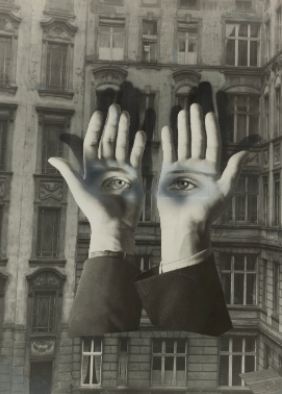
While I haven’t posted many auction previews/results in recent months, I think the upcoming single owner Buhl sale at Sotheby’s is worth following. Henry Buhl’s extensive collection of photographic hands (over 1000 images I'm told) is somewhat legendary among collectors. Shown at the Guggenheim in 2004, it’s an obsessive, expansive, single subject matter private collection that spans the entire history of the medium, from Fox Talbot and early daguerreotypes to Wall, Baldessari and Sherman. It includes photograms, Surrealism, FSA imagery, a wide range of portraits, photojournalism, advertising, scientific photographs, basically any and every type of photograph ever made with a hand in it in some fashion. As subject matter driven collectors ourselves, I am fascinated by what he has unearthed and gathered together, and how compellingly it can tell the story of photography through a single narrow slice. Most every major photographic name is represented here, sometimes by an iconic show stopper (like the ones illustrated at right), but often by an image that is much less well known. I think this is the genius and joy of the collection - going off in a direction no one else is interested in and uncovering countless gems that have been overlooked and underappreciated. The sale itself includes a total of 432 lots across two days, with a total High estimate of $12157500. The preview will certainly be worth a visit, for collectors and casual gallery goers alike.

Here's the statistical breakdown:

Total Low Lots (high estimate up to and including $10000): 270
Total Low Estimate (sum of high estimates of Low lots): $1560500

Total Mid Lots (high estimate between $10000 and $50000): 116
Total Mid Estimate: $2387000

Total High Lots (high estimate $50000 and above): 46
Total High Estimate: $8210000

The top lot by High estimate is lot 33, Alfred Stieglitz, Georgia O'Keeffe - Hands and Thimble, 1919, at $800000-1200000. (Image at right, top, via Sotheby's.)

Here's the list of photographers represented by four or more lots in the sale (with the number of lots in parentheses):

Man Ray (7)
Ruth Bernhard (4)
Imogen Cunningham (4)
Adam Fuss (4)
Ralph Gibson (4)
Robert Mapplethorpe (4)
Edward Weston (4)

(Lot 12, Herbert Bayer, Lonely Metropolitan, 1932, at $300000-500000, image at right, middle, and lot 20, Laszlo Moholy-Nagy, Fotogramm, 1925, at $300000-500000, image at right, bottom, both via Sotheby's.)

The complete lot by lot catalog can be found here.

A Show of Hands: Photographs from the Collection of Henry Buhl
December 12th and 13th

Sotheby's
1334 York Avenue
New York, NY 10021

Tuesday, June 19, 2012

Heinrich Kuehn and His American Circle: Alfred Stieglitz and Edward Steichen @Neue Galerie

JTF (just the facts): A total of 105 photographs, variously framed and matted, and hung in a series of five rooms on the third floor of the museum. 76 of the works were made by Heinrich Kuehn, between the years of 1894 and 1929; the rest were made by other photographers. The exhibit was curated by Monika Faber. A catalog of the exhibition is available from the museum for $50 (here). (Installation shots at right, courtesy of the Neue Galerie.)

For each room of the exhibit, a list of photographers included is provided, followed by the total number of images on view, the print process and the print date information in parentheses:

Gallery 1
Heinrich Kuehn (1 gum gravure, 1911, 1 platinum print on Japanese paper, 1907, 1 collotype on Japanese paper, 1907, 3 platinum prints, 1904)
Frank Eugene (4 platinum prints, 1907)
Alfred Stieglitz (1 carbon print, 1893, 1 heliogravure, 1904)
 
Gallery 2
Heinrich Kuehn (3 platinum prints, 1894, 1895, 1904, 1 bicolored gum bichromate print, 1896, 1 tricolor gum bichromate print, 1897, 14 gum bichromate prints, 1898, 1899, 1900, 1901, 1902, 1903, 1904, 1906, 1908, 1 ozotype, 1902, 2 gum gravures, 1905, 1909, 1 multiple oil transfer print, 1906)
Hugo Henneberg (3 gum brichromate prints, 1898, 1901, 1903)
Hans Watzek (1 multicolored gum gravure, 1901, 1 multicolored gum print, 1901, 1 gum bichromate print, 1900)
 
Gallery 3
Heinrich Kuehn (1 duplex half tone reproduction from Camera Work, 1911, 1 gum bichromate print, 1902, 1 Camera Work gravure, 1908, 1 multiple oil transfer print, 1908, 1 heliogravure, 1911)
Hugo Henneberg (2 Camera Work gravures, 1906)
George Henry Seeley (1 Camera Work gravure, 1907)
Edward Steichen (3 color half tone reproductions from Camera Work, 1906, 1 Camera Work gravure, 1906, 1 half tone reproduction from Camera Work, 1901)
Alfred Stieglitz (1 Camera Work gravure, 1905)
Hans Watzek (1 Camera Work gravure, 1906)
Clarence White (1 Camera Work gravure, 1905)
In glass case: 1 complete issue of Camera Work, 1 letter from Stieglitz to Kuehn
 
Gallery 4
Heinrich Kuehn (7 gum bichromate prints, 1906, 1907, 1908, 1912, 6 gum bichromate over platinum prints, 1905, 1906, 1908, 1909, 1911, 2 multiple oil transfer prints, 1913, 1920, 1 pigment print on tissue, 1920, 2 gelatin silver prints, 1912, 1920, 1 double oil transfer print on Japanese paper, 1915, 2 bromoil transfer prints on tissue, 1908, 1914, 1 multiple oil transfer print on watercolor paper, 1911, 1 carbon print, 1915, 1 bromoil print, 1929, 3 gum gravures, 1908, 1911, 2 platinum prints, 1906, 1907, 2 multiple oil transfer prints on Japanese paper, 1908, 1912, 1 bicolor gum bichromate print, 1909, 1 gum bichromate over platinum print on Japanese paper, 1913, 1 platinum print on Japanese paper, 1912)
Gertrude Kasebier (1 carbon print, 1902)
Edward Steichen (1 gelatin silver print, 1903, 2 waxed platinum and gum prints, 1901, 1902)
Clarence White (1 platinum print, 1902, 1 carbon print, 1903)
In glass case: paper samples, sketchbooks, technical manuals, color charts, photo micrographs
 
Gallery 5
Heinrich Kuehn (5 multiple oil transfer prints, 1907, 1914, 1915, 1924, 1 gum bichromate over platinum print, 1915, 2 platinum prints, 1906, 1913)
1 film, explaining Kuehn's autochromes
 
Comments/Context: Imagine reading this one line event listing in some current magazine: "Heinrich Kuehn at the Neue Galerie - carefully staged photographic portraits and landscapes, augmented by complex technical manipulations". Based on this description alone and without any clue that most of these images were made more than a century ago, it would be perfectly natural to assume the show contained cutting edge contemporary work, as our digital world is now full of staging and manipulation. Of course, these works were made in a turn of the century Pictorialist style that now seems dreamy and dated, but the parallels between the two time periods make a case for reconsidering just how relevant these works might be to our current dialogue.
 
This exhibition lies somewhere between a retrospective and a closely reasoned argument, tracing Kuehn's artistic development in a roughly chronological manner, intermittently tying in the influence of Stieglitz and Steichen. After an opening hallway of back and forth portraits among Kuehn and his famous contemporaries and handful of introductory images, the show moves on Kuehn's early work, almost all of it in colored gum bichromate, where rolling landscapes, cypress trees, and Italian villas are executed in intense atmospheric hues. Using textured papers with mottled surfaces, these images have the look of painterly blurred watercolors, tinted in various pigments from thick grey and warm brown to soft blue and rich orange. One wall in this room has recreated the show that Stieglitz installed in his gallery 291, showing Kuehn's work (as well as those of a few others in his Viennese avant-garde circle) against a light brown wall with a pleated green cloth curtain below (installation shot at right, second from the top). This was a time when photography was still struggling to secure its place as fine art, and these works (and the installation) did their best to strip away the mechanized reproduction of the camera and substitute in a more intimate, personal, hand crafted aesthetic, reminiscent of painting.
 
After a small room of images by Kuehn and others which were reproduced in Stieglitz' influential journal Camera Work, the show moves on to document Kuehn's evolution as an artist over the next decade or two, where his windy colored landscapes are entirely replaced by portraits of his children and their nanny, nudes, still lifes, and other carefully composed outdoor genre scenes. Led by Stieglitz and Steichen, Kuehn clearly started down a path toward Modernism, changing his camera angles and subject matter, only to ultimately reject the forward momentum of that movement, turning back and recommitting himself to the painterly perfection and compositional harmony he preferred.
 
In these works, Kuehn's control over all the elements of his photographic process is extremely rigorous, eliminating any chance elements or spontaneous moments. The images are entirely pre-visualized, often sketched out beforehand and then executed with methodical attention to detail, his models posed in custom color-coded clothing to ensure proper tonal matching and contrast, the light managed to avoid unwanted shadows. The resulting images have a timeless, peaceful, almost fairy tale quality, looking back to happier, better times, rather than forward. Many of the works are meticulous, nearly scientific studies of tonal values, catching the highlights on a white dress and contrasting them with the dark areas of a formal hat, or letting light dissolve into abstraction when seen through a drinking glass or still life vase. Outdoor scenes play with the balance of black and white smocks and dresses against the land, using them to manage the weights of a wider composition, and Kuehn's sensual nudes of Mary Warner use her long dark hair as a counterweight to the lightness of her skin. The final room displays a series of images of hikers on a hillside and beneath a tree, where Kuehn's total management of the process is reinforced; one scene waits for a certain cloud formation, another times specific distances between the individual subjects in the group, and a third retouches out a hiker who has strayed into the wrong place.
 
While the show does connect the dots between Kuehn's artistic evolution and the influences of Stieglitz and Steichen, what was most surprising to me was just how far Kuehn had taken his efforts to control the look and feel of his output. The show is a parade of different arcane print types and technical innovations, each one carefully optimized by Kuehn and then matched to certain pictorial circumstances and desired outcomes. And then each composition left nothing to chance, every single fold of a dress, tilt of a hat, or roll of a background meadow placed just so. If these works are not dreamy stolen moments from a bucolic, soft focus, 19th century childhood but instead premeditated scenes designed and built for particular effect, there is certainly an added dimension of exacting intent and thoughtful execution to be considered. I came away from this exhibit with an entirely different view of Heinrich Kuehn than I had previously had, one of an artist painstakingly struggling to bring forth his own vision of the best of photography, using every trick in the book, even when he defiantly knew that the world was passing him by.
 
Collector's POV: This is a museum show, so of course, there are no posted prices. Kuehn's work has been consistently available at auction in the past decade, with prices ranging from roughly $1000 (generally Camera Work photogravures) to $26000. There are two gallery shows of Kuehn's work on view in New York for those collectors interested in following up: one at Howard Greenberg (here, through August 3rd), and the other at Hans Kraus (here, through June 29th).
 
Rating: ** (two stars) VERY GOOD (rating system described here)
 
Transit Hub:
  • Reviews/Features: NY Times (here), The Economist (here), Huffington Post (here)
Through August 27th
 
1048 Fifth Avenue
New York, NY 10028

Tuesday, November 22, 2011

Photographic Treasures from the Collection of Alfred Stieglitz @Met

JTF (just the facts): A group show consisting of 47 photographic works from 35 different photographers, generally framed in black and matted, and hung spotlit against dark blue walls in a series of three small connecting rooms on the second floor of the museum. The prints were made between 1890 and 1912, using a variety of processes, including gum bichromate, carbon, platinum, and photogravure. (Installation shots at right.)

The following photographers have been included in the exhibit, with the number of images on view and their dates in parentheses:

James Craig Annan (2, 1890-1893)
Anne Brigman (2, 1905-1908)
Alvin Langdon Coburn (5, 1902-1908)
F. Holland Day (6 plus 1 group of 7, 1896-1899)
Baron Adolf De Meyer (3, 1906-1912)
Frank Eugene (2, 1898-1907)
Frederick Evans (1, 1909)
Gertrude Käsebier (4, 1899-1910)
Joseph Keiley (1, 1898)
Heinrich Kühn (2, 1908-1909)
George Seely (2, 1904-1906)
Edward Steichen (8, 1901-1906)
Pierre Troubetzkoy (1, 1904)
Clarence White (6, 1898-1906)
Clarence White/Alfred Stieglitz (2, 1907)

This exhibit is a companion show for the larger Stieglitz and His Artists: Matisse to O'Keeffe exhibit, on view through January 2nd (here). The photographs included in this broader show are mostly portraits of Stieglitz or other artists with work on view. Details on the photographers and photographs included follow below (not including the large photographic images laminated to the walls):

Alvin Langdon Coburn (2, 1903-1907)
Frank Eugene (1, 1907)
Heinrich Kühn (1, 1904)
Edward Steichen (7, 1901-1915)
Alfred Stieglitz (13, 1893-1933)
Paul Strand (1, 1929)

Comments/Context: It's probably hard to underestimate the influence of Alfred Stieglitz on fine art photography of the early 1900s. As both an artist and gallery owner, he made choices and supported aesthetic ideas that set the standard for the medium, almost single handedly pushing tastes toward (and then away from) what is now known as Pictorialism. The show is strong reflection of what Stieglitz valued, showed, bought, saved, and ultimately donated; both before and after his death, he made important gifts of key photographic prints to the Met, forming the foundation of the museum's outstanding photography collection.

The works on display here were drawn entirely from Stieglitz' personal collection, and together they provide a one-stop master class in Pictorialism, covering the major technical processes/innovations and including gems from virtually all of the important figures of the period. There are portraits and nudes, allegories and religious subjects, classical maidens and dreamlike children, all executed with a meticulous, tactile craftsmanship and a reverence for expressive emotion. De Meyer's The Shadows on the Wall - Chrysanthemums from 1906 turns simple blossoms in a vase into a soft-focus silhouette, clearly influenced by the asymmetry of Japanese wood block prints and reminiscent of amorphous jellyfish in a shadowy sea. Clarence White's Morning - The Bathroom from 1906 shows a woman in a bathtub, wearing a flowy, transparent gown and bathed in the delicate, tranquil light streaming in through the window. And Edward Steichen's Cyclamen - Mrs. Philip Lydig from 1905 pairs an evocative society portrait (with a steely-eyed stare) with wispy strands of almost abstract flowers that jut out across the picture plane.

Given that this kind of work quickly went out of favor with the arrival of straight photography, the exhibit has a kind of time capsule feeling, where we marvel at unearthed items that now seem woefully dated. But while it might be easy to be dismissive of these photographs, there is a consistency of expert skill on view here that is hard to overlook. We may have moved on from the overly evocative, painterly impressionism that these turn of the century photographers found exciting, but even a century later, the mastery of their craft as evidenced by these images is no less impressive.

Collector's POV: Given this is a museum show, there are obviously no posted prices for the works on display.
Rating: * (one star) GOOD (rating system described here)
.
Transit Hub:
  • Reviews: NY Times (here), NY Photo Review (here), Bullett Media (here)
Photographic Treasures from the Collection of Alfred Stieglitz
Through February 26th

Metropolitan Museum of Art
1000 Fifth Avenue
New York, NY 10028

Thursday, June 16, 2011

Auction Results: Important Photobooks & Photographs, May 19, 2011 @Swann

The results of Swann's recent combination sale of photographic books and photographs were generally consistent with previous incarnations of this type of sale at the auction house. In both sections of the sale, the buy-in rate was over 35% and the Total Sale Proceeds fell below the estimate range.
.
The summary statistics across the two portions of the sale are below (all results include the buyer’s premium):

Total of Both

Total Lots: 391
Pre Sale Low Total Estimate: $1169650
Pre Sale High Total Estimate: $1704150
Total Lots Sold: 243
Total Lots Bought In: 148
Buy In %: 37.85%
Total Sale Proceeds: $964281

Important Photobooks Only

Total Lots: 128
Pre Sale Low Total Estimate: $208050
Pre Sale High Total Estimate: $312050
Total Lots Sold: 80
Total Lots Bought In: 48
Buy In %: 37.50%
Total Sale Proceeds: $160772

Photographs Only

Total Lots: 263
Pre Sale Low Total Estimate: $961600
Pre Sale High Total Estimate: $1392100
Total Lots Sold: 163
Total Lots Bought In: 100
Buy In %: 38.02%
Total Sale Proceeds: $803509

Here is the breakdown, separated into two sections (using the Low, Mid, and High definitions from the preview post, here):

Important Photobooks Only

Low Total Lots: 122
Low Sold: 76
Low Bought In: 46
Buy In %: 37.70%
Total Low Estimate: $208050
Total Low Sold: $99812

Mid Total Lots: 5
Mid Sold: 4
Mid Bought In: 1
Buy In %: 20.00%
Total Mid Estimate: $104000
Total Mid Sold: $60960

High Total Lots: 1
High Sold: 0
High Bought In: 1
Buy In %: 100.00%
Total High Estimate: "Refer to Department"
Total High Sold: $0

The top lot by High estimate in the book section was lot 99, 21ST Editions, Collection, 1998-2010, at "Refer to Department"; it did not sell. The top book outcome was lot 13, Alfred Stieglitz, 291, Numbers 1-12, 1915-1916, at $31200. (Image at right, middle, via Swann.)

Only 62.50% of the lots that sold had proceeds in or above the estimate range in this portion of the sale. There were two surprises in this section (defined as having proceeds of at least double the high estimate):

Lot 76, Eugene Smith, Minamata: Life - Sacred and Profane, 1973, at $960
Lot 119, Richard Avedon, An Autobiography, 1993, at $3840

Photographs Only

Low Total Lots: 242
Low Sold: 151
Low Bought In: 91
Buy In %: 37.60%
Total Low Estimate: $1003100
Total Low Sold: $576709

Mid Total Lots: 21
Mid Sold: 12
Mid Bought In: 9
Buy In %: 42.86%
Total Mid Estimate: $389000
Total Mid Sold: $226800

High Total Lots: 0
High Sold: NA
High Bought In: NA
Buy In %: NA
Total High Estimate: $0
Total High Sold: NA

The top lot by High estimate in the photographs section was tied between two lots: lot 161, Ansel Adams, Clearing Storm, Mount Williamson, From Manzanar, Sierra Nevada, California, 1944/1970s, and lot 212, Walker Evans, 5 photographs from the portfolio Walker Evans, 1935-36/1971, both at $20000-30000; the Adams did not sell and the Evans sold for $21600.The top outcome of this section of the sale was lot 289, Andre Kertesz, A Hungarian Memory portfolio, 1914-1923/1980, at $48000.

66.26% of the lots that sold had proceeds in or above the estimate range. There were a total of 11 surprises in this section (defined as having proceeds of at least double the high estimate):

Lot 131, Japanese Imperial Family, Stacked wooden box with photographs, 1912, at $2400
Lot 142, Frederick Gutekunst, Group of 50 photographs, 1878, at $15600
Lot 153, Edward Curtis, An Oasis in the Badlands, 1905, at $9600
Lot 216, Press Photography, 350 topical news photographs, 1930-1940s, at $3600
Lot 220, Roman Vishniac, Studying Cabala in a Basement in Kazimierz, the Old Ghetto of Cracow, 1936/1970s, at $6240 (image at right, middle, via Swann)
Lot 250, David Vestal, Group of 3 photographs, 1959-1960, at $6000
Lot 278, Julius Shulman, Case Study House #22, Pierre Koenig, Los Angeles, 1950/1980s, at $6240 (image at right, top, via Swann)
Lot 289, Andre Kertesz, A Hungarian Memory portfolio, 1914-1923/1980, at $48000
Lot 298, Hollywood, Group of 68 photographs, 1930s, at $19200
Lot 307, Garry Winogrand, Untitled from Women are Beautiful, 1968/1981, at $10800
Lot 372, Marry Ellen Mark, Untitled (prostitute of Bombay), 1978, at $5040

Complete lot by lot results for both sections can be found here.

Swann Galleries
104 East 25th Street
New York, NY 10010

Tuesday, December 21, 2010

Stieglitz, Steichen, Strand @Met

JTF (just the facts): A total of 115 photographs, all drawn from the permanent collection, variously framed and matted, and hung in a series of three connected rooms on the second floor of the museum. A handful of images are exhibited on the exterior walls, showing work from each photographer plus additional detail on several photographic processes. In the main exhibit area, each photographer is given his own room. In the Stieglitz room on the left, there are a total of 42 individual photographs by Stieglitz (either framed or in cases), plus two cases of Camera Work and other books/plates and 4 portraits of Stieglitz - 1 by Steichen and 3 by Strand. The Steichen room in the center contains 36 photographs by Steichen, either framed and hung on the grey walls or laid out on tables. The Strand room on the right contains 24 works by Strand, with 1 portrait of Strand by Stieglitz and a case containing 3 Camera Work gravures. Overall, the works in the exhibit span the period from the early 1890s to the mid 1930s, and cover a wide range of processes, including gelatin silver, platinum, platinum-palladium, palladium, direct carbon, gum bichromate and autochrome. A catalog of the exhibition has been published by Yale (here) and is available for $35. A supporting group exhibit of 1910s photography entitled Our Future is in the Air continues in adjacent rooms. (Blurry, crowded installation shots of the main show at right.)

Comments/Context: The Stieglitz, Steichen, Strand show at the Met is exactly what its title suggests: three silos of star-power vintage work by contemporaneous master photographers, the connecting backstory provided by snippets of explanatory wall text. Given the Met's truly world class holdings in the work of these three influential artists, the show is a budget-friendly way for the museum to bring some of its treasures out of storage.
.
The Stieglitz room is basically a mini-retrospective, with representative images from most of his major themes and subjects: late 1800s Pictorialist New York, Modernist nudes of Georgia O'Keeffe, cloud study Equivalents, views near Lake George, and later 1930s New York cityscapes. It's a solid, greatest hits summary of Stieglitz' career, with everything from Spring Showers and The Steerage to Spiritual America. While this room is densely packed with famous imagery, Stieglitz' nudes of O'Keeffe never fail to outshine everything else for me. There is a full wall of elegant fragmented body parts on display, pared down and thrillingly alive; few have done it better in the century since.

The Steichen room focuses on his turn of the century Pictorialist work, leaving out virtually all of his later career. Clustered at one end of the room are some of the gems of this era: moonlit landscapes, ethereal nudes, and haunting images of Rodin's Balzac. But shockingly, even these masterpieces fade into the background when hung near the set of three large exhibition prints of the Flatiron Building. Seen alternately in soft green, rich blue, and dark brown, the building's personality changes, looming out of the twilight. Together, they are a staggering example of tour-de-force printing.
.
The Strand room centers on the first two decades of the photographer's career, and it is Strand's images from before 1920 that are the most relevant to the discussion of the interactions with Stieglitz and Steichen. His sparse, geometric abstractions from 1915-1917 really broke with the past and ushered in Modernism. The black rectangles of Wall Street, the arcs of bowls, the patterned shadows on a table, even laundry strung across city backyards are all transformed into pure lines and shapes, breaking with the fussiness of Pictorialism and leading the move to straight photography.
.
With such an embarrassment of riches on display, it seems downright ridiculous to find fault with this show, and yet, I think it suffers from trying to do too many things, and ultimately fails to tell us anything particularly new about these three photographers. If the goal was to parse the intricate connections between these three (both artistically and as people), then a chronological ordering and timeline would have been much more effective in teasing out the influences; the current structure creates three distinct buckets, and the connections and overlaps between them aren't made particularly clear (the supporting exhibit of 1910s photography doesn't add much to the narrative either). And while the Stieglitz room has a retrospective feel, the other two are edited in ways that add more random and tangential elements into the conversation (Steichen's autochromes, Strand's Mexican portfolio). There is also an overlay of process instruction, begun on an exterior wall, but left unfinished and uncorrelated in the three gallery spaces.

In the end though, these quibbles are drowned out by the power of some of the iconic prints on view. While the scholarship ball may not have been moved forward much with this show, what I'll remember about this exhibit five or ten years from now is getting the rare opportunity to stand up close to those three Steichen Flatirons, and to see for myself just how spectacular they truly are.
.
Collector's POV: I'm going to forgo the usual discussion of prices for this show, not only because this is a museum exhibition, but because trying to accurately pin down prices for the rarities on display here is simply a fool's exercise. While the work of all three photographers is generally available in the secondary markets, if we focus on the "best of the best" prints (especially the large exhibition prints), there are few if any market equivalents. Undeniably, if some of these masterworks were to inexplicably come into the market now, they would easily fetch well into the millions. This isn't true for everything on display, but this exhibit has a stronger concentration of exceptionally valuable/expensive vintage photography than any other show in New York this year.
.
Rating: ** (two stars) VERY GOOD (rating system described here)
.
Transit Hub:
  • Reviews: NY Times (here), New Yorker (here), Financial Times (here), Haber Arts (here)
Through April 10th

1000 Fifth Avenue
New York, NY 10028

Wednesday, December 9, 2009

Alfred Stieglitz Photographs in Georgia O'Keeffe: Abstraction @Whitney

JTF (just the facts): The main Georgia O'Keeffe exhibit contains over 125 paintings, drawings, and watercolors, spread across several large adjoining rooms and galleries. In a small side room, a total of 13 black and white photographs by Alfred Stieglitz, taken of O'Keeffe, are variously framed and matted and hung against medium brown walls. 9 of the images are gelatin silver prints; the other 4 are platinum prints. All of the works are from the period 1918 to 1922. A single glass case includes issues of Camera Work, 291, other books and related ephemera.

The Whitney does not allow photography in the galleries, so unfortunately, there are no installation shots of this show. The image at right, of O'Keeffe's hands from 1918, is via the George Eastman House website, although a print from this same negative is on view in this show.

Comments/Context: The scandalous relationship between Georgia O'Keeffe and Alfred Stieglitz is a minor back story to the expansive abstraction show of O'Keeffe's work now on view at the Whitney. While famously flaunting convention and living as lovers (out of wedlock) after WWI, the two passionate artists collaborated on a series of iconic photographic portraits and nudes of O'Keeffe that have been included in the show in a side gallery. The images have nothing to do with abstraction or O'Keeffe's place in the pantheon of painters; they do however have something to say about O'Keeffe's powerful and confident personality and about Stieglitz' talents as a photographer.

All of the photographs in this small adjunct show come from the early part of their audacious relationship. Many of the images are close-up fragments of O'Keeffe's strong body: her hands/fingers, breasts, and torso are willingly posed in a variety of artful compositions - arms swoop above her head, hands grip her own breasts, expressive bent fingers clutch and turn, the curve of her wiry torso stands silhouetted against a window. The other images are portraits in a more traditional sense - head and upper body shots of O'Keeffe, nearly always with a serious and penetrating glare on her face, directly confronting and overtly rejecting the implied criticisms of the surrounding world. For their times, these were pretty startling pictures, both radical in their content and lyrical in their execution; here was a woman laid bare to the camera, and yet defiantly beautiful in her own powerful sexuality.

It is a testament to both photographer and sitter that these images remain so potent after almost a century. Few nudes (particularly of hands) have reached this pinnacle of success in all of the intervening years. So while the main focus of this major exhibit is O'Keeffe's abstract paintings, don't fail to miss the side gallery of Stieglitz' photographs of O'Keeffe, as they rightfully belong among the great works in the history of the medium.

Collector's POV: Alfred Stieglitz' portraits and nudes of Georgia O'Keeffe are among the most rare/valuable photographs ever made. Most of these works are safely housed in museum collections. From time to time, these images do however come into the secondary markets. In the past five years or so, a handful of these vintage works have come free, finding willing buyers between $250000 and $1500000.

Of course, many of these spectacular images would fit perfectly into our own collection of female nudes. The unfortunate reality is that they are far out of reach for us; we'll just have to wistfully covet and enjoy them from afar.

Rating: ** (two stars) VERY GOOD (rating system described here)

A few words on this particular rating: in general, the quality of the photography in this exhibit easily deserves three stars, hands down. But since this exhibit is primarily about O'Keeffe and her abstract paintings (with the photographs as a tangential afterthought), I can't in good faith give the show a three star rating and recommend going out of your way to see it just for the photography. If the show was a separate entity, with more prominent credit to Stieglitz for the photographs, and some scholarly discussion of their history and importance in the context of both photography and their personal relationship, it would easily merit three stars. As it is, I can reluctantly only give it two.

Transit Hub:
Georgia O'Keeffe: Abstraction
Through January 17th

Whitney Museum of American Art
945 Madison Avenue
New York, NY 10021

Friday, April 10, 2009

Cloud 9: Imogen Cunningham, Alfred Stieglitz, Edward Weston @Silverstein

JTF (just the facts): A total of 9 vintage gelatin silver prints (thus the clever show title): 2 by Imogen Cunningham, 4 by Alfred Stieglitz, and 3 by Edward Weston, all small prints, variously framed and hung on one blue wall in the front gallery. All of the images are from the 1920s and 1930s. (Installation shot at right.)

Comments/Context: Virtually every human being has at some point in their lives looked up into the sky and seen meaning in the clouds, even if it was simply a cluster of wisps that looked momentarily (to us) like a rabbit or a dog. Master photographers are no different, and this small amuse-bouche of a show gathers together a handful of examples of what three of them found when they pointed their cameras skywards.
.
The most recognizable images in the show are the four Stieglitz Equivalents, images of diaphanous clouds, designed to evoke emotional states. Stieglitz made many of these images over his career; most are printed in the same small size, requiring intimate attention. The Weston clouds have more form to them; in one, the thin clouds are transformed into energetic fingers of fire. The Cunningham clouds were a surprise to me, as we had never seen cloud images made by her before. Her choice of puffy, cotton ball clouds gave her more freedom to play with negative and positive space.

Collector's POV: The Stieglitz images are priced between $55000 and $65000 (though not all are for sale), the Weston prints are between $25000 and $75000, and the Cunninghams are $20000 each. While clouds are not a part of our particular collection, I like the idea of having a small appetizer show in the front of the gallery that can explore a smaller theme in thoughtful detail, as a warm up for larger exhibit(s) in the back.

Rating: * (one star) GOOD (rating system described here)

Through April 25th

535 West 24th Street
New York, NY 10011