Showing posts with label Museum of Modern Art. Show all posts

Friday, August 9, 2013

Walker Evans, American Photographs @MoMA

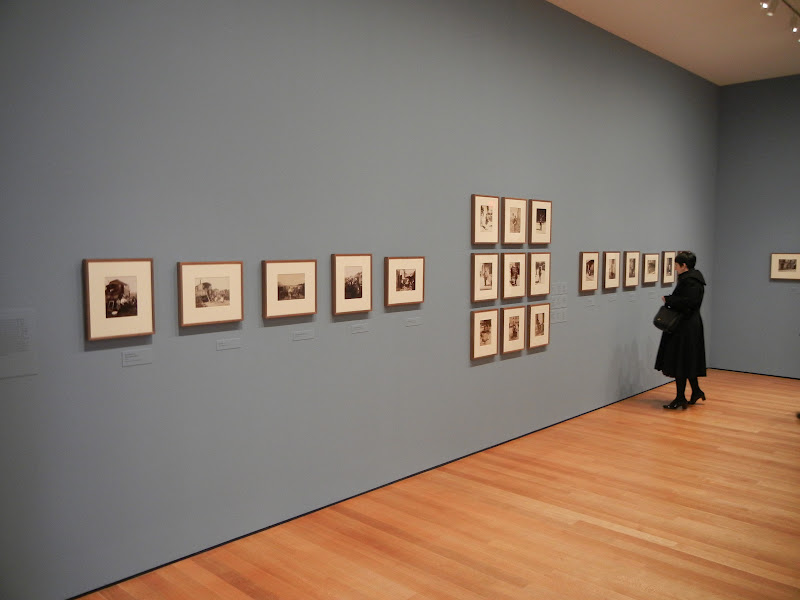
JTF (just the facts): A total of 57 black and white photographs, framed in white and matted, and hung against white walls in a single room gallery on the 4th floor of the museum. Aside from one bulletin page (found in a glass case), all of the works are vintage gelatin silver prints, made between 1929 and 1936. The exhibition was organized by Sarah Hermanson Meister and Drew Sawyer. A 75th anniversary edition of American Photographs has been published by the museum (here) and can be purchased in the bookshop for $35. (Installation shots at right.)

Comments/Context: At this point, some 75 years after its first display, there isn't much to debate about Walker Evans' American Photographs. It was the first one-person exhibit of photography at the MoMA in 1938 (a ground breaking feat at the time) and the accompanying catalog became a defining classic for the photobook genre. The photographs that made up the exhibit and book have influenced generations of downstream artists, capturing Depression-era America with a sense of exacting clarity and respectful austerity. Whether his camera was pointed at flourishes of 19th century architecture, examples of vernacular culture, or scenes of intimate social reality, his images consistently found a careful balance between poetic dignity and straight-on directness. These were, and still are, undeniable masterworks in the history of the medium, full stop.

Given the historical importance of the anniversary and the deserved reverence applied to these images, the curators of this show were actually faced with some thorny issues. Should they stay true to the original exhibition and recreate it with meticulous attention to detail (so as to preserve the artist's original intent), or should they reinterpret the body of work in search of new insights and fresh connections? In many ways, their answer lies somewhere in the middle, more a "spirit of the law" effort than a blind adherence to the original specifics. This show is smaller than its predecessor (many of the original 100 images edited out), opts for frames rather than prints glued directly to the walls (no surprise there, given the rarity of the vintage prints on view), and alternates the sequencing of the images between direct image by image fidelity and wholesale reordering. The photographs themselves are no less impressive, but the look and feel of the exhibit is somewhat different.

Part of the contemporary resonance that comes from this exhibit is its connection to the current Renaissance in photobook publishing. American Photographs was one of the first photobooks to be designed and sequenced with a perfectionist's eye for intent; Evans made careful decisions about which pictures went in which order, and how the two sections of the book worked together. No self-respecting photobook enthusiast has failed to spend hours poring over this volume and considering how it was put together. So if the curators of the current show were making a case for the importance of this work in the history of photobooks, and were making a particular point about the genius in the sequencing, I'm a bit surprised that they didn't try to recreate Evans' layout exactly. While the exhibit does have sections which follow his sequencing image by image, most of the walls remix the images into new lines of visual thought. This is not to say that the new sequencing is any less eloquent or well considered; in fact, some of the new groups and progressions seem clearer in terms of the hand offs between adjacent photographs. But if I'm a purist, they aren't exactly what Evans laid out, and if we're celebrating his fierce bookmaking intent, then I think we're off the mark just a bit.

The other new idea introduced here is the sense of broader context with the rest of American art. This exhibit is not huddled off in the photography galleries flanked by the history of photography, but dropped directly into the progression of the permanent collection of paintings and sculpture. To get to the Evans gallery, the viewer must first pass through the Abstract Impressionism of De Kooning, Pollock, Newman, and Rothko; to its side lies a gallery of Rauschenberg and Johns, and it is followed by the beginnings of Pop Art (Warhol, Lichtenstein, and Ruscha). While the chronological progression is slightly off (the Evans photographs are from the mid 1930s), Evans' placement amid this pantheon is well deserved. There are fascinating connections in every direction: the bold contrast between Evans' puritanical restraint and the heroic gestures (and scale) of the AbEx painters, the dialogue between Evans' vision of America and the one implied by Jasper Johns' encaustic flag or a Rauschenberg combine, and the interest in vernacular signage and cultural signifiers starting with Evans and being reconsidered by the Pop artists. It is long overdue to see a major photographer placed on equal footing with other bold faced artistic names, and found to be just as influential and critical to our understanding of the evolution of American art.

So while much of what is on view here will be familiar to most photography fanatics, the astonishing quality of the photographs is undiminished and the small riffs on the canon that have been introduced help keep the exhibit fresh. Those that were hoping for a historical rehanging of the original icon will be somewhat disappointed, but Walker Evans' American Photographs remains a landmark body of work, and I expect when we see it again in another 25 years, it will be even more integrated into the larger narrative of the American artistic experience.

Collector's POV: Since this is a museum exhibition, there are, of course, no posted prices for the works on view. Evans' prints are routinely available in the secondary markets, with dozens of prints coming up for auction every year, mostly later prints and broken up portfolios. Recent prices have ranged from $1000 to nearly $200000, with vintage prints of his most iconic images at the top end of that range.

Rating: ** (two stars) VERY GOOD (rating system described here)

Transit Hub:
  • Features/Reviews: New York Times Lens (here), New York Times (here), New Yorker (here), Ahorn (here), MoMA Inside/Out (here)
Through January 26
 
11 West 53rd Street
New York, NY 10019

Wednesday, July 17, 2013

XL: 19 New Acquisitions in Photography @MoMA

JTF (just the facts): A group show of the work of 14 photographers, variously framed and matted, and hung in a series of 4 divided rooms on the 3rd floor of the museum. All of the works are recent acquisitions. (Installation shots at right.)
 
The following photographers have been included in the exhibit, with the number of works on view and image details in parentheses:
  • Yto Barrada (1 set of 4 chromogenic color prints, 2004)
  • Liz Deschenes (1 chromogenic color print, 2009)
  • Robert Frank (7 gelatin silver prints, 1976-1998)
  • Paul Graham (21 pigmented inkjet prints, 1981-1982/2011)
  • Birgit Jürgenssen (1 gelatin silver print with applied ink, 1972, 1 gelatin silver print, 1976)
  • Jürgen Klauke (1 set of 4 gelatin silver prints, 1974-1975)
  • Běla Kolářová (4 gelatin silver prints, 1962-1963)
  • Lynn Hershman Leeson (3 gelatin silver print, 1974-1978, 1 16mm film, 1978, 5 chromogenic color prints, 1976-1978/2003, 1 silver dye bleach print, 1976, 4 chromogenic color prints, 1975-1976, 1 chromogenic color print, 1977/1999, 1 modacrylic fiber wig, 1 pigmented inkjet print, 1978, 1 offset lithograph, 1974, 1 pigmented inkjet print, 1975/2003)
  • Dora Mauer (1 set of 24 gelatin silver prints and graphite on paper, 1972, 1 set of 28 gelatin silver prints and graphite on paper with 1 map, 1979)
  • Oscar Muñoz (1 set of 12 chromogenic color prints, 2007/2012)
  • Mariah Robertson (1 chromogenic color print, 2012)
  • Alan Sekkula (18 dye transfer prints and 7 text panels, 1988-1995)
  • Stephen Shore (1 set of 32 gelatin silver prints, 1969/2013, 16 chromogenic prints, 1972-1979/2013, 4 chromogenic prints, 2012)
  • VALIE EXPORT (3 gelatin silver prints, 1968/2011, 1 gelatin silver print, 1968, 1 set of 40 gelatin silver prints with pencil and pen on paper, 1968/1973, 1 gelatin silver print with package of cigarettes, 1970/2005, 4 gelatin silver prints, 1972)
Additional works by Taryn Simon, Phil Collins, Stan Douglas, Leslie Hewitt, and Hank Willis Thomas will be added to the exhibit on August 23rd.

Comments/Context: The everyday trade-offs that are faced by museum accession committees and curators are often much more complicated and multi-faceted than outsiders might imagine. Start with a fixed budget (and one that it is inevitably smaller than might be desired) and an existing permanent collection with its own particular strengths and weaknesses, and add to that mix a shifting set of priorities, personalities, and upcoming shows. Should precious acquisition dollars be spent on new and emerging work that is representative of the current trends, or should gaping holes in the collection be filled with key masterworks? And which gaps in the collection are most pressing (assuming a perfect "solution" could be found at the right price)? If we can ascribe intention to the acquisitions process (and not just the random arrival of donations and gifts), those works a museum acquires in any given period can tell us something about how these choices are being made.

This show brings together a selection of MoMA's recent photography acquisitions and mostly finds the museum shoring up its foundations and deepening its commitment to certain thematic ideas. It's clear that Paul Graham, Stephen Shore, and Robert Frank are critical photographers in the history of the medium, so it's not surprising to see the museum filling in their holdings of these three masters; perhaps what is more unexpected is that this work wasn't already in the collection. New acquisitions include a selection of prints (unfortunately recent) from Paul Graham's early 1980s color classic A1: The Great North Road, a set of Robert Frank's darker, more psychologically raw later multi-image works (1970s-1990s), and a sampler of Stephen Shore's work, from modern prints from American Surfaces and Uncommon Places to an early conceptual piece and some recent images from Ukraine.

Thematically, the intersecting circles of feminism, gender studies, performance, and female photographers continue to get a strong push from the museum, often with a European bent. Běla Kolářová's circular radiograms from the early 1960s are paired with Dora Mauer's 1970s conceptual studies in the opening gallery, and a few rooms later, VALIE EXPORT, Lynn Hershman Leeson and Birgit Jürgenssen are collected in more breadth and depth. It's undeniably clear that the museum is interested in the evolving aesthetic and conceptual ideas in this strain of photography, and in using these and other artists as a platform for more current discussions of female identity.

The last gallery in the current show (another room will be added in August when the Brandt show comes down) is a grab bag of more recent work, from Alan Sekkula's comprehensive documentation of global port cities and seafaring industries to Liz Deschenes' vibrating field of abstract dots. Both Mariah Robertson's looping expressionistic roll of photograms and the systematically woven portraits of Oscar Muñoz seem like strong additions to the collection. That said, I look forward to the inclusion of the final room later in the summer, as the current configuration seems woefully incomplete in terms of exciting new photography.

All in, this is a summer group show without a theme, a disconnected but high quality gathering of photographs that provide a trail of bread crumbs for those interested in charting the museum's point of view. As always, the new acquisitions look like a delicate balance of reinforcing the core strengths of the collection, following the interests of the curators, and attempting to capture the best of what's new.
 
Collector's POV: Since this is a museum exhibition, there are, of course, no posted prices for the works on view. As such, we'll pass on the normal discussion of pricing trends and secondary market history that would usually appear here.
 
Rating: * (one star) GOOD (rating system described here)
 
Transit Hub:
  • Features/Reviews: Opening Ceremony (here)

XL: 19 New Acquisitions in Photography
Through January 6
 
11 West 53rd Street
New York, NY 10019

Monday, April 22, 2013

Bill Brandt: Shadow & Light @MoMA

JTF (just the facts): A total of 156 black and white photographs, variously displayed in white, grey, and black frames with mats, and hung against white walls with grey horizontal stripes in three interconnected gallery spaces on the third floor of the museum. The works on view are generally vintage prints, taken between 1929 and 1978. The exhibit was curated by Sarah Hermanson Meister with assistance from Drew Sawyer. A catalog was published by MoMA in conjunction with the exhibition (here). (Installation shots at right.)

The show is divided into six named sections, with a short introductory prelude. For each section, the number of prints on view has been tallied, along with relevant dates for the images. Books and magazine spreads shown in cases have also been listed.

(Prelude)
4 gelatin silver prints, 1929, 1930, 1933
1 case containing 9 album pages, 1920s-1930s

London in the Thirties
36 gelatin silver prints, 1932-1939

Northern England
12 gelatin silver prints, 1937

World War II
22 gelatin silver prints, 1939-1945
7 cases containing 11 magazine spreads, 1939-1945

Portraits
25 gelatin silver prints, 1946-1978

Landscapes
13 gelatin silver prints, 1945-1963
1 case containing 8 magazine spreads and 2 books, 1942-1961

Nudes
44 gelatin silver prints, 1945-1959

Comments/Context: When a photographer starts to have labels like "the most important British photographer of the 20th century" affixed to his name, it might be safe to assume that the story of his art and life would be well understood, that it could be summed up in a pithy sentence or two designed for easy recitation. But of all our modern masters, Bill Brandt remains the most stubbornly elusive. Whether we are looking at the trajectory of his life or the evolution of his photography, the facts just don't seem to fall neatly into place. This robust and scholarly retrospective does an admirable job of trying to make sense of it all, diving into the forgotten details and uncovering important missing links, but in the end, Brandt resists easy interpretation, remaining ever evasive and ambiguous, an artistic shape shifter quietly slipping through our fingers.

While most exhibition introductions feel like throwaways, this one sets the stage particularly adeptly. Four early prints from the late 1920s and early 1930s show Brandt searching for his own vision, trying on the styles and subject matter of Kertesz, Brassai, Man Ray, and Abbott, with a little rich Eastern European darkness here and a little distorted Surreal camera angle there. The albums of early snapshots displayed underneath find Brandt examining British life with an unexpected mix of outsider perspective (he was German by birth after all) and upper class insider access. Together, this smart prelude conceptually brings together the many influences of his early years and loosely predicts some of what would come later.

The first major section of the exhibit combines images from Brandt's first real claim to fame, his 1936 book The English at Home, and its speedy follow up, A Night in London, from 1938. The pictures capture a broad spectrum of British life, from parlourmaids and bar customers to top-hatted aristocrats and grimy miners, and from street kids and theatregoers to intellectuals and illicit lovers. But there is much more going on in these pictures than straight documentation; each photograph has an undercurrent of almost anthropological curiosity, an eye for the dark oddness of the everyday. Fancy men in morning suits and ladies in hats cluster atop a carriage for a better view of the hunt, while blank-eyed children stand frozen in a forest of weary birthday party balloons. A fish market porter balances a tuna on his head, while a young girl prances in the street saucily showing off a bit of leg. A raceday barker stands in a pose of crucifixion, while a policeman guards a gloomy brick alley. Back and forth, Brandt mixes high and low with unexpected deftness, highlighting the muted eccentricities of both with equal success. In his hands, even little details, like a display of opera hats and an elegant white egret in a grassy manicured garden, seem at once entirely ordinary and surprisingly weird.

Many of Brandt's 1930s images are steeped in deep darkness, full of shadows and hollows and printed with an eye for middle range greys. Brandt's photographs of the depressed coal mining and industrial towns of Northern England follow in this stylistic path, capturing sooty smokestacks, rainswept cobblestones, and dirty children with heavy visual weight. His images of the London blackout and the bombed out buildings of World War II are equally pensive and moody. Crowds sleep on top of each other in improvised air-raid shelters in tube stations, while moonlight darkly illuminates rubble piles in front of the looming dome of St. Paul's. As the years passed, it was almost as if the novelty of being British had started to wear off, and a more morose tone took its place.

I think the biggest revelation this exhibit has to offer is the examination of the middle years of Brandt's career in the context of magazines. The many spreads from Lilliput, Picture Post and others show Brandt on assignment, his images reproduced in thematic groups in small hand held (mostly vertical) formats. For me, this background material helped to fill in an underlying logic for how and why Brandt transitioned from his early work to the landscapes, portraits, and other subjects that seem less obviously connected. His 1940s landscapes have a rough, elemental wildness, from sheep grazing near the stones of Avebury to the dramatic wind-blown grasses of Top Withens. Forests and rolling hills are reduced to expanses of darkness, while paths and rivers burn with bright whiteness against the encroaching land. Brandt's commissioned portraits from the same period (and later) settle into a similarly serious mood: Norman Douglas glowers from his writing desk and Francis Bacon looks lost in a brooding reverie while walking along a grey park path. The shifting moods of these images point to a increasingly psychological approach to photography, with Brandt layering swaths of dark, personal emotion on top of whatever was in front of his camera.

When we finally get to Brandt's superlative nudes (in the final room), there is the sense that his full creative voice has come though, and that a further evolution of his artistic thinking continued to take place as he dove deeper into the subject matter. While a stupendous room of Brandt nudes should be enough to please anyone, my one quibble with this otherwise extraordinary exhibit is that I wish the nudes had been arranged more chronologically, rather than mixed together on the walls (salon style in one case). Then it would have been easier to see the minute transitions that took place from the late 1940s Victorian interior nudes, to the more distorted close-up interior nudes of the mid 1950s, to the rocky beach nudes of the late 1950s, and on to the sometimes scary and disturbed 1970s nudes (which have been omitted here), and the amazingly intense, close-up eye portraits of the early 1960s (shown in the previous portrait section) would have had a more time-specific context. The result of this hanging choice is that the nudes seem like an indivisible whole, a theme and variation story of body parts, fragmented forms, and elegant distortions, when in fact I think there is more sequential evolution going on (from more narrative infused, psychologically rich nudes on chairs and in dark rooms all the way to full abstractions over the course of more than a decade). There is so much to explore in these nudes, and I just wish the organization of this particular section had been more strictly rigorous, so Brandt's churning, changing brilliance could have been more step-by-step visible.

One topic that is touched on in this show and expanded on with more force in the accompanying catalog is a discussion of Brandt's printing techniques. As the years pass in this exhibit (and as you walk through the sections of the show), Brandt's palette very visibly moves from an enveloping thick blackness to a grainier, more exaggerated high contrast extremity of black and white; it's impossible to miss if you sweep your eyes across the rooms. If you look closely at Brandt's prints, they are heavily retouched, covered in ink blots, scrapes, highlights, and scrawls that enhance the visual effect. I always used to chalk this up to Brandt being a poor or messy printer, who required all kinds of post-production modifications to make his prints even workable. I have now come to see Brandt's tuning as something more consciously and controllingly artistic, a physical process of reinterpreting the negative again and again. Three prints of his famous nude with her elbow bent (unhelpfully entitled London, but iconic nonetheless) show how he was experimenting with size and contrast over the decades, moving between curved, nuanced depth and rough flatness. Lee Ann Daffner's text in the catalog is truly fascinating, showing thumbnails of each additive and reductive technique, a kind of parade of obsessive hidden craftsmanship.

What I find exhilarating about this exhibit is that even with all the obvious smartness poured in here, and all the new things to be learned, Brandt emerges with his elusiveness intact. I still walk away unsure of where exactly he stands. For me, this is part of his enduring draw; his photographs are mercurial, and volatile, and ultimately unknowable, even when I feel like I've found my way in.

Collector's POV: Given this is a museum show, there are of course no posted prices. Brandt's work is readily available in the secondary markets, with dozens of prints on offer each year. Recent prices have ranged from $2000 for lesser known works and later prints to more than $90000 for vintage prints of his most iconic images. The Brandt estate is represented in New York by Edwynn Houk Gallery (here).

Rating: *** (three stars) EXCELLENT (rating system described here)

Transit Hub:
  • Estate site (here)
  • Features/Reviews: NY Times (here), Boston Globe (here), TimeOut New York (here), New Yorker (here), Time LightBox (here)

Bill Brandt: Shadow & Light
Through August 12th

Museum of Modern Art
11 West 53rd Street
New York, NY 10019

Wednesday, November 7, 2012

New Photography 2012 @MoMA

JTF (just the facts): A group show of the work of six contemporary photographers (4 individuals and 1 partnership), variously framed and matted, and hung in a divided two room gallery on the 3rd floor. The exhibit was curated by Eva Respini. (Installation shots at right.)
 
The following photographers have been included in the show, with the number of works on view and image details in parentheses:
  • Michele Abeles: (9 pigmented inkjet prints, framed in white and unmatted, from 2009-2012)
  • Birdhead (Ji Weiyu and Song Tao): (1 group of 71 gelatin silver prints, tacked directly to the wall in a grid, overlaid with 8 additional photographs set in mahogany frames, from 2012)
  • Anne Collier: (4 chromogenic color prints, framed in white and unmatted, from 2009-2012)
  • Zoe Crosher: (1 group of 11 chromogenic color prints (including 1 set of 15 images mounted together), mostly framed in white with no mat (two are mounted and unframed), from 2012)
  • Shirana Shahbazi: (4 chromogenic prints, 3 gelatin silver prints, and 1 wallpaper lithograph with applied pigment, framed in white/black and unmatted, from 2011-2012)
Comments/Context: This year's annual roundup of new photography at the MoMA follows in the footsteps of its predecessor and opts for inclusive diversity as its overriding theme. Given the explosion of image making triggered by the digital revolution and coupled with the loosening definitions and boundaries of the medium, this would seem like a safe and prudent choice. But with today's backdrop of tumultuous innovation and risk-taking experimentation, I have to say I was surprised at how dull and expected this show is. It covers bases and samples styles (especially those with a conceptual bent), but ultimately fails to get out to the edges and bring back something fresh and brilliant.
 
In my view, the overwhelming standout in this show is Michele Abeles. What's exciting about her work is that it both collapses several discrete genres (nude, still life, studio staging) and throws the results into the digital mixer, flattening out the space and cutting it into misaligned strips and layers. Odd juxtapositions of male bodies, plywood, printed fabrics, potted plants, wine bottles, engineering drawings, and colored filters lead to puzzlingly complex groupings, which are then further upended by digital stitching and rework, creating woven plaids and jittering lines of image fragments. I like the clash of ideas in these pictures, as well as the smart integration of digital wizardry; the photographs feel like the beginnings of something truly original and invigorating.
 
The other four bodies of work are all accomplished, of course, but don't really offer wildly compelling or particularly new paths forward. Anne Collier sharply recontextualizes printed ephemera (album covers, magazine ads, a MoMA event calendar with a Weston nude), forcing the viewer to reconsider embedded stereotypes and biases. Zoe Crosher immerses herself in the appropriated archive of a 1970s woman, rephotographing and altering her subject's Mae West poses and fantasy lives in a Cindy Sherman-esque study of identity. Birdhead furiously snaps offhand black and white images of the vitality of everyday Shanghai, finding the energy of self-centered youth in a city of bridges, TV towers, and palm trees. And Shirana Shahbazi pairs commercial-style abstractions in bold color with the parallel visual motifs of a jagged mountain or a diver in flight.
 
So while this show certainly covers many of the key themes in today's photographic dialogue (it's all appropriately "on trend"), the overall feeling of the exhibit is more like a checklist of the topics we're supposed to be discussing rather than a discovery or championing of groundbreaking ideas. As we might expect, there's China, and appropriation, and archives, and digital manipulation, and image proliferation, and commercial approaches, and crossing medium boundaries, but aside from the impressive chaos of Michele Abeles, much of the output is less than memorable.
 
Collector's POV: Given this is a museum show, there are of course no posted prices. The photographers in the exhibit are represented by the following galleries:
  • Michele Abeles: 47 Canal (here)
  • Birdhead: ShanghART Gallery (here)
  • Anne Collier: Anton Kern Gallery (here)
  • Zoe Crosher: Perry Rubenstein (here)
  • Shirana Shahbazi: Galerie Bob Van Orsouw (here)
None of these artists has any meaningful history in the secondary markets, so gallery retail will likely be the best option for those collectors interested in following up.

Rating: * (one star) GOOD (rating system described here)
 
Transit Hub:
  • Exhibition site (here)
  • Features/Reviews: New Yorker (here), Time LightBox (here), New Yorker PhotoBooth (here), Capital New York (here)
  • Michele Abeles artist site (here)
  • Zoe Crosher artist site (here)
Through February 4th 
 
11 West 53rd Street
New York, NY 10019

Wednesday, May 23, 2012

Taryn Simon: A Living Man Declared Dead and Other Chapters I-XVIII @MoMA

JTF (just the facts): A total of 9 multi-panel mixed-media works, framed in brown wood with cream colored mounts, and hung in a divided two room gallery space on the 3rd floor of the museum. Each work is made up of three sections: an ordered group of pigmented inkjet prints displayed in 1-4 panels, a single narrow panel of explanatory text and image details, and a third panel containing other related photographs and ephemera. All of the works are dated 2011. A think monograph of this entire body of work was published in 2011 by MACK books (here) and is on display in a glass case. A newspaper style catalog is available for free in a rack outside the exhibit. As an aside, most of the works on view came from the collection of Michael and Jane Wilson. (Installation shots at right.)

Comments/Context: Taryn Simon's newest photographic project dives deeper into the nature and definition of history than any of her previous work. It explores how photographs, text, and other documents can be used to piece together a story, providing clues and context while still leaving many questions unanswered. Her works are like exploded files from an archive, presented with an eye for order and classification, teasing out buried multi-generational narratives of struggle, violence, and survival.

From afar, Simon's panels are totally indecipherable. Row upon row of deadpan faces (and in one case, rabbits in vitrines), strictly laid out in a genealogical tree from eldest to youngest, stare out at the viewer, devoid of recognizable context. Only after the textual background on the middle panel is read can the stories start to unfold. The people are surviors (or remains) of the Srebrenica massacre, or Ukranian orphans, or Jewish settlers, or the countless offspring of a Kenyan polygamist healer. Tied up in each of these narratives is the study of inherited consequences, of descendants being trapped by the decisions (or fate) their ancestors. An Indian man was mistakenly declared dead by the local land office, thereby throwing the ownership of the land into confusion for his entire family. A legal adviser to Hitler and a PFLP airplane hijacker permanently alter their family histories. And hundreds of Australian rabbits die testing poisonous strains of viruses used to control the exploding population, descendants from an original group of 24 introduced over 150 years earlier. It seems there is no escape from the effects of choices made long ago.

The third panel of each work is a kind of grab bag of evidence; photographs, documents, and other ephemera are offered as related facts or footnotes to the larger stories. These items and artifacts further probe the idea of how historians edit and connect, and how seemingly random pieces of information are tied together to tell a broader, more comprehensive story. In one work, Simon documents a family chosen to represent China by the State Council Information Office. Alongside these photographs and the accompanying background text, Simon has included a gift bag provided by the SCIO. It is a surprisingly resonant data point (almost ominously comic) used to reinforce just how controlled her interaction with this agency was, deftly undermining the veracity of the family story she is supposedly telling.
.
In these works, the documentary photographs are just one element that supports the creation of an entire narrative. And while all of the stories (constructed from both text and visuals) are presented with a kind of cohesive, scientific rigor, the structured, conceptual analysis isn't conclusive; the patterns are there to be observed, but the process of creating the history itself is also on view. In the end, these works are an examination of the components of history, and how they are fit together to uncover and discern meaning.
.
Collector's POV: Given this is a museum show, there are of course no posted prices. Taryn Simon is represented by Gagosian Gallery in New York (here) and Almine Rech Gallery in Paris and Brussels (here). Simon's work has only recently begun to enter the secondary markets, so no definitive pricing history has yet emerged. As such, gallery retail is likely the only real option for interested collectors at this point.

Rating: * (one star) GOOD (rating system described here)

Transit Hub:
  • Artist site (here)
  • Features/Reviews: Aesthetica (here), Artnet (here), Cool Hunting (here), Photograph (here),  Independent (here)
Taryn Simon: A Living Man Declared Dead and Other Chapters I-XVIII
Through September 2nd

Museum of Modern Art
11 West 53rd Street
New York, NY 10019

Wednesday, May 2, 2012

The Shaping of New Visions: Photography, Film, Photobook @MoMA

JTF (just the facts): A total of 210 photographs, films, and photobooks, from 80 different photographers/artists, variously framed and matted, and hung in a series of connecting rooms on the third floor of the museum. The works span the period from 1910 to 2009, and are drawn the museum's permanent collection of photography. The exhibit was curated by Roxana Marcoci. (Installation shots at right.)

In each room, a list of photographers with work on view is provided, with the number of photographs/films/books and image/publication dates in each in parentheses:

Gallery 1
Man Ray (5 gelatin silver prints, 4 photogravures, 1 book and 1 film, 1922, 1923, 1924, 1927, 1931)
Paul Eluard and Man Ray (1 book, 1935)
Laszlo Moholy-Nagy (5 gelatin silver prints and 1 film, 1923-1925, 1925, 1926, 1930)
Florence Henri (1 gelatin silver print, 1928)
Paul Strand and Charles Sheeler (1 film, 1921)
Edward Steichen (1 gelatin silver print, 1932)
Berenice Abbott (1 gelatin silver print, 1935)
Charles Sheeler (1 gelatin silver print, 1927/1941)
Paul Strand (1 photogravure, 1916)
Alfred Stieglitz (1 gelatin silver print, 1910)
.
Gallery 2
Herbert Bayer (1 gelatin silver print, 1928)
Florence Henri (1 gelatin silver print, 1937)
El Lissitzky (1 gelatin silver print, 1 book and 2 magazines, 1924, 1928, 1929)
Paul Citroen (1 gelatin silver print and 1 book, 1923, 1927)
Aleksandr Rodchenko (7 gelatin silver prints and 12 magazines, 1923, 1924, 1926, 1927, 1928, 1928-1930, 1930)
Gustav Klutsis, Aleksandr Rodchenko, and Sergei Senkin (1 magazine, 1924)
Gustav Klutsis (1 magazine, 1931)
Solomon Telingater (1 magazine, 1931)
Dziga Vertov (1 gelatin silver print and 1 film, 1929, 1930)
Walker Evans (1 gelatin silver print and 1 book, 1936, 1938)
Henri Cartier-Bresson (1 gelatin silver print and 1 book, 1933/1968, 1952)
Tina Modotti (1 gelatin silver print, 1928)
Claude Cahun (1 gelatin silver print, 1928)
Andre Kertesz (2 gelatin silver prints, 1929, 1933)
Horst P. Horst (1 gelatin silver print, 1939)
Jan Lukas (1 gelatin silver print, 1933)
Hans Bellmer (1 gelatin silver print and 3 books, 1934, 1935-1937, 1936, 1949)
Grete Stern (1 gelatin silver print, 1949)
Georges Hugnet (1 collage, 1935)
Imogen Cunningham (1 gelatin silver print, 1932)
Edward Weston (1 palladium or platinum print, 1925)
Man Ray (1 gelatin silver print and 1 book, 1924, 1927)
Unknown (1 gelatin silver print, 1921)
Jacques-Andre Boiffard (2 books, 1929, 1930)
Germaine Krull (1 gelatin silver print and 1 book, 1927, 1929)
Albert Renger-Patzsch (1 gelatin silver print and 1 book, 1928, 1930)
August Sander (2 gelatin silver prints and 1 book, 1928, 1929)
Max Burchartz (1 gelatin silver print, 1928)
Josef Albers (1 set of 12 gelatin silver prints, 1931)
Umbo (1 gelatin silver print, 1927)
Raoul Hausmann (1 gelatin silver print, 1931)
Berenice Abbott (1 gelatin silver print, 1930/1950)
Maurice Tabard (1 gelatin silver print, 1929)
John Heartfield (1 gravure, 1932)
Laszlo Moholy-Nagy (2 photomontages, 1925)

Gallery 3 (small side room)
Gerhard Ruhm (1 set of 17 photomontages/text, 1959)

Gallery 3
Lee Friedlander (21 gelatin silver prints, 1979, 1981, 1982, 1983, 1985, 1986, 1987)
Helen Levitt (40 color slides in projection, 1971-1974)
Michael Schmidt (4 gelatin silver prints, 1965-1967)
Kikuji Kawada (1 gelatin silver print, 1960-1965)
Daido Moriyama (1 gelatin silver print and 1 book, 1967, 1968)
Tetsuya Ichimura (1 gelatin silver print, 1964)
Ryoji Akiyama (1 gelatin silver print, 1970)
Shomei Tomatsu (1 gelatin silver print and 1 book, 1961, 1966)
Robert Frank (2 gelatin silver prints and 2 books, 1955, 1956, 1959)
William Klein (1 gelatin silver print and 1 book, 1955, 1956)
Harry Callahan (1 gelatin silver print, 1959)
Roy DeCarava (1 gelatin silver print, 1952)
Dorothea Lange (1 gelatin silver print, 1957)
Garry Winogrand (2 gelatin silver prints, 1969)
Diane Arbus (1 gelatin silver print, 1967)
Richard Avedon (1 set of gelatin silver prints, 1971)

Gallery 4A
Valie Export (2 gelatin silver prints with ink, 1972, 1976)
Mel Bochner (1 set of cards/envelope, 1970)
Eleanor Antin (1 set of postcards, 1971-1973)
On Kawara (3 sets of postcards, 1977)
Stephen Shore (9 postcards and 1 chromogenic print, 1972, 1973/2002)
William Eggleston (1 dye transfer print, 1969)
Robert Adams (6 gelatin silver prints, 1968, 1969, 1970)
Bernd and Hilla Becher (2 gelatin silver prints, 1970, 1982)
Joel Sternfeld (1 chromogenic print, 1979/1987)
Ed Ruscha (15 books, 1963, 1965, 1966, 1967, 1968)
John Baldessari (1 set of gelatin silver prints with oil tint and polymer paint, 1986)
Gordon Matta-Clark (1 silver dye bleach print and 1 film, 1974, 1978)

Gallery 4B
Robert Heinecken (6 silver dye bleach prints, 1988)
Philip-Lorca diCorcia (2 chromogenic prints, 1990-1992)
Martha Rosler (12 pigmented inkjet prints, 1967-1972/2011)
Sigmar Polke (9 gelatin silver prints with applied color, 1970, 1971, 1973, 1975)

Gallery 5
The Atlas Group/Walid Raad (1 set of 100 pigmented inkjet prints, 1996-2004)
Paul Graham (1 set of 6 pigmented inkjet prints and 1 book, 2004/2008, 2007)
Carter Mull (1 chromogenic color print with pasted chromogenic color print, 2009)
Joann Verburg (1 set of 2 chromogenic color prints, 1991)
Jules Spinatsch (1 pigmented inkjet print and 3 videos, 2003)
Harrell Fletcher (7 sets of pigmented inkjet prints, 2005)
.
Comments/Context: With the job of head photography curator currently vacant, this year's annual rehanging of the permanent collection of photography at MoMA marks a period with the team in transition. In the past, this show was the work of the curators as a group and had a more institutional point of view, but in recent years, the rehang has been given a more personal feel under the hand of a single curator. This year's effort has been organized by Roxana Marcoci, and its thematic construct tilts away from a traditional history of the medium, taking a more anti-establishment view of the progression of artistic ideas. Instead of a parade of beloved and easily recognizable photographic masterworks, this exhibit follows the path of avant-garde and experimental movements of various kinds, tracing lines of criticism, dissent, and rejection of the mainstream. It's a more radical history than we're used to, riskier and less obvious than the one we all carry around in our heads.

The kind of vanguardism that Marcoci is interested in doesn't really begin until the early 1900s, so the entire 19th century is thrown overboard here. The story starts with Man Ray and Dada, Moholy-Nagy and the Bauhaus, and a handful of images awash in the glory of skyscrapers and industry. The playfulness of Many Ray's rayographs is juxtaposed with the intellectual rigor and sobriety of Moholy-Nagy's photographs and still lifes, and Steichen and Sheeler carry the banner of Modernism. Each mini-section is puctuated by a film, making the differences in vision more clear; Moholy-Nagy's A Lightplay, Black White Gray is a mesmerizing onslaught of rotating, shifting, abstract forms and interplays of light, while Sheeler and Strand's Manhatta captures the frenetic pace of the city.

The next room continues the between the wars theme with samples of Constructivism, Surrealism, and works from the New Objectivity movement. An entire wall is devoted to images by Rodchenko, offset by examples of letterpress pamphlets and magazines using many of the same images combined with vivid typography and graphic design. Surrealism is led by Bellmer and Kertesz, with an additional dividing wall covered with distorted eyes and faces. Krull, Renger-Patzsch and Sander make up the short history of New Objectivity (where is Blossfeldt?), matched by iconic photobooks from each, including Krull's geometric masterpiece Metal.

As we cross into the 1950's, the named artistic movements start to disappear, and the definition of the avant-garde starts to shift. As a result, the narrative of this show becomes more diffuse, with individually driven social and political criticism coming to the forefront a bit more. A small selection of gritty Japanese works (both photographs and books from the likes of Moriyama, Tomatsu and others) is well-paired with Michael Schmidt from Germany (an excellent choice) and Frank, Klein and Arbus from America, as they all developed unique and ultimately influential visual vocabularies. The rest of the room felt less in line with the "new visions" construct, especially the out of chronological order Friedlanders from the 1980s.

Moving into the 1970s in the next room, Conceptual photography takes the lead, followed closely by the New Topographics and the emergence of American color. Books, postcards, and other materials  are seamlessly merged with the photographs, giving Bochner, Kawara, and Ruscha appropriately equal footing with the likes of the Bechers, Robert Adams, and Matta-Clark. The entire corner containing Valie Export's body configurations, Eleanor Antin's lines of rubber boots, and Stephen Shore's dull small town postcards is particularly strong.

As is often the case in these historical summary shows, when we reach the 1980s and beyond, the prints and the series projects get physically larger, so less diversity tends to get shown in the last few rooms. This is a real problem, as complex trends get boiled down to a small number of not necessarily representative works. In a room meant to encompass the 1980s and 1990s, we have a group of 1970s experimental works by Polke, a series of Martha Rosler's Vietnam war-charged collages (also from the 1970s), a group of Heinecken's magazine composites, and a pair of diCorcia portraits. All of these work inside the construct of opposition to mainstream cultural values and the creation of new aesthetics. I'm just not convinced however that these four adequately tell the entire story of changes that were going on during that twenty year period. As an example, while we might argue about whether the Dusseldorf school was avant-garde enough or not in this definition, it was undeniably an influential movement/vision and leaving it out altogether seems puzzling. Perhaps we're just back to small rooms that won't hold all the pictures we might like to see.

The final room highlights new visual motifs from Graham's time-lapsed series work to Walid Raad's exploration of archival material (car bombs). Given the newness of the work here, the vanguardism and eventual downstream influence is less clear, although all of the pieces have an angle of social or political commentary. Whether these disparate themes congeal into nameable historical movements is too early to tell, but experimental questioning in all its forms is still very much alive and well.

In general, I like the fact that the MoMA is offering alternative views of history for us to examine and evaluate; we'd be bored by the same old anointing of champions. But if you're looking for Ansel Adams, Edward Weston, Irving Penn, or many other household names, this show will both sorely disappoint you and perhaps open your eyes to some new perspectives. While its overarching scholarly theme gets stretched thin in places, the exhibit does provide a coherent outline of the development of avant-garde ideas in photography and their ongoing and continued relevance to the evolution of the medium. The story peters out a bit toward the end, but that may have more to do with the ever changing definitions of what is in and outside the mainstream and the atomisation of trends, than with any lack of pushing the edges of the artistic envelope.

Collector's POV: Given this is a broad museum show, there are, of course, no posted prices, and with such a wide range of work on view, we'll pass on the usual secondary market analysis for this exhibition.
.
Rating: ** (two stars) VERY GOOD (rating system described here)

Transit Hub:
  • Previous permanent collection installations: 2011 (here), 2010 (here), 2009 (here), 2008 (here)
The Shaping of New Visions: Photography, Film, Photobook
Through April 29th (2013)

Museum of Modern Art
11 West 53rd Street
New York, NY 10019

Friday, March 9, 2012

Cindy Sherman @MoMA

JTF (just the facts): A total of 171 photographic works (including 1 short film), variously framed and matted, and hung against both white and colored walls in a series of 11 rooms and the entry foyer on the 6th floor of the museum. The exhibit was curated by Eva Respini and Lucy Gallun. A catalog of the exhibition was recently published by MoMA (here). (Installation views at right, courtesy MoMA, © 2012 Cindy Sherman.)

For each section of the show, I've outlined the number of images on display, the processes, and the dates. There are no actual titles to these sections/rooms, so the names in parentheses are my placeholder subjects.

Entry (title/mural)
1 pigment print on PhotoTex adhesive fabric, 2010

Room 1 (introduction)
1 set of 23 hand colored gelatin silver prints, 1975
5 gelatin silver prints, 1975
4 chromogenic color prints, 1983, 1985, 1992, 2008

Room 2 (untitled film stills)
70 gelatin silver prints, 1977-1980

Room 3 (fashion)
8 chromogenic color prints, 1983, 1984, 1993, 1994, 2007-2008, 2011

Room 4 (centerfolds)
12 chromogenic color prints, 1981

Room 5 (backdrops)
8 chromogenic color prints, 1980, 2002, 2003, 2004, 2007-2008, 2008

Room 6 (grotesque)
7 chromogenic color prints (including 1 diptych) 1986, 1987, 1989, 1992

Room 7 (history portraits)
22 chromogenic color prints, 1988, 1989, 1990

Room 8 (headshots)
13 chromogenic color prints, 2000

Room 9 (fairy tale/carnival)
8 chromogenic color prints (including 1 diptych), 1985, 1994, 2003, 2004

Room 10 (society portraits)
6 chromogenic color prints, 2008

Room 11 (multiple figures)
1 16mm film, 1975
2 cut-out gelatin silver prints mounted on board, 1976
3 chromogenic color prints, 2004, 2007-2008, 2008

Comments/Context: I'm probably the last of the photography critics to weigh in on the spectacle that is Cindy Sherman, now on view at the MoMA. In the past two weeks since the show opened, the press coverage has been a veritable deluge of uninterrupted and well deserved praise for Sherman, a re-coronation of one of the now generally undisputed greats in American artistic history. But let me say at the outset that I think there are two different topics worth discussing here: Cindy Sherman (the artist) and Cindy Sherman (the exhibit), and their paths diverge quite quickly I'm afraid.

As I wandered through the winding rooms of this show, I came to the distinct and strongly held conclusion that Cindy Sherman has hardly made any uninspired work in her entire career, which of course isn't probably true on the margin, but certainly seemed so in these galleries. Surprisingly, I found myself thinking this not because of the three unparalleled rooms that hold respectively the entire Untitled Film Stills, the entire set of centerfolds, and a deep collection of the history portraits. These three rooms are simply a walk off home run, a stand up and cheer celebration, a jubilant, ecstatic, jaw dropping, crowd pleaser. Seeing them in this level of completion, as fully formed series, they shine and sparkle with incandescent originality, even decades later.

When I took a moment to breathe and recenter myself after immersing myself in these treasures, what really impressed me were the lesser known works and the in-between periods, and this is where the exhibit unfortunately flies off the rails. More than half of the rooms in the show are thematic groups, mixing images from various projects and connecting them via content, style, or approach. While I certainly understand the desire to use something other than a standard, chronological structure (in the hopes of bringing a new perspective to work which is clearly already well known and loved), in this case, I think it was a major mistake. These thematic bunches, from loosely gathered fashion related works to those that use different kinds of backdrops, and from the grotesque (broadly defined) to those containing multiple figures, fail to be thought provoking or illuminating, and they bind this retrospective in ways that prevent a bigger, more robust, and more complete reading of her entire career. Sherman has always worked in series format, and I am mystified as to the logic behind pulling images from different series into separate, unconnected thoughts - it just feels like there are clowns everywhere. I carefully pored over the catalogue essays in the hopes of finding a set of defendable reasons for this framework, but alas, there is no such coherent or lucid argument presented.

The reason a comprehensive chronological approach is of paramount importance for Sherman is that we need to see the subtle progression in both ideas and technique that was happening from project to project. Her student work gets scant attention, a couple of pieces in the first room and a couple more at the very end. I actually think there's probably an entire stand alone exhibit to be done on these pictures that pre-date the film stills. I was fascinated by the stop motion doll clothes film, the repetitive collages, many of the seeds of the future there to be seen.

I have a similar complaint about the period of the 1980s and 1990s, after the centerfolds and bookending the history portraits. There were only a handful of images from this entire period, with some entire series overlooked altogether. I would have loved to see several more rooms of the harsh, ugly, and still engrossing photographs she made then, and to see them as distinct, separate projects, rather than all jumbled together. Many of these are hard, perhaps unpopular pictures I realize, but these were the ones that I wish there were more of, as they show Sherman extending her aesthetic and challenging her limits. Without the benefit of strict chronological context, we can't see the patterns of when she started using prosthetics, or when she removed herself from the images altogether, or when she experimented with projected backdrops (a couple of which are stuffed into a side room). I found this lack of order befuddling, even though I was starved for more of Sherman's work from these missing years.

Sherman's headshots from the early 2000s were so much better than I remembered that they were like a new discovery for me. I suddenly saw the beginnings of the ideas that ultimately manifested themselves in the recent society portraits (there is a specificity to these headshot characters that is more aspirational and personal than what came before). These kind of connections are what retrospectives are all about. A single room of clowns should have come next, instead of spreading them all around the exhibit to continually unsettle visitors with their creepiness. The reason this would have been critically important is that this series signalled the beginning of Sherman's use of digital technology. Placing these in front of the scathingly perceptive society portraits (which are also digital) would have given us the ability to see how she was refining her technique and mastering the new tools. Then the progression to her newest work (buried in the fashion room) and the huge murals in the entry would have made more sense. In these monumental pictures, Sherman has begun to digitally manipulate her own features as well as expanding her notion of painterly background, turning more knobs and opening up new possibilities.

My ultimate reaction to this exuberant show was a kind of maddening schizophrenia, where I was truly awestruck by certain rooms, only to be disappointed by the ones that followed. This reaction had nothing to do with the quality of the photography and everything to do with the chain of thinking that was being presented; it just didn't hold water for me. That said, I did come away with genuine respect for Sherman's craft across the years (especially in the age before Photoshop where her staged constructions were all done by hand), and for her unique ability to hold up a mirror to ourselves. For nearly 40 years, she has consistently and unflinchingly shown us our stereotypes and roles, our categories and cliches, our delusional hopes and shattered dreams. For those who are passionate about photography, this exhibit is not an optional excursion; it's on the required three star syllabus, and for many, its parade of undeniable greatest hits will be more than enough to happily fill an afternoon. For me, I left the galleries torn: on one hand, gleefully glowing from the reflected brilliance of all that I had seen, and on the other, muttering over the lingering whiff of the superlative retrospective that had somehow slipped away.

Collector's POV: Given this is a museum show, there are, of course, no prices. Sherman's works are ubiquitous in both the secondary markets for contemporary art and photography, so much so that a sale can hardly happen without a Sherman picture as an anchor or cover lot, with dozens more available in every season. Recent prices have ranged from as low as roughly $2000 (for one of her large edition prints) to as high as nearly $4 million for her iconic vintage works (at the time in 2011, this $3.89 million price was the largest amount ever paid for a photograph, only to be subsequently eclipsed by Gursky).

Rating: *** (three stars) EXCELLENT (rating system described here)

Transit Hub:
  • Special exhibition site (here)
  • Features/Reviews: New Yorker (here), NY Times (here), Wall Street Journal (here and here)
Cindy Sherman
Through June 11th

Museum of Modern Art
11 West 53rd Street
New York, NY 10019

Friday, February 17, 2012

Eugène Atget: Documents Pour Artistes @MoMA

JTF (just the facts): A total of 107 photographs and 1 negative (in a lightbox), framed in brown wood and matted, and hung against light blue walls in a two room divided gallery on the 3rd floor. All of the works are gelatin silver printing out paper, matte albumen silver, or albumen silver prints, taken between 1898 and 1925. The works come from the Abbott-Levy Collection at MoMA. The exhibit was curated by Sarah Meister. (Installation shots at right.)

The show is divided into 6 sections, with the number of photographs on view in each in parentheses:

People of Paris (24)
Courtyards (14)
Jardin de Luxembourg (13)
Parc de Sceaux (24)
Surrogates and the Surreal (13)
Fifth Arrondissement (19)

Comments/Context: The encyclopedic 4 volume set, the single volume monograph with matching Szarkowski texts, countless exhibits over the years, it's hard to imagine a stronger champion for the work of Eugène Atget (beyond Berenice Abbott of course) than the photography department at MoMA. It might also be hard to fathom exactly what more there might be to say about Atget that hasn't already been said more eloquently elsewhere, and yet this new show does an admirable job of cutting a new cross section through the museum's Atget holdings and showing us a crisp mix of the known and unknown in equally thoughtful measure.
.
The title of the exhibition Documents Pour Artistes references Atget's own sign outside his humble place of business, and in a retro-chic kind of way announces him as being in on the appropriation joke far before almost everyone else. Indeed, his whole approach was predicated on the idea that artists would want to borrow from his photographs and use them as guides. For those visitors with a more contemporary postmodern bent, this positioning is a subtle reminder that Atget is still very relevant to the artistic issues of the day.
.
Several sections of the show will seem happily familiar: courtyards, doors, and entryways, surrounded by layers of interior and exterior space, the Luxembourg gardens, with statues, urns, roses, and reflecting pools, and the facades of buildings, complete with sculptural stonework and elaborate iron. These cobblestone Paris streets, angled buildings, and formal gardens are the Atget we know and love, and the power of these photographs has not dimmed with age or repeated viewing.
.
The other three sections take a slightly less traveled path through the Atget archive. One gathers together Atget's images of people, relative rarities in his prolific career. His portraits center on vendors (lampshades, wire baskets, figurines, bread), rag pickers, and prostitutes, subjects who could be easily found on the streets and in the alleys. The are mostly full length shots, often capturing idiosyncratic Parisian nuances and personalities. A second grouping follows the theme of Atget's unintentional popularity among the Surrealists. These photographs are quirky and odd, many of storefronts and dusty window displays: headless mannequins, a seance clock, taxidermy, a skeleton, hairdressers' wigs, corsets, and spooky merry go rounds. A third group collects many of his late images of the Parc de Sceaux. In comparison with the formality of the Luxembourg garden images, these pictures are moody and wild, with overgrown ivy, bare trees, broken statues, and crumbling stairways. His lakeside reflections and shadowy and atmospheric, darker and more romantic. The whole series is full of lovely decaying grandeur.

Even for those who think they already know Atget, this show will be both satisfying and perspective broadening. It's also a refreshing reminder that small, well curated shows of vintage photography can still be new and exciting.
.
Collector's POV: Given this is a museum show, there are of course no prices. Atget's works are consistently available in the secondary markets, with unknown images and later prints by Berenice Abbott selling at auction for as little as $2000, and iconic works finding buyers well into six figures; rare Atgets have recently pushed up towards $700000. In general, high quality vintage images of Paris street scenes are often priced in the low to mid five figure range.

Rating: ** (two stars) VERY GOOD (rating system described here)
.
Transit Hub:
  • Features/Reviews: Time LightBox (here), TimeOut New York (here), Capital New York (here)
Eugène Atget: Documents Pour Artistes
Through April 9th

11 West 53rd Street
New York, NY 10019

Wednesday, November 2, 2011

New Photography 2011 @MoMA

JTF (just the facts): A group show of the work of six contemporary photographers, variously framed and matted, and hung in a two room divided gallery on the 3rd floor. The exhibit was curated by Dan Leers. (Installation shots at right.)

The following photographers have been included in the show, with the number of works on view and image details in parentheses:
  • Moyra Davey (2 works, consisting of grids of 25 and 16 c-prints respectively, unframed and pinned directly to the wall, from 2010-2011)
  • George Georgiou (8 pigmented inkjet prints, framed in white and unmatted, from 2006-2007)
  • Deana Lawson (7 pigmented inkjet prints, framed in white and unmatted, from 2007-2010)
  • Doug Rickard (8 pigmented inkjet prints, framed in white and unmatted, from 2009-2011)
  • Viviane Sassen (8 pigmented inkjet prints, variously framed and unmatted, various sizes, from 2006-2010)
  • Zhang Dali (20 gelatin silver prints, with photomechanical reproductions and type written text, framed in white and matted, from 2003-2011)
Comments/Context: There's a little bit of everything in this year's New Photography exhibit at the MoMA, making it much broader and more inclusive than other recent incarnations of this annual survey. Rather than highlighting a particular theme or grouping similar/contrasting approaches, this show runs the gamut from documentary to digital appropriation, with relatively equal measures of conceptual and straight photography, offering us diversity and divergence as opposed to a particular institutional point of view. The implication is that the medium is expanding and extending in so many directions that it's impossible to use any one narrow definition anymore, and there's quality and innovation to be found in a plethora of styles and working methods.

In terms of sheer visual elegance, Viviane Sassen's photographs are far and away the most successful. Her pictures have a perplexing, mesmerizing magic, where simple forms and odd compositional angles create an atmosphere of the unexpected. Orange soda is poured into a hole in the sidewalk, a boy lies tipped over in a blue plastic chair, a paper bursts into flames in front of a subject's face, and a woman's body lies draped in a light blue sheet. Seemingly normal subjects take on an air of confusing mystery, and decoding some kind of plausible narrative becomes tricky, pushing the viewer back into an exploration of the lines, color, and space of the formal elements of the pictures. The enigmatic, unknowable secrets of the images give them a power that goes far beyond their straightforward appearance.

I think the opposite wall pairing of Doug Rickard and Zhang Dali was an inspired connection of related ideas, where elusive photographic truth and power-driven propaganda mix with surveillance, privacy, and the omniscience of the digital Internet. Rickard's photographs are full of thorny conceptual questions, from how they were made (appropriated from Google Street View and then selected/cropped/reframed) to what they might represent (the digital embodiment of "everything", the intrusion on the edges of personal freedoms, and the details of suburban decline which they so clearly document). All of the works look downward from the all-seeing robot cameras, finding a depressing array of rusting cars, muddy lots, wayward youths, and poverty stricken streets, unvarnished and exposed to the eyes of the Internet. Zhang's pictures are proof positive of deliberate photographic censorship and alteration in a more political sense, where history and collective memory get changed by airbrushing out undesirables. Photo ops of Chairman Mao are retouched and enhanced, simplifying the visual story, collaging together separate parts, or cropping out distractions to get to a new kind of truth. Both sets of work consider the nature of documentatio, manipulation and archival memory, and standing between them, the resonance of interchangeable ideas is very strong.
.
The remaining works by Moyra Davey, Deana Lawson, and George Georgiou are all accomplished in their own ways (although slightly less exciting to my eye/brain), ranging from voyeuristic portraiture to documentary photography capturing the dichotomies of old/new, returning all the way back to a pleasingly retro, analog dip into the tangible. Davey's intellectual taxonomies of bare bulb light fixtures and book bindings/empty coffee cups are much better in grid form than in the long around-the-room hang of her last gallery show; the visual echoes and repeated patterns of tape are much more apparent.

All in, this show has a something-for-everyone safety that makes it approachable, while still educating viewers about the complex heterogeneity of the contemporary photographic world. In the future, I think this incarnation of the New Photography series will be remembered as a coming out party for Viviane Sassen, and as a further validation of the artistic white space created by Internet driven digital imagery, as embodied by the work of Doug Rickard.

Collector's POV: Given this is a museum show, there are of course no prices. The photographers in the show are represented by the following galleries:
  • Moyra Davey: Murray Guy (here)
  • George Georgiou: unknown
  • Deana Lawson: unknown
  • Doug Rickard: Yossi Milo (here)
  • Viviane Sassen: Motive (here), Stevenson (here)
  • Zhang Dali: Eli Klein (here)
None of these artists has any significant secondary market track record, so gallery retail will likely be the only option for acquiring their work in the short term.

Rating: * (one star) GOOD (rating system described here)

Transit Hub:
  • Exhibition site (here)
  • Reviews: NY Times (here), New Yorker (here), Time LightBox (here), PhotoBooth (here)
  • George Georgiou artist site (here)
  • Deana Lawson artist site (here)
  • Doug Rickard artist site (here)
  • Viviane Sassen artist site (here
New Photography 2011
Through January 16th

Museum of Modern Art
11 West 53rd Street
New York, NY 10019