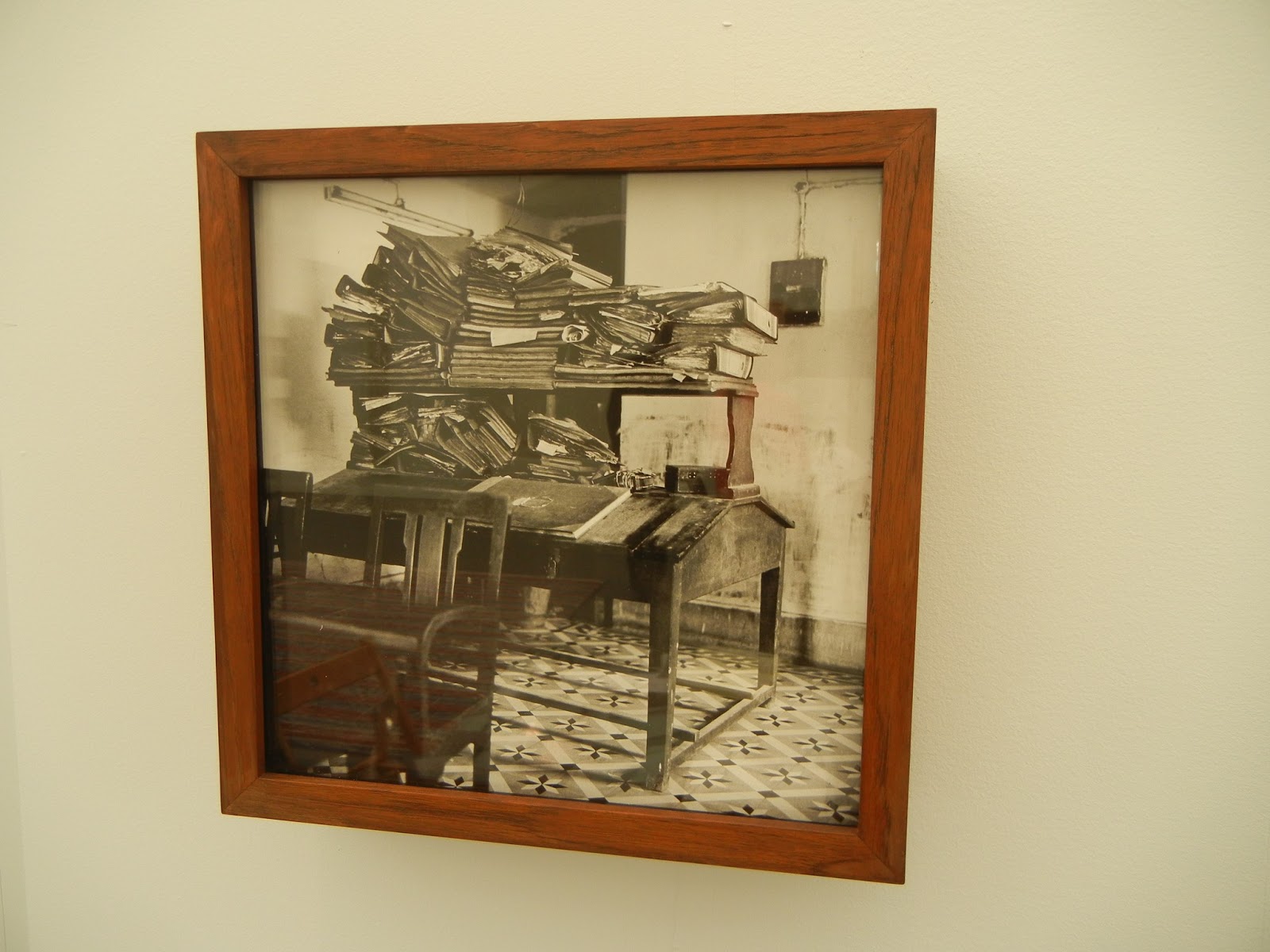
Comments/Context: It is altogether fitting that Dayanita Singh's visual meditation on the nature of paper in our digital age should smell so good. It's the kind of book that rewards a nose pressed into the gutters and a deep lungful of breath, the sweet perfume of inks and rough tactile paper creating a real physical experience of what paper can mean. This simple sensual moment quickly pulls us down the rabbit hole and we are transported to Singh's surreal and magical world of Indian file rooms, each its own peculiar mountain of sagging, tilted, toppled papers. Fluorescent bulbs buzz overhead as we silently wander the narrow hallways of shelving in state archives and municipal offices, overwhelmed by the endless paperwork of bureaucracy.
At first glance, the groaning file rooms offer a nearly hopeless pessimism, a head shaking feeling of astonished helplessness in the face of such suffocating, ancient chaos. But then a glimmer of order starts to reveal itself; the ledgers, books, files and loose papers have been stacked, bound, and piled using a dizzying array of methods. They are tied together with twine, bundled with cloth like laundry, padlocked in cupboards, and stored in flat files. Small rooms and warehouses are stacked to the ceiling with metal shelves and wooden cabinets, with cubby holes, lockers, trunks and boxes providing additional organization. Papers are heaped on every available surface, but their fluttering, jagged edges become regular horizontal lines and flat angles. Every room is its own unbelievable system, the labyrinthine domain of a human archivist who knows where things are.
Sometimes this person is a head peeking out from a sea of files, but mostly the archivist is absent, represented by a clean table and chair where work is done. While the papers encroach from all sides, the table is a tiny oasis of free space, a place where the battle for order is won. When an archivist is present, he or she seems to radiate quiet confidence and competent pride, certain that the arcane symbols and unknowable numerical markings on the shelving will lead to the right answers with swift efficiency. Singh's photographs document both the physical manifestation of complex systems of coding and classification and the human element that makes the systems work, organizing principles that are at once hidden and entirely visible.
In our age of digital bits, these images tell the age old story of bureaucratic paper with rich, dusty sympathy. There is a unruly beauty to these dark, magical rooms, where history and memory are slowly fading to nothingness. Once important papers are now neglected or forgotten, fused together by moisture and decay. The photographs are a reminder of the precariousness of memory, of how history is so easily lost. In a certain way, Singh's Indian file room project is like an archive of archives, an attempt to capture something important before it disappears, and not unlike the efforts of the Bechers to document various vanishing industrial forms. Her photographs tell the story of how we used to do things, with a sense of wonder and nostalgia that makes the pictures engrossing.
To my eye, there is something grandly mysterious about Singh's anachronistic file rooms, full of secrets and intrigues, buried under an avalanche of paper. Order and disorder shift back and forth like two sides of a coin, and shadowy figures wait to unlock the past for those with the right questions. These places seem like sets out of fantastical literature, but are clearly rooted in the punishingly mundane realities of decades of government work. File Room is the kind of book to get lost in, a glimpse of a world that seems too odd to be true.
Collector’s POV: Dayanita Singh is represented by Frith Street Gallery in London (here); she doesn't appear to have New York representation. Her work has not yet reached the secondary markets with any regularity, so gallery retail remains the best option for those collectors interested in following up.
Transit Hub:
- Artist site (here)
- Deutscher Pavillon at Venice Biennale, 2013 (here)
- Feature: Financial Times (here)