Showing posts with label Sean Kelly Gallery. Show all posts

Wednesday, February 15, 2012

Alec Soth, Broken Manual @Kelly: A Review Conversation with Richard B. Woodward

Rather than following my normal format, today’s review of Alec Soth’s new show at Sean Kelly will once again take the form of a casual, but hopefully thoughtful, conversation. Regular readers might remember that I experimented with this collaborative approach in a recent review of the Jeff Wall show at Marian Goodman (here), where I went back and forth with longtime photo critic AD Coleman. As a reminder, this structure has no pre-sets – it’s an open ended discussion that leads wherever the ideas might take us.

I’m happy to say that Richard B. Woodward has decided to join me for today’s conversation. Woodward is an arts critic who contributes regularly to the Wall Street Journal, where he often covers major museum shows of photography from around the US, normally in longer format reviews containing a mix of historical background and artistic explication. His writing is also easily found in any number of photo books and exhibit catalogues from the past decade or two, where his essays provide lucid context and critical interpretation. I’m overjoyed to have lured him away from the tactile pleasures of the printed page and into the freewheeling online realm, at least for the moment.

DLK: I have to admit up front that I didn’t come into this show completely cold. Like many other collectors I’m sure, I had seen several prints from this series in the Weinstein Gallery booth at last year’s AIPAD and had also encountered a number of reproductions in the exhibition catalog from Soth’s retrospective at the Walker Art Center in 2010, so at some level, I knew what I was in for before I arrived. But with that caveat, I will say that I most certainly got a fuller experience of the work in this gallery show than I had previously felt.

My first reaction was at some level less about the photographs themselves as individual works (we’ll get to that in a moment I’m sure) and more about the overall mood that they create in tandem. To me, Broken Manual is an obvious progression from and intensification of the atmosphere of The Last Days of W (Soth’s previous project). We’ve clearly moved on from exhaustion (in many forms), political cynicism, tempered anger, and angst to something altogether more desperate and personal. While there is of course something action oriented about the desire to flee and disappear, I felt the heavy weight of powerlessness in this show. It’s as if these people (all men that I could see) have banged their heads against the metaphorical wall for so long (without anyone listening) that they have finally given up and retreated to the margins and wastelands of America. Whether they’re hermits, survivalists, hippies, government haters, conspiracy theorists or just plain crazy (by some definition), they’re living in a roughly similar emotional landscape, and Soth seems to have found a sense of deep empathy for parts of what made these men want to be alone. So my point is that the pictures are really capturing an abstract state of mind, and any particular authentic reality in the photographs is just a symbol of that frustrated psychological atmosphere.

RBW: I appreciate your asking me to trade fours with you on the bandstand in your club. I’m new and somewhat averse to on-line media (I don’t even have a Facebook page) but your blog is among the few that I regularly read, both to catch myself up on shows I’ve missed (you see everything) and to compare my reactions to your intelligent takes.

Like you, I had seen this body of Soth’s work before. I saw his retrospective last year at the Walker Art Center in Minneapolis, his home town, and Broken Manual was installed as part of that. The selection was, if I remember, somewhat larger but also presented in a subdued, grayish atmosphere. There were probably 10 pictures from the series in the catalog, From Here to There: Alec Soth’s America, that aren’t here.

I like this version better. It is, as you say, a deepening and a concentration of the glib and cynical tone in The Last Days of W and it’s also a logical progression from Sleeping by the Mississippi. The mood here is more crushingly sad than at the Walker. (I’ll see if I can explain why later.) We can talk in another exchange about his techniques for treating people who are not as economically advantaged or emotionally stable as he is, how he has earned their trust and whether or not you think he has betrayed it, and whether or not that’s inevitable.

But his choice to focus on men who choose to live apart from American society was smart and full of photographic possibilities. As types, they populate both our 19th century history (the Western prospector, the crazy hermit, persecuted religious sects such as the Mormons, various utopian communards) and our tabloid culture of paranoid loners and political lunatics. There was Eric Rudolph who blew up abortion clinics and attacked the Atlanta Olympic Games and went on to survive in the North Carolina woods for years. And, of course, there was “Unabomber” Ted Kaczynski who is alluded to a couple of times in the show.

Soth is one of the most thoughtful photographers around, a guy who is always wrestling with the question of where to stand in relation to his subjects and how to keep the documentary tradition vital so that he can poke his nose where it doesn’t belong and still have a clear conscience. I wonder if you felt, as I did, that one of the strengths of the show is that one feels Soth is tempted by the idea of abandoning his life as a dutiful Magnum member and breadwinner in order to go off and live in a cave. He’s trying to empathize with these men, even a skinhead neo-Nazi, and, like Arbus, he keeps asking himself, “hmm, what would happen to me if?” He sees the appeal of getting away from home, and working. In fact, that’s what he’s doing here. How different is a photographer on the road from a guy holed up in the desert? Being both inside and outside is always a hard act to pull off. How do you think he succeeds at that?

DLK: Watching parts of the documentary running in the darkened side room made me conclude that Soth got the balance generally right, not too far in (thereby losing a sense of wider perspective), and not too far apart (with the danger of a smug mocking eye). The trust he built with his subjects seems to have been easy going and genuine. That said, the installation of ephemera in the first room wouldn’t look as manic and serial killer crazy as it does unless Soth had become somewhat fascinated by the whole culture he was exploring; I don’t want to speculate on exactly how far he was drawn in, but I think he imbibed enough of the kool aid to at least intellectually understand some of the motivations. I thought some of the best moments in the film are when nothing happens, and Soth is wandering frustrated in search of something or someone he can’t seem to find; the project takes a more obsessive tone at that point, which seems somehow appropriate for the subject matter. I do agree that Soth’s overall commitment to and engagement with “disappearing” makes these pictures more successful than they would have been at arm’s length.

The only image in the whole show that I think comes to close to the exploitation line is the portrait of the tanned, naked man standing in the water lily pond (the titles of these images are universally unhelpful for identification purposes). I actually think this is a very powerful image (especially printed as large as it is), juxtaposing the swastika tattoo and Garden of Eden setting, but I do wonder a bit about the coaxing that occurred to get this shot. Of course, I don’t know the back story to the photograph, but it seems pretty unlikely to me that the man came up with standing naked in the pond all by himself. That isn’t to say that he wasn’t a willing participant; on the contrary, I think he probably was, and the starved for attention quality that many of the men have is an important and unexpected discovery that Soth makes in these pictures. While the other portraits in the show are of course somewhat posed (he’s using a large format camera after all), this is the only one that seemed a bit unnatural to me. But maybe that risk taking (by both sides) is what makes it more memorable.

RBW: I think the project is rife with exploitation, as is any project with a gross imbalance of power between photographer and subject. And most projects are! That’s the nature of photography. The opening for the show at Sean Kelly was packed with friends of Soth and other photographers who were a world apart from the subjects in the pictures. I wonder if any of the lost souls featured here has seen the work and, if they have, I’d be curious what they thought of it. I doubt any of them would be too upset. Even the fellow standing naked in the water, with shaved head and swastika tattoo, seems proud of himself and would be probably be OK with seeing himself on the walls of a Chelsea gallery.

One of the many things I like about Broken Manual is that Soth has recognized this problem of the portrayer and the portrayed, and his photographs reflect that. There is a blurry portrait that suggests it was taken with a long lens, as though these are men of whom we are slightly afraid and who are slightly afraid of us. There’s a surveillance quality to the picture. Or it could indicate an early phase of his getting to know these guys: he could only see them from afar, stalking them in the woods as though they were Bigfoot. Other pictures, including the one you cite, and another of a bearded man sleeping, show a much greater degree of trust.

He has approached these men as if he were an anthropologist. He reveals not only their portraits but their abodes, reading matter, tools (including a sex toy) and their attempt to dress up or glamorize their surroundings. The saddest picture in the show to me was the mirrored globe hanging off a branch in the middle of nowhere. Soth has photographed it in the grayest, flattest light so that it barely reflects anything. Not many disco parties in that neck of the woods, I’m guessing.

DLK: I very much agree that the grainy, out of focus photo of the bearded man in the woods captures something important about this whole project. I think you’re right on as far as the feel of voyeuristic surveillance it employs, as well as the stalking, fleeting glimpse it offers. It’s indistinct, and marginal, and just out of reach, and yet the American flag bandanna around the man’s neck somehow opens up other narrative possibilities: is this a veteran, or perhaps someone fiercely patriotic, troubled by an America that seems to have lost its way, whose only logical response was to reject it and head for the hills?

The still life images are a bit of a departure for Soth I think. Not only are they in black and white, but they are set against blank backgrounds, just like Taryn Simon’s Contraband series. And in a sense, they have an affinity with that project, in that the objects are outside societal norms in one way or another: conspiracy videos, a makeshift knife, a welded iron helmet almost medieval in its roughness, a slug dragging a trail of slime, a sex toy. I absolutely see the resonance of these objects as part of the larger story, but I wonder if they would all be as powerful if taken out of context and forced to stand alone.

I also agree that both the disco ball and the light bulb in the lonely woods are achingly sad. Here I think the return to black and white is very effective; draining away the color makes the blanket on the forest floor or the rocky camp site seem even more dismal and gloomy. Here’s where the glamour and romance of disappearing really meet the harsh reality of being alone; time seems to stand still in these pictures, in a bone tired, dispiriting way.

I’m not sure if it’s just a quirk of this particular hanging, but with fewer portraits as a percentage of the whole, I think the places (the white cave with hangers, the house built into the rock wall, the dome in the desert, the house boat covered in lights, the single light bulb interior with graffiti) and objects start to act like stand-ins for invisible people. The eccentricities pile up, but they are harder to hold on to. The photographs are indirect portraits of their owners, which when taken together as a group, takes me back to the project as an exercise in abstraction, of using symbols to document a continuum of specific behavior that all converges on an underlying set of interlocking emotions.

RBW: I like your idea that the objects are stand-ins for people. The things these guys have taken with them into the woods are not only tools, they’re also totems. A single light bulb would be a fairly grim source of illumination in a room. Hanging from a tree it’s both a surreal symbol of civilization and an indication of one man’s extreme isolation.

But I don’t understand what you mean by “exercise in abstraction.” Soth is trying to evoke a sense of loneliness and rejection and self-exile strictly through traditional documentary means: portraits, forensic or evidentiary pictures of habitat and possessions. One of those techniques would only take us so far in setting a mood about a way of life. Portraits alone couldn’t transport us to that emotional place without a lot of obtrusive text telling us what to think about the economic plight of these guys. And the light bulb, mirror globe, sex toy, boat, coat hangers, slimy slug would be too allusive--too Taryn Simon--if seen alone. You’re right that what power these objects have derives from the context and conjunction with the portraits.

The published survivalist material stacked against one wall is another documentary technique, even if it’s not photographic. The array of pamphlets and books is a sign, as you say, that Soth has burrowed deeply into this culture. He also may want to show us how many kinds of crazy there are. As I wrote before, hermits have existed throughout our history and developed their own eccentric culture. In the 1950s and ‘60s men built fall-out shelters as they prepared for nuclear war. The survivalists in Soth’s photos don’t seem to conform to any single political philosophy. They’re not all neo-Nazis or Tea Party extremists or disappointed Left-wing radicals or hippies gone to seed. But many are clearly paranoid. I was interested to hear in the documentary from the old guy who expected Obama to be assassinated as a pretext by a cabal for a government take-over.

The books help to show that these men aren’t just camping and they’re not homeless. They’re serious and determined to live apart, and they have allies in the fringes of the business world. Preaching the apocalypse can be profitable. On various radio stations and on the Internet you can find advertisements now for a Food Insurance outlet selling “gourmet” meals guaranteed to last for 25 years. The company is endorsed by Sean Hannity and Glenn Beck. Economic or ecological collapse is not as unthinkable as it was 20 years ago, and some people have already begun to build their arks for the hard rain that’s gonna fall.

DLK: I like the way Soth has captured the broad diversity of these characters, but still retained their elusiveness. Most of the photographs are the opposite of traditional portraits: eyes closed, walking away into a thicket of brambles, camouflaged in a ghillie suit, dwarfed by towering trees or overgrown greenery. Soth has effectively matched his unconventional compositions to the marginal nature of his subjects.

By the way, I didn’t mean “abstraction” to represent anything more than the simple idea that all of the works here attempt to depict something which is underneath and invisible, and therefore a step away from the literalness of what they are and a leaning toward the metaphorical of what they might represent. The pictures themselves are of course not abstract in the visual sense, they are documentary (broadly defined) as you point out. All I was trying to get at was the representational aspect of trying to convey complex emotion, which to me ends up being somewhat “abstract”. I’m probably in the semantic weeds here, so let’s move on.

Overall, I came away from this show impressed with Soth’s dedication to an unruly project, and with his ability to consciously broaden his photographic toolkit to include more subject matter types and aesthetic approaches; I certainly got the impression he was pushing himself beyond his comfort zone. From my vantage point as a collector, I’m always trying to get my head around the difference between the durable and the forgettable, and I think there are at least half a dozen photographs on view here that will likely age very well indeed, that will retain their power to startle far into the future (even when taken out of context) and will be emblematic of the particular embittered times from which they came. Many of the others will likely fill the role of quirky supporters, especially in book form where they can be additive to the overall mood. I imagine a certain slice of collectors will find this work too far out there, a bit puzzling and hard to categorize. For the most part, I found Broken Manual compelling and original, and I was left wondering whether this body of work is the terminal end point to a line of thinking that began many years ago for Soth, or whether it is some kind of intermediate transitory stage, where he has been flexing his artistic muscles a bit with a tough problem, only to pivot and apply those new strategies and techniques to something altogether different in the future. As a show, I think it cements his reputation as a leader, and leaders don’t always take the obvious path.
RBW: Here are a few last thoughts.

I agree that Soth is working on the edge of where his core artistic beliefs and training have taken him. He and several other members of Magnum, including Susan Meiselas and Jim Goldberg, are rethinking what it means to document a culture. The danger is that in trying to encompass more by nibbling around the edges of a subject to get at “an overall mood,” you take a lot of lesser photographs instead of a few dazzling ones. I don’t see any great pictures in the show, although I see a number of good ones that mesh nicely and, as you say, “half a dozen photographs on view here will likely age very well.”

He’s also, as you say, “a leader.” From what I observe and hear, he’s very generous to other photographers. His drive to succeed to work hard has not blinkered him or turned him into an egomaniac. He has an expansive attitude about what documentary photography can be and he seems dissatisfied with the status quo. I expect lots more good work from him.

We haven’t talked much about the size of the prints and how unexpectedly large or small some of them are. My first reaction upon seeing the print of the ship was, ‘why so big?’ Then, on closer inspection, it won me over. If it were smaller, you wouldn’t see the detail of the jerry-rigged wiring on the masts and the quite unglamorous domesticity that life on the water affords. (Soth must be attracted to living on a boat or being near water, as the theme turns up repeatedly in his work.)

I wasn’t sure what he gained by mixing black-and-white and color. (The black-and-white prints here are actually, as I understand, just dialed down color negatives, not made from “true” black-and-white negatives.) Then, I decided this is another way for him to keep us on our toes and not let us think we could immerse ourselves in this alien world. If everything were color or everything were black-and-white it would be much easier to feel he was a reliable guide around these men. To revert for a moment to artspeak, he was revealing his camera and photography as a mediator, and not an inclusive or impartial one.

I was a little disappointed that he didn’t include here any of the videos he has made. Several were in the Walker retrospective and they revealed what a smart, goofball he can be. They might have disrupted the sobriety of this show and we can see those aspects of his personality in the film about him that’s playing in the first gallery. Still, I thought he could have mixed up his approach and complicated the mood even further with more irreverence.

The subject of men driven by a need to remove themselves from society has been taken up by writers (Jon Kracauer’s Into the Wild) and by movie makers (Jeff Nichols’s Take Shelter) but I don’t know that many photographers have attempted it. Joel Sternfeld’s Utopia project is much more sociable. Soth has to solve the problem of showing absence and emptiness and anomie and detachment and hostility, and that’s hard to do in a photograph. Too many others, when they decide to document, say, the homeless, will take portraits and maybe the makeshift shelters they construct, leave it at that.

Soth has tried to come up with a more nuanced solution and I applaud him for it. Like you, I see it as transitional in his development. I’ll be curious to see what his next project will be. The choice of subject often determines what you photograph and how, and it’s usually the hardest decision to make. I have a hunch we’re going to see more video.

Thanks again for inviting me for a chat in your digital man cave. Let’s do it again.


And now the usual supporting sections:

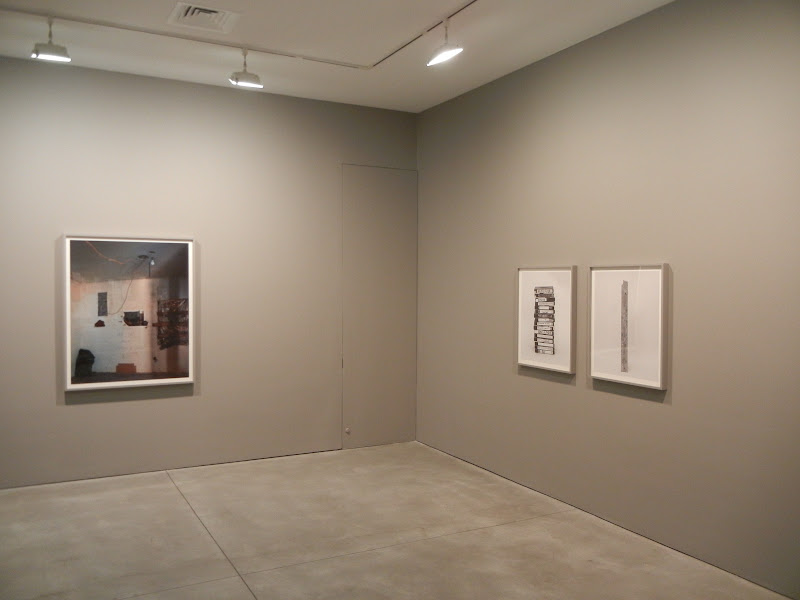
JTF (just the facts): A mixed group of 26 black and white and color photographs, framed in grey wood and unmatted, and hung against grey walls in the main gallery space, the entry, and a single side room. All of the works are archival pigment prints, mounted either to paper or 4 ply museum board, all in editions of 7+3AP. Sizes range from 10x8 to 70x56 (or reverse). There are 13 black and white and 13 color images in the show. The images were taken between 2006 and 2008. The exhibit also includes an installation of Broken Manual limited editions and other ephemera related to the project. In a darkened side room, a 57 minute documentary called Somewhere to Disappear (here) is on view. A trade edition of Broken Manual is apparently forthcoming from Steidl (here). (Installation shots at right.)

Collector's POV: The prints in this show are priced as follows. The smallest 10x8 images start at $5000, and generally increase in price according to size, reaching $28000 for the largest 70x56 prints. Intermediate prices include $6000, $9000, $15000, and $20000, with a couple of images NFS. Soth's work has begun to appear in the secondary markets more consistently in recent years (a handful of lots each year), with prices ranging from roughly $4000 to $22000.

Rating: ** (two stars) VERY GOOD (rating system described here)

Transit Hub:
  • Interview: Interview (here)
  • Artist site (here)
  • Magnum Photos page (here)
  • Soth’s book publishing arm, Little Brown Mushroom (here)
Through March 11th
.
528 West 29th Street
New York, NY 10001

Tuesday, May 31, 2011

Robert Mapplethorpe, 50 Americans @Kelly

JTF (just the facts): A total of 51 black and white and color photographs, variously framed and matted, and hung against red striped walls in the main gallery space, two smaller side rooms, and the hallway that connects them. Each photograph is labeled with information on the person who chose the image (name, state, profession, age, race), along with quotes about why the image was chosen, what it meant to him/her, and opinions about Mapplethorpe and his work. There are 46 gelatin silver prints and 5 dye transfer prints in the exhibit. Dates range from 1976 to 1989, with a few posthumous prints mixed in. Edition sizes start at 4+1 and continue up to 15+3, with several intermediate sizes. Physical dimensions range between 10x10 and 23x19, most in square format. (Installation shots at right.)

Comments/Context: This exhibit is like a simple but well designed science experiment, testing the powers and limits of "crowdsourcing". The story begins with 50 people, one individual from each of the 50 states, a broadly diverse sample based on age, gender, race, occupation, and lifestyle. This group was then exposed to a 2000 image online archive of the work of Robert Mapplethorpe and asked to choose one single picture each that was found to be of interest. These 50 pictures have then been displayed in no particular order as one gallery show, along with the comments and opinions of the participants on wall labels. As a construct, it seems like the kind of intellectually interesting idea that might produce something surprising or unexpected.

What actually emerges from this process is something quite a bit less novel. The kind of imagery that apparently resonates with "everyday Americans" is a watered down, more conservative Mapplethorpe: obvious flowers, Lisa Lyons nudes, children, classical body forms, and celebrity portraits. This show contains almost nothing controversial or provocative, by any broad definition; the elegance and precision of Mapplethorpe's art is what has risen to the surface, as embodied in generally safe subject matter.

While there are plenty of thoughtful comments, reactions and opinions expressed by the team of selectors (including by those who had never heard of Mapplethorpe before), I don't think professional curators have much to fear from this kind of democratization. An entirely random selection of 50 works from the archive would have produced an almost equally effective show; the only difference here is that the "explicitness" meter has been quietly but consciously turned down by the participants. As such, even though the photography on view is as exquisite as ever, this show isn't really about Mapplethorpe or even his legacy. It's more an investigation of the respectful mainstreaming and popularization of art, of how we choose to see what we want to see, somewhat regardless of the originality or intent of the artistic voice. For me, the exhibit was a strong reminder of why we need smart curators who challenge and jolt us, who take chances, make connections and explain backstories. Left to our own devices, we'll still enjoy the pretty pictures and happily pick our favorites, but we'll likely miss (or ignore) an entire layer of potential understanding (sometimes uncomfortable) that might have made us actually stop and think more deeply.
.
Collector's POV: The works in this show are priced between $8500 and $105000, with the majority under $30000; a few images are marked "price upon request" or "not for sale". Mapplethorpe's prints are ubiquitous in the secondary markets, with dozens of images coming up for sale in any given year. Prices range from a few thousand dollars for obscure images to well into six figures for his most iconic and well recognized works.

Rating: * (one star) GOOD (rating system described here)
.
Transit Hub:
  • Foundation site (here)
  • Reviews: New Yorker (here), John Haber (here)
Robert Mapplethorpe, 50 Americans
Through June 18th
.
Sean Kelly Gallery
528 West 29th Street
New York, NY 10001

Tuesday, November 16, 2010

James Casebere, House @Kelly

JTF (just the facts): A total of 20 black and white and color works, variously framed and matted, and hung in the main gallery space, two smaller side rooms, and the office area. The works in the main gallery are large scale digital chromogenic prints mounted to Dibond and framed in black with no mat. There are 6 prints in this room, ranging in size from 70x86 to 70x106, each in editions of 5+2, from 2009/2010. The works in the other spaces are vintage black and white works from earlier in Casebere's career. 13 of the works are single image gelatin silver prints and 1 is a photo-lithograph diptych. Physical dimensions range from 14x11 to 28x38, and the prints come in multiple edition sizes (7+2, 10+1, 10+2, 24+3, 60). The black and white works were made between 1978 and 1994. (Installation shots at right.)

Comments/Context: James Casebere's new large scale color works are bigger and bolder than ever before. His purpose-built architectural models have now grown to include an entire subdivision of fabricated houses, executed in painstaking, abstracted detail. Displayed in conjunction with a group of earlier, more pared down black and white works, these images show Casebere extending and evolving his artistic approach, adding in additional layers of stylized realism and complexity to tell broader stories.
.
The new pictures document an imaginary community of homes in Dutchess County, New York, where large multi-story houses painted in pastel colors are clustered closely together over rolling hills. Freshly mown grass stripes the front lawns, while lakes, roads, and specimen trees (in fall colors) separate the landscape. Play structures, above ground pools, satellite dishes, and barbecues dot the backyards. It has the air of a perfect planned community, complete with wind farm on the brow of the hill (clean energy!) and a rainbow overhead.

What makes these photographs successful is their subtle, almost effortless irony. The abstracted nature of the model makes this community a kind of "everywhere", where the American dream of owning a home has happily come true. But it is this undercurrent of the surreal, the mythical, and the hoped for that smacks head on with the reality of the recent housing bubble and foreclosure crisis, making this cozy little community look entirely insane.
.
Casebere's earlier black and white works hung in the adjacent rooms have a more sinister, haunted quality. In these works, Casebere has constructed and photographed a single home or building, highlighting the contrast of bright white materials and shadowy dark lighting. Row houses, tenement buildings, prisons, factories, and even suburban ranch houses (complete with constructed cacti) have become quiet phantoms, with black square windows and simple boxy geometries. These pictures are more elemental and moody, filled with viewer-supplied memories and anxieties.

In all of these photographs, Casebere is uncovering our complicated relationships with common places. The new pictures dig into questions of what we think (or remember) we want, what has been built to fulfill our supposed desires, how we feel when we see these dreams come true, and the unreality underneath the surface of that cleaned-up sunny life. His light touch makes the satire earlier to swallow, making the images less overtly critical and all the more thought-provoking.
.
Collector's POV: The prices for the works in this show are as follows. The large color works are generally $70000 each, although one of the images that was included in the Whitney Biennial is marked "price on request". The older black and white images generally range from $16000 to $30000 based on size (with many intermediate prices), with the smallest image (from a large edition) priced at $1800. Casebere's work has become consistently available in the secondary markets in recent years, with a handful of lots available every year for almost a decade. Prices at auction have ranged between $1000 and $60000.
.
Rating: * (one star) GOOD (rating system described here)
.
Transit Hub:
  • Artist site (here)
  • Review: NY Times (here)
  • Interview BOMB (here)
Through December 4th

528 West 29th Street
New York, NY 10001

Thursday, June 3, 2010

Marina Abramović, Personal Archaeology @Sean Kelly

JTF (just the facts): A total of 18 works, including photographs, videos, and a mixed media wood cabinet, displayed in the two front rooms and the main gallery space in the back. There are 15 photographic works (a mix of color and black and white), generally framed in black and not matted. The photographic prints have been made using a variety of processes (often with an accompanying page of text/instructions): gelatin silver, cibachrome, chromogenic, archival pigment, and color lambda. They have been printed in various edition sizes, ranging from 3+2 to 18+9. Individual prints range in size from 24x20 to 86x65, with one multi-panel work measuring 49x286. The photographs were taken between 1973 and 2009, with many of the prints made more recently. The videos were made in 2010, and the mixed media cabinet is from 1997/1999. (Installation shots at right.)

Comments/Context: You'd have to have been living under a rock, off the grid, to have missed the continuous media frenzy surrounding Marina Abramović's recent performance/retrospective, which closed earlier this week at the MoMA. In the self-referential art world, for the past month or two, it's been all Abramović, all the time. This exhibition at Sean Kelly is the obligatory paired selling show, offering those who have been inspired at the museum an opportunity to follow-up on their interest in the artist's varied work.
.
Having watched Abramović performing her 700+ hour marathon in the atrium a couple of times during its long run, I have to say that I now have an entirely different perspective on the photographic documentation of performance art. Perhaps a decade or two hence, in a gallery somewhere, there will be photographs of Abramović, in one of her long flowing robes (blue, red, or white), her braid pulled to one side, staring intently ahead at the random visitor seated opposite her. To someone who hasn't seen the performance in person, these images will look like a symmetrical, perhaps conceptual pairing of people in chairs, with a table in between or not (this changed during the course of the performance), in an otherwise empty space. But those future viewers will have a hard time understanding how powerful this piece really was, even if there are paired portraits of Abramović's steely gaze and those of her respective partners. The photographs likely just won't do it justice, but perhaps there will be collectors and museums who will still want these imperfect representations, as they will be all that remains of a surprisingly historic and moving but otherwise ephemeral event.
.
Which brings me back to the photographs on view in this specific show. Having not witnessed the many performances of Abramović's ground-breaking career, I was left wondering how the photographs on these walls captured (or not) the essence of what had actually transpired long ago. I didn't see her carve a star into her belly, slam knives between her fingers, carry a skeleton, or mop the floor, so I don't really know if these photographs depict the nuanced reality of what occurred or not. As such, I was forced to evaluate the pictures in a different way, as objects in and of themselves, on their merits as stand alone artworks, rather than snapshots or souvenirs of something crazy and challenging that happened decades before.
.
When seen from this vantage point, these photographs become something altogether different I think. In general, they are images of a statuesque and often beautiful woman in a variety of strange and unsettling staged circumstances. At some points, they verge on the surreal, at others, physical danger lurks in the background, but if you don't know the stories, the "film stills" which should be eerily personal seem oddly disconnected.
.
The combination of seeing Abramović perform live at the MoMA and seeing these photographs hung in this gallery left we with the strong, lightbulb-over-the-head-like realization that photographs of performance art are a paltry substitute for the real thing. They're likely the best (or perhaps only) way for performance artists to make a living off of their performances, so this photographic documentation method isn't going away any time soon, and they're a decent way to help remember the obvious high points. But I came away from these two shows with the palpable feeling that these photographs are missing the most important quality of performance art: the hit-you-in-the gut, blast of energy that comes from seeing an artist out there on the edge. In a certain way, as an advertisement for the transformative power of performance art, Abramović could hardly have been more successful.
.
Collector's POV: The photographs in this show range in price from $30000 to $150000. Abramović's work has not been regularly available in the photography secondary markets; perhaps it has been more readily accessible in the contemporary art auctions, I don't entirely know. The historical prices I was able to discover have ranged between $4000 and $30000, but these may not include works sold outside the strict definition of the "photography" market, so take this data with a degree of skepticism when matching it against the gallery prices above. Given the excitement surrounding the MoMA show, her prices are certainly going to be rising.
.
Rating: * (one star) GOOD (rating system described here)

Transit Hub:
  • Exhibit: The Artist Is Present, 2010, MoMA (here)
  • MoMA reviews: NY Times (here and here)
  • Interview: WSJ (here)
  • Marina Abramović Made Me Cry (here)
  • Roundup: Hyperallergic (here)
Marina Abramović
Through June 19th

Sean Kelly Gallery
528 West 29th Street
New York, NY 10001

Friday, May 22, 2009

Frank Thiel, New Work @Kelly

JTF (just the facts): A total of 14 large scale chromogenic prints mounted to Plexiglas, framed in white with no mat, and hung in the main light filled gallery and two smaller side rooms. Each image is printed 96x71 (a smaller 54x40 size is also available, although not on display), and the images were taken in 2007 and 2008. The prints are made in editions of 5+2AP. (Installation shots at right.)

Comments/Context: German photographer Frank Thiel's entire career has been centered around images of the transformations in his home city of Berlin, so the massive patterned and monochrome images that are now on view at Sean Kelly might seem an odd departure. The back story to these works is that they are images of curtains, found in abandoned East Berlin buildings and cleaned up by Thiel. The curtains were then hung in brightly lit windows, photographed, and enlarged to three times life size. The resulting images capture the undulating folds of the fabric, the texture of the weaves, and the interplay of the printed patterns, while having an undertone of historical meaning for unified Germany.

There are three subsets to this larger series: monochrome patterns, solid colors, and color patterns. At first glance, the monochrome curtains seem like wavy indistinct vertical stripes and repetitions; step in closer and there is an amazing level of intricate detail in these zig-zagging lines, an echo of Sol Lewitt's wall sized pencil drawings.

The solid colored works (in red, green, yellow, and brown) emphasize transparent texture, with diaphanous light flowing through the gaps in the weave, highlighting the subtle bumps and imperfections in the cloth. The color patterns are interplays of geometric dots, stripes, and printed leaves, further abstracted and reworked by the interlaced folds of the fabric.

While these works surely have a compelling decorative quality (a backhanded compliment in today's world), I very much enjoyed the delicate abstractions that Thiel has discovered in these mundane subjects. What could have been a clever set piece has become something altogether more elegant and ethereal than would have been expected.

Collector's POV: The prints in the show are priced at 11500€ or 23000€ depending on size. Thiel's work has started to show up at auction with more regularity in recent years, with prints selling between $8000 and $23000. As we have mentioned before, while the immense size of these works clearly contributes to their interest, it also makes them wholly impractical for us as collectors. So while I certainly enjoyed these works, the prints would need to be much smaller to be a fit for our particular collection.

Rating: ** (two stars) VERY GOOD (rating system described here)

Transit Hub:
  • Constructing New Berlin at the Phoenix Art Museum (here)
  • UBS Art Collection (here)
  • DLK COLLECTION book review: Frank Thiel: A Berlin Decade, 1995-2005 (here)
Through June 20th
528 West 29th Street
New York, NY 10001
.
Administrative Note: There will be no posts on Monday, US Memorial Day.

Wednesday, March 25, 2009

Book: Frank Thiel, A Berlin Decade, 1995-2005

JTF (just the facts): Published by Galeria Helga de Alvear, Sean Kelly Gallery, Galerie Krinzinger, and Hatje Cantz Verlag in 2006. 260 pages, with 131 color plates and assorted other images. With essays by Robert Hobbs and David Moos. (Cover at right.)

Comments/Context: German photographer Frank Thiel was an unknown for us prior to seeing his work for the first time at the recent Armory show. We were impressed by several of the large scale photographs we saw there, and bought this book to get ourselves up to speed on his larger body of work.

Most people know the highlights of recent German history: the falling of the Wall, the reunification of East and West, and the movement of the capital from Bonn to Berlin. What is perhaps less well known to outsiders and foreigners is that the reunification of the city (and country) led to a massive construction effort, both demolition of the old and building of the new. In joining the two cities once again, the entire fabric of the urban geography has been recently remade.

Thiel has spent the past decade documenting the architectural transformations going on his city, making wall sized images of both wide angle and close up views of destruction and construction. His pictures are full of cranes, scaffolding, bucket trucks, and temporary curtains. What he has chosen to pull out of these scenes of activity are the geometric patterns that lie beneath the perfect facades, often only visible during the building process. There are grids of rebar, intersecting lines of pipes, walls of tile, and repetitions of windows and concrete framing. Many of these pictures are extremely precise, meticulously aligned abstracted images of form and space. Thiel has also focused his eye on the deterioration and decay found in many of the older buildings. A series of peeling paint images recall Aaron Siskind and Minor White, but on a larger scale and infused with a spectrum of soft pastel colors.

What I found surprising in these images is that they are not particularly harsh or critical of the transformations being documented, as one might expect in our current age of skepticism and environmental awareness. Instead, these works have a little of the old 1920s/1930s romance in them, a more positive view of the efforts of man to make awe inspiring buildings; many of the close ups are in fact quite beautiful. Even the destruction shots have an underlying sense of optimism, a feeling that this new world could somehow be an improvement on the old.

Collector's POV: Thiel is represented in New York by Sean Kelly Gallery (here). A show of new photographs will be on display at the gallery starting in May (and we will surely make a visit).

There have been so many pictures made recently of the construction boom all over the world, as a collector, it is often hard not to get confused about which images belong to whom. And while a few of these pictures have echoes of Andreas Gursky in them, most have an authentic and recognizably different point of view (much less cool and detached, even though these are straight pictures), even though the subject matter may be similar. Thiel's work would fit very well into our collection, resonating with other city and industrial scenes we already own. The problem is that his work is universally way too large for our old Colonial home (low ceilings and small walls); we don't have much use for a mural sized image that won't fit through the doors. That said, I have very much enjoyed seeing more of Thiel's work and look forward to seeing a larger group of his pictures hung together later this spring.