Showing posts with label Fischli and Weiss. Show all posts

Monday, March 11, 2013

Photography in the 2013 Armory Show, Part 2 of 2

Part 1 of this two part post can be found here. Start there for background and a general explanation of the format of the summary. This portion of my notes covers the shorter area on the left of Pier 94 and all of Pier 92.

Lisson Gallery (here): Gerard Byrne (1), Cory Arcangel (2)

Max Wigram Gallery (here): Jose Dávila (1 set of 53, 1), Slater Bradley (1). Dávila is another artist playing with the properties of the cut photograph. In this work, he has taken pictures of famous sculpture from around the world and then excised the artworks, leaving white outlines and blobs which are surprisingly recognizable (entire set $65000).


The surrounding area in the Bradley nude below is entirely covered in black marker, making a slightly striated and entirely opaque background ($40000).


i8 (here): Roni Horn (1 set 5), Orri Jonsson (3)

Galleri Bo Bjerggaard (here): Per Bak Jensen (1)

Loock Galerie (here): Holly Zausner (3 multi-image arrays)

Marlborough Chelsea (here): Rashaad Newsome (4 collages)

Yancey Richardson Gallery (here): Alex Prager (2), Zanele Muholi (5), Victoria Sambunaris (1), Sharon Core (1), Andrew Moore (1), Olivio Barbieri (2), Rachel Perry Welty (1)

Galleri Brandstrup (here): Ola Kolehmainen (2)

Paradise Row (here): Adam Bloomberg and Oliver Chanarin (1), Douglas White (1), Jane and Louise Wilson (1)

Rotwand Gallery (here): Klaus Lutz (5)

CLEARING (here): Ryan Foerster (9)

Rokeby Gallery (here): Matthew Sawyer (8)

Winkleman Gallery (here): Shane Hope (2). While most of the works in this booth were made using 3D printing, there were two quasi-photographic works on view: the one below (a digital print, $18000) and another, which was a holographic/lenticular print. The density of collaged digital imagery in this work is truly astounding, with layer upon layer of structural elements, exploded genomes, and other scientific models.


Victoria Miro (here): Isaac Julien (1), Idris Khan (1)

Sean Kelly Gallery (here): Frank Thiel (1), Alec Soth (2), Idris Khan (1), James Casebere (1). This is a new work by Casebere, with a falling table top house and a wildfire ($50000).


Galerie Rodolphe Janssen (here): Adam McEwen (2), Justin Liberman (1)

Galerie Nathalie Obadia (here): Andres Serrano (2), Youssef Nabil (2), Lorna Simpson (9)

Michael Kohn Gallery (here): Simmons & Burke (1)

Henrique Faria Fine Art (here): Alexandra Apostol (1)

Rena Bransten Gallery (here): Vik Muniz (2)

Other Criteria (here): Mat Collinshaw (3), Damien Hirst (1)

Parkett (here): Liu Xiaodong (1), Zoe Leonard (1), Yto Barrada (2), Tracey Emin (1)

Mike Karstens (here): Thomas Wrede (1), Gerhard Richter (2)

Mixografia (here): John Baldessari (1 set of 6)

Crown Point Press (here): Darren Almond (6)

Durham Press (here): Mickalene Thomas (1)

Bitforms Gallery (here): Rafael Lozano-Hemmer (2). These works were massive arrays of high definition scans of fingertips (taken from financial services employees), each rectangle its own individual set of whorls and lines ($37000).


Derek Eller Gallery (here): Thomas Barrow (1)

Galerie Forsblom (here): Ola Kolehmainen (1)

Galerie Daniel Templon (here): David LaChapelle (1), James Casebere (1)

Blain Southern (here): Wim Wenders (1)

Galerie Eva Presenhuber (here): Martin Boyece (1), Matias Faldbacken (2)

HackelBury Fine Art (here): William Klein (6), Mike & Doug Starn (3), Pascal Kern (4), Garry Fabian Miller (4), Bill Armstrong (3)

Wetterling Gallery (here): Mike & Doug Starn, Nathalia Edenmont (3), Pinar Yolaçan (2). I thought these works by Yolaçan were very smart. She's taken fleshy nudes and covered the skin with some kind of textured lotion. With the heads cropped out and the bodies posed against colored backgrounds, they turn into stone fertility idols ($7500).


Galerie Michael Schultz (here): Andres Serrano (3), Vik Muniz (1)

Mireille Mosler Ltd. (here): Fischli/Weiss (1), Richard Prince (1). Pretty hard to beat this fabulous Fischli/Weiss shoe sculpture ($75000).


David Klein Gallery (here): Trisha Holt (2)

Alan Koppel Gallery (here): Garry Winogrand (2), Hiroshi Sugimoto (3), Patrick Faigenbaum (1)

Forum Gallery (here): Davis Cone (1)

Robert Klein Gallery (here): Irving Penn (10), Bill Jacobsen (2), Francesca Woodman (4), Richard Avedon (1), Leonce Raphael Agbodjelou (3), Imogen Cunningham (1), Edward Weston (1), Alfred Stieglitz (1). Lots of vintage treasures in this booth, including a wall of bold Irving Penn fashion portraits. While there were other more famous Penn images on view, I enjoyed this one the most, with its tower of hair and its flared collar ($45000).


Fleisher/Ollman Gallery (here): Eugene Von Bruenchenhein (5)

Senior & Shopmaker Gallery (here): Robert Rauschenberg (1 collage of 4)

Marc Selwyn Fine Art (here): Rodney Graham (1), Irving Penn (1), Richard Misrach (1)

Chowaiki and Co. (here): Vik Muniz (2), Man Ray (1)

Galleria Repetto (here): Hiroshi Sugimoto (2)

Galerie Thomas (here): Marc Quinn (4)

Vivian Horan Fine Art (here): Almagul Menilbayeva (2)

Wednesday, March 14, 2012

Photography at the 2012 Armory Show

In previous years, my review of the photography at the Armory Show has required a handful of posts, breaking the fair up into smaller, more easily digestible chunks, since there was so much to write about. This year, I have collapsed all of the data into one single mega-post, the entire experience boiled down to something you can read in a few minutes. The reason I have chosen this approach is that for the first time in my many years of attending this fair, I was generally underwhelmed by what I saw on offer.

Taking pot shots at art fairs is far too easy to be any fun, and I have long been one of the few hold outs who actually enjoys the process of wandering through the bazaar, poking my head into booth after booth in search of something exciting hiding on an interior side wall. Perhaps it is because I already see so much here in New York that I felt that a spark was somehow missing this time; I bounced along the hallways, dutifully making my notes, but mostly nodding my head and moving along rather than digging in to engage the gallery owners. The fact that I could systematically cover the entire fair (both Piers) in just under two and half hours is proof that I didn't stop much to inquire more. I would hate to feel like I'd seen it all before, but that was certainly part of my reaction this year.

The second part of my conclusion was that I saw much more clearly a focus on what was sellable. For many of the non-photography specialist venues, I think the mantra was, when in doubt, put up a Cindy Sherman. From an economic standpoint, this makes complete sense - cover the walls of your booth with art that will sell (and sell for high prices) to ensure that you cover your costs of renting the space and doing all the work the fair entails; hopefully you'll sell a few pieces, meet some new collectors/clients, and come out ahead. The challenge is that if every gallery operates in this same manner, the fair takes on a quality of sameness that becomes dull. The richness of a fair comes in its diversity and risk taking, which is potentially at odds with maximizing profits. As I traveled the crowded halls, I felt the pressure of this commercial push and pull much more acutely than I had before. Of course, none of this is news, I just noticed it more than usual this year.

In any case, my notes from the fair are below, grouped by Pier and arranged by my path through the halls. For each booth, a list of photographers has been provided, with the number of works on display in parentheses. Additional commentary, prices, and pictures of the installation are also included as appropriate.

Pier 94

Galerie Anhava (here): Hreinn Fridfinnsson (1 set of 6)

NoPlace (here): Ingvild Langgård (1), Kjetil Berge (2), Kristine Jakobsen (2), Tommy Høvik
 (3)

Galleri Christian Torp (here): Marianne Hurum (1)

V1 Gallery (here): Peter Funch (1 triptych)

Christian Larsen Gallery (here): Charlotte Gyllenhammer (1), Joakim Eneroth (1). I liked the crisp abstract geometries of this series of red Swedish buildings by Eneroth. A monograph of the work is being published by Steidl. The print was priced at $10000.


Gallery Niklas Belenius (here): Leif Elggren (1 set of 18), Miriam Bäckström (2). There were two of these circular portraits by Bäckström in this booth. I was told the subjects are famous theater actors, but what I found intriguing was the heavy mirrored framing, tinted to match the photograph. The works were priced at $40000 each.


ELASTIC (here): Per Mårtensson (1 set of 8), Maria Hedlund (1 triptych, 1)

CRYSTAL (here): Julia Peirone (1 triptych, 1)

Galerie nächst St. Stephan Rosemarie Schwarzwälder (here): James Welling (1)

Galerie Nathalie Obadia (here): Youssef Nabil (1 diptych)

Whitechapel Gallery (here): Susan Hiller (1), Richard Wentworth (1), Paul Graham (1), Thomas Struth (1), Zarina Bhimji (1), Franz West (1), John Baldessari (1)

Richard Heller Gallery (here): Corey Arnold (4)

Howard Greenberg Gallery (here): Saul Leiter (6, plus 6 gouaches), Aaron Siskind (9), Charles Jones (4), Edward Burtynsky (1 diptych, 1), Vivian Maier (6), Weegee (5), Bruce Davidson (3), Robert Mapplethorpe (1), William Klein (1). I continue to enjoy Leiter's color work, and a grid of Siskind divers is always a high contrast visual statement.

Cardi Black Box (here): Shirana Shahbazi (1 diptych). I have been hearing more about this Iranian photographer's work lately, but haven't actually seen much of it in person. This diptych was priced at 25000€.


Upstream Gallery (here): Jeroen Jongeleen (1)

Bruce Silverstein Gallery (here): Shinichi Maruyama (3), Andre Kertesz (grid of 20, 1), Trine Sondergaard (2), Silvio Wolf (1), John Wood (1), Frederick Sommer (1 collage), Edward Weston (1), Constantin Brancusi (1), Robert Frank (1), Michael Wolf (1), Aaron Siskind (grid of 36), Todd Hido (2), Keith Smith (1 book), Zoe Strauss (grid of 12). There were several strong grids of work in this booth: the Kertesz distortions, the Siskind rock walls, and the Strauss color images on the outside wall.

Yossi Milo Gallery (here): Tim Hetherington (3), Matthew Brandt (1), Alison Rossiter (4 diptychs, 1), Simen Johan (1), Chris McCaw (1 diptych, 1), Sze Tsung Leong (1), Pieter Hugo (2)

Angles Gallery (here): Soo Kim (2), Ori Gersht (1 diptych), Augusta Wood (1), Judy Fiskin (2)

Frederic Snitzer Gallery (here): Kehinde Wiley (1), Sean Dack (1)

Galeria Senda (here): Ola Kolehmainen (1)

Galerie Crone (here): Rosemarie Trockel (2), Adrien Missika (4)

Michael Kohn Gallery (here): Simmons & Burke (5)

Rhona Hoffman Gallery (here): Robert Heinecken (1 triptych, 1 set of 6), Luis Gispert (1)

Galerie Parisa Kind (here): Mike Bouchet (1)

Peter Blum Gallery (here): Su-Mei Tse (1), John Beech (2)

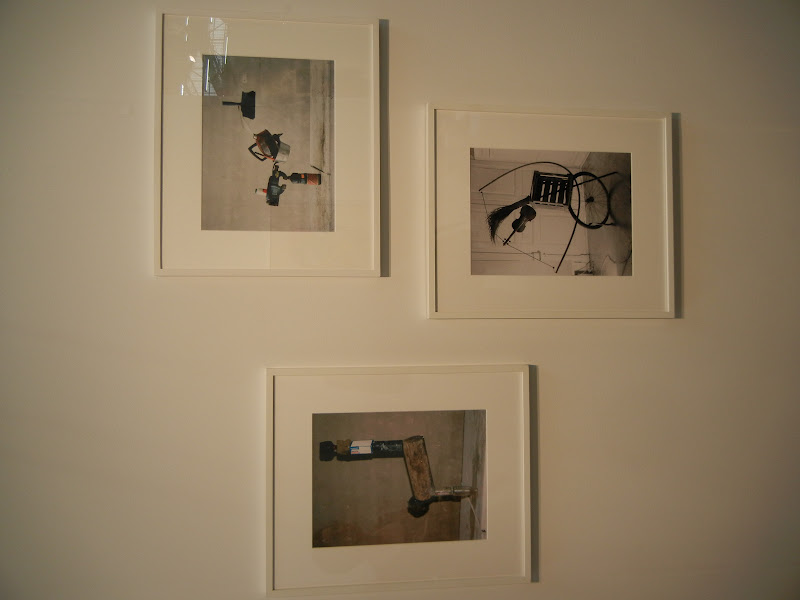
Sprüth Magers (here): Louise Lawler (1), Cindy Sherman (3), Peter Fischli and David Weiss (3), Andreas Gursky (1), Barbara Kruger (1). I thought these perilously staged sculptural images by Fischli/Weiss were the best thing I saw at the fair. They were priced at 55000€ each.


Galleria Continua (here): Shilpa Gupta (1)

Mai 36 Galerie (here): John Baldessari (1 triptych, 1 diptych), Lugi Ghirri (1), Thomas Ruff (1), Robert Mapplethorpe (2). Hard to beat a monumental Ruff head shot portrait for being eye-catching and imposing.

Corvi-Mora (here): Anne Collier (1)

Kukje Gallery (here): Candida Höfer (1), Yeondoo Jung (1)

Corkin Gallery (here): Barbara Astman (1 group of 6, 6), Brett Weston (1), Marjorie Content (1), Berenice Abbott (1), Garry Winogrand (2), Robert Frank (1), Margaret Bourke-White (1), Herbert Bayer (1), Walker Evans (1), George Platt Lynes (2), Andre Kertesz (1), Guy Bourdin (1), Francesco Scavullo (3), Thaddeus Holownia (16), Frank Madler (4), Ian Baxter (1)

Galeria Filomena Soares (here): Joao Penalva (1), Carlos Motta (21), Helena Almeida (1), Vasco Araujo (1)

Dirimart (here): O Zhang (1)

Kalfayan Galleries (here): Hrair Sarkissian (3), Breda Beban (3)

Ai Kowada Gallery (here): Hiroshi Sugimoto (3)

moniquemeloche (here): Aaron Siskind (2), Laszlo Moholy-Nagy (1)

BISCHOFF/WEISS (here): Michael Reisch (3)

Ratio 3 (here): Geof Oppenheimer (3), Matthew Hale (1)

Cherry and Martin (here): Robert Heinecken (1 triptych, 1 set of 5), Amanda Ross-Ho (1)

Jack Shainman Gallery (here): Hank Willis Thomas (1), Gauri Gill (1)

González y González (here): Patrick Hamilton (3), Jota Castro (2)

Carolina Nitsch (here): Cindy Sherman (1), EV Day (1), Carsten Holler (5), Vera Lutter (1)

Galeria Nara Roesler (here): Lucia Koch (2), Marcos Chaves (1)

Galerie Georg Kargl (here): Cindy Sherman (1)

Galerie Bob van Orsouw (here): Nobuyoshi Araki (16), Shirana Shahbazi (2). This wall of Araki images from the 1960s/1970s was looser and less staged than his later, more recognizable work.

Lisson Gallery (here): James Casebere (1), Gerald Byre (1 set of 16), Tim Lee (1)

Max Wigram Gallery (here): Mustafa Hulusi (2)

Ingleby Gallery (here): Peter Liversidge (1), Garry Fabian Miller (1)

Bryce Wolkowitz Gallery (here): Pertti Kekarainen (2), Ola Kolehmainen (4), Jorma Puranen (4), Susanna Majuri (2), Niko Luoma (4)

Other Criteria (here): Polly Borland (2)

Parkett Publishers (here): Zoe Leonard (1), Tracy Emin (1)

Mary Ryan Gallery (here): Sangbin Im (1 dipytch, 1)

Poligrafa Obra Grafica (here): Tony Oursler (1)

Galerie Anne de Villepoix (here): Sam Samore (1)

Kavi Gupta (here): Roe Ethridge (3)

Edward Tyler Nahem Fine Art (here): Andres Serrano (13). An entire booth of bold silhouetted toys and action figures, derivative of David Levinthal I thought.

Andréhn-Schiptjenko (here): Matts Leiderstam (14)

Victoria Miro (here): William Eggleston (1), Stan Douglas (1), Issac Julien (1), Francesca Woodman (3), Alex Hartley (1 diptych), Doug Aitken (1 lightbox)

Sean Kelly Gallery (here): James Casebere (2), Frank Thiel (1), Idris Khan (3), Robert Mapplethorpe (2), Alec Soth (3). These new images of London landmarks by Khan seem less ridigly conceptual than his earlier works, while still employing the ghostly multiple overlayed exposure technique. This print was priced at £35000. The Soth images were from his series of goth girls.


Leo Koenig Inc. (here): Gerhard Richter (3), Sigmar Polke (1)

Mendes Wood (here): Paolo Nazareth (7)

ONE AND J. Gallery (here): Kang Hong-Goo (6, 1 triptych, 1 wall installation)

On Stellar Rays (here): Clifford Owens (1 wall installation)

Henrique Faria Fine Art (here): Marta Minujin (6), Alessandro Balteo Yazbeck (1), Pedro Teran (2), Anna Bella Geiger (1 set of 18)

Galerie Forsblom (here): Chen Jiagang (1), Ola Kolehmainen (1). I haven't seen images by Chen this large before; it appeared to be in three integrated panels. The work was priced at $60000.


Luciana Brito Galeria (here): Caio Reisewitz (1)

Galerie Daniel Templon (here): James Casebere (1)

BLAIN/SOUTHERN (here): Mat Collinshaw (1), Wim Wenders (4)

Marianne Boesky Gallery (here): Anthony Pearson (5)

Baro Galleria (here): Claudia Jaguaribe (2)


Pier 92

Vivian Horan Fine Art (here): Cindy Sherman (2), John Baldessari (1), Elger Esser (1)

Springer & Winckler Galerie (here): Hiroshi Sugimoto (1), Arnold Odermatt (3 color, 6 black and white), Georges Rousse (1), Andy Goldsworthy (1), Bernd and Hilla Becher (1 set of 4). I think these black and white Odermatt car crashes are wonderfully formal; while I've seen many of them before, they continue to grow on me. They were priced between $4000 and $8000 each.


Galerie Thomas (here): Thomas Struth (1)

Galerie Sho Contemporary Art (here): Helmut Newton (1)

Wetterling Gallery (here): Nathalia Edenmont (2), Mike and Doug Starn (2)

HackelBury Fine Art (here): Garry Fabian Miller (4, 1 set of 11), Mike and Doug Starn (5)

Senior & Shopmaker Gallery (here): Jan Dibbets (1), Richard Long (1)

Mireille Mosler Ltd. (here): Ed Van Der Elsken (1), Philip-Lorca diCorcia (1), Cindy Sherman (8), William Wegman (1 diptych). I really enjoy the clever absurdity of Wegman's early 1970s conceptual work. This work is entitled Which Tube Attracts the Dog?; Wegman holds a tiny tube on the left and a massive one on the right. The dog's head peeks in from the left in the right panel. The work was priced at $30000.


Marc Selwyn Fine Art (here): Robert Heinecken (3), Matt Lipps (1), Richard Misrach (1)

Alan Koppel Gallery (here): Walker Evans (1), August Sander (1), Hiroshi Sugimoto (4), Diane Arbus (1), Yves Klein (1). For our particular collection, this tiny Walker Evans was the best fit at the fair. I have always coveted the few images from this series of train tracks he did in the late 1920s, and this is one of the best I've seen. It was priced at $20000.


James Barron Art (here): Luigi Ghirri (3)

Chowaiki & Co. (here): Marilyn Minter (2), Cindy Sherman (1), Gregory Crewdson (1), Nobuyoshi Araki (1 diptych), Shirin Nehsat (1)

Gerald Peters Gallery (here): Alfred Steiglitz (2), J. Henry Fair (2), Craig Varjabedlan (3). The two O'Keeffe nudes by Stielglitz were on a side wall.

Robert Klein Gallery (here): Francesca Woodman (7), Mario Giacomelli (4), Edward Burtynsky (1), Irving Penn (10), Bill Jacobsen (3)

Yancey Richardson Gallery (here): Jitka Hanzlova (6), Andrew Moore (1), Sharon Core (5), Rachel Perry Welty (2), Bryan Graf (3), Olivo Barbieri (1), Sebastiao Salgado (1), Victoria Samburnaris (1), Bernd and Hilla Becher (1 set of 9), Kenneth Josephson (1)

Ricco Maresca Gallery (here): Tim Freccia (4)

Carl Hammer Gallery (here): Blythe Bohnen (3)

Tuesday, February 8, 2011

Auctions: Contemporary Art Evening and Day Sales, with the Valencia Collection, February 17 and 18, 2011 @Phillips London

Phillips seems to have lost the battle of the recent photography consigments, as its first offering of photography in 2011 is decidedly underwhelming. In contrast to the total photo value on offer at Sotheby's (roughly 3 million pounds) and Christie's (roughly 4 million pounds) earlier in the week in London, Phillips' sale is a distant third, hardly within shouting distance. Overall, there are a total of 29 lots of photography available across the three Phillips sales (none in the high end Evening sale), with a Total High Estimate for photography of £458000.

Here's the statistical breakdown:

Total Low Lots (high estimate up to and including £5000): 3
Total Low Estimate (sum of high estimates of Low lots): £11000

Total Mid Lots (high estimate between £5000 and £25000): 21
Total Mid Estimate: £287000

Total High Lots (high estimate above £25000): 5
Total High Estimate: £160000

The top lot by High estimate is tied between two works: lot 298, Fischli and Weiss, Untitled (SAS and Concorde, NY), 1988/1989, image at right, middle, and lot 306, Marilyn Minter, Runs, 2005, image at right, bottom, both at £25000-35000. (Images via Phillips.)

Here is the very short list of the photographers who are represented by more than one lot in the three sales (with the number of lots in parentheses):

Marilyn Minter (3)
Vik Muniz (2)
Thomas Ruff (2)

(Lot 310, Jörg Sasse, 2075, 2003, at £4000-6000, image at right, top, via Phillips.)

The complete lot by lot catalogs can be found here (Evening), here (Day) and here (Valencia).
.
Contemporary Art Evening Sale
February 17th
.
Contemporary Art Day Sale
February 18th

Valencia Contemporary Art Collection
February 18th

Phillips De Pury & Company
Howick Place
London SW1P 1BB

Wednesday, August 11, 2010

The Original Copy: Photography of Sculpture, 1839 to Today @MoMA

JTF (just the facts): A massive, thematic group show, displayed in a series of 8 connected rooms on the 6th floor of the museum. The exhibit includes 340 works by 110 artists and photographers, covering the period from 1839 to the present. A special exhibition website has been created (here) and a hardback catalog is available in the museum store for $55 (here). The exhibit was curated by Roxana Marcoci. Unfortunately, no photography was allowed inside the exhibit, so there are no installation shots for this show. Aside from the image at right (taken outside the exhibit itself), the single images that accompany this review were taken from the MoMA website.

The exhibition is divided into ten (10) discrete sections; sometimes a theme fills an entire room, in other cases, an idea takes up an adjacent wall or two. The following photographers have been included in the show, with the number of works on view in parentheses:

I. Sculpture in the Age of Photography
.
Adolphe Bilordeaux (1)
Brassaï (1)
Jan De Cock (2)
Théodule Devéria (1)
Ken Domon (1 diptych)
Maxine Du Camp (1)
Elliott Erwitt (1)
Roger Fenton (1)
Larry Fink (1)
François-Alphonse Fortier (1)
Ann Hamilton (1)
Alphonse Eugène Hubert (1)
Frances Benjamin Johnston (1)
Clarence Kennedy (6)
André Kertész (4, 1 magazine)
Barbara Kruger (1)
Louise Lawler (1)
An-My (1)
Charles Nègre (2)
Lorraine O'Grady (1 diptych)
Cindy Sherman (1)
William James Stillman (1)
William Henry Fox Talbot (1)
Stephen Thompson (1)
Adam Clark Vroman (1)

II. Eugène Atget: The Marvelous in the Everyday
.
Eugène Atget (29)
.
III. Auguste Rodin: The Sculptor and the Photographic Enterprise
.
Eugène Druet (10) (Eugène Druet, The Clenched Hand, before 1898, at right.)
Edward Steichen (4)

IV. Constantin Brancusi: The Studio as Groupe Mobile
.
Constantin Brancusi (26)
.
V: Marcel Duchamp: The Readymade as Reproduction
.
Marcel Duchamp (3, 1 case of hand colored photos)
Marcel Duchamp/Man Ray (1)
Man Ray (3)
Henri-Pierre Roché (1)
John Schiff (1)
Alfred Stieglitz (1)
.
VI. Cultural and Political Icons
.
Berenice Abbott (1)
Ai Weiwei (1)
Sibylle Bergemann (1)
Bruno Braquehais (2)
Henri Cartier-Bresson (6, 2 magazines)
Walker Evans (2)
Robert Frank (1)
Lee Friedlander (20)
Cyprien Gaillard (table of 90 Polaroids)
David Goldblatt (8)
Anselm Kiefer (1)
Josef Koudelka (1)
Nikolai Kuleshov (1)
Alois Löcherer (1)
S.L.A. Marshall (1)
Igor Moukhin (1)
Charles Nègre (1)
Tod Papageorge (1)
Rosalind Solomon (1)
Guy Tillim (2)
Unknown (1)
Garry Winogrand (1)
.
VII. The Studio Without Walls: Sculpture in the Expanded Field
.
Robert Barry (1 diptych)
Christo (2)
Michael Heizer (1)
Richard Long (1)
Gordon Matta-Clark (1)
Bruce Nauman (1)
Dennis Oppenheim (1)
Robert Smithson (9 as 1, 1 magazine)
Rachel Whiteread (3)
Zhang Dali (1)
.
VIII. Daguerre's Soup: What is Sculpture?
.
Brassaï (5, 1 magazine)
Marcel Broodthaers (12 as 1)
Marcel Duchamp (1)
Fischli/Weiss (6) (Fischli/Weiss, The Proud Cook, 1984, at right.)
Robert Gober (3)
Rachel Harrison (41)
Gabriel Orozco (1)
Man Ray (3, 1 magazine)
David Smith (3)
Alina Szapocznikow (6)
.
IX. The Pygmalion Complex: Animate and Inanimate Figures
.
Johannes Theodor Baargeld (2)
Herbert Bayer (1)
Hans Bellmer (2, 1 magazine)
Claude Cahun (1)
Henri Cartier-Bresson (1)
Max Ernst (2)
Walker Evans (1)
Hans Finsler (1)
Laura Gilpin (1)
Hannah Höch (1)
Horst P. Horst (1)
André Kertész (3)
Clarence John Laughlin (1)
Robert Mapplethorpe (1, 6 as 1)
Man Ray (4, 2 magazines)
Jindřich Štyrský (1)
Maurice Tabard (1)
Sophie Taeuber-Arp (1)
Gillian Wearing (1)
Edward Weston (1)
Iwao Yamawaki (1)

X. The Performing Body as Sculptural Object
.
Bas Jan Ader (4 as 1)
Eleanor Antin (32 as 1)
Joseph Beuys (1)
Günter Brus (1)
Jim Dine (1)
Marcel Duchamp (1)
VALIE EXPORT (1)
Gilbert & George (1)
Red Grooms (1)
Yves Klein (1, 1 newspaper)
Milan Knížák (1)
Yayoi Kusama (1)
Ana Mendieta (2)
Robert Morris (1)
Bruce Nauman (4)
Claes Oldenburg (2)
Dennis Oppenheim (1)
Charles Ray (2)
Robin Rhode (9 as 1)
Hannah Wilke (10 as 1)
Robert Whitman (2)
Erwin Wurm (9 as 1)
.
Comments/Context: One of the now agreed upon truths of the digital age is that photography no longer belongs in its own separate artistic silo, isolated from the rest of contemporary artistic practice - there are just too many artists routinely drawing on photographic tools and techniques to keep the medium segregated in its own misunderstood backwater. With the convergence of media, art historians, scholars and artists are now exploring connections between heretofore largely separate lines of thinking and discovering new ways to see relationships between works of art that had traditionally been kept far apart.

Roxana Marcoci's smart show on the intersections of photography and sculpture digs into a seemingly obvious theme (artists making pictures of sculpture) and unearths a rich vein of interaction and cross pollination, going all the way back to the invention of photography. It seems these two art forms have been having a complicated, evolving conversation for many decades now, but perhaps we just weren't paying close enough attention to see how the many ideas were flowing back and forth. This exhibit attempts to set the record straight, to follow the connections back to their sources, and to provide a conceptual construct to tease out the underlying influences and important conclusions. While such a task is inherently messy, this show does a generally fine job of giving us new ways to understand the powerful links between these two artistic mediums.

The exhibit gets off to a stumbling start with an introductory room that tries to be too clever. In what should have been a tightly edited group of 19th century works used to set the foundation for how photography and sculpture began their relationship, we instead get a puzzling juxtaposition of 19th century and contemporary works that fails to clarify the thesis to be explored. To my eye, and with the benefit of knowing what comes later in the show, the contemporary works which are interleaved with the 19th century images are those that don't easily match any of the later themes; they are a gathering of one-offs that didn't fit more naturally somewhere else, but were relevant or exciting enough to want to be jammed in. But put these distractions aside for a moment and focus on the 19th century works in this first room. While you might expect that the earliest photographs of sculpture would be straightforward documents, think again. From the very beginning, photographers used effects of light, scale, and composition to subtly alter the way we experience marble statues and stone busts; some grouped collections of antiquities into dense still lifes, others found drama in broken fragments or narrative in studio views.
.
This idea of photography being used to interpret sculpture is explored expertly in the next three sections of the show. Three different sets of images by Eugène Atget show how he applied his own viewpoint in capturing the sculpture found at Versailles, Saint Cloud, Sceaux and elsewhere. He looks up at statues and frames them against dark backgrounds to create drama, he peers across formal ponds and gardens at silhouettes of tiny statues (disregarding the rigid symmetry of the architects), and he gets up close to highlight fragments of ornate door knockers and reliefs on urns. Rodin's sculptures are interpreted in the next section, with Steichen bathing Balzac in green Pictorialist moonlight, and Druet narrowing in on gnarled, expressive hands and experimenting with time via making photographs of sculptures in various stages of completion. Perhaps the best example of interpretation comes in the section of photographs Constantin Brancusi made of his own sculpture. Brancusi clearly understood the different aesthetic options provided by photography. His images experiment with glare, reflection and blurring, and his studio is a cluttered installation of ever shifting permutations of sculpture, bases, and pedestals. All of these techniques are used in the attempt to see the sculpture in new ways, to capture alternate realities not evident in their three dimensional forms. I found these pictures to be astonishingly interesting and multi-layered, in a way that I had failed to notice before. (Constantin Brancusi, Golden Bird, c1919, at right.)

Marcel Duchamp provides the next big conceptual breakthroughs, with his readymade sculptures and assemblages of random objects. While the photographs on display in the Duchamp section aren't particularly inspiring, the ideas of making sculpture out of found objects, or of creating impermanent installations of things that then function as sculpture were groundbreaking. Suddenly, a photograph of almost anyhting could be a sculpture, and fleeting events, performances and happenings could be documented by the camera and preserved as a kind of ephemeral sculpture. These fundamental ideas would provide fodder for artists for the next few decades, and are elaborated on in several additional sections of the exhibit.
.
One nearby room is devoted to a wide variety of photographic documents of altered sites, land art, and outdoor events: Dennis Oppenheim's rings in the snow, Gordon Matta-Clark's cut up house, and Christo's barrels stacked up in front of the MoMA. In each case, sculpture was created to be photographed; photography was both an integral part of the conception of the project and a necessary enabler. The two mediums (photography and sculpture) were now completely intertwined, their combination allowing for new forms of artistic expression. Another room follows Duchamp's readymade concept to its ultimate end, where found objects of all kinds are isolated and turned into sculptural forms. Man Ray's hand mixer, Brassaï's cotton balls, toothpaste, and bus tickets, and Alina Szapocznikow's chewing gum all become something exciting when their context is changed by the camera. (It seems to me that this theme could also have included a Blossfeldt flower or a Weston pepper, as "objectivity" was prized by both German and American photographers in the 1920s/1930s and their collective works set the stage for many who came later.) In all of these images, the photographer is not only discovering the sculpture, but then interpreting it as well; without the photograph, the object would have no life as a "sculpture".
.
The final room of the exhibit opens up the idea of the artist's body as living sculpture, and of the camera being a witness to performance art of various kinds. While many collectors will be more familiar with the works on display here, as they fit more neatly into the conceptual ruts of contemporary art, many seem to take on a freshness when seen from the vantage point of photography as the willing participant in the artistic process. Erwin Wurm's one minute sculptures (pickles between toes, a chair resting on a woman's eye), Ana Medieta's body covered with mud or flowers, Bruce Nauman's visual puns and Robin Rhode's trompe l'oeil flag waving all rely on photography to help create the illusions and unexpected situations. (Robin Rhode, Stone Flag (detail), 2004, at right.)

The other two sections in the show seem like tangential but relevant bolt-ons to the main line of reasoning. One centers on a specific type of sculpture, the public monument, and chronicles how artists have evolved their approaches to photographing it. The mini-thesis here is that from the very beginning photographers have been commenting on monuments via their images. The section starts with a few 19th century images, but quickly transitions to 20th century works that apply increasing levels of irreverence and irony, providing alternate contexts for what were supposed to be heroic or ideal symbols. Igor Mouhkin finds a Russian worker statue in an overgrown alley, Robert Frank silhouettes St. Francis in front of a gas station, Henri Cartier-Bresson captures tourists pulling on Abraham Lincoln's nose, and a series of Lee Friedlanders juxtapose monuments and memorials with beer cars, a lost dog sign, and the chaos of Times Square. David Goldblatt and Guy Tillim provide a more caustic edge, with Nelson Mandela dwarfed by construction scaffolding, and Henry Stanley toppled over and broken off at the feet. In the end, Ai Weiwei gives San Marco square in Venice the finger. (David Goldblatt, Monument Honouring the Contribution of the Horse to South African History, 2005, at right.) The other section loosely connected to the main line of thinking covers a grab bag of mannequins, dolls, figurines and puppets, mixed together with collage and photomontage effects. These pictures draw on themes from other sections: found objects as sculpture, the staging of imagery just for the camera, and the mixing of photography and sculpture to create alternate artistic options.
.
The show ends on a rather abrupt note, and left me wondering why a bridge to the future was left unbuilt. Where are the mixed media digital mashups, the computer generated forms, and the algortihms or executables as sculpture? A final small room of wild, unruly hybrids and flights of fresh fancy would have made the case that the disciplines of photography and sculpture will be inextricably intermingled on a going forward basis, evolving in directions we haven't yet begun to understand.

Overall, I found Marcoci's conceptual argument well-reasoned and thoughtful, with illuminating examples to be found in nearly every section. While I might quibble with a few of the choices here or there, in general, this exhibit successfully delivers a new perspective on the role of photography in the larger artistic discussion and convincingly proves that sculpture and photography have had a long history of co-dependence. It's a challenging, intellectual approach that expects some active engagement by the viewer and rewards this time spent with some simple, but powerful ideas. So in the dog days of summer, go and engage your brain, and whatever you do, don't miss the Brancusis.
.
Collector's POV: This kind of a broad museum survey, heavy on scholarly argument, isn't a great place for a discussion of gallery/auction prices or market dynamics. So we've highlighted a few favorites, but dispensed with the usual discussion of pricing trends.

Rating: *** (three stars) EXCELLENT (rating system described here)

Transit Hub:
  • Reviews: NY Times (here), Wall Street Journal (here), L Magazine (here), Village Voice (here)
Through November 1st
.
The Museum of Modern Art
11 West 53rd Street
New York, NY 10019