Showing posts with label Josephine Meckseper. Show all posts

Monday, May 7, 2012

Photography at the 2012 Frieze New York Art Fair, Part 2 of 3

This is Part 2 of my review of the photography at the 2012 Frieze New York Art Fair. Part 1 can be found here, along with some background information on the fair and an explanation of the format I'm using for the the booth by booth details.


Yellow Section

Metro Pictures (here): Cindy Sherman (1 set of 35, 1 diptych), Louise Lawler (2), Olaf Breuning (1)

Regen Projects (here): James Welling (3), Wolfgang Tillmans (1), Gillian Wearing (1), Walead Beshty (1 diptych), Doug Aitken (1). It was hard to miss the eye-catching blast of saturated color in these photograms by Beshty. Priced at $48000 and already sold.


Renwick Gallery (here): Talia Chetrit (8). The Renwick booth was a solo show of Chetrit's recent work, with up-close fragments of textural skin, hair and body parts. This chain and nipple image was priced at $3500.


Marcelle Alix (here): Charlotte Moth (1 set of 8, 1 )

Hollybush Gardens (here): Benoit Maire (2)

Galleria Raffaella Cortese (here): William Jones (5), Marcello Maloberti (2), Roni Horn (6), Yael Baratana (2). The floor of this booth was covered in magazine cut outs of mountain ranges, echoing Maloberti's photograph of the process.

Karma International (here): Carissa Rodriguez (3)

The Third Line (here): Youssef Nabil (2)

Gallery Hyundai (here): Seung-Taek Lee (15)

Johann König (here): Annette Kelm (2)

47 Canal (here): Michele Abeles (6). The 47 Canal booth was a solo show of Abeles' work, with densely layered still lifes/photo collages. They were priced at $3600 each and all sold.


Carlier Gebauer (here): Paul Graham (1 diptych)

Galerie Diana Stigter (here): Nathaniel Mellors (1), Amalia Pica (slide show)

Laura Bartlett Gallery (here): Cyprien Gaillard (5), John Divola (3), Becky Beasley (1 set of 3). I liked the changing definition of space in this hybrid of sculpture and photography by Beasley. It was priced at £11500.


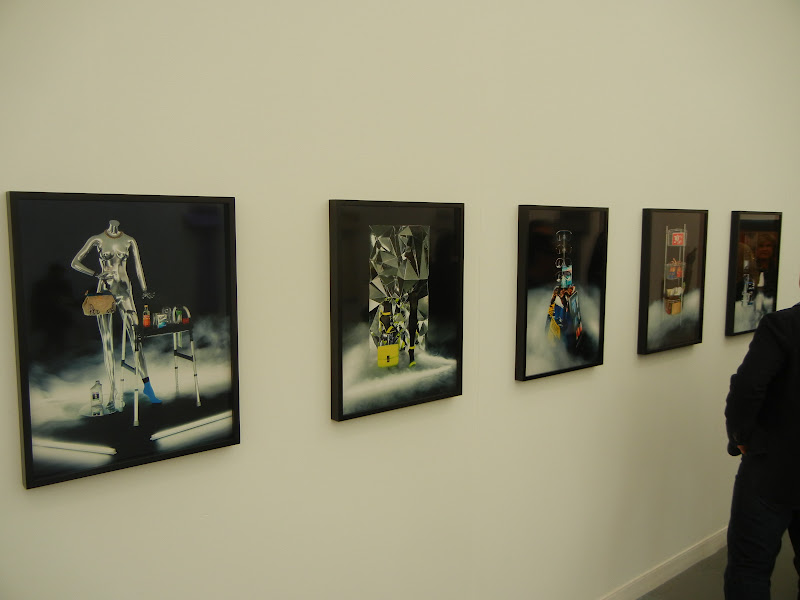
Andrea Rosen Gallery (here): Josephine Meckseper (5), Walker Evans (3), Wolfgang Tillmans (7), Aaron Bobrow (1 diptych, 1). I found Meckseper's assemblages of commercial items, complete with fog, fluorescent lighting, and shiny mannequins and backdrops unexpected and odd. They were priced at $7000 each. And while I have seen them before, I continue to enjoy the big Tillmans abstractions of misty color. This one was priced at $78000.


A Gentil Carioca (here): Thiago Rocha Pitta (3)


Orange Section

The Modern Institute (here): Luke Fowler (2)

Galerie Gisela Capitain (here): Alina Szapocznikow (1 set of 20), Christopher Williams (1 diptych), Zoe Leonard (5), Barbara Bloom (3)

Galerie Guido W. Baudach (here): Rashid Johnson (1), Jurgen Klauke (1)

Marc Foxx (here): Luisa Lambri (3), Anne Collier (1)

Mitchell-Innes & Nash (here): Amanda Ross-Ho (1). This Ross-Ho sculptural wall arrangement follows along from similar work show at MoMA in 2010. It was priced at $40000.


Alfonso Artiaco (here): Gilbert & George (1 set of 9), Vera Lutter (1 diptych), Darren Almond (2)

Galerie Francesca Pia (here): Elad Lassry (3, 1 set of 4)

Galerie Meyer Riegger (here): Helen Mirra (3)

Corvi-Mora (here): Anne Collier (1)

Galerie Krinzinger (here): Frank Thiel (1), Valie Export (1), Gunter Brus (2), Otto Muehl (1), Oleg Kulik (2), Mike Kelley and Paul McCarthy (1), Thomas Zipp (1), Rudolf Schwartzkoger (1 set of 7), Marina Abramovic (1 set of 3), Vito Acconci (1). This large peeling paint image by Thiel is a recent addition to his Stadt series; it was priced at $34000.


Xavier Hufkens (here): Robert Mapplethorpe (4)

Galerie Praz-Delavallade (here): Amalia Saban (1)

Kerlin Gallery (here): Willie Doherty (2)

Richard Telles (here): Dan Finsel (1 diptych), Josephine Pryde (1)

Vermelho (here): Claudia Andujar (3), Rosangela Renno (1), Odires Mlaszho (2 collages)

Sean Kelly Gallery (here): Frank Thiel (1), Alec Soth (2), James Casebere (1), Robert Mapplethorpe (2), Iran do Espirito Santo (1), Yves Klein (1)
Galerie Chantal Crousel (here): Wolfgang Tillmans (2), Jean-Luc Moulene (3)

Salon 94 (here): Liz Cohen (1 set of 150, 1 diptych), David Benjamin Sherry (7), Carlo Mollino (39 Polaroids), Lorna Simpson (19 collages). While still life images of tools have been done before many times, I liked both the choice of smaller individual scale and the wall-filling volume of this typology; it was priced at $72000.


Sommer Contemporary Art (here): Yael Bartana (3), Gregor Hildebrandt (3)

Experimenter (here): Bani Abidi (1 installation). While the content and message of this piece were of less interest to me, I was intrigued by the agglomeration of photographic layers, of the pictures of pictures (in various sizes) then stacked and placed in spatial relationship to each other in a single collection.


Cheim & Read (here): William Eggleston (2), Jack Pierson (1)

Part 3 is here.

Tuesday, September 30, 2008

New Photography 2008: Josephine Meckseper and Mikhael Subotzky @MoMA

JTF (just the facts): On one side of the gallery, 21 chromogenic prints, each approximately 40x50, negatives from 2006-2008. On the other side, 5 larger than life size color portraits (each approximately 80x60), negatives from 2006. One wall, behind several of the portraits, is covered with printed color wallpaper with a silvery reflective backing. 3 mixed media installations (glass cases/shelves) and 2 additional color works (negatives from 2008) complete the group.

Comments/Context: Back in 1985, the MoMA began the process of putting on a show of new photography once a year. Each year, it has been a chance to step away from the established masters and recognized stars to explore what is happening out on the bleeding edge, and to ask some questions about how the medium is evolving and where it might be going. It's an opportunity for the curators to step out a bit and let us know what they think is important, and given the preeminence of this particular museum, we tend to pay attention.

In contrast to shows past where a handful of photographers have been presented, this year there are only two: Josephine Meckseper and Mikhael Subotzky. This structure inevitably leads to a comparison of the two (who doesn't walk out of the gallery and ask their friends which one they thought was "better"?). This is particularly hard and potentially misleading, since these two bodies of work could hardly be more different.

Subotzky's work is rooted in the traditions of photojournalism and documentary photography. His images chronicle the life in and around the Beaufort West Prison, located in a desert area of the Western Cape in South Africa. The pictures are consistently strong in their storytelling, their use of color, and their contrasts. (See installation photo at right.) I was particularly moved by the images of a surreal man in a Spider-Man mask striding through a staggering trash heap (Samuel, Vaalkoppies, 2006) and the one of a prisoner taking a nap on a bench near a wall painted to look like the desert outside (Jaco, Beaufort West Prison, 2006), but the work is well made across the board.

The intersection of the ideas of art and photojournalism has always been a puzzle for me. We now call the work of Walker Evans, Margaret Bourke-White, Weegee and many others "art", and yet virtually all of this work was done at the time in the context of commercial photojournalism. Where do these areas overlap? Is it merely a function of time and quality, such that if the images are strong and enough time goes by, the work that was once commercial is now art? Are the thousands of digital images on a documentary photographer's hard drive in Iraq today (only a handful of which were used by any major news outlet) the great art of our times?

I like Subotzky's work and I imagine he will have a long and fruitful career as a photojournalist. That said, we have seen pictures of prisons, and racism, and poverty, and helplessness before. My take away from his work is less therefore about him and more about what his work tells me about the state of the medium. My conclusion is that even in today's 24-hour news cycle, always on, YouTube world, there are still stories to tell about our world that are going unnoticed and unreported and that are worth hearing. And that even in a digitally manipulated, airbrushed and increasingly cynical environment, the truth still matters.

As you cross the gallery into Josephine Meckseper's side, a visual assault takes place. The photos are huge, the wallpaper is shiny and colorful, and the whole scene seems carefully managed. (See installation photo at left.) It would be pretty hard not to grasp the conceptual commentary on advertising and consumerism that is throughout this work (it is delivered with a sledge hammer). And yet, I didn't come away with much that I found new here. We've seen plenty of appropriation art over the years (Warhol, Prince etc.) and plenty of reworking of advertising into fine art, and while this installation did have a subtle Eastern bloc feel to it that was a little different, it just didn't seem particularly novel I'm afraid. There are plenty of references to "political" themes in the press release and wall text, but these were lost (to me at least) in the other messages being sent.

What this tells us about the state of photography is not clear. Perhaps it is an acknowledgment that contemporary artists are more and more using the camera as one of a whole toolbox of implements to make their art, thereby blurring the lines of what "photography" is. Perhaps it is a commentary on the saturation of images that we have come to see as normal, and the undercurrents of what those images represent.
.
Collector's POV: Neither of these photographers fits into our personal collection in any way. But it is absolutely worth going to see this show, both to see the specific works and to understand the themes these selections represent and how the MoMA is viewing the important trends in contemporary photography.
.
One last aside: if you get down to the small type of this exhibit, you'll notice that this show was made possible by JGS Inc. I recently had a chance to sit down with the folks behind JGS and hear about all the projects they are up to. One way to think about JGS is that it is a "post collecting" endeavor. While they started as photography collectors, they have moved beyond the hunt for particular images to an all encompassing support of contemporary photography. They are no longer looking back to the past, they are focused on the future, and that future includes sponsoring exhibitions, supporting the creation of artists books and DVDs, and the building of their amazing virtual destination, the Forward Thinking Museum. Bricks and mortar curators out there should take heed; these folks are out in the unexplored territory, figuring out how technology impacts what a museum might be in the 21st century (and guess what, it isn't a touch screen kiosk in the corner of the gallery). And when they go from 35 or so "floors" of photography exhibits in their museum to 500, they will be reinventing how the Internet generation thinks of photography.
.
Rating: * (1 star) GOOD (rating system defined here)
.
Museum of Modern Art
11 West 53rd Street
New York, NY 10019