Showing posts with label Doug Rickard. Show all posts

Tuesday, November 20, 2012

Doug Rickard, A New American Picture @Milo

JTF (just the facts): A total of 16 color photographs, framed in white and unmatted, and hung against white walls in the East and West gallery spaces. All of the works are archival pigment prints, made between 2009 and 2011. The prints come in three sizes: 26x42 (in editions of 5+3AP), 40x64 (in editions of 5+3AP), and 21x34 (in editions of 7+3AP, but not on view in this show). A monograph of this body of work was recently published by Aperture (here). (Installation shots at right.)
  
Comments/Context: Doug Rickard's A New American Picture is one of the most polarizing bodies of contemporary photography to surface in the past few years. While it is deeply and thoughtfully rooted the history of the medium, it aggressively pushes previously established boundaries and fundamental definitions. This has led to a wide spectrum of opinions on its merits, from ringing praise to scathing dismissal. In my view, heated arguments are a very good sign of something worth paying attention to - it's a sign that the establishment feels just a little bit threatened.
 
Part of what has caught the wider public's attention about this work is its unconventional process. All of the images are appropriated from Google Street View (the car mounted effort to mechanically photograph every street in America), then digitally tuned, reframed and edited by Rickard, and finally rephotographed from his computer screen. Supporters see these methods as an innovative extension of old school image appropriation, smartly matched to a 21st century flood of available digital files. They understand the pixelation and optical blur in the final works to be deliberate remnants of (and references to) their original quasi-surveillance function, and consider his archive mining as the natural next step in the onward progression of digital art. Detractors openly scoff at his tools, mocking him as an editor rather than a photographer and ridiculing the low fidelity image quality. They remind us of other artists doing similar things, characterize his interventions as less than original, and generally walk away underwhelmed.
 
The other part of the conversation that surrounds these pictures is their bleak, sometimes boring, often poverty laced content. For the most part, Rickard has selected uneventful scenes on the outskirts of our cities, where vacant lots grow weedy, street corners are closed or boarded up, and young men (virtually all black) wander in packs. Look closely and it will become apparent that Rickard has a well trained eye for overlooked detail: the billowing clouds over a cemetery, the shadow of a telephone pole, a blindingly white dog, the intense pop of a red wall flanked by a person in lime green pants, an overturned toy truck in a muddy yard at sunrise. And if you've ever read Rickard's excellent blog, American Suburb X, you will know that Rickard is undeniably informed by a sense of history. His body of work is not an accidental grouping of snapshots thrown together; he knows exactly which images he is referencing, from the FSA photography of Evans to the road trip images of Frank, and from the American color of Eggleston, Shore, and Sternfeld to the street photography of Winogrand. So I think it's an oversimplification to just see these as a newfangled extension of iconic street photography, dumbed down for a digital age. Given his raw material, he has carefully selected images that have echoes of the old but depict a very different, more modern existence and aesthetic.
 
Having heard both sides of the Rickard debate and looked closely at the pictures, I have to say that I come down on the side of being excited by what he's doing. Not every photograph on view here is wildly memorable or entirely pleasing, but I came away won over by the thoughtfulness with which he is breaking rules and extending limits. I hope that Rickard will not end up hopelessly branded as a "Google Street View" photographer, as his broader approach is applicable to more than just this one method. This body of work asks us to reconsider the definitional edges of image capture and artistic creation, and to think differently about how the avalanche of digital imagery we now create can be repurposed and recontextualized. This work is a sign post pointing toward the new. So even if we have the innate urge to pick it apart as something unlike what we're used to, we would be foolish not to watch closely.
 
Collector's POV: The prints in this show are priced as follows. The 26x42 prints are $6000 each, the 40x64 prints are $8000 each, and the smaller 21x34 prints (not on view) are $4500 each. Rickard's work has not yet reached the secondary markets with any regularity, so gallery retail is likely the best option for those collectors interested in following up.
 
Rating: ** (two stars) VERY GOOD (rating system described here)
 
Transit Hub:
  • Artist site (here)
  • American Suburb X (here)
  • Features/Reviews: Artforum (here), New Yorker PhotoBooth (here), Time LightBox (here), Believer (here), Daily Beast (here)
Through November 24th
 
245 Tenth Avenue
New York, NY 10001

Friday, November 16, 2012

Aperture Remix @Aperture

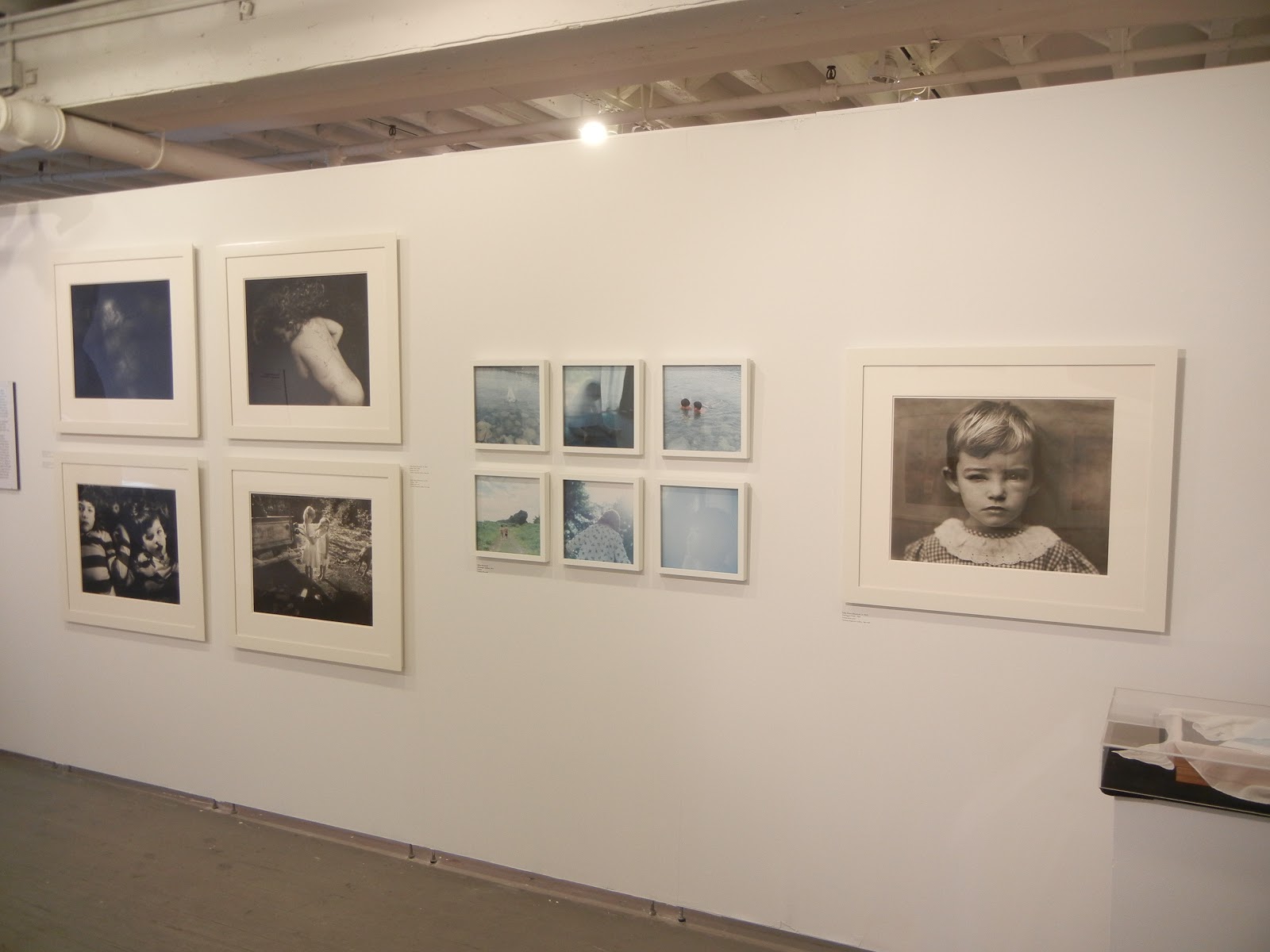
JTF (just the facts): A group show consisting of 8 individual photographers and 1 artistic pair who were asked to make new work inspired by an Aperture publication. The exhibit is divided into 9 sections, with each section containing the new works, a sample of the works which made up the original book/magazine, and a limited edition book combining the old and new. The exhibit was curated by Lesley Martin. (Installation shots at right.)
 
The following photographers have been included in the show, with their chosen influential publication as reference. The details on the works on view made by both the commissioned artists and the subjects are underneath.
 
Rinko Kawauchi: Sally Mann, Immediate Family, 1992
  • Mann: 5 gelatin silver prints, 1984-1989
  • Kawauchi: 6 c prints, 2012
  • Case with Kawauchi's limited edition book
Vik Muniz: Edward Weston, Daybooks, Volume 1, Mexico, 1973
  • Weston: 3 gelatin silver prints, 1921-1924
  • Muniz: 1 digital gelatin silver print, 2012, 1 copy of Daybooks cut up
Taiyo Onorato and Nico Krebs, Aperture essay books, 1976-2011
  • Onorato/Krebs: 1 camera made from a dozen cut through books, 1 archival pigment print
Martin Parr: Aperture issue 103, 1986
  • Nan Goldin: 2 cibachrome prints, 1977-1980
  • Chris Killip: 2 gelatin silver prints, 1983-1984
  • Larry Sultan: 2 digital c prints, 1984
  • Parr: 3 digital c prints, 1990-2001
  • Case with Parr's limited edition book
Doug Rickard: Stephen Shore, Uncommon Places, 1982
  • Shore: 1 set of postcards, 1971-2000, 5 chromogenic prints, 1973-1975
  • Rickard: 8 archival pigment pigment prints, 1971-1978/2012
  • Case with Rickard's limited edition book
Viviane Sassen: Edward Weston, Nudes, 1977
  • Weston: 3 gelatin silver prints, 1 palladium print, 1927-1936
  • Sassen: 5 archival pigment prints, 2003
  • Case with Sassen's limited edition book
Alec Soth: Robert Adams, Summer Nights, 1985
  • Adams: 4 gelatin silver prints, 1975-1980
  • Soth: 1 video
  • Case with letters and Soth's limited edition book
Penelope Umbrico: Masters of Photography series, 1977-1999
  • Group of source images: 2 Henri Cartier-Bresson gelatin silver prints, 1948 and 1964, 1 Wynn Bullock gelatin silver print, 1958, 2 Manuel Alvarez Bravo gelatin silver prints, 1966 and 1967, 1 Edward Weston gelatin silver print, 1935, 1 Alfred Stieglitz gelatin silver print, Eikoh Hosoe gelatin silver print, 1996, 1 Paul Strand gelatin silver print, plus other reproductions
  • Umbrico: 87 iPhone images, manipulated by apps, hung as a single cluster
  • Case with Umbrico's limited edition book and stack of original Masters of Photography series books
James Welling: Paul Strand, Time in New England, 1980
  • Strand: 6 gelatin silver prints, 1928-1946
  • Welling: 22 archival pigment prints, 1 diptych, and 3 texts, 2012
  • Case with Welling's limited edition book
Comments/Context: In honor of its 60th anniversary this year, Aperture might have easily trotted out a luscious parade of past masters and iconic photobooks, in a deservedly congratulatory and self-referential manner given the publisher's important position in the history of the medium. But the overly obvious greatest hits show has been smartly avoided and instead recast by asking ten contemporary photographers to make fresh works (and books) in reference/homage to any one of Aperture's many publications. The idea of exploring how a contemporary artist borrows and incorporates ideas from other artists is not a new one, of course, but in our age of image explosion and remixed culture, one that seems ever more relevant. Where is the line between responding and appropriating, riffing and reworking, entirely reformulating and just being derivative? The works in this show examine this process, opening a dialogue between past and present, asking and answering thorny questions about the nature of influence and interpretation across the photographic generations.
 
Edward Weston provides the starting point for two of the photographers included. Viviane Sassen has made deceptive pink toned nudes in reference to Weston's iconic almost abstract creations, starting with a similar interest in the lines of the human form, but extending it in her own way into multi-body nudes that have a mysterious selection of extra limbs. Her images are both seductive and sculptural like Weston, but startlingly disconcerting and unexpected. Vik Muniz has also channeled Weston, immersing himself in the Daybooks and building one of his signature constructions out of text fragments from the book and other Weston imagery. His rework of Weston's elegant portrait of Tina Modotti holding a white iris is both reverential and also uniquely Muniz.
 
Alec Soth's homage to Robert Adams' Summer Nights is fascinating near failure. After backtracking from night photography to experimenting with his new camera's video function, Soth opted for still video clips of trees and their shadows, strip malls at twilight, and houses with lights in the windows; my first reaction was that it was all a little too literal for me, and not quite enough of Soth's own vision coming through. But then I stopped looking and started listening more actively: the rustling of the trees, the background noise of a town, the settling down for the night, all captured (perhaps inadvertently) by the video. It's an amazingly perfect soundtrack of summer nights, achingly evocative of Adams' own photographs.
 
Other pairings are equally clever  and thoughtful. Rinko Kawauchi reconsiders Sally Mann's images of her children, with her own ephemeral, atmospheric shots of kids: boys swimming, a splash of water, a baby behind a curtain, the soft sunlight streaming down behind a young girl. Penelope Umbrico dives into images of mountains made masters of the medium, and then reworks them using her iPhone, creating a candy colored array of the very same mountains, somehow made less imposing by tints, tiling, and reorientations. And Doug Rickard parrots Stephen Shore's own postcard idea back at him, discovering his own 1970s era postcards of motels, cars, and restaurants, and then further tuning them to accent the saturated yellow palette of the times; they're a smart homage, using Rickard's own affinity for found imagery.
 
What I like best about this show is its sense of honoring without fawning, of acknowledging influence while still staying true to original thinking. If all of our remixed, reshuffled, chopped, and appropriated digital art of the future is as shrewd as most of what is on view here, we need not ever fear that photography is somehow over.
 
Collector's POV: One of the consistently puzzling things about this venue is that it is always a challenge to figure out what is actually for sale. For the most part, this is a non-selling environment more like a museum, so there is hardly ever an easily accessible checklist with ready price information and image details. What is perplexing about this approach is that often at least some of the works are really for sale or there are additional prints available in the print room, so it usually takes some initiative to get the answers. In the case of this particular show, it is not at all clear whether any of the photographs are available for purchase. My assumption is that at a minimum the limited edition collaborative books are for sale, but I didn't surface any prices, so interested collectors will need to follow up directly with Aperture or potentially with the various galleries that represent the artists.
 
Rating: * (one star) GOOD (rating system described here)
 
Transit Hub: 
  • Features/Reviews: CNN (here), Capital NewYork (here), New Yorker PhotoBooth (here), Time LightBox (here)
Through November 17th
 
547 West 27th Street
New York, NY 10001

Wednesday, November 2, 2011

New Photography 2011 @MoMA

JTF (just the facts): A group show of the work of six contemporary photographers, variously framed and matted, and hung in a two room divided gallery on the 3rd floor. The exhibit was curated by Dan Leers. (Installation shots at right.)

The following photographers have been included in the show, with the number of works on view and image details in parentheses:
  • Moyra Davey (2 works, consisting of grids of 25 and 16 c-prints respectively, unframed and pinned directly to the wall, from 2010-2011)
  • George Georgiou (8 pigmented inkjet prints, framed in white and unmatted, from 2006-2007)
  • Deana Lawson (7 pigmented inkjet prints, framed in white and unmatted, from 2007-2010)
  • Doug Rickard (8 pigmented inkjet prints, framed in white and unmatted, from 2009-2011)
  • Viviane Sassen (8 pigmented inkjet prints, variously framed and unmatted, various sizes, from 2006-2010)
  • Zhang Dali (20 gelatin silver prints, with photomechanical reproductions and type written text, framed in white and matted, from 2003-2011)
Comments/Context: There's a little bit of everything in this year's New Photography exhibit at the MoMA, making it much broader and more inclusive than other recent incarnations of this annual survey. Rather than highlighting a particular theme or grouping similar/contrasting approaches, this show runs the gamut from documentary to digital appropriation, with relatively equal measures of conceptual and straight photography, offering us diversity and divergence as opposed to a particular institutional point of view. The implication is that the medium is expanding and extending in so many directions that it's impossible to use any one narrow definition anymore, and there's quality and innovation to be found in a plethora of styles and working methods.

In terms of sheer visual elegance, Viviane Sassen's photographs are far and away the most successful. Her pictures have a perplexing, mesmerizing magic, where simple forms and odd compositional angles create an atmosphere of the unexpected. Orange soda is poured into a hole in the sidewalk, a boy lies tipped over in a blue plastic chair, a paper bursts into flames in front of a subject's face, and a woman's body lies draped in a light blue sheet. Seemingly normal subjects take on an air of confusing mystery, and decoding some kind of plausible narrative becomes tricky, pushing the viewer back into an exploration of the lines, color, and space of the formal elements of the pictures. The enigmatic, unknowable secrets of the images give them a power that goes far beyond their straightforward appearance.

I think the opposite wall pairing of Doug Rickard and Zhang Dali was an inspired connection of related ideas, where elusive photographic truth and power-driven propaganda mix with surveillance, privacy, and the omniscience of the digital Internet. Rickard's photographs are full of thorny conceptual questions, from how they were made (appropriated from Google Street View and then selected/cropped/reframed) to what they might represent (the digital embodiment of "everything", the intrusion on the edges of personal freedoms, and the details of suburban decline which they so clearly document). All of the works look downward from the all-seeing robot cameras, finding a depressing array of rusting cars, muddy lots, wayward youths, and poverty stricken streets, unvarnished and exposed to the eyes of the Internet. Zhang's pictures are proof positive of deliberate photographic censorship and alteration in a more political sense, where history and collective memory get changed by airbrushing out undesirables. Photo ops of Chairman Mao are retouched and enhanced, simplifying the visual story, collaging together separate parts, or cropping out distractions to get to a new kind of truth. Both sets of work consider the nature of documentatio, manipulation and archival memory, and standing between them, the resonance of interchangeable ideas is very strong.
.
The remaining works by Moyra Davey, Deana Lawson, and George Georgiou are all accomplished in their own ways (although slightly less exciting to my eye/brain), ranging from voyeuristic portraiture to documentary photography capturing the dichotomies of old/new, returning all the way back to a pleasingly retro, analog dip into the tangible. Davey's intellectual taxonomies of bare bulb light fixtures and book bindings/empty coffee cups are much better in grid form than in the long around-the-room hang of her last gallery show; the visual echoes and repeated patterns of tape are much more apparent.

All in, this show has a something-for-everyone safety that makes it approachable, while still educating viewers about the complex heterogeneity of the contemporary photographic world. In the future, I think this incarnation of the New Photography series will be remembered as a coming out party for Viviane Sassen, and as a further validation of the artistic white space created by Internet driven digital imagery, as embodied by the work of Doug Rickard.

Collector's POV: Given this is a museum show, there are of course no prices. The photographers in the show are represented by the following galleries:
  • Moyra Davey: Murray Guy (here)
  • George Georgiou: unknown
  • Deana Lawson: unknown
  • Doug Rickard: Yossi Milo (here)
  • Viviane Sassen: Motive (here), Stevenson (here)
  • Zhang Dali: Eli Klein (here)
None of these artists has any significant secondary market track record, so gallery retail will likely be the only option for acquiring their work in the short term.

Rating: * (one star) GOOD (rating system described here)

Transit Hub:
  • Exhibition site (here)
  • Reviews: NY Times (here), New Yorker (here), Time LightBox (here), PhotoBooth (here)
  • George Georgiou artist site (here)
  • Deana Lawson artist site (here)
  • Doug Rickard artist site (here)
  • Viviane Sassen artist site (here
New Photography 2011
Through January 16th

Museum of Modern Art
11 West 53rd Street
New York, NY 10019