Showing posts with label Howard Greenberg Gallery. Show all posts

Tuesday, March 26, 2013

William Klein: Paintings, etc. @Greenberg

JTF (just the facts): A total of 9 paintings and 13 photographs, variously framed and unmatted, and hung against light brown walls in the main gallery space, the book alcove, and the back transition gallery. All of the photographs are gelatin silver prints, taken between 1949 and 1962 and printed later. Physical dimensions range from 20x24 to 60x64; editions are either 15 or 30, except for the hand painted contacts which are unique. The paintings were made between 1948 and 1964 and range in size from 21x30 to 91x182. A monograph of this body of work was recently published by Contrasto Books (here). (Installation shots at right.)

Comments/Context: While William Klein's brash street and fashion photography have already cemented their rightful place in photographic history, this show digs back to the very beginning of his career, where his transition from painter to photographer was taking place. It provides clues to Klein's evolving graphic sensibility and chronicles his early experiments using photography to achieve gestural, painterly results.

Klein's paintings from the late 1940s and early 1950s are full of stark lines and hard edged geometries. Still life objects and tabletops are pared down to abstract black and white forms, eventually giving way to layers of colored shapes and interlocked lines. His early photographs from the same period follow a similar trajectory. His pair of 1949 barn sides are a positive/negative inversion of high contrast black and white, reducing the structure to lines and edges. That same year, he began playing with light drawings, creating thick, loopy movements of black on white and more frenetic, squiggly compositions of white on black; both are reminiscent of Barbara Morgan's light drawings from the early 1940s, but are clearly part of Klein's ongoing investigations of how photography could be used for abstraction. Images from just a few years later find Klein using blurred multiple exposure squares to create movement and bright verticals to create high impact linearity. In the early 1960s, Klein returned to the light drawings, this time hybridizing them with fashion imagery, with models appearing to juggle balls and blow smoke rings made of gestural white light. And this mashup idea comes full circle in a selection of his recent contacts, where enlarged photographic sheets have been overpainted with vibrant, active marks.

I think this show provides an important backstory to the larger Klein narrative and helps to explain some of his later artistic decision making. These photographs are big and muscular, more loose than the paintings. They show Klein incorporating his learnings from painting and extending them into the vocabulary of photography, in the process, bringing fresh immediacy and vitality to the medium. With the intermediate steps now visible, his original sense for the bold and graphic now seems entirely understandable.

Collector's POV: The photographs in the show are priced between $14000 and $30500; the paintings are generally NFS, except for the huge mural, which is $105000. Klein's work is routinely available in the secondary markets for photography, particularly his later prints. Prices have ranged between roughly $1000 and $145000, with the top end of that range reserved for vintage prints of his most iconic images.

Rating: * (one star) GOOD (rating system described here)

Transit Hub:
  • Features: NY Times Lens (here), Interview (here)
  • HackelBury exhibit, 2012 (here)
 
Through April 27th

Howard Greenberg Gallery
41 East 57th Street
New York, NY 10022

Friday, December 14, 2012

Joel Meyerowitz, 50 Years of Photographs, Part II: 1976-2012 @Greenberg

JTF (just the facts): A total of 43 color photographs, framed in white and variously matted/unmatted, and hung against light brown walls in the main gallery space, the book alcove, the back transition gallery, and the smaller side viewing room. All of the works are either chromogenic or archival pigment prints made between 1976 and 2011 (most are from the 70s and 1980s); the show includes a mix of vintage and modern prints. Physical sizes range from 8x10 to 51x40 (or reverse). No edition information was available for the vintage prints; edition sizes for the modern prints are variously 5, 10, 15, or 20. (Installation shots at right.)
 
Comments/Context: This second part of the Joel Meyerowitz gallery retrospective begins with the late 1970s period when color itself became the primary subject of the artist's work. Looking back, we now think of this time as the innovative heyday of American color photography, and this selection of images makes a compelling case that Meyerowitz was right in the thick of things. As he slowly traded the streets of New York for the beach communities of Truro and Provincetown out on Cape Cod, his pictures settle down a bit, no longer chasing the chaos of a cinematic city scene; they move more deliberately, waiting for the right light conditions that would produce the color effects he was now interested in.
 
The last few New York images on display here all primarily play with color as a compositional tool. A glowing red neon sign is balanced by the green tinge of a New Jersey neighborhood street light. The sliver of the Empire State Building is offset by the rich afternoon light on an orange storefront, punctuated by a dancer in a bright green dress. A spinning lobby Christmas tree is transformed into a conical electric rainbow. And the soft pink of a bathtub becomes a study in color gradations and shadows.
 
Meyerowitz' photographs from the Cape seem even slower, where the buzz of yellow neon reflects across a wood sided station wagon and car doors are aimlessly left open revealing saturated red warmth against the dark purple twilight. Dusk seems to have been his most productive time of day, when the changing tones of cotton candy pink, burnt orange, and periwinkle blue could be captured through the railing of a porch, over a swimming pool, near the light of a telephone booth, or simply at the beach looking out to sea. His daytime pictures of cottages are more formal, using the scallop of a roofline to decorate the disorienting view to the ocean through a rectangular hallway or interleaving the lattice pattern of a rose trellis with its own shadows in the punishing midday sun. A side room of beachgoers stand at attention near the water, prefiguring Rineke Dijkstra's famous images but with a more casual, easygoing, summertime mood.
 
Aside from the shattered blue of an extra large Hockney-esque swimming pool pattern, most of Meyerowitz' recent works are executed in a more subtle and subdued palette. The skulls and tin cups of Cezanne's studio in Aix-en-Provence sink into tactile grey, a warehouse butchery in Tuscany wallows in muted reds and browns, and the twinkling light streaming through early morning cypresses washes everything to silhouetted black and white. The color is now soft, worn, and understated.
 
In general, as with the first part of the survey, I think this second part has been well chosen, mixing instantly recognizable photographs with lesser known rarities. While there are gaps in the story and the recent work is less memorable, the selections from the 1970s and 1980s certainly show Meyerowitz' artistic progression and clarify his evolving approach to the medium. Across these two exhibits, we've been given a smart and thorough retrospective of Meyerowitz' long career, with plenty of highlights to burnish his reputation.
 
Collector's POV: The works in the show are priced between $10000 and $26000. Meyerowitz' work is routinely available in the secondary markets, particularly prints of his 1970s images made in large editions (75 or even 100). Prices have typically ranged from $1000 to $14000, mostly on the lower end of that range.
 
Rating: * (one star) GOOD (rating system described here)
 
Transit Hub:
  • Artist site (here)
  • DLK COLLECTION review of Part I of the exhibit (here)
  • Joel Meyerowitz: Taking My Time, published by Phaidon (here
 
Through January 5th

Howard Greenberg Gallery
41 East 57th Street
New York, NY 10022

Wednesday, November 21, 2012

Joel Meyerowitz, 50 Years of Photographs, Part I: 1962-1977 @Greenberg

JTF (just the facts): A total of 47 black and white and color photographs, variously framed and matted, and hung against light brown walls in the main gallery space, the book alcove, and the back transition gallery. The works in the show were made between 1962 and 1976. The 17 black and white images are a mix of vintage gelatin silver prints and modern archival pigment prints, sized between 9x13 and 11x15. No edition information was available for the vintage prints; the pigment prints are available in editions of 25. The 30 color images are a mix of modern archival pigment prints, vintage chromogenic prints and vintage dye transfer prints, sized between 9x14 and 27x40 (or reverse). No edition information was available for the vintage prints; edition sizes for the modern prints are variously 10, 15, 20, or 25. (Installation shots at right.)

Comments/Context: Joel Meyerowitz seems to having a bit of a resurgence these days. A new two volume retrospective book, a European museum show, a couple of lifetime achievement awards, and now, in conjunction with joining the stable at Howard Greenberg, a two part career survey at the gallery. It feels like a consolidating, summing up moment for the influential American photographer.
 
This show digs back into the archive and tells the story of Meyerowitz' early career. It finds him moving back and forth between black and white and color, testing the affinities and limits of both approaches. During this time period, there is a slow evolution from a focus on street photography (particularly in New York) to a broader look at the effects of color, in locations all around the world. But this transition doesn't happen like a turning on a light switch; it's more like a faucet, starting with a trickle of ideas that eventually overwhelms the previous style. Many of Meyerowitz' early street scenes center on a single event: a woman in a coffee shop, a Times Square ticket seller obscured by the window grill, the splash of a red dress and gauzy hat at Easter, a cluster of women in white pumps standing in a doorway, the kiss of a hand in Central Park. A few of the pictures then start to become more complex and cinematic: a woman being thrown into a convertible, a gathering of people on a front stoop all looking in different directions, the blown hair of couples in Dallas, a fallen man in Paris surrounded by a chaotic group of gawkers.

One wall of the exhibit shows pairs of images in black and white and color, taken seconds apart. They are evidence of Meyerowitz' changing mind set, and the creeping influence of color on his work. The astro turf swimsuit man standing under a blimp is far more puzzling in color than in black and white. Slowly, the images seem to turn on the play of color rather than the coalescing of a decisive moment: the blue brushes of a Bulgarian car wash, a shadowy green room with an American flag, a pile of grey police barriers, a pair of camel hair coats on the sidewalk. And once again, the compositions increase in complexity, this time balancing many color fields: a bikini clad body, a blue car, and the long white line of a curb, snug in a mess of Florida telephone poles, a shapely bus driver's leg in white boots in warm yellow sun, a lion balanced by a photo-taker in a car, taken through the dark frame of another car window. The few vintage dye transfers on view tint these kinds of scenes with a more saturated, richer color, both darker and more tactile.

I liked the sense of experimentation that is found in this selection of pictures - they're not all greatest hits or best shots. Whether it was a woman behind a projection screen, the flowers in a window of a trailer, or a jumping poodle, Meyerowitz was honing his craft and internalizing the nature of photographic color. Overall, this show is a solid sampler of work from the artist's formative years, and sets the stage for Part II of the exhibit coming in December.
 
Collector's POV: The works in the show are priced between $5000 and $40000. Meyerowitz' work is routinely available in the secondary markets, particularly prints of his 1970s images made in large editions (75 or even 100). Prices have typically ranged from $1000 to $14000, mostly on the lower end of that range.

Rating: * (one star) GOOD (rating system described here)
 
Transit Hub:
  • Artist site (here)
  • Features/Reviews: NY Times (here), New Yorker (here)
  • Joel Meyerowitz: Taking My Time, published by Phaidon (here)
Through December 1st

Howard Greenberg Gallery
41 East 57th Street
New York, NY 10022

Tuesday, October 16, 2012

Gordon Parks: Centennial @Greenberg

JTF (just the facts): A total of 51 black and white and color photographs and 1 video, variously framed and matted, and hung against light brown walls in the main gallery space, the book alcove, the small back gallery, and one of side viewing rooms. The works in the show were made between 1941 and 1970. The black and white images are a mix of vintage and modern gelatin silver prints, sized between 9x12 and 30x20 (or reverse); no edition information was available for these prints. The color images are later pigment or Ektacolor prints; the pigment prints are sized 24x24 or 20x16 (in editions of 10 and 25 respectively), while the Ektacolor prints are sized 14x19 (with no edition information). The book alcove also includes a display case with 3 LIFE magazines. (Installation shots at right.)

Comments/Context: This centennial exhibit, in honor of the 100th anniversary of the birth of Gordon Parks, successfully gives the viewer an idea of the photographer's tremendous range and talent. The show includes photo essays and street photography made on assignment for LIFE, incisive portraits of artists and celebrities, and even a few fashion shots. Never seen color rarities from the 1950s round out the four decade selection, a treat for those already familiar with Parks and his work. And a mini-retrospective like this one would be incomplete without Parks' now iconic American Gothic, but not to worry, it hides on a side wall, tucked into one of the viewing rooms.

Parks' documentary work and photo essays are full of simmering tension and emotion. The Fontenelle family stands together at the poverty board desk, clinging to each other, exhausted and grimly resigned to the ruling of the bureaucracy. Gang members openly fight in Harlem streets, followed either by a tender embrace or attendance at a wake. Dirty children in Rio de Janeiro favelas play with spiders and carry water in makeshift parades. And his recently rediscovered color works capture the realities of small town segregation, picking out separate "colored" entrances at the theater, the ice cream shack, and storefront drinking fountains.

Parks' portraiture is equally accomplished. The show includes powerful images of black leaders and celebrities, from Malcolm X and Stokely Carmichael in the passion of speech making, to a sweaty, meditative Muhammad Ali and a somber Eldridge Cleaver. Duke Ellington is artfully reflected in his piano, a shadowy Langston Hughes stands with an empty picture frame, and Sugar Ray Robinson plays golf with muscular style. These portraits are consistently atmospheric, personal, and full of life.

All in, this is a solid gathering of work from Parks' many projects and interests, and it provides an impressive and useful introduction to one of the most influential African-American photographers of the past century.

Collector's POV: The works in the show are priced as follows. The gelatin silver prints range in price from $8500 to $25000. The pigment prints range from $5000 to $10000, and the Ektacolor prints are $12000 each. Parks' work has only been sporadically available in the secondary markets in recent years, and many of his most famous images have not come up for sale at auction during that time. Recent prices have ranged between $1000 and $9000, but this may not be entirely representative of the market for his most important photographs.

Rating: * (one star) GOOD (rating system described here)

Transit Hub:
  • Parks Foundation site (here)
  • Features/Reviews: New Yorker (here), Le Journal de la Photographie (here), Elizabeth Avedon (here)
  • Companion Exhibit: Contact: Gordon Parks, Ralph Ellison and "Invisible Man" (DLK COLLECTION review here)
Through October 27th

Howard Greenberg Gallery
41 East 57th Street
New York, NY 10022

Friday, October 5, 2012

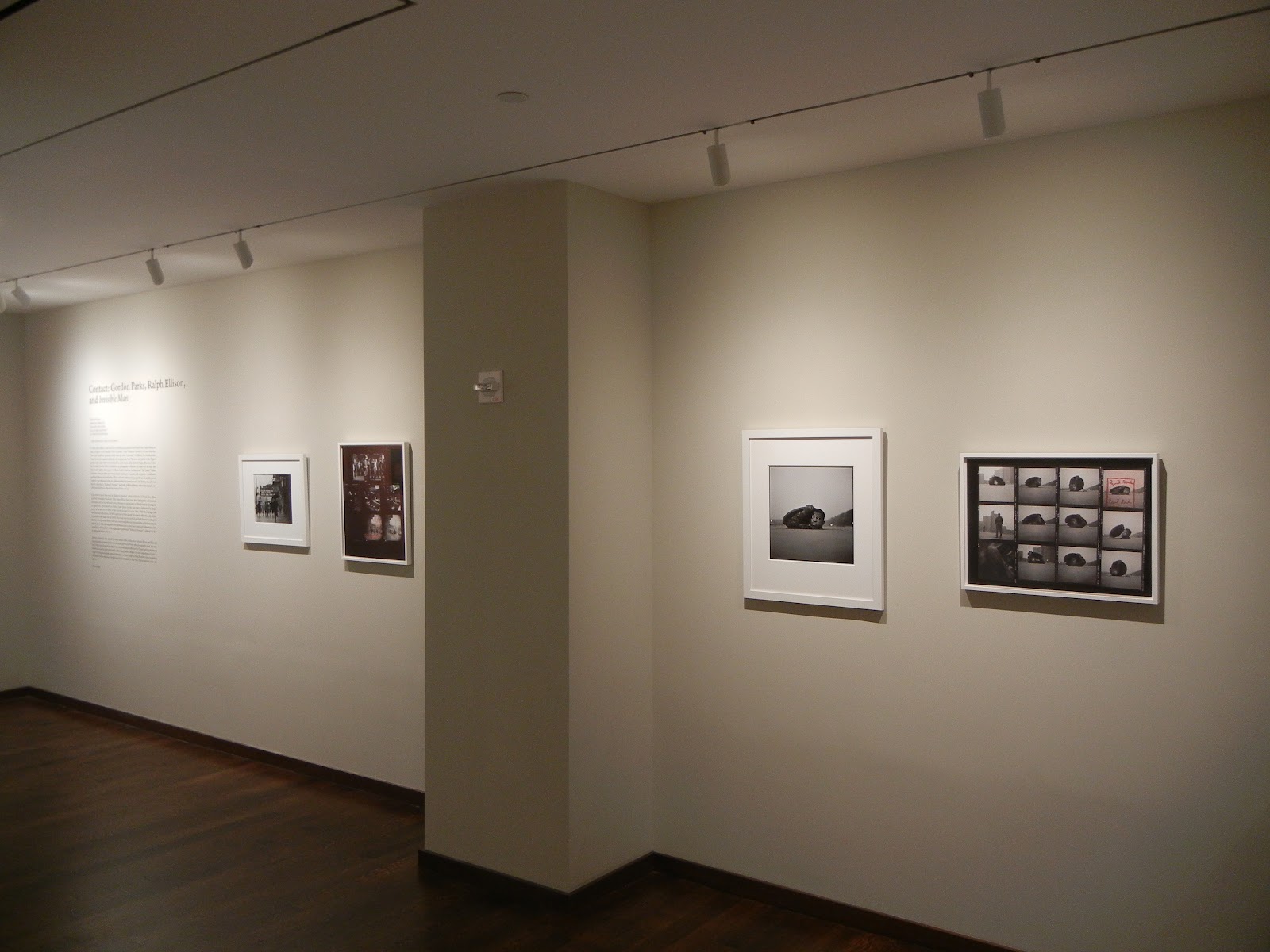
Contact: Gordon Parks, Ralph Ellison, and "Invisible Man" @Greenberg

JTF (just the facts): A total of 25 black and white photographs, framed in white and variously matted, and hung in the second gallery space to the left of the main entrance. The show combines prints and contact sheets made between 1948 and 1952; there are 13 individual prints and 12 contact sheets on display. The single images are a mix of vintage gelatin silver prints and more recent pigment prints, sized between 8x10 and 20x16 (or reverse); the later prints are available in editions of 5 or 10. The contact sheets are all recent pigment prints, sized 24x20 (or reverse). The show also includes 3 magazine spreads from LIFE, displayed directly on the wall under plexiglas. (Installation shots at right.)
 
Comments/Context: Of all the exhibits dedicated to the work of Gordon Parks on view in the city right now (and there are several), this small show is my favorite. Curated by the artist Glenn Ligon, it primarily examines the images Parks made in 1952 to illustrate some of the scenes from Ralph Ellison's ground-breaking book Invisible Man. The exhibit dives deep into important single images from the project and the related contact sheets that show Parks' artistic process, and then pairs them with more documentary-style street photographs made by Parks in Harlem a few years earlier (again with the associated contact sheets). The result is a show that smoothly moves back and forth between fact and fiction, between real life and literature, all within the context of Parks' compositional eye.
 
The images Parks made for Invisible Man have a definite sense of the staged or the imagined. A man peers out from under a manhole cover in the middle of the street with an uncertain, fugitive look in his eye, another works turntables amid a light blub covered underground retreat (complete with superimposed city lights above), and various suited men dash with suitcases on darkened sidewalks. The contact sheets show Parks experimenting with poses and angles, looking for just the right range of quietly surreal tension and contrast.
 
What's amazing is that many of Parks' street scenes from Harlem exhibit some of these same kind of moments, albeit drawn from everyday life. Pedestrians trudge in the rain under a movie marquee announcing Dealers in Crime and Hoodlum Empire, while lines of abandoned shoes lie on the sidewalk. Most of these photographs document lingering life on stoops and outside storefronts: watching the world go by, yawning, arguing, in front of the Indian herb store or the grocer advertising neck bones. The contact sheets show Parks making multiple exposures of each chosen vignette, refining the spatial relationships until the gestures coalesced.
 
Seeing these two sets of photographs intermingled, along with their respective outtakes, helped me to see the literary in Parks' street pictures, to understand how his selections from the bustle of life were informed by an aim for a certain tone. His editing wasn't just a search for the cleanest negative or the crispest composition, but was often keyed by an atmospheric connection of some kind; he was looking for something in particular when he was out there with his camera. Overall, not only does this small show deliver some fantastic images, it opens up a window into Parks' working process, which was far more nuanced and complex than I had ever understood.

Collector's POV: The works in the show are priced as follows. The vintage gelatin silver prints range in price from $8500 to $15000, while the more recent pigment prints are either $5000 or $6500. The contact sheets are $2400 each. Surprisingly, Parks' work is only intermittently available in the secondary markets, and many of his best known works have not come up for sale at auction in a long time. Recent prices have ranged between $1000 and $9000, but this may not be entirely representative of the market for his most iconic photographs.
  
Rating: ** (two stars) VERY GOOD (rating system described here)

Transit Hub:
  • Parks Foundation site (here)
  • Review: New Yorker (here)
Through October 27th

Howard Greenberg Gallery
41 East 57th Street
New York, NY 10022

Friday, April 13, 2012

Frank Gohlke, One Thing and Another @Greenberg

JTF (just the facts): A total of 34 black and white photographic works, variously framed and matted, and hung in the main gallery space and the book alcove. The main exhibit includes 8 diptychs and 10 single images hung in pairs, while the book alcove has 16 single images. (Installation shots at right.)

The works in the show come from the following projects/series. For each, the number of works on view is listed, accompanied by additional print details:
  • Ten Minutes in North Texas (5 gelatin silver prints mounted to aluminum, each 53x38, in editions of 5, taken in 1995 and printed in 2011)
  • Unpacked (3 pigment prints, each 24x60, in editions of 5, taken in 2008-2009 and printed in 2012)
  • Aftermath (3 pairs of 2 gelatin silver prints, each 14x18, edition AP, taken in 1979/1980 and printed in 1980/1982)
  • Mt. St. Helens (2 pairs of 2 gelatin silver prints, each 10x24, in editions of 15, taken in 1983/1990 and printed in 1993)
  • Grain Elevators (9 gelatin silver prints, ranging from 7x7 to 14x11, taken and printed between 1972 and 1974)
  • Landscape/Untitiled (4 gelatin silver prints, ranging from 9x9 to 14x11, taken and printed between 1973 and 1975)
  • Untitled (3 Polaroid type 50 series prints as a set, each 3x4, unique, taken and printed in 1971-1972)
Comments/Context: I'm not sure if it is a larger trend or just a quirk of New York gallery scheduling, but this is the third show I've seen in the last month or so that has used paired images to explore the idea of elapsed time in photography. Frank Gohlke's use of this conceptual structure is altogether different than that of Paul Graham and Eve Sonneman however. In contrast to the jump cut, attention shifting jerkiness of these two, Gohlke's images are astonishingly calm and meditative. Time passes in Gohlke's works as well, but it does so deliberately, with ample time for reflection and investigation. The other glaring difference is that both Graham and Sonneman are primarily interested in activites and perceptions of the humans (or themselves), while Gohlke is centered on the evolution of the land.

Aside from a group of vintage grain elevators and other landscapes in the book alcove, all of the works in this show are diptychs or pairs, with varying amounts of time between the first and second images. In both his Mt. St. Helens volanco eruption photographs and in those made in the aftermath of a Witchita Falls tornado, Gohlke turns the usual "before and after" motif on its head, making it "after, and then later". The first image in each pair is a catalog of destruction: blown down trees, piles of ash and deep craters, or houses turned to rubble, roofs ripped off, and neighborhoods decimated. The second image is a story of healing, rebirth, and starting over, years later. New evergreens have sprouted up and craters have silted over, or straight sidewalks and new one story houses have once again become neat and tidy communities. Both man and nature are seen to be remarkably resilient in the face of disaster.

Gohlke's newest pictures shorten the interval between shots down considerably, in one series down to just ten minutes. In these deceptively unassuming images of broad Texas scrublands and prairies, the changes are extremely subtle: the path of the clouds, the wind on the grass, the movement of a river, or the shading of the sunlight. They require patience, and quiet, and contemplation, and they reveal a kind of solemn, pared down poetry of ever shifting tiny details. Their pleasures reside not in the cleverness of their conceptual framework, but in their deep and humble respect for the texture of the land itself.
 
The final set of pairs are a real surpise in the context of Gohlke's photographic history: paper abstractions made from carboard packing boxes. Piled up in clusters and jumbles of angles and geometries, and then alternately seen at different times of day or from slightly different viewpoints, they are intricate puzzles of lines and planes, full of formal realignment and dilation. What started out as a pile of throw away debris clearly turned into a more complicated exercise in photographic seeing.

Gohlke's work has an old school sense of nuance that we seem to be forgetting in these fast paced times. He still values rhythm and lyricism, tempered by thoughtfulness and a sense of history. He continues to look intently at the world around him, eschewing the interruptions and distractions, seeing the details that only come from consistent, sustained attention.
 
Collector's POV: The works in the show are priced as follows. The diptychs from Ten Minutes in North Texas and Unpacked are $10000 each. The pairs of prints from Aftermath are $20000 or $25000, while the pairs of prints from Mt. St. Helens are $10000. The vintage Grain Elevators are $10000 each, while the vintage landscapes are $15000 each. The set of Polaroids is $15000. Gohlke's work has only been intermittently available at auction in recent years. While prices have ranged between $3000 and $6000, this may not be entirely representative of the market for his best work. As such, gallery retail is likely still the best option for those collectors interested in following up.
 
Rating: * (one star) GOOD (rating system described here)
 
Transit Hub:
  • Artist site (here)
  • Interview: Terrian.org (here)
Frank Gohlke, One Thing and Another
Through May 5th
 
41 East 57th Street
New York, NY 10022

Wednesday, March 7, 2012

Peripheral Visions: Italian Photography in Context, 1950s-Present @Hunter College Art Galleries

JTF (just the facts): A group show of the work of 22 Italian photographers, variously framed and matted, and hung in the entry areas and a series of three small gallery spaces. The works were made between 1953 and 2011. The show was curated by Maria Antoinella Pelizzari. A catalog of the exhibition has been published by Charta (here). (Installation shots at right.)

The following photographers were included in the exhibit, with the number of works on view, dates, and processes in parentheses:
.
Marina Ballo Charmet (2 gelatin silver prints, 1 DVD, 1993/1994, 1995, 1996)
Olivo Barbieri (2 chromogenic prints, 1 archival pigment print, 1985, 2009)
Gabriele Basilico (4 gelatin silver print, 1 book, 1979/1980, 1981, 2006)
Gianni Berengo Gardin (1 gelatin silver print, 1970)
Mario Carrieri (4 gelatin silver prints, 1 book, 1957-1959)
Vincenzo Castella (1 chromogenic print, 1 video, 2009)
Cesare Colombo (1 gelatin silver print, 1961)
Mario Cresci (1 group of 3 prints, 2 lithographs, 1 book, 1975, 1978, 1979)
Paola Di Bello (1 digital chromogenic print on diasec, 1 c-print mounted on diasec, 1997, 1999/2001)
Luigi Ghirri (6 chromogenic prints, 3 books, 1973, 1974, 1975, 1976, 1978, 1984, 1985, 1991)
Guidi Guidi (3 chromogenic prints, 1989, 1991, 2000)
Alessandro Imbriaco (4 inkjet prints, 2007-2011)
Francesco Jodice (1 digital print on Hahnemuhle paper, 1996)
Mimmo Jodice (1 gelatin silver print, 1977)
Armin Linke (1 accordion book of 16 chromogenic prints, 1999/2008)
Maurizio Montagna (1 group of 8 gelatin silver prints, 2004/2006)
Paolo Monti (2 gelatin silver prints, 1953-1956, 1959)
Ugo Mulas (1 gelatin silver print contact sheet, 1969)
Walter Niedermayr (1 chromogenic diptych, 1999)
Franco Vaccari (1 8mm film, 1 collage of 2 chromogenic prints, 1971, 1972)
Massimo Vitali (1 c-print diptych on Dibond, 2004)

Comments/Context: While a handful of contemporary Italian photographers have clearly established themselves in the global art conversation, I've often thought that what has been missing was a wider survey of recent Italian photography to provide some deeper national context for their approaches, choices, and influences. Spanning roughly sixty years and using the "little of each" sampler approach, this exhibit fills in some yawning historical gaps and places key figures amid lesser known artists (at least here in the US), offering a smoother continuum of related aesthetic ideas.

If there is a common theme to this work produced since the 1950s, it is an interest in topographical changes in the land, and the influx of urban sprawl on Italian life. There are no pictures of ornate churches, grand palazzos, historical treasures, or tourist sites included here. These images study the effects of hulking apartment blocks, office buildings, and dense concrete compression, often looking at the edges and intersections of old and new. This skeptical investigation has parallels to similar photographs made in America in the 1970s, exploring the complicated results of our own rapid suburban and industrial expansion.

Through the eyes of Paolo Monti, 1950s Milan was a grubby, alienating place: torn chain link fence, smoky skies, rubble strewn vacant lots. Gabriele Basilico picks up some of this same emotion, albeit in a much more rigorous and formal way, with architectural images from the late 1970s and a more recent monumental portrait of the smog covered expanse of urban Naples. Closer looks at details of buildings range from Luigi Ghirri's intimate and atmospheric color works to Guido Guidi's angular construction sites and sheds. Decades apart, Mario Cresci and Paola Di Bello take on similar city-centric subjects with a more conceptual bent. Even the glossy contemporary works by Massimo Vitali and Walter Niedermayr brush up against the encroaching ugliness: a chugging nuclear power plant looms in the distance behind one of Vitali's blinding beach scenes, and an overstuffed auto graveyard abuts a busy highway as seen from Niedermayr's signature bird's eye view.

All in, this is a smartly edited summary that offers multiple artistic viewpoints and interpretations of the dominant societal trend in Italy in the past half century: the tremendous, ever expanding growth of its cities. The space itself makes this show feel a bit cramped and chaotic, but with some visual patience, the choices here provide a thoughtful progression, both through time and across evolving photographic ideas.

Collector's POV: Since this is a museum exhibit, there are, of course, no posted prices. For those interested in following up on examples of recent Italian photography, a succinct companion show called An Italian Perspective is now on view in Howard Greenberg Gallery's new second space (here), through March 13th. It includes 12 images by Luigi Ghirri ($12000 or $13500 each), 6 images by Gabriele Basilico (ranging from $8000 to $19000 each), 1 image by Massimo Vitali ($39700), and 5 works by Vincenzo Castella (4 single images at $16000 or $28000 each, based on size, 1 diptych at $15000).

Rating: * (one star) GOOD (rating system described here)

Transit Hub:
  • Features/Reviews: New Yorker (here), Village Voice (here)
Peripheral Visions: Italian Photography in Context, 1950s-Present
Through April 28th

Hunter College Art Galleries
Hunter West Building
(southwest corner of 68th Street and Lexington Avenue)
New York, NY 10065

Friday, February 24, 2012

New York in Color @Greenberg

JTF (just the facts): A group show of 42 color photographs from 30 different photographers, generally framed in black and matted, and hung against light brown walls in the main gallery space, a side viewing room, and the back room near Greenberg's office. The mostly later prints were made using a mix of chromogenic, pigment, and dye transfer processes, with physical dimensions ranging in size from 10x8 to 46x34. The images were taken between 1947 and 2008. A monograph of this body of work was published by Abrams in 2011 (here). The exhibit was curated by Bob Shamis. (Installation shots at right.)

The following photographers have been included in the show, with the number of images on view and the print dates in parentheses:

Micha Bar'am (1, 1968/Later)
Nina Berman (1, 2000/Later)
Erwin Blumenfeld (2, 1955/Later)
Jerry Dantzic (1, 1950s/Later)
Bruce Davidson (1, 1980/Later)
Louis Faurer (2, 1947, 1950)
Burt Glinn (2, 1959/Later, 1964/Later)
Ernst Haas (1, 1952/1995)
Gail Albert Halaban (1, 2008)
Erich Hartmann (1, 1971/Later)
Eveyln Hofer (1, 1964/Later)
Don Hunstein (1, 1961/Later)
Len Jenshel (1, 2003)
William Klein (1, 1962/Later)
Saul Leiter (2, 1954/Later, 1957/Later)
Helen Levitt (1, 1972)
Danny Lyon (1, 1966/2005)
Jeff Mermelstein (2, 1993, 2000/2009)
Joel Meyerowitz (3, 1964/Later, 1974/Later, 1975/Later)
Abelardo Morell (1, 2009)
Margaret Morton (2, 2006, 2008)
Marvin Newman (3, 1952/Later, 1953/Later, 1956/Later)
Normal Parkinson (1, 1949/Later)
Frank Paulin (1, 1956/2011)
Lynn Saville (1, 2003/Later)
Harvey Stein (1, 1995/Later)
Todd Weinstein (1, 1980/Later)
Susan Wides (3, 1999, 2007, 2010)
Harry Wilks (1, 2005)
Amani Willett (1, 2005)

Comments/Context: When asked to remember the most iconic and emblematic photographs of New York, I think it's safe to say that many, if not all of us would come up with images in black and white. This broadly inclusive show (and the accompanying book) tries to rebalance the scales a bit by gathering pictures of the city that were made in vibrant, exuberant color. Bypassing the obvious, it is a show of lesser known discoveries and rediscoveries.

As I circled the galleries, I found myself gravitating toward those images that were really about color, rather than just in color. Saul Leiter's shiny red and yellow taxi, Danny Lyon's blue and yellow subway platform, Marvin Newman's yellow Coney Island photo shop, and Ernst Haas' geometric brown and white locksmith's sign all turn on bold contrasts and color textures. Other images have jolts and sparkles of color that enliven their stories: Joel Meyerowitz' red Easter dress, Louis Faurer's blue sidewalk, Burt Glinn's saturated yellow liquor cabinet, and Norman Parkinson's jaunty red hat. Of the many street photographs in this show, I liked Nina Berman's Times Square casting call best, not so much for its use of color, but because of its layers of personal narratives (and different sized heads) all caught in a single frame.

Given that this show spans nearly sixty years of New York history, it's not surprising that it feels eclectic and uneven; I imagine that's on purpose at some level, to illustrate the diversity of stylistic approaches used in documenting life in the city across time. As such, I think this show is less the ultimate scholarly canon of New York color photography, and more a roomy sampler of what has perhaps been unjustly overlooked.

Collector's POV: The prints in this show range in price from $1600 to $25000, with most available for under $5000.

Rating: * (one star) GOOD (rating system described here)

Transit Hub:
  • Reviews/Features: NY Times Lens (here), Huffington Post (here)
New York in Color
Through March 17th

Howard Greenberg Gallery
41 East 57th Street
New York, NY 10022

Monday, January 23, 2012

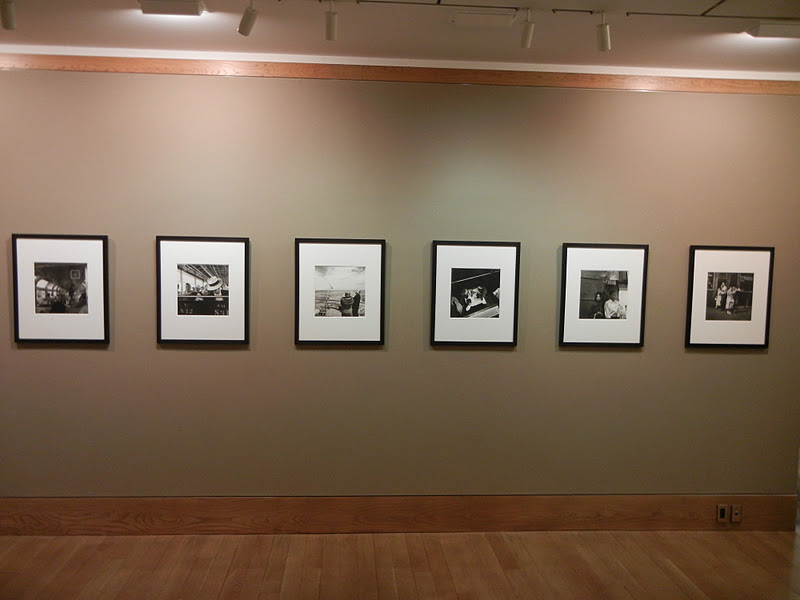
Vivian Maier: Photographs from the Maloof Collection @Greenberg

JTF (just the facts): A total of 56 black and white photographs, framed in black and matted, and hung in the main gallery space and the book alcove. 31 of the prints (shown in the main space) are posthumous/modern gelatin silver prints, each sized 12x12, in editions of 15. The other 25 prints (shown in the book alcove) are lifetime gelatin silver prints, ranging in size from 4x3 to 11x14. All of the images were taken in the 1950s and 1960s. A monograph of this body of work was published by powerHouse Books in 2011 (here). (Installation shots at right.)
.
Comments/Context: Whatever we might think about the rediscovery of the 1950s street photographs of Vivian Maier, it's impossible to conclude that the press coverage has been anything but breathless and ubiquitous; if you have even the slightest interest in photography, you can't have missed this story in the past year or two. Since every feature article follows the same exact path (the nanny, the storage locker, the 100,000 negatives, the auction, etc.), I'm going to assume this thin background is by now pretty well common knowledge.
 
Photography is likely the only mainstream artistic medium where we continue to unearth potentially major talents who have been heretofore completely overlooked or lost, so Maier's emergence is by no means an isolated case. In recent years, similar stories have played out with the work of Charles Jones and Mike Disfarmer to name just two of many. I think the hard thing about such rediscoveries is that it is very difficult to place these photographers back into their original historical context, since no one of that era saw the work or was influenced by it, nor do we have any concrete information about what shows the artist saw, what people he/she met or admired, or what books were on his/her shelves; the whole artistic narrative is disconnected. Until this data is uncovered by diligent scholarship and historical study (if ever), all we can really do is look at the pictures and try to draw our own narrowly drawn hypothetical conclusions about what might have been.
 
The other challenge with such a project, especially when the work is found as an undifferentiated whole, is that we really have no sense of Maier as an editor of her own art. We don't know which pictures she thought were her best, which ones she thought were failures, and which ones she thought were interesting but not necessarily representative of what she was trying to accomplish. In this small show, there are photographs reminiscent of Friedlander, Frank, Model, Callahan, Winogrand, Levinstein, Weegee, and even Arbus. Seeing such a gathering, one might plausibly conclude that she was a photographer still searching for her own style, perhaps trying on other ways of working in the process of looking for her own, borrwing here and there and incorporating pieces she found useful. Absent verifiable connections or a complete chronology, it's impossible to say which came first, or which echo was purposeful, random, or otherwise uniquely original.
 
So it is fair to say that I came to this show with a fair amount of inherent skepticism, especially given the hype. What is evident however is that Vivian Maier was undeniably talented. Her street photographs have a sense of formal control that is too consistent to be a coincidence; there is very little motion or chance in these pictures. She had an eye for small urban gestures: the turn of head on the street, the resting of a sleeping head on the bus, the clasp of hands across a lunch table, or the matching hats and newspapers on the train. She also had a fondness for the eccentric details in people: a crop of bushy white hair under a hat, the scowling veiled faces of society women in furs, the elastic bands exploding out of a conductor's back pockets, the watch chain of a suited man sleeping in a car, or the blurry glamour of a puffy white dress in the night. There is a strong undercurrent of crisp storytelling here, even with her self-portraits, which capture her modest figure with deadpan rigor, often reflected in shop windows or store mirrors.
.
This show felt to me like a broad introductory edit, a little of everything, and I look forward to tighter slices of her work as the overall view of her photography becomes clearer. It's too early to say definitively where Maier fits or to understand how reinserting her into the march of 1950s photography might alter the agreed-upon progression, but it's safe to declare that her photographs are truly exciting and well-crafted. Much more work is clearly needed to process her voluminous output and synthesize it down into those images that represent a unique, innovative contribution to the history of the medium. That work is ongoing, so I expect this will be just the first of many Vivian Maier shows to come, bit by bit (re)defining her legacy.
.
Collector's POV: The prints in this show are priced as follows. The posthumous prints start at $1800 and rise up through $2600 and $3500 to $5000. The lifetime prints range from $4750 to $8250, with a few NFS or already sold. Maier's work has not yet reached the secondary markets, so gallery retail is likely the only option for interested collectors at this point.
 
Rating: ** (two stars) VERY GOOD (rating system described here)
.
Transit Hub:
  • Artist site/Maloof (here)
  • Artist site/Goldstein (here)
  • Reviews/Features: NY Times (here), Lens (here), New Yorker (here)
Through January 28th

Howard Greenberg Gallery
41 East 57th Street
New York, NY 10022

Monday, November 21, 2011

Edward Burtynsky @Greenberg

JTF (just the facts): A total of 13 large scale color photographs, framed in black and not matted, and hung in the entry area and the main gallery space. All of the works are chromogenic color prints, in one of four sizes: 24x28 (in editions of 15), 34x41 (in editions of 10), 39x52 (in editions of 9) or 48x60/48x64 (in editions of 6). The images were taken between 1985 and 2010. A second group of 8 works from Burtynsky's Pentimento portfolio are displayed in the book alcove, also framed in black and not matted. All of these works are chromogenic color prints, each 20x24, from a portfolio containing 10 prints, in an edition of 30. These images were taken in 2000. A concurrent show of Burtynsky's newest work is on view at Bryce Wolkowitz Gallery (here). (Installation shots at right.)

Comments/Context: This is Edward Burtynsky's first show at Howard Greenberg Gallery since changing gallery representation, and while Burtynsky's most recent works adorn the large Chelsea walls of partner Bryce Wolkowitz Gallery (review linked below), the Greenberg show is a mini-retrospective of sorts, offering a sampler from the Canadian photographer's entire career, displayed in smaller, more intimate print sizes. Perhaps another way to think about this show is that it provides a succinct introduction to Burtynsky for the vast Greenberg collector database, many of whom might be more accustomed to vintage work.

The selections on view and their sequencing provide a summary view of Burtynsky's fascination with the scale of industrial sites and their upstream and downstream impacts. There are immense Chinese factories, flanked by cargo containers and endless apartment complexes, quarries and mines near railway infrastructure cut directly through steep rocky mountainsides, and oil wells responding to staggering piles of discarded tires and concrete ribbons of intersecting freeway. New aerial images from the oil spill in the Gulf of Mexico track greasy brown and black oil slicks as they creep across pure expanses of blue and green. And the book alcove contains images from Burtynsky's series on tidal shipbreaking in Bangladesh; the prints are executed in contrasty black and white with rough edges and chance drips, connecting the steel carcasses and towering hull silhouettes to 19th century industrial photography.

Seeing these prints in the smaller sizes, I was reminded of just how powerful many of Burtynsky's works are when printed at more monumental scale; some of the staggering destructive scale of these places is somewhat lost when seen more up close. That said, I think this show does a respectable job of providing a taste of Burtynsky's visual ideas, thoughtfully packaged to fit the constraints of the available wall space and the expectations of the audience.
.
Collector's POV: The prices for the works in this show are as follows: the 24x28 prints are $6200, the 34x41 prints are $10000, 39x52 prints are $16500, the 48x64 prints are $24000. Burtynsky's photographs have slowly become more available in the secondary markets over the past few years, with prices at auction ranging between roughly $5000 and $48000.

Rating: * (one star) GOOD (rating system described here)

Transit Hub:
  • Artist site (here)
  • DLK COLLECTION review of concurrent Wolkowitz show (here)
Edward Burtynsky
Through December 10th

Howard Greenberg Gallery
41 East 57th Street
New York, NY 10022

Thursday, October 27, 2011

Bruce Davidson: Subway @Aperture

JTF (just the facts): A total of 47 color photographs, framed in brown wood and matted, and hung in a single line around the large gallery space. The show is extremely light on detailed information, with no wall labels or other identifiers apart from a mention that the prints came from the collection of Susan Steinhauser and David Greenberg. A bit of detective work upon coming back from the gallery led me to the conclusion that these prints are not vintage, but from a portfolio published in 2006 by Howard Greenberg Gallery (here) and Rose Gallery (here). This portfolio contains 47 dye transfer prints, each 15x23 or reverse, in an edition of 6. The exhibit also includes a single glass case, with copies of Subway from 1986, 2003 and 2011; the show coincides with the reissue of the monograph from Aperture (here). (Installation shots at right.)

Comments/Context: Even though Bruce Davidson's Subway has already cemented its revered place in the march of photographic history, I tried to force myself to see this "victory lap" show with fresh eyes, and to consider carefully how this body of work has aged over the thirty years since its making. Is it merely a masterful visual document of a certain place and time, namely New York City in the more violent and dodgy early 1980s? Or does it transcend its period and continue to deliver messages that are more broad and universal?

Circling the gallery, I saw these photographs in a much more technical light than I ever had before, particularly in Davidson's observation of color and in his framing and composition. While the overall palette is often dark and shadowy (with moments of intense flash-lit brightness), bold, saturated color jumps out from these pictures: an orange door echoed by orange pants, the red outfit of a gun-to-the-head robber, a stripe of yellow light across a platform, drips of black graffiti near a red hat, a pink headscarf. Davidson then pairs these interior blocks of color and texture with a spectrum of light (and season) coming through the subway car windows: soft snowy whiteness, springtime flowers, crackled broken glass, honeyed evening light on a platform, the Twin Towers at sunset, the Wonder Wheel lit up in blue twilight. While there are of course plenty of personal stories here, I was most struck by the juxtapositions and angles that Davidson used to create the compositional interactions between the passengers, the subway car, and their larger surroundings: some make an up-close declaration, while others play layers of space against each other, creating unexpected combinations and ironies.

While it is impossible to avoid a sense of datedness in pictures from so many years ago, this doesn't come across as a nostalgic patina; in fact, the images remain brilliantly vibrant and energetic, colors bursting from the darkness. I certainly came away from this show with a better sense of how this work fits into the narrative of late 1970s color photography, in addition to its well deserved place in the history of New York photography. So while we have all seen this work before, it was surprisingly refreshing and thought provoking to see it unearthed once again.

Collector's POV: Since this is a not-for-sale show, there are, of course, no prices. As a proxy for the secondary market for these images, a complete copy of this Subway portfolio sold at the Berman sale at Christie's a year or two ago, fetching $146500.

Rating: ** (two stars) VERY GOOD (rating system described here)

Transit Hub:
  • Magnum Photos page (here)
  • Reviews: New Yorker (here), Art in America (here)
Bruce Davidson: Subway
Through October 29th

Aperture Gallery
547 West 27th Street
New York, NY 10001

Friday, February 11, 2011

Allen Ginsberg @Greenberg

JTF (just the facts): A total of 52 black and white photographs, framed in black and matted, and hung in groups against light brown and cream walls in the main gallery space and the book alcove. All of the works are gelatin silver prints, taken between 1945 and 1996, with most made in the 1950s and 1960s. The 15 photobooth and "drugstore" prints range in size from 2x2 to 4x5; the 37 regular prints range between 8x10 and 16x20, with many at 11x14. The show includes a mix of vintage and later prints, many with hand written captions; no edition information was available. One portrait of Ginsberg with Peter Orlovsky taken by Richard Avedon in 1963 is also included at the beginning of the exhibit. (Installation shots at right.)

Comments/Context: Back in 2002, Howard Greenberg Gallery acquired over 1000 photographs from the estate of the famous poet and activist Allen Ginsberg. This show is a sampler of Ginsberg's photographic work from his entire career, including many vintage and later prints of himself and his fellow Beat writers.
.
I think Ginsberg's pictures are of interest for two main reasons. First, they provide a time capsule view of the 1950's Beat writers and poets: Ginsberg himself, Jack Kerouac, William S. Burroughs, Neal Cassady, Gregory Corso et al. The images are an insider's snapshot of this small group of men: caught at the typewriter, joking around in Ginsberg's apartment, walking on the street, traveling in Tangier, meeting other now-famous people. They reconstruct their days in New York and San Francisco, and provide insights into the real personalities of these influential writers.

Second, and I think more durably, Ginsberg explored the idea of combining text with his images, often via elaborate hand-written captions and inscriptions right on the white space of the prints themselves. Sometimes these words are merely descriptions of people and locations, but in many cases, Ginsberg provides personal scene setting and story telling details: what books an author was working on at the time, evidence of first or last meetings between people, who was strung out, or what someone was eating that day. While not every caption is particularly poetic, I think Ginsberg successfully broke down some of the barriers between text and imagery in ways that hadn't been crossed before, and these written words transform relatively straightforward pictures into something deeper and more unexpected. The front-and-center captions make the history come alive.
.
As such, this show works on two levels: one for fans of Ginsberg and the other Beat writers who want to live vicariously through these stolen moments, and one for photographers interested in expanding the boundaries of portraiture thought the addition of text.

Collector's POV: The works in this show are generally priced in two groups: the vintage photobooth and "drugstore" prints range in price between $9000 and $22000, with several intermediate prices, and the larger prints range between $4000 and $25000, again with a variety of prices in the middle. A small number of Ginsberg's prints seem to come up at auction every year, with prices ranging between $1000 and $16000 in the past few seasons.
.
My favorite photograph in the show was Eager Kerouac, East 7th Street, New York, 1963; it's the image on the bottom left in the cluster of four prints in the top installation shot. I like the way the bookshelf and the vertical shadows obscure the author's face, making the portrait a little less obvious.

Rating: * (one star) GOOD (rating system described here)
.
Transit Hub:
  • Artist site (here)
  • Exhibit: Beat Memories @NGA, 2010 (here)
  • Feature: Smithsonian magazine (here)
Allen Ginsberg
Through March 12th

41 East 57th Street
New York, NY 10022

Monday, November 22, 2010

Leon Levinstein, Living in the Edge, @Greenberg

JTF (just the facts): A total of 56 black and white photographs, alternately framed in black or silver and matted, and hung in groups against light brown walls in the main gallery space and the book alcove. All of the works are gelatin silver prints, taken between 1952 and 1978. Sizes range from 9x11 to 17x14 or reverse, and no information was provided on image editions. Smaller exhibits of Levinstein's work from Coney Island (8 images from 1955-1970) and from various foreign locales (7 images from Haiti, Mexico, and Spain, from 1958-1965) can be found in the small area outside Greenberg's office and in one of the side viewing rooms. 2 portraits of Levinstein by Victor Obsatz and Harvey Shaman are also included in the show. (Marginal installation shots at right.)

Comments/Context: This mini-retrospective of Leon Levinstein's work is a natural gallery companion piece to the recent Hipsters, Hustlers, and Handball Players show at the Met (reviews linked below). It provides a broad sample of his street photography across several decades, and echoes many of the subjects, themes, and visual motifs seen in the museum exhibition.

The show begins with a cross section of peep show and flop house players: go-go girls, hookers and pimps brazenly loitering in doorways, and furtive men hanging around on sidewalks, flanked by bold store window graphics to entice them in. Levinstein's pictures capture funky threads, short shorts, gritty salesmanship, and the boredom of waiting. A nearby group of pictures follows this fashion trend further, with passersby in foot-high white afros, zoot suits, bold stripes, flared pants, and fancy white shoes.
.
Many of the images in the show are faces and heads pulled out of the diverse chaos of street crowds, where hats, expressions, cigarettes and folds of skin tell individual city stories. Sometimes the angled compositions crop out the noise, centering full frame on a single face, while other images force the viewer to peer through layers of out-of-focus movement to identify an interesting subject. Levinstein goes on to fragment the action further, abstracting bodies into triangles of elbows and legs, or capturing arms in variety of tender embraces. His city throbs with energy and vitality, full of colorful personalities and fleeting human moments.

All in, this is a solid follow-up offering, unearthing a representative sampler of Levinstein's work for those collectors that found themselves wowed by the Met exhibit and wanting to learn more.

Collector's POV: The works in this show are generally priced between $6500 and $15000, with a variety of intermediate prices ($7500, $8000, $9000, and $12000). Levinstein's prints have been intermittently available at auction in recent years, with prices ranging between $1000 and $9000.

Rating: * (one star) GOOD (rating system described here)

Transit Hub:

  • Reviews: New Yorker (here), Wall Street Journal (here, scroll down)
  • Met Exhibit Reviews: DLK COLLECTION (here), NY Times (here), New Yorker (here)
Leon Levinstein, Living in the Edge
Through December 4th

Howard Greenberg Gallery
41 East 57th Street
New York, NY 10022