Showing posts with label Stefan Stux Gallery. Show all posts

Wednesday, June 5, 2013

Heide Hatry, Not a Rose @Stux

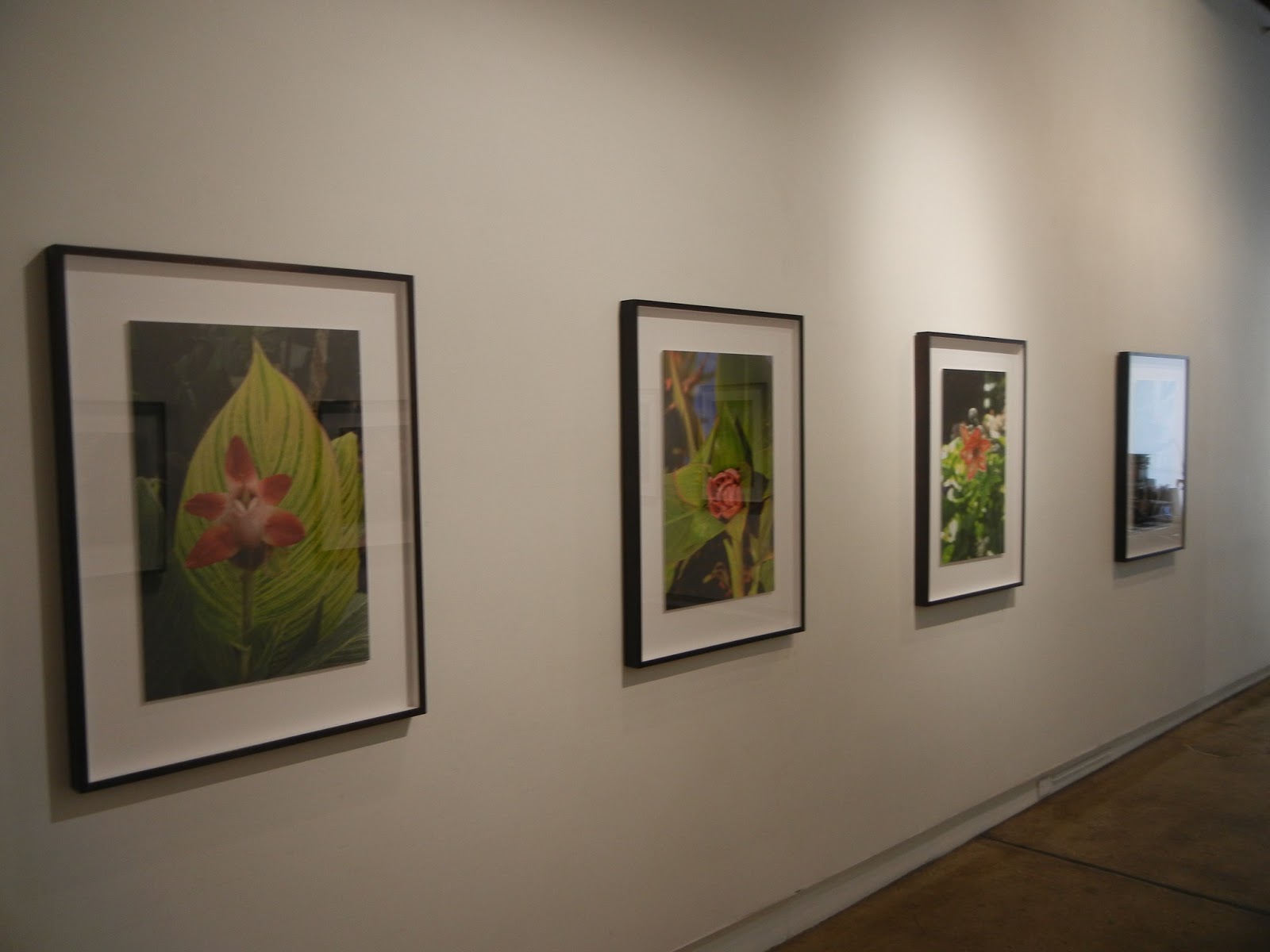
JTF (just the facts): A total of 35 color works, framed in dark brown wood and unmatted, and hung in the entry area, the main gallery space (separated by a dividing wall) and the upper viewing area in the back of the gallery. All of the works are silver halide prints, made between 2007 and 2011. Physical sizes range from to 15x17 to 35x70 (or reverse), with many intermediate sizes; editions are either 5+3AP, 7+3AP, or 9+3AP, with the smallest prints in the largest editions. The show also includes a video of Hatry at work, with interviews with various artists and writers discussing the project. A monograph of this body of work was recently published by Charta (here) and is available from the gallery for $35. (Installation shots at right.)

Comments/Context: At first glance, Heide Hatry's floral photographs look like standard, botanical garden images - exotic blossoms and rare specimens singled out for up close attention, with a backdrop of leafy greenery or jungle undergrowth for context. But after a few would be orchids and possible roses, it starts to become clear that something else is going on here. These lovely flowers are surprisingly rich and fleshy, almost too thick and juicy to believe. And then the moment of horror comes - these aren't real flowers, they are dissected animal parts sculpted to look like flowers. Easy going attraction is turned into shocked revulsion in an instant.

Part of the reason Hatry's inversion is so successful is that her constructions are so believably perfect. Her "flowers" bloom in a bold spectrum of colors, from luscious pink and red to delicate white and yellow, their petals spun into intricate geometries of patterns and folds. Some are soft and velvety, others spiky and hairy, but they all seem like something plausibly natural, designed to attract pollinators or enable reproduction through the dissemination of seeds. That she has created these fictions out of animal waste, offal, and discarded sex organs sets up her artful betrayal. The image checklist is a stomach turning list of component parts: duck tongues, fish eyes, pig ears, deer eyelids, starfish arms, chicken combs, crab claws, lobster gills, sheep intestines, bull stomach, deer esophagus, cow vagina, sheep penis, with a little coagulated blood thrown in for decoration. Reading such a catalog creates in almost instant reflex reaction of disgust, which is just exactly what she wants to have happen.
Hatry is by no means the first artist/photographer to explore the artificiality of flowers. Joan Fontcuberta has made brilliantly impossible hybrid constructions of nonexistent plants in the New Objectivity style of Karl Blossfeldt, while Vik Muniz has taken carefully posed images of hand made silk flowers. But Hatry has taken this idea of upended floral reality several steps further with these works. Her "flowers" lead off in a multitude of conceptual directions. There is the "flower as sex organ" constructed with meaty sex organs idea, where a kind of carnal eroticism is mixed with taboos and phobias about bodies. There is a more primal two sided coin of confused beauty and ugliness, where something seductive becomes something repulsive in the blink of an eye. And there is the underlying theme of exploitation of the natural world and the thorny issues of large scale production of meat and flowers for human consumption that these pictures open up.

In many ways, it's hard to imagine that flower images could be full of so much tension and contradiction. Hatry has cleverly deconstructed the genre and rebuilt it with more suggestive and sensational parts, bringing dark questions to a normally liltingly uncontroversial subject.

Collector's POV: The works in this show are priced based on size, starting at $1800 and continuing up through $2000, $3500, $6000, and $8000, eventually reaching $15000 for the largest work on view. Hatry's photographs have very little secondary market history, so at this point, gallery retail remains the best/only option for those collectors interested in following up.
 
Rating: * (one star) GOOD (rating system described here)
 
Transit Hub:
  • Artist site (here)
  • Features/Reviews: ARTnews (here), Huffington Post (here)
 
Through June 22nd
 
530 West 25th Street
New York, NY 10001

Friday, September 28, 2012

Ruud van Empel, Sunday @Stux

JTF (just the facts): A total of 7 color works, hung in the upper viewing area in the back of the gallery. 5 of the works are archival pigment prints, framed in brown wood, from 2012. These prints are sized 28x20, and are available in editions of 7+2AP. The other 2 works are archival pigment prints mounted to Dibond and Plexiglas, unframed, also from 2012. These works are sized 59x41, and are available in editions of 5+2AP. (Installation shots at right.)

Comments/Context: Ruud van Empel's small show provides two new bodies of work to contemplate, both in his now-signature style of flawlessly stitched together, composite imagery. At this point, van Empel's digital collages of meticulously rendered but somehow surreal children are immediately identifiable, and these new projects don't stray too far from his proven visual formula.
 
Most of the images in the exhibit substitute a backdrop of manicured, formal gardens for the lush jungle vegetation the artist has regularly employed as a setting. But there is something over-the-top and manic about these manufactured gardens filled with endless topiaries, pruned evergreens, boxwood hedges and shrubbery specimens. Kids primly stand in their Sunday best (thus the title of the series), freckly red haired boys in proper coats and ties, and black children in snappy blazers and bow ties or sweater dresses and mary janes. As they pose on the gravel paths, with a stray peacock or dove nearby, the gardens engulf and overtake them, controlled nature on the verge of out of control. For the first time, van Empel has also introduced an older lady as a subject, seen up close, in a fur collared coat. The background of her portrait explodes with angular, geometric forms in green, with a nod to the Renaissance, but inexplicably dense and layered.
 
The other two images on view play with linear perspective in new ways. A crowd of kids of varying sizes (and varying outfits) is arrayed against a formless grey background, seemingly following the rules of aerial depth perception but floating unrooted to any landscape. Shadows are cast by the children (so there is a consistent light source), but otherwise they have no connection to a setting or narrative. The works almost seem like a temporary peg board resting place for van Empel's fancy fabricated kids, as though he was simply waiting to insert them into some other elaborate scene but they have been stranded in this endless netherworld in the meantime. While the colors are bright and energetic, the works felt oddly dispiriting, like the well-meaning kids were trapped in some kind of cleaned-up stylish hell.
 
Part of what I like about van Empel's work is this sense of discomfort that grows as you look as his photographs. The first glance always seems placid and inviting, but a closer examination always seems to uncover an undercurrent of the threatening, the puzzling, or the unsettlingly mismatched. It's a hyper-perfect world, where the fastidious, glossy detail is often slightly disturbing.

Collector's POV: The works in this show are priced as follows. The smaller 28x20 prints are $24000 and the larger 59x41 prints are $32000. Van Empel's prints have become more consistently available in the secondary markets in recent years. Prices at auction have ranged between roughly $15000 and $120000.
 
Rating: * (one star) GOOD (rating system described here)
 
Transit Hub:
  • Artist site (here)
  • Exhibit: MOPA, San Diego, 2012 (here)
  • Feature: Trendland (here)
Ruud van Empel, Sunday
Through October 20th
 
530 West 25th Street
New York, NY 10001

Monday, April 25, 2011

Ruud van Empel, Wonder @Stux

JTF (just the facts): A total of 11 large scale color works, hung unframed in the entry, the two main gallery spaces, and the upper viewing area in the back of the gallery. All of the works are chromogenic prints mounted to Dibond and Plexiglas. Physical dimensions range from 33x24 to 49x130 (yes, wider than 10 feet); the larger images are printed in editions of 7+2AP, and the smaller images are printed in editions of 10+2AP. All of the works on view were made in 2010. A catalog of the exhibition is available from the gallery. (Installation shots at right.)
.
Comments/Context: This show gathers together a variety of fresh work from the Dutch photographer Ruud van Empel, and finds him both continuing down old paths and evolving new but related ones to explore. Process-wise, we are still in the realm of elaborate composite images, where thousands of visual fragments have been Photoshopped together into van Empel's signature otherworldly hyper-reality, full of unnerving children portrayed in a combination of perfect detail and odd flatness.

Three of the images on view extend his popular World series, where black kids sit submerged in verdant, idealized pools (complete with lily pads and tropical flowers), or stand in plaid sport coats and party dresses amidst the clean, leafy eden. His Generation series of children in the rigid rows of a traditional school picture also has a new member; this time the risers are populated with a majority of Jewish kids. Other new works seem to riff on existing ideas, but expand them in new directions. The Theatre series takes the night time palette of the Moon series and applies it to dark, wooded scenes (almost like the forbidden forest of fairy tales), thick with tree trunks edge to edge. Connection seems to jump off from the Dawn series, but in an up-close panorama format, while Wonder seems descended from the Generation pictures, but is exploded outward to cram faces together in a crowded all-over pattern of childhood diversity. Brothers & Sisters takes some of the formality of the paired portraits of World, and adds the simple idea of family resemblance.

As a result, this show has the feeling of something altogether familiar, of van Empel subtly tuning and editing, but not changing the overall formula much; if you liked his prior work, you'll probably like these images as well, and if you didn't, you'll probably feel like these are more of the same. These recent pictures are not radical, frame-breaking experiments, but more a consolidation of the artist's complex visual toolkit, or perhaps better, a lively sprinkling of nuanced iterations.

Collector's POV: The works in this show are priced between $25000 and $98000, depending on size and on the location in the edition. In the past year or so, Van Empel's prints have found secondary market buyers between roughly $16000 and $35000.

My favorite image in the show was Brothers and Sisters 3, 2010; it's the picture on the left in the bottom installation shot. I like the idea of moving away from the consciously exotic; here van Empel has traded the lush, succulent jungle of the World series for the Northern forest in spring, placing two pale skinned, red haired children in 3/4 pose among the leaves. Even with the dated turtleneck sweater, it has an almost Victorian quality to it that I found intriguing.

Rating: * (one star) GOOD (rating system described here)

Transit Hub:

Ruud van Empel, Wonder
Through May 14th
.
Stefan Stux Gallery
530 West 25th Street
New York, NY 10001

Monday, October 18, 2010

Ruud van Empel, Generation @Stux

JTF (just the facts): A total of 4 color works, hung unframed in the upper viewing area in the back of the gallery. All of the works are chromogenic prints mounted to Dibond and Plexiglas. The two large works, each 49x130, are printed in editions of 7+2AP, and were made in 2010; the two smaller works, each 24x17, are printed in editions of 10+2AP, and were made in 2009.(Installation shots at right.)
.
Comments/Context: In Ruud van Empel's newest works, the Dutch photographer has moved away from the lush leafiness of his previous jungle settings and has opted for the buttoned-up formality of the traditional class portrait, with rows of school children in their picture day best outfits, standing on risers against a yellow curtain. Squint your eyes to blur the details and his ten foot wide panoramas look like any school picture taken in the past 50 years.
.
But when your eyes come back into focus, it becomes clear that van Empel's children are unlike any you have seen before. Using Photoshop to composite together hundreds of images, he has created a signature style that has become the hallmark of his work: glossy perfected children with big eyes, staring out from the plane of the picture with an almost surreal oddness - what seems at first glance to be idealized comes out more than a bit unsettling. In past works, he has highlighted a single child, or perhaps a pair of kids, sometimes in matching fancy dresses or sport coats, sometimes with bare skin. These new works amplify and expand his cast of characters, allowing him to play with clothing, hairstyles, and facial features to create a kaleidoscope of different personalities.
.
On one wall, all of the school children are black; on the other, it's a predominantly white class with a lone black student. Subtleties of culture come out in bow ties and sweater vests, braids and barrettes, Peter Pan collars, striped turtlenecks, and bold, candy colored patterns, a range of faces lit by sparkly eyes and hiding underneath big glasses. In his prior work, van Empel used the natural environment of lily pads and flowers to create a kind of protected paradise for his subjects; in these works, he pushes on this concept of childhood innocence, but from a less fanciful and whimsical perspective; the formality of school creates boundaries and limits. The flatness of the compositions and the "optimized" children still make for an unnerving scene, but the entire effect seems better balanced with reality, closer to real life to make his tweaks and constructions all the more resonant.
.
This show only contains a couple of works and its location in the galleries in the back tests the viewer's willingness to wander through another larger show to find the pictures. That said, I was intrigued to see how van Empel is evolving his style and finding new ways to situate his instantly recognizable characters.
.
Collector's POV: The works in this small show are priced as follows. The two large images are priced between $59000 and $69000, depending on the location in the edition; the two small images are priced between $12000 and $14000, again in a rising edition. Van Empel's work has recently become more consistently available in the secondary markets, with a handful of lots coming up for sale in any given year. Prices have been steadily rising, from roughly $15000 to up over six figures, with a sweet spot in the low 30s. Van Empel is also represented by Flatland Gallery in Utrecht (here).
.
As an aside, I think it would be fascinating to hang one of these van Empel school portraits together with one of Tomoko Sawada's class pictures (all of herself) to see the contrasts/commonalities in style and message.
.
Rating: * (one star) GOOD (rating system described here)

Transit Hub:
Ruud van Empel, Generation
Through October 23rd

Stefan Stux Gallery
530 West 25th Street
New York, NY 10001

Friday, February 27, 2009

Ruud van Empel: Souvenir, Dawn, Moon, World @Stux

JTF (just the facts): A total of 22 works (20 photographs and 2 bronze sculptures), displayed throughout the entry, the two lower galleries, and the upper galleries. The photographs are glossy Cibachrome prints, mounted to Dibond and plexiglass (not framed), all from 2008, ranging in size from approximately 33x24 for the smallest images up to wall sized murals. (Installation shots at right.)

Comments/Context: While digital manipulation has become the rule rather than the exception in new contemporary photography, Ruud van Empel's approach is something altogether more radical than a simple touch up. His works are composed of literally thousands of fragments and components of various photographs, meticulously merged and constructed within the confines of his computer. His images of children in lush garden settings are at once realistically detailed and fantastically fabricated, creating a surreal world where beauty and innocence are mixed with a small dose of an undefined and unsettling undercurrent: what is really going on here?
.
Van Empel's process leads to pictures that are extremely painterly, with lush colors and classical compositions. In a previous post on Van Empel, we touched on connections to Rousseau and Disfarmer (post here); during this visit, we were struck by the relationship to early Renaissance portraits and allegorical paintings, where figures were abstracted to represent an idealized version of a person, rather than anyone in specific. The children in these images are expressionless, with big eyes and flawless skin; at one level they are perfect, at another they are just a bit creepy.

Van Empel has several series of works progressing at the same time, all of which are represented in this show of new work. The World images are likely the most recognizable to collectors, with deadpan white and black children situated in idealized tropical rain forests and lagoons (complete with water droplets and amazing insects). The Venus series uses this same setting for a series of symbolic nudes. The Moon series follows a similar formula of formal children against a natural background, only this time the images are moonlit, bringing darker blues and greens into van Empel's palette. The recent Dawn series has a more casual compositional style, with the children often resting in beds of flowers or lying in the leaves. While each of these projects has its own specific details, they all share the same general approach: the mix of natural beauty with the innocence of childhood, boiled down to neutral and artificial symbolic types.
.
A series of wholly different and much more personal pictures entitled Souvenir are shown in the upper galleries. In these images, van Empel constructs dense interior still lifes out of images of items from his childhood home. While many of the tokens and mementos have a kitchy quality to them, it is clear that each and every one has been wrapped in some personal significance or memory. Van Empel uses the same computer driven composite approach, and the resulting feeling of unreality of his other works is found in these smaller pictures as well. These pictures jump off the wall quite a bit less than the more vibrant tropical scenes, but perhaps show van Empel experimenting with new narrative directions beyond those which made him famous.

Overall, this is a terrific show, with many eye-popping works to draw your attention, many of the kids seeming even more surreal than in earlier images. There is a catalogue of van Empel's new work entitled Ruud van Empel Photoworks available from the gallery for $50.
.
The artist's website can be found here.
.
Collector's POV: The World, Venus, Moon and Dawn images in this show range from $14000 to $69000, with most in the $30000 range. The Souvenir series is priced between $9500 and $14000. The prints are in editions of various sizes, ranging from 7 to 13. The two white statues are $47000 each, in editions of 3. Van Empel's work has only been available in the secondary markets since 2007, but has performed well, fetching prices from approximately $15000 to $45000. Given the originality of his work, it seems likely that these prices will continue to rise.
.
Rating: ** (two stars) VERY GOOD (rating system described here)

Through March 7th

530 West 25th Street
New York, NY 10001

Another review of this show can be found at The Year in Pictures here.