Showing posts with label Barbara Crane. Show all posts

Friday, March 30, 2012

2012 AIPAD Review, Part 1 of 2

With two sessions at this year's AIPAD under my belt (the opening night event and a solid bunch of hours yesterday afternoon), I can say with confidence that the overall sophistication of this anchor event in the NY photo year continues to increase. There are less overcrowded, bin stuffed booths, more well edited and thoughtful displays, and slowly but surely, a little more contemporary work is creeping into this traditionally vintage affair. The gala Wednesday evening was polished and well attended, and I thoroughly enjoyed seeing countless old friends, and meeting some of the many collectors, curators, critics, artists and gallery owners that I had previously known only by email or reputation. Year after year, there is an evolution away from casual, table based selling and a movement toward more refined service.

While I left my notebook at home on opening night, I was more systematic yesterday, covering the fair aisle by aisle, booth by booth. My notes cover approximately 40+ booths in some level of detail, generally listing the photographers with works on view, the number of prints on display, and in some cases, specific works that I thought merited attention or were new. Of course, my coverage of this show is perhaps more personally biased towards our own collecting interests than normal, and there is a significant amount of vintage work on display, so my apologies in advance if my selections are overly dominated by black and white. Also, I have generally refrained from talking about work which I have recently covered in review form; this provides some limits for my discussion, especially for those galleries that have opted for a sampler from the current stable.

My review is divided into two parts. This first part covers a selection of the out of town galleries, in alphabetical order. The second part will cover some of the New York galleries, as well as a few close by Northeastern neighbors. Covering this entire sprawling show in exhaustive detail is beyond the scope of what I can realistically deliver, so please don't take it personally if I have omitted your gallery or your work. My goal is to give readers a flavor of what I thought was intriguing and thought provoking, not to provide an analysis of every image on view, in the bins/flat files, and under the tables.

Stephen Bulger Gallery (here): Robert Bourdeau (4), Andre Kertesz (2, 1 diptych, 1 set of 5), Gilbert Garcin (6), Fausta Faccipone (1), Allison Rossiter (11), Clive Holden (1 set of 4), Scott Conarroe (1), Dave Heath (1 set of 6), Jospeh Hartman (1), Benoit Aquin (1). Lots of new abstract poured/dipped chemical Rossiters here, a few almost like landscapes or starry skies.

John Cleary Gallery (here): Susan Burnstine (3), Maggie Taylor (3), Ansel Adams (1), Henri Cartier-Bresson (2), Robert Mapplethorpe (1), Robert Doisneau (1), Gordon Parks (1), Willy Ronis (1), Sanko Abadric (1), Renate Aller (2), David Fukos (2), John Chakeres (2), Brett Weston (2). Had a thoughtful discussion about pricing in the market for Mapplethorpe flowers in this booth, triggered by the Tiger Lily on display priced at $40000.

Stephen Daiter Gallery (here): John Gossage (2), Imogen Cunningham (3), Art Sinsabaugh (2), Adam Fuss (1), Andre Kertesz (4), Harry Callahan (1), Stanley Kubrick (1), Weegee (3), Sid Grossman (1), Marvin Newman (1), Aaron Siskind (1), Minor White (1), Frederick Sommer (2), Alex Webb (4). I continue to find Sinsabaugh's elongated Midwestern landscapes to be powerfully original; this one was priced at $16000 and already sold.


Catherine Edelman Gallery (here): Gary Briechle (9), John Cyr (9), Daniel Beltra (1), Viktoria Sorochinski (4), Lauren Simonutti (10), Kelli Connell (2), Gregory Scott (1). Briechle's gelatin silver prints from wet plate collodion negatives are darkly old school. Look closely at scar on this wrinkled hand, echoed by the gathering of the sleeve (reasonably priced at $1400 each). John Cyr's images of the developer trays of famous photographers (Mann, Siskind, Gowin, Davidson etc.) were also drawing a crowd.


Etherton Gallery (here): Harry Callahan (7), Manuel Alvarez Bravo (4), Frederick Sommer (6), Emmet Gowin (4), Allen Ginsberg (1), August Sander (1), Duane Michals (1), John Gutman (1), Wright Morris (2), Henry Wessel (3), Ansel Adams (2), Richard Misrach (3), O. Winston Link (2), Ralph Gibson (2), Lee Friedlander (2), Horace Bristol (1), Peter Stackpole (2), Rodrigo Moya (1), Ted Croner (1), Flor Garduno (1), Joel-Peter Witkin (1), Eikoh Hosoe (1), Aaron Siskind (4), Michael O'Neil (1), Danny Lyon (4). I think the flash lit mid 1970s night Misrachs are among his best; I enjoyed this one with its spiky verticals and the long exposure light trail in the sky.


Eric Franck Fine Art (here): Karen Knorr (3), Josef Koudelka (3), Graham Smith (6), Chris Killip (4), Martine Franck (4), Andy Warhol (3), Ogawa Gesshu (3), Heinz Hajek-Halke (4), Gaspar Gasparin (6), Henri Cartier-Bresson (5), Norman Parkinson (5). I continue to be impressed by Killip and Smith and wish their work was more consistently on view here in New York. There was also a terrific Warhol of stratified neckties on a side wall.

Halsted Gallery (here): Irving Penn (4), Jaromir Funke (1), Brassai (1), Wynn Bullock (1), Edward Weston (4), Andre Kertesz (2), Michael Kenna (1), Barbara Morgan (1), Bill Brandt (1), Henri Cartier-Bresson (1), Arnold Newman (2), Lucien Herve (1), Berenice Abbott (4), Cornell Capa (1), William Clift (1), Carleton Watkins (2), Don Hong-On (1), Margaret Bourke-White (1), Annie Leibowitz (1). This intimate, reasonably priced ($12000) Funke abstraction from the late 1920s was a quick seller.


Paul M. Hertzmann Inc (here): Sherril Schell (1), Clarence John Laughlin (1), Ei-Q (3), Ansel Adams (6), Henri Cartier-Bresson (1), Edward Weston (2), Alfred Stieglitz (1), Dorothea Lange (1), Man Ray (1), Carlotta Corpon (1), Eugene Atget (1), Dennis Stock (1), Frank Espada (1), Joe Schwartz (1), Roger Schall (1), Minor White (1), Ruth Bernhard (1), Gerard Petrus Fieret (1), plus 4 bins. Someone (annoyingly) snapped up this sublime Schell of Penn Station almost immediately, as it had a red dot just minutes into the evening gala.


Paul gave me a short primer on Japanese photographer Ei-Q (aka Hideo Sugita), who was apparently of Eikoh Hosoe's teachers. I very much enjoyed this densely layered photogram, made using cut paper stencils and modifications to the negative. (priced at $22500)


There were also a handful of small 1930s vintage Ansel Adams prints on view, as well as a lovely solarized calla lily by Corpon.

Michael Hoppen Gallery (here): Shomei Tomatsu (3), Miyako Ishiuchi (1), Issei Suda (1), Kishin Shinoyama (1), Hiroshi Hamaya (2), Daido Moriyama (2), Valerie Belin (2), Noe Sendas (3), Bruce Bernard (3), Sigmar Polke (1), Guy Bourdin (4), Boris Savalev (1). I liked the bold patterns of the Moriyama fishnet stocking variants here. Two new muted black and white Belins dominate the main wall.

James Hyman Photography (here): Pierre Manguin (3), Henri Le Secq (2), Bisson Freres (2), Charles Negre (4), Edmund Bacot (2), Louis Alphonse de Brebisson (1), Edmund Nicolas (1), Pierre-Emile-Joseph Pecarrere (1), Amedee Varin (1), Edouard-Denis Baldus (2), Vallou de Villeneuve (1), Henri Ange Eugene Mailand (1), Gustave Le Gray and Auguste Mestral (1), Anonymous (3), Neurdein School (1), Paul Strand (1), Edward Weston (1), Francesca Woodman (1), Lucien Clergue (2), Arthur Siegel (1), Harry Callahan (2), Eugene Atget (4), Tony Ray-Jones (4). The inside of the Hyman booth has been transformed by a well-edited selection of 19th century French church/monastery images, complete with muted light, a sculptural fragment in the center, and images of gargoyles high on the walls.

Jackson Fine Art (here): George Georgiou (2), Chip Simone (4), Frank Horvat (2), Todd Selby (1), Greg Lons (4), Todd Murphy (3), Mona Kuhn (4), Vivian Maier (3), Ruud Van Empel (3).

Kopeikin Gallery (here): Irving Penn (1), Jeffrey Milstein (2), Lee Friedlander (2), David Schoerner (1), Harry Callahan (3), Katy Grannan (2), Sally Mann (1), Peter Beard (1), Robert Frank (1), Andy Freeberg (1), Garry Winogrand (3), Chris Jordan (1), Marta Soul (1), Moby (1), Kevin Cooley (1). I liked the smaller black and white Grannan portraits in this booth best. Jordan has reworked Van Gogh's Starry Night in thousands of colored plastic lighters, a bit more painterly and Vik Muniz-like than previous images of his I've seen.

Lee Gallery (here): Walker Evans (1), Julia Margaret Cameron (1), JB Greene (1), Bisson Freres (1), Carleton Watkins (1), Charles Negre (1), Harry Callahan (7), Robert Adams (4), plus 4 bins. The Lee's booth was dominated by a string of exquisite vintage Callahans across the back wall. Below are two nudes that came out of the boxes for a closer look: a terrific early (mid 1960s) Barbara Crane, and a sculptural 1934 Weston of Charis.


M+B (here): Matthew Brandt (7), Matthew Porter (3), LeRoy Grannis (4), Lisa Jack (4). Brandt was the big story in this booth, with 3 images on a nearby outside wall made by submerging the large prints in the bodies of water they depict (leading to abstract, acidic swirls) and 4 works made out of different flavors of brightly colored chewing gum hung across the back wall.

Monroe Gallery (here): Nina Berman (4), Eric Smith (2), Rikki Reich (2), Steve Schapiro (6), Carl Mydans (1), Grey Villet (4), Bill Eppridge (7), Paul Schutzer (1), Carl Iwasaki (1), Bob Gomel (1), Martha Holmes (2), John Dominis (1), Stephen Wilkes (2). A startling Berman of a veiled woman with her diploma is on the outside wall.

Richard Moore Photographs (here): Peter Sekaer (2), Dorothea Lange (3), Marion Post Wolcott (1), Walker Evans (1), Ben Shahn (1), Ansel Adams (4), Sonya Noskowiak (1), Imogen Cunningham (1), William Post (1), Helen Levitt (1), Weegee (2), Percy Loomis Sperr (4), Eadward Mybrudge (1), plus 3 bins. The eye catching Cunningham Magnolia Blossom had a major tear, which had been repaired quite well but clearly changed its value by an order of magnitude.

Scheinbaum & Russek Ltd. (here): Aaron Siskind (3), Arnold Newman (1), Brassai (1), Jerry Uelsmann (2), Lee Friedlander (1), Paul Strand (1), John Szarkowski (1), Paul Caponigro (1), Minor White (3), Edward Weston (1), Ansel Adams (1), Brett Weston (1), Berencie Abbott (1), Harry Callahan (2), Andre Kertesz (2), Todd Webb (4), Laura Gilpin (2), Eliot Porter (6), Diane Arbus (1), Henri Cartier-Bresson (2), Manuel Alvarez Bravo (2), Van Deren Coke (2), Roy DeCarava (1), W. Eugene Smith (1).

Barry Singer Gallery (here): Elyn Zimmerman (2), Lewis Hine (1), Edmund Teske (1), Arnold Newman (2), W. Eugene Smith (1), August Sander (2), Joel-Peter Witkin (1), Garry Winogrand (1), Robert Doisneau (1), John Albok (1), Marcia Resnick (1), Lou Stoumen (3), Ansel Adams (2), William Dassonville (1), Bill Brandt (1), Brett Weston (1), Wilson Bentley (1), Charles Jones (1), Edward Weston (1), Robert Graham (7), Herb Ritts (1), Jack Welpott (1), plus 4 bins.

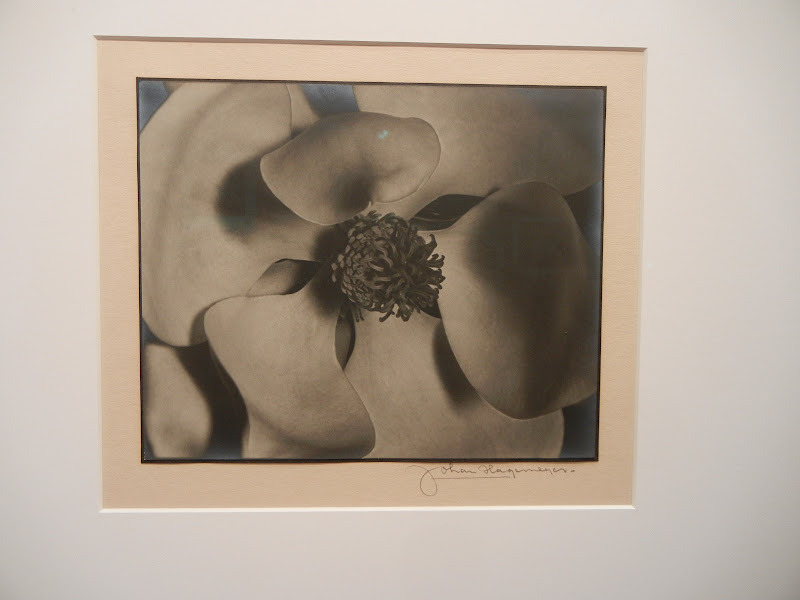
Joel Soroka Gallery (here): Lynn Bianchi (1), Cig Harvey (4), Franco Donnagio (1), Berencie Abbott (2), Jindrich Vanek (1), Man Ray (1), Johan Hagemeyer (1), Ilse Bing (1), Brassai (1), Brett Weston (1), Gyorgy Kepes (3), Beatrice Helg (4). While there was an excellent group of Kepes abstracts along the back wall, this elegant Hagemeyer floral caught my eye, fully priced at $40000.


Weinstein Gallery (here): Alec Soth (5), Helmut Newton (1), Robert Mapplethorpe (5), Robert Polidori (3), Vera Lutter (4), Nancy Rexroth (18). Three huge Polidoris of India cover the entire back wall of the booth; one is a dense warren of overlapping slum geometries. The Soths are from Bogota, the Lutters from Venice.

Weston Gallery (here): Oliver Gagliani (2), Harry Callahan (2), Marion Post Wolcott (2), George Tice (1), Sonya Nostowiak (1), Henri Cartier-Bresson (1), Danielle Nelson-Mourning (2), Hill & Adamson (2), Linnaeus Tripe (1), Charles Aubry (1), Andre Kertesz (1), Robert Frank (1), Johan Hagemeyer (1), Edward Weston (4), Paul Strand (2), Wynn Bullock (1), Ansel Adams (8), Imogen Cunningham (2).

Part 2 of the review can be found here.

Tuesday, January 4, 2011

A Grab Bag of Holiday Photobooks

Over the holidays, I was lucky enough to receive a handful of photobooks, both old and new, as gifts. Rather than embark on full reviews for them all, I've added a few thoughts and reactions to each below:


Thomas Ruff, Surfaces, Depths, Kunstahalle Wien, 2009.
.
I first saw this book on a display shelf at David Zwirner, during Ruff's show there last spring (review here). What is striking about this book is that although it is bound like a regular retrospective catalogue, inside it is printed on newsprint, giving the pages a more fragile feel. This presentation totally recontextualizes many of his older projects, especially those that appropriate black and white imagery. The book is the first place I have found that publishes his new Cassini and Zycles works, and it also includes stereo photographs, interiors, newspaper images, and "portraits" of Herzog & De Meuron buildings that I had never seen before. All in, an unexpectedly terrific addition to the discussion of Ruff's work.
.
Barbara Crane: Chicago Loop, LaSalle Bank, N.A., 2001. (here)
.
Kim Bourus of Higher Pictures (which represents Crane) showed me this book a year or so ago, and I have been wanting a copy for our library ever since. It gathers together a group of black and white images that Crane made of the Chicago Loop between 1976 and 1978, and the works could hardly be a better fit for our particular collecting affinities. Each is a textural mix of geometric layers, where grids of windows and edges of skyscrapers are deftly juxtaposed and flattened into intricate patterns and abstractions. It's a spectacular exercise in compositional control.
.
Irving Penn, Still Life, Bullfinch Press, 2001.
.
I'm not exactly sure why we've never acquired a copy of this Penn standard, but I was nevertheless glad to see it emerge from under the tree on Christmas morning. I was most excited to see some of the less familiar images that are mixed in among the greatest hits, and for the first time, I started to understand Penn's still life work within a stronger sense of chronology, starting in the late 1940s and moving back and forth between commercial and more personal work through the decades.
.
William Abranowicz, Hellas, Hudson Hills Press, 2010.
.
Abranowicz' new images of modern Greece are filled with warmth and affection. Elderly men and women tend goats and sheep or idle in the streets and cafes, while still lifes of fish and tomatoes pop with mouth-watering exuberance. The enveloping blue of the Mediterranean is rarely far from view, and cloudless skies range from washed out pastel to almost purple. What keeps these pictures from becoming a travel brochure is their subtle mixing of the modern and ancient: religious icons, church spires and island landscapes are juxtaposed with kisses on the beach in Mykonos, tourist postcards, and active nightlife. The story keeps shifting, with moments of subtle realism poking through the veil of obvious expectations.

Monday, March 22, 2010

2010 AIPAD Review, Part 2 of 4

Part 1 of this multi-part AIPAD post can be found here.

Robert Mann Gallery (here): Holly Andres (3), Michael Kenna (4), Robbert Flick (2), Joe Deal (5), Gail Albert Halaban (2), Mary Mattingly (1), Jeff Brouws (1), Wijnanda Deroo (1), Susan Rankatis (2), Aaron Siskind (2), Henry Wessel (1), Robert Frank (4), Ansel Adams (1), Alfred Stieglitz (2), Paul Strand (1), Paul Haviland (1), Elijah Gowin (1 set of 8). USC professor Robbert Flick was another discovery for me at the show. All of the individual images in the grid below were taken in the same concrete parking structure, with a mix of natural and fluorescent light slashing across the dark floors and walls. (Robbert Flick, SV# 034/81 - Inglewood Parking Structure #2, 1981, at $10000.)


Scheinbaum & Russek (here): Luis Gonzalez Palma (5), Manuel Alvarez Bravo (5), Beaumont Newhall (1), Henri Cartier-Bresson (2), Andre Kertesz (2), Flor Ganduno (1), Manuel Carillo (1), Brett Weston (1), Paul Caponigro (2), Walter Chappell (1), Edward Weston (1), Harry Callahan (3), Minor White (3), Aaron Siskind (2), Lynn Geesaman (2), Eliot Porter (6), plus 2 bins. I thoroughly enjoyed seeing the Walter Chappell nude below, not only because it is a spectaular image that would fit well into our collection, but also because we took it out of the frame to see the notes on the back, which explain that the print was reversed for the cover of Aperture #79, at the request of Minor White. (Walter Chappell, Nude Armpit, Wingdale, NY, 1962/1969, ay $8500.)

Yossi Milo Gallery (here): Myoung Ho Lee (1), Loretta Lux (5), Youssef Nabil (4), Kohei Yoshiyuki (9), Sze Tsung Leong (11), Robert Bergman (2).

Robert Koch Gallery (here): Larry Schwarm (2), Ilse Bing (2), Eadward Muybridge (1), Francis Frith (1), Michael Wolf (3), Brian Ulrich (1), Amy Stein (1), Jeff Brouws (4), Josef Koudelka (2), Bill Owens (1), plus 1 bin. The Koudelka image below was not at all what I envision when I think of his work, but I very much liked the simplicity of the forms in this wide print. (Josef Koudelka, Dunkerque-Port, 1986/1991, at $18000.)


Joseph Bellows Gallery (here): Bevan Davies (4), Terry Wild (2), Steven Salmieri (2), Randall Levenson (3), Wayne Lazorik (2), Enrico Natali (4), Nacio Jan Brown (2), Joanne Leonard (2), Jack Teemer (2), Joni Sternbach (6), Bill Arnold (1), Jay Boersma (4), Michael Light (4 large format books), plus 4 bins. This booth had plenty of unexpected and tempting work in it. I enjoyed both Joni Sternbach's atmospheric tintype surfers, as well as Michael Light's massive aerial scenes of Los Angeles highways and refineries. My favorite image in the booth was this small Terry Wild image below; I liked the stark contrast of adjacent black and white walls. (Terry Wild, Los Angeles, CA, 1969, at $5000.)


Project 5 (here): Jill Greenberg (6), Thomas Allen (8), Guido Castagnoli (7), Stuart O'Sullivan (1), Olaf Otto Becker (1). Project 5 brings together the work from five different New York galleries: ClampArt, Foley Gallery, Sasha Wolf Gallery, Daniel Cooney Fine Art, and Amador Gallery. The first portfolio from the group contains five prints: one each from a single artist from each gallery stable. I liked the contagious energy in this small booth, driven by three of the gallery directors collaborating to answer questions.

Catherine Edelman Gallery (here): Julie Blackmon (5), Gregory Scott (3), Lauren Simonutti (21), Joel-Peter Witkin (2), Keith Carter (1), Holly Roberts (2). I have recently been exploring some of the undefined edges of contemporary photography, where cameras are no longer used and traditional definitions of photography are hopelessly quaint. Gregory Scott's lightbox works in this booth have HD video embedded inside; stand and watch one for a while and a small portion of it will change and then stop again, turning the idea of a still frame on its head. It's not video art, nor is it exactly photography; it's something else, a 21st century mashup, with a hint of where we may see the medium go in the future. (Gregory Scott, Color Grid, 2009, at $22000.)

Gitterman Gallery (here): Alfred Stieglitz (2), Louis Faurer (1), Josef Breitenbach (1), Eugene Smith (1), Minor White (1), Edward Weston (1), Ferenc Berko (5), Kenneth Josephson (7), Roger Mayne (1), Allen Frame (4), Lewis Baltz (2), plus 2 bins. As always, there were good things to see in Tom Gitterman's booth. I enjoyed the two Baltz images, as well as the selection of Josephson prints (we'll visit the larger show on view at the gallery soon). Below is a Ferenc Berko from the late 1940s, a spare composition of thin lines and simple abstracted black shapes, almost like a Calder. (Ferenc Berko, Store Display, Chicago, 1947-48, at $5500.)


Bonni Benrubi Gallery (here): Massimo Vitali (1), Georges Dambier (2), Matthew Pillsbury (4), Andreas Feininger (3), Gillian Laub (3), Abelardo Morell (4), Josef Hoflehner (1), Laura McPhee (1 diptych), Jehad Nga (2).

Halsted Gallery (here): Irving Penn (1), Emmet Gowin (1), Harry Callahan (2), Walker Evans (4), Andre Kertesz (5), Ruth Orkin (3), George Tice (1), Larry Glazer (1), Berenice Abbott (2), Frederick Evans (2), Michael Kenna (2), Ansel Adams (2), Arnold Newman (1), O. Winston Link (1), Edward Weston (4), Imogen Cunningham (1), Bill Brandt (1), Morris Engel (1), William Christenberry (1), plus 3 bins. The Halsteds have been running their photo gallery for 40 years now, and there was a fun book on the table in the booth showing old pictures of various family members paired with famous photographers, interspersed with letters and other correspondence. In the booth, I liked the vintage Max Yavo from San Francisco best, with its overlapping layers of houses. (Max Yavno, Army Street, 1940s, at $4500.)


Higher Pictures (here): Barbara Crane (9), Issei Suda (3), LaToya Ruby Frazier (4), Alfred Gescheidt (10), Scott Peterman (3), Sam Falls (4), Jill Freedman (7). While I have written about Barbara Crane's repeats previously, I continue to find them original and exciting. (Barbara Crane, Dan Ryan Expressway, Chicago, 1975, at $7000.)


Beijing Jade Jar Fine Art (no website that I could find): Zhou Ning (3), Hu Wugong (3), Wang Shilong (3), Wang Yishu (2), Fu Yu (2), Yiming Jiang (9), Lu Houmin (6), Yu Deshui (6), Liu Tiesheng (1), Jin Hongwei (13). It was great to see a mix of vintage and contemporary Chinese photography in this booth; we need to see much more of this kind of work here in the United States to begin to make sense of the evolution of Chinese photography.
.
Continue to Part 3 here.

Wednesday, January 20, 2010

Barbara Crane: Repeats @Higher Pictures

JTF (just the facts): A total of 13 black and white images, framed in white and matted, and hung in the small single room gallery space. All of the works in the show are vintage gelatin silver prints, in editions of 3 to 5, taken between 1969 and 1975. The images are generally elongated horizontal rectangles, ranging in size from 1 to 9 inches in height and 10 to 22 inches in length. (Installation shots at right.)

Comments/Context: At first glance, Barbara Crane's Repeats look like regular film strips or contact sheets, multiple similar images one after another. But upon closer inspection, something altogether different and more complicated is revealed, taking the resulting works much deeper into the realm of abstraction. In each image, small pictures have been meticulously selected and laid out, often in exact copies or subtle variants/series, and printed in strips that are arranged in several layers (on top of each other, upside down, mirrored etc.).
.
The effect is that the shapes and forms found in each small image are transformed into intimate patterns and delicate repetitions. Tar spills on a roadway become paper dolls with linked hands, swooping highway flyovers become a swirling psychedelic optical wiggle, and straight tree trunks in the snow become a zipper. Metal rowboats, laundry on a clothesline, shadows of leaves and branches, and even a traditional mountain vista are all painstakingly transformed into contrasty fugues of theme and variation.

We can go all the way back to Muybridge's 19th century locomotion studies or Grand Tour multiple image panoramas of famous ports and cities to give these works some historical context; the idea of using multiple frames to construct a larger narrative goes back to the beginnings of the medium. Crane's studies at the ID in Chicago under Callahan, Siskind, and others were also clearly influential in the development of the ideas that underlie these particular works; there is marked resemblance/debt to both Siskind's abstractions and Callahan's multiple exposure images, although taken in a new direction by Crane and refined into a different mode of seeing.
.
What I like best is that the prints work at two different distances: from afar, they are entirely abstract exercises; up close, they resolve into specific content that is only discovered after investing effort in really looking. (This is show that works extremely well in a small space, as each work requires one-on-one, eyes to the frame inspection.) While Crane's images were made in the analog 1970s, I think the foundation concepts that form the framework for her approach here have significant relevance to the digital age, where multiple images can now be stitched together with much more ease. All in, this show is worth a visit, for both the luscious craftsmanship and conceptual ideas embedded in the artworks on display, and also as a directional signpost for areas of potential exploration in the contemporary digital world.
.
Collector's POV: Each of the vintage prints in the show is priced at $4000. Crane's work has not been widely available in the secondary markets in recent years; very few of her prints have come up for sale, and therefore, there is little credible price history for collectors to reference. Barbara Crane is also represented by Stephen Daiter Gallery in Chicago (here).

While these works aren't a direct fit for our particular collection, I certainly enjoyed Dan Ryan Expressway, Chicago, 1975, and can imagine a thought provoking pairing with a few of Catherine Opie's California freeways.

Rating: * (one star) GOOD (rating system described here)

Transit Hub:
  • Artist site (here)
  • Review: John Haber (here)
  • Amon Carter Museum retrospective, 2009 (here)
Through January 30th
764 Madison Avenue
New York, NY 10065

Friday, December 18, 2009

Barbara Crane: Private Views @Aperture

JTF (just the facts): A total of 30 color images, framed in white and not matted, and hung unevenly in a small side viewing room. Since neither wall labels nor a handy exhibition checklist was readily available, the usual detailed information about sizes, dates, editions, formats, and even titles was not present; what follows are my assumptions or simply approximate guesses. While these works were taken on 4x5 Polaroid film, the prints in the show are somewhat larger than this, perhaps roughly 7x9. All of the images were apparently taken between 1980 and 1984. A monograph of this work has been recently published by Aperture and is available in the shop for $40 (here). (Installation shots at right.)

Comments/Context: Barbara Crane's snapshot images of people at crowded Chicagoland street fairs capture the sweaty essence of 1980s summer warmth. Using lush Polaroid color and daytime flash to isolate her subjects, Crane crops the mass of humanity into fragments of body parts, highlighting t-shirts and tank tops, satin jackets and sunglasses, striped short shorts and dated hair styles. Visitors clutch boom boxes and ice cream cones, reveling in the food and drink of a casual day in the city.

The best of the images in this show document the intimate gestures of family, friends and lovers, the passing touches that are reminders of attachment and connection in a big crowd. Arms are interlinked, draped across each other, and wound around waists and hips. Hands are held and bodies are squashed together in playful embraces. People sit together, side by side, or on top of one another. Kisses are both furtive and outrageous.

In my view, this is an excellent example of a body of work that thrives in book form. The prints are small and together they give a tangible sense for wandering among these teeming crowds. While a few rise up to being strong stand alone images, many work better in juxtaposition with other images, where the saturated color of the fashions and the closeness of the movement create an ebullient down and dirty primer on body language.

Collector's POV: Since the images in this show are not for sale, no prices were offered. Barbara Crane is represented by Stephen Daiter Gallery in Chicago (here) and Higher Pictures in New York (here). Even though Crane has had a long and prolific career as a photographer, the availability of her work in the secondary markets is spotty at best; there have been very few of her works sold at auction in the past few years, thus creating very little recent price history.

While the images in this show don't fit particularly well into our specific collection, some of her earlier black and white work from the 1960s and 1970s (tying into her studies at the ID) certainly would.

Rating: * (one star) GOOD (rating system described here)

Transit Hub:

  • Artist site (here)
  • Amon Carter Museum retrospective, 2009 (here)
Barbara Crane: Private Views
Through January 21st

Aperture Gallery
547 West 27th Street
New York, NY 10001