Showing posts with label Pace/MacGill Gallery. Show all posts

Monday, July 29, 2013

Snap Noir: Snapshot Stories from the Collection of Robert E. Jackson @Pace/MacGill

JTF (just the facts): A total of 61 black and white photographs, framed in white/black and matted, and hung against grey and white walls in the main rooms of the gallery. All of the photographs are vintage gelatin silver prints, made by unknown photographers from generally undated negatives. The prints are arranged into groups ranging in size from 4 to 21 prints. All of the prints come from the collection of Robert E. Jackson. There is no photography allowed in the gallery, so the installation shots at right are via the Pace/MacGill website.
 
Comments/Context: The dividing line between art photography and vernacular photography has always been a bit murkier than we might like to admit. Definitionally, we might say that it all comes down to original intent: in an art photograph, the person clicking the shutter was consciously making an artwork, while in a vernacular photograph, that same person might have been making a snapshot, documenting something of note, or acting for an infinite number of other reasons, except for making an artwork. Where things get a little bit more troublesome is that down the line, years later, it is altogether possible to see vernacular photographs with new eyes, where their original purpose or context is entirely removed, and their underlying artistic merit comes forth. Across the history of the medium, this has happened time and again, where images made for scientific, evidentiary, or documentary purposes (by photographers known and unknown) have been placed in the white walled context of a museum or gallery and have been instantly transformed into "art", not by some decree from on high, but by the intrinsic artistic merits of the images themselves.
 
This show gathers together a small sampler from the vast collection of found/vernacular photographs assembled by Robert E. Jackson and directly confronts this recontextualization issue. The images are grouped into sets, with common subjects and themes tying the photographs together, some apparently taken by a single photographer, others likely made by many different shooters. The first two groups track personal eccentricity: a grown woman posing with her stuffed animal bunny and a man in sunglasses showing off a seemingly endless wardrobe of tight swimsuits/briefs. Other sets find a more voyeuristic tone: cocktail-drinking deck chair inhabitants seen from behind, multiple images of a topless woman through an open doorway, and a selection of views through chain link fences. The largest group is a parade of the ominous and slightly odd: a pair of women in gasmasks, a man holding a deer carcass, a surreal stare near a waffle, a boy with a gun, a woman with a snake, with incidents with choking, whipping, and Halloween masks mixed in for good measure. Taken out of their original context and resequenced here, the images effectively take on the slightly creepy, noir mood intended.
 
I think this editing and selection of found photographs raises an intriguing question about artistic and/or curatorial intent. What if the press release had not told us about a selection of vernacular images from the vast collection of Robert E. Jackson, but it had instead introduced the artworks of Robert E. Jackson, made up of found appropriated and recontextualized found photographs? Would we react to them differently? What we are being shown here is partially Jackson's vision, his decisions about the creation of typologies and sets and his imposition of implied relationship or connection; the individual photographs (however wonderful or unexpected) are merely the (appropriated) raw material used to implement a particular edited point of view. A choice was clearly made to show (and sell) the photographs in series form rather than as a selection of singular images, and yet, in the end, we are asked to step back from that idea and return to the broader concept of vernacular photographs offering a multitude of potential interpretations; these groupings are just one, arguably temporary, approach to the vast image database of a huge collection like Jackson's.
 
The result is a show that is infused with a kind of inescapable mystery. The questions we have about the actual details of these images are unknowable, and so we are left with their formal qualities and the flights of our collective imagination to make sense of what we see. But that ambiguity is surprisingly powerful, forcing us to get away from reading wall labels and sizing up artistic reputations and back to just looking at the photographs themselves and seeing what surprises they have to offer.
 
Collector's POV: The groups of photographs in this show are priced based on the number of prints in the set, ranging from $2000 to $9500. Since the photographers are anonymous, there is no secondary market history available for any of the artists.
 
Rating: * (one star) GOOD (rating system described here)
 
Transit Hub:
  • Exhibit: The Art of the American Snapshot, 1888-1978 @NGA, 2007 (here)
  • Interview: Design Observer (here)
  • Features/Reviews: New Yorker (here)
  
Through August 21st
 
32 East 57th Street
New York, NY 10022

Tuesday, June 18, 2013

Richard Misrach, On the Beach 2.0 @Pace

JTF (just the facts): A total of 13 large scale color photographs, framed in either off white, blond or black wood and unmatted, and hung in the single large gallery space, which is divided into three separate viewing areas. All of the works are pigment prints mounted to either aluminum or Dibond, and made in 2011 or 2012. Physical sizes range from 63x83 to 88x146; the largest of the prints are available in editions of 3+1AP, while the rest are available in editions of 5+1AP. (Installation shots at right.)

Comments/Context: It's been nearly a decade since Richard Misrach surprised us all with his On the Beach series. Made in reaction to the September 11th attacks, his aerial images of Hawaiian beaches astounded us with their enveloping, monumental scale and subtly reminded us of our vulnerability out there alone in the water. While many of the images were bright and sunny, with clusters of colorful beachgoers arrayed at the water's edge, there was a sense of something vaguely unsettling lurking underneath, adding a layer of tension to the idyllic vacation paradise. Misrach recently went back to his Honolulu hotel room perch and made a new series of bird's eye view pictures of the sea and sand. While the subject matter is arguably the same and the massive scale has been repeated, the mood of these pictures is subtly different, slightly more relaxed and meditative.

There are really two sets of photographs in this show, one with figures and one without. The images without tiny isolated people expand into all over abstractions, where dappled light bounces off the wave tops creating endless patterns of ripples. Misrach's palette is quietly muted, running from soft blues, greens, greys and tans, to darker bronzes and blacks. Given their size, standing in front of one of these ocean images is like getting lost in painterly texture, the entire surface an amorphous, undulating series of blobs and squiggles. While their detail is staggeringly precise up close, the sense of scale is lost without any identifiers; the water fans out like a series of dunes, stretching on for what might be feet or miles.

When even a single small figure is introduced to the sea or sand, the abstraction collapses and our eye is drawn to the central character. Now we're drawn back into the realm of narrative, where a guy with a book over his face, a determined swimmer, or a body wrapped in a pink towel becomes the tentative basis for a story. The best image in this group captures a solitary woman on a surfboard, looking away to the expanse of ocean in the darkening afternoon; her wistful presence turns the scene into something out of a 19th century Romantic painting, with the tiny figure in the foreground to remind us of the awe inspiring majesty of the vista. While Misrach has retained the sense of separation and distance in these pictures, the foreboding feeling of the previous works has been replaced with a more easy going mood - instead of struggling against the endless water, his figures execute perfect handstands and playfully perch on each other's shoulders.

In revisiting this series, Misrach seems to have been less concerned with recapturing a certain temperament and more seduced by the nuances of detailed texture. The subtle undercurrent of menace that permeated the first project is generally gone, replaced by a deeper interest in the changing surface of the water and the shifting footprints in the sand. With the setting afternoon sun comes a sense of contemplation, a slow mulling over of the endless cycles of ebb and flow.

Collector's POV: The works in this show are priced as follows. The smallest 63x83 (plus or minus an inch or two in either direction) are priced at $55000 each. Intermediate sized works are either $65000 or $850000, and the largest works (88x146) are $90000 each. While this show is taking place at the Pace Gallery space on 25th Street, it is being jointly organized by Pace and Pace/MacGill Gallery (here). Richard Misrach is also represented on the West coast by Fraenkel Gallery (here).

Rating: * (one star) GOOD (rating system described here)

Transit Hub:
  • Features/Reviews: Daily Serving (here)
 
Through June 29th

Pace Gallery
510 West 25th Street
New York, NY 10001

Wednesday, May 8, 2013

Henry Wessel: Incidents @Pace/MacGill

JTF (just the facts): A total of 27 black and white photographs, framed in white and matted, and hung against yellow and white walls in the main rooms of the gallery. All of the photographs are modern gelatin silver prints, made from undated negatives. Each of the images is sized 12x18 (or reverse) and the prints are uneditioned. There is no photography allowed in the gallery, so the installation shots at right are via the Pace/MacGill website.

Comments/Context: In an art market that actively celebrates the power of the single, wall-dominating artwork, the carefully sequenced series of photographs that functions together as an integrated whole has slowly become something unexpected. While we are of course used to common subjects gathered together in photographic projects, true edited sequences have generally been relegated to books, limited edition portfolios and other special circumstances. Henry Wessel's new show bucks this prevailing tide, bringing together a selection of unrelated images and placing them in exacting order, creating a kind of visual rhythm not unlike a poem. While each "incident" can stand alone, when seen together, they connect into an elegant linear flow of motifs and ideas.

The first photograph in the series is a kind of invitation, an encouraging participatory gesture to follow the trail of people walking into the park. Soon we encounter a dog, and then observe a man watching the world go by from a bus bench, puzzlingly wearing soccer cleats with his everyday attire. We spin around from his perspective and watch cars go by - dinged doors, angled stoplights, and a station wagon full of kids catching our attention. In a flash, we are inside those same cars, looking out through dark framed windows at boys choking each other or men in suits walking near whitewashed low rise apartments. We get off at a bus top, and back on the street, we notice the shine of a fur collared coat and the squiggled shadow of a stairway railing, only to be further distracted by a series of geometries seen in sidewalk paving, privacy walls, brickwork, and jutting balconies. Shadows and natural greenery pull us onward, only to be interrupted by more rigid man-made lines of fences and window frames. We start to notice the patterns in doorways as we walk along, drawn into scalloped edges, window portholes, and dense horizontal blinds. A topless theater entrance leads to a couple in front of an abandoned stage, and pairs of people bring the wandering journey to a close, with interlocked legs, expansive backs, and a final thigh bruise to put a period on the impressionistic narrative.

While I didn't resonate with every image in Wessel's parade of California bright street photography, I was fascinated by the visual hand-offs that were occurring between each picture and its neighbors; there really is a smart connection at every transition. As such, I was less focused on whether any single photograph had been optimized for success, and more on how the whole package had been so perfectly assembled. This show is like an old string of Christmas lights that won't work unless every bulb is plugged in; each individual light is lively and exciting, but they only really dazzle when they're all tied together in exacting order.

Collector's POV: The photographs in this show are priced at $3300 each. Wessel's prints have been intermittently available in the secondary markets in recent years, with prices ranging from roughly $3000 to $16000.

Rating: ** (two stars) VERY GOOD (rating system described here)

Transit Hub:
  • San Francisco Art Institute faculty page (here)
Through June 15th
 
32 East 57th Street
New York, NY 10022

Monday, March 25, 2013

Peter Hujar @Pace/MacGill

JTF (just the facts): A total of 18 black and white photographs, framed in white and matted, and hung against grey and white walls in the two room gallery space. All of the works are either vintage gelatin silver prints or posthumously printed digital pigment prints, made from negatives taken between 1973 and 1985. The individual prints range in size from 15x15 to 16x16 and there is one triptych. There is no edition information for the vintage prints; the digital pigment prints come in editions of 10. (No photography is allowed in the gallery, so the installation shots at right are via the Pace/MacGill website.)

Comments/Context: Pace/MacGill has recently taken over New York representation of the estate of Peter Hujar, so this show provides an introductory entry point for those who might be unfamiliar with the artist's work. For the most part, it gathers together a selection of Hujar's penetratingly spare portraits of 1970s/1980s downtown artists, writers, and other scene makers, with a few animals and nudes thrown in for good measure.

Hujar was particularly adept at taking a simple, straightforward, some might say classical, center-focused compositional style and infusing this approach with surprising intensity and personal connection. Regardless of whether his subject was a drag queen, a friend, or a famous name, he was consistently able to come away with portraits that were sharp and perceptive without sacrificing sensitivity. Candy Darling on her deathbed and the deadpan face of David Wojnarowicz will be familiar to many, but other lesser known figures peer out from subtle cones of light here as well and demand our respect and attention with equal force and presence.

While many of Hujar's portraits are important both as documents and artworks, his trio of male nudes in the second room is to my eye a riskier and more durably original artistic expression. Not only are these three portraits full frontal male nudes, which by itself would be somewhat unusual, they boldly celebrate the male erection, a visual taboo for many even today. What is thought provoking about these photographs is not exactly that Hujar took forbidden pictures, but that he bypassed both a Modernist abstraction of the body into line and form and a campy beefcake style aimed at a queer audience and instead opted for a stripped bare structure, using a subject with a sinewy dancer's body and posing him in an unadorned, featureless space. The effect is both quietly pure and extremely personal, the power of the experience reflected in each tensed muscle. The images are erotic to be sure, but taut and elemental rather than lightly titillating.

All in, this is a solid first-level sampler of the artist's career. Go for the discerning parade of John Waters, Divine, Peggy Lee, William Burroughs, and others, but my guess is you will come away haunted by the unexpected intensity of the show-all male nudes.

Collector's POV: The vintage prints in this show are priced at $20000 each, with a few marked "sold out" or "museum sale only". The posthumous digital prints are $10000 each, with the triptych at $25000. Hujar's work has not been consistently available at auction over the years; his prints do pop up from time to time, but not with any great regularity. Prices have generally ranged between $2000 and $25000.

Rating: * (one star) GOOD (rating system described here)

Transit Hub:
  • Features/Reviews: Time Lightbox (here)

Peter Hujar
Through April 20th

Pace/MacGill Gallery
32 East 57th Street
New York, NY 10022

Tuesday, February 12, 2013

Nicholas Nixon: Here and Now @Pace/MacGill

JTF (just the facts): A total of 25 black and white photographs, framed in black and matted, and hung against blue and almond colored walls in the entry and two main gallery rooms. All of the works are gelatin silver prints, made from negatives taken in 2011 and 2012. The prints are sized either 11x14 (contact prints) or 16x20 (enlargements) and are available in editions of 10. (No photography is allowed in the galleries, so the installation shots at right are via the Pace/MacGill website.)

Comments/Context: Nicholas Nixon's newest photographs are measured and deliberate, slowed down to the point where attentiveness can overcome everyday distraction. They express interest in the cycle of life, from babies to centenarians, and consider the wearying effects of aging with warmth, curiosity, and affection. They are evidence of a photographer confident in his craft and unhesitant to contemplate the changing stages of his life.

In his previous show, Nixon had already begun to turn the camera on himself, making fragmented self-portraits of his rugged, bearded face. New images take that idea one step further, bringing his wife Bebe into the frame. Up-close pairs of eyes and mouths, the photographer's bristly whiskers pushing against her skin, his face buried in her long hair, the pictures revel in personal detail. More importantly, they deftly capture a sense of shared intimacy, of genuine caring and closeness built over a lifetime. They function equally well as masterful exercises in photographic texture and as love letters.

Nixon's images of mothers and their babies, flanked by centenarians and their loved ones (wives, husbands, sons, and daughters), center on the contrast of young and old, the opposite ends of the human spectrum. These photographs are all about embrace, about touching, holding, hugging, and supporting with the kind of fondness and emotion that is impossible to fake. In a certain way, both sets of images feel a little like commissioned portraits, but they are executed with such grace and good will that is hard not to admire them. The other images in the show capture humble nature scenes from Massachusetts and France, snowscapes and apple trees, meadows of long grasses and hollyhocks in bloom. They are quietly observant, catching and capturing the often overlooked details of changing seasons.
 
As he ages, Nixon's work is moving farther and farther away from the conceptual fastidiousness and the art school irony that is now so prevalent in contemporary photography. It's as if that stuff couldn't matter less when compared to the nuanced questions of life, of the passing of time and the maturing of love. His pictures are nurturing, and thoughtful, and subdued in a way that is entirely out of step with the whims of fashion. Their gentle authenticity is refreshing and encouraging, like one of the reassuring caresses shared by his subjects.
 
Collector's POV: The prints in this show are priced based on size and on the place in the edition, with the 11x14 images starting at $4500 (one was already at $6000) and the 16x20 images starting at $6500. Nixon's work is intermittently available in the secondary markets, with prices generally ranging from $1000 to $7000, with the top prices reserved for his images from The Brown Sisters series. Nixon is also represented by Fraenkel Gallery in San Francisco (here).

Rating: * (one star) GOOD (rating system described here)

Transit Hub:
  • Review: New Yorker (here)

Nicholas Nixon: Here and Now
Through February 23rd

Pace/MacGill Gallery
32 East 57th Street
New York, NY 10022

Tuesday, November 27, 2012

Lee Friedlander: Nudes @Pace

JTF (just the facts): A total of 74 black and white photographs, framed in white/black and matted, and hung against white and grey walls in the large two room gallery space. The 56 prints by Lee Friedlander are all modern gelatin silver prints, taken between 1977 and 1991. The works are sized either 11x14 or 16x20 and are uneditioned. The 9 works by Bill Brandt are vintage gelatin silver prints, each sized roughly 9x8, and taken between 1947 and 1959. The 9 works by Edward Weston are vintage gelatin silver prints, sized either 4x5 or 8x10, and taken between 1933 and 1936. (Installation shots at right. There is no photography allowed in the gallery, so the images are courtesy of the Pace/MacGill website.)
 
Comments/Context: For many years after first seeing Lee Friedlander's nudes, I had a hard time enjoying them. As I look back now, I'm not sure I ever really even saw them in some sense. They were just too hairy, too confrontationally real in a way that I found unsettling, and as a result, I didn't engage them enough. It wasn't that they were excessively aggressive or explicit exactly, but more that they seemed to fly in the face of everything I thought I knew (and valued) about the elegant photographic nude. That joltingly contrarian book (Lee Friedlander Nudes) sitting on our shelves was somehow radioactive, bursting with an energy that was too far out of control for me. I would take it down and look at it from time to time with the trepidation of handling a ticking time bomb, quickly flipping through it and putting it back before it could explode.
 
This show brings together a selection of these challenging Friedlander nudes and places them on equal footing with works by the two most important and influential photographers of the nude from the 20th century, Edward Weston and Bill Brandt. A side room plays host to this brilliant juxtaposition, teasing out the visual ideas and motifs that tie Friedlander to his predecessors. Weston's nudes turn on close in framing to create unexpected body abstractions and employ plenty of elongated lounging forms (on the famous sand) built on sinuous lines. Brandt's early pictures use shadowy interiors to host mysterious models in chairs, while later images create their magic with the bold, fragmented distortion of curves and overexposed whites. With these two sets of images as a historical backdrop and artistic foil, it's possible to carefully follow the aesthetic connections and pathways between the photographers and to pinpoint Friedlander's new and original innovations.
 
While the often disorienting twisting and turning of bodies in Friedlander's nudes certainly has parallels in both Weston and Brandt, Friedlander's approach is neither sculpted perfection nor full force abstraction. His pictures are rooted in the mundane and the everyday, in real individuals rather than dreamy ideals. Young bodies sprawl on couches and chairs with effortless ease, spread across messy beds and bent over crumpled blankets, not far from cluttered coffee tables filled with cosmetics and ashtrays. The camera spins and looms, often lingering from above or cropping out the head. His flash creates brash highlights that bounce off up-close hips, breasts and flanks, with dark hairy armpits and crotches offset by the dated patterns of woven upholstery and fringed pillows. Just when you've been distracted by the intrusion of a clip-on lamp, the interruption of a protruding window frame, or the swirl of a floral patterned bedsheet, Friedlander delivers an unexpectedly graceful curve or arched arm that takes your breath away; his nudes move back and forth between direct, honest, small apartment realism and compositionally complex formal exercises. In every picture, the casual and ordinary have been transformed into something striking, a jumble of overlapping female limbs, crowded and serenely chaotic rather than merely pared down.
 
What's most important about this exhibit is how it so successfully shows both Friedlander's respect for the past and his own one-of-a-kind rule breaking vision. There are obvious echoes of Weston and Brandt here, but those influences have been thoroughly digested, incorporated by Friedlander and then evolved in his own direction for several more iterative generations. The result is a body of work that is at once familiar and foreign, reverent and shockingly irreverent. All in, this is a show worth making a detour for. It finally led me to get over my own preconceived notions and prejudices about what the photographic nude is supposed to be, and to embrace Friedlander's nudes for the genius that they are.
 
Collector's POV: The prints in this show are generally priced based on size, with the 11x14 prints at $6800 each and the 16x20 prints at $8500 each. Outliers from this overall price pattern include the 11x14 image from the cover of the original Lee Friedlander Nudes book (at $7400) and the 16x20 images of Madonna (at $9500). Friedlander's work is routinely available in the secondary markets, with recent prices at auction ranging from roughly $2000 on the low end to as much as $80000 for his most iconic vintage prints. The Brandts (from David Dechman's collection) and Westons (from MoMA) are not for sale.
 
Rating: *** (three stars) EXCELLENT (rating system described here)
 
Transit Hub:
  • Features/Reviews: Daily Beast (here), NY Photo Review (here)
Lee Friedlander: Nudes
Through December 22nd

Pace Gallery
32 East 57th Street
New York, NY 10022

Wednesday, November 14, 2012

Lee Friedlander: Mannequin @Pace/MacGill

JTF (just the facts): A total of 28 black and white photographs, framed in white and matted, and hung against purple and grey walls in the two room gallery space. All of the prints are gelatin silver prints made between 2009 and 2011. Each of the works is sized 18x12 and is uneditioned. A monograph of this body of work was recently published by Fraenkel Gallery (here). (Installation shots at right. There is no photography allowed in the gallery, so the images are courtesy of the Pace/MacGill website.)

Comments/Context: Few photographers can boast of having consistently subverted existing visual genres as often as Lee Friedlander has. Over the years, he has radically disassembled the self portrait, the urban scene, the architectural image, the landscape, the floral still life, and even the nude, making each uniquely and undeniably his own. In this show of recent work, Friedlander takes on a classic of street photography - the reflected storefront window - and tries to wholly reenvision a subject that Atget, Abbott, Modell and many others have justifiably made iconic.

Friedlander has long been a master of complex, overlapping, interrupted compositions, so it is not particularly surprising that he was drawn to the layered flatness offered by the alternately transparent and reflective glass of these displays. His mannequins pose with rigid style, draped in clashing reflections and repeated geometric patterns. Sleek torsos are offset by soaring modern skyscrapers and grids of stone windows, sometimes framing the body with bold lines and other times trampling all over the background figure. Areas of dark and light, brightness and shadow, invert compositions and add a double exposure effect. A few of the headless models look like they are actually dressed with buildings, city trees bursting from their heads and metal scaffolding cutting straight through their graceful figures. No one would ever mistake these shop windows for pictures made by anyone but Friedlander.

My one quibbling criticism of these otherwise well made photographs is that a few too many are a bit flat, lacking in the crackling wit that I enjoy so much about Friedlander's work. The compositions are characteristically cluttered, but I just didn't feel the same restless energy and vitality that I do with his other bodies of work. Perhaps this has something to do with the fact that he hasn't been able to break the rules quite as much with this subject matter as he has been able to do with others; the Surrealists had plenty of fun with reflections like these, so Friedlander's images seem less transgressive and shocking than they normally might. He's at his best when he thoroughly upends the viewer's expectations, and these photographs only turn the chaos up a notch or two from scenes we are already familiar with. All that said, they're still a singular new riff on an old visual motif, and evidence that Friedlander's eye continues to be distinctive and exceptional.

Collector's POV: The prints in this show are priced at $8500 each. Friedlander's work is routinely available in the secondary markets, with prices at auction ranging from approximately $2000 to as much as $80000 in recent years.
 
Rating: ** (two stars) VERY GOOD (rating system described here)
 
Transit Hub:
  • Features/Reviews: Artcritical (here), New Yorker PhotoBooth (here), Le Journal de la Photographie (here)
Through December 22nd

Pace/MacGill Gallery
32 East 57th Street
New York, NY 10022

Tuesday, September 25, 2012

Fazal Sheikh: Ether @Pace/MacGill

JTF (just the facts): A total of 38 black and white and color photographs, framed in white and unmatted, hung against orange and khaki walls in the main rooms of the gallery. All of the works are pigment prints on handmade Innova Smooth Cotton Natural White paper mounted to board, made between 2008 and 2011. Most of the prints are sized roughly 5x8, and are available in an edition of 7; 4 prints are sized slightly larger at roughly 9x7, and are also available in an edition of 7. There is no photography allowed in the gallery, so the installation shots at right are via the Pace/MacGill website.

Comments/Context: Fazal Sheikh's nighttime images of the Ganges river holy city of Varanasi are steeped in a quiet sense of meditative calm. Instead of pointing his camera at the crowded chaotic hustle of everyday Indian life, he has chosen to document the motionlessness of dark repose, when the city sleeps and tranquility and peace return to its streets and alleys. His pictures capture the endless cycle of birth and death in this spiritual place, grasping for the dissolving, elemental strands of earth, air, fire, water, and the ephemeral, elusive ether.

Sheikh's images of slumbering people form the core of this show. Bodies lie covered in sheets and blankets and serene, undisturbed faces peek out from the shadows. Those merely sleeping and those who have passed on seem indistinguishable and interchangeable, the transition from the weary to the corpse a completely natural one. Each lies in restful but safe vulnerability, bathed in a warm glow, moving from dark bronze to softly golden as the hours pass. Even the dogs are asleep, curled up on stone platforms, near muddy puddles.

The remaining images in the show provide a supporting backdrop for these dusty, shrouded forms, creating a noticeable rhythm around the gallery. The photographs are grouped into small sets, where sleepers are flanked by the wilting flowers of a shrine, the glowing embers of a fire, or the misty, star-filled sky. An interior wall pairs images of newborns in swaddling clothes with the dead covered in garlands, reinforcing the cyclicality of this life. The overall effect is one of stillness and harmony, of spiritual rest and natural rebirth, often ending with a view into the dark night.

In this age of monumental contemporary photography, Sheikh's intimate prints are a welcome surprise. They encourage a slower, more attentive engagement with the work, rather than a fast-food inhalation of imagery. And they successfully evoke a specific mood, one that flies in the face of the conventional view of the tumult and pandemonium of Indian street life. Shiekh's photographs are like a hushed lullaby, a gentle moment of reflection on things larger and more intangible.

Collector's POV: The photographs in this show are priced at $4000 each. Sheikh's work has not yet reached the secondary markets, so gallery retail is likely the only option for those collectors interested in following up.

Rating: * (one star) GOOD (rating system described here)
 
Transit Hub:
  • Artist site (here)
  • Features/Reviews: Time LightBox (here), New Yorker (here)
Through October 20th
 
32 East 57th Street
New York, NY 10022

Monday, September 10, 2012

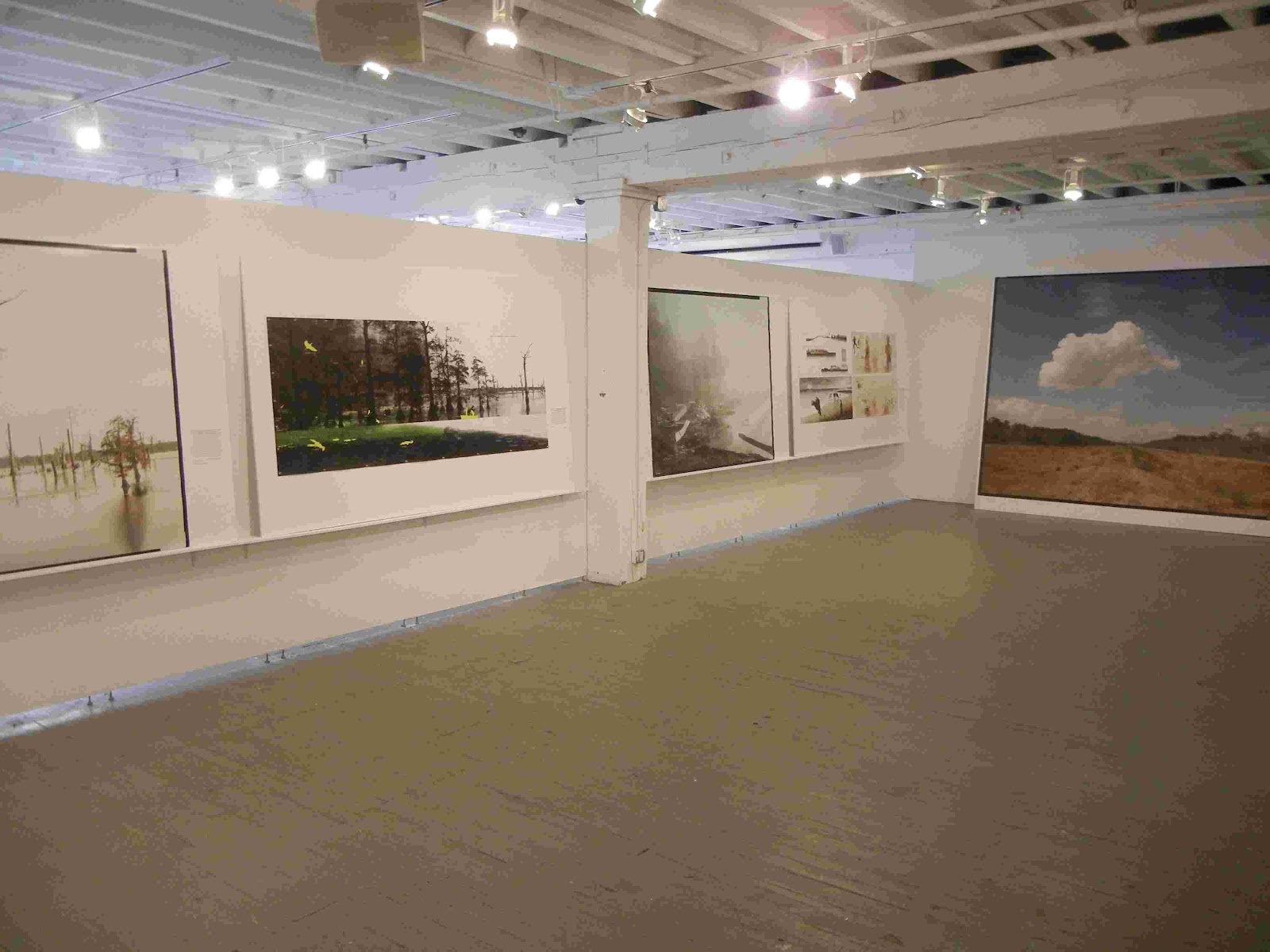
Petrochemical America: Project Room, Photographs by Richard Misrach, Throughlines by Kate Orff/SCAPE @Aperture

JTF (just the facts): A total of 32 color photographs and 20 maps, diagrams, and other informational displays/ephemera, hung unframed against dark blue and white walls in the main gallery space. Misrach's exhibition prints are sized either 96x120 or 60x76/82 and have been pinned directly to board, the largest leaning against the walls at angles. There is also an array of original contact prints, each sized 8x10. All of the works are digital c-prints, the vast majority taken in 1998, with an outlier or two made in 2010. Orff's diagrams are mounted directly to board and displayed on small ledges. A two-sided plexiglas divider wall contains a dense selection of sketches, emails, and preliminary drawings, and a small table contains two copies of the book and its supplement for easy viewing. An in-depth monograph of this body of work was recently published by Aperture (here) and is available in the bookshop for $80. (Installation shots at right.)
 
Comments/Context: The last decade has seen a marked increase in the photographic investigation of the oil industry in America. Many leading contemporary photographers have tackled this immense subject (most notably Mitch Epstein and Edward Burtynsky) and made pictures of wells, refineries, the Gulf oil spill, and the whole end-to-end delivery chain of petrochemical products that has touched nearly every corner of American society. Given the scale of the industry, most of these pictures play with size and scope in formal ways, juxtaposing large with small, corporate with community, ugly with beautiful. We have come to expect a looming hugeness in these kinds of images, where an attempt is made to simplify this bafflingly complex industry by boiling it all down to a handful of iconic visual motifs.
 
Richard Misrach's approach to documenting the world of oil is in many ways a contrarian response to this dumbing down trend. Pairing up with landscape architect Kate Orff, the two have produced an exhibit which positively revels in complexities, diving deep into the interconnected details and working extremely hard to connect the dots coherently. Instead of looking at issues on a worldwide scale, they have focused on a stretch of the Mississippi River from Baton Rouge to New Orleans (a corridor known as "Cancer Alley"), and have collaboratively explored the impact of the industry on virtually every factor of life in this zone, from economic growth to toxic waste, from swamp ecosystems to food cycles.
 
Given this intellectual mindset, Misrach's photographs come off as extremely careful and deliberate. The obvious juxtapositions are still there (a big refinery dwarfing a small house, a pipeline running through a swampy marsh, a forest of dead cypresses, a basketball hoop backed by another refinery etc.) but each image seems precisely chosen with an eye for illustrating a specific piece of the larger story. There are subtle angles on poverty, the gradual poisoning the community, misty historical ghosts, and the enduring life of the river. Orff's diagrams and maps trace and define these ideas more fully, grappling with the complexities of how waste is metabolized, how synthetic nitrogen cycles through the environment, and how the flora and fauna of the bayou is being transformed. It's brainy, time-consuming, scientific stuff, with a focus on secondary and tertiary downstream impacts, and its density is smartly balanced by Misrach's visually elegant vignettes which help bring home the key messages.

What I like best about this exhibit is its respect for the viewer, its attempt to unpack something seemingly impenetrable and make sense of it in a manner that requires real attention and thoughtful engagement. The dialogue between the photographs and the supporting material produces something that is successfully both emotional and educational, where the fluffy 19th century cumulus clouds over the Shell refinery are initially quite beautiful and then revealed to be fed by the flare of hydrocarbons coming from the plant, giving us a grim sense for the multi-layered complexity of what's really going on. Overall, Misrach and Orff make a persuasive, deftly constructed argument here, combining photography and rigorous investigation into something rich and weighty, going beyond the easy simplicity of a bunch of well made pictures.
 
Collector's POV: Since this venue is typically a non-selling environment, there were, of course, no posted prices for the photographs. Misrach's work is consistently available in the secondary markets, with prices ranging from roughly $2000 to $80000, with his newer, larger prints at the top end of that range. Misrach is represented in New York by Pace/MacGill Gallery (here) and in San Francisco by Fraenkel Gallery (here).
 
Rating: * (one star) GOOD (rating system described here)
 
Transit Hub:
  • Exhibit: High Museum of Art, 2012 (here)
  • Kate Orff's SCAPE bio (here)
Through October 6th
 
547 West 27th Street
New York, NY 10001

Monday, April 9, 2012

August Sander/Boris Mikhailov: German Portraits @Pace MacGill

JTF (just the facts): A total of 23 black and white and color photographs, hung against grey walls in the main rooms of the gallery. All of the works by August Sander (11 prints in total) are gelatin silver prints hinged to board, framed in blond wood, and taken between 1924 and 1943. Each image is sized roughly 10x7, in an edition of 12. All of the works by Boris Mikhailov (12 prints in total) are archival pigment prints mounted to Sintra, framed in white, and taken in 2008. Each image is sized 29x20, in an edition of 5. A monograph of Mikhailov's body of work, Maquette Braunschweig, was published by Steidl in 2009 (here). There is no photography allowed in the gallery, so the installation shots at right are via the Pace/MacGill website.

Comments/Context: The pairing of contemporary portrait photography with the work of August Sander has now become a kind of subculture of exhibition all its own. Given Sander's wide ranging influence in the genre, showing paired juxtapositions of old and new offers an opportunity to set a baseline and provide aesthetic comparisons. Using Sander's formal portraits as a kind of gold standard, these exhibits both reinforce Sander's importance, and provide visual connections across photographic history.
.
Sander's foil in this show is Ukranian photographer Boris Mikhailov, and the pairing is particularly apt since Mikhailov just did a recent series of portraits of German citizens from the town of Braunschweig. So not only are their stylistic parallels to discover, but their are also social and cultural angles to be explored, separated by 70 years. The selection of Sander images has been meticulously edited and hung, placing like poses and profiles in small groups, rigidly reinforcing commonality and repetition in the gestures and looks.
.
Mikhailov's newer portraits are even more strict in their composition: crisp head shot profiles against deep black backgrounds. This approach accents the line of the profile, and the details of chins, noses and foreheads become more prominent, like a figure and ground illusion. Mikhailov's portraits take Sander's idea of the subject who is both an individual and a type to its logical extreme, where images of the men and women show quirks of hair style, skin, personality and genetics, while seeming anthropologically scientific at the same time. The portraits are simultaneously wholly contemporary and unabashedly classic, connecting to Ruff's deadpan frontal portraits from the late 1980s and Old Masters paintings with equal power.
.
In general, this is a thoughtful, subdued pairing, which to some degree mutes in the freshness of Mikhailov's works. This duet highlights ties to the past, reinforcing historical links and echoes, where a more contemporary pairing might have given the Mihkailov portraits a more radical frame. Regardless, it's a refreshingly solid one two punch of German portraiture.
.
Collector's POV: The photographs in this show are priced at as follows. The Sander prints are $4500 each. Sander's photographs are widely available in the secondary markets, including portraits, landscapes, and later prints/portfolios made by both Gunther and Gerd Sander. As a result, prices vary widely, from as little as $1000 for lesser known images to more than $100000 for iconic vintage portraits. The Mikhailov prints are $7500 each. Mikhailov's work has only been sparsely available at auction; prices have ranged between roughly $3000 and $30000, but the number of lots up for sale has been small. As a result, gallery retail may still be the best option for those collectors interested in his work.
.
Rating: * (one star) GOOD (rating system described here)
.
Transit Hub: 
  • Exhibit: August Sander: People of the Twentieth Century @Getty, 2008 (here)
  • Mikhailov Feature: Deutsche Bank ArtMag (here)
Through March 5th

32 East 57th Street
New York, NY 10022

Tuesday, November 15, 2011

Hiroshi Sugimoto: Lake Superior @Pace/MacGill

JTF (just the facts): A total of 12 black and white photographs, framed in black wood and matted, and hung against grey and dark grey colored walls in the main rooms of the gallery. All of the photographs are gelatin silver prints mounted to board, made in either 1995 or 2003. Each mounted image is 20x24; no edition information was available. There is no photography allowed in the gallery, so the installation shots at right are via the Pace/MacGill website.

Comments/Context: Hiroshi Sugimoto's photographic seascapes have become so iconic that at this point, I'm ashamed to say that I think I take them a bit for granted. This isn't to say that I adore or admire them any less, it's just that my brain uses some kind of mental shorthand that assumes I've already absorbed most of what they have to offer, and thereby often skips over them in search of something else. In the past few years, Sugimoto's seascapes have been shown at monumental scale in New York gallery shows, and at that size, their largeness becomes enveloping and almost spiritual. In contrast, this show gathers together images taken of Lake Superior and displays them in the smaller size, forcing the viewer into an entirely different and much more intimate, one-on-one interaction.

The sequencing of this show is important to notice, as there is a careful progression along a spectrum of color and mood. The first image the visitor encounters when coming out of the elevators is an almost pure white on white picture (the best in the show, in my opinion), which is then followed around the wall by whites that become more foggy and unstable, and waves and undulations that become more noticeable. As the viewer passes into the adjoining room, the bisected images become more contrasty, the water darker, sometimes grey and soft, sometimes smooth, sometimes crisp and almost sharp against the featureless sky, ending with a single night seascape with its tonalities of light and dark reversed. Seen together at this size, the changing weather conditions generate forward motion through the gallery, and the subtle gradation enables a meditative flow of muted emotion.
.
Sugimoto's seascapes are a tremendous reminder of the power of pared down, photographic simplicity. His views of the water offer endless variations, combining both a cerebral quality of conceptual thinking and a deeply human sense of timeless, elemental purity. Even if you're sure you've seen them before, they undeniably merit a second (or third, or fourth) look.
.
Collector's POV: The photographs in this show are priced at $35000 each. Sugimoto's work is routinely available in the secondary markets, in various sizes and at various price points. Images of equivalent size (20x24) as those on display here (seascapes, as well as other subjects/projects) have generally been available at auction at prices ranging between $10000 and $90000.
.
Rating: ** (two stars) VERY GOOD (rating system described here)
.
Transit Hub:
Hiroshi Sugimoto: Lake Superior
Through December 3rd

Pace/MacGill Gallery
32 East 57th Street
New York, NY 10022

Friday, June 17, 2011

Boris Mikhailov: Case History @MoMA

JTF (just the facts): A total of 19 large scale photographs, unframed and pinned directly to the wall, and hung in a single room space on the 3rd floor (the normal divider wall has been removed). While exact dimensions were not available, the prints are larger than life size and have additional white strips at the top and bottom. The images were made between 1996 and 1997 as part of a much larger series, and a monograph of this body of work was published by Scalo in 1999. The exhibit was curated by Eva Respini. (Installation shots at right.)

Comments/Context:  Boris Mikhailov's photographs of homeless people in Kharkov, Ukraine, in the aftermath of the post-Soviet collapse are tough, often disturbing images. Taken in the late 1990s, the images depict worn down men and weary women as they stand in the snow in dirty winter overcoats or huddle in forgotten grubby parklands, often exposing their naked sagging flesh with bored indifference or a twinkle of wry complicity. The images are a sad parade of down trodden vulnerability, punctuated by black eyes, skin welts, dirty toilets and explicit flashing.

What's different about Mikhailov's portraits is just how involved he is with the sitters; it's almost as if he's in the frame himself. While the pictures have the patina of documents (the interiors often flash lit), there is plenty of mannered posing and collaboration going on here, which absolutely crosses the line into performance, voyeurism and exploitation. In many of the portraits, the sitters seem to treat the exercise like a joke or a lark, as if this one last humiliation of pulling down their pants or vamping with a dead fish is no worse than whatever else has come before. There is a palpable sense of theater in the works, as if allegorical stories are being played out by these unlikely actors.

Compositionally, several of the images reference Christian iconography or art historical precedents, adding a layer of painterly control to seemingly loose snapshots. A man in a snowy coat stands with outstretched arms as though on the cross, while another slumps shirtless in a classic pieta. Given the size of the prints, I was often drawn to connections to classic paintings of portraits and nudes across the ages, and then roughly ripped back to reality by the dingy grime or abject craziness of the settings and lives on display. A bearded man pretends to sleep in the snow with a rock as his pillow, with the fallen glory of a hulking mansion in the background; he seems like the perfect symbol for the new world order. Another wields an ax while wearing an old army uniform; it could easily be a portrait of a former general or hero, and yet, it's clear that unbalanced delusion is really at work.

This exhibit had me torn, in that I found several of the images to be mesmerizing and spectacular, while plenty of others left me cold or just unmoved by their blunt staginess. This isn't an easy show to like, but one that I think is worth the investment of time to read carefully.

Collector's POV: As this is a museum show, there are of course no posted prices. Mikhailov's work has only been intermittently available in the secondary markets in recent years; prices have ranged between roughly $3000 and $30000, but the number of lots available has been small. As a result, gallery retail may still be the best option for those collectors interested in his work. Mikhailov is represented by Pace/MacGill Gallery in New York (here) and Galerie Barbara Weiss in Berlin (here).

As an aside, after I had spent some time with this show, I stood and watched the stream of casual visitors as they entered the gallery, to see how they reacted when they were confronted by the images on display. A meaningful number had an aghast reaction and decided that they didn't need to see any more, quickly making a detour or reversing course. For the random tourist taking in a sampler of artistic delights at the museum, this exhibit was clearly a splash of cold water, and one which many just didn't have the stomach to engage with.
.
Rating: ** (two stars) VERY GOOD (rating system described here)

Transit Hub:

  • Reviews: NY Times (here), Wall Street Journal (here)
  • Features: Time LightBox (here), LensCulture (here)
Boris Mikhailov: Case History
Through September 5th
.
Museum of Modern Art
11 West 53rd Street
New York, NY 10019

Thursday, May 5, 2011

Henry Wessel, Vintage Photographs @Pace/MacGill

JTF (just the facts): A total of 30 black and white photographs, framed in white and matted, and hung against orange and almond colored walls in the main rooms of the gallery. All of the photographs are vintage gelatin silver prints, made between 1968 and 1987. Image dimensions range from 6x9 to 11x16 or reverse; no edition information was available. There is no photography allowed in the gallery, so the installation shots at right are via the Pace/MacGill website.

Comments/Context: When we look at all the stars of 1970s American photography, from the emerging color giants to the New Topographics photographers to a handful of other greats, I suppose it's not surprising that an artist like Henry Wessel has gotten a bit overlooked. His quirky pictures document the quintessential idiosyncrasies of life in California and the West, and capture those moments with a harsh bright whiteness that is wholly his own. I've always thought his work was a bit under appreciated, so I'm glad to see a well-selected group of his vintage pictures swing back through New York.

Well placed humor is rare in photography, but Wessel consistently finds flashes of wry visual wit hidden among seemingly ordinary situations: a woman drinking from a glass amid a riot of clashing bedding patterns, a solitary ice advertisement in the rocky desert, a heart shaped cactus, a weirdly groomed poodle, a single telephone pole in an expanse of dry land. He also has an eye for the strange absurdities of the California experience, from the muscled man in sunglasses in front of the Ocean Sands and the man watching a flock of pigeons taking off, to a thicket of grasses blocking the front of a house and the baton twirlers in white go-go boots. An over-manicured evergreen, a man staring at the desert between two houses, the blinding whiteness of vernacular architecture, it all has an undercurrent of the oddly surreal, as if something slightly off kilter was going on in this world of suburban bungalows and beaches.
 
I think Wessel's dry one-liners and visual eccentricities deserve more attention and acclaim that they have heretofore received. This show is an excellent sampler of Wessel's work and should provide a compelling introduction for those who have inadvertently passed him over chasing the more famous names of the 1970s.

Collector's POV: The photographs in this show are priced between $1000 and $20000. Wessel's prints are intermittently available in the secondary markets, with prices at auction ranging between $3000 and $16000 in recent years

My favorite image in the show was actually a series of four images hung together; they're in the center of the middle installation shot. It starts with the back of woman's platinum blond head, followed by the back of a suited man on the beach, followed by two sculpturally rounded front yard evergreens, followed by a woman in a bikini, once again from the back. Together, they create a whimsical, peculiar rhythm.

Rating: ** (two stars) VERY GOOD (rating system described here)

Transit Hub:
  • Feature: PDN Photo of the Day (here)
  • Exhibit: SFMOMA, 2007 (here)
  • Book: Five Books from Steidl (here)
Henry Wessel: Vintage Photographs
Through July 8th

Pace/MacGill Gallery
32 East 57th Street
New York, NY 10022 .

Tuesday, April 5, 2011

Harry Callahan and Jackson Pollock: Early Photographs and Drawings @Pace/MacGill

JTF (just the facts): A total of 22 black and white photographs and 10 drawings, hung against dark blue and putty colored walls in the main rooms of the gallery. All of the photographs are vintage gelatin silver prints, framed in white and matted, and made between 1943 and 1956. Image dimensions range from 2x2 to 8x10 or reverse. The drawings were made in various media (pencil, pen, black ink, oil, or wash on paper) and were executed between 1938 and 1956. Dimensions range from 3x4 to 25x39. This show was organzied in cooperation with Washburn Gallery (here). There is no photography allowed in the gallery, so the installation shots at right are via the Pace/MacGill website.

Comments/Context: Regular readers here will perhaps remember my particular disappointment with MoMA's fumbling of the photography portion of the recent AbEx show (here); in my view, it was a major missed opportunity to carefully examine the interplay of visual ideas that were manifesting themselves in different but similar ways in concurrent painting, sculpture and photography. This intimate show of just a handful of works by Jackson Pollock and Harry Callahan does everything the MoMA show didn't do, hanging relevant chronological examples side by side, so the aesthetic parallels and compositional echoes become obvious. It's a superbly edited and sequenced comparison, crackling with exciting connections.

Since Callahan and Pollock didn't actually meet until the 1950s, I don't think this show is making an explicit case for causation or influence, but rather exploring the nature of parallel evolution of like ideas. Both artists were interested in expanding the boundaries of representation, breaking down the recognizable into gestures, rhythms, and expressive marks, moving from the solitary object to all-over abstraction. The exhibit is a catalog of repeated visual motifs, organized in a back-and-forth manner: the angles and curves of Pollock drawings are paired with similar forms in Callahan torn sign photographs, dense interlaced line drawings from Pollock parallel the squiggly lines of Callahan's sunlight on water and flashlight movements, and Pollock's ink scratchings are juxtaposed with Callahan's multiple exposure images of trees, all from generally matching time periods. The argument is persuasive, and the repetitions are conclusive evidence for the commonality of thinking.

While this is a small show, I think it does an excellent job of putting Callahan's work into a larger artistic context; his efforts to understand photographic abstraction make better sense when placed side by side with Pollock's own early inventions. This is the first vintage show I have seen this year that goes beyond a gathering of fine, rare or valuable photographs and instead uses the works to teach us something about the broader march of art history. Not only is this a great Callahan show, but it's a lesson in how photography can be highly relevant to important art in other media.

Collector's POV: The photographs in this show are priced between $25000 and $85000. Callahan's prints are ubiquitous in the secondary markets, with dozens of vintage and later prints available every year. Prices at auction generally range from $3000 to $15000 for later prints, continuing up to roughly $100000 for vintage rarities. The Pollock drawings in the show are priced between $150000 and $275000.

I think the best pairing in the show can be found in the center of the bottom installation shot. It compares a Callahan photograph of spindly plant forms in snow with a Pollock ink drawing on orange colored paper, also covered with small black dots and hashed lines. The two motifs are nearly exactly the same, even though they have been executed using entirely different methods.

Rating: *** (three stars) EXCELLENT (rating system described here)

Transit Hub:

  • Reviews/Features: NY Times (here), New Yorker (here)
Harry Callahan and Jackson Pollock: Early Photographs and Drawings
Through April 16th

Pace/MacGill Gallery
32 East 57th Street
New York, NY 10022