Showing posts with label Higher Pictures. Show all posts

Friday, May 17, 2013

Travess Smalley, Capture Physical Presence @Higher Pictures

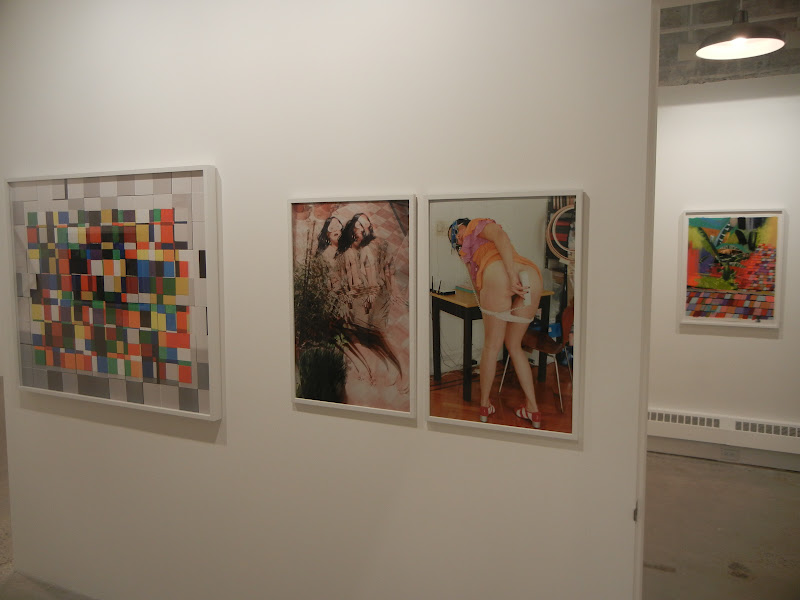
JTF (just the facts): A total of 6 large scale photographic works, framed in white and unmatted, and hung against white walls in the single room gallery space. All of the works are unique pigment prints, made in 2011. Physical sizes range from 42x32 to 47x34. This is the artist's first solo show in New York. (Installation shots at right.)

Comments/Context: Travess Smalley is out exploring the undefined borderlands of what we used to traditionally call photography. Using neither camera nor darkroom, he has instead married a flatbed scanner with the digital manipulations of Photoshop, pushing aesthetic boundaries by capturing, editing, printing, and cutting in a never ending circle of iterative digital collage. What separates Smalley from the growing legion of slick Photoshop jockeys and their crisp digital mashups is his incorporation of the tactile and the physical, or more broadly, his innovate way of connecting the immediacy of authentic texture with the power of software in a kind of lo-tech/hi-tech hybrid.

The cut paper abstraction has always been a staple of art school photographic experimentation, but Smalley's version of this studio practice is dynamic and multi-layered rather than muted and static, less about the nuances of falling light and more about the action of repetitive stratified creation. Construction paper is Xacto knifed into arcs and angles, then arranged and scanned, the process leaving behind tiny ghosts and shadows like the edges of photocopied zines. Color and pattern run the gamut from fine gradients and tight repetitions to expressive gestural lines and swirling psychedelic blobs. Gritty grainy texture is always present, no matter how frenetic and complex the compositions get - there is always a sense of being grounded in some kind of physical reality, even when highly engineered modifications are taking place. Piled into layer upon layer of overlapping, obscuring forms and then flattened back to one plane by the scanner, the works have a vitality and energy that isn't often associated with cut paper photocollage.

In these works, Smalley is testing the limits of modern photographic image construction in smart ways. Instead of falling into the trap of being satisfied with the capabilities of the ubiquitous digital environment, he has found a way to reintroduce the rough and hand-crafted back into the conversation. His abstractions combine contrasting elements of perfection and imperfection, never letting one side dominate the other.

Collector's POV: The works in this show are priced at $13000 each. At this early point in his career, Smalley's work has no secondary market history, so gallery retail is really the only option for those collectors interested in following up.

Rating: * (one star) GOOD (rating system described here)

Transit Hub:
  • Feature: L Magazine (here)
  • Interview: Future Shipwreck (here)
 
Through June 1st

Higher Pictures
980 Madison Avenue
New York, NY 10075

Friday, January 11, 2013

Letha Wilson @Higher Pictures

JTF (just the facts): A total of 10 photo-based sculptures, framed in white and unmatted or mounted without framing and hung against white walls in the single room gallery space. The works are either c-prints or gelatin silver prints, with additional concrete, white portland cement, wood dowel, or paint. They generally range in size from 24x17 to 28x28, with one larger column piece at 106x17. All are unique and were made in 2012. (Installation shots at right.)

Comments/Context: Vistas of the Grand Tetons, the flat expanse of salt flats, the rumble of storm clouds, the wave patterns of eroded canyons, these awe inspiring natural treasures have now become the territory of landscape photography cliche. We have already "seen" them, the past masters of the medium having expertly captured these places with any number of emotions and mindsets: grandeur, reverence, joy, picture postcard banality, disappointment, anger, and even irony. But Letha Wilson's unconventional photo-based sculptures have done something I wouldn't have thought likely - they've brought tactile physicality back to landscape photography, and in doing so, have made the old tropes we've generally written off surprisingly fresh and immediate.

Wilson's photographic raw material is entirely forgettable: photograms of evergreen branches, views of the Badlands, lonely plants in sand dunes and sagebrush underfoot. But her sculptural interventions are unexpected and invigorating. The black and white evergreen silhouettes are geometrically cut through and pulled back, revealing backside images in color. The rocky hills of the Badlands are interrupted by flows of rough concrete, slashing through like thick strips of sediment. The endless dryness of salt flats is covered in a thin white scrim of cement, hovering like a delicate crusted veil. And the swirls and whorls of pink canyons are twisted like a fan, the image folded again and again, but on a turning axis that mirrors the flow of the walls. Each material intrusion matches its subject, and by reminding us of its tangible presence, each manipulation enhances our experience of the land. It's photography unafraid of its objectness, mixing visual elegance with physical, textural grit.

Wilson is yet another example of a contemporary photographer who is smartly disassembling genre boundaries. Her works find an easy structural balance between photography and sculpture, allowing her photographs to be both representative imagery and paper based things that can be cut, torn, slashed, and filled. The best of these works have an effortless combination of natural beauty and man made construction that settles into an unsteady but harmonious equilibrium. All in, a plenty promising debut.

Collector's POV: The works in this show are generally priced between $4000 and $6500, with the large concrete column priced at $18000. At this early point in her career, Wilson's work has no secondary market history, so gallery retail is the only option for those collectors interested in following up.

Rating: * (one star) GOOD (rating system described here)

Transit Hub:
  • Artist site (here)
  • Interview: Hyperallergic (here)
Letha Wilson
Through January 26th

Higher Pictures
980 Madison Avenue
New York, NY 10075

Friday, November 30, 2012

Lynne Cohen, Occupied Territory 1971-1988 @Higher Pictures

JTF (just the facts): A total of 14 black and white photographs, framed in original marbled frames and matted, and hung against white walls in the single room gallery space. All of the works are vintage/early gelatin silver prints made between 1975 and 1982. 12 of the prints are 8x10 contact prints; the other 2 are sized 30x40 and have titles printed directly on the mats. No edition information was available on the checklist. The 1987 monograph of this body of work was recently reissued by Aperture (here). (Installation shots at right.) 
 
Comments/Context: If Lynne Cohen's images of interiors were made today, we might easily mistake them for stage sets or ironic art installations. Their kitschy, dated unreality and odd, empty formality make them seem quietly preposterous, perfect for some arch conceptual twist or sideways social commentary. But the fact is these images were made more than three decades ago and depict actual found environments rather than mysterious constructed fictions. These offices, showrooms, and public spaces were indeed real places, making their blend of seriousness and unintentional absurdity all the more head-shakingly amusing.
 
As I circled the gallery, I found myself thinking that these pictures had a strong underlying kinship with Mike Mandel and Larry Sultan's Evidence series. There is something perplexing and unknowable about why a recording studio would be outfitted to look like an undersea world (complete with stuffed and mounted swordfish and tuna) or who would decorate an ordinary office with a dense flock of duck stencils, a tower of birdfeeders, and a few twisted tree branches on the floor. Cohen's interiors have an elaborateness to them, a controlled attention to detail that from a distance seems downright laughably puzzling. Why the taxidermied animal heads in the tiled stairwell? Or the woodland scene pinned up behind the badminton court? Or the floor-to-ceiling cloud wall in the drab office? I thoroughly enjoyed the orderly tile/brick/siding showroom, with its display of suitcase style arrays hung neatly on the peg board wall - it's just the kind of lonely weirdo salesroom I imagine to be inside one of Lewis Baltz' flat roofed industrial park office buildings.
 
Cohen brings a straightforward deadpan eye to these almost perfect simulations and oddball assemblages, bridging between late 1970s witty conceptualism and the New Topographics photographers' interest in the suburban built environment. Her pictures feel both steeped in the artistic issues of that particular moment and simultaneously remarkably fresh and smart. This is a body of work that has aged well, still as crisp, biting, and subtly hilarious as ever.
  
Collector's POV: The prints in this show are priced as follows. The 8x10 prints range from $6000 to $8000 each, while the 30x40 prints are $15000 each. Cohen's work has very little secondary market history, with only a handful of lots coming up for sale in the past decade. Those prints found buyers at prices ranging between $2000 and $5000.
  
Rating: * (one star) GOOD (rating system described here)
 
Transit Hub:
  • Artist site (here)
  • Video interview (here)
  • Features/Reviews: New Yorker (here), Daily Beast (here)
Through December 8th
 
980 Madison Avenue
New York, NY 10075

Friday, October 12, 2012

Artie Vierkant @Higher Pictures

JTF (just the facts): A total of 6 sculptural photographic objects, mounted unframed and unmatted, and hung against white walls in the single room gallery space. All of the works are UV prints on thick machine cut sintra, made in 2012. Five of the works are roughly rectangular, ranging in size from 14x59 to 19x55; the other work on display is roughly square, at 54x56. All of the works are unique. This is Vierkant's first solo show in New York. (Installation shots at right.)
 
Comments/Context: While my itinerant wanderings through the galleries and museums of New York are mostly about looking at and thinking about the art, I would be a liar if I didn't say that there is a healthy component of socialization and information transfer that goes on as well. From time to time, the endless chatter inside the photography bubble converges around certain ideas or artists that seem to be particularly relevant or of the moment. In my experience, for the past few months, the work of Artie Vierkant has been one of those recurring themes, his images popping up in group shows and his name echoing in idle conversation. Folks are paying attention more than you might expect for a generally unknown artist.
 
In a certain way, I think this is happening more for the elegance and timeliness of his ideas than for the end points of his artworks. For nearly its entire history, photography has been concerned with the final print as the ultimate and definitive expression of the will of the artist. In our post Internet digital age, Vierkant calls this whole mindset into question, cutting the Gordian knot of what digitization means with a single easy stroke. His view is that the art object now floats between multiple instantiations, unlimited by the traditional boundaries of medium. In this world, there is no original or better copy, the digital file (or software code) being just as valid or important as the gallery print. The "data" of the art is simply presented or represeneted in different ways, moving back and forth between the logical and the physical, taking into account the nature of the communities with which it is interacting.
 
The works on the walls at Higher Pictures were constructed in PhotoShop, starting with geometric forms and straightforward gradients. The colorful abstractions were then layered iteratively, using filters, skew angles and color mixing to create stuttering, overlapped shapes built from shared elements. Different "final" compositions have been time stamped, as the process continued and additional incarnations/versions were conceived. There are fades, blurs, wipes, and arcs, both pure in their brightness and perfectly flat, the appearance of space squashed into a single plane. As objects, the prints have an unexpected texture, a matte finish that somehow seems sparkly without being glossy; as digital files on the gallery website, they pop with eye-boggling crispness.
 
As abstractions, I think Vierkant's images feel like first steps; I think he can (and likely will) go much further in terms of complexity and risk taking in the future. What I find exciting is the idea of the mediumless artist who moves effortlessly from one output form to another, equally happy in video, sculpture, photography or the open ended, shared, remixed, reworked data file. Some might argue that we are no longer in the realm of pure photography, but likely that definition doesn't really matter any more. Vierkant seems to be a model for a new kind of artistic thinking, one that embraces and extends the fluidity of the digital world rather than fighting it.
 
Collector's POV: The 5 rectangular pieces on view were priced at $6000 each and the larger square piece was $10000. I use the past tense on purpose here, since all of the works were sold before the show even opened. Vierkant's work has not yet reached the secondary markets, so gallery retail is likely the only option for those collectors interested in following up.
 
Rating: * (one star) GOOD (rating system described here)
 
Transit Hub:
  • Artist site (here)
Artie Vierkant
Through October 27th

Higher Pictures
980 Madison Avenue
New York, NY 10075

Friday, June 29, 2012

George Dureau, Black 1973-1986 @Higher Pictures

JTF (just the facts): A total of 15 black and white photographs, framed in white and matted, and hung in the main gallery space. All of the works are vintage gelatin silver prints, taken between 1973 and 1986. The prints are square format on 20x16 paper, and were not reliably editioned. (Installation shots at right.)

Comments/Context: George Dureau's 1970s era portraits of muscular black men from New Orleans offer plenty of entry points for discussion, so many that I think the recent dialogue around the work has gotten somewhat misplaced. His photographs are both classical in structure and intimate in nature, capturing both the sculptural forms of the male body and the individual personalities of his sitters. His authentic connection to his models is undeniably visible in these portraits, and this trust is what makes the images durably engaging.

The bodies in Dureau's photographs range from tight and gangly to thick and burly, with a wide range of bushy afros and dreadlocks as decoration. Perfect athletic muscles flank the deformed bodies of dwarves and amputees, and humanistic beauty is evident in all of them. With an echo of Avedon, his subjects are quietly posed against flat white backgrounds or simple interior walls, focusing the viewer's attention on the shapes and forms of torsos and full length figures. There is a deliberate use of contrast in nearly all of the images, placing bright white clothing and featureless environments in contrast with the dark skin of the sitters, almost like silhouettes.

There are three lines of critical analysis around this work that I find to be distracting, if not downright misleading. There is the "white man taking photographs of black men" racial angle, the "male nude must mean homoerotic" angle, and the "Mapplethorpe was influenced by Dureau, so that's why these pictures are important" angle. All three unnecessarily pigeon hole the work into "black photography", "gay photography" and "Mapplethorpe knock-off photography", none of which is particulalrly accurate or representative of what the portraits really show us. I think this overly easy tagging of the work also inverts the causality -  we should first determine the merits of the photography on its own before we attempt to place it into larger contextual frameworks, not the other way around. As a collector, I can't really imagine buying one of these portraits and then telling visitors to my home "it's a George Dureau; he influenced Mapplethorpe" as if that was some kind of logical explanation for why I purchased it. The Mapplethorpe connection is of course interesting in tracing the evolution of visual motifs between the artists, but it wouldn't matter if the Dureau photographs themselves weren't accomplished in their own right.

So bypass the critical red herrings that fly around this show and see these images for what they are: well-executed, empathetic, classically-influenced male portraits, distilled down to an essential mix of truth, strength, and vulnerability.

Collector's POV: The prints in this show are priced between $8000 and $12000. Dureau's work does not have much history in the secondary markets for photography, so gallery retail is likely the best option for interested collectors at this point. Dureau is represented in New Orleans by Arthur Roger Gallery (here).
.
Rating: * (one star) GOOD (rating system described here)
.
Transit Hub:
  • Reviews/Features: NY Times (here), New Yorker (here), Gallerist NY (here), Photograph (here)
Through July 13th
.
980 Madison Avenue
New York, NY 10075

Tuesday, May 1, 2012

Photography Is @Higher Pictures

JTF (just the facts): A group show consisting of a total of 27 photographic works by 20 different photographers/artists, variously framed and mounted, and hung against white walls in the main gallery space and the back viewing room. All of the works were made between 2008 and 2012. Edition size/information for each piece was not available on the checklist. (Installation shots at right.)
.
The following photographers/artists are included in the show, with the number of works on view and image details in parentheses:
  • Lucas Blalock (1 c-print, 2011)
  • Matthew Brandt (1 c-print soaked in Fall Creek Lake water, 2009)
  • Talia Chetrit (1 gelatin silver print, 2011)
  • Joshua Citarella (1 c-print, 2011)
  • Jessica Eaton  (1 archival pigment print, 2010)
  • Sam Falls (1 acrylic, pastel, and watercolor on archival pigment print, 2011)
  • K8 Hardy (2 c-prints, 2011)
  • John Houck (2 archival pigment prints, 2012)
  • Katherine Hubbard (4 Polaroids, 2012)
  • Sarah Anne Johnson (2 chromogenic prints, embossed and screen printed, 2011)
  • Anouk Kruithof (1 inkjet on Hahnemuhle Baryta paper with favorite color sheets, 2011)
  • Andrea Longacre-White (1 archival inkjet print, 2012)
  • Adam Marnie (1 inkjet photographs mounted on displaced wall, 2011)
  • Aspen Mays (1 archival inkjet print, 2008)
  • MPA (1 c-print, 2012)
  • Illiana Ortega (2 archival pigment prints, 2010)
  • Emily Roysdon (1 gelatin silver print, 2010)
  • Matthew Stone (1 archival inkjet on wood, 2011)
  • Arite Vierkant (1 uv print on sintra, 2012)
  • Letha Wilson (1 cement, c-prints, 2012)
Comments/Context: Trying to pin down an exacting definition of "contemporary photography", an ultimate list of what's in and what's out, has proven to be an elusive, frustrating, and perhaps even delusional, pastime. Do we distinguish between or eliminate camera-less images, photograms, darkroom effects, collage, montage, and rephotography/appropriation? Or do we just include anything and everything that has its output as a photographic print, regardless of the intermediate processes used to make it? Where are the edges and bright lines? These kinds of questions and debates have become even more puzzling with the increasingly broad use of digital technology and the advent of countless new printing processes. The boundaries of our photographic playing field are getting murkier every day.

This smart show declares this kind of old school thinking tired and outdated. It sees contemporary photography at the nexus of interdisciplinary art making, where the definitional intersections between traditional photography and painting, sculpture, performance art, collage, computer-based art, and other less well defined genres are less clear or even important. Processes and techniques from various disciplines are layered on top of each other, creating hybridized end products that defy easy categorization. We're now living in the in-between spaces and borderlands of art, where the rules are less well enforced and the outcomes less predictable, and this multivalent thinking is offering new avenues for exploration and experimentation.
.
There really isn't a single straightforward "photograph" in this entire exhibit. Letha Wilson merges nature photographs and cement into an abstract object with textural roughness and slashing elegance. John Houck starts with computer-generated all-over grids of color, which are then repeatedly folded and rephotographed to create subtle undulations and angles. Jessica Eaton’s piece begins with a pile of sculptural blocks which are then painstakingly masked off in-camera in small squares, resulting in a single aggregate exposure that becomes a shifting, chance-driven geometric mass of color. Matthew Stone starts with a seemingly classical nude, overlays it with a draped fabric reproduction, and outputs the image on wood, creating a multi-layered, fleshy distortion with unexpected textural warmth. Talia Chetrit resizes everyday coins into a deceptive trail of conceptual breadcrumbs. And Lucas Blalock turns Tums (or are they SweetTarts) into a decorative pattern of pink and purple spots. Performances are staged, photographs are overpainted, collage elements are added, and unconventional ideas and methods are free to spread and evolve, sometimes melding two or three previously separate approaches or discrete steps into a unconventionally heady brew.
.
I think this kind of show is a message from the future. It indicates that the simplistic Photoshop effects of a decade ago are far in the rear view mirror. What lies ahead, at least on the bleeding edge, is the mature investigation of multiple media in concert, with the artist employing increasingly sophisticated levels of control to achieve his/her desired results. The camera is just one tool in the overstuffed tool box, and the thought patterns we bring from the world of vintage photography will be increasingly irrelevant. This show is fresh, and challenging, and unexpected, and this new style of "photography" is going to knock us out of our comfort zone until we begin to accept that the edges we once drew around the medium have been erased.
  
Collector's POV: The works in this show are priced as follows, listed alphabetically by photographer/artist:
  • Lucas Blalock: $3300
  • Matthew Brandt: $4500
  • Talia Chetrit: $2500
  • Joshua Citarella: $1800
  • Jessica Eaton: $6500
  • Sam Falls: $6000
  • K8 Hardy: $6000 each
  • John Houck $4000 each
  • Katherine Hubbard: $1200 each
  • Sarah Anne Johnson: $4500 each
  • Anouk Kruithof: $1500
  • Andrea Longacre-White: $2000
  • Adam Marnie: $3000
  • Aspen Mays: $2800
  • MPA: $1500
  • Illiana Ortega: $3300/$3400
  • Emily Roysdon: $8000
  • Matthew Stone: $8500
  • Artie Vierkant: $4000
  • Letha Wilson: $3000
In general, none of these photographers/artists has much, if any, secondary market history. As a result, gallery retail will be the best option for those collectors interested in following up.

Rating: * (one star) GOOD (rating system described here)
.
Transit Hub:
  • Lucas Blalock artist site (here)
  • Talia Chetrit artist site (here)
  • Jessica Eaton tumblr (here)
  • John Houck artist site (here)
  • Matthew Stone artist site (here)
  • Letha Wilson artist site (here)
  • Feature: ARTINFO (here)
Through May 26th
.
980 Madison Avenue
New York, NY 10075

Wednesday, November 16, 2011

Jessica Eaton, Cubes for Albers and LeWitt @Higher Pictures

JTF (just the facts): A total of 11 color photographs, framed in black and unmatted, and hung in the small single room gallery space and the adjacent viewing alcove. All of the works are archival pigment prints, made in 2010 or 2011. The images have been printed in one of two sizes: 40x32 (in editions of 3) or 20x16 (in editions of 5); there are 5 in the large size and 6 in the small size on view. (Installation shots at right.)

Comments/Context: Jessica Eaton's layered, experimental geometries and additive color studies delve into the deep artistic traditions of the elemental cube and square, using complex photographic techniques to echo and reinterpret visual motifs from the masters of minimalist/abstract painting and sculpture. Her works reconsider nested Albers squares and stacked LeWitt cubes using the tools of multiple exposure photography, generating compositions with new degrees of aesthetic freedom.

Using simple painted cubes of different sizes and an array of primary colored filters, Eaton is able to mix and match to create interlocking planes and transparent stratifications, pushing from obvious recreations and homages to more chaotic sets of angles and colors. The best of the images explore theoretical boundaries, where three dimensionality and flatness intersect in unexpected ways, sometimes producing a blurred optical buzzing that shimmers and shifts.

While Ion Zupcu has explored some of the same visual territory (albeit in a monochrome palette), I think Eaton's successes are found her ability to extend the abstractions beyond a simple series of cubes, to let the ghosted forms intermingle and unravel a bit, and where the color theory gets more complicated and contradictory. While there is certainly technical mastery evident in her photographic recreation of an Albers, I was most excited to see Eaton's original point of view come through more clearly in the highly splintered and deconstructed forms.

Collector's POV: The prints in this show have ratcheting prices, based on the place in the edition. The 40x32 prints range from $3500 to $5500, while the 20x16 prints range from $2500 to $3500. Eaton's work has not yet made it to the secondary markets in any meaningful manner, so gallery retail is likely the only option for interested collectors at this point.

Rating: * (one star) GOOD (rating system described here)

Transit Hub:
  • Artist tumblr (here)
Jessica Eaton, Cubes for Albers and LeWitt
Through December 17th

Higher Pictures
764 Madison Avenue
New York, NY 10065

Thursday, October 20, 2011

Jill Freedman, Street Cops, 1978-1981 @Higher Pictures

JTF (just the facts): A total of 27 black and white photographs, framed in white and matted, and hung in the small single room gallery space and the adjacent viewing alcove. All of the works are vintage gelatin silver prints, taken between 1978 and 1981. The images have been printed in one of two sizes: 11x14 (or reverse) or 20x24 (or reverse); there are 3 of the large size and 24 of the small size in the show. A monograph of this body of work, entitled Street Cops, was published by Harper & Row in 1981. (Installation shots at right.)

Comments/Context: Every collector takes his or her own often serendipitous path in learning about the history of photography, and depending on which books we read, which galleries we frequent, and who we talk to, we piece together an understanding of which photographers were important or influential and how it all fits together, framed by our own personal likes and dislikes. With each passing year, we refine this understanding by seeing new works, reevaluating ones we already know, and filling in gaps in our knowledge. While there may be a somewhat standard path for this learning, chance certainly plays some role in this ongoing educational process.

So while some of you will likely already be completely familiar with the work of Jill Freedman, until this show, I really wasn't; perhaps I had run across a print or two here and there, but I hadn't developed any real opinion on her photography. As a result, my reaction to this excellent show was all the more profound: where had Jill Freedman been hiding all these years, and why wasn't she more well known? This exhibit of her Street Cops work is the first solo show of the work in New York since it was made more than 30 years ago, and when you see the quality and consistency of these prints, this fact will seem all the more remarkable and downright puzzling.
.
In this project, Freedman followed the men and women in blue of the Ninth Precinct on their daily rounds, walking their beats and riding in their cars. The streets of late 1970s New York were a gritty place, with a never ending stream of hookers and hustlers, thieves and addicts, crazies and runaways to deal with, and her pictures are an intimate catalogue of crime scenes, accidents, and arrests. While she doesn't flinch from showing us the realism of blood and guts, her pictures avoid some of the harshness and voyeurism of Weegee, focusing instead on the warmth of a gesture or the humor of an interaction. As such, they have more in common with the works of Levitt or Kertesz, where the turn of a head or the framing of a picture can create a feeling of sympathy or outright comedy. At a time when the reputation of the police force wasn't particularly positive, Freedman found the human side to their work, the subtle kindness and compassion buried beneath bushy moustaches and long sideburns.

Almost all of her pictures turn on the play of a facial expression or the visual cleverness of the framing. Laughter, disbelief, skepticism, and concern, accompanied by the matching body language, give us the narrative moods and help to tell the stories of different kinds of confrontations. Paired cops slide down a cramped hallway and vault over a cinder block wall in perfect synchronization, while injured brothers hold each other shirtless like a pieta on a dingy sidewalk. This kind of photographic craftsmanship is on display again and again around the walls of this show; it's not a parade of lucky shots, but instead a controlled example of a consistent vision and disciplined execution.

I came away from this exhibit thinking that this body of work could happily share a wall the best of 1970s street photography, especially in the context of what makes New York a unique place. As such, it certainly belongs in the collections of our local museums, both for its "snapshot of a time gone by" documentary power and for its relevance to the evolution of the artistic genre. This is one of the best shows of vintage work I have seen all year, so don't wait another 30 years to rediscover this lesser known gem.

Collector's POV: The prints in this show are priced as follows: the 11x14 prints are $6500 each, and the 20x24 prints are $13000 each. Freedman's work is not widely available in the secondary markets, so gallery retail is likely the best option for interested collectors at this point.

Rating: *** (three stars) EXCELLENT (rating system described here)
.
Transit Hub:
  • Reviews: New Yorker (here), Artforum (here, scroll down), WSJ (here), NY Photo Review (here)
  • Feature: NY Times, 2008 (here)
Through October 29th

Higher Pictures
764 Madison Avenue
New York, NY 10065

Wednesday, June 22, 2011

Always the Young Strangers @Higher Pictures

JTF (just the facts): A group show consisting of a total of 29 works by 17 different photographers, variously framed and matted, and hung against white walls in the small main gallery space and the viewing alcove. (Installation shots at right.)

The following photographers have been included in the show, with image numbers and details in parentheses:
  • Erica Allen (2 digital c-prints, each 14x11, editions of 3, 2008)
  • Cortney Andrews (2 videos with sound, editions of 3, 2010)
  • Talia Chetrit (2 gelatin silver prints, 24x20 and 20x16, editions of 4, 2010)
  • Jessica Eaton (1 archival pigment print, 40x30, edition of 3, 2010)
  • LaToya Ruby Frazier (1 photolithograph/silkscreen, 17x14, 2011)
  • Anna Krachey (1 archival pigment print, 18x25, edition of 4, 2010)
  • Jessica Labatte (1 archival inkjet print, 71x59, edition of 5, 2010)
  • Andrea Longacre-White (1 archival inkjet print, 36x24, unique, 2011)
  • Aspen Mays (2 gelatin silver prints, 12x16 and 7x5, unique, 2011, with bag of buttons)
  • MPA + Katherine Hubbard (6 polaroids, each 4x6, unique, 2010)
  • Yamini Nayar (1 c-print, 36x48, edition of 5, 2010)
  • Emily Roysdon (1 digital chromogenic print, paper litho, wood block, collage, 35x48, unique, 2010)
  • Carrie Schneider (1 c-print, 40x50, edition of 5, 2011)
  • Kate Steciw (1 c-print, 30x24, edition of 5, 2010)
  • Letha Wilson 1 c-print, cheesecloth, cement, 24x20x7, unique, 2011, and 1 wood frame, glass, cement, c-print, plywood, 17x13x2, unique, 2011)
  • Ann Woo (3 c-prints, each 14x11, editions of 5, 2009) 
Comments/Context: If this well-edited show is any indication, a contemporary photography revolution is underway, where the old truths and rules from the recent past have been rejected or simply left behind as irrelevant, and fresh ideas are springing forth to redefine what the medium can and should mean. If there is any one common theme to the diverse set of works on display here, it is a conscious deliberateness; there are no decisive moments or lucky shots here. In fact, these cerebral photographs make the consistent argument that it isn't enough just to do one simple or straightforward thing anymore; the cutting edge now requires combining and referencing all kinds of other artistic and visual sources, juxtaposing and remixing them into something more layered and thoughtful.

A couple of years ago, I wrote a short essay on "digital craftsmanship" and the challenges faced by the increasing perfection offered by digital tools (here). As I reviewed the images in this show, I began to think that they can provide an unexpected answer to some of the questions raised by that discussion. If we take as a given that most photographers will no longer be able to differentiate themselves on printing craft alone, the "handmadeness" of the art, and the visceral touch of the artist, will need to come out in other ways. Nearly every image in this show turns on the process being used by the artist; I'm not talking about chemicals and print types (that's old school thinking), but the activity that takes place as part of (before, during, and after) the image making. A sense of brainy involvement pervades all of these works.

Many of the photographs on view are images of constructed environments, places for performances, or installations made solely to be photographed. Others employ analog, digital, and even physical processes to modify the nature of the imagery, moving it beyond the representational to the interpretive. Ideas are pushed and pulled and twisted back on themselves, blurring the definitional lines to which we have become accustomed. Terms like landscape, still life, portrait and even abstraction seem woefully inadequate as useful categorizations, since many of the works which might normally fall into one of those buckets actually function on multiple discrete levels.

While I can't say that every image hit the mark for me, this show is full of potential answers to the question of "where is photography headed?" These works are evidence of a growing rejection of the glossy, large scale, art object deadpan that has dominated contemporary photography for the past decade or two, and a potential return to the introspective, intellectual and personal. While no consensus has yet formed out of this swirling, chaotic multiplicity of competing ideas and hand crafted approaches, there are certainly enough data points to start to see a pattern emerging.

Collector's POV: The images in the show are priced as follows:
  • Erica Allen ($700 each)
  • Cortney Andrews ($2000 each)
  • Talia Chetrit ($3000 and $2500)
  • Jessica Eaton ($3500)
  • LaToya Ruby Frazier (NFS)
  • Anna Krachey ($1600)
  • Jessica Labatte ($8500)
  • Andrea Longacre-White ($1500)
  • Aspen Mays ($3500 and $3200)
  • MPA + Katherine Hubbard ($1000 each)
  • Yamini Nayar ($5000)
  • Emily Roysdon ($6500)
  • Carrie Schneider ($5000)
  • Kate Steciw ($1500)
  • Letha Wilson ($2500 and $1250)
  • Ann Woo ($650 each)
While a few of the photographers in this show may be familiar to collectors, none of the artists has any significant secondary market history; the work is just too new. As such, gallery retail is likely the only option for interested collectors at this point.

My favorite image in the exhibit was Letha Wilson's Bryce Canyon Cement Pour, 2011; it's on the far left in the top installation shot. I liked it's conceptual mixing of artistic genres, where photography meets sculptural plywood and poured cement, referencing both Land Art and Minimalism.

Rating: * (one star) GOOD (rating system described here)

Transit Hub:
  • Reviews/Features: New York Times (here), New Yorker (here)
  • Letha Wilson artist site (here)
Always the Young Strangers
Through July 9th

Higher Pictures
764 Madison Avenue
New York, NY 10065

Wednesday, April 20, 2011

Max Kozloff: New York Means Business 1977-1984 @Higher Pictures

JTF (just the facts): A total of 25 color photographs, framed in white and matted, and hung in the small single room gallery space. All of the works are c-prints, taken between 1977 and 1984. The images have been printed in one of two sizes: 20x16 (or reverse) or 3x2 (or reverse); there are 13 of the large size and 12 of the small size in the show. Kozloff does not edition his prints, and as such, the works on view are a mix of vintage and later prints. (Installation shots at right.)

Comments/Context: Max Kozloff is probably best known as a wide-ranging art historian, an exacting art critic, and a former editor of Artforum. That Kozloff is also a talented photographer in his own right was news to me, and this small show of his early work certainly helped to place his artistic output into the larger framework of 1970s color photography.

Kozloff's faded images of tired New York storefronts and window displays fall into a long subject matter tradition, reaching back to Atget and Abbott, and on to the crackling compositional experiments of Friedlander. While a few of Kozloff's storefronts follow in the traditional mode, providing elements of the surrounding architecture as context, most of his images have cropped out the framing, centering on the view through the glass itself and into the careful arrangements on display. His works feature the random marginalia of commerce: columns of twine, dusty curtains in various colors, a dense array of gold watches, triangular towers of fabric, and a parade of wigs. Other images add a layer or two of visual complexity, using mirrors to capture multiple angles, sunglasses to capture fleeting self-portraits, and reflections from the street to tell more dense and complicated stories. Placed in the context of the color experimentation going on in the 1970s, Kosloff's images show the beginnings of employing color as a primary and featured compositional tool.
.
While I'm not sure I can detect a refined and original voice in these pictures, it is clear that Kozloff was working through the same visual challenges that were confronting photographers like Levitt and Callahan, trying to bridge from an accepted black and white methodology into an entirely different mode of visual thinking. Color for color's sake was becoming the new norm, and I see this body of work as yet another well-crafted example of a transitional effort to span the two sets of adjacent but competing aesthetic ideas.

Collector's POV: The prints in this show are priced as follows: the 20x16 prints are $3200 each, and the 3x2 prints are $2300 each. Kozloff's work is not widely available in the secondary markets; the few public sales results that I could find were all under $1000.
.
My favorite image in the show was Zipper Shop, 1978; it's on the far right in the top installation shot. In it, strips of zipper ribbon hang from a sagging pair of wires, creating an eye-catching striped design, punctuated by the stenciled words on the window itself. The composition seems to have one foot in the old world and one in the new, using splashes of bright color as the focal point, enriching and rebalancing an otherwise standard view.
.
Rating: * (one star) GOOD (rating system described here)

Transit Hub:
  • Books: The Theatre of the Face, 2008 (here), New York: Capital of Photography, 2002 (here)
Max Kozloff: New York Means Business 1977-1984
Through May 7th

Higher Pictures
764 Madison Avenue
New York, NY 10065

Wednesday, January 20, 2010

Barbara Crane: Repeats @Higher Pictures

JTF (just the facts): A total of 13 black and white images, framed in white and matted, and hung in the small single room gallery space. All of the works in the show are vintage gelatin silver prints, in editions of 3 to 5, taken between 1969 and 1975. The images are generally elongated horizontal rectangles, ranging in size from 1 to 9 inches in height and 10 to 22 inches in length. (Installation shots at right.)

Comments/Context: At first glance, Barbara Crane's Repeats look like regular film strips or contact sheets, multiple similar images one after another. But upon closer inspection, something altogether different and more complicated is revealed, taking the resulting works much deeper into the realm of abstraction. In each image, small pictures have been meticulously selected and laid out, often in exact copies or subtle variants/series, and printed in strips that are arranged in several layers (on top of each other, upside down, mirrored etc.).
.
The effect is that the shapes and forms found in each small image are transformed into intimate patterns and delicate repetitions. Tar spills on a roadway become paper dolls with linked hands, swooping highway flyovers become a swirling psychedelic optical wiggle, and straight tree trunks in the snow become a zipper. Metal rowboats, laundry on a clothesline, shadows of leaves and branches, and even a traditional mountain vista are all painstakingly transformed into contrasty fugues of theme and variation.

We can go all the way back to Muybridge's 19th century locomotion studies or Grand Tour multiple image panoramas of famous ports and cities to give these works some historical context; the idea of using multiple frames to construct a larger narrative goes back to the beginnings of the medium. Crane's studies at the ID in Chicago under Callahan, Siskind, and others were also clearly influential in the development of the ideas that underlie these particular works; there is marked resemblance/debt to both Siskind's abstractions and Callahan's multiple exposure images, although taken in a new direction by Crane and refined into a different mode of seeing.
.
What I like best is that the prints work at two different distances: from afar, they are entirely abstract exercises; up close, they resolve into specific content that is only discovered after investing effort in really looking. (This is show that works extremely well in a small space, as each work requires one-on-one, eyes to the frame inspection.) While Crane's images were made in the analog 1970s, I think the foundation concepts that form the framework for her approach here have significant relevance to the digital age, where multiple images can now be stitched together with much more ease. All in, this show is worth a visit, for both the luscious craftsmanship and conceptual ideas embedded in the artworks on display, and also as a directional signpost for areas of potential exploration in the contemporary digital world.
.
Collector's POV: Each of the vintage prints in the show is priced at $4000. Crane's work has not been widely available in the secondary markets in recent years; very few of her prints have come up for sale, and therefore, there is little credible price history for collectors to reference. Barbara Crane is also represented by Stephen Daiter Gallery in Chicago (here).

While these works aren't a direct fit for our particular collection, I certainly enjoyed Dan Ryan Expressway, Chicago, 1975, and can imagine a thought provoking pairing with a few of Catherine Opie's California freeways.

Rating: * (one star) GOOD (rating system described here)

Transit Hub:
  • Artist site (here)
  • Review: John Haber (here)
  • Amon Carter Museum retrospective, 2009 (here)
Through January 30th
764 Madison Avenue
New York, NY 10065

Friday, December 18, 2009

Barbara Crane: Private Views @Aperture

JTF (just the facts): A total of 30 color images, framed in white and not matted, and hung unevenly in a small side viewing room. Since neither wall labels nor a handy exhibition checklist was readily available, the usual detailed information about sizes, dates, editions, formats, and even titles was not present; what follows are my assumptions or simply approximate guesses. While these works were taken on 4x5 Polaroid film, the prints in the show are somewhat larger than this, perhaps roughly 7x9. All of the images were apparently taken between 1980 and 1984. A monograph of this work has been recently published by Aperture and is available in the shop for $40 (here). (Installation shots at right.)

Comments/Context: Barbara Crane's snapshot images of people at crowded Chicagoland street fairs capture the sweaty essence of 1980s summer warmth. Using lush Polaroid color and daytime flash to isolate her subjects, Crane crops the mass of humanity into fragments of body parts, highlighting t-shirts and tank tops, satin jackets and sunglasses, striped short shorts and dated hair styles. Visitors clutch boom boxes and ice cream cones, reveling in the food and drink of a casual day in the city.

The best of the images in this show document the intimate gestures of family, friends and lovers, the passing touches that are reminders of attachment and connection in a big crowd. Arms are interlinked, draped across each other, and wound around waists and hips. Hands are held and bodies are squashed together in playful embraces. People sit together, side by side, or on top of one another. Kisses are both furtive and outrageous.

In my view, this is an excellent example of a body of work that thrives in book form. The prints are small and together they give a tangible sense for wandering among these teeming crowds. While a few rise up to being strong stand alone images, many work better in juxtaposition with other images, where the saturated color of the fashions and the closeness of the movement create an ebullient down and dirty primer on body language.

Collector's POV: Since the images in this show are not for sale, no prices were offered. Barbara Crane is represented by Stephen Daiter Gallery in Chicago (here) and Higher Pictures in New York (here). Even though Crane has had a long and prolific career as a photographer, the availability of her work in the secondary markets is spotty at best; there have been very few of her works sold at auction in the past few years, thus creating very little recent price history.

While the images in this show don't fit particularly well into our specific collection, some of her earlier black and white work from the 1960s and 1970s (tying into her studies at the ID) certainly would.

Rating: * (one star) GOOD (rating system described here)

Transit Hub:

  • Artist site (here)
  • Amon Carter Museum retrospective, 2009 (here)
Barbara Crane: Private Views
Through January 21st

Aperture Gallery
547 West 27th Street
New York, NY 10001

Tuesday, November 3, 2009

Doug DuBois: All the Days and Nights @Higher Pictures

JTF (just the facts): A total of 16 color images, framed in white and matted, and hung in the very small gallery space and viewing alcove. All of the works are digital c-prints; most are 20x24 in size and printed in editions of 10; there is a single image in a larger size (approximately 38x45) in an edition of 5. The images were made between 1984 and 2008. A monograph of this work was recently published by Aperture (here). (Installation shots at right.)
.
Comments/Context: As we never seem to be afraid to go out on a limb, out we go once again: I think Doug DuBois clearly belongs on a top ten list of the most underrated contemporary photographers. While DuBois is well known by many working photographers and photography insiders, I'm sorry to say that I think he is likely a mystery to most collectors. I'd like to think that this intimate show might expose a few more people (at least in New York) to the emotional power of his work.
.
DuBois' images document the minefield of tense, pregnant moments in the history of his family. Like the work of Larry Sultan, Mitch Epstein and even Tina Barney, DuBois captures the subtle gestures, stolen moments, sideways glaces, and awkward spaces that make up the relationships between family members, but his pictures seem even more full of weary intensity and agonizing pathos ("pathetic" in the true meaning of that word). Seeing these images gathered together from across the decades is like watching a slow motion car crash; the bonds of family are worn, and tested, and finally break, leaving behind an exhausted emptiness and isolation.

What most impressed me in this show was the consistency of the work. In most shows that travel these kinds of interior paths, there are a handful of images that get it "right", while the rest miss the mark by a click or two, producing generally forgettable pictures. Not so here - virtually every picture in this show packs an emotional punch; there aren't any throw aways or filler.
.
I can't say that if you spend the time to really look at these pictures that you won't come away a bit tired and depressed by the anguished dissolution of this family. I can say however that the craft on display is top notch, and the intensity found in the images will grab your attention and make you think a bit deeper about the fragility of the bonds that tie your own family together.
.
Collector's POV: The images in the this show are priced at either $2000 or $3800, based on size. DuBois' work has very little auction history; the two recent images in the Christie's Berman sale both bought in. As a result, gallery retail is likely the only real option for interested collectors at this point. While these works aren't a match for our collecting genres, I think the work would fit especially well with Mitch Epstein's Family Business series.
.
On a side note, the folks at Higher Pictures should be commended for their simple and efficient handouts for this show. When I walked in, I was handed a copy of the press release and two pages of thumbnails with all the images in the show and their relevant details/prices. This package was given to every single visitor while I was in the gallery. Straightforward, effective, and useful: well done.
.
Rating: ** (two stars) VERY GOOD (rating system described here).

Transit Hub:
  • Artist site (here)
  • Interview with Alec Soth @Conscientious (here)
  • Book review by Amy Stein @Ahorn Magazine (here)
  • Best shot @Guardian (here)
Doug DuBois: All the Days and Nights
Through December 5th
.
Higher Pictures
764 Madison Avenue
New York, NY 10065