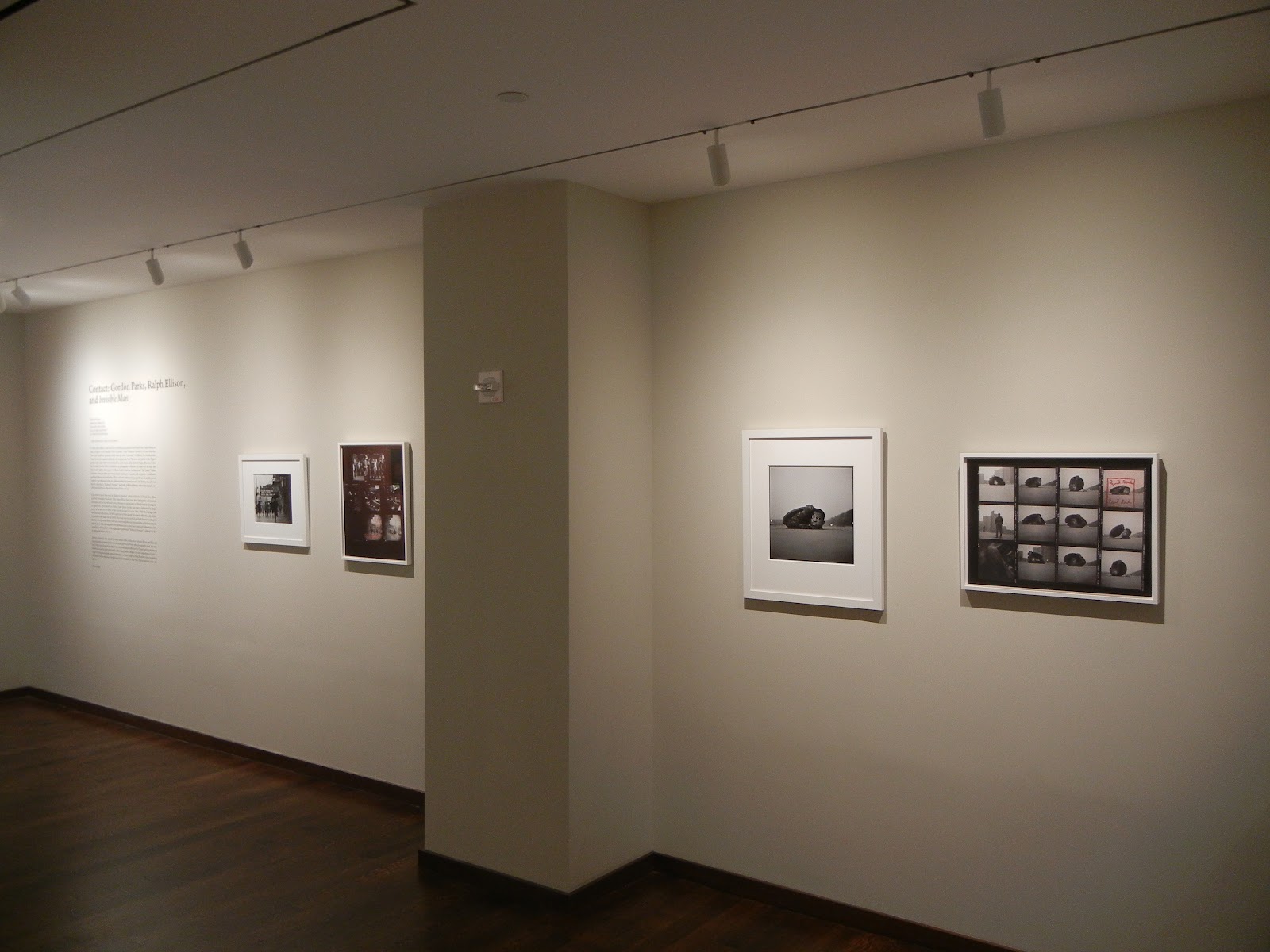
JTF (just the facts): A total of 51 black and white and color photographs and 1 video, variously framed and matted, and hung against light brown walls in the main gallery space, the book alcove, the small back gallery, and one of side viewing rooms. The works in the show were made between 1941 and 1970. The black and white images are a mix of vintage and modern gelatin silver prints, sized between 9x12 and 30x20 (or reverse); no edition information was available for these prints. The color images are later pigment or Ektacolor prints; the pigment prints are sized 24x24 or 20x16 (in editions of 10 and 25 respectively), while the Ektacolor prints are sized 14x19 (with no edition information). The book alcove also includes a display case with 3 LIFE magazines. (Installation shots at right.)
Comments/Context: This centennial exhibit, in honor of the 100th anniversary of the birth of Gordon Parks, successfully gives the viewer an idea of the photographer's tremendous range and talent. The show includes photo essays and street photography made on assignment for LIFE, incisive portraits of artists and celebrities, and even a few fashion shots. Never seen color rarities from the 1950s round out the four decade selection, a treat for those already familiar with Parks and his work. And a mini-retrospective like this one would be incomplete without Parks' now iconic American Gothic, but not to worry, it hides on a side wall, tucked into one of the viewing rooms.
 Parks' documentary work and photo essays are full of simmering tension and emotion. The Fontenelle family stands together at the poverty board desk, clinging to each other, exhausted and grimly resigned to the ruling of the bureaucracy. Gang members openly fight in Harlem streets, followed either by a tender embrace or attendance at a wake. Dirty children in Rio de Janeiro favelas play with spiders and carry water in makeshift parades. And his recently rediscovered color works capture the realities of small town segregation, picking out separate "colored" entrances at the theater, the ice cream shack, and storefront drinking fountains.
 Parks' portraiture is equally accomplished. The show includes powerful images of black leaders and celebrities, from Malcolm X and Stokely Carmichael in the passion of speech making, to a sweaty, meditative Muhammad Ali and a somber Eldridge Cleaver. Duke Ellington is artfully reflected in his piano, a shadowy Langston Hughes stands with an empty picture frame, and Sugar Ray Robinson plays golf with muscular style. These portraits are consistently atmospheric, personal, and full of life.
All in, this is a solid gathering of work from Parks' many projects and interests, and it provides an impressive and useful introduction to one of the most influential African-American photographers of the past century.
 Collector's POV: The works in the show are priced as follows. The gelatin silver prints range in price from $8500 to $25000. The pigment prints range from $5000 to $10000, and the Ektacolor prints are $12000 each. Parks' work has only been sporadically available in the secondary markets in recent years, and many of his most famous images have not come up for sale at auction during that time. Recent prices have ranged between $1000 and $9000, but this may not be entirely representative of the market for his most important photographs.
Rating: * (one star) GOOD (rating system described here)
Transit Hub:
- Parks Foundation site (here)
- Features/Reviews: New Yorker (here), Le Journal de la Photographie (here), Elizabeth Avedon (here)
- Companion Exhibit: Contact: Gordon Parks, Ralph Ellison and "Invisible Man" (DLK COLLECTION review here)
Through October 27th
Howard Greenberg Gallery
41 East 57th Street
New York, NY 10022