Showing posts with label Michael Stevenson Gallery. Show all posts

Tuesday, August 6, 2013

Book: Viviane Sassen, In and Out of Fashion

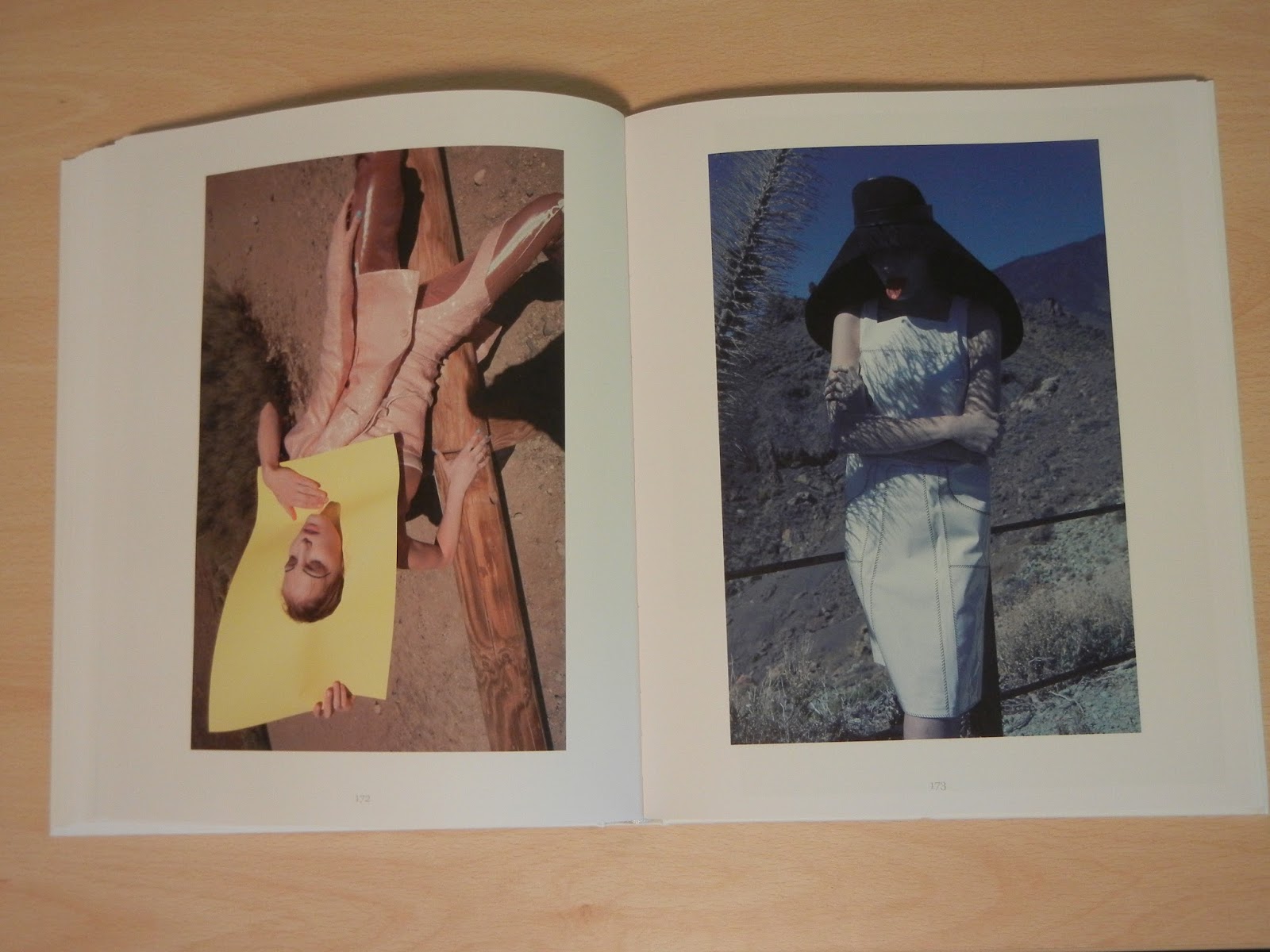
JTF (just the facts): Published in 2013 by Prestel (here). Hardcover, 296 pages, with 250 color images. The volume includes essays by Nanda van den Berg and Charlotte Cotton, and a spread by spread bibliography of Sassen's fashion work from 1998 to 2012. (Spread shots below.)

Comments/Context: For all its attempts to catch our eye with outlandish styling and elaborate set-ups, much of contemporary fashion photography still follows the simple underlying formula of the model and dress (or other accessories) given front and center attention. As a result, no matter how fresh, original, or shocking the surrounding trappings might be, the central compositions have a familiar, generic uniformity to them; there are only so many ways to pose a model while still explicitly featuring the fashions. A casual flip through any thick fashion monthly will quickly clarify the conventional boundaries most fashion photographers are working within.
 
These genre-defining methods are what make Viviane Sassen's fashion photographs seem so unexpected. In comparison to the standard fare, her work brashly defies the normal routines, breaking quietly accepted visual rules left and right. This hefty volume is a retrospective look at Sassen's fashion photography from 1998 to 2012 and offers a seemingly never ending stream of strange surprises. Her pictures are the opposite of obvious or straightforward, forcing the viewer to do a double take just to puzzle out what is going on; she plays on our ingrained expectations, and takes every opportunity to upend those short hand assumptions.
 
Sassen's compositions are built with a knowing eye for how the camera sees. Her models become sculptural human forms, where clothing is almost incidental to the posing of the limbs and torso. Bodies are bent, arched, and contorted in unusual ways, often further fragmented by the reflections of a mirror or made surreal by the intertwining of multiple models into one unlikely mass of arms and legs. Odd camera angles and vantage points (upside down, twisted, off kilter) add another layer of disorientation, making the flattening out of the visual field and the interplay of space even more mysterious. In nearly every shoot, she has rejected any kind of thematic narrative or clichéd setting (a day at the beach, a glamorous nightclub, a city woman on the street etc.) and instead opted for something much more inconclusive, abstract and conceptual.
 
Sassen takes this innovation further by disregarding another foundation rule of fashion photography - the idea that we need to see the model's face. In image after image, she obscures faces, covering them with dark shadows, hair, or simply the rotation of the body getting in our way. At first, this lack of looking eye to eye is meaningfully disconcerting; there is none of the usual back and forth connection we have come to expect. But this visual device forces the viewer to return to the sculptural realm, where beauty is seen in the shapes and forms on view. Sassen can then additional layers of extremity by punctuating a composition with intense light or bold color. Body paint, color filters, flares of color, neon light streaks, or simply the unexpected introduction of a brightly colored prop (a green garden hose, red shoes, an orange scarf, a yellow piece of construction paper) help to unbalance things. By the time all these ideas are crammed into one frame or shoot, Sassen's brand of surreal glamour has become ravishingly unconventional.
 
Seen across more than a decade of work, the originality in Sassen's eye is proven to be remarkably varied and consistent; time and again, she has done something startling, kicking us out of our visual ruts. Hers is the kind of work that always keeps us guessing, making us active and engaged participants in her images, rather than glassy eyed zombies mindlessly searching for the next fashions to consume.
 
Collector’s POV: Viviane Sassen is represented by Stevenson Gallery in Cape Town (here); she does not appear to have consistent representation in New York. More broadly, her work has not yet reached the secondary markets with any regularity, so gallery retail remains the best option for those collectors interested in following up.
 
Transit Hub:
  • Artist site (here)
  • Exhibit: Huis Marseille Museum, 2013 (here)
  • Features/Reviews: Time LightBox (here), photo-eye (here),  Feature Shoot (here)


Tuesday, August 4, 2009

Book: Guy Tillim, Avenue Patrice Lumumba

JTF (just the facts): Published in 2008 by Prestel (here) in association with the Peabody Museum of Archaeology and Ethnology, Harvard University. 128 pages, with 60 color images, each a two page spread. Includes essays by Robert Gardner and the artist. All of the images were taken in 2007 and 2008. Locations include the DR Congo, Ghana, Angola, Mozambique, and Madagascar. (Cover shot at right, via Photo Eye.)

Comments/Context: Patrice Lumumba was the first elected Prime Minister of the Democratic Republic of Congo after it gained its independence from Belgium in 1960. Only a few months later, he was deposed in a coup and assassinated, but his nationalist dreams have lived on a number of African states, where his name adorns streets, buildings, and other monuments.

South African photographer Guy Tillim has been documenting the complex environment of post-colonial Africa for more than two decades, successfully bridging the worlds of photojournalism and fine art. This recent body of work focuses on the everyday life in a handful of African nations, as embodied by the decaying Modernist buildings left over from the late colonial times and their reuse by the current population.

What were once optimistic, clean lined concrete boxes, with geometric patterns and fancy grillwork, are now aging administration buildings and apartment blocks, covered in water damage and pollution stains, peeling paint, broken windows and rotting concrete. Stunted trees and weed strewn scrub are all that remain of the tidy landscapes; roadways are cracked and unmaintained. Toppled and beheaded statues lie forgotten in empty courtyards. Hotel swimming pools are overgrown and abandoned. Laundry flutters from Modernist adornments.

Inside, shadowy bare rooms have become simple offices with cast off, mismatched furniture, workers processing paperwork using antique typewriters and rubber stamps; papers and files have been stacked in mountains. The colors are muted and washed out, the action slow and deliberate. People are seen from back, gazing out of upper floor windows. Bright, pure light floods into the worn rooms and buildings. Simple surfaces like the dented top of a wooden desk or the chipped layers of paint on the edge of a door frame have become stories of their own.

These images are full of contrasts and juxtapositions, of what might have been and what has actually transpired. While it might be easy to see these images as discouraging or depressing, there is a quality of grace that Tillim has found amidst the rubble that makes these images rise into something altogether more poetic. The ravages of time are certainly in evidence, as are the hopes that didn't come true and the plans that didn't quite work out. In the end, these are quiet, contemplative pictures that powerfully chronicle what happens when the bright future doesn't actually take place.

Collector’s POV: Guy Tillim is represented by Michael Stevenson Gallery in Cape Town (here). Tillim's work has not yet found its way into the secondary markets in any volume, so gallery retail will be the best/only option for follow up in the short term.

I think I first saw this body of work at Michael Stevenson's booth at the Armory earlier this year. Seeing it again in book form has increased my appreciation for the images; it's a terrific book and I think the meditative story is much fuller and more resonant when seen across a wider group of pictures.

Transit Hub:
  • Exhibitions: FOAM through August 30 (here), Peabody through September 7 (here)
  • Reviews: 5B4 (here), Foto8 (here)
  • Interviews: Lens Culture (here), Verbal Hmmm (here), Natal Witness (here)