Showing posts with label Richard Misrach. Show all posts

Tuesday, June 18, 2013

Richard Misrach, On the Beach 2.0 @Pace

JTF (just the facts): A total of 13 large scale color photographs, framed in either off white, blond or black wood and unmatted, and hung in the single large gallery space, which is divided into three separate viewing areas. All of the works are pigment prints mounted to either aluminum or Dibond, and made in 2011 or 2012. Physical sizes range from 63x83 to 88x146; the largest of the prints are available in editions of 3+1AP, while the rest are available in editions of 5+1AP. (Installation shots at right.)

Comments/Context: It's been nearly a decade since Richard Misrach surprised us all with his On the Beach series. Made in reaction to the September 11th attacks, his aerial images of Hawaiian beaches astounded us with their enveloping, monumental scale and subtly reminded us of our vulnerability out there alone in the water. While many of the images were bright and sunny, with clusters of colorful beachgoers arrayed at the water's edge, there was a sense of something vaguely unsettling lurking underneath, adding a layer of tension to the idyllic vacation paradise. Misrach recently went back to his Honolulu hotel room perch and made a new series of bird's eye view pictures of the sea and sand. While the subject matter is arguably the same and the massive scale has been repeated, the mood of these pictures is subtly different, slightly more relaxed and meditative.

There are really two sets of photographs in this show, one with figures and one without. The images without tiny isolated people expand into all over abstractions, where dappled light bounces off the wave tops creating endless patterns of ripples. Misrach's palette is quietly muted, running from soft blues, greens, greys and tans, to darker bronzes and blacks. Given their size, standing in front of one of these ocean images is like getting lost in painterly texture, the entire surface an amorphous, undulating series of blobs and squiggles. While their detail is staggeringly precise up close, the sense of scale is lost without any identifiers; the water fans out like a series of dunes, stretching on for what might be feet or miles.

When even a single small figure is introduced to the sea or sand, the abstraction collapses and our eye is drawn to the central character. Now we're drawn back into the realm of narrative, where a guy with a book over his face, a determined swimmer, or a body wrapped in a pink towel becomes the tentative basis for a story. The best image in this group captures a solitary woman on a surfboard, looking away to the expanse of ocean in the darkening afternoon; her wistful presence turns the scene into something out of a 19th century Romantic painting, with the tiny figure in the foreground to remind us of the awe inspiring majesty of the vista. While Misrach has retained the sense of separation and distance in these pictures, the foreboding feeling of the previous works has been replaced with a more easy going mood - instead of struggling against the endless water, his figures execute perfect handstands and playfully perch on each other's shoulders.

In revisiting this series, Misrach seems to have been less concerned with recapturing a certain temperament and more seduced by the nuances of detailed texture. The subtle undercurrent of menace that permeated the first project is generally gone, replaced by a deeper interest in the changing surface of the water and the shifting footprints in the sand. With the setting afternoon sun comes a sense of contemplation, a slow mulling over of the endless cycles of ebb and flow.

Collector's POV: The works in this show are priced as follows. The smallest 63x83 (plus or minus an inch or two in either direction) are priced at $55000 each. Intermediate sized works are either $65000 or $850000, and the largest works (88x146) are $90000 each. While this show is taking place at the Pace Gallery space on 25th Street, it is being jointly organized by Pace and Pace/MacGill Gallery (here). Richard Misrach is also represented on the West coast by Fraenkel Gallery (here).

Rating: * (one star) GOOD (rating system described here)

Transit Hub:
  • Features/Reviews: Daily Serving (here)
 
Through June 29th

Pace Gallery
510 West 25th Street
New York, NY 10001

Tuesday, October 23, 2012

Richard Misrach, The Desert Cantos @Mann

JTF (just the facts): A total of 20 large scale black and white and color photographs, framed in white and variously matted/unmatted, and hung unframed against white walls in the main gallery space. 16 of the works are chromogenic dye coupler prints (1 has a laminate surface), made between 1984 and 1999. The other 4 works are vintage split-tone prints, made between 1975 and 1977. Physical dimensions generally range from 14x14 to 48x60; no edition information was available. (Installation shots at right.)

Comments/Context: Spanning more than 15 years, made up of literally hundreds of photographs, and divided into 20 separate and distinct thematic subsections, Richard Misrach's Desert Cantos were a huge artistic undertaking. Such a broad body of work can't possibly be jammed into a single gallery show without trade-offs, omissions, and sacrifices, and so what we have here is really more of a jumbled appetizer plate of Desert Cantos ideas rather than anything comprehensive or in-depth. These core images have been bracketed by a few early and a few more recent photographs, spreading the focus of the exhibit even wider. For those unfamiliar with Misrach, the show provides a succinct overview-style introduction to his output over three decades.

A preliminary scan of the gallery provides a striking sense of tone and color; Misrach's palette is full of expansive pastels and soft yellow sands. The intensity of a fire, the stillness of a flood, the wispy gradient of a massive sky or a clearing storm, all of these natural events are exercises in luscious color. But a closer inspection of the pictures opens up multiple lines of thinking beyond pure aesthetics: an abandoned atomic bomb pit, a burned out bus, a dead animal, a buried rocket, a deflated oversized globe (a Burning Man leftover), a Playboy magazine shot full of holes, these are the evidence of an active, not necessarily benign human presence in the desert. Misrach's famous image of the orange dining sets in the middle of the blistering white salt flats caps this sense of puzzling intervention in the unforgiving landscape.

The show also includes several early flash lit night images (palms, monumental rocks), a vast, tumultuous Golden Gate Bridge vista, and even one of the Louisiana pipeline photographs from the recent Aperture show, albeit on a much smaller scale (review here). These pictures provide a skeleton framework for Misrach's artistic evolution, perhaps overly simplified but at least offering a few reference points to help generate a continuum.

Overall, this little of this, little of that gathering is a solid reminder of the enduring strength of the Desert Cantos project. These pictures are now forever part of the history of the American landscape, still fresh and relevant even decades later.

Collector's POV: The prints in this show are priced as follows. The chromogenic dye coupler prints range in price from $12000 to $50000 (some are already sold), while the split-tone prints are either $22000 or $35000. Misrach's work is routinely available in the secondary markets, with prices ranging from roughly $2000 to $80000, with his newer, much larger prints at the top end of that scale. Misrach is represented in New York by Pace/MacGill Gallery (here) and in San Francisco by Fraenkel Gallery (here).

Rating: * (one star) GOOD (rating system described here)

Transit Hub:
  • Features/Reviews: Wall Street Journal (here), PDN Photo of the Day (here)
Through October 27th

Robert Mann Gallery
525 West 26th Street (new location)
New York, NY 10001

Monday, September 10, 2012

Petrochemical America: Project Room, Photographs by Richard Misrach, Throughlines by Kate Orff/SCAPE @Aperture

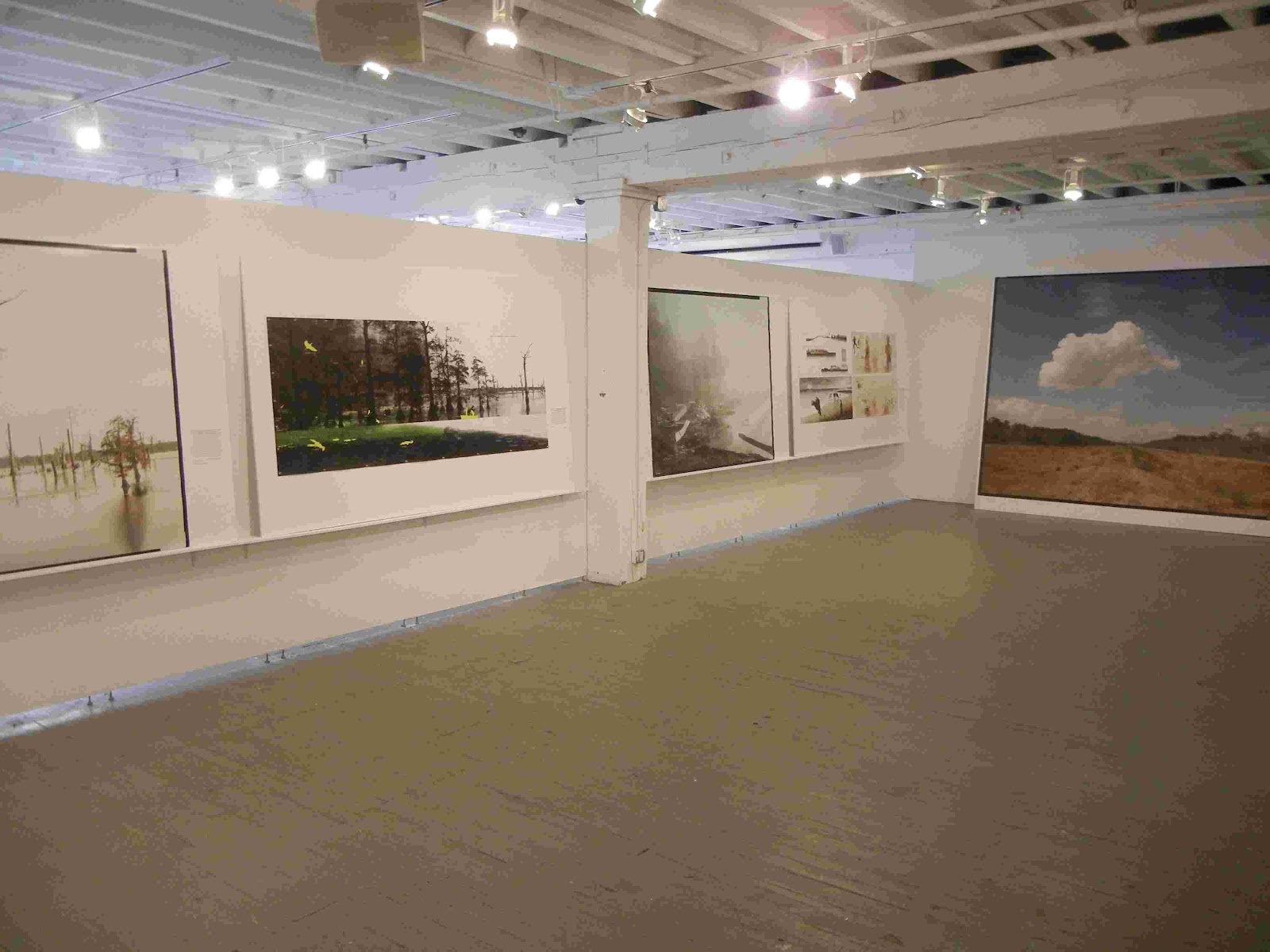
JTF (just the facts): A total of 32 color photographs and 20 maps, diagrams, and other informational displays/ephemera, hung unframed against dark blue and white walls in the main gallery space. Misrach's exhibition prints are sized either 96x120 or 60x76/82 and have been pinned directly to board, the largest leaning against the walls at angles. There is also an array of original contact prints, each sized 8x10. All of the works are digital c-prints, the vast majority taken in 1998, with an outlier or two made in 2010. Orff's diagrams are mounted directly to board and displayed on small ledges. A two-sided plexiglas divider wall contains a dense selection of sketches, emails, and preliminary drawings, and a small table contains two copies of the book and its supplement for easy viewing. An in-depth monograph of this body of work was recently published by Aperture (here) and is available in the bookshop for $80. (Installation shots at right.)
 
Comments/Context: The last decade has seen a marked increase in the photographic investigation of the oil industry in America. Many leading contemporary photographers have tackled this immense subject (most notably Mitch Epstein and Edward Burtynsky) and made pictures of wells, refineries, the Gulf oil spill, and the whole end-to-end delivery chain of petrochemical products that has touched nearly every corner of American society. Given the scale of the industry, most of these pictures play with size and scope in formal ways, juxtaposing large with small, corporate with community, ugly with beautiful. We have come to expect a looming hugeness in these kinds of images, where an attempt is made to simplify this bafflingly complex industry by boiling it all down to a handful of iconic visual motifs.
 
Richard Misrach's approach to documenting the world of oil is in many ways a contrarian response to this dumbing down trend. Pairing up with landscape architect Kate Orff, the two have produced an exhibit which positively revels in complexities, diving deep into the interconnected details and working extremely hard to connect the dots coherently. Instead of looking at issues on a worldwide scale, they have focused on a stretch of the Mississippi River from Baton Rouge to New Orleans (a corridor known as "Cancer Alley"), and have collaboratively explored the impact of the industry on virtually every factor of life in this zone, from economic growth to toxic waste, from swamp ecosystems to food cycles.
 
Given this intellectual mindset, Misrach's photographs come off as extremely careful and deliberate. The obvious juxtapositions are still there (a big refinery dwarfing a small house, a pipeline running through a swampy marsh, a forest of dead cypresses, a basketball hoop backed by another refinery etc.) but each image seems precisely chosen with an eye for illustrating a specific piece of the larger story. There are subtle angles on poverty, the gradual poisoning the community, misty historical ghosts, and the enduring life of the river. Orff's diagrams and maps trace and define these ideas more fully, grappling with the complexities of how waste is metabolized, how synthetic nitrogen cycles through the environment, and how the flora and fauna of the bayou is being transformed. It's brainy, time-consuming, scientific stuff, with a focus on secondary and tertiary downstream impacts, and its density is smartly balanced by Misrach's visually elegant vignettes which help bring home the key messages.

What I like best about this exhibit is its respect for the viewer, its attempt to unpack something seemingly impenetrable and make sense of it in a manner that requires real attention and thoughtful engagement. The dialogue between the photographs and the supporting material produces something that is successfully both emotional and educational, where the fluffy 19th century cumulus clouds over the Shell refinery are initially quite beautiful and then revealed to be fed by the flare of hydrocarbons coming from the plant, giving us a grim sense for the multi-layered complexity of what's really going on. Overall, Misrach and Orff make a persuasive, deftly constructed argument here, combining photography and rigorous investigation into something rich and weighty, going beyond the easy simplicity of a bunch of well made pictures.
 
Collector's POV: Since this venue is typically a non-selling environment, there were, of course, no posted prices for the photographs. Misrach's work is consistently available in the secondary markets, with prices ranging from roughly $2000 to $80000, with his newer, larger prints at the top end of that range. Misrach is represented in New York by Pace/MacGill Gallery (here) and in San Francisco by Fraenkel Gallery (here).
 
Rating: * (one star) GOOD (rating system described here)
 
Transit Hub:
  • Exhibit: High Museum of Art, 2012 (here)
  • Kate Orff's SCAPE bio (here)
Through October 6th
 
547 West 27th Street
New York, NY 10001

Friday, March 30, 2012

2012 AIPAD Review, Part 1 of 2

With two sessions at this year's AIPAD under my belt (the opening night event and a solid bunch of hours yesterday afternoon), I can say with confidence that the overall sophistication of this anchor event in the NY photo year continues to increase. There are less overcrowded, bin stuffed booths, more well edited and thoughtful displays, and slowly but surely, a little more contemporary work is creeping into this traditionally vintage affair. The gala Wednesday evening was polished and well attended, and I thoroughly enjoyed seeing countless old friends, and meeting some of the many collectors, curators, critics, artists and gallery owners that I had previously known only by email or reputation. Year after year, there is an evolution away from casual, table based selling and a movement toward more refined service.

While I left my notebook at home on opening night, I was more systematic yesterday, covering the fair aisle by aisle, booth by booth. My notes cover approximately 40+ booths in some level of detail, generally listing the photographers with works on view, the number of prints on display, and in some cases, specific works that I thought merited attention or were new. Of course, my coverage of this show is perhaps more personally biased towards our own collecting interests than normal, and there is a significant amount of vintage work on display, so my apologies in advance if my selections are overly dominated by black and white. Also, I have generally refrained from talking about work which I have recently covered in review form; this provides some limits for my discussion, especially for those galleries that have opted for a sampler from the current stable.

My review is divided into two parts. This first part covers a selection of the out of town galleries, in alphabetical order. The second part will cover some of the New York galleries, as well as a few close by Northeastern neighbors. Covering this entire sprawling show in exhaustive detail is beyond the scope of what I can realistically deliver, so please don't take it personally if I have omitted your gallery or your work. My goal is to give readers a flavor of what I thought was intriguing and thought provoking, not to provide an analysis of every image on view, in the bins/flat files, and under the tables.

Stephen Bulger Gallery (here): Robert Bourdeau (4), Andre Kertesz (2, 1 diptych, 1 set of 5), Gilbert Garcin (6), Fausta Faccipone (1), Allison Rossiter (11), Clive Holden (1 set of 4), Scott Conarroe (1), Dave Heath (1 set of 6), Jospeh Hartman (1), Benoit Aquin (1). Lots of new abstract poured/dipped chemical Rossiters here, a few almost like landscapes or starry skies.

John Cleary Gallery (here): Susan Burnstine (3), Maggie Taylor (3), Ansel Adams (1), Henri Cartier-Bresson (2), Robert Mapplethorpe (1), Robert Doisneau (1), Gordon Parks (1), Willy Ronis (1), Sanko Abadric (1), Renate Aller (2), David Fukos (2), John Chakeres (2), Brett Weston (2). Had a thoughtful discussion about pricing in the market for Mapplethorpe flowers in this booth, triggered by the Tiger Lily on display priced at $40000.

Stephen Daiter Gallery (here): John Gossage (2), Imogen Cunningham (3), Art Sinsabaugh (2), Adam Fuss (1), Andre Kertesz (4), Harry Callahan (1), Stanley Kubrick (1), Weegee (3), Sid Grossman (1), Marvin Newman (1), Aaron Siskind (1), Minor White (1), Frederick Sommer (2), Alex Webb (4). I continue to find Sinsabaugh's elongated Midwestern landscapes to be powerfully original; this one was priced at $16000 and already sold.


Catherine Edelman Gallery (here): Gary Briechle (9), John Cyr (9), Daniel Beltra (1), Viktoria Sorochinski (4), Lauren Simonutti (10), Kelli Connell (2), Gregory Scott (1). Briechle's gelatin silver prints from wet plate collodion negatives are darkly old school. Look closely at scar on this wrinkled hand, echoed by the gathering of the sleeve (reasonably priced at $1400 each). John Cyr's images of the developer trays of famous photographers (Mann, Siskind, Gowin, Davidson etc.) were also drawing a crowd.


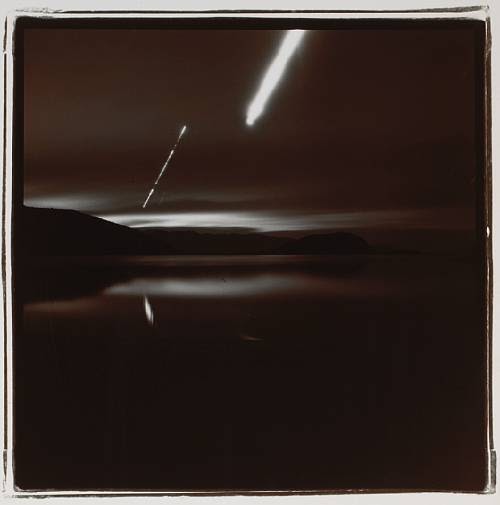
Etherton Gallery (here): Harry Callahan (7), Manuel Alvarez Bravo (4), Frederick Sommer (6), Emmet Gowin (4), Allen Ginsberg (1), August Sander (1), Duane Michals (1), John Gutman (1), Wright Morris (2), Henry Wessel (3), Ansel Adams (2), Richard Misrach (3), O. Winston Link (2), Ralph Gibson (2), Lee Friedlander (2), Horace Bristol (1), Peter Stackpole (2), Rodrigo Moya (1), Ted Croner (1), Flor Garduno (1), Joel-Peter Witkin (1), Eikoh Hosoe (1), Aaron Siskind (4), Michael O'Neil (1), Danny Lyon (4). I think the flash lit mid 1970s night Misrachs are among his best; I enjoyed this one with its spiky verticals and the long exposure light trail in the sky.


Eric Franck Fine Art (here): Karen Knorr (3), Josef Koudelka (3), Graham Smith (6), Chris Killip (4), Martine Franck (4), Andy Warhol (3), Ogawa Gesshu (3), Heinz Hajek-Halke (4), Gaspar Gasparin (6), Henri Cartier-Bresson (5), Norman Parkinson (5). I continue to be impressed by Killip and Smith and wish their work was more consistently on view here in New York. There was also a terrific Warhol of stratified neckties on a side wall.

Halsted Gallery (here): Irving Penn (4), Jaromir Funke (1), Brassai (1), Wynn Bullock (1), Edward Weston (4), Andre Kertesz (2), Michael Kenna (1), Barbara Morgan (1), Bill Brandt (1), Henri Cartier-Bresson (1), Arnold Newman (2), Lucien Herve (1), Berenice Abbott (4), Cornell Capa (1), William Clift (1), Carleton Watkins (2), Don Hong-On (1), Margaret Bourke-White (1), Annie Leibowitz (1). This intimate, reasonably priced ($12000) Funke abstraction from the late 1920s was a quick seller.


Paul M. Hertzmann Inc (here): Sherril Schell (1), Clarence John Laughlin (1), Ei-Q (3), Ansel Adams (6), Henri Cartier-Bresson (1), Edward Weston (2), Alfred Stieglitz (1), Dorothea Lange (1), Man Ray (1), Carlotta Corpon (1), Eugene Atget (1), Dennis Stock (1), Frank Espada (1), Joe Schwartz (1), Roger Schall (1), Minor White (1), Ruth Bernhard (1), Gerard Petrus Fieret (1), plus 4 bins. Someone (annoyingly) snapped up this sublime Schell of Penn Station almost immediately, as it had a red dot just minutes into the evening gala.


Paul gave me a short primer on Japanese photographer Ei-Q (aka Hideo Sugita), who was apparently of Eikoh Hosoe's teachers. I very much enjoyed this densely layered photogram, made using cut paper stencils and modifications to the negative. (priced at $22500)


There were also a handful of small 1930s vintage Ansel Adams prints on view, as well as a lovely solarized calla lily by Corpon.

Michael Hoppen Gallery (here): Shomei Tomatsu (3), Miyako Ishiuchi (1), Issei Suda (1), Kishin Shinoyama (1), Hiroshi Hamaya (2), Daido Moriyama (2), Valerie Belin (2), Noe Sendas (3), Bruce Bernard (3), Sigmar Polke (1), Guy Bourdin (4), Boris Savalev (1). I liked the bold patterns of the Moriyama fishnet stocking variants here. Two new muted black and white Belins dominate the main wall.

James Hyman Photography (here): Pierre Manguin (3), Henri Le Secq (2), Bisson Freres (2), Charles Negre (4), Edmund Bacot (2), Louis Alphonse de Brebisson (1), Edmund Nicolas (1), Pierre-Emile-Joseph Pecarrere (1), Amedee Varin (1), Edouard-Denis Baldus (2), Vallou de Villeneuve (1), Henri Ange Eugene Mailand (1), Gustave Le Gray and Auguste Mestral (1), Anonymous (3), Neurdein School (1), Paul Strand (1), Edward Weston (1), Francesca Woodman (1), Lucien Clergue (2), Arthur Siegel (1), Harry Callahan (2), Eugene Atget (4), Tony Ray-Jones (4). The inside of the Hyman booth has been transformed by a well-edited selection of 19th century French church/monastery images, complete with muted light, a sculptural fragment in the center, and images of gargoyles high on the walls.

Jackson Fine Art (here): George Georgiou (2), Chip Simone (4), Frank Horvat (2), Todd Selby (1), Greg Lons (4), Todd Murphy (3), Mona Kuhn (4), Vivian Maier (3), Ruud Van Empel (3).

Kopeikin Gallery (here): Irving Penn (1), Jeffrey Milstein (2), Lee Friedlander (2), David Schoerner (1), Harry Callahan (3), Katy Grannan (2), Sally Mann (1), Peter Beard (1), Robert Frank (1), Andy Freeberg (1), Garry Winogrand (3), Chris Jordan (1), Marta Soul (1), Moby (1), Kevin Cooley (1). I liked the smaller black and white Grannan portraits in this booth best. Jordan has reworked Van Gogh's Starry Night in thousands of colored plastic lighters, a bit more painterly and Vik Muniz-like than previous images of his I've seen.

Lee Gallery (here): Walker Evans (1), Julia Margaret Cameron (1), JB Greene (1), Bisson Freres (1), Carleton Watkins (1), Charles Negre (1), Harry Callahan (7), Robert Adams (4), plus 4 bins. The Lee's booth was dominated by a string of exquisite vintage Callahans across the back wall. Below are two nudes that came out of the boxes for a closer look: a terrific early (mid 1960s) Barbara Crane, and a sculptural 1934 Weston of Charis.


M+B (here): Matthew Brandt (7), Matthew Porter (3), LeRoy Grannis (4), Lisa Jack (4). Brandt was the big story in this booth, with 3 images on a nearby outside wall made by submerging the large prints in the bodies of water they depict (leading to abstract, acidic swirls) and 4 works made out of different flavors of brightly colored chewing gum hung across the back wall.

Monroe Gallery (here): Nina Berman (4), Eric Smith (2), Rikki Reich (2), Steve Schapiro (6), Carl Mydans (1), Grey Villet (4), Bill Eppridge (7), Paul Schutzer (1), Carl Iwasaki (1), Bob Gomel (1), Martha Holmes (2), John Dominis (1), Stephen Wilkes (2). A startling Berman of a veiled woman with her diploma is on the outside wall.

Richard Moore Photographs (here): Peter Sekaer (2), Dorothea Lange (3), Marion Post Wolcott (1), Walker Evans (1), Ben Shahn (1), Ansel Adams (4), Sonya Noskowiak (1), Imogen Cunningham (1), William Post (1), Helen Levitt (1), Weegee (2), Percy Loomis Sperr (4), Eadward Mybrudge (1), plus 3 bins. The eye catching Cunningham Magnolia Blossom had a major tear, which had been repaired quite well but clearly changed its value by an order of magnitude.

Scheinbaum & Russek Ltd. (here): Aaron Siskind (3), Arnold Newman (1), Brassai (1), Jerry Uelsmann (2), Lee Friedlander (1), Paul Strand (1), John Szarkowski (1), Paul Caponigro (1), Minor White (3), Edward Weston (1), Ansel Adams (1), Brett Weston (1), Berencie Abbott (1), Harry Callahan (2), Andre Kertesz (2), Todd Webb (4), Laura Gilpin (2), Eliot Porter (6), Diane Arbus (1), Henri Cartier-Bresson (2), Manuel Alvarez Bravo (2), Van Deren Coke (2), Roy DeCarava (1), W. Eugene Smith (1).

Barry Singer Gallery (here): Elyn Zimmerman (2), Lewis Hine (1), Edmund Teske (1), Arnold Newman (2), W. Eugene Smith (1), August Sander (2), Joel-Peter Witkin (1), Garry Winogrand (1), Robert Doisneau (1), John Albok (1), Marcia Resnick (1), Lou Stoumen (3), Ansel Adams (2), William Dassonville (1), Bill Brandt (1), Brett Weston (1), Wilson Bentley (1), Charles Jones (1), Edward Weston (1), Robert Graham (7), Herb Ritts (1), Jack Welpott (1), plus 4 bins.

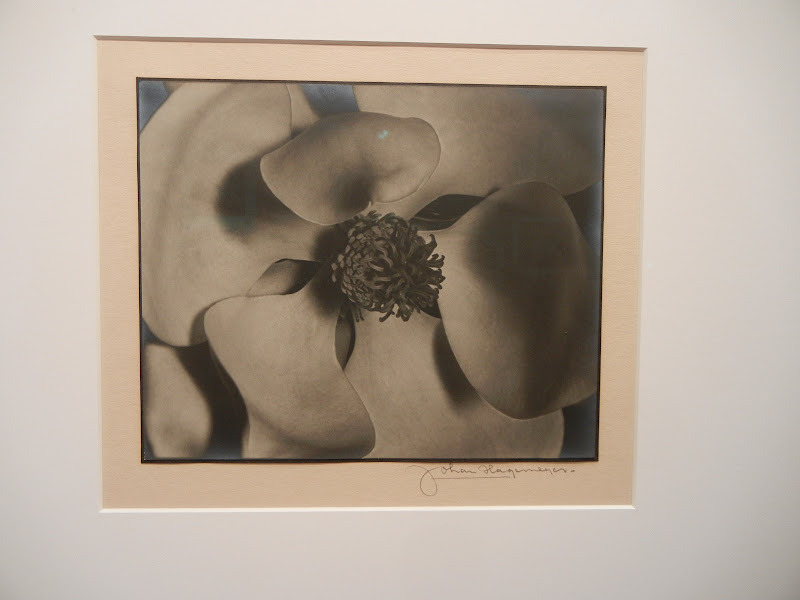
Joel Soroka Gallery (here): Lynn Bianchi (1), Cig Harvey (4), Franco Donnagio (1), Berencie Abbott (2), Jindrich Vanek (1), Man Ray (1), Johan Hagemeyer (1), Ilse Bing (1), Brassai (1), Brett Weston (1), Gyorgy Kepes (3), Beatrice Helg (4). While there was an excellent group of Kepes abstracts along the back wall, this elegant Hagemeyer floral caught my eye, fully priced at $40000.


Weinstein Gallery (here): Alec Soth (5), Helmut Newton (1), Robert Mapplethorpe (5), Robert Polidori (3), Vera Lutter (4), Nancy Rexroth (18). Three huge Polidoris of India cover the entire back wall of the booth; one is a dense warren of overlapping slum geometries. The Soths are from Bogota, the Lutters from Venice.

Weston Gallery (here): Oliver Gagliani (2), Harry Callahan (2), Marion Post Wolcott (2), George Tice (1), Sonya Nostowiak (1), Henri Cartier-Bresson (1), Danielle Nelson-Mourning (2), Hill & Adamson (2), Linnaeus Tripe (1), Charles Aubry (1), Andre Kertesz (1), Robert Frank (1), Johan Hagemeyer (1), Edward Weston (4), Paul Strand (2), Wynn Bullock (1), Ansel Adams (8), Imogen Cunningham (2).

Part 2 of the review can be found here.

Monday, April 25, 2011

Auction: Photographs, May 10, 2011 @Bonhams

Bonhams' various owner Photographs sale in two weeks has a deeper selection of Sugimoto prints than we've seen at auction anywhere this year. The top seven lots in the sale are all Sugimotos, including a solid mix of seascapes and blurred architecture images; another four Sugimotos can be found down the estimate list a little further. Overall, there are 170 photographs on offer, with a total High estimate of $1283600.
Here's the statistical breakdown:

Total Low Lots (high estimate up to and including $10000): 139
Total Low Estimate (sum of high estimates of Low lots): $673600
.
Total Mid Lots (high estimate between $10000 and $50000): 31
Total Mid Estimate: $610000

Total High Lots (high estimate above $50000): 0
Total High Estimate: NA

The top lot by High estimate is tied between two lots: lot 122, Hiroshi Sugimoto, Colors of Shadow C1018, 2006, and lot 123, Hiroshi Sugimoto, Colors of Shadow C1027, 2006, (image at right, top, via Bonhams), both at $30000-50000.
.
Below is the list of photographers represented by 4 or more lots in the sale (with the number of lots in parentheses):

Ansel Adams (13)
Hiroshi Sugimoto (11)
Lee Friedlander (8)
Edward Curtis (7)
Alfred Eisenstaedt (6)
Joel Meyerowitz (5)
Richard Misrach (5)
Peter Beard (4)
Andre Kertesz (4)
Michael Light (4)
Irving Penn (4)
Sandy Skoglund (4)
Joel-Peter Witkin (4)

(Lot 89, Lee Friedlander, Stems, 1994, at $3000-4000, image at right, middle, and lot 131, Richard Misrach, Plate 4 from Desert Night Series, 1977, at $5000-7000, image at right, bottom, both via Bonhams.)
.
The complete lot by lot catalog can be found here.

Photographs
May 10th
.
Bonhams
580 Madison Avenue
New York, NY 10022

Monday, January 17, 2011

Richard Misrach: Graecism Portfolio @Richardson

JTF (just the facts): A total of 6 color photographs, framed in white and matted, and hung in the small Project Gallery in the back. All of the prints are vintage dye transfer prints, each roughly 16x20, drawn from a portfolio of 12 images that was published by Grapestake Gallery in an edition of 25. The images were taken between 1978 and 1981. This exhibit supports a larger show of Mars scenes by Kahn & Selesnick on view in the main gallery. (Installation shots at right.)

Comments/Context: Richard Misrach's Graecism portfolio chronologically falls between his flash lit nighttime Hawaiian jungles and his Desert Cantos. Stylistically, the works follow in the footsteps of the jungle pictures, using a similar strobe lighting/long exposure technique to add bright light to the foreground of otherwise dark outdoor scenes, but in this case, his subjects are the ruins of Greece and Rome: temples, columns, and weathered fallen stone.

The ideas I found exciting in the Hawaiian landscapes (their departure from traditional rules of landscape) can also be seen in some of these architectural pictures. Instead of taking the obvious postcard views in the serenity of the sunset/twilight, Misrach has broken up the picture plane with columns that have been bleached white by the flash, making them jump out of the surrounding and encroaching shadows. Another image documents the nothingness of a bare dirt patio looking out into blackness. For the most part, he resists the temptation to do what has been done before by tourists across the ages, and instead explores the unexpected and often jarring contrasts of color and light introduced by the strobe.

Prior to seeing this show, I hadn't ever encountered images from this project, so this small exhibit provided a nice gap filler for my understanding of Misrach's history.

Collector's POV: The six images in this show are being sold separately (rather than as a portfolio), each at $5000. Misrach is officially represented in New York by Pace/MacGill Gallery (here) and in San Francisco by Fraenkel Gallery (here). Misrach's works are generally available in the secondary markets, especially his desert images; these have typically ranged from $2000 to $12000, with a few outliers even higher. His newer works of more significant size have also begun to enter the auction markets; these have generally ranged between $40000 and $80000.
.
My favorite image in the show was Athena, Nike (column), 1979; it's the image on the far right in the bottom installation shot. I like the way the brightly lit column cuts directly through the center of the frame, breaking up the view of the temple in the background.
.
Rating: * (one star) GOOD (rating system described here)

Transit Hub:
  • Recent 2010 show @PaceWildenstein (DLK COLLECTION review here)
Richard Misrach: Graecism Portfolio
Through February 19th

535 West 22nd Street
New York, NY 10011

Friday, December 17, 2010

Auction Results: Photographs, December 13, 2010 @Christie's

The results of Christie's final various owner Photographs sale of the year generally met expectations, falling right in the heart of the estimate range. Even though the two Penn lots that topped the sale failed to sell, a handful of prints by Peter Beard picked up the slack. The overall Buy-In rate came in just over 25%, ensuring a solid if uneventful outing.
.
The summary statistics are below (all results include the buyer’s premium):
.
Total Lots: 187
Pre Sale Low Total Estimate: $830500
Pre Sale High Total Estimate: $1234000
Total Lots Sold: 139
Total Lots Bought In: 48
Buy In %: 25.67%
Total Sale Proceeds: $920688

Here is the breakdown (using the Low, Mid, and High definitions from the preview post, here):

Low Total Lots: 173
Low Sold: 127
Low Bought In: 46
Buy In %: 26.59%
Total Low Estimate: $951000
Total Low Sold: $716938

Mid Total Lots: 14
Mid Sold: 12
Mid Bought In: 2
Buy In %: 14.29%
Total Mid Estimate: $283000
Total Mid Sold: $203750

High Total Lots: 0
High Sold: NA
High Bought In: NA
Buy In %: NA
Total High Estimate: $0
Total High Sold: NA
.
The top lot by High estimate was tied between two lots: lot 65, Irving Penn, Cuzco Children, Neg. No 142, Peru, Dec 1948, 1949, and lot 137, Irving Penn, Juliet Auchincloss, 1949, both at $30000-50000; neither of these lots sold. The top outcome of the sale was lot 160, Carrie Mae Weems, Untitled #2450, from Kitchen Table Series, 1990, at $35000 (image at right, top, via Christie's).

While only 70.50% of the lots that sold had proceeds in or above the estimate range, there were a total of thirteen surprises in this sale (defined as having proceeds of at least double the high estimate):
.
Lot 23, Richard Misrach, White Man Contemplating Pyramids, 1989/1991, at $13750 (image at right, middle, via Christie's)
Lot 50, Ansel Adams, Jeffrey Pine, Sentinel Dome, 1940/Later, at $7500
Lot 73, Peter Beard, 150-160 Iber, Tsavo North, along Athi-Tiva, in hunting block 33, Feb 1965, Later, at $21250 (image at right, bottom, via Christie's)
Lot 74, Peter Beard, From The End of the Game (Last Word from Paradise), c1965/Later, at $18750
Lot 75, Peter Beard, Bibiana at El Molo Bay, Loiyangalani, Lake Rudolph, 1968/Later, at $26250
Lot 76, Peter Beard, Orphaned Cheetah Cubs at Mweiga National Park headquarters, 1968, at $27500
Lot 88, George Tice, Country Road, Lancaster, Pennsylvania, 1991/1999, at $7500
Lot 107, Leif Erik Nygards, Marilyn Monroe, Bel Air Hotel, June 27th, 1962/Later, at $7500
Lot 110, Henri Cartier-Bresson, La Plaine de la Brie, 1968/1970s, at $20000
Lot 122, Eddie Adams, Symbolism: March on Washington, 1963, at $9375
Lot 135, Ruth Bernhard, Hips Horizontal, 1975, at $16250
Lot 160, Carrie Mae Weems, Untitled #2450, from Kitchen Table Series, 1990, at $35000 (image at right, top, via Christie's)
Lot 179, Elliott Erwitt, New York City, 1953/Later, at $10625

Complete lot by lot results can be found here.

Christie's
20 Rockefeller Plaza
New York, NY 10020
.
ADMINISTRATIVE NOTE: Thankfully, this is the last of the auction results posts for the year. After a pair of remaining show reviews at the beginning of next week, we'll head into our massive year end roundups. These will include the 2010 auction summary and top 10 lots at auction in 2010, the top 10 gallery and museum shows of 2010, the top 10 photobooks of 2010 and a sincere plug for our 2010 sponsors. Get ready!

Tuesday, August 17, 2010

Starburst: Color Photography in America 1970-1980 @Princeton

JTF (just the facts): A large group show, containing a total of 581 images/works by 36 photographers, variously framed and matted, and hung in an open lobby area and a series of densely packed, winding rooms. All of the works (except those in the prologue and legacy addendum sections) were made by American photographers between 1970 and 1980. The exhibit was curated by Kevin Moore and was shown first at the Cincinnati Art Museum earlier this year (here). A detailed catalogue, containing 304 images, with essays by Kevin Moore, James Crump, and Leo Rubinfien, has been published by Hatje Cantz (here) and is available in the museum shop. Unfortunately, no photography was allowed in the galleries, so there are no installation shots of the show; the images at right come from the exhibition website. (Stephen Shore, Sault Ste. Marie, Ontario, August 13, 1974, at right.)

The following photographers are included in the main exhibit, with the number of photographs or other works on view in parentheses:

Harry Callahan (12)
William Christenberry (15)
John Divola (10)
William Eggleston (17)
Mitch Epstein (10)
Jan Groover (8)
Robert Heinecken (18 lithographs on magazine pages, 1 video, 1 case containing 5 reconfigured magazine spreads)
Barbara Kasten (8, 2 cyanotypes)
Les Krims (9)
Helen Levitt (40 color slides, projected onto gallery wall)
Joel Meyerowitz (14 photographs from two different projects)
Richard Misrach (12)
John Pfahl (9)
Leo Rubinfien (12)
Stephen Shore (312 images from American Surfaces in lobby, 10 commercial post cards, 10 photographs)
Neal Slavin (6)
Eve Sonneman (6 diptychs)
Joel Sternfeld (16 photographs from two different projects)
plus a glass case containing press releases, invitation cards, news articles and related ephemera

Two additional sections bracket the main body of the exhibit, and are not included in the catalogue; most if not all of the images seem to be drawn from the permanent collection of the PUAM. The photographers with work on view in these sections are listed below (John Divola, Zuma #21, 1977, at right):

Prologue

Diane Arbus (1)
Harry Callahan (1)
Harold Edgerton (1)
Robert Frank (1)
Ernst Haas (1)
Dorothea Lange (1)
Eliot Porter (1)
Aaron Siskind (1)
Edward Weston (1)
Minor White (1)
Garry Winogrand (1)

Legacy

Tina Barney (1)
Uta Barth (1)
Philip-Lorca DiCorcia (1)
Rineke Dijkstra (1)
Nan Goldin (1)
Candida Höfer (1)
Thomas Ruff (1)
Cindy Sherman (1)

Comments/Context: The well-known story of American color photography is often spun as a simplified tale of three misunderstood protagonists (Eggleston, Shore, and Sternfeld), fighting the black and white establishment and paving the way for an entire generation of colorists. Simple is easy to remember, so many of us mindlessly spit out these three names whenever the color conversation comes around. The fact is, while these three were undeniably important and massively influential, the actual history is much more complicated, with many more meaningful figures participating in the 1970s melting pot of photographic ideas. (Jan Groover, Untitled, 1978, at right.)

This excellent show does several smart things. First, it limits the playing field to a manageable size: we're only discussing Americans (no one else), color photography (not anything concurrently happening in the world of black and white), and the fixed decade of 1970-1980 (nothing before or after). These boundaries force us to focus on those artists who were really part of the active dialogue around the growth of color photography, without getting distracted and sidetracked by tangentially related themes and activities. Second, it grounds the imagery in the social and political history of the time and the current events of the 1970s, including Vietnam, Nixon, economic crisis, and the general mood of confusion and indifference. And third, it broadens the discussion far beyond the best known names to consider the contributions of many who didn't achieve a permanently meteoric rise.

The result of this set of curatorial framing decisions is an exhibit that isn't a linear, "this came first" kind of argument about the mainstream emergence of color in American photography, but more a snapshot of the diversity of color approaches that were being explored during those specific years, with plenty of opportunities to see connections and exchanges between different modes of experimentation. The story is much less straight and obvious than we have been led to believe - while Eggleston's show at MoMA in 1976 was clearly a watershed, his work didn't just arrive from an alien spacecraft to enlighten the world; many related ideas were percolating around in the artistic community (and in society at large), manifesting themselves in differing forms.

The exciting opportunity this exhibit provides is the ability to compare the work of a variety of contemporaneous artists and to stand in front of each display and ask two critical questions: how did this particular photographer use the newness of color, and most importantly, why?

The answers to these two questions are tremendously varied and utterly fascinating:
  • Callahan and Levitt add color like a top layer over an existing black and white aesthetic. Callahan's approach created planes of color from the volumes and voids of Providence houses. Levitt's color allowed her to explore pattern and contrast (in fabrics, clothing, and street architecture), giving her another tool around which to coalesce a composition. Both of their color work can be seen as an extension of their earlier imagery, with color creating new opportunities within the existing framework.
  • Christenberry matches his use of color with the sense of Southern vernacular history he is trying to document. His color is derived from a specific, drugstore print patina, layering a sense of everyday faded memory across the locations he has visited repeatedly over time.
  • Epstein, Shore, Meyerowitz, Sternfeld, and Rubinfein all use color as a way to get at new kinds of relevant subject matter. Whether employing a snapshot aesthetic or a more formal view camera sense of control, these photographers were closely looking at the world of the 1970s, with its mass culture, its suburbia, its new ironies and unexpected vibrant garishness. Epstein uncovers a riot of patterned dresses, a woman with a snake, and a man sleeping on a cot near the West Side Highway. Shore documents hotel rooms, weird roadside interiors, and a parade of top down still life meals, and later turns his camera toward parking lots, piles of oranges, and empty streets. Meyerowitz grabs shots from passing cars, and captures the colored lights of gas stations, fast food joints, and Cape Cod cottages. Sternfeld finds blurred heads flashing by, and more formal views of beached whales, aquatic theme parks, and a basketball hoop in the desert. And Rubinfein sees the beginnings of empty globalization found in airports, taxicabs, ferries, and trains. In each case, color is an enabler, a method for making a new kind of picture that touched on the realities of 1970s life, without seeming stuck in the purity of black and white.
  • Heinecken and Slavin are particularly interested in the colors of rampant commercialism. Heinecken boldly juxtaposes a Vietnamese soldier holding two severed heads with women's fashion ads, and collages provocative nudes into otherwise normal magazine spreads. Slavin uses the vocabulary of commercial portraiture to get at the wackiness of our subculutres, from Star Trek fans to rod and gun club members. Both are leveraging the ideas of advertising, of serial imagery, and of biting cultural commentary.
  • Kasten, Groover, Krims, Pfahl, Divola and Sonneman are all using color in much more conceptual ways, getting beyond the found documentary moment to constructions, performances, and new ways of seeing. Kasten builds intricate sculptures made to be photographed, where color combines with geometric lines and forms to create complex abstractions. Groover makes elegant still lifes of fragmented kitchen utensils, carefully arranging forks, egg slicers and pie tins into controlled, formal compositions. Krims experiments with colorful staged sexuality, adorned with goldfish, pickles and balloons. Pfahl disrupts landscapes with tin foil, colored string, and oranges, playing with our sense of visual perception. Divola combines staged destruction with natural perfection, juxtaposing a destroyed beach house interior (complete with broken windows and spray painted decorations) and the the lilting colors of pink sunsets. And Sonneman plays with the idea of cinematic vision, making diptychs of action taken seconds apart, using color to highlight the changes from moment to moment. In all these cases, color is a subtext to a larger set of ideas, a tool for enhancing the conceptual pay-off. (Barbara Kasten, Construct II-B, 1979, at right.)
  • I think Eggleston and Misrach are the most radical in their use of color, and this may explain both the initial negative reaction to Eggleston's work and its ultimate rise to stardom. Misrach tries something entirely unexpected - he creates blasting, glare-filled pictures of lush green Hawaiian jungles. The images take the normal landscape and turn it on its head, entirely via a change in the approach to color. Eggleston goes one step further - he takes ordinary fragments of life and pares them down to studies of color. While we've seen many of the images on display here before, the context of the other color photographers exposes just how extreme and unconventional Eggleston was. The stove interior, the red ceiling, the peaches sign are experiments in making the known unknown, in seeing the colors of the world as something wholly divorced from subject matter, even when there is an undercurrent of narrative. This was what upset people the most, and what liberated so many later on.
The exhibit itself suffers from some unfortunate quirks of architecture, where the huge array of Shore prints is divorced from the flow of the show (out in the lobby), and the one-way rabbit warren of narrow galleries makes it hard to double back and explore non-adjacent connections and echoes. Also, the "prologue" and "legacy" groups of pictures that bookend the show are entirely forgettable, and therefore fail to deliver the historical context they were attempting to provide. But these are only minor faults with an otherwise terrific and thought-provoking show.

In the end, the reason to get in your car and make a special drive down to Princeton is that this show doesn't offer any easy answers or a pat summary for cocktail parties. The story of 1970s American color is a mixed bag of experimentation, with artists and photographers going in all kinds of different directions, looking for new doors to open based on their own ideas of what was important in photography. So it isn't just Eggleston, although the show certainly helps clarify why he was ultimately so influential. And it wasn't a "school" so much as a group of artists loosely linked by a confluence of ideas, some inextricably tied to existing approaches to photography and others off on new tangents. The show reminds us that the common thread in this confused insider narrative is the richness of seeing the world in vibrant, chaotic, living color, and in adapting our collective art making to capture the broad diversity of that magnificence.

Collector's POV: Given the popularity of many of the photographers included in this show, collectors can easily find representative samples of their work in the secondary markets. In the event a more specific search is required, I've listed the gallery representatives and artist sites below (Richard Misrach, Hawaii V, 1978, at right):
  • Harry Callahan: Pace/MacGill Gallery (here), Stephen Daiter Gallery (here), Fraenkel Gallery (here)
  • William Christenberry: Pace/MacGill Gallery (here)
  • John Divola: Gallery Luisotti (here), artist site (here)
  • William Eggleston: Cheim & Read (here), artist site (here)
  • Mitch Epstein: Sikkema Jenkins & Co. (here), artist site (here)
  • Jan Groover: Janet Borden Inc. (here)
  • Robert Heinecken: Pace/MacGill Gallery (here)
  • Barbara Kasten: Yancey Richardson Gallery (here), Stephen Daiter Gallery (here), artist site (here)
  • Les Krims: artist site (here)
  • Helen Levitt: Laurence Miller Gallery (here)
  • Joel Meyerowitz: Edwynn Houk Gallery (here)
  • Richard Misrach: Pace/MacGill Gallery (here), Fraenkel Gallery (here)
  • John Pfahl: Janet Borden Inc. (here), artist site (here)
  • Leo Rubinfien: Robert Mann Gallery (here)
  • Stephen Shore: 303 Gallery (here)
  • Neal Slavin: artist site (here)
  • Eve Sonneman: Nohra Haime Gallery (here), artist site (here)
  • Joel Sternfeld: Luhring Augustine (here)
Rating: *** (three stars) EXCELLENT (rating system described here)

Transit Hub:
  • Reviews: Wall Street Journal (here), NY Times (here), Daily Beast (here), CityBeat Cincinnati (here)
Starburst: Color Photography in America 1970-1980
Through September 26th

Princeton University Art Museum
Princeton, NJ 08544

Monday, February 1, 2010

Richard Misrach @PaceWildenstein

JTF (just the facts): A total of 18 large scale color photographs, framed in either beige or dark brown wood frames with no mat, and hung in the massive gallery space, which is divided into three viewing areas and the entry. The largest of the works measure roughly 8x10 feet, and are archival pigment prints mounted to aluminum, in editions of 3. The rest of the works are archival pigment prints mounted to Dibond, either roughly 60x80, in editions of 5, or roughly 45x60, in editions of 7. There are 3 works in the largest size, 11 in the medium size, and 4 in the smallest size. (PaceWildenstein does not allow photography in the galleries, and no installation shots are available on their website. So annoying as it is, there are no installation shots for this show. UPDATE: I found some installation shots buried on the Pace/MacGill website, and have added them to the post.)

Comments/Context: The otherworldly nature of the negative image has captivated photographers from the very beginnings of the medium. Pick up any book on 19th century photography and you'll find negative images of Grand Tour destinations, the Sphinx or the Taj Mahal glowing white in an otherwise dark black world. Fast forward to today, where Vera Lutter's large scale camera obscura images transpose light and dark, capturing cities and built structures in striking contrast. The fact is that even the most pedestrian of everyday snapshots can become puzzling and downright bizarre when the black and white tonalities are reversed; normal becomes abnormal in the blink of an eye.

In his newest body of work, Richard Misrach has taken this relatively simple idea and updated it for the digital age. His works are color negatives, where all of the complex colors and hues of the spectrum have been "reversed". Surfers now ride waves of cotton candy pink water and the towering rock formations of the Oregon coast look like frozen Antarctic icebergs. Up close rock walls and thickets of interlocking shrubbery become swirling all-over abstract designs. Tiny figures are now pinpricks of bright white.

The danger with a project like this one is that it relies too heavily on a technical gimmick. I'm happy to report that Misrach has avoided the "parlor trick" effect for the most part by selecting scenes that are transformed in unexpected ways by the complicated palette switch. Given the surfeit of iceberg photography these days, the boulders and sand dunes turned icy blue and white seem all too familiar; while the scale makes the images more impressive and memorable, I think these compositions are in the end the least interesting; they are undeniably the most eye-catching when you first walk in, but after a turn around the gallery, I found myself drawn back to other more nuanced works.

The palette reversal in the more abstract photographs is actually much stronger and more mesmerizing; it's quite a bit less obvious and flashes of weird muted color splash across the images, highlighting unexpected textures. Tangled branches and sticks become pure Jackson Pollock; explosive lines run in every direction, intersecting and overlapping like dashes of ink. A sunny sea scene becomes a cream colored fabric, covered by black dots and sparkles. And the jumbled walls of rock are even more romantic and painterly, becoming blobs of thickly applied Abstract Expressionist paint. Again, the scale here is monumental, so the images encourage both getting right up close to peel back layers of information, and then moving much further back to see the forms coalesce.

What I like best about these works is that while the images have a process-centric undercurrent of technology experimentation, the subdued colors in the resulting pictures have a expansive lushness that I found surprisingly enveloping. The exhibit is a soothing and meditative mix of greys, browns, blues and greens. While not every picture was a standout for me, I think the abstractions are both photographically original and quietly beautiful. All in, this body of work explores plenty of rich and thoughtful topics, and offers some truly new conclusions on the uses of color, the nature of the contemporary digital landscape, and the power of scale.

Collector's POV: While I wasn't able to get detailed information on prices for this show, I was told the works on view range from $22000 to $90000, based on size. Misrach's photographs have become consistently available at auction in the past few years, especially his earlier desert works that are generally smaller in size; these have rountinely ranged from $2000 to $12000, with a few outliers even higher. The newer works of more monumental size are just beginning to find their way into the secondary markets; these have ranged in price between $40000 and $80000 for the few lots that have come up for sale.

For the sake of clarity, Misrach is not actually represented by PaceWildenstein (the venue of the show); he is represented by Pace/MacGill Gallery in New York. Given the size of the works, it is no wonder that a partnership was needed to display them. A selection of the images on view can be found on the Pace/MacGill website (here). Richard Misrach is also represented on the West coast by Fraenkel Gallery (here).

Rating: ** (two stars) VERY GOOD (rating system described here)

Transit Hub:

  • On the Beach: NGA, 2008 (here); AIC, 2007 (here)
  • Interviews: SeeSaw, 2006 (here); View Camera, 1998 (here)
Richard Misrach
Through February 20th

PaceWildenstein
534 West 25th Street
New York, NY 10001