Showing posts with label Sonnabend Gallery. Show all posts

Wednesday, February 27, 2013

Elger Esser @Sonnabend

JTF (just the facts): A total of 10 large scale color photographs, framed in light brown wood and unmatted, and hung in the entry gallery and two of the smaller rooms in the back (center and left). All of the works are c-prints on Diasec, made in 2011 and 2012. The prints come in one of two sizes: 73x95 or 55x73, both in editions of 7+1AP; there are 8 of the largest prints and 2 of the more medium sized prints in the show. The photographs were taken in Egypt and France. (Installation shots at right.)
 
Comments/Context: Elger Esser's newest photographs take us back to familiar territory: standing at the water's edge, looking out to a broad landscape with a low horizon and a big featureless sky. They are variations on pictures we have seen before from Esser, but this does nothing to lessen their contemplative power. When he gets the proportions of land, sea, and sky just right and the soft hues diffuse across the frame like watercolors, they reach a meditative sublime that few contemporary photographers can match.
 
The images in the first two rooms of the show travel the length of the Nile River, like modern day Grand Tour pictures that hearken back to the masters of 19th century landscape photography. But there are no pyramids or Sphinxes here, only slow river scenes with traditional sailboats, sandy banks, and oasis-style greenery, all bathed in a dry, warm, washed out yellow light. Evidence of modernity is subtle and fleeting - geometric concrete building shells perched on the banks, the ghost of an electrical tower or telephone pole, new whitewashed buildings nestled into the hillside in front of a timeless, hazy mosque. Their elegance seems faded in the heat, the water quietly lapping at the hulls of wooden boats.
 
The works in the final back room come from France and explore nuances of pastel color more deeply. A concrete dock looks out on a light green sea, long exposure waves crashing over it like wispy white fog. A dark band of land bisects a composition in soft cornflower blue, with a slight tint of pink wandering through the sky. The red cupola of shoreline church punctuates a rocky shoreline in desolate yellow. And the layers of clouds above tiny Mont St. Michel in the distance settle into an ethereal blend of gorgeous light blue; in my view, this last image is a breathtaking showstopper, its enveloping presence far better in person than in my marginal installation shots.
 
While not every image in this show entirely hits the mark for me, the few that do find the center of the target are memorably magnificent. This show is like the refrain of the chorus at the end of a well known song, when the singer cranks it up a notch with a little extra flourish to keep it fresh and exciting. We've been down this road with Esser in the past, but he still has the power to astonish us with his timeless sense of grace.
 
Collector's POV: The works in this show are priced based on size, with the 73x95 prints at 40000€ each and the 55x73 prints at 25000€ each. Esser's work is now routinely available in the secondary markets for both photography and contemporary art, with recent prices ranging from $5000 to $110000, with a sweet spot between $25000 and $75000.
 
Rating: ** (two stars) VERY GOOD (rating system described here)
 
Transit Hub:
  • Artist site (here)

Elger Esser
Through March 16th

Sonnabend Gallery
536 West 22nd Street
New York, NY 10011

Tuesday, October 2, 2012

Bernd and Hilla Becher @Sonnabend

JTF (just the facts): A total of 28 black and white photographic typologies, individually framed in white and matted, and hung against white walls in the entry gallery, the two side rooms in the front, and two of the rooms in the rear. All of the works are made up of gelatin silver prints, in groups of 2 to 15 prints, made between 1963 and 1998 and printed recently. The combinations in the typologies are never repeated, so they are all unique works. (Installation shots at right.)

The works on view come from three different subject matter series, with a mix of traditional typologies (one image per location) and other works which combine multiple perspectives of a single structure or site. For each series, the number of typologies, their makeup (number of prints), and the overall dimensions are provided below:

Industrial Facades:
6 nine image typologies, each sized 56x68

Coal Bunkers:
1 two image typology, sized 37x22
2 four image typologies, each sized 38x46 (or reverse)
3 six image typologies, each sized 37x55
2 eight image typologies, each sized 38x76
2 nine image typologies,each sized 68x55

Stone Works:
1 two image typology, sized 22x41
5 three image typologies, each sized 22x64 or 38x42
5 four image typologies, each sized 38x46 (or reverse)
1 fifteen image typology, sized 68x94

Comments/Context: What struck me most about the new show of photographs by Bernd and Hilla Becher at Sonnabend is something I really should have realized a very long time ago. Drag your hand across the volumes of their work on our library shelves and the idea starts to take hold: gas tanks, water towers, blast furnaces, framework houses, industrial facades, coal mine tipples, mineheads, and even a few industrial landscapes. To gather enough pictures to make their signature typologies, to find half a dozen or a dozen structures which exhibit the same underlying architectural forms so they can be grouped together for comparison, the sheer vastness of their artistic effort has to have been truly staggering. Across forty years and countless miles, they built up a vernacular archive like no other. And here we have a show of coal bunkers and stone works (with their own architectural idiosyncrasies), plus some more industrial facades, evidence that the archive was even bigger than we had assumed.

The large typologies of industrial facades in the entry gallery will feel the most familiar to Becher-philes. They use boxy factories and warehouses to highlight stepped roof lines in brick, curved barrel roofs, arched windows, rectangular boxes with repeating window patterns, peaked roofs with vertical striping, and buildings decorated with external pipes running horizontally. The theme and variation style of the typology structure focuses crisp attention on these overlooked details.

While traditional typologies have also been employed for the coal bunkers and stoneworks, with their boxy squared off forms, train tracks running underneath, angled chutes/conveyors, and cylindrical holding areas, the Bechers also used an organizational form called the "development" that instead collects multiple views of the same structure into one stand alone architectural portrait. Some of the images are frontal (on each side) while others use angled perspectives. The effect is almost like a stop motion circular panorama, where the viewer moves around the site to see the building from every vantage point. These works are not collections of like objects, but an in-depth examination of one place. The Bechers' rigid conceptual approach still comes through, but the intimate attention being paid somehow seems more intense. Trapezoidal shapes, arched concrete, graduated angled roof lines, wood siding in vertical and horizontal directions, these all seem more like personality traits of an individual rather than commonalities of a group. When hung together in a room, these "developments" tell a very different story about the evolution of functional motifs than the typologies; they provide a closer investigation of both similarities to and deviations from a common form, and they seem to imply both cross pollination of architectural ideas as well as elemental, universal styles that evolve strictly from local usage.

So for those of you who may think you have already seen everything the Bechers had to offer, this show brings together both lesser known subject matter and an unexpected conceptual twist on their signature typology. As always, the work is exquisitely crafted and meticulously considered; what I appreciated here was the sense of smart freshness that seemed to reanimate their much celebrated and highly influential photographic approach.

Collector's POV: The works in this show are priced as follows, and have stayed consistent (without price escalation) over the past few years. The works are priced based on the number of prints in the typology. As such:

2 image typologies: $26000
3 image typologies: $39000
4 image typologies: $52000
6 image typologies: $78000
8 image typologies: $104000
9 image typologies: $117000
15 image typologies: $195000

The Bechers' work is now consistently available at auction, in every season and every geography. Prices for single images have ranged from roughly $3000 to $35000 in recent years; typologies have ranged between roughly $25000 to $180000 during that same time.

Rating: ** (two stars) VERY GOOD (rating system described here)
 
Transit Hub:
Through October 27th

Sonnabend Gallery
536 West 22nd Street
New York, NY 10011

Wednesday, May 16, 2012

Gilbert & George, London Pictures @Lehmann Maupin and Sonnabend

JTF (just the facts): A total of 66 multi-image works spread across 3 gallery venues. Each mixed-media work is made up a grid of individual images hung edge to edge, each framed in black and unmatted. The works range in size from 4 panels (2x2, sized 60x50 in total) to 36 panels (4x9, sized 119x225 in total). All of the works are unique and were made in 2011. A catalog of of all 292 of the works in this London Pictures series was recently published by Hurtwood Press (here) and is available from the galleries for $30. (Installation shots at right, from all three galleries.)
 
For each of the venues below, I have used the panel configuration as the method for tallying the number of works on view (in parentheses):
 
Lehmann Maupin Chrystie Street (18)
 
Front Room
2x2 (1)
4x4 (1)
5x4 (1)
 
Main Space
4x4 (3)
4x6 (4)
4x9 (2)
 
Upstairs Room
2x2 (6)
 
Lehmann Maupin West 26th Street (23)
 
Main Space
3x3 (2)
3x4 (5)
3x6 (2)
4x6 (4)
 
Back Room
2x2 (6)
2x3 (4)
 
Sonnabend (25)
 
Side Front Room 1
2x2 (2)
2x3 (1)
3x5 (1)
3x6 (1)
 
Side Front Room 2
2x2 (1)
3x4 (2)
3x6 (1)
 
Entry Room
2x2 (1)
 
Back Center Room
2x2 (2)
2x4 (1)
3x4 (1)
 
Back Left Room
2x3 (3)
3x3 (2)
 
Back Right Room
2x2 (2)
2x4 (1)
3x3 (2)
3x5 (1)
.
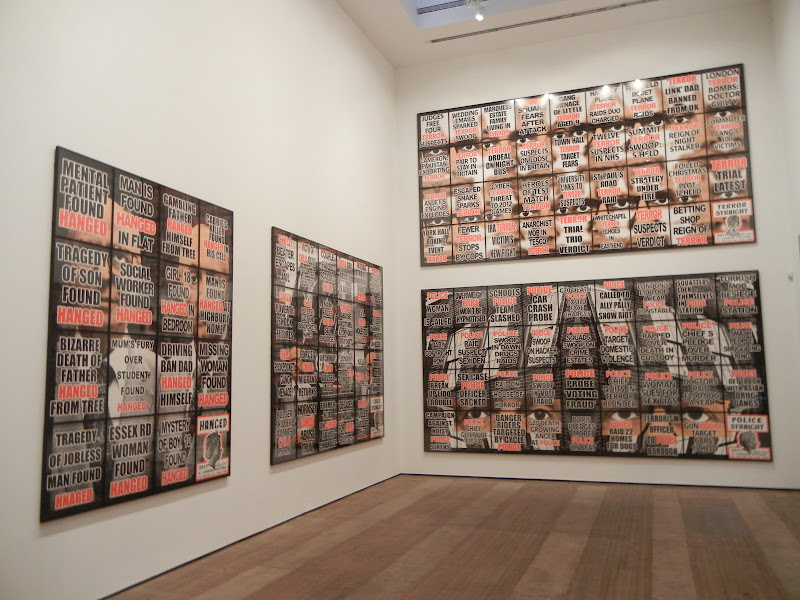
Comments/Context: Gilbert and George's sprawling new series London Pictures is really the final outcome of a rigorously academic linguistics study, delivered in the form of contemporary art. It is a meticulous and exhaustive examination of words and their charged relationships in our attention starved modern culture, thrown back at us in carefully ordered groups of shouting, hysterical headlines from the tabloid press. Spread across three galleries here in New York (and countless others across the globe from London to Hong Kong), the works are a taxonomy of urban horrors, collated and ordered into surprisingly universal patterns.
 
The back story to these pictures starts with the tearsheets found displayed outside newsstands across London. Gilbert and George managed to discretely steal a total of 3712 of these disposable posters over the period of several years, providing them with the raw material for their further sorting and classification of subjects and key phrases. The resulting clusters of common topics tell the story of 21st century urban life, with an eye for the shock factor that catches eyes and sells papers. Citizens are STABBED, HANGED, KNIFED, and MURDERED, while a parade of troublemakers and undesirables run rampant: ADDICT, MUGGER, PLAYBOY, BANKER, BURGLAR, RAPIST, GUNMAN, HOOKER, KILLER, DRUNK. TERROR, SEX and DEATH are never far behind (see the entire list in the installation shot from Sonnabend above). Displayed in large block letters and highlighted in vibrant red, these repetitive words and phrases dominate the artworks, the rest of the text (in black) fading into the background. The effect is both initially startling and ultimately dulling, as the weight of the text piles up.
 
The black and white photographic images that lie behind the graphic design elements are often patterned or kaleidoscopic, but in a supremely unassuming manner. Tree limbs and brick paving provide angled patterns, while rows of faceless windows, sidewalks, and car reflections are distorted by fish eye lenses. Gilbert and George appear as peach-faced, dapper-suited characters, like grim pedestrians on the street. And the profile of the queen (taken from various coins) makes an appearance in the corner of each work, hovering over the messiness of life with stiff upper lip formality. But all of this imagery is secondary to the bold overlaid text, which relentlessly pounds the viewer into submission.
 
I visited all three NY venues for this mega-show, and there is certainly a sense that once you have seen a few of these works, you've seen them all. This is entirely a function of visual overstimulation; seen as stand alone works, these will all pop off the wall, but when seen together over and over again, they quickly lose their punch - the shocking is no longer so urgent once you've seen it a dozen times, which is perhaps an apt reflection of our media saturated lives. In any case, if you're only going to visit one of the three spaces, I'd suggest going to Lehmann Maupin's Chrystie Street venue, as it has both the largest grids its towering main gallery, as well as a selection of the small grids upstairs, so you can see the whole breadth of the project in one place.
 
In the end, I like the mix of appalling truth and the can't-make-this-stuff-up wackiness that is found in these grids of words. Gilbert and George have reminded us how the odious and the offensive have become everyday entertainment, and how commonplace and universal these tawdry tales really are. They have mapped the sensational, dumbed-down vocabulary of big city living, exposing the lurid extremes that we now take for granted.
 
Collector's POV: The works in these shows range in price from £50000 for the smallest 2x2 grids to £160000 for the largest 4x9 grids. Using an average selling price of £75000, the 292 works in the full series represent roughly £21900000 of primary market value; collectors should get used to seeing these works, as they are likely to become a fixture in the secondary markets for years to come. In general, works by Gilbert & George can be found at auction with regularity at this point, mostly in Contemporary Art sales as opposed to Photographs sales. Prices for their multi-panel works have ranged between roughly $50000 and $900000 in the past decade, with a few single image or editioned works at lower prices.
.
Rating: ** (two stars) VERY GOOD (rating system described here)
.
Transit Hub:
  • Features/Interviews: Art in America (here), Wall Street Journal (here), Telegraph (here), Daily Beast (here), Economist (here), Huffington Post (here)
Gilbert & George, London Pictures (here, here, and here)
Through June 23rd

Lehmann Maupin
540 West 26th Street
New York, NY 10001

Lehmann Maupin
201 Chrystie Street
New York, NY 10002

Sonnabend Gallery
536 West 22nd Street
New York, NY 10011

Friday, October 21, 2011

Elger Esser, "Et nous avons des nuits plus belles que vos jours." @Sonnabend

JTF (just the facts): A total of 13 works, hung in the entry gallery and two of the smaller rooms in the back (center and left). 8 of the works are large scale c-prints from 2010, framed in black and unmatted. These images range in size from 48x73 to 73x92, in editions of 7+1AP. The 5 other works are heliogravures on Butten papier from 2010, mounted and framed in black but unmatted. Each of these prints is 46x52, in editions of 12+3AP. (Installation shots at right.)

Comments/Context: Monet's gardens at Giverny have become a place of pilgrimage for countless artists, and the now famous bridge, ponds, water lilies, and reflections have been reinterpreted over and over again to such an extent that it seems difficult to imagine there is much more to be said about this particular location. Elger Esser has taken on this familiar landscape subject, and turned it on its head by making long exposure photographs at night. The results are extremely dark and shadowy, bathed in a silent stillness.

Rather than point his camera at the obvious sight lines, Esser's images take in smaller, more intimate views of the pond, with dense bunches of trees growing along the banks. The long exposures create misty blurs as the wind moves across the land and water, and stars leave linear trails across the sky. His palette moves between opaque painterly blackness to a muted silver not unlike a tintype, with a few images that bring in an infusion of orange or blue at the beginning or end of the day. Silhouetted tree trunks punctuate the scenes, leaving the viewer with a sense of timeless emptiness.

In recent years, Esser has spent quite a bit of effort examining the nature of memory, especially in his heliogravures, which intentionally recall 19th century photographic landscapes in their framing and style. These new images of Givery are in many ways the exact negative of our expectations, the lively, colorful pond we all recognize turned into something dark and almost foreboding. Given the quiet and melancholy mood, I think viewer reactions to these pictures will range from underwhelmed (and potentially bored) to engrossed by a fleeting glimpse of something previously unseen.

Collector's POV: The works in this show are priced as follows: the large scale c-prints are either 25000€ or 40000€ each, based on size, and the heliogravures are 8000€ each. Esser's work has become routinely available in the secondary markets for both photography and contemporary art, with prices ranging from $5000 to $110000 in recent years.

Rating: * (one star) GOOD (rating system described here)

Transit Hub:
Elger Esser, "Et nous avons des nuits plus belles que vos jours."
Through October 29th

Sonnabend Gallery
536 West 22nd Street
New York, NY 10011

Friday, June 24, 2011

Clifford Ross: From Landscape to Imagination @Sonnabend

JTF (just the facts): A total of 10 photographic works and 1 video, generally framed in white and matted, and hung in the main gallery space and two of the smaller back rooms (one darkened for the video projection). All of the photographs are archival pigment ink on Japanese paper. 9 of the images are single prints, while 1 is a triptych. 6 of the single images are sized between roughly 24x42 and 27x55, in editions of 12+3AP. The other three single images are respectively 50x41 (edition of 6+2AP), 65x54 (edition of 20), and 76x135 (edition of 6+2AP). The triptych is 85x153 in total, in an edition of 6+2AP. All of the works were made between 2005 and 2011. Many of the images apparently come in additional larger or smaller sizes. (Installation shots at right.)

Comments/Context: Back in 2005, Clifford Ross made what seemed like a traditional landscape image of Mount Sopris in Colorado, complete with dense forests, a reflecting lake, and a lofty peak. What was original about this image was its staggeringly immense detail; using a specialized camera, Ross was able to pack in an enormous amount of visual information to every inch of the photograph, at all depths and locations, much like a Daguerreotpe. The viewer can get closer and closer to the image without losing any depth of detail; as a photograph, it's a bit of a technical marvel, taking realism in new directions.

Fast forward a few years, and Ross has taken that same mountain scene as a starting place for a journey away from realism toward complete abstraction. In both photography and video, he begins with the high density image and then proceeds to fragment it into small shards, particularly one small rectangle of the trees which becomes a motif that gets multiplied, tinted, and reversed into an explosion of hundreds of little squares. If you walk around the gallery in the right order, the color landscape is slowly transformed by this viral beast, strips and squares spun and manipulated, eventually covering the entire surface of the image like a textural blast of colorful confetti.

The video on view takes this idea to another level, aided by a wide variety of computer animation tricks. The single piece of the forest becomes a 3D grid made of layers and towers, which is then spun into a rainbow colored tornado of little fragments, and on and on through various renderings; it's like the graphics department went a little wild and the turned the photographic image into a high tech TV advertisement using every cool visual tool in the toolbox.
.
To my eye, these images work better as intellectual concepts than they do as photographs. The idea of taking one hyper realistic image and having it become the basis for a riff on abstraction is intriguing, and watching the image morph through various stages and patterns of evolution is perhaps entertaining in a sense of organic random growth, but in the end, the pictures didn't get beyond clever computer gimmickry for me. That said, for those who are interested in breaking down the edges of photographic visualization via computer rendering, this show is worth a visit for a deep dive into bleeding edge process.

Collector's POV: The works in the exhibit are priced as follows. The six smaller images are either $12000 or $15000 each, while the 50x41 and 65x54 images are $18000 each. Both the large image of Mount Sopris and the triptych are priced at $85000. Again, many of the images are available in additional sizes with alternate prices, so check with the gallery as appropriate. Ross' work has not been consistently found in the secondary markets in recent years, so gallery retail is still likely the best option for interested collectors.
.
Rating: * (one star) GOOD (rating system described here)

Transit Hub:

Clifford Ross: From Landscape to Imagination
Through July 29th

Sonnabend Gallery (artnet page here)
536 West 22nd Street
New York, NY 10011

Friday, November 12, 2010

Bernd and Hilla Becher, Water Towers @Sonnabend

JTF (just the facts): A total of 26 single image black and white photographs and 6 black and white typologies, individually framed in white and matted, and hung in the entry gallery and two of the rooms in the rear. All of the single image works are gelatin silver prints in editions of 5, made between 1978 and 1995 in New York city (while no dimensions were given, I believe these works are roughly 24x20). There are five 9-image typologies and one 15-image typology, again consisting of gelatin silver prints, made between 1972 and 2009 (the individual prints in these works appear to be roughly 20x16); the combinations in the typologies are never repeated, so they are all unique works. (Installation shots at right.)

Comments/Context: Grids of water towers by the Bechers have become so common that it's pretty hard to visit a major contemporary art museum and not bump into one. With such universal acclaim and ubiquitous display, it seems altogether possible that these works would somehow become overexposed, losing their visual power due to sheer repetition. And yet, their cool conceptualism and crisp execution keep them startlingly fresh; they never fail to stand out in a crowd.

My first reaction when I heard about this show was: what more can Sonnabend have to say about the revolutionary Becher water towers? Haven't they been completely covered already? And one of the back rooms of the show does provide a sampler of familiar typologies, the kind of work we have come to know and love: groups of bulb towers, concrete cylinders, towers with geometric bases or ones that open upward like funnels, some striped with vertical lines, all arrayed in rigid grids to highlight their architectural variations.

But what is both surprising and exciting are the other images that make up most of the show: iconic New York rooftop water tanks. I had never seen these pictures before; it's like the Bechers have made a conceptual valentine to the city. In each image, a single cone-topped wood barrel tank sits centered on some kind of iron mounting or platform. The cylindrical banded barrels are generally the same, except for the finials on the top that distinguish the two main manufacturers. But the Bechers theme and variation style finds hundreds of small details worth noting: tubes that run down the sides or from the bottom, arched ladders, brick backgrounds, sculptural frameworks of girders that hold the tanks in the air, patterns and geometries in the angles of bases. In nearly every picture, the dark black form of the tank looms against the white sky of the city, often with a contextual frame of surrounding buildings.

For the Bechers, these tanks are likely just another piece of vernacular industrial architecture to be codified and preserved, another form to be documented and explored. But I think local New Yorkers will find much more to connect with in these pictures. They combine both the exacting standards of the Bechers artistic vision with a tiny twinge of nostalgia for something authentic and original to this city, overlooked subject matter that is deep in the fabric of this particular, crazy place.

Collector's POV: The works in this show are priced as follows. The single image water towers from New York are $25000 each. The 9-image typologies are $117000 and the 15-image typology is $195000. The Bechers' work is consistently available at auction, with prices for single images ranging from $3000 to $34000 in recent years; typologies (including diptychs of two images as well as much larger groups) have ranged between $23000 to $176000. We continue to covet images by the Bechers for the city/industrial genre of our collection; what we'd really like to find is one of the smaller, earlier diptychs (with one large image on one side and a grid of nine smaller images as one on the other), but both locating such a piece and then having it be the right price (for us) have so far been elusive. But we keep looking.

Rating: ** (two stars) VERY GOOD (rating system described here)
.
Transit Hub:

  • Museum Collections: Met (here), Getty (here), Guggenheim (here), Walker (here)
  • Feature: Tate (here)
  • Interview: Art in Amercia, 2002 (here)
Through December
.
Sonnabend Gallery (artnet page here)
536 West 22nd Street
New York, NY 10011

Friday, March 12, 2010

Candida Höfer, Florence and Naples @Sonnabend

JTF (just the facts): A total of 7 large scale works, framed in blond wood with no matting, and hung in the entry and the center room in the rear of the gallery. The c-prints range in size from roughly 75x61 to 80x102 and are made in editions of 7. All of the negatives are from 2008 and 2009, and were taken in Florence and Naples. A monograph of this body of work (entitled Napoli) has recently been published by Schirmer/Mosel (here). (Installation shots at right.)

Comments/Context: After years of seeing shows of Candida Höfer's images of ornate public spaces and interiors and thinking they all looked generally the same, this exhibit of recent work from Florence and Naples made me think quite a bit more deeply about her artistic approach. For the first time, I got beyond the documentary novelty/awe of the over-the-top constructions and ornamentations themselves, and started to think about these pictures as a kind of nuanced portraiture, to see the artist's style more clearly layered over the subtleties of architectural personality.

In a certain way, these Italian pictures look like any number of other pictures she has taken previously: formal rooms, frescoed ceilings, checkerboard marble floors, classical sculpture, cherubs, flashy chandeliers, and rows of columns. There are impressive palaces, ballrooms, entry halls and libraries, all designed as overt signals of wealth, power, and status. Each is entirely empty of people, the polished floors reflecting the pure white light which pours quietly in through the windows.

I guess it was the simple thought exercise of comparing these images to how I would expect these same famous rooms to look on post cards in the nearby gift shops that started me down a more complicated reading of these photographs; when they're printed large and hung as individual objects, it's sometimes easy to just get lost in the grandeur of the prints and forget to think about the subtle differences in composition, framing, or lighting that Höfer has employed.
.
If we looked at a series of Avedon or Penn portraits, all taken with monochrome backgrounds and frontal poses, we wouldn't say they all looked the same; we'd see the tiny gestures that have been captured that make the people individuals, and we'd see the overlay of the photographer's approach augmenting the exploration of these often hidden features. The same is true here: I suddenly became aware of how the square framing had been used to better capture the elongated decorated ceilings, or how the curves of a chandelier were carefully placed to interact with the balconies of a double height room. I also saw how Höfer had highlighted the cluster of modern plastic chairs that were set up in one of the ballrooms and realized how they formed a surprising juxtaposition to the ornate religious frescoes and gold leaf on the walls and ceilings. Even the David (perhaps the most cliched subject imaginable, often seen looking up at its magnificence) was photographed in an unexpected way that made the immense statue look more vulnerable, the grandeur of the domed glass atrium in which it stands dwarfing the iconic sculpture.
.
All in, I was much less distracted by the grand locations themselves in this body of work, and as a result, saw much more of Höfer's aesthetic approach than I have noticed previously. I've come to the conclusion that Höfer's work cannot be appreciated via the normal "stand for 5 seconds and move on" approach to gallery hopping; it requires the patience to let the initial eye-catching drama dissipate and dissolve a little, so that the more subtle details of the photographic craft can come though.

Collector's POV: The prints in this show are priced between 45000 and 50000€, based on size. Höfer's work is readily available in the secondary markets, in a variety of dimensions and edition sizes. Smaller pieces can be found well under $10000 (often in editions of up to 100), while the larger works (printed in much smaller editions, usually 6) range between $20000 and $50000, with a few outliers even higher.

Rating: * (one star) GOOD (rating system described here)

Transit Hub:
  • Architecture of Absence, ICA UPenn, 2006 (here)
  • NY Times review, 2004 (here)
Candida Höfer, Florence and Naples
Through April 17th

Sonnabend Gallery (artnet page here)
536 West 22nd Street
New York, NY 10011
Wednesday, November 11, 2009

Clifford Ross @Sonnabend

JTF (just the facts): A total of 18 black and white images, framed in white with no mat, and hung in the entry and 3 back rooms of the gallery. All of the prints are archival pigment prints, made in 2009, in editions of 5. The works are either 48x68 or 48x82, and all are titled "Hurricane" followed by a roman numeral. There are 4 images in the smaller size and 14 images in the larger size on display. (Installation shots at right.)

Comments/Context: Clifford Ross' images of hurricane force waves are unlike any other images of breaking surf that I have seen previously. From afar, they look a little mundane and routine; repeated black and white shots of waves cresting, smashing down into the sand, spraying water into the air and creating a frothy white soup of backwash. But up close, something altogether unexpected and magical occurs.
.
Within a few feet of the images, their staggering, extreme detail becomes apparent; every flying drop, every rolling curve, every ounce of spray is crisp and clear. The works feel like scientific studies of the physical properties of water, reminiscent of the stop motion photography of Harold Edgerton (here), but on a much grander scale. The crashing waves are revealed as intricate layers of volume, dark tubular forms and curtains of water, piled on top of each other and intermixed. The texture and color of the water is also suddenly of interest, sometimes smooth, sometimes rough and bubbled, the colors ranging from pure white to intense black. It's easy to stand in front of one of these images and get lost in the minutiae.
.
At the same time, there is a powerful sense of narrative drama in these pictures; the fury and danger of the ocean is on display. While these aren't the massive deep sea waves that engulf entire ships, there is still plenty of excitement and energy in these smaller cousins. Compositionally, the works merge the romance and awe of Winslow Homer (here) and Hiroshige (here) with the meditative simplicity of Hiroshi Sugimoto's bisected seascapes. Circling the gallery, the works prove that there is infinite variety and interest in this altogether straightforward subject.

Collector's POV: The works in the exhibit are priced at either $32000 or $35000 based on size. While Ross' work has not appeared much in the secondary markets, an earlier image from the same series (2002) sold at Christie's this past summer for £10000.
.
For once, I think the large size of these photographs makes them work better. I can clearly imagine one of these big wave studies successfully filling an entire huge wall. That said, I also think that these images would make a terrific book, as the subtle changes in patterns and textures across the series are a compelling theme and variation fugue.
.
Rating: ** (two stars) VERY GOOD (rating system described here)
.
Transit Hub:

  • Artist site (here); make sure to look under "Process" to see shots of Ross taking the pictures in the surf
  • Photos from opening @Guest of a Guest (here)
  • New Yorker feature, 2006 (here)
  • NY Times review, 2005 (here)
Through December 19th

Sonnabend Gallery (artnet page here)
536 West 22nd Street
New York, NY 10011

Friday, May 15, 2009

Beate Gütschow @Sonnabend

JTF (just the facts): A total of 16 black and white light jet prints, framed in white with no mat, hung in the entry and three back galleries. The works are printed in various sizes, ranging from 36x31 up to 70x105, and are made in editions of 5 or 15. The images were created between 2004 and 2009. (Installation shots at right.)

Comments/Context: While deadpan images of decaying cities and towns have become a commonplace subject for many contemporary photographers, Beate Gütschow has taken this idea to an entirely different level in the works now on view at Sonnabend. Gütschow starts by taking hundreds of analog images of architecture in locations all over the world, and then combines fragments from these pictures digitally into seamless and entirely original views that walk the line between apparent reality and obvious falsehood.
.
On first glance, these abandoned buildings and empty plazas look hauntingly plausible, perhaps a documentary record of desolation from a far off failed state or a Julius Shulman-type record of some unknown architect's massive constructions. And yet, something is just not quite right - the scale of the buildings is so immense, the wastelands that surround them are so expansive - where on earth could this be?

The word "post-apocalyptic" has become a science fiction cliché, but these images truly seem to depict a world after some kind of disaster, where nearly all the people are gone (leaving behind only a few disoriented survivors, seen wandering aimlessly between the overly huge buildings) and the open sky has become a cloudless monotone grey. The images portray a convincing alternate reality (the cobblestones and concrete are cracked and worn), one that is more than a bit unsettling and depressing.
.
What I think is compelling here is that Gütschow is using significant digital manipulation not in an obvious, attention grabbing fashion (look at me!), but with a degree of subtlety and understatement that draws the viewer into the trap. Once the viewer catches on (and gets over the staggering amazement of how these pictures were actually constructed), a second level of meaning in the works is discovered and their implicit commentary on our world is delivered with much more force. Even if you are not an architectural photography fan, this show merits a visit to see how digital tools can be used in sophisticated new ways.

Collector's POV: The prints in this show are priced between 8000 and 20000 Euros. To date, there have been few if any images available in the secondary markets. I very much enjoyed the works in this show, and if they weren't so large, I could absolutely imagine adding one to our collection. I have a strong sense that these images will age well, and would provide an interesting dialogue with traditional architectural works, in the same way that Joan Fontcuberta's fabricated flowers offer unique contrasts to normal floral still lifes.

Rating: ** (two stars) VERY GOOD (rating system described here)

Transit Hub:
  • MOCP show, 2006 (here)
  • LS/S Aperture monograph (here), Conscientious review of the book (here)
  • Frieze magazine article (here)
  • Danziger Projects Landscape show, 2005 (here)
Beate Gütschow
Through July

Sonnabend Gallery (artnet page here)
536 West 22nd Street
New York, NY 10011

Monday, March 16, 2009

Elger Esser: Wrecks and Landscapes @Sonnabend

JTF (just the facts): This show includes three different sets of new work. In the entry room, 3 wall sized silver prints with hand coloring are displayed, framed in black, all from 2007. In the main room, 3 color landscapes are shown, in two sizes (40x48 and 70x80), framed in blond wood, C-prints on Diasec, all from 2008. In the far left room, there are 9 black and white heliogravure landscapes, each 48x54, framed in black, all from 2008. (Installation shots at right.)

Comments/Context: If we play a word association game and start with "Elger Esser", the first word that comes to my mind is yellow. Esser's large scale landscapes have often been diffused with a soft, washed out earthy yellow that is reminiscent of dreamy, lyrical 19th century romantic paintings. For me, it is a signature color; I can immediately identify his works from across a room based on the use of this particular color; no one else uses it the way he does.

There are a few images in the new show at Sonnabend that continue in this same "yellow" direction, combinations of painterly sky and water, from beaches or valleys or picturesque wetlands, often with a subtle 20th century intrusion. While Esser did his studies with the Bechers in Dusseldorf, his work seems to have evolved away from their deadpan objectivity to a warmer, more subjective reality in his picture making.
.
Three new works at Sonnabend seem to extend this romanticism further. Rather than starting with "real" images of sky filled landscapes, these pictures are built upon enlarged vintage postcard images of aging and decaying shipwrecks, hand colored with his same earthy palette, to create smoky, melancholy scenes, much darker in color and mood than his other works. The images are extremely grainy, to the point of almost having a Pointillist feeling, millions of tiny dots making the pictures vibrate. While they were completely unexpected in terms of my vision of what an Esser looks like, these pictures grew on me as I looked at them more. Perhaps we can place them in the context of a larger definition of his neo-Romanticism, not just sunny and idyllic visions, but also scary, sad, and almost apocalyptic ones.

In the back room, there were a group of more traditional black and white landscapes of France that seemed to lack emotional punch in comparison to the works in the other rooms. Perhaps I just needed some further background information on the significance of the images or their relationship to Esser's art, as on their own, they weren't particularly memorable.

Collector's POV: The large silver prints with hand coloring are priced at $50000 each. The color landscapes are either $10000 or $30000 based on size. The heliogravures are $8000 each, in editions of 12. Esser's work has generally been available at auction in recent years, typically ranging between $25000 and $75000 (with a few outliers).

Rating: * (one star) GOOD (rating system described here)

Elger Esser: Wrecks and Landscapes
Through March 21

Sonnabend Gallery (artnet page here)
536 West 22nd Street
New York, NY 10011

Friday, January 30, 2009

Candida Höfer, Philadelphia @Sonnabend

JTF (just the facts): A total of 12 large scale color C-prints, framed in blond wood frames with no matting, arrayed in the entry and two rooms in the rear of the gallery. Images range in size from roughly 60x64 to nearly 70x100. All of the negatives are from 2007. (Installation shots with significant glare at right and below.)

Comments/Context: German photographer Candida Höfer has spent the better part of the past 30 years making huge deadpan images of public architectural spaces around the world. She has captured museums, hotels, banks, libraries, and palaces of all kinds, always devoid of people and often lit with pure daylight. Her current show at Sonnabend displays a group of new pictures taken in some of Philadelphia's most ornate Federal buildings.
.
Höfer is, of course, one of the group of highly successful students of the Bechers at the Dusseldorf Academy of Art, and her work shares their clinical approach to picture making. The images are all taken from a rigid square frontal position, the subject matter has variation within an overall sameness, and the prints are made with a high degree of technical mastery.

Despite all of the over the top ornamental flourishes found in these rooms, the interiors are chillingly vast and empty, like tombs that have recently been unearthed and opened to anthropologists. While there are frequently subtle effects resulting from the placement of the light, for the most part, the images are dry and emotionless, in contrast to the clear hopes for grandeur and awe of the builders.

We have often seen Höfer's work in the pages of glossy design magazines, her images hung on the walls of flashy apartments and newly redecorated lofts. It seems they often serve as stand ins for a dreamed about library or ballroom, a symbol of decorative luxury just out of reach. For us, there seems to be something absent, a missing connection that would normally draw us back to the images again and again. While Höfer has pointed her camera at a vast array of amazing places, there doesn't seem to be anything new, fresh or memorable going on, and over time, the images become surprisingly interchangeable. And in a mind bending twist, perhaps that is just the point.

Collector's POV: Candida Höfer's work is readily available in the secondary market, in a range of sizes from small to gigantic. The pictures in this show are priced between 40000 and 50000 Euros. At auction, the smaller pieces can be found well under $10000 (often in editions of up to 100), while the larger works (perhaps more representative of what she's trying to do and printed in much smaller editions, usually 6) seem to range between $20000 and $50000, give or take a few outliers on the high side.

Rating: * (one star) GOOD (rating system described here)

Candida Höfer, Philadelphia
Through February 14

Sonnabend Gallery (artnet page here)
536 West 22nd Street
New York, NY 10011