Showing posts with label Edwynn Houk Gallery. Show all posts

Monday, June 10, 2013

Lalla Essaydi @Houk

JTF (just the facts): A total of 10 large scale color photographic works, each mounted and unframed, and hung against cream colored walls in the entry, the main gallery space, and the smaller side room. There are 8 single images and 2 triptychs on view. All of the works are chromogenic prints mounted to aluminum with a UV protective laminate, and were made between 2009 and 2012. Sizes for the single images range from 24x20 to 60x48 (or reverse); the triptychs are made up of panels sized 24x20 and 88x71 respectively. Edition sizes are either 10 or 15. (Installation shots at right.)

Comments/Context: Lalla Essaydi's new show follows a direct conceptual line from her previous projects, revisiting her earlier subject matter and building fresh ideas on top of old ones. Like a theme and variation exercise, her path forward seems thoughtful and methodical, reworking a palette of interconnected motifs in search of new insights. This clear sense of deliberate progression leads to a smart pairing of two new projects, where elaborate fabrics face off with bullets as primary decorative elements.

For the most part, Essaydi's artistic starting point generally remains the same: large scale color images of young Arab women, draped in exotic caftans and posed in hidden rooms and tiled alcoves, their skin covered with elaborate Islamic calligraphy. Her women disappear into a camouflage of henna lines and geometric patterns, trapped by Orientalist fantasies and Western stereotypes of the Arab world. But Essaydi's newest harem girls don't vanish into a swirl of gauzy beige or match with the abstract tile designs nearby. These women lounge in overflowing piles of embroidered silks, luxuriating in flowing, shiny color. While the women still wear Essaydi's signature tattoos on their faces, hands, and feet, the dark swirling lines are no longer the visual focal point; our attention is immediately drawn to the riotous clash of sumptuous rich silks and the forbidden exoticsm they represent. These specific works deserve a pairing with Mickalene Thomas' pattern saturated images of African-American women, not only for their parallels of vibrant color, but for their commonalities of feminist perspective.

From afar, Essaydi's other new series is equally full of glitter and sparkle, her models draped in washes of golden metallic medallions. Up close, she upends the glamour, building the entire spectacle out of brass shell casings. Patterns of bullets decorate the back walls in repeating patterns, while elaborate robes, dresses and jewelry are expertly woven from left-over ammunition. Her illusion is surprisingly successful, as even after the viewer understands the inversion (and the resulting implications of violence and control that the bullets bring to the imagery), the works still shimmer with remarkable beauty. The tension is more overt and confrontational in this series, especially when enlarged to monumental scale like the larger-than-lifesize triptych that dominates the center wall of the main room.

These new works show Essaydi slowly expanding her artistic territory and bringing in additional complexity. They point to bolder contrasts and more challenging juxtapositions, where elegant finery and rough weaponry are equally seductive and symbolic, and where historical gender roles brush up against the modern world with persistent force.

Collector's POV: The works in this show are priced as follows. The single image photographs are either $9500, $16500 or $24000, based on size. The two triptychs are $24000 and $85000, again based on size. Essaydi's photographs have become more available in the secondary markets in recent years, with prices ranging from roughly $7000 and $57000.
 
Rating: * (one star) GOOD (rating system described here)
 
Transit Hub:
  • Artist site (here)
  • Interview: PBS (here)
  • Feature/Review: Smithsonian, 2012 (here)

Through June 22nd
 
745 Fifth Avenue
New York, NY 10151

Monday, May 6, 2013

Bill Brandt, Early Prints from the Collection of the Family @Houk

JTF (just the facts): A total of 74 black and white photographs, framed in white and matted, and hung against beige walls in the entry area, the main gallery space, and the smaller side room. All of the works are vintage gelatin silver prints, made between 1929 and 1966. While no size information was available on the checklist, most of the images were roughly 9x7, with a few slightly larger. (Installation shots at right.)

Comments/Context: When a big museum retrospective comes to town, it's common practice for the relevant galleries to put on companion shows to capitalize on the fresh interest created by the exhibit. While these shows make complete sense from a business perspective, they're usually not all that noteworthy. But on the heels of the masterful Bill Brandt: Shadow & Light retrospective at the MoMA (here), Edwynn Houk has put on an unexpectedly strong supporting show, gathering together an exemplary group of prints drawn from Brandt family members.

The Houk show is organized in roughly the same manner as the one at MoMA, creating a kind of echo effect if you've seen both exhibits. What is so surprising about this gallery show is its comprehensive depth; it's not just a handful of random prints, but a deep, well-edited selection of standouts. The gallery has been representing the estate for roughly 30 years, and during that time, it stands to reason that many of its great treasures were long ago dispersed. But this show brings to market a new cache of vintage prints that had been stored away by the family. I was particularly astonished by the large group of Brandt nudes assembled here, some 30 prints of interior scenes, high contrast abstractions, and rocky beach distortions. From our own collecting activities, I know how hard it would be to amass such a group in this day and age, so to see them all together outside the confines of a museum was pretty magical. There were even a few images that were new to me (a patterned wallpaper interior nude, a crossed knees beach study), unpublished or lesser known gems that were exciting to encounter for the first time.

So while this is a standard selling show paired with a retrospective, it's certainly a best of breed example of such an exhibit. It covers all the major projects from his career, with plenty of superlative prints and memorable images. It's like the Brandt market has received a much needed blood transfusion, with many classic photographs that were thought to be entirely unavailable now floating freely once again.

Collector's POV: The works in this show are priced between $18500 and $60000, with most between $25000 and $40000. Brandt's work is consistently available in the secondary markets, with dozens of prints on offer each year. Recent prices have ranged from $2000 for lesser known works and later prints to more than $90000 for vintage prints of his most iconic images.

Rating: ** (two stars) VERY GOOD (rating system described here)

Transit Hub:
  • Estate site (here)

Bill Brandt, Early Prints from the Collection of the Family
Through May 11th

Edwynn Houk Gallery
745 Fifth Avenue
New York, NY 10151

Wednesday, March 13, 2013

Valérie Belin @Houk

JTF (just the facts): A total of 8 black and white photographs, framed in white and unmatted, and hung in the main gallery space. 6 of the works on view are large scale pigment prints, sized 82x62 or 73x55 and available in editions of 3. The other 2 works are smaller gelatin silver prints, sized 5x7 and available in editions of 5. All of the works were made in 2012. (Installation shots at right.)

Comments/Context: Edwynn Houk has recently taken on representation of Valérie Belin and this show offers a small sampler of her most recent work. In the past few years, Belin's photography has taken on a consistent look and feel, settling into the dark middle tones of grey and black and sandwiching negatives together into dense, layered compositions. Her new pictures resist easy recognition and force closer inspection to unpack their rich, tactile mysteries.

The most successful images in this show are Belin's conflicted images of brides. Her images mix classic studio portraits of brides with princess tiaras and elaborate floral bouquets with storefront shots of adult DVD stores and sex shops covered in shouting neon. The effect is something akin to Robert Heinecken's magazine interventions, but with the harshness softened into something more inscrutable. Belin uses the same approach in a series of nudes, with a curvy burlesque performer juxtaposed with an array of backstage TV studio gear (including a flashing APPLAUSE sign) or the furniture of a stylish 70's living room. The final pair of images on display dive down the rabbit hole of cluttered, overstuffed, hoarder-style interiors, with walls and shelves filled to the breaking point with collected stuff. Belin's dark palette gives these intimate reflections of personality an ominous tint.

If Belin's multiple negative works had been printed smaller, they might have had a Surreal feel, but at such large scale, they become almost abstract, the interlocking images breaking down into fragments and snippets of something identifiable. The layered images fight with each other, struggling for visual dominance, pushing the viewer's ultimate conclusion back and forth between opposing poles. In the end, it's an uneasy balance, the images settling into intermingled uncertainty.

Collector's POV: The works in this show are priced as follows. The large pigment prints are $32000 each and the smaller gelatin silver prints are $7500 each. Belin's work has only been intermittently available in the secondary markets in the past few years, with prices ranging from roughly $5000 to $15000.

Rating: * (one star) GOOD (rating system described here)

Transit Hub:
  • Artist site (here)

Valérie Belin
Through March 30th

Edwynn Houk Gallery
745 Fifth Avenue
New York, NY 10151


Tuesday, January 15, 2013

Sissi Farassat @Houk

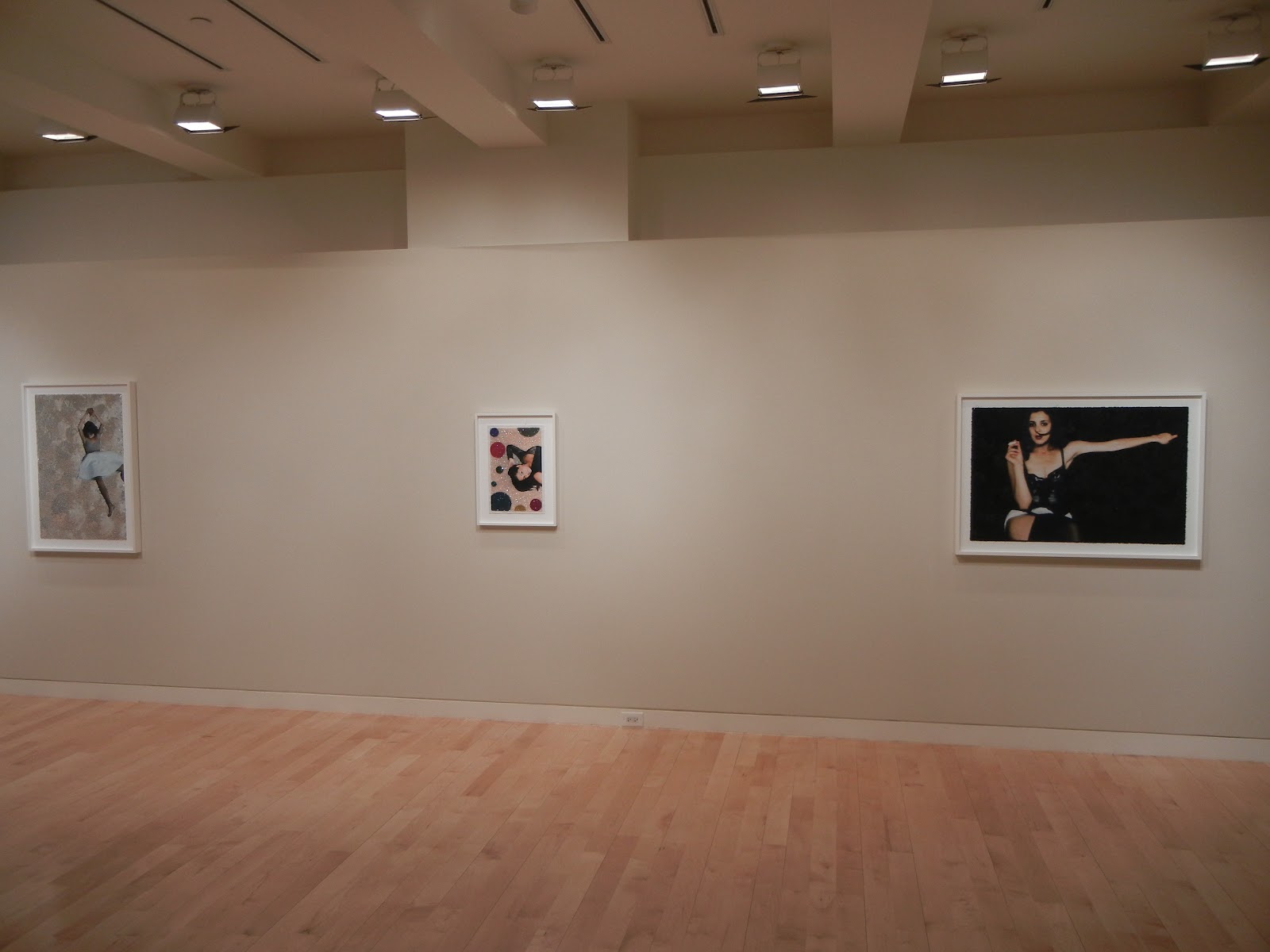
JTF (just the facts): A total of 16 color photographs, framed in white and unmatted, and hung against almond colored walls in the main gallery space and the smaller side room. All of the works are chromogenic prints with added tinsel, carpet thread, Swarovski crystals, or sequins, made between 2004 and 2012. Physical dimensions range from roughly 8x10 to 40x60 and each work is unique. This is the artist's first solo show in New York. (Installation shots at right.)

Comments/Context: My first reaction to Sissi Farassat's show was that it announced the arrival of photographic bling. Her casual snapshot-style photographs are densely encrusted with crystals, sequins, and other sparkly things, grabbing your attention with their flash and daring you to look away from their glamour. They initially seemed pretty and vacuously decorative, especially the ones covered in happy colorful polka dots.

But as I circled the gallery, I started to see what Farassat was doing was not some over-the-top exercise in inane craftiness, but instead an investigation of the boundaries of photographic surface and texture. Her clear sequins let the background show through while breaking it up into overlapping round bits; one might even call it analog pixelization. When the sequins are opaque (in shiny black and silver), the backgrounds are completely obscured, leaving cut out women to pose against swirling Starry Night whorls of geometric complexity. And when the sequins are used in complementary shades of color (greens and blues in one work), the circles crowd into competing bubbles.

Farassat employs carpet threads with equal grace. White fibers act like transparent gauzy lace, echoing a female form silhouetted against a light filled window; those same tiny strands are then transformed into a soft snowstorm when placed over a long dark coat. Green fibers over a garden scene add a layer of wispy, prickly texture, like blowing, scattered evergreen needles. These images are crisp and photographic, but somehow also mysterious and sculptural at the same time. The additions are well integrated and expanding, rather than simply glued on for extra obvious dazzle.

The idea that photographs can have unexpected surface, and that that surface can be augmented and disrupted is exciting. The trick for Farassat will be to consistently find methods and materials that do this in ways that are challenging and surprising rather than cloying and heavy handed. The best of the works on view here prove that she's headed off in an original direction.

Collector's POV: The works in this show are priced between $7500 and $18500, based on size and applied material. Farassat's works have very little secondary market history in the US (there have been a handful of sales in the Austrian auction houses), so gallery retail remains the best option for those collectors interested in following up.

Rating: * (one star) GOOD (rating system described here)

Transit Hub:
  • Artist site (here)
  • Features/Reviews: ARTslant (here)
 
Through February 16th
 
745 Fifth Avenue
New York, NY 10151

Friday, December 7, 2012

Gail Albert Halaban: Hopper Redux @Houk

JTF (just the facts): A total of 11 color photographs, generally framed in white and unmatted, and hung against light peach colored walls in the main gallery space and the smaller side room. 9 of the works are archival pigment prints mounted to plexi, made between 2010 and 2012. Physical dimensions range from roughly 33x42 to 34x45 and the prints are available in editions of 5. The other two works on display archival pigment prints on film, fitted into custom LED lightboxes, made in 2011 and 2012. Physical dimensions of these works are roughly 25x31 and the works come in editions of 10. (Installation shots at right.)
 
Comments/Context: In Gail Albert Halaban's previous series, Out My Window, her photographs of buildings in New York drew an implicit parallel with Edward Hopper's urban street scene paintings, sharing a sense of dark moodiness and making common use of isolated figures looking out windows. In her newest body of work, Halaban has made this artistic connection to Hopper more explicit, tracking down the houses in Gloucester, Massachusetts, that were the subjects of his early watercolors, and making recreations in her own style from the exact same vantage points.
 
Hopper's watercolor portraits of seaside houses, with their Victorian details, mansard roofs, and New England unpretentiousness, shimmer in bright sunlight, giving them an unexpected energy and vitality. The world has of course changed in the roughly ninety intervening years between these two projects, and the front yard trees are now larger, the telephone wires and satellite dishes are more intrusive, and the details of the houses (awnings, paint color, other architectural decorations) are more reflective of modern tastes. While Halaban has taken great pains to echo Hopper's compositions, she has entirely reconsidered the light, often capturing the houses at twilight, when the streetlights have just begun to come on, the sky is a soft purple, and the windows glow from the inside. Nearly every picture includes a person posed in a window, both visible from the street and obliquely looking outward, seen and seeing at the same time. These Hitchkockian characters add the potential for mysterious lonely narratives to the now vaguely spooky houses. Even a house draped in friendly icicle lights has a faintly sinister cast.
 
In updating these architectural portraits, Halaban has transformed their overall temperament. Their spirit is now more separate and guarded; the light in the windows isn't entirely welcoming and beds of flowers and overturned bikes can look a little imposing. The images have been infused with both crisp photographic detail and a modern sense of isolation, at once concealed and visible, reclusive and longing for connection.
 
Collector's POV: The prints in this show are priced as follows. The large prints are $12000 each and the smaller lightboxes are $8500. Halaban's photographs have very little secondary market history, so gallery retail remains the best option for those collectors interested in following up.
 
Rating: * (one star) GOOD (rating system described here)
 
Transit Hub:
  • Artist site (here)
  • Features/Reviews: NY Times (here), Guardian (here)
Through December 22nd

Edwynn Houk Gallery
745 Fifth Avenue
New York, NY 10151

Monday, September 24, 2012

Sally Mann: Upon Reflection @Houk

 
JTF (just the facts): A total of 23 black and white photographic works, unframed and hung against light peach colored walls in the main gallery space and the smaller side room. All of the works are ambrotypes (unique collodion wet-plate positives on black glass), made between 2006 and 2012. Each unit print is sized roughly 15x14. The individual works are arranged into groups and grids of 1, 3, 6, 9, and 20 prints, and are divided by subject matter into two projects: Self-Portraits and Omphalos. There are 17 works from Self-Portraits and 6 works from Omphalos on view. (Installation shots at right.)

Comments/Context: In the future, when some museum does a full and comprehensive retrospective of Sally Mann's work, I think it will be fascinating to consider how her embrace of the wet-plate collodion process has changed the trajectory of her artistic life. In my view, there is a very distinct break right in the middle of her prolific career, a before wet-plate and after wet-plate bright line where her work took an entirely new direction. Some will argue that the progression is smoother than I am making out, that she has always thoughtfully focused her camera on her family and the land around her, but to my eye, while the subjects haven't evolved dramatically, the mood is meaningfully different, perhaps a byproduct of the ghostly look and feel of the wet-plate prints, or perhaps a turn inward toward a more complex and personal psychological landscape.

What is new here is that after a riding accident laid her up with serious injuries in 2006, she boldly turned the camera on herself, making countless head shot portraits and nude torsos. There are no smiling, happy faces in this parade, however; her expressions cover the territory from deadpan to grave, with a few stops for steely, weary, wise, zombie-eyed, and almost meditatively ecstatic in between. The tonalities shift from washed out grey to brown to bronze to shadowy black, and the chance movements of the chemicals create unexpected spectral drips, swirls, and highlights that often obscure the image. Some of the works have also been scratched and abraded, with the emulsion flaking and chipping off, exposing areas of crackly black glass. Seen together as grids and typologies, the faces become a taxonomy of subtle emotional states; a wisp of hair or the details of wrinkles make some of the pictures humanly specific, while others drift into silhouette or death mask, the personal features erased and blurred. Mann's torso images are generally more abstract, reducing her body to a sculptural mass of white with a shadowy hint of a belly button or a dark triangle. The classical forms seem smooth and weathered, like fertility symbols from antiquity, at once haunting and timeless. The variation in these images is more subtle, elemental curves repeated with minute changes in brightness and contrast.

While Mann's images her nude husband were tender in their unflinching truth, these images of her own face and body seem tougher to me, even in their most elegant state. When she does engage the camera, her gaze is strict and penetrating, and I felt a sense of quiet defiance, a letting down of her guard but with a knowing resignation to and acceptance of what she was letting in. Taken together, the works are a rich, multi-dimensional portrait, full of dark, complex emotions and ephemeral moods, riding on an undercurrent of inner strength.

Collector's POV: The prints in this show are priced based on the number of prints included in the work/grid. The single print works are $20000, the 3 print works are $36000, the 6 print works are $60000, the 9 print works are $84000, and the 20 unit work is $172000. Mann's photographs are widely available in the secondary markets. Auction prices for Mann's prints have generally ranged between $3000 and $70000 in recent years, with most still under $20000. Her earlier works were printed in editions of 10 and 25, so these new unique works will clearly have a different scarcity value. Mann is also represented in New York by Gagosian Gallery (here).

Rating: * (one star) GOOD (rating system described here)

Transit Hub:
  • Artist site (here)
  • Exhibit: Virginia Museum of Art, 2010 (here)
Through November 3rd
 
745 Fifth Avenue
New York, NY 10151

Monday, April 30, 2012

August Sander: Citizens of the Twentieth Century @Houk

JTF (just the facts): A total of 34 black and white photographs, framed in black and mounted, and hung against almond colored walls in the main gallery space. All of the works are posthumous gelatin silver prints with black borders, printed by Gerd Sander in 1990. 29 of the prints are roughly 10x7, in editions of 12. There are also 5 larger prints, ranging from 23x13 to 23x18 in size. The images were originally made by August Sander between 1906 and 1940. (Installation shots at right.)

Comments/Context: I doubt that there are any words worth adding to the celebration of August Sander's landmark photography project Citizens of the Twentieth Century. His ambitious and exhaustive portrait of the German people has influenced generations of photographers from across the globe, as evidenced by recent paired showings here in New York with both Seydou Keïta (here) and Boris Mikhailov (here). Edwynn Houk as recently taken on representation of the August Sander family collection, and this show is a foundation sampler of images from this iconic project.

The prints in this exhibit are not vintage rarities, but posthumous prints made by Gerd Sander relatively recently. So instead of the warm patina of age, they have a sharp crispness of silver tonality, making them seem surprisingly modern. The pastry cook, the bricklayer, the boxers, the three young farmers, the pairs of children, the soldier, they are all brisk and refreshed rather than tired. Several of the images have been enlarged to roughly twice the original size (I had never seen these before), but they too are clean and lively.

While this show doesn't give us any particularly new or original insights on August Sander, seeing a strong grouping of his portraits like this one never fails to impress. It's proof that greatness doesn't age, and that the true masters of the medium can be revisited time and again without becoming stale.
Collector's POV: The prints in this show are priced as follows. The 10x7 prints are either $4500 or $6000. The larger prints (roughly 23x16) are either $12000 or $18000. Sander's photographs are widely available in the secondary markets, including portraits, landscapes, and later prints/portfolios made by both Gunther and Gerd Sander. As a result, prices vary widely, from as little as $1000 for lesser known images to more than $100000 for iconic vintage portraits.

Rating: * (one star) GOOD (rating system described here)

Transit Hub:
  • Feature: Wall Street Journal, 2008 (here)
  • Exhibit: SFMOMA, 2002 (here)
Through May 12th

Edwynn Houk Gallery
745 Fifth Avenue
New York, NY 10151

Wednesday, January 25, 2012

Robert Bourdeau @Houk

JTF (just the facts): A total of 24 black and white photographs, framed in black and matted, and hung in the main gallery space. All of the works are vintage (or printed with a year or two) gelatin silver prints, many toned with gold, alternately available in editions of 15 or 30. Physical dimensions range between 8x12 and 11x14 (or reverse). The images were originally taken between 1981 and 2005. (Installation shots at right.)

Comments/Context: Robert Bourdeau's recent photographs of decaying industrial architecture are in many ways a throwback to a time when superlative black and white craftsmanship was regarded as the pinnacle of photographic achievement. His images celebrate the tactile quality of surface texture with an almost fetish-like reverence, making stained steel and flaking concrete glow with burnished gold-toned glory.

Bourdeau's compositions crop out the sky, centering down on fragments of piping and industrial cement, where boilers, engines, furnaces, ladders, and railings criss-cross in layered abstract geometries. Residues drip down the sides of steel tubs, walls erode and crumble, swirls and imperfections decorating every inch of disused, dusty equipment. These are formal pictures, where shapes, angles and patterns have been arranged with care, their subtle tonalities enhanced by exacting printing. They have the echo of Bourdeau's friend and teacher, Minor White, the rotting hulks infused with an almost spiritual grace.

While we have all certainly seen these kinds of industrial subjects over and over again across the history of the medium, that doesn't take away from the fact that these are undeniably well made photographs. They're almost like old cabaret songs or jazz standards being sung once again; they're entirely familiar but still noteworthy when executed with such obvious technical expertise.

Collector's POV: The prints in this show are priced at $8500 each.
Bourdeau's work has not yet reached the secondary markets with any regularity, so gallery retail is likely the only option for interested collectors at this point.
.
Rating: * (one star) GOOD (rating system described here)
.
Transit Hub:
Robert Bourdeau
Through February 18th

Edwynn Houk Gallery
745 Fifth Avenue
New York, NY 10151

Monday, November 28, 2011

Erwin Blumenfeld: Vintage Fashion @Houk

JTF (just the facts): A total of 30 black and white photographs, framed in black and matted, and hung in the main gallery space. All of the works are vintage gelatin silver enlargement prints, made between 1937 and 1962. Physical dimensions range between 12x8 and 20x16 (or reverse). A wall of Blumenfeld's Vogue covers is on display in the entry area. (Installation shots at right.)
 
Comments/Context: Erwin Blumenfeld's fashion photography takes many of the visual motifs from Surrealism and Dada and mixes them together with stylish glamour in a manner driven by risk-taking experimentation. While his covers and spreads are full of the usual array of striking models in elegant designer clothing, it is his use of unexpected and unorthodox methods and manipulations that makes his images durably exciting.

This show is a parade of staged devices and darkroom machinations: multiple exposures layered and composited, mirrors used to multiply sitters, transparent screens used to veil bisected models, sideways and overhead camera angles, shadows and light in linear forms, and prints made extra graphic and contrasty. His ravishing silhouettes alternate between black and white like dancers in a line, and pure faces peer at each other or echo like matched twins, swaddled in folds of silk and loose jewels. Moments of classicism are simultaneously enhanced and undercut by Blumenfeld's twists on the usual; even the cliched cross hatched bars of the Eiffel Tower become fresh when paired with the billowy plaid patterns of a long dress blowing in the wind.

All of these images have the sense of the unconventional, of taking the agreed upon fashion formula and changing it up, pushing the edges of what the audience will find acceptable. The works also provide evidence for the beginning of an advertising-driven attention deficit (even in the 1940s and 1950s), of images that are trying hard to grab the viewer with something visually new, reacting against the noise in the background. As such, Blumenfeld's many striking innovations provide a bridge between the graceful beginnings of fashion photography and the explosion of extreme aesthetics that we now take for granted.

Collector's POV: The works in the show are priced between $22000 and $40000, with one print marked POR. Blumenfeld's photographs are often available in the secondary markets, with recent prices at auction ranging from $2000 to $58000.

Rating: * (one star) GOOD (rating system described here)

Transit Hub:
  • Features: Trendland (here), T Magazine (here)
Erwin Blumenfeld: Vintage Fashion
Through January 7th

Edwynn Houk Gallery
745 Fifth Avenue
New York, NY 10151

Wednesday, October 19, 2011

Hannes Schmid: Cowboy @Houk

JTF (just the facts): A total of 14 large scale color photographs, framed in black and unmatted, and hung in the entry, the main gallery space, and the smaller side room. All of the works are chromogenic prints on Fujicolor Crystal Archive paper mounted on Dibond. Physical dimensions are either 30x45 or 43x65 (or reverse), both in editions of 10; there are 8 images in the larger size and 6 images in the smaller size on display. The works are dated between 1996 and 2002 and were printed in 2011. (Installation shots at right.)

Comments/Context: Hannes Schmid's photographs of cowboys in the American West have such an instantly recognizable, stylistic familiarity it's as if they have been embedded in our collective consciousness. And of course, as the basis for the famous Marlboro advertising campaigns, his images have become iconic symbols for the rugged masculinity and confident freedom of life on the range. Regardless of the specific works on view, Schmid's visual approach brings together the mythical and the aspirational, capturing a quality that many might now call uniquely American. Ropes and spurs, leather chaps, majestic vistas, herds of wild horses, saturated orange sunsets, silhouettes of rough hardworking men, it's all part of a cinematic sense of bold, romantic adventure.
.
Over the years, many of Schmid's most famous cowboy images have been appropriated by Richard Prince, who layered on a postmodern sense of suspicion and skepticism, where we were led to question the motivations behind the pictures and see them in a more ironic, almost mocking light. Given Prince's tremendous art world success, this point of view has become the dominant one, and it is nearly impossible to go back and see Schmid's photographs with a sense of rediscovered, original purity.

That Schmid took the subject of the American cowboy and transformed it into something profoundly memorable is, I think, without question. What is intriguing about his re-emergence now is that in the intervening years since they were made, layer upon layer of additional meanings and connections have been added to these pictures. This gives them a richness of ideas that goes beyond their visual content; they can be taken at face value and enjoyed for their dynamism (with a touch of nostalgic sentimentality) or they can be considered in the context of having been hijacked and recontextualized, forever symbols of someone else's intellectual irony. This show is an attempt to make the argument that both perspectives are valid, and that the photographs can stand on their own, regardless of, or perhaps in celebration of, the changing moods of the times.
.
Collector's POV: The works in the show are priced based on size; the 30x45 prints are $18000 each and the 43x65 prints are $24000 each. Schmid's photographs have very little secondary market history, so gallery retail is likely the only option for interested collectors at this point.
.
Rating: * (one star) GOOD (rating system described here)
.
Transit Hub: 
  • Artist site (here)
  • Review: New Yorker (here)
Through October 29th

Edwynn Houk Gallery
745 Fifth Avenue
New York, NY 10151

Wednesday, May 11, 2011

Herb Ritts @Houk

JTF (just the facts): A total of 28 black and white photographs, framed in black and matted, and hung in the main gallery and entry spaces. 24 of the prints are gelatin silver prints, some of which are toned; the other 4 prints are platinum. The images on view were taken between 1979 and 2000, with most made in the 1980s and 1990s. Physical dimensions range from 11x14 to 26x22, and editions range from editions of 1 to editions of 12. (Installation shots at right.)

Comments/Context: Imagine I was to draw a Venn diagram with three intersecting circles, and then label those circles: Celebrity, Fashion, and Nude. If we were then to brainstorm photographers who would best fit in the intersection of those three areas, I'm guessing that Herb Ritts would be either the first or at least one of the first names we might come up with. Ritts made a highly successful career out of mixing these three genres, developing a visual style that has been remarkably durable and popular, walking the knife edge of "classic" and "glamour" with surprising deftness.
.
Edwynn Houk has recently taken on the representation of the estate of Herb Ritts, and this solid first show smartly avoids a greatest hits parade, and instead dives a little deeper into his back catalog, digging up variants, alternates, and lesser knowns and juxtaposing them with a few crowd pleasers. While Madonna, Richard Gere, and Michael Jackson all take star turns, most of the images are nudes or fashion images, or some combination of the two.

If I am to be honest, I must admit that I am not a massive fan of the "glamour nude" as practiced (and perfected) by Ritts and others. Even though we are collectors of photographic nudes, and while I can certainly appreciate the quality of the prints and the beauty of the bodies, the sleek stylized perfection of these works crosses some invisible line for me, away from elegance and purity of form and toward something more glossy and artificial. For this reason, I think I was most drawn to some of the more anonymous nudes that have been unearthed in this show, where Ritts may have been exploring the contrast of dark and light or the interaction of line and form, but without having amped it up to that level of fabulousness that is his signature.

With this caveat, I came away from this show very much impressed with the consistency of Ritts' craft from image to image across the decades, as well as with a renewed interest in his compositional skill. If you step back into the middle of the gallery and look beyond the specific people and the embellished details of the stately polished bodies, many of his images resolve themselves into bold, simplified graphics, bringing back the formal refinement and proportion that I think underlies all great nudes. All in, I think this show forced me to look beyond the flashiness of Ritts that I have heretofore found a bit rich for my tastes, and to see more of the underlying talent that was being masked for me by the celebrity glamour.
.
Collector's POV: The works in the show range in price from $5000 to $150000, with many intermediate prices, most under $35000. Ritts' work is routinely available in the secondary markets, with dozens of images for sale in any given year, especially those images printed in editions of 25. Recent prices have ranged between $1000 and $110000, with most under $20000.

My favorite image in the show was Christy Turlington, Versace 6, El Mirage, 1990; it's second from the right in the bottom installation shot. I liked the furry feathered texture of the dress, and the dark arch of her back.
.
Rating: * (one star) GOOD (rating system described here)

Transit Hub:
  • Foundation site (here)
  • Book: Herb Ritts: The Golden Hour (here)
Herb Ritts
Through June 25th

Edwynn Houk Gallery
745 Fifth Avenue
New York, NY 10151

Thursday, December 16, 2010

Lalla Essaydi, Harem @Houk

JTF (just the facts): A total of 14 large scale color photographs, each mounted but unframed, and hung against alternately red and cream colored walls in the main and side galleries. There are 12 single images and 2 triptychs on view. Neither process information nor physical dimensions were given on the gallery checklist. The works were made between 2008 and 2010 and are available in editions of either 10 or 15. (Installation shots at right.)
.
Comments/Context: I'm guessing that most contemporary photography collectors can easily identify the work of Lalla Essaydi: large scale color images of young Arab women, draped in gauzy white clothing and covered head to toe with Islamic calligraphy, with the patterns of writing echoed on the walls and furnishings around the subjects, creating an enveloping environment of patterned henna lines. Her works explore and reimagine Western stereotypes of the Arab world, from exoticism to 19th century Orientalism (think Delacroix), adding a uniquely modern, feminist point of view.

This show reprises some familiar images from her Les Femmes du Maroc series and mixes them with new work from her Harem series. It isn't surprising to find that at some point the "all-over calligraphy" artistic motif would eventually run its course, and Essaydi has now moved on to exploring the adjacent territory of the colorful decorative patterns found in the tiled areas of Moroccan palaces, particularly the hidden rooms reserved for members of the harem. Her models pose in sitting nooks, doorways, on floors and near archways, surrounded by elaborate wood carvings and staggering patterned tilework. Once again, she uses the camouflage technique of matching her models' robes to the surrounding environment, this time covering the loose drapery with endless blue and white abstract geometries. Her young women are trapped in these spaces, lost in the endless and elaborate ornamentation, dissolving into intricate designs.

These new works once again consider many of the same themes from her earlier work: the role of women in the modern Arab world, the constraints of tradition, and the Islamic cliches, conventions and misunderstandings of the West. Her pictures continue to be pleasingly decorative, while at the same time quietly undermining the scenes they portray. All in, in this new series, Essaydi hasn't radically modified the artistic formula that has worked for her in the past; instead, she has made a smaller step to a related set of subject matter that can be easily placed into her existing (and already successful) visual framework.

Collector's POV: The works in the show range in price from $9500 to $32000, largely based on size it appears. Essaydi's prints have entered the secondary markets with more regularity in recent years, particularly in Contemporary Art auctions. Prices for these sales have generally ranged between $7000 and $15000.

Rating: * (one star) GOOD (rating system described here)

Transit Hub:
  • Exhibit: DeCordova Museum, 2009 (here)
  • Book: Les Femmes du Maroc (here)
Through January 15th

Edwynn Houk Gallery
745 Fifth Avenue
New York, NY 10151

Monday, October 11, 2010

Bettina Rheims @Houk

JTF (just the facts): A total of 17 large scale color photographs, alternately framed in thick black and brown with no mats, and hung in the entry, main and side galleries. Neither process information nor physical dimensions were given on the gallery checklist. The works were made between 1991 and 2005 and are available in editions of either 3 or 5. (Installation shots at right.)

Comments/Context: The portraits and nudes of Bettina Rheims are a potent cocktail of celebrity, fashion, and tangled hair naturalness. Her images capture strong female personalities (known and unknown) in a kind of Annie Leibovitz meets Helmut Newton aesthetic, bringing together direct confrontation and edgy voyeurism, with a twist of subtle French seduction.

Her more commercial celebrity shots avoid obvious perfection, finding confident beauty in small staged moments: Monica Bellucci in a red shirt dress pouring ketchup on spaghetti (her jet black hair in a snarl), Marion Cotillard brazenly posing in lingerie and boots with a pool cue, model Anne Pedersen blowing a bubble while wearing green sparkly mascara around her intense blue eyes, and Heather Graham writhing on a white shag rug holding a crushed can of Tab. Rheims' glamour is messy and unkempt, bold and aggressive.

Her nudes are similarly disheveled, staged in flowery hotel rooms, but her quiet models display a more conflicted mix of emotional states. Reserved and demure partially clothed poses are punctuated with flashes of skin, taking ordinary scenes and amplifying their sexuality, the softly romantic settings becoming charged with surprising eroticism.

All of Rheims' images, even the most subtle and vulnerable, have a sense of unflinching defiance, of the women confidently taking on the gaze of whoever might be looking. As such, these pictures vigorously grab your attention, reversing the normal power of the viewer, forcing you into an interaction controlled by the self-assured subject on the wall.

Collector's POV: The works in this show are priced at either $22000 or $32000 depending on size. Rheims' work has become quite a bit more available at auction in recent years, with a number of lots up for sale every year. Prices have ranged between $2000 and $45000, with celebrity portraits (particularly of Madonna) at the top of that range.

Rating: * (one star) GOOD (rating system described here)

Transit Hub:
  • Artist site (here)
  • Book: Bettina Rheims: Retrospective (here)
  • Interview: Artinfo (here and here)
  • Feature: NY Times T Magazine (here)
Bettina Rheims
Through October 30th
745 Fifth Avenue
New York, NY 10151
Friday, June 4, 2010

Man Ray, Paris @Houk

JTF (just the facts): A total of 30 black and white works, variously framed and matted, and hung in the entry and main gallery space. All of the works are vintage gelatin silver prints, made between 1917 and 1947, with the vast majority made in the 1920s and 1930s. The prints range in size from a small 2 inch diameter circle (a portrait of Lee Miller) to larger, roughly 11x9 works. (Installation shots at right.)

Comments/Context: While the recent Man Ray retrospective at the Jewish Museum (linked below) covered the artist's long and prolific career in broad strokes, this tight show travels some of the less frequented back roads of his best years in Paris, uncovering a wealth of lesser known but equally startling avant-garde photographs. In many ways, this period was Man Ray's most innovative, when he was at the height of his creative powers (at least photographically), and given the strong demand for his works from this time, this deep gathering of top quality examples is all the more impressive.
.
The show covers a wide range of subject matter and technique: unexpected abstract rayographs, nudes (both male and female), solarizations, and a large collection of excellent portraits (Breton, Joyce, Duchamp et al.). I particularly enjoyed seeing the face of Max Ernst fragmented by broken glass, as well as the small nudes of Meret Oppenheim. The two versions of the portrait of Dora Maar, one with a dark background, the other with a more intense, solarized/negative effect, show how Man Ray was experimenting with combining different visual ideas - the outcome is a classic of Surrealism.

Overall, this is a solid collection of hard to find Man Ray rarities, each the result of a heady process of inventive exploration and visionary speculation.

Collector's POV: There are lots of big prices on display in this show, with plenty of prints marked NFS as well. For the most part, the prices range from $32000 to $165000, with two outliers, one at $370000 (the starfish rayograph) and one at a jaw-dropping $950000 (Dora Maar).
.
Man Ray's photographs are consistently available at auction. Lesser known works and later prints can be as inexpensive as $3000-5000, while his more mainstream pieces typically range between $10000 and $40000. Vintage rayographs and iconic works, when they infrequently appear, have stretched between $100000 and $450000.
.
Rating: ** (two stars) VERY GOOD (rating system described here)

Transit Hub:
  • Review: New Yorker (here)
  • Feature: NPR (here)
  • Alias Man Ray: The Art of Reinvention, Jewish Museum, 2009 (DLK COLLECTION review here)
Man Ray, Paris
Through June 26th
745 Fifth Avenue
New York, NY 10151

Thursday, April 22, 2010

Pioneers of Color @Houk

JTF (just the facts): A group show of a total of 48 color works from three different photographers (William Eggleston, Joel Meyerowitz, and Stephen Shore), all framed in white and matted, and hung in the entry, the main gallery space, and the smaller back gallery. The exhibit coincides with the publication of Starburst: Color Photography in America 1970-1980 by Hatje Cantz (here) and a larger survey at the Cincinnati Art Museum. (Installation shots at right.)

Details on the included works are as follows, with the number of images on display in parentheses:
  • Stephen Shore (20): Most of the works on view are vintage chromogenic contact prints, made between 1973 and 1979. Nearly all of these prints are 8x10 or reverse (there is one that is 12x15). A few larger c-prints (20x24) have also been included, as well as a pigment print on rag paper of one of Shore's journal pages (18x14).
  • Joel Meyerowitz (20): The vintage works on display are either 20x24 dye transfers or smaller 8x10 RC prints. Recent pigment prints from the older negatives have been made in three sizes 20x24, 30x40, and 48x60, in editions of 15 or 20, 10, and 5 respectively. All of the images were taken between 1963 and 1983.
  • William Eggleston (8): Most of the works on display are 16x20 dye transfers from the Dust Bells 2 portfolio (taken between 1970 and 1974, published in 2004). Others are similar in size or slightly smaller (12x18).

Comments/Context: Even though the main thread of the 1970s color story is now well known, this vein of photography continues to be an active area for exploration and (re)discovery. Likely due to the predominance of color in today's contemporary work and the powerful influence of the early color photographers on those working today, there seems to be a consistent interest in going back to the roots of this narrative and revisiting the evolution of the major practitioners. This exhibit focuses on three of the main players (Eggleston, Shore, and Meyerowitz), while the related survey book covers a much broader selection of photographers (by the way, there was also a terrific exhibit at Julie Saul in 2008 here that collected some of these same artists).

While this show is directly making a case for Meyerowitz' rightful inclusion at the top echelon of the 1970s color establishment, I must admit that it was the Egglestons that really made me think. Placed in the side-by-side temporal context with Shore and Meyerowitz, Eggleston's images display a marked difference in photographic style. I found his approach to be significantly more radical: the compositions are skewed and off-kilter and the colors are much stronger and more saturated - I concluded that these works were less about their depicted subjects and much more about color itself. A room becomes orange, a wall is green, a car is red - the colors are purer and the aesthetic is more wholly new, an entire rethinking of photography based on how color really operates.

For Shore and Meyerowitz, these artists seemed to be using more established modes of picture making (drawn from various black and white traditions) and modifying them for the successful inclusion of color, more evolution than revolution. In these cases, the use of color transforms topographical images or motion-filled street shots in new ways; there are new compositional nuances and relationships to explore. Hotel rooms, shop fronts, clusters of people on street corners, TVs and dated furniture, clothing and patterned fabrics, they all present newfound opportunities to build color-oriented pictures. I particularly enjoyed the angles of Shore's striped rug and yellow bedspread at the Harbor View Motel, and Meyerowitz' colorful neon circles on the ceiling of a food stand at the Hartford county fair.

What I like best about this exhibit is that it has just enough depth to tease out the patterns and differences. Instead of just one or two pictures hung together sampler-style (which is often how early color is treated), this show allows for a more thoughtful and deeper comparison of contrasting approaches and experiments.

Collector's POV: The prices for the works in this show are as follows:
  • Stephen Shore: The vintage chromogenic contact prints are either $18500 or $24000. The larger c-prints are $25000, and the pigment print of Shore's journal page is $6000.
  • Joel Meyerowitz: The vintage dye transfers are either $32000 or $40000; the RC prints range between $14000 and $35000. The later prints are priced based on size, starting at $10000 for the 20x24s, moving to $16000 for the 30x40s, and ending at $24000 for the 48x60s.
  • William Eggleston: Most of the available images are priced at $20000. Several (including the red ceiling and the drink on the airplane tray table) have been marked SOLD or NFS.
These prices seem generally on the high side (this is gallery retail after all), especially when placed in the context of recent secondary market sales of roughly equivalent material.

Rating: * (one star) GOOD (rating system described here)

Transit Hub:
  • Review: New Yorker (here)
  • Joel Meyerowitz artist site (here)
  • William Eggleston artist site (here)
Through April 24th

Edwynn Houk Gallery
745 Fifth Avenue
New York, NY 10151

Thursday, November 5, 2009

Legacy: The Preservation of Wilderness in New York City Parks, Photographs by Joel Meyerowitz @MCNY

JTF (just the facts): A large show comprising two sets of prints: 1.) a total of 74 color images, framed in white with no mats, hung in groups (organized by NYC borough) in a large gallery space with a center wall divider, and 2.) a group of 13 extra large scale color works printed on Tyvek, and hung as wavy tapestries in the first two rooms of the exhibition (several are also printed directly on divider screens and one is mounted on the floor.) All of the images were taken between 2006 and 2009. The regular pigment prints come in a variety of sizes, including panoramas; the smallest prints are often hung in pairs, two high. (Marginal installation shots at right.)

Comments/Context: I think Joel Meyerowitz' big show of images from New York City's many parks caught me a bit off guard; it wasn't what I was expecting, and as a result, I found myself wandering through the galleries with questions bouncing around in my head. The punch line is that I think this show is less about the art and more about the parks, so my frame of reference was meaningfully out of kilter.

As you enter the exhibit, you are engulfed in a small room with floor to ceiling waterscapes of the Bronx River in various seasons, covering every inch of the space, including the floor (see picture at right, top). While these are photographs, they are printed on non-traditional surfaces and materials, making them feel a bit like trade show decor rather than art. The second room continues with these huge fabric images, now mostly of specimen trees, albeit in a more traditional gallery like setting, adorned with park benches (see picture at right, middle). While this two room prelude certainly succeeds at being both unexpected and eye catching, I was left a little perplexed by its kitchy theatricality.


The main gallery spaces bring you back down into the traditional world of a museum, with normal sized images hung in frames on white walls. The exhibit is organized by borough (Manhattan, the Bronx, Brooklyn, Queens, Staten Island), and depicts the various parks in those locales, across the seasons.

One of the first questions that I began to consider when seeing these images was "what is a park anyway"? There are no grand Ansel Adams vistas here, no majestic mountains, broad canyons, or sinuous deserts. These are straightforward, mostly deciduous forests (common across the Northeast), often connected to local waterways, and hemmed in by urban sprawl. Much of the landscape depicted is new growth forest; there are lots of spindly young trees recapturing land that was once cleared, making it "wilderness" once again. These are close-up spaces that have been protected against the thundering herds of humanity that threaten to overrun them; some are open for public use, while others are hidden and left generally alone. They all provide opportunities for residents to get out of the concrete canyons and spend time in "nature", although that word seems to have a relatively broad definition in these pictures; while there are plenty of glimpses of beauty on view here, there are also odd juxtapositions, boring and mundane views, and more than a few remnants of human alterations left behind to rot.

Which brings me to the second question in my head: "what is landscape photography in the 21st century"? Meyerowitz' images of NYC parks are surprisingly lacking in a common view point. In some pictures, there are the astonishing colors and delicate compositions of Eliot Porter, unfortunately veering into the realms of calendar art from time to time. In others, we see the sawed off tree trunks, worn ruts, and ugly remains of Robert Adams, reminding us of how we have carelessly destroyed many of these pristine environments. Still others have the claustrophobic feel of Lee Friedlander's dense thickets, overgrown with vines and underbrush. And a few have the subtle grace of Joel Sternfeld's landscapes, images taken with the knowing eye of a local, who can appreciate the nuances of change across the seasons, even in unspectacular terrain. Where Meyerowitz was in all this was harder to discern; while the good and bad of the subject matter certainly had an impact on the options the photographer had for making the pictures, I had a hard time finding Meyerowitz' own point of view in this exhibit.

As a stood in the galleries, I heard several other visitors proudly exclaim "I've been there!" and I think this is actually the keystone for appreciating this show; for folks who live in New York, this exhibit will end up being less about Joel Meyerowitz and his particular artistic vision for the landscape form, and more about the parks themselves and the various experiences they offer to visitors. Many of us will discover new places to explore, or be reminded of places we haven't been in years and should go back to. In this way, the show is quite satisfying; it succeeds in reintroducing the land to its inhabitants. As memorable art, I'm not sure it rates quite so highly; while these images are undeniably well crafted, I think the only way these pictures stand up to the tests of the canon of great landscape photography is if we redefine what the genre is based on the realities of our current time, placing a greater weight on those pictures which tell the ongoing story of the coexistence of land and man.

Collector's POV: Joel Meyerowitz is represented by Edwynn Houk Gallery in New York (here). Meyerowitz' work is routinely available in the secondary markets, dominated by prints made in large editions (75 or even 100) of his 1970s images, particularly his series of porches on Cape Cod. Prices have typically ranged from $1000 to $14000, mostly on the lower end of that range. I have heard several times from different people over the past year or so that there is a movement afoot to "reposition" Meyerowitz, putting more emphasis on his early street work and his relationship to other early adopters of color. How that relates to this current body of landscape work is less clear.

.

Rating: * (one star) GOOD (rating system described here)

Transit Hub:

  • Artist site (here)
  • Aperture book (here) and box set (here)
  • New York City Department of Parks and Recreation site (here)

Museum of the City of New York
1220 Fifth Avenue

New York, NY 10029