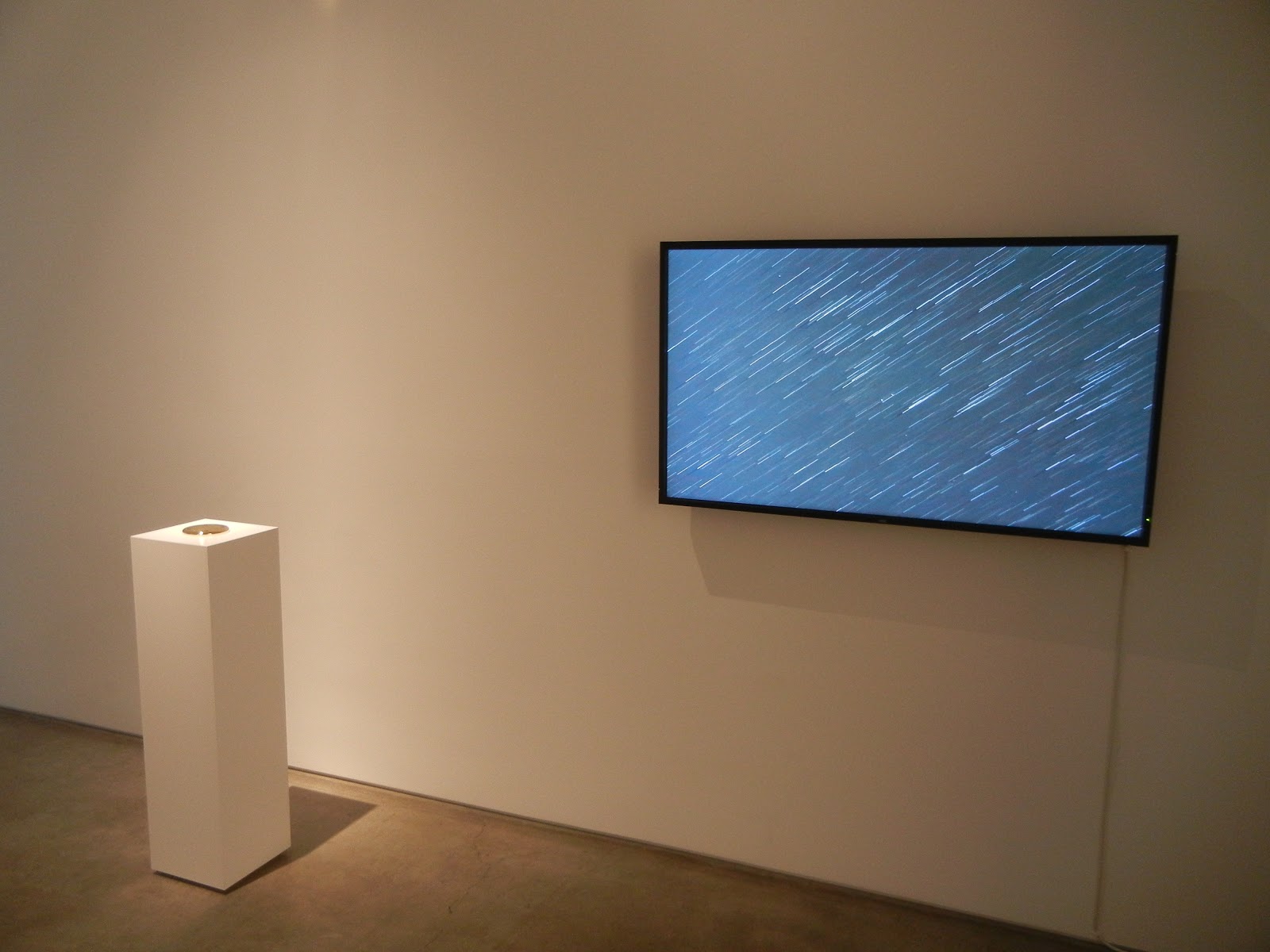
 JTF (just the facts): A total of 11 single image photographs, 4 photographic diptychs, 2 videos and other various ephemera, framed in black/white and unmatted, and hung against white walls in the three adjoining gallery spaces on the first floor. All of the single image photographs are c-prints, ranging in size from 42x34 to 70x91 or reverse, each available in an edition of 5. The diptychs are either gelatin silver prints (each panel 24x32) or c-prints (each panel 38x43), also available in editions of 5. The show also includes 1 framed postcard, an array of 182 images pinned to the wall, a small model of the EchoStar communications satellite, 2 scrapbooks, 1 reference volume of satellite launches, 2 etched artifacts, 1 video containing 100 still images, and 1 video of the moving satellite against a starry backdrop. No specific date information was provided on the checklist. A monograph of this body of work was recently published by Creative Time and the University of California Press (here) and is available from the gallery for $25. (Installation shots at right.)
Comments/Context: Trevor Paglen's newest project, The Last Pictures, is one of the most intellectually complex photographic endeavors I've run across in many years. On the surface, the plan seems remarkably straightforward - select a group of photographic images to be stored as a documentary artifact and bolt them on the side of a communcations satellite as a kind of message from humanity for future discovery by spacefaring aliens. This kind of thing has been done before by well-meaning scientists hoping to communicate something of our existence to those who might run across our deep space probes, but this is the first time an artist has driven the process, and it's clear that Paglen's rigorous and thoughtful approach quickly drove the effort into the conceptual weeds, where the problems of long time scale durability, engineering, and design quickly morphed into meticulous investigations of mathematics, philosophy, anthropology, linguistics, and a whole host of less defined but equally thorny questions and concerns.
 Given the scientific facts of geosynchronous orbits and their propensity to stay stable, the time scale of this project is truly staggering - it is altogether possible that if left unperturbed, Paglen's selections will remain in place until the sun explodes, an event scheduled for billions of years from the present; in all likelihood, humanity will be long gone. Questions of communication, and meaning, and interpretation, and intelligibility become almost imponderable across such a distance of time. But instead of leaving behind a bread crumb trail of smiling happy people and a politically correct selection of world music and cultural signifiers, Paglen has chosen to try to tell a story of how a civilization dies, of how its grand gestures, its hubris, and its collective narcissism become inherently suicidal.
Paglen mixes his own photographs with many more gleaned from various archives, so once again, we find a contemporary photographer less concerned with the functioning of his camera and more interested in using existing imagery to craft his chosen narrative. In this case, if you put yourself into the mindset of trying to discern meaning from his choices an eternity in the future, the project starts to feel a little like Mike Mandel and Larry Sultan's Evidence - something certainly happened in these pictures, but what it was and why it was important is altogether less clear. Given the benefit of our current context, Paglen's view of technology, our relationship with nature, the pace of change, and our disregard for consequences is full of a quiet sense of creeping pessimism; it we assume the human race has extinguished itself on the time scale of this artifact, then many of the causes, reasons, and contradictions of our doomed choices are to be found here. Images of people fleeing drone strikes, cave paintings documenting the Spanish massacre of the Navajo, overgrown riverside greenery, the immense construction complexity of the Hoover Dam, and Bruegel's painting of the Tower of Babel offer a subtle undercurrent of ominous foreboding.
 As an intellectual exercise, this project is deeply and almost impossibly rich and challenging, but as stand alone art objects, Paglen's photographs are a bit underwhelming. I think the folks at Metro Pictures chickened out a bit with the installation, adding a room full of Paglen's earlier images of government black sites and spy satellites as background. These works are more mysteriously graphic and eye-catching, and likely more saleable, so I certainly understand the logic for their inclusion, but they take up valuable space that could have been used to show more of the 100 selections. I also think the corner of outtakes and images that didn't make the cut is a colorful distraction; while the in-versus-out decision making is an intriguing process (the cute kittens, the Goya firing squad, and the Japanese woodcut of a woman being erotically devoured by a squid didn't make it), I wish the show had committed to giving us Paglen's entire distilled vision rather than showing the cycle on a video screen. As it is, there are only roughly a dozen of his selections on view as prints, which is a pretty small sample of the whole. This makes his choices seem even more random and disconnected than I think they really are - check out the accompanying book for a better and more comprehensive understanding of the recurring themes and the interlinked motifs.
In a certain way, I am deeply conflicted by this show. Its brainy relentlessness, its willingness to travel down esoteric intellectual backroads, and its intense thoughtfulness about unanswerable human questions make its underlying conceptual framework undeniably brilliant. There are clearly hours and hours to be spent pondering the intricacies of this extremely smart project. And yet, I found most of the images on display somewhat forgettable, as if I needed the context of the larger project to find enhanced meaning in the individual images. Which of course pulls me down the rat hole of how an alien race would figure out anything from these same photographs and how one might communicate nuances of meaning across such unfathomable divisions of space and time. In the end, my head scratching conclusion is that this show is truly brimming with ideas (and wholeheartedly worth a visit), if only for its ability to ask questions that will rattle around in your head for weeks to come.
 Collector's POV: The photographs in this show are generally priced between $10000 and $40000 based on size. Paglen's work has not yet reached the secondary markets with any regularity, so gallery retail is likely the best/only option for those collectors interested in following up.
Rating: ** (two stars) VERY GOOD (rating system described here)
Transit Hub:
- Artist site (here)
- Creative Time project site (here)
- Features/Reviews: E-Flux (here), New Yorker (here), NY Times T magazine blog (here), Time LightBox (here)
Through March 9th
519 West 24th Street
New York, NY 10011


